Conducting Very Well - Conducting Very Badly A guide to electrical properties
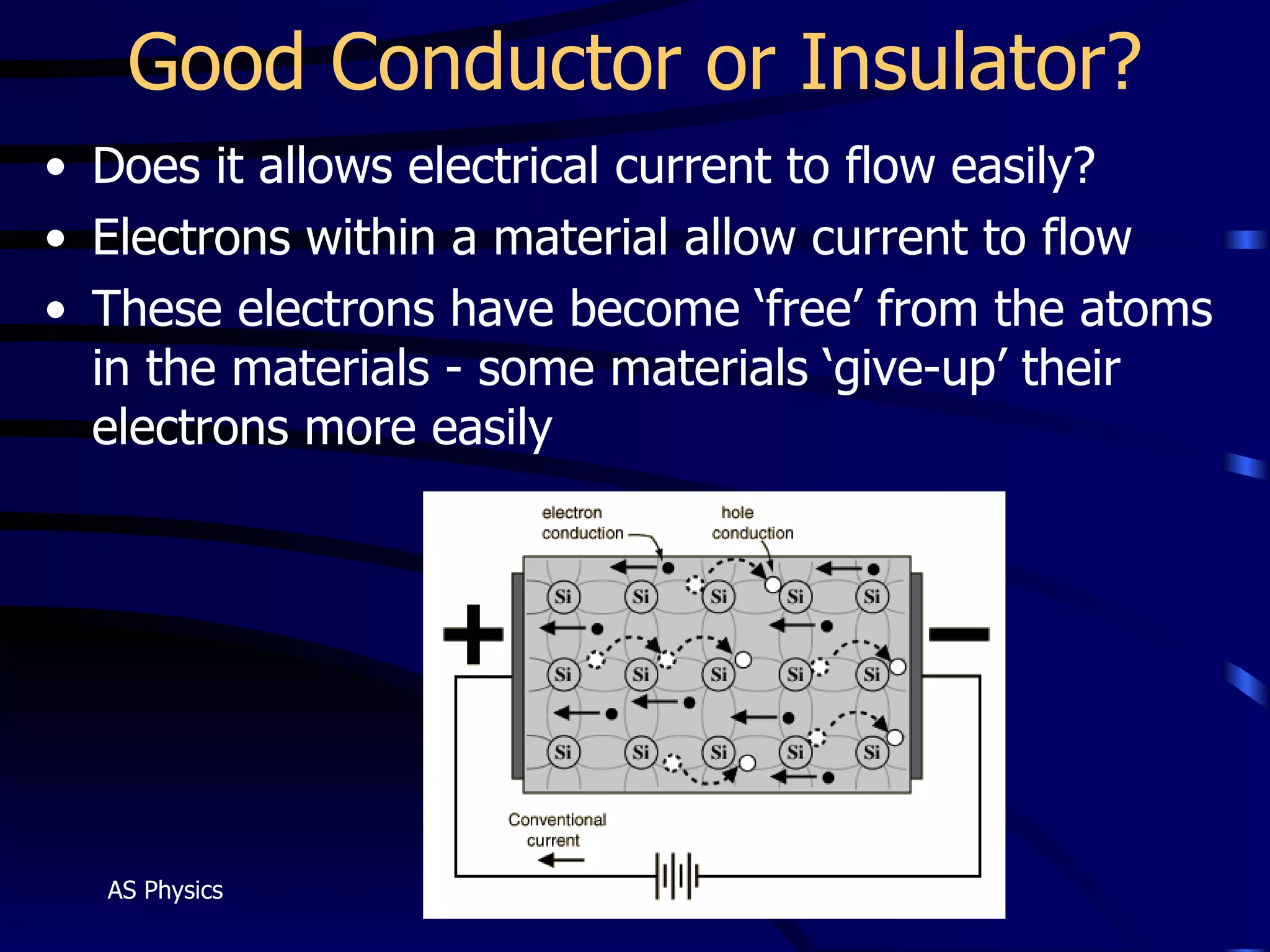
Good Conductor or Insulator? Does it allows electrical current to flow easily? Electrons within a material allow current to flow These electrons have become ‘free’ from the atoms in the materials - some materials ‘give-up’ their electrons more easily
Good Conductor or Insulator? If it has a low Resistance, it lets more current through it - these are Conductors If it has a high resistance, it lets less current through it - these are called Insulators
How do we measure these characteristics? Resistance is measured in Ohms (Ω) Current is measured in Amperes (A) Voltage is measured in Voltage (V) Ohm’s Law  V = I R
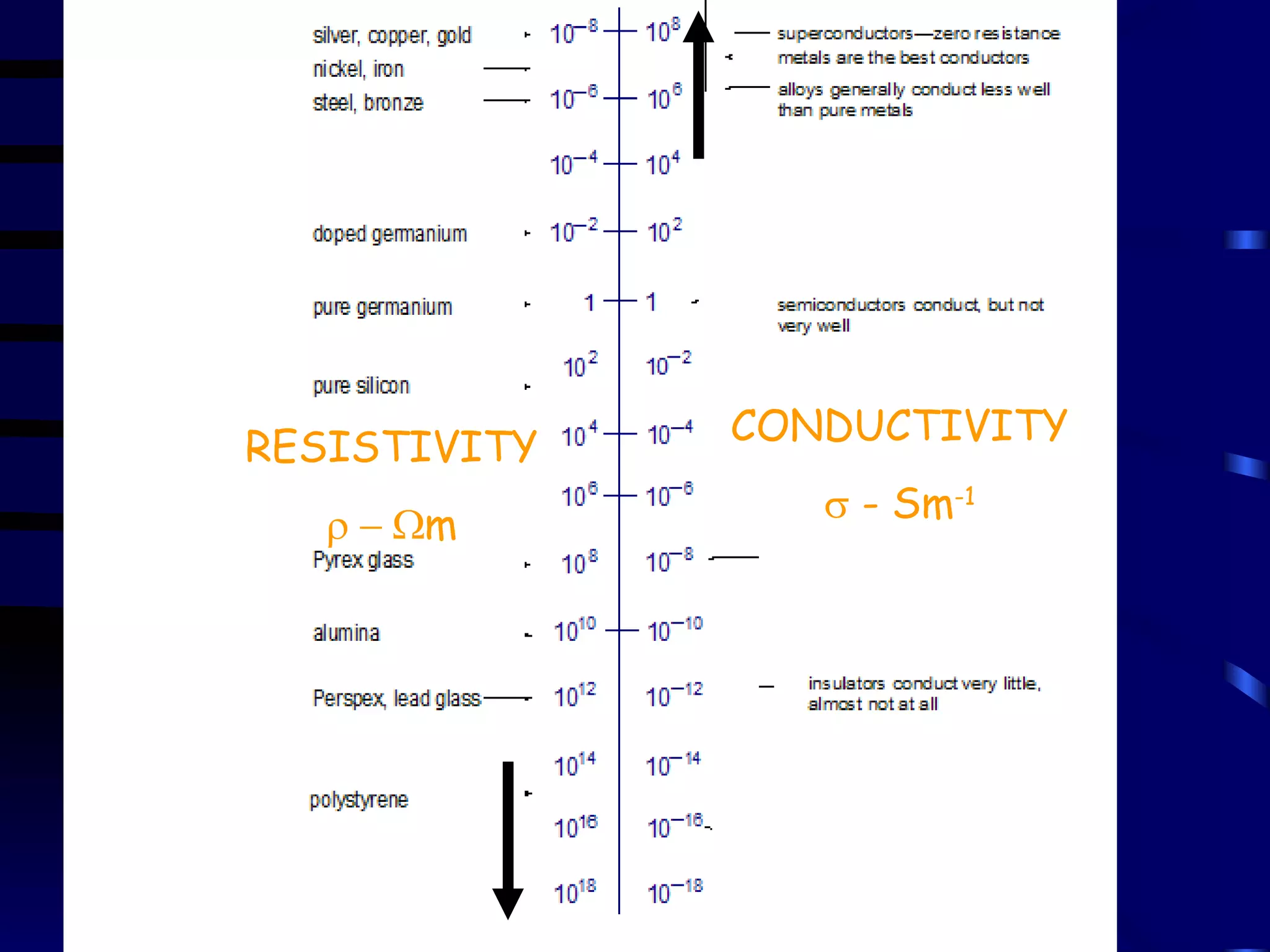
CONDUCTIVITY    - Sm -1 RESISTIVITY  m
Resistivity or Conductivity? Resistivity is the reciprocal of Conductivity Both are dependent on the material BUT: What are Resistance and Conductance?
Resistance Resistance is based on an individual object or component The resistivity of silver is 10 -8  Ωm but what is the  resistance  of a piece of silver wire?
Measuring the resistance of various wires Measure the resistance of various lengths of wire What happens when: you double the length? You double the cross-sectional area?
Resistance It depends on: The Cross-Sectional Area The Length and the resistivity (  ) of the material Resistance =     L / A in Ohms
Conductance The reciprocal of Resistance Resistance = 1 / Conductance Therefore Conductance (G) = L /     A   or σ A / L  (where σ is conductivity in Siemens m -1 )
Investigation Can we use these equations to calculate resistivity and conductivity? We need to measure length, cross-sectional area and resistance. We should be able to calculate the resistivity and/or conductivity of the material from the results

Conducting Well And Badly 2

  • 1.
    Conducting Very Well- Conducting Very Badly A guide to electrical properties
  • 2.
    Good Conductor orInsulator? Does it allows electrical current to flow easily? Electrons within a material allow current to flow These electrons have become ‘free’ from the atoms in the materials - some materials ‘give-up’ their electrons more easily
  • 3.
    Good Conductor orInsulator? If it has a low Resistance, it lets more current through it - these are Conductors If it has a high resistance, it lets less current through it - these are called Insulators
  • 4.
    How do wemeasure these characteristics? Resistance is measured in Ohms (Ω) Current is measured in Amperes (A) Voltage is measured in Voltage (V) Ohm’s Law V = I R
  • 5.
    CONDUCTIVITY  - Sm -1 RESISTIVITY  m
  • 6.
    Resistivity or Conductivity?Resistivity is the reciprocal of Conductivity Both are dependent on the material BUT: What are Resistance and Conductance?
  • 7.
    Resistance Resistance isbased on an individual object or component The resistivity of silver is 10 -8 Ωm but what is the resistance of a piece of silver wire?
  • 8.
    Measuring the resistanceof various wires Measure the resistance of various lengths of wire What happens when: you double the length? You double the cross-sectional area?
  • 9.
    Resistance It dependson: The Cross-Sectional Area The Length and the resistivity (  ) of the material Resistance =  L / A in Ohms
  • 10.
    Conductance The reciprocalof Resistance Resistance = 1 / Conductance Therefore Conductance (G) = L /  A or σ A / L (where σ is conductivity in Siemens m -1 )
  • 11.
    Investigation Can weuse these equations to calculate resistivity and conductivity? We need to measure length, cross-sectional area and resistance. We should be able to calculate the resistivity and/or conductivity of the material from the results