The wave modelwas introduced in the previous two chapters. We have seen that waves are
very different from particles. A particle is of zero size, whereas a wave has a characteristic size,
its wavelength. Another important difference between waves and particles is that we can
explore the possibility of two or more waves combining at one point in the same medium.
Particles can be combined to form extended objects, but the particles must be at different
locations. In contrast, two waves can both be present at the same location. The ramifications
of this possibility are explored in this chapter.
Introduction
4.
Waves in Interference
Manyinteresting wave phenomena in nature cannot be described by a single traveling wave.
Instead, one must analyze these phenomena in terms of a combination of traveling waves. As
noted in the introduction, waves have a remarkable difference from particles in that waves can be
combined at the same location in space. To analyze such wave combinations, we make use of the
Interference: refers to what happens when two or more waves pass through the same region at
the same time. The resultant of the interference is another wave which has a maximum
displacement at some regions which known as antinodes and happened due to constructive
interference and another regions which has minimum displacement which known as nodes and
happened due to destructive interference.
5.
Superposition of twotraveling waves
Consider two traveling waves 𝑦1 and 𝑦2 which have:
❖ The same amplitude.
❖ The same type.
❖ The same frequency.
❖ The same wavelength.
superposition principle:
If two or more traveling waves are moving through a medium, the resultant value of the wave
function at any point is the algebraic sum of the values of the wave functions of the individual
waves.
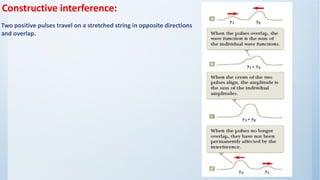
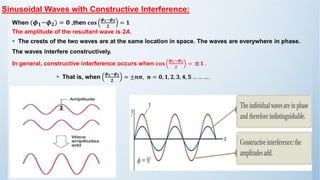
Sinusoidal Waves withConstructive Interference:
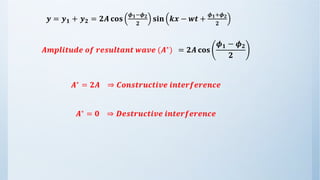
When (𝝓𝟏−𝝓𝟐) = 𝟎 ,then 𝐜𝐨𝐬
𝝓𝟏−𝝓𝟐
𝟐
= 𝟏
The amplitude of the resultant wave is 2A.
▪ The crests of the two waves are at the same location in space. The waves are everywhere in phase.
The waves interfere constructively.
In general, constructive interference occurs when 𝐜𝐨𝐬
𝝓𝟏−𝝓𝟐
𝟐
= ±𝟏 .
▪ That is, when
𝝓𝟏−𝝓𝟐
𝟐
= ±𝒏𝝅, 𝒏 = 𝟎, 𝟏, 𝟐, 𝟑, 𝟒, 𝟓 … … … .
11.
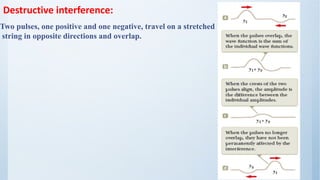
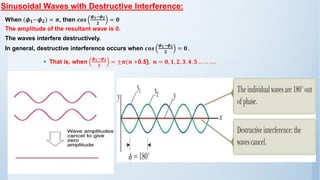
Sinusoidal Waves withDestructive Interference:
When (𝝓𝟏−𝝓𝟐) = 𝝅, then 𝒄𝒐𝒔
𝝓𝟏−𝝓𝟐
𝟐
= 𝟎
The amplitude of the resultant wave is 0.
The waves interfere destructively.
In general, destructive interference occurs when 𝒄𝒐𝒔
𝝓𝟏−𝝓𝟐
𝟐
= 𝟎 .
▪ That is, when
𝝓𝟏−𝝓𝟐
𝟐
= ±𝝅(𝒏 +0.5), 𝒏 = 𝟎, 𝟏, 𝟐, 𝟑, 𝟒, 𝟓 … … … .
12.
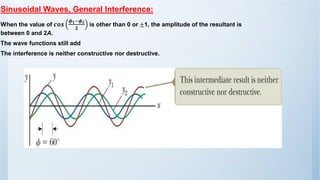
Sinusoidal Waves, GeneralInterference:
When the value of 𝒄𝒐𝒔
𝝓𝟏−𝝓𝟐
𝟐
is other than 0 or ±1, the amplitude of the resultant is
between 0 and 2A.
The wave functions still add
The interference is neither constructive nor destructive.
13.
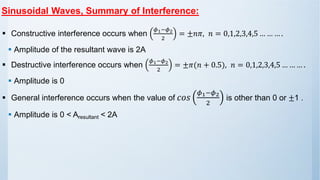
Sinusoidal Waves, Summaryof Interference:
▪ Constructive interference occurs when
𝜙1−𝜙2
2
= ±𝑛𝜋, 𝑛 = 0,1,2,3,4,5 … … … .
▪ Amplitude of the resultant wave is 2A
▪ Destructive interference occurs when
𝜙1−𝜙2
2
= ±𝜋(𝑛 + 0.5), 𝑛 = 0,1,2,3,4,5 … … … .
▪ Amplitude is 0
▪ General interference occurs when the value of 𝑐𝑜𝑠
𝜙1−𝜙2
2
is other than 0 or ±1
▪ Amplitude is 0 < Aresultant < 2A
14.
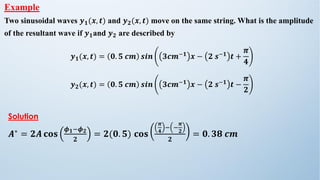
Example
Two sinusoidal waves𝒚𝟏(𝒙, 𝒕) and 𝒚𝟐(𝒙, 𝒕) move on the same string. What is the amplitude
of the resultant wave if 𝒚𝟏and 𝒚𝟐 are described by
𝒚𝟏(𝒙, 𝒕) = 𝟎. 𝟓 𝒄𝒎 𝒔𝒊𝒏 𝟑𝒄𝒎−𝟏 𝒙 − 𝟐 𝒔−𝟏 𝒕 +
𝝅
𝟒
𝒚𝟐(𝒙, 𝒕) = 𝟎. 𝟓 𝒄𝒎 𝒔𝒊𝒏 𝟑𝒄𝒎−𝟏 𝒙 − 𝟐 𝒔−𝟏 𝒕 −
𝝅
𝟐
Solution
𝑨∗
= 𝟐𝑨 𝐜𝐨𝐬
𝝓𝟏−𝝓𝟐
𝟐
= 𝟐(𝟎. 𝟓) 𝐜𝐨𝐬
𝝅
𝟒
− −
𝝅
𝟐
𝟐
= 𝟎. 𝟑𝟖 𝒄𝒎
15.
Interference in SoundWaves:
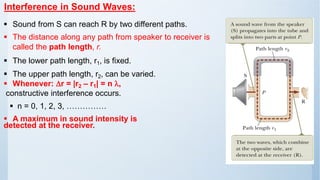
▪ Sound from S can reach R by two different paths.
▪ The distance along any path from speaker to receiver is
called the path length, r.
▪ The lower path length, r1, is fixed.
▪ The upper path length, r2, can be varied.
▪ Whenever: r = |r2 – r1| = n ,
constructive interference occurs.
▪ n = 0, 1, 2, 3, ……………
▪ A maximum in sound intensity is
detected at the receiver.
16.
▪ Whenever r= |r2 – r1| = (n+0.5), destructive interference occurs.
▪ n = 0, 1, 2, 3,………..
▪ No sound is detected at the receiver.
▪ A phase difference may arise between two waves generated by the
same source when they travel along paths of unequal lengths.
17.
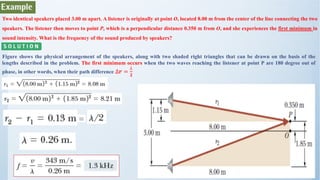
Two identical speakersplaced 3.00 m apart. A listener is originally at point O, located 8.00 m from the center of the line connecting the two
speakers. The listener then moves to point P, which is a perpendicular distance 0.350 m from O, and she experiences the first minimum in
sound intensity. What is the frequency of the sound produced by speakers?
Figure shows the physical arrangement of the speakers, along with two shaded right triangles that can be drawn on the basis of the
lengths described in the problem. The first minimum occurs when the two waves reaching the listener at point P are 180 degree out of
phase, in other words, when their path difference ∆𝒓 =
λ
𝟐
18.
Standing Waves:
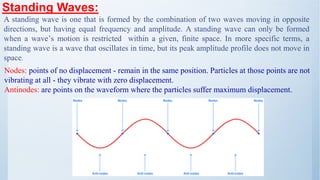
Nodes: pointsof no displacement - remain in the same position. Particles at those points are not
vibrating at all - they vibrate with zero displacement.
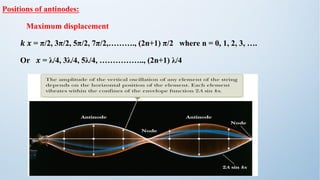
Antinodes: are points on the waveform where the particles suffer maximum displacement.
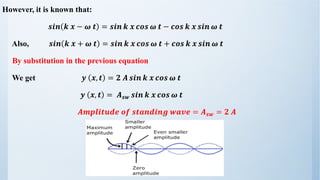
A standing wave is one that is formed by the combination of two waves moving in opposite
directions, but having equal frequency and amplitude. A standing wave can only be formed
when a wave’s motion is restricted within a given, finite space. In more specific terms, a
standing wave is a wave that oscillates in time, but its peak amplitude profile does not move in
space.
19.
Standing Waves:
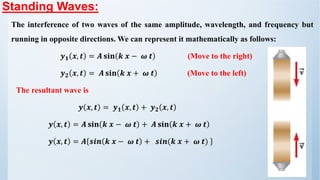
The interferenceof two waves of the same amplitude, wavelength, and frequency but
running in opposite directions. We can represent it mathematically as follows:
𝒚𝟏 𝒙, 𝒕 = 𝑨 𝐬𝐢𝐧 𝒌 𝒙 − 𝝎 𝒕 (Move to the right)
𝒚𝟐 𝒙, 𝒕 = 𝑨 𝐬𝐢𝐧 𝒌 𝒙 + 𝝎 𝒕 (Move to the left)
The resultant wave is
𝒚 𝒙, 𝒕 = 𝒚𝟏 𝒙, 𝒕 + 𝒚𝟐 𝒙, 𝒕
𝒚 𝒙, 𝒕 = 𝑨 𝐬𝐢𝐧 𝒌 𝒙 − 𝝎 𝒕 + 𝑨 𝐬𝐢𝐧 𝒌 𝒙 + 𝝎 𝒕
𝒚 𝒙, 𝒕 = 𝑨 𝒔𝒊𝒏 𝒌 𝒙 − 𝝎 𝒕 + 𝒔𝒊𝒏(𝒌 𝒙 + 𝝎 𝒕)
Transverse Velocity ofthe Standing Wave is:
𝒗𝒚 =
𝝏𝒚
𝝏𝒕
= −𝝎 𝑨𝒔𝒘 𝐬𝐢𝐧 𝒌 𝒙 𝐬𝐢𝐧 𝝎 𝒕
Transverse Acceleration of the Standing Wave is:
𝒂𝒚 =
𝝏𝒗𝒚
𝝏𝒕
= − 𝝎𝟐 𝑨𝒔𝒘 𝐬𝐢𝐧 𝒌 𝒙 𝐜𝐨𝐬 𝝎 𝒕
Positions of nodes
Minimum displacement
𝒌 𝒙 = 0, π, 2π, 3π, 4π, 5π, ………., nπ where n = 0, 1, 2, 3, ….
Or 𝒙 = 0, λ/2, λ, 3λ/2, 2λ, 5λ/2, 3λ, …………….., n λ/2
22.
Positions of antinodes:
Maximumdisplacement
𝒌 𝒙 = π/2, 3π/2, 5π/2, 7π/2,………., (2n+1) π/2 where n = 0, 1, 2, 3, ….
Or 𝒙 = λ/4, 3λ/4, 5λ/4, …………….., (2n+1) λ/4
23.
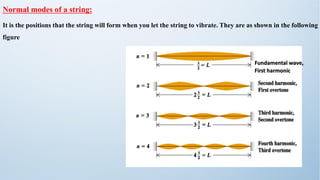
Normal modes ofa string:
It is the positions that the string will form when you let the string to vibrate. They are as shown in the following
figure
Fundamental wave,
First harmonic
24.
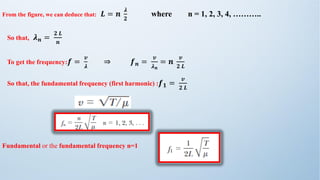
From the figure,we can deduce that: 𝑳 = 𝒏
𝝀
𝟐
where n = 1, 2, 3, 4, ………..
So that, 𝝀𝒏 =
𝟐 𝑳
𝒏
To get the frequency:𝒇 =
𝒗
𝝀
⇒ 𝒇𝒏 =
𝒗
𝝀𝒏
= 𝒏
𝒗
𝟐 𝑳
So that, the fundamental frequency (first harmonic) :𝒇𝟏 =
𝒗
𝟐 𝑳
Fundamental or the fundamental frequency n=1
25.
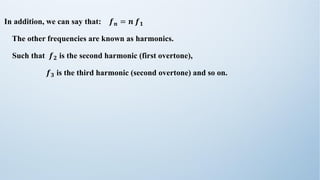
In addition, wecan say that: 𝒇𝒏 = 𝒏 𝒇𝟏
The other frequencies are known as harmonics.
Such that 𝒇𝟐 is the second harmonic (first overtone),
𝒇𝟑 is the third harmonic (second overtone) and so on.
26.
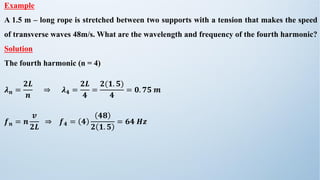
Example
A 1.5 m– long rope is stretched between two supports with a tension that makes the speed
of transverse waves 48m/s. What are the wavelength and frequency of the fourth harmonic?
Solution
The fourth harmonic (n = 4)
𝝀𝒏 =
𝟐𝑳
𝒏
⇒ 𝝀𝟒 =
𝟐𝑳
𝟒
=
𝟐(𝟏. 𝟓)
𝟒
= 𝟎. 𝟕𝟓 𝒎
𝒇𝒏 = 𝒏
𝒗
𝟐𝑳
⇒ 𝒇𝟒 = 𝟒
𝟒𝟖
𝟐 𝟏. 𝟓
= 𝟔𝟒 𝑯𝒛
27.
Example
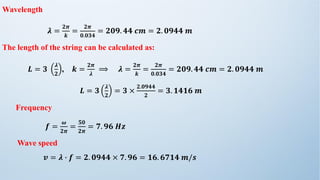
A string oscillatesin its third harmonic which has a shape described by:
𝒚(𝒙, 𝒕) = (𝟓. 𝟔 𝐜𝐦) 𝐬𝐢𝐧[ 𝟎. 𝟎𝟑 𝒓𝒂𝒅/𝒄𝒎 𝒙] 𝒄𝒐𝒔[ 𝟓𝟎 𝒓𝒂𝒅/𝒔 𝒕]
(a) Find the amplitude of the travelling waves that make up this standing wave.
(b) Find the wavelength
(c) What is the length of the string?
(d) frequency, and speed of travelling waves.
28.
Solution
The general equationof standing wave is:
𝒚 𝒙, 𝒕 = 𝑨𝒔𝒘 𝒔𝒊𝒏 𝒌 𝒙 𝒄𝒐𝒔 𝝎 𝒕
By comparing this form with the given one
𝑦(𝑥, 𝑡) = (5.60 𝑐𝑚) 𝑠𝑖𝑛 0.03
𝑟𝑎𝑑
𝑐𝑚
𝑥 𝑐𝑜𝑠[(50.0 𝑟𝑎𝑑/𝑠)𝑡]
𝑨𝒔𝒘 = 𝟓. 𝟔 𝒄𝒎, 𝒌 = 𝟎. 𝟎𝟑 𝒓𝒂𝒅/𝒄𝒎, and 𝝎 = 𝟓𝟎 𝒓𝒂𝒅/𝒔
𝑨𝒔𝒘 = 𝟐 𝑨
Therefore, the amplitude of the travelling wave is:
𝑨 =
𝑨𝒔𝒘
𝟐
=
𝟓.𝟔𝟎
𝟐
= 𝟐. 𝟖𝟎 𝒄𝒎
𝑨 = 𝟎. 𝟎𝟐𝟖 𝒎
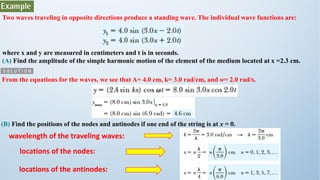
Two waves travelingin opposite directions produce a standing wave. The individual wave functions are:
where x and y are measured in centimeters and t is in seconds.
(A) Find the amplitude of the simple harmonic motion of the element of the medium located at x =2.3 cm.
From the equations for the waves, we see that A= 4.0 cm, k= 3.0 rad/cm, and w= 2.0 rad/s.
(B) Find the positions of the nodes and antinodes if one end of the string is at x = 0.
wavelength of the traveling waves:
locations of the nodes:
locations of the antinodes:
31.
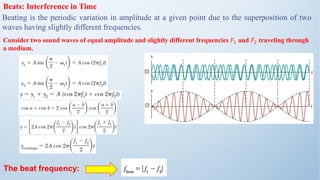
Beats: Interference inTime
Beating is the periodic variation in amplitude at a given point due to the superposition of two
waves having slightly different frequencies.
Consider two sound waves of equal amplitude and slightly different frequencies 𝐹1 and 𝐹2 traveling through
a medium.
The beat frequency:
32.
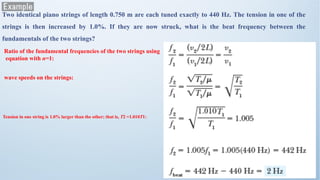
Two identical pianostrings of length 0.750 m are each tuned exactly to 440 Hz. The tension in one of the
strings is then increased by 1.0%. If they are now struck, what is the beat frequency between the
fundamentals of the two strings?
Ratio of the fundamental frequencies of the two strings using
equation with n=1:
wave speeds on the strings:
Tension in one string is 1.0% larger than the other; that is, T2 =1.010T1:


![Assume two traveling waves 𝒚𝟏 and 𝒚𝟐 are traveling in the same direction,
with the same frequency, wavelength and amplitude.
By applying the superposition principle, we obtain
𝒚𝟏 = 𝑨 𝐬𝐢𝐧 𝒌𝒙 − 𝒘𝒕 + 𝝓𝟏 𝒚𝟐 = 𝑨 𝐬𝐢𝐧 𝒌𝒙 − 𝒘𝒕 + 𝝓𝟐
𝒚 = 𝒚𝟏 + 𝒚𝟐 = 𝑨 [𝐬𝐢𝐧 𝒌𝒙 − 𝒘𝒕 + 𝝓𝟏 + 𝐬𝐢𝐧 𝒌𝒙 − 𝒘𝒕 + 𝝓𝟐 ]
Superposition of two traveling waves
Remember that:
𝐬𝐢𝐧 𝒂 + 𝐬𝐢𝐧 𝒃 = 𝟐 𝐜𝐨𝐬
𝒂 − 𝒃
𝟐
𝐬𝐢𝐧
𝒂 + 𝒃
𝟐
𝒚 = 𝒚𝟏 + 𝒚𝟐 = 𝑨 𝟐 𝒄𝒐𝒔
𝝓𝟏−𝝓𝟐
𝟐
𝒔𝒊𝒏
𝟐𝒌𝒙−𝟐𝒘𝒕+𝝓𝟏+𝝓𝟐
𝟐
&](https://image.slidesharecdn.com/lec7-250724105242-effc51c3/85/Physics-Lecture-7-Superposition-and-Standing-Waves-8-320.jpg)
![Example
A string oscillates in its third harmonic which has a shape described by:
𝒚(𝒙, 𝒕) = (𝟓. 𝟔 𝐜𝐦) 𝐬𝐢𝐧[ 𝟎. 𝟎𝟑 𝒓𝒂𝒅/𝒄𝒎 𝒙] 𝒄𝒐𝒔[ 𝟓𝟎 𝒓𝒂𝒅/𝒔 𝒕]
(a) Find the amplitude of the travelling waves that make up this standing wave.
(b) Find the wavelength
(c) What is the length of the string?
(d) frequency, and speed of travelling waves.](https://image.slidesharecdn.com/lec7-250724105242-effc51c3/85/Physics-Lecture-7-Superposition-and-Standing-Waves-27-320.jpg)
![Solution
The general equation of standing wave is:
𝒚 𝒙, 𝒕 = 𝑨𝒔𝒘 𝒔𝒊𝒏 𝒌 𝒙 𝒄𝒐𝒔 𝝎 𝒕
By comparing this form with the given one
𝑦(𝑥, 𝑡) = (5.60 𝑐𝑚) 𝑠𝑖𝑛 0.03
𝑟𝑎𝑑
𝑐𝑚
𝑥 𝑐𝑜𝑠[(50.0 𝑟𝑎𝑑/𝑠)𝑡]
𝑨𝒔𝒘 = 𝟓. 𝟔 𝒄𝒎, 𝒌 = 𝟎. 𝟎𝟑 𝒓𝒂𝒅/𝒄𝒎, and 𝝎 = 𝟓𝟎 𝒓𝒂𝒅/𝒔
𝑨𝒔𝒘 = 𝟐 𝑨
Therefore, the amplitude of the travelling wave is:
𝑨 =
𝑨𝒔𝒘
𝟐
=
𝟓.𝟔𝟎
𝟐
= 𝟐. 𝟖𝟎 𝒄𝒎
𝑨 = 𝟎. 𝟎𝟐𝟖 𝒎](https://image.slidesharecdn.com/lec7-250724105242-effc51c3/85/Physics-Lecture-7-Superposition-and-Standing-Waves-28-320.jpg)