GRID CONNECTIVITY OF RENEWABLE 
ENERGY SOURCES ISSUES & SOLUTION 
Swathi venugopal 
Semester; 8 
Electrical & Electronics 
RIT, Kottayam 
Date; 22/02/13
More than 400 
cities 
50 million people 
globally 
Major icons went 
dark 
Seminar 
Series-4, 
2013 
GRID CONNECTIVITY OF RENEWABLE ENERGY SOURCES ISSUES & SOLUTION
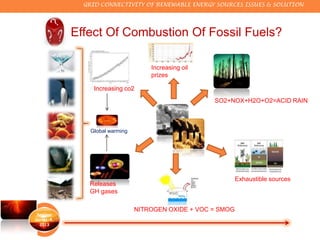
Effect Of Combustion Of Fossil Fuels? 
Increasing oil 
prizes 
Exhaustible sources 
Increasing co2 
Releases 
GH gases 
SO2+NOX+H2O+O2=ACID RAIN 
NITROGEN OXIDE + VOC = SMOG 
Global warming 
Seminar 
Series-4, 
2013 
GRID CONNECTIVITY OF RENEWABLE ENERGY SOURCES ISSUES & SOLUTION
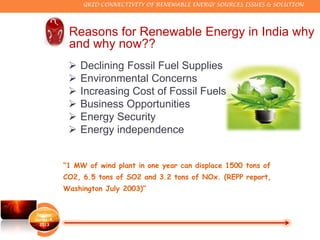
Reasons for Renewable Energy in India why 
and why now?? 
 Declining Fossil Fuel Supplies 
 Environmental Concerns 
 Increasing Cost of Fossil Fuels 
 Business Opportunities 
 Energy Security 
 Energy independence 
“1 MW of wind plant in one year can displace 1500 tons of 
CO2, 6.5 tons of SO2 and 3.2 tons of NOx. (REPP report, 
Washington July 2003)” 
Seminar 
Series-4, 
2013 
GRID CONNECTIVITY OF RENEWABLE ENERGY SOURCES ISSUES & SOLUTION
The vision of Indian renewable energy program 
“To develop new and renewable energy technologies, 
processes, materials, components, sub-systems, 
products and services at par with international 
specifications, standards and performance parameters 
in order to make the country a net foreign exchange 
earner in the sector and deploy such indigenously 
developed and/or manufactured products and services 
in furtherance of the national goal of energy 
security”. 
Seminar 
Series-4, 
2013 
GRID CONNECTIVITY OF RENEWABLE ENERGY SOURCES ISSUES & SOLUTION
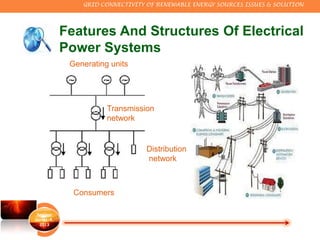
Features And Structures Of Electrical 
Power Systems 
Generating units 
Transmission 
network 
Distribution 
network 
Consumers 
Seminar 
Series-4, 
2013 
GRID CONNECTIVITY OF RENEWABLE ENERGY SOURCES ISSUES & SOLUTION
Features And Structures Of Electrical 
Power Systems 
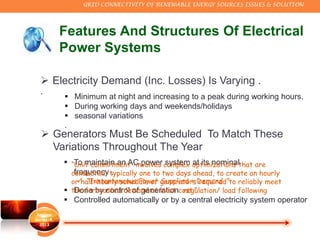
 Electricity Demand (Inc. Losses) Is Varying . 
.  Minimum at night and increasing to a peak during working hours. 
 During working days and weekends/holidays 
 seasonal variations 
. 
 Generators Must Be Scheduled To Match These 
Variations Throughout The Year 
 To maintain an AC power system at its nominal 
frequency , 
 “Instantaneous Power Supplied = Demand .” 
 Done by control of generation regulation/ load following 
 Controlled automatically or by a central electricity system operator 
Seminar 
Series-4, 
2013 
GRID CONNECTIVITY OF RENEWABLE ENERGY SOURCES ISSUES & SOLUTION
Grid connectivity renewable energy issues and solutions . 
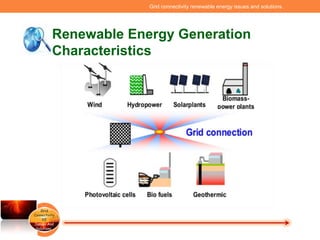
Renewable Energy Generation 
Characteristics 
Grid 
Connectivity 
RE 
Issues And 
Solutions .
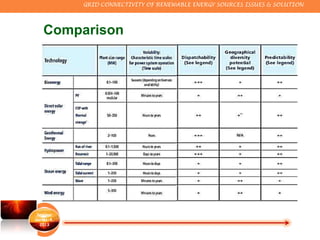
Comparison 
Seminar 
Series-4, 
2013 
GRID CONNECTIVITY OF RENEWABLE ENERGY SOURCES ISSUES & SOLUTION
CHALLENGES WITH INTEGRATING INTO 
ELECTRICAL POWER SYSTEMS 
 Most RE resources are location specific. 
• Renewable-generated electricity may need to be 
transported over considerable distances. 
• Beneficial combinations of renewable sources may 
not always be practicable. 
 Lack of flexibility 
• Balancing supply and demand 
• Uncertainty in predicted out-put. 
Seminar 
Series-4, 
2013 
GRID CONNECTIVITY OF RENEWABLE ENERGY SOURCES ISSUES & SOLUTION
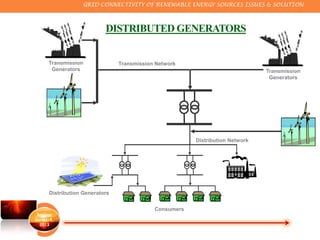
Transmission 
Generators 
Transmission Network 
Distribution Network 
Distribution Generators 
Consumers 
Transmission 
Generators 
DISTRIBUTED GENERATORS 
Seminar 
Series-4, 
2013 
GRID CONNECTIVITY OF RENEWABLE ENERGY SOURCES ISSUES & SOLUTION
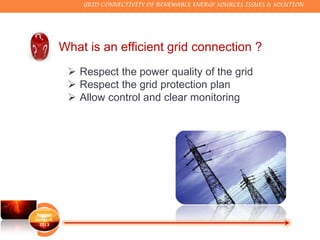
What is an efficient grid connection ? 
 Respect the power quality of the grid 
 Respect the grid protection plan 
 Allow control and clear monitoring 
Seminar 
Series-4, 
2013 
GRID CONNECTIVITY OF RENEWABLE ENERGY SOURCES ISSUES & SOLUTION
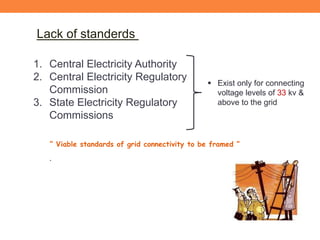
Lack of standerds 
1. Central Electricity Authority 
2. Central Electricity Regulatory 
Commission 
3. State Electricity Regulatory 
Commissions 
. 
 Exist only for connecting 
voltage levels of 33 kv & 
above to the grid 
“ Viable standards of grid connectivity to be framed ”
INTEGRATING INTO ELECTRICAL POWER 
SYSTEMS ISSUES & SOLUTIONS 
Voltage fluctuation and regulation 
 Extended under voltage causes “brownouts” 
 Extended overvoltage decreases the life of 
equipment's. 
 DG systems are not only affected by voltage 
fluctuations, but can cause voltage fluctuations 
themselves 
Seminar 
Series-4, 
2013 
GRID CONNECTIVITY OF RENEWABLE ENERGY SOURCES ISSUES & SOLUTION
1. Grid-derived voltage fluctuations 
 Inverters - ‘voltage-following’ 
 Disconnect DG when the grid voltage moves outside set parameters. 
 Ensure suitable power quality 
 Antislanding. 
 Automatic disconnection will cause overloading of other generators 
• Avoid this happening, Low Voltage Ride-through Techniques 
(LVRT) could be incorporated into inverter design 
 Inverters -‘voltage-regulating’ mode 
 inject reactive power during voltage sags 
 Reduce network voltage by drawing reactive power during voltage 
rise. 
 provide current that is out of phase with the grid voltage so provide 
power factor correction. 
Seminar 
Series-4, 
2013 
GRID CONNECTIVITY OF RENEWABLE ENERGY SOURCES ISSUES & SOLUTION
2. Voltage imbalance 
 Voltage imbalance is when the amplitude of each 
phase voltage is different in a three-phase system or 
the phase difference is not exactly 120°. 
 High RE penetrations, the cumulative size of all 
systems connected to each phase should be as equal 
as possible. 
3. Power output fluctuation 
 Short-term fluctuations 
 Geographical dispersal 
 Forecasting 
 Storage 
 Affect power quality 
 Continuous tap-changing and capacitor switching 
 increased number of switching surge 
 Long-term fluctuations 
 Require back-up generation to maintain power 
supply. 
Seminar 
Series-4, 
2013 
GRID CONNECTIVITY OF RENEWABLE ENERGY SOURCES ISSUES & SOLUTION
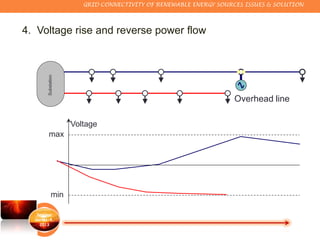
4. Voltage rise and reverse power flow 
Voltage 
Substation 
max 
min 
Overhead line 
Seminar 
Series-4, 
2013 
GRID CONNECTIVITY OF RENEWABLE ENERGY SOURCES ISSUES & SOLUTION
 To minimize voltage rise and reverse power flow 
 Ensuring PV systems are smaller than the daytime load, 
 Use dynamically controlled inverter (DCI) to gradually reduce PV 
output 
 Use of a minimum import relay (MIR) to disconnect the RE system, 
 Use of a reverse power relay (RPR) to disconnect the system on 
low voltage and reverse power flow 
 Decreasing the network’s series impedance , to reduce voltage 
drop. 
 Requiring customer loads to operate at improved power factor 
 Requiring customers with large loads to incorporate some form of 
load-shedding scheme, 
 The use of storage units 
Seminar 
Series-4, 
2013 
GRID CONNECTIVITY OF RENEWABLE ENERGY SOURCES ISSUES & SOLUTION
Grid connectivity renewable energy issues and solutions . 
Power factor correction 
 Poor power factor -increases line losses & makes voltage 
regulation more difficult. 
 voltage-following have unity power factor 
 voltage-regulating mode provide power factor correction. 
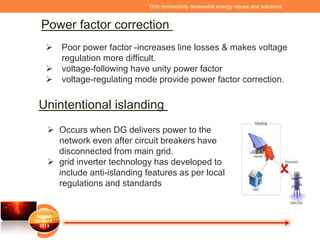
Unintentional islanding 
 Occurs when DG delivers power to the 
network even after circuit breakers have 
disconnected from main grid. 
 grid inverter technology has developed to 
include anti-islanding features as per local 
regulations and standards 
Seminar 
Series-4, 
2013
Frequency variation and regulation 
 Unbalanced supply-demand lead to frequency fluctuation 
 High penetration of intermittent energy make control more 
difficult. 
 DG inverters can provide frequency control in milliseconds, 
Only when they can inject power into the network 
 DG linked to thermal plant are restricted in their ability to 
provide frequency regulation because of their thermal loads. 
 Inverters disconnect from the grid when the frequency moves 
outside set limits (as a form of islanding detection), 
 Ability to provide frequency support may be compromised. 
 All DG will also disconnect, exacerbating the power imbalance 
 Leads to complete system shutdown 
. 
“New frequency ride through systems that do not interfere with the anti-islanding 
protection systems will need to be developed” 
Seminar 
Series-4, 
2013 
GRID CONNECTIVITY OF RENEWABLE ENERGY SOURCES ISSUES & SOLUTION
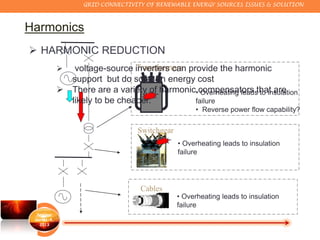
Harmonics 
Transformers 
• Overheating leads to insulation 
failure 
• Reverse power flow capability? 
Switchgear 
• Overheating leads to insulation 
failure 
Cables 
• Overheating leads to insulation 
failure 
Seminar 
Series-4, 
2013 
GRID CONNECTIVITY OF RENEWABLE ENERGY SOURCES ISSUES & SOLUTION
Harmonics 
 HARMONIC REDUCTION 
 voltage-source inverters can provide the harmonic 
support but do so at an energy cost 
 There are a variety of harmonic compensators that are 
likely to be cheaper. 
Seminar 
Series-4, 
2013 
GRID CONNECTIVITY OF RENEWABLE ENERGY SOURCES ISSUES & SOLUTION
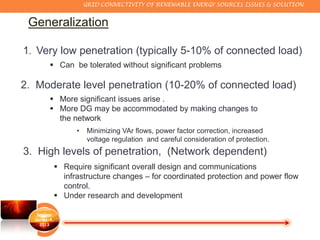
Generalization 
1. Very low penetration (typically 5-10% of connected load) 
 Can be tolerated without significant problems 
2. Moderate level penetration (10-20% of connected load) 
 More significant issues arise . 
 More DG may be accommodated by making changes to 
the network 
• Minimizing VAr flows, power factor correction, increased 
voltage regulation and careful consideration of protection. 
3. High levels of penetration, (Network dependent) 
 Require significant overall design and communications 
infrastructure changes – for coordinated protection and power flow 
control. 
 Under research and development 
Seminar 
Series-4, 
2013 
GRID CONNECTIVITY OF RENEWABLE ENERGY SOURCES ISSUES & SOLUTION
What are the other key barriers ? 
 No market 
 Utility culture & framework 
 Lack of expertise 
 Limited role for private sector 
 Capital costs vs. variable energy costs 
 Transmission access & strength of grid 
Seminar 
Series-4, 
2013 
GRID CONNECTIVITY OF RENEWABLE ENERGY SOURCES ISSUES & SOLUTION
What are the Strategies to overcome 
barriers ? 
 Promote market development 
 Support utility RE procurement 
 Encourage private investment 
 Provide long-term contracts 
 Value RE attributes 
 Facilitate access to Electricity grid 
 Train RE designers and operators 
Seminar 
Series-4, 
2013 
GRID CONNECTIVITY OF RENEWABLE ENERGY SOURCES ISSUES & SOLUTION
GUIDE LINES 
Seminar 
Series-4, 
2013 
GRID CONNECTIVITY OF RENEWABLE ENERGY SOURCES ISSUES & SOLUTION
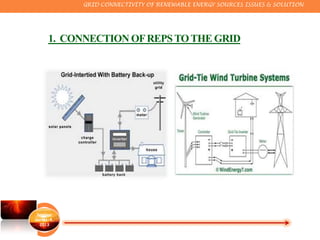
1. CONNECTION OF REPS TO THE GRID 
Seminar 
Series-4, 
2013 
GRID CONNECTIVITY OF RENEWABLE ENERGY SOURCES ISSUES & SOLUTION
2. SAFETY CONSIDERATIONS 
 Incorporate an anti islanding function 
 Install a lockable switch at an easily accessible position – 
manually isolate REPS from grid 
 Update circuit diagram regularly and display at 
appropriate locations 
 Establish a direct communication channel between owner 
and utility 
Seminar 
Series-4, 
2013 
GRID CONNECTIVITY OF RENEWABLE ENERGY SOURCES ISSUES & SOLUTION
3. EQUIPMENT PROTECTION 
 Carry out assessments on the new fault levels due 
to connection of REPS 
 Incorporate the following features 
 auto switching & auto reclosing 
 facility to isolate REPS from DS when fault occur 
 protection facilities against transient abnormalities in the grid 
 stable and fast responding voltage & frequency regulators 
 Protection facilities to avoid unsynchronized connections 
 4 pole CB to provide complete isolation from DS when REPS 
is not in service. 
 Automatic reconnection facility after the fault is removed 
Seminar 
Series-4, 
2013 
GRID CONNECTIVITY OF RENEWABLE ENERGY SOURCES ISSUES & SOLUTION
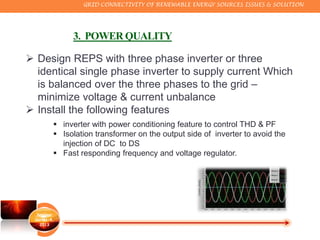
3. POWER QUALITY 
 Design REPS with three phase inverter or three 
identical single phase inverter to supply current Which 
is balanced over the three phases to the grid – 
minimize voltage & current unbalance 
 Install the following features 
 inverter with power conditioning feature to control THD & PF 
 Isolation transformer on the output side of inverter to avoid the 
injection of DC to DS 
 Fast responding frequency and voltage regulator. 
Seminar 
Series-4, 
2013 
GRID CONNECTIVITY OF RENEWABLE ENERGY SOURCES ISSUES & SOLUTION
What is the the need for government 
involvement? 
 Policy implementation & enforcement 
 Renewable energy market promotion 
 Pricing of electricity 
 Cost sharing 
Seminar 
Series-4, 
2013 
GRID CONNECTIVITY OF RENEWABLE ENERGY SOURCES ISSUES & SOLUTION
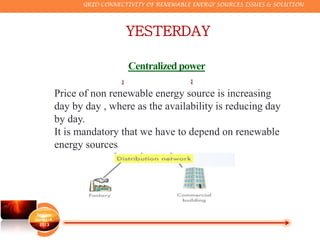
YESTERDAY 
Centralized power 
Seminar 
Series-4, 
2013 
GRID CONNECTIVITY OF RENEWABLE ENERGY SOURCES ISSUES & SOLUTION 
Price of non renewable energy source is increasing 
day by day , where as the availability is reducing day 
by day. 
It is mandatory that we have to depend on renewable 
energy sources
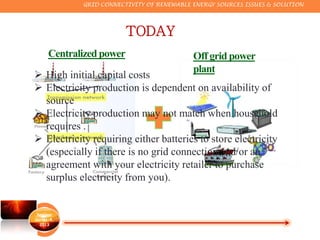
Centralized power Off grid power 
plant 
TODAY 
Seminar 
Series-4, 
2013 
GRID CONNECTIVITY OF RENEWABLE ENERGY SOURCES ISSUES & SOLUTION 
 High initial capital costs 
 Electricity production is dependent on availability of 
source 
 Electricity production may not match when household 
requires . 
 Electricity requiring either batteries to store electricity 
(especially if there is no grid connection and/or an 
agreement with your electricity retailer to purchase 
surplus electricity from you).
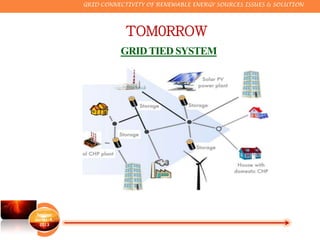
TOM0RROW 
GRID TIED SYSTEM 
Seminar 
Series-4, 
2013 
GRID CONNECTIVITY OF RENEWABLE ENERGY SOURCES ISSUES & SOLUTION
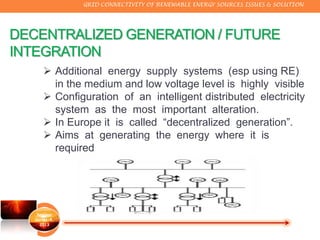
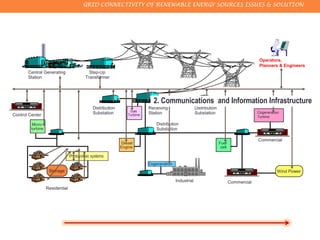
DECENTRALIZED GENERATION / FUTURE 
INTEGRATION 
 Additional energy supply systems (esp using RE) 
in the medium and low voltage level is highly visible 
 Configuration of an intelligent distributed electricity 
system as the most important alteration. 
 In Europe it is called “decentralized generation”. 
 Aims at generating the energy where it is 
required 
Seminar 
Series-4, 
2013 
GRID CONNECTIVITY OF RENEWABLE ENERGY SOURCES ISSUES & SOLUTION
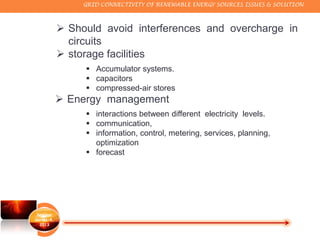
 Should avoid interferences and overcharge in 
circuits 
 storage facilities 
 Accumulator systems. 
 capacitors 
 compressed-air stores 
 Energy management 
 interactions between different electricity levels. 
 communication, 
 information, control, metering, services, planning, 
optimization 
 forecast 
Seminar 
Series-4, 
2013 
GRID CONNECTIVITY OF RENEWABLE ENERGY SOURCES ISSUES & SOLUTION
4 
7 
Central Generating 
Station 
GRID CONNECTIVITY OF RENEWABLE ENERGY SOURCES ISSUES & SOLUTION 
Step-Up 
Transformer 
Distribution 
Substation 
Receiving 
Station 
Distribution 
Substation 
Distribution 
Substation 
Commercial 
Industrial Commercial 
Gas 
Turbine 
Diesel 
Engine 
Cogeneration 
Cogeneration 
Turbine 
Fuel 
cell 
Micro-turbine 
Wind Power 
Storage 
Residential 
Photovoltaic systems 
Control Center 
Operators, 
Planners & Engineers 
2. Communications and Information Infrastructure
CONCLUSION 
Seminar 
Series-4, 
2013 
GRID CONNECTIVITY OF RENEWABLE ENERGY SOURCES ISSUES & SOLUTION 
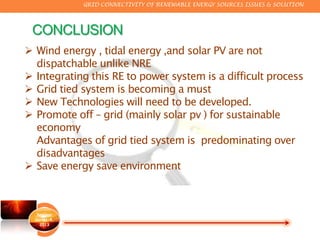
 Wind energy , tidal energy ,and solar PV are not 
dispatchable unlike NRE 
 Integrating this RE to power system is a difficult process 
 Grid tied system is becoming a must 
 New Technologies will need to be developed. 
 Promote off – grid (mainly solar pv ) for sustainable 
economy 
Advantages of grid tied system is predominating over 
disadvantages 
 Save energy save environment
REFERENCE 
 Integration of Renewable Energy into Present and Future Energy 
Systems-Ralph Sims (New Zealand), Pedro Mercado (Argentina), 
Wolfram Krewitt †(Germany) 
 Vergnet S.A. Integration Of A Wind Farm Into The Utility Grid 
Eric ANDRIEU, Electric Al Design Département Manager Pierre 
PESNEL,Export Manager 
 Grid integration of renewable energy sources 
GermanP. Kammer, A. Kober BTU Cottbus Cottbus, y 
 Renewable Energy Sources (RES) Grid Integration: Key Issues 
and Challenges Bharat Singh 
Seminar 
Series-4, 
2013 
GRID CONNECTIVITY OF RENEWABLE ENERGY SOURCES ISSUES & SOLUTION
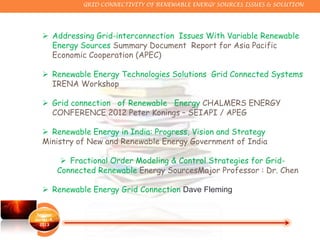
 Addressing Grid-interconnection Issues With Variable Renewable 
Energy Sources Summary Document Report for Asia Pacific 
Economic Cooperation (APEC) 
 Renewable Energy Technologies Solutions Grid Connected Systems 
IRENA Workshop 
 Grid connection of Renewable Energy CHALMERS ENERGY 
CONFERENCE 2012 Peter Konings – SEIAPI / APEG 
 Renewable Energy in India: Progress, Vision and Strategy 
Ministry of New and Renewable Energy Government of India 
 Fractional Order Modeling & Control Strategies for Grid- 
Connected Renewable Energy SourcesMajor Professor : Dr. Chen 
 Renewable Energy Grid Connection Dave Fleming 
Seminar 
Series-4, 
2013 
GRID CONNECTIVITY OF RENEWABLE ENERGY SOURCES ISSUES & SOLUTION
Grid integration issues and solutions

Grid integration issues and solutions

  • 1.
    GRID CONNECTIVITY OFRENEWABLE ENERGY SOURCES ISSUES & SOLUTION Swathi venugopal Semester; 8 Electrical & Electronics RIT, Kottayam Date; 22/02/13
  • 2.
    More than 400 cities 50 million people globally Major icons went dark Seminar Series-4, 2013 GRID CONNECTIVITY OF RENEWABLE ENERGY SOURCES ISSUES & SOLUTION
  • 3.
    Effect Of CombustionOf Fossil Fuels? Increasing oil prizes Exhaustible sources Increasing co2 Releases GH gases SO2+NOX+H2O+O2=ACID RAIN NITROGEN OXIDE + VOC = SMOG Global warming Seminar Series-4, 2013 GRID CONNECTIVITY OF RENEWABLE ENERGY SOURCES ISSUES & SOLUTION
  • 4.
    Reasons for RenewableEnergy in India why and why now??  Declining Fossil Fuel Supplies  Environmental Concerns  Increasing Cost of Fossil Fuels  Business Opportunities  Energy Security  Energy independence “1 MW of wind plant in one year can displace 1500 tons of CO2, 6.5 tons of SO2 and 3.2 tons of NOx. (REPP report, Washington July 2003)” Seminar Series-4, 2013 GRID CONNECTIVITY OF RENEWABLE ENERGY SOURCES ISSUES & SOLUTION
  • 5.
    The vision ofIndian renewable energy program “To develop new and renewable energy technologies, processes, materials, components, sub-systems, products and services at par with international specifications, standards and performance parameters in order to make the country a net foreign exchange earner in the sector and deploy such indigenously developed and/or manufactured products and services in furtherance of the national goal of energy security”. Seminar Series-4, 2013 GRID CONNECTIVITY OF RENEWABLE ENERGY SOURCES ISSUES & SOLUTION
  • 6.
    Features And StructuresOf Electrical Power Systems Generating units Transmission network Distribution network Consumers Seminar Series-4, 2013 GRID CONNECTIVITY OF RENEWABLE ENERGY SOURCES ISSUES & SOLUTION
  • 7.
    Features And StructuresOf Electrical Power Systems  Electricity Demand (Inc. Losses) Is Varying . .  Minimum at night and increasing to a peak during working hours.  During working days and weekends/holidays  seasonal variations .  Generators Must Be Scheduled To Match These Variations Throughout The Year  To maintain an AC power system at its nominal frequency ,  “Instantaneous Power Supplied = Demand .”  Done by control of generation regulation/ load following  Controlled automatically or by a central electricity system operator Seminar Series-4, 2013 GRID CONNECTIVITY OF RENEWABLE ENERGY SOURCES ISSUES & SOLUTION
  • 8.
    Grid connectivity renewableenergy issues and solutions . Renewable Energy Generation Characteristics Grid Connectivity RE Issues And Solutions .
  • 9.
    Comparison Seminar Series-4, 2013 GRID CONNECTIVITY OF RENEWABLE ENERGY SOURCES ISSUES & SOLUTION
  • 10.
    CHALLENGES WITH INTEGRATINGINTO ELECTRICAL POWER SYSTEMS  Most RE resources are location specific. • Renewable-generated electricity may need to be transported over considerable distances. • Beneficial combinations of renewable sources may not always be practicable.  Lack of flexibility • Balancing supply and demand • Uncertainty in predicted out-put. Seminar Series-4, 2013 GRID CONNECTIVITY OF RENEWABLE ENERGY SOURCES ISSUES & SOLUTION
  • 11.
    Transmission Generators TransmissionNetwork Distribution Network Distribution Generators Consumers Transmission Generators DISTRIBUTED GENERATORS Seminar Series-4, 2013 GRID CONNECTIVITY OF RENEWABLE ENERGY SOURCES ISSUES & SOLUTION
  • 12.
    What is anefficient grid connection ?  Respect the power quality of the grid  Respect the grid protection plan  Allow control and clear monitoring Seminar Series-4, 2013 GRID CONNECTIVITY OF RENEWABLE ENERGY SOURCES ISSUES & SOLUTION
  • 13.
    Lack of standerds 1. Central Electricity Authority 2. Central Electricity Regulatory Commission 3. State Electricity Regulatory Commissions .  Exist only for connecting voltage levels of 33 kv & above to the grid “ Viable standards of grid connectivity to be framed ”
  • 14.
    INTEGRATING INTO ELECTRICALPOWER SYSTEMS ISSUES & SOLUTIONS Voltage fluctuation and regulation  Extended under voltage causes “brownouts”  Extended overvoltage decreases the life of equipment's.  DG systems are not only affected by voltage fluctuations, but can cause voltage fluctuations themselves Seminar Series-4, 2013 GRID CONNECTIVITY OF RENEWABLE ENERGY SOURCES ISSUES & SOLUTION
  • 15.
    1. Grid-derived voltagefluctuations  Inverters - ‘voltage-following’  Disconnect DG when the grid voltage moves outside set parameters.  Ensure suitable power quality  Antislanding.  Automatic disconnection will cause overloading of other generators • Avoid this happening, Low Voltage Ride-through Techniques (LVRT) could be incorporated into inverter design  Inverters -‘voltage-regulating’ mode  inject reactive power during voltage sags  Reduce network voltage by drawing reactive power during voltage rise.  provide current that is out of phase with the grid voltage so provide power factor correction. Seminar Series-4, 2013 GRID CONNECTIVITY OF RENEWABLE ENERGY SOURCES ISSUES & SOLUTION
  • 16.
    2. Voltage imbalance  Voltage imbalance is when the amplitude of each phase voltage is different in a three-phase system or the phase difference is not exactly 120°.  High RE penetrations, the cumulative size of all systems connected to each phase should be as equal as possible. 3. Power output fluctuation  Short-term fluctuations  Geographical dispersal  Forecasting  Storage  Affect power quality  Continuous tap-changing and capacitor switching  increased number of switching surge  Long-term fluctuations  Require back-up generation to maintain power supply. Seminar Series-4, 2013 GRID CONNECTIVITY OF RENEWABLE ENERGY SOURCES ISSUES & SOLUTION
  • 17.
    4. Voltage riseand reverse power flow Voltage Substation max min Overhead line Seminar Series-4, 2013 GRID CONNECTIVITY OF RENEWABLE ENERGY SOURCES ISSUES & SOLUTION
  • 18.
     To minimizevoltage rise and reverse power flow  Ensuring PV systems are smaller than the daytime load,  Use dynamically controlled inverter (DCI) to gradually reduce PV output  Use of a minimum import relay (MIR) to disconnect the RE system,  Use of a reverse power relay (RPR) to disconnect the system on low voltage and reverse power flow  Decreasing the network’s series impedance , to reduce voltage drop.  Requiring customer loads to operate at improved power factor  Requiring customers with large loads to incorporate some form of load-shedding scheme,  The use of storage units Seminar Series-4, 2013 GRID CONNECTIVITY OF RENEWABLE ENERGY SOURCES ISSUES & SOLUTION
  • 19.
    Grid connectivity renewableenergy issues and solutions . Power factor correction  Poor power factor -increases line losses & makes voltage regulation more difficult.  voltage-following have unity power factor  voltage-regulating mode provide power factor correction. Unintentional islanding  Occurs when DG delivers power to the network even after circuit breakers have disconnected from main grid.  grid inverter technology has developed to include anti-islanding features as per local regulations and standards Seminar Series-4, 2013
  • 20.
    Frequency variation andregulation  Unbalanced supply-demand lead to frequency fluctuation  High penetration of intermittent energy make control more difficult.  DG inverters can provide frequency control in milliseconds, Only when they can inject power into the network  DG linked to thermal plant are restricted in their ability to provide frequency regulation because of their thermal loads.  Inverters disconnect from the grid when the frequency moves outside set limits (as a form of islanding detection),  Ability to provide frequency support may be compromised.  All DG will also disconnect, exacerbating the power imbalance  Leads to complete system shutdown . “New frequency ride through systems that do not interfere with the anti-islanding protection systems will need to be developed” Seminar Series-4, 2013 GRID CONNECTIVITY OF RENEWABLE ENERGY SOURCES ISSUES & SOLUTION
  • 21.
    Harmonics Transformers •Overheating leads to insulation failure • Reverse power flow capability? Switchgear • Overheating leads to insulation failure Cables • Overheating leads to insulation failure Seminar Series-4, 2013 GRID CONNECTIVITY OF RENEWABLE ENERGY SOURCES ISSUES & SOLUTION
  • 22.
    Harmonics  HARMONICREDUCTION  voltage-source inverters can provide the harmonic support but do so at an energy cost  There are a variety of harmonic compensators that are likely to be cheaper. Seminar Series-4, 2013 GRID CONNECTIVITY OF RENEWABLE ENERGY SOURCES ISSUES & SOLUTION
  • 23.
    Generalization 1. Verylow penetration (typically 5-10% of connected load)  Can be tolerated without significant problems 2. Moderate level penetration (10-20% of connected load)  More significant issues arise .  More DG may be accommodated by making changes to the network • Minimizing VAr flows, power factor correction, increased voltage regulation and careful consideration of protection. 3. High levels of penetration, (Network dependent)  Require significant overall design and communications infrastructure changes – for coordinated protection and power flow control.  Under research and development Seminar Series-4, 2013 GRID CONNECTIVITY OF RENEWABLE ENERGY SOURCES ISSUES & SOLUTION
  • 24.
    What are theother key barriers ?  No market  Utility culture & framework  Lack of expertise  Limited role for private sector  Capital costs vs. variable energy costs  Transmission access & strength of grid Seminar Series-4, 2013 GRID CONNECTIVITY OF RENEWABLE ENERGY SOURCES ISSUES & SOLUTION
  • 25.
    What are theStrategies to overcome barriers ?  Promote market development  Support utility RE procurement  Encourage private investment  Provide long-term contracts  Value RE attributes  Facilitate access to Electricity grid  Train RE designers and operators Seminar Series-4, 2013 GRID CONNECTIVITY OF RENEWABLE ENERGY SOURCES ISSUES & SOLUTION
  • 26.
    GUIDE LINES Seminar Series-4, 2013 GRID CONNECTIVITY OF RENEWABLE ENERGY SOURCES ISSUES & SOLUTION
  • 27.
    1. CONNECTION OFREPS TO THE GRID Seminar Series-4, 2013 GRID CONNECTIVITY OF RENEWABLE ENERGY SOURCES ISSUES & SOLUTION
  • 28.
    2. SAFETY CONSIDERATIONS  Incorporate an anti islanding function  Install a lockable switch at an easily accessible position – manually isolate REPS from grid  Update circuit diagram regularly and display at appropriate locations  Establish a direct communication channel between owner and utility Seminar Series-4, 2013 GRID CONNECTIVITY OF RENEWABLE ENERGY SOURCES ISSUES & SOLUTION
  • 29.
    3. EQUIPMENT PROTECTION  Carry out assessments on the new fault levels due to connection of REPS  Incorporate the following features  auto switching & auto reclosing  facility to isolate REPS from DS when fault occur  protection facilities against transient abnormalities in the grid  stable and fast responding voltage & frequency regulators  Protection facilities to avoid unsynchronized connections  4 pole CB to provide complete isolation from DS when REPS is not in service.  Automatic reconnection facility after the fault is removed Seminar Series-4, 2013 GRID CONNECTIVITY OF RENEWABLE ENERGY SOURCES ISSUES & SOLUTION
  • 30.
    3. POWER QUALITY  Design REPS with three phase inverter or three identical single phase inverter to supply current Which is balanced over the three phases to the grid – minimize voltage & current unbalance  Install the following features  inverter with power conditioning feature to control THD & PF  Isolation transformer on the output side of inverter to avoid the injection of DC to DS  Fast responding frequency and voltage regulator. Seminar Series-4, 2013 GRID CONNECTIVITY OF RENEWABLE ENERGY SOURCES ISSUES & SOLUTION
  • 31.
    What is thethe need for government involvement?  Policy implementation & enforcement  Renewable energy market promotion  Pricing of electricity  Cost sharing Seminar Series-4, 2013 GRID CONNECTIVITY OF RENEWABLE ENERGY SOURCES ISSUES & SOLUTION
  • 32.
    YESTERDAY Centralized power Seminar Series-4, 2013 GRID CONNECTIVITY OF RENEWABLE ENERGY SOURCES ISSUES & SOLUTION Price of non renewable energy source is increasing day by day , where as the availability is reducing day by day. It is mandatory that we have to depend on renewable energy sources
  • 33.
    Centralized power Offgrid power plant TODAY Seminar Series-4, 2013 GRID CONNECTIVITY OF RENEWABLE ENERGY SOURCES ISSUES & SOLUTION  High initial capital costs  Electricity production is dependent on availability of source  Electricity production may not match when household requires .  Electricity requiring either batteries to store electricity (especially if there is no grid connection and/or an agreement with your electricity retailer to purchase surplus electricity from you).
  • 34.
    TOM0RROW GRID TIEDSYSTEM Seminar Series-4, 2013 GRID CONNECTIVITY OF RENEWABLE ENERGY SOURCES ISSUES & SOLUTION
  • 35.
    DECENTRALIZED GENERATION /FUTURE INTEGRATION  Additional energy supply systems (esp using RE) in the medium and low voltage level is highly visible  Configuration of an intelligent distributed electricity system as the most important alteration.  In Europe it is called “decentralized generation”.  Aims at generating the energy where it is required Seminar Series-4, 2013 GRID CONNECTIVITY OF RENEWABLE ENERGY SOURCES ISSUES & SOLUTION
  • 36.
     Should avoidinterferences and overcharge in circuits  storage facilities  Accumulator systems.  capacitors  compressed-air stores  Energy management  interactions between different electricity levels.  communication,  information, control, metering, services, planning, optimization  forecast Seminar Series-4, 2013 GRID CONNECTIVITY OF RENEWABLE ENERGY SOURCES ISSUES & SOLUTION
  • 37.
    4 7 CentralGenerating Station GRID CONNECTIVITY OF RENEWABLE ENERGY SOURCES ISSUES & SOLUTION Step-Up Transformer Distribution Substation Receiving Station Distribution Substation Distribution Substation Commercial Industrial Commercial Gas Turbine Diesel Engine Cogeneration Cogeneration Turbine Fuel cell Micro-turbine Wind Power Storage Residential Photovoltaic systems Control Center Operators, Planners & Engineers 2. Communications and Information Infrastructure
  • 38.
    CONCLUSION Seminar Series-4, 2013 GRID CONNECTIVITY OF RENEWABLE ENERGY SOURCES ISSUES & SOLUTION  Wind energy , tidal energy ,and solar PV are not dispatchable unlike NRE  Integrating this RE to power system is a difficult process  Grid tied system is becoming a must  New Technologies will need to be developed.  Promote off – grid (mainly solar pv ) for sustainable economy Advantages of grid tied system is predominating over disadvantages  Save energy save environment
  • 39.
    REFERENCE  Integrationof Renewable Energy into Present and Future Energy Systems-Ralph Sims (New Zealand), Pedro Mercado (Argentina), Wolfram Krewitt †(Germany)  Vergnet S.A. Integration Of A Wind Farm Into The Utility Grid Eric ANDRIEU, Electric Al Design Département Manager Pierre PESNEL,Export Manager  Grid integration of renewable energy sources GermanP. Kammer, A. Kober BTU Cottbus Cottbus, y  Renewable Energy Sources (RES) Grid Integration: Key Issues and Challenges Bharat Singh Seminar Series-4, 2013 GRID CONNECTIVITY OF RENEWABLE ENERGY SOURCES ISSUES & SOLUTION
  • 40.
     Addressing Grid-interconnectionIssues With Variable Renewable Energy Sources Summary Document Report for Asia Pacific Economic Cooperation (APEC)  Renewable Energy Technologies Solutions Grid Connected Systems IRENA Workshop  Grid connection of Renewable Energy CHALMERS ENERGY CONFERENCE 2012 Peter Konings – SEIAPI / APEG  Renewable Energy in India: Progress, Vision and Strategy Ministry of New and Renewable Energy Government of India  Fractional Order Modeling & Control Strategies for Grid- Connected Renewable Energy SourcesMajor Professor : Dr. Chen  Renewable Energy Grid Connection Dave Fleming Seminar Series-4, 2013 GRID CONNECTIVITY OF RENEWABLE ENERGY SOURCES ISSUES & SOLUTION