Storage
1
Role of storage in smart grid
• When the sun is shining, solar cells produce a large amount of
electricity that is then fed into the grid, where it needs to find
consumers. However, if clouds appear, power output will drop
suddenly.
• In general, the more fluctuating energy sources, such as sun and
wind power, are connected to the grid, the more difficult it is to
ensure grid stability. Supply and demand have to be balanced at
all times. If they are not, the resulting fluctuations in voltage and
frequency can disrupt or even destroy electronic equipment.
• In view of this, it is clear that energy storage systems will become
increasingly important in the future. Storage units take in surplus
electricity that is not needed at a given time and then feed it back
into the grid when demand rises.
• For decades now, efficient pumped-storage electrical power
stations have been used for long-term storage needs.
2
Different types of storage
technologies
 BATTERIES
 SMES (SUPERCONDUCTING MAGNETIC ENERGY STORAGE)
 PUMPED HYDRO
 COMPRESSED AIR ENERGY STORAGE
3
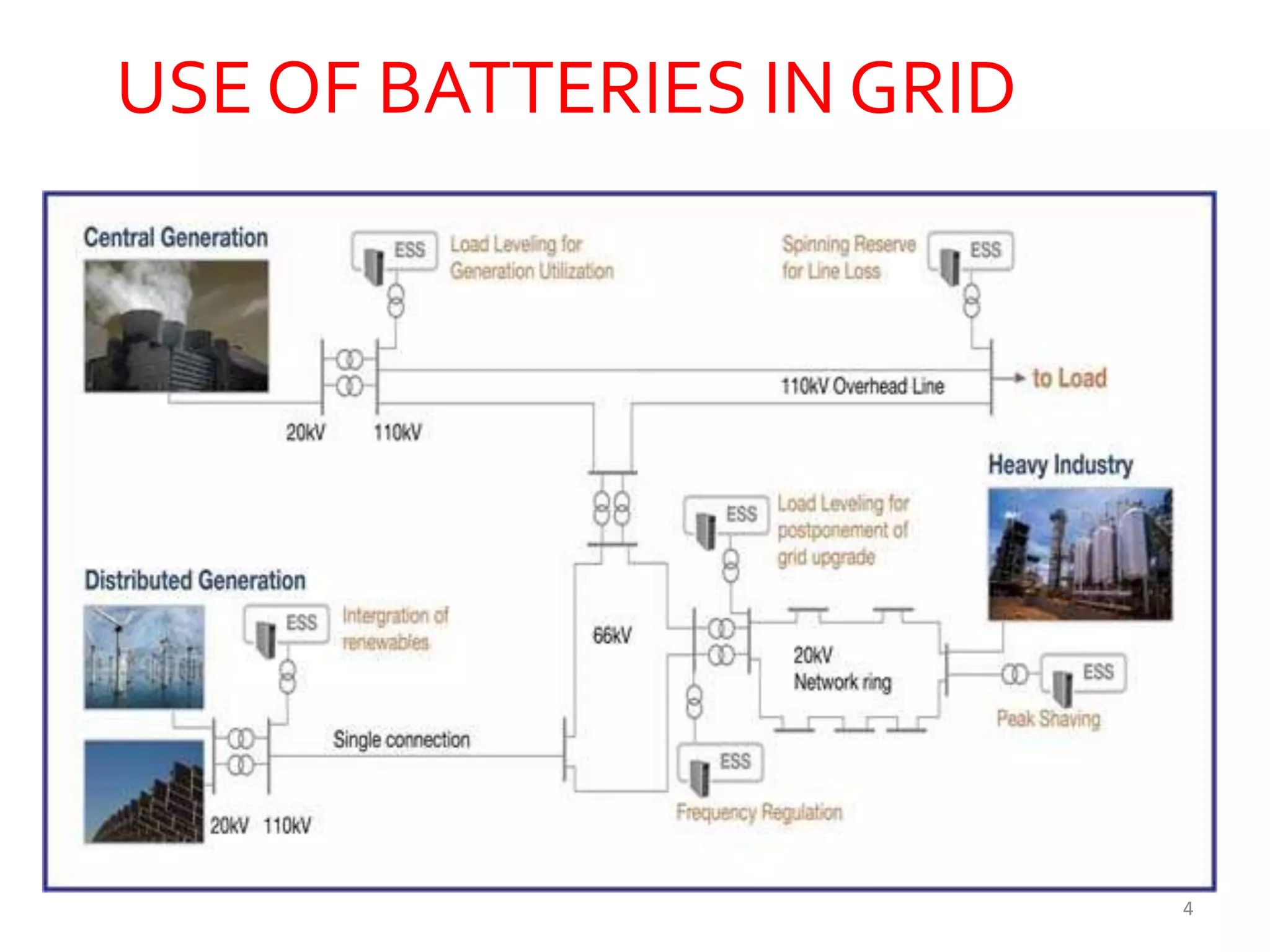
USE OF BATTERIES IN GRID
4
BATTERIES
“Battery systems connected to large solid-state converters have
been used to stabilize power distribution networks”.
For example, in Rico a system with a capacity of 20 megawatts for 15
minutes (5 megawatt hour) is used to stabilize the frequency of
electric power produced on the island.
A 27 megawatt 15-minute (6.75 megawatt hour) nickel-cadmium
battery bank was installed at Fairbanks Alaska in 2003 to stabilize
voltage at the end of a long transmission line.
Another possible technology for large-scale storage is the use of
specialist large-scale batteries such as flow and liquid metal and
Sodium-Ion. Sodium-sulfur batteries could also be inexpensive to
implement on a large scale and have been used for grid storage in
Japan and in the United States.
5
Battery storage power station
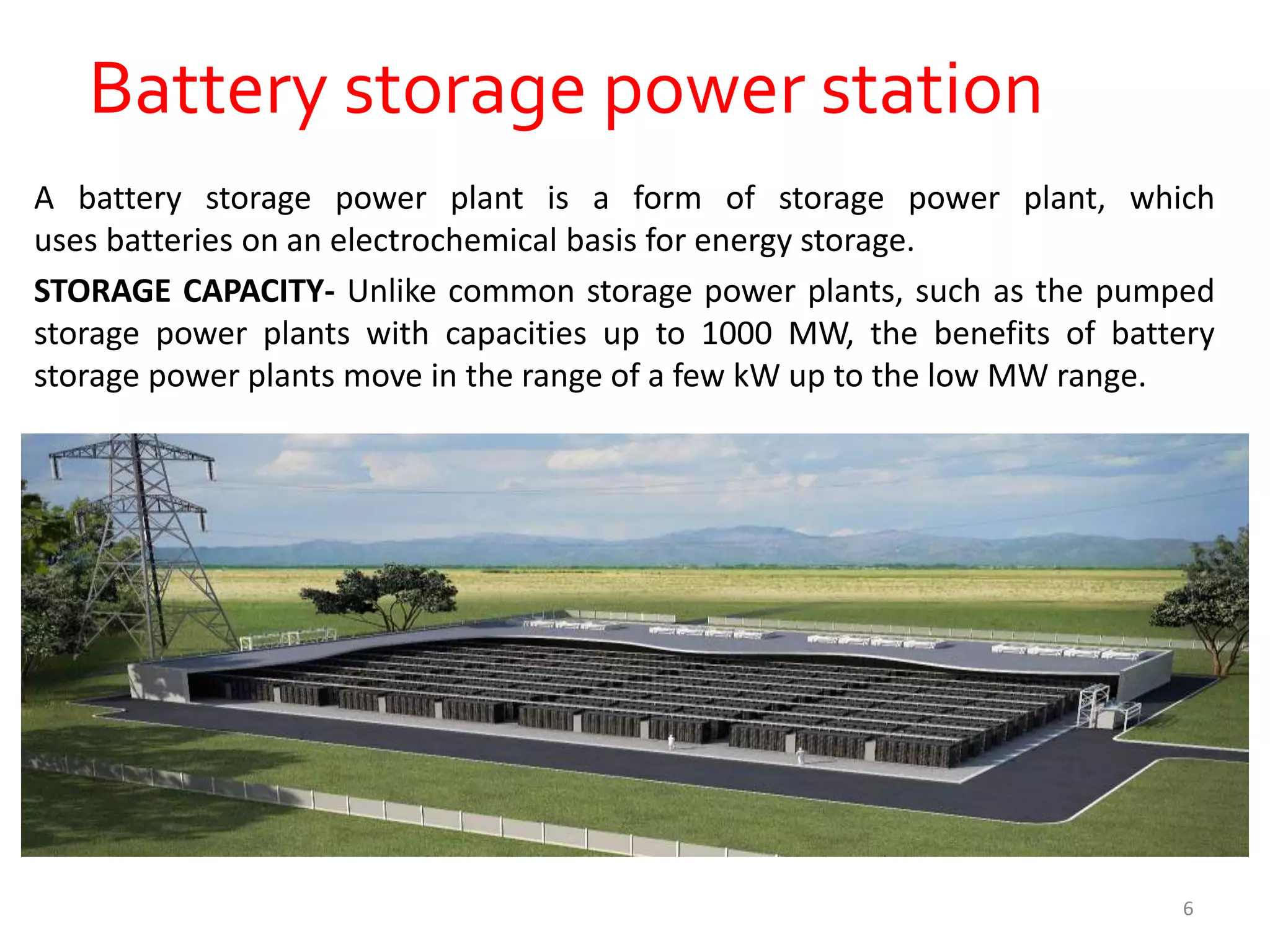
A battery storage power plant is a form of storage power plant, which
uses batteries on an electrochemical basis for energy storage.
STORAGE CAPACITY- Unlike common storage power plants, such as the pumped
storage power plants with capacities up to 1000 MW, the benefits of battery
storage power plants move in the range of a few kW up to the low MW range.
6
TYPES OF BATTERIES
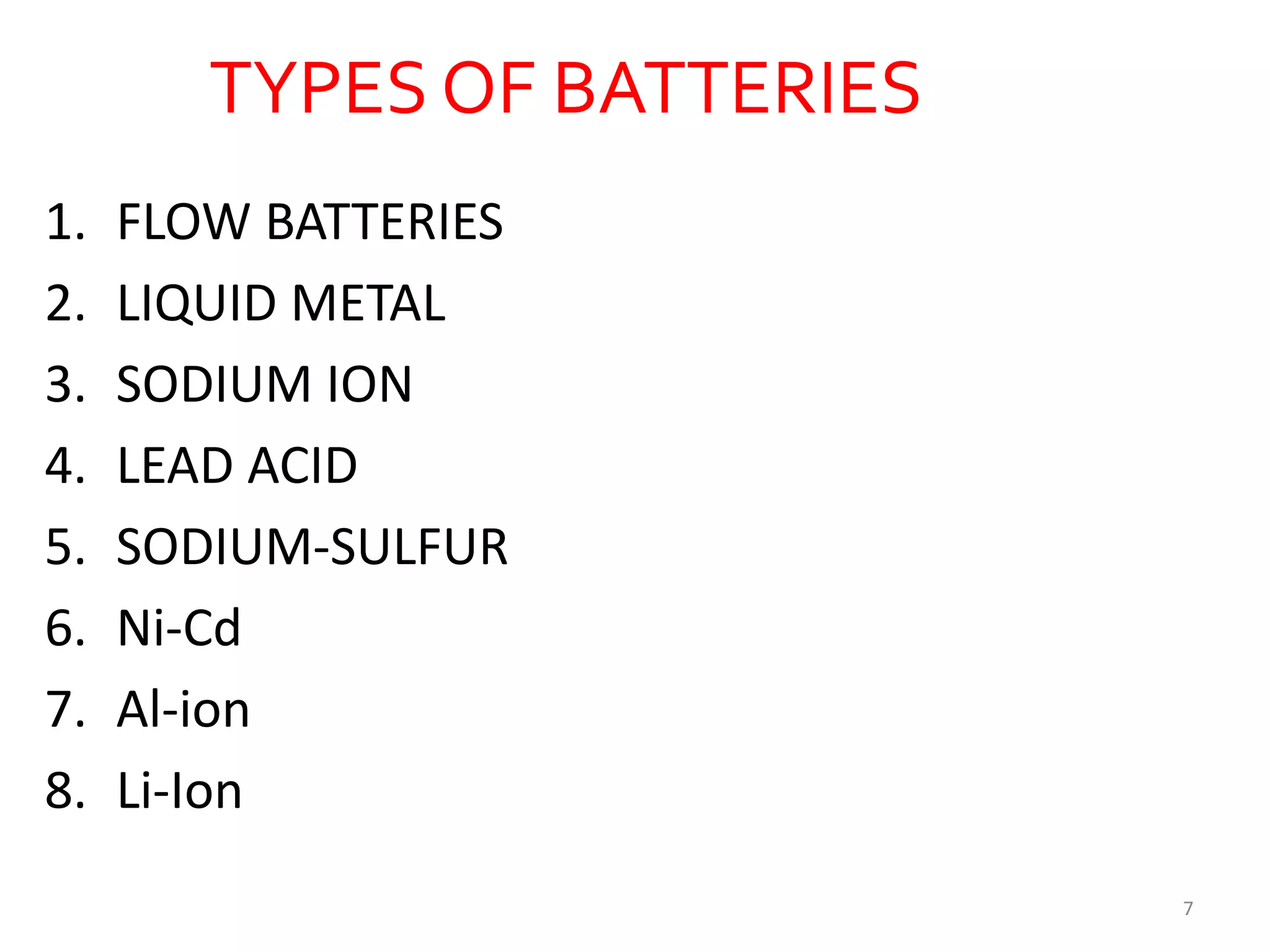
1. FLOW BATTERIES
2. LIQUID METAL
3. SODIUM ION
4. LEAD ACID
5. SODIUM-SULFUR
6. Ni-Cd
7. Al-ion
8. Li-Ion
7
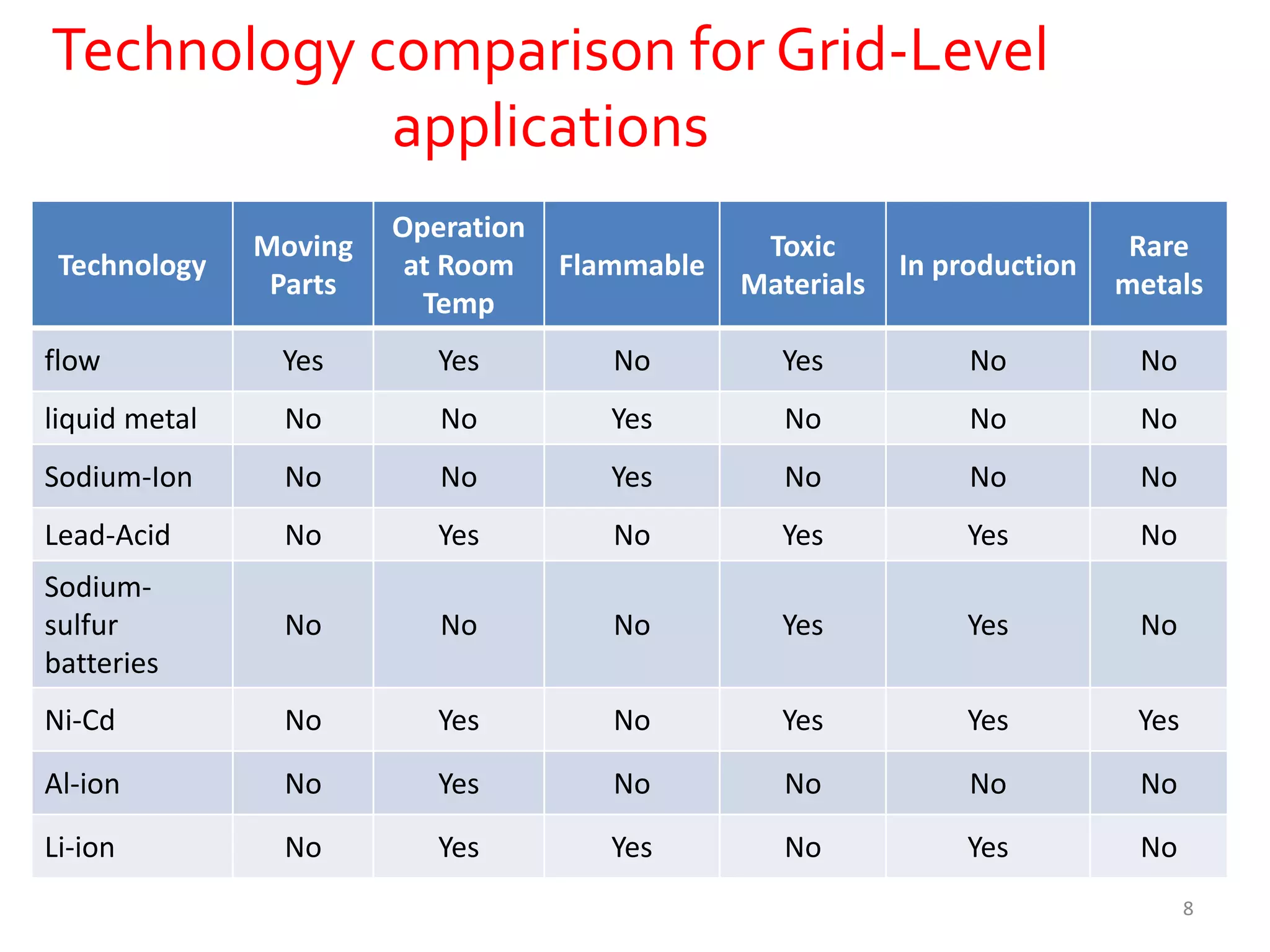
Technology comparison for Grid-Level
applications
8
Technology
Moving
Parts
Operation
at Room
Temp
Flammable
Toxic
Materials
In production
Rare
metals
flow Yes Yes No Yes No No
liquid metal No No Yes No No No
Sodium-Ion No No Yes No No No
Lead-Acid No Yes No Yes Yes No
Sodium-
sulfur
batteries
No No No Yes Yes No
Ni-Cd No Yes No Yes Yes Yes
Al-ion No Yes No No No No
Li-ion No Yes Yes No Yes No
SMES (SUPERCONDUCTING MAGNETIC
ENERGY STORAGE)
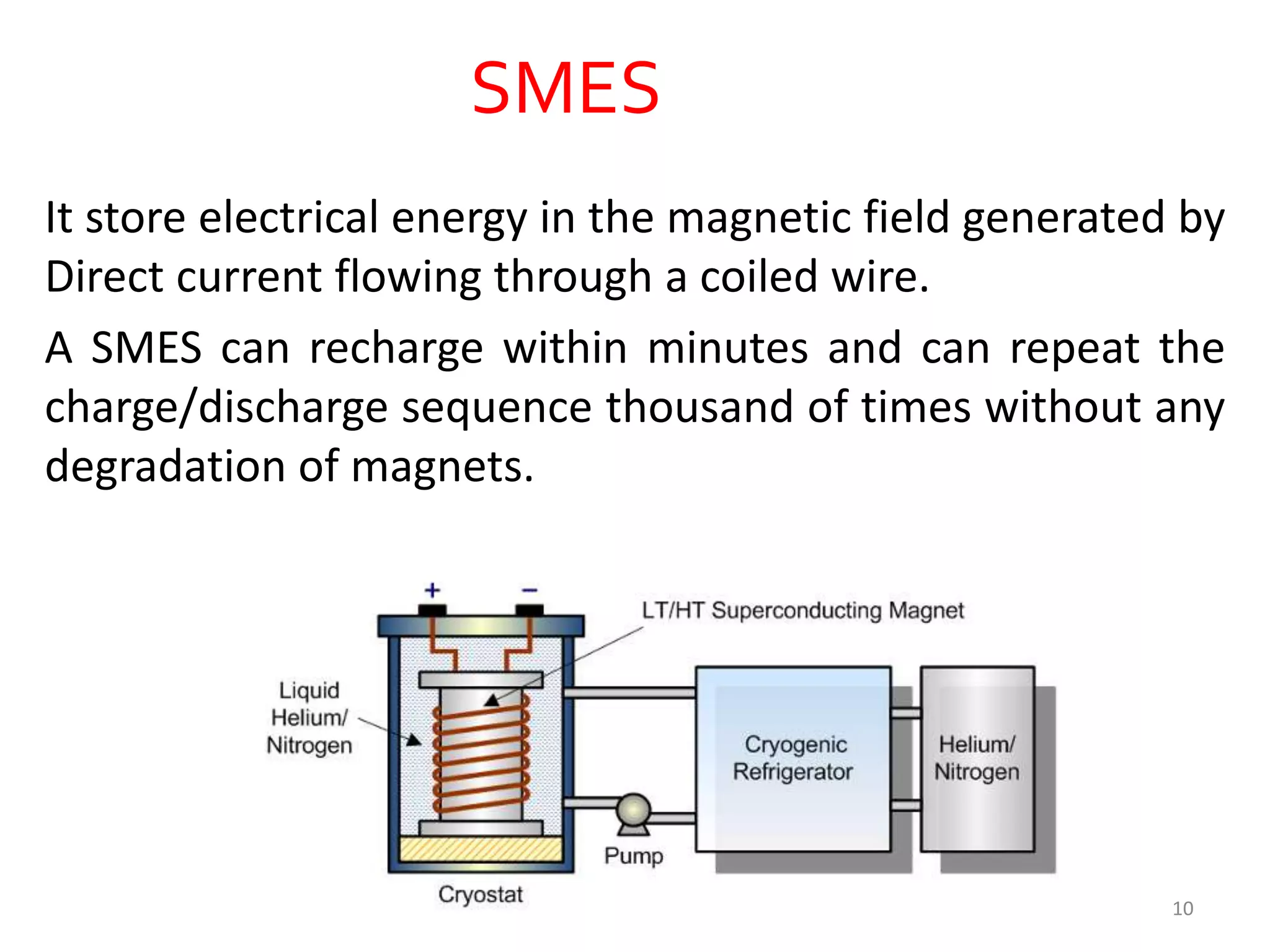
Superconducting Magnetic Energy Storage (SMES) systems store
energy in the magnetic field created by the flow of direct current in
a superconducting coil which has been cryogenically cooled to a
temperature below its superconducting critical temperature.
A typical SMES system includes three parts:
• Superconducting coil,
• Power conditioning system and
• Cryogenically cooled refrigerator.
Once the superconducting coil is charged, the current will not decay
and the magnetic energy can be stored indefinitely. The stored
energy can be released back to the network by discharging the coil.
9
SMES
It store electrical energy in the magnetic field generated by
Direct current flowing through a coiled wire.
A SMES can recharge within minutes and can repeat the
charge/discharge sequence thousand of times without any
degradation of magnets.
10
HOW ITWORKS?
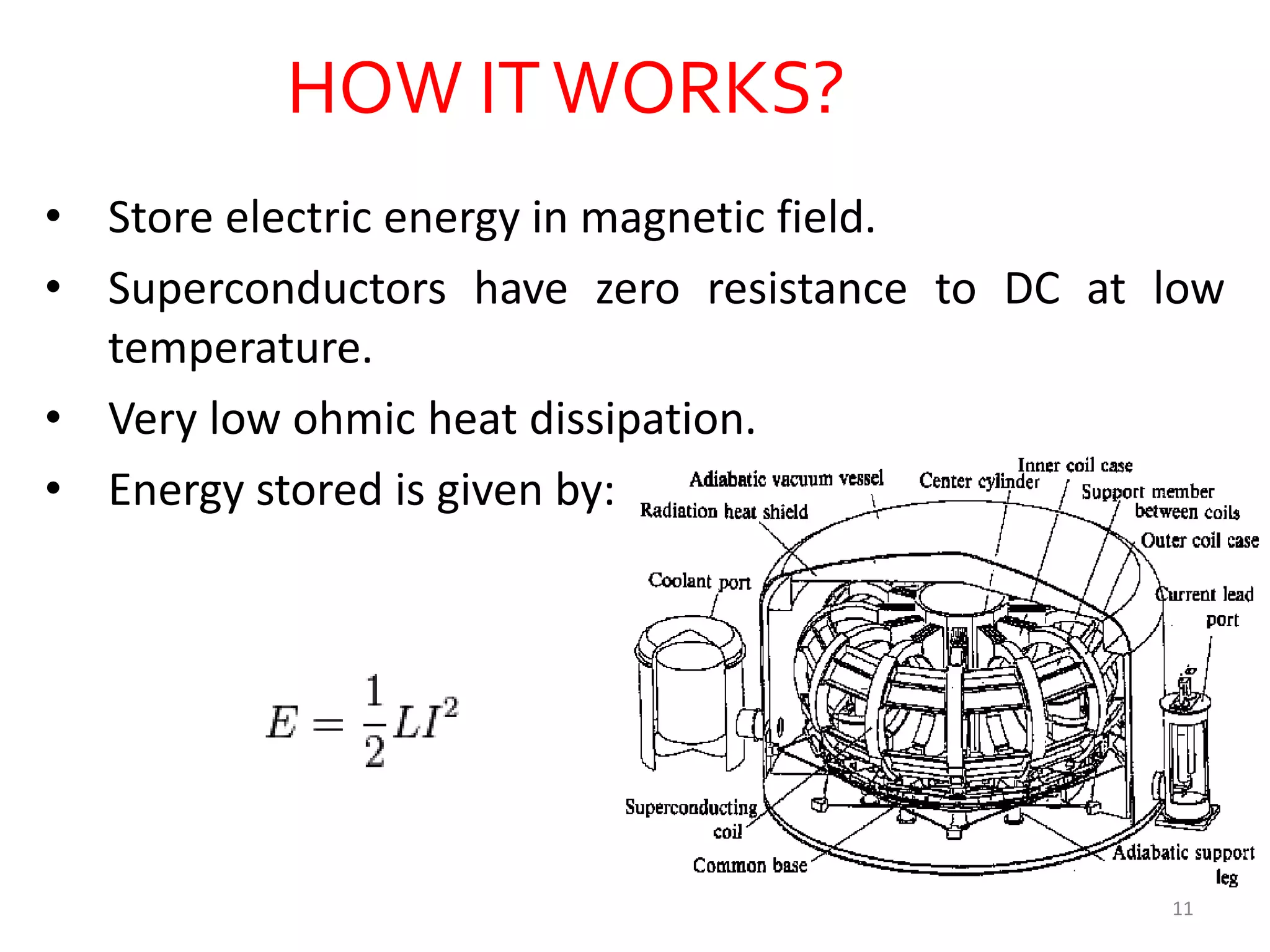
• Store electric energy in magnetic field.
• Superconductors have zero resistance to DC at low
temperature.
• Very low ohmic heat dissipation.
• Energy stored is given by:
11
PUMPED HYDRO
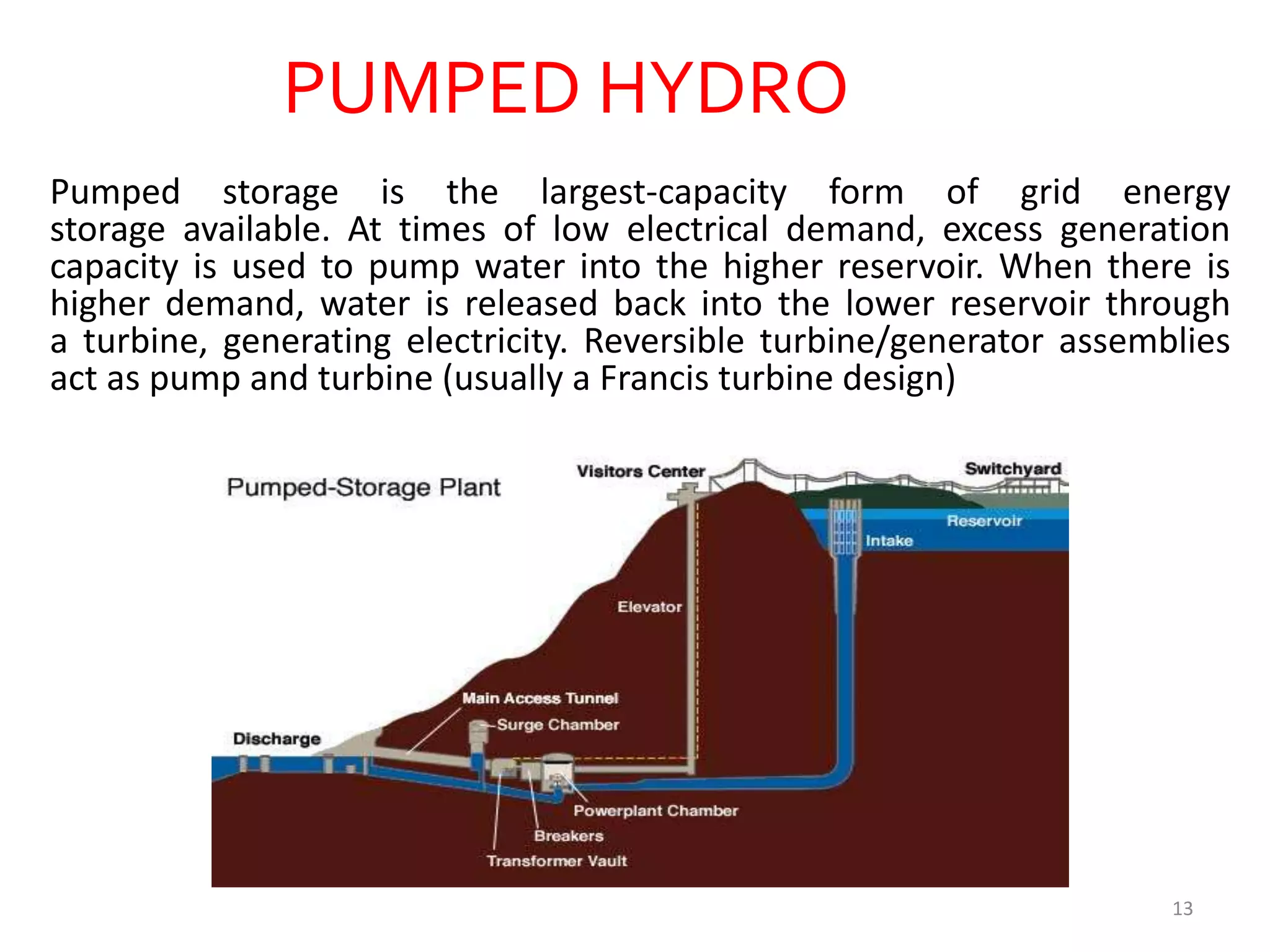
Pumped-storage hydroelectricity (PSH), or Pumped Hydroelectric
Energy Storage (PHES), is a type of hydroelectric energy
storage used by electric power systems for load balancing. The
method stores energy in the form of gravitational potential
energy of water, pumped from a lower elevation reservoir to a
higher elevation.
Low-cost off-peak electric power is used to run the pumps.
During periods of high electrical demand, the stored water is
released through turbines to produce electric power. Although the
losses of the pumping process makes the plant a net consumer of
energy overall, the system increases revenue by selling more
electricity during periods of peak demand, when electricity prices
are highest.
12
PUMPED HYDRO
Pumped storage is the largest-capacity form of grid energy
storage available. At times of low electrical demand, excess generation
capacity is used to pump water into the higher reservoir. When there is
higher demand, water is released back into the lower reservoir through
a turbine, generating electricity. Reversible turbine/generator assemblies
act as pump and turbine (usually a Francis turbine design)
13
COMPRESSEDAIR ENERGY
STORAGE
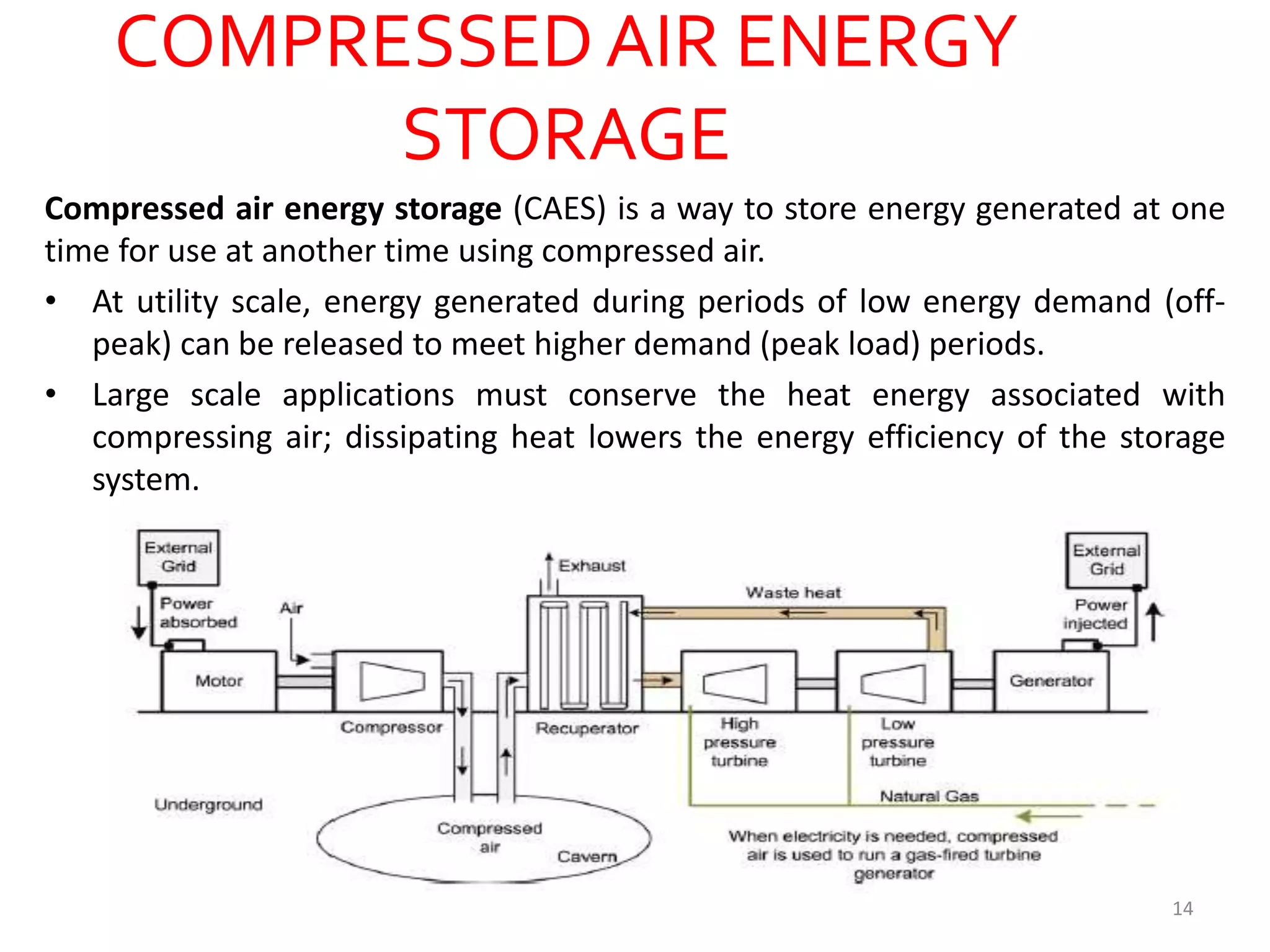
Compressed air energy storage (CAES) is a way to store energy generated at one
time for use at another time using compressed air.
• At utility scale, energy generated during periods of low energy demand (off-
peak) can be released to meet higher demand (peak load) periods.
• Large scale applications must conserve the heat energy associated with
compressing air; dissipating heat lowers the energy efficiency of the storage
system.
14
WORKING
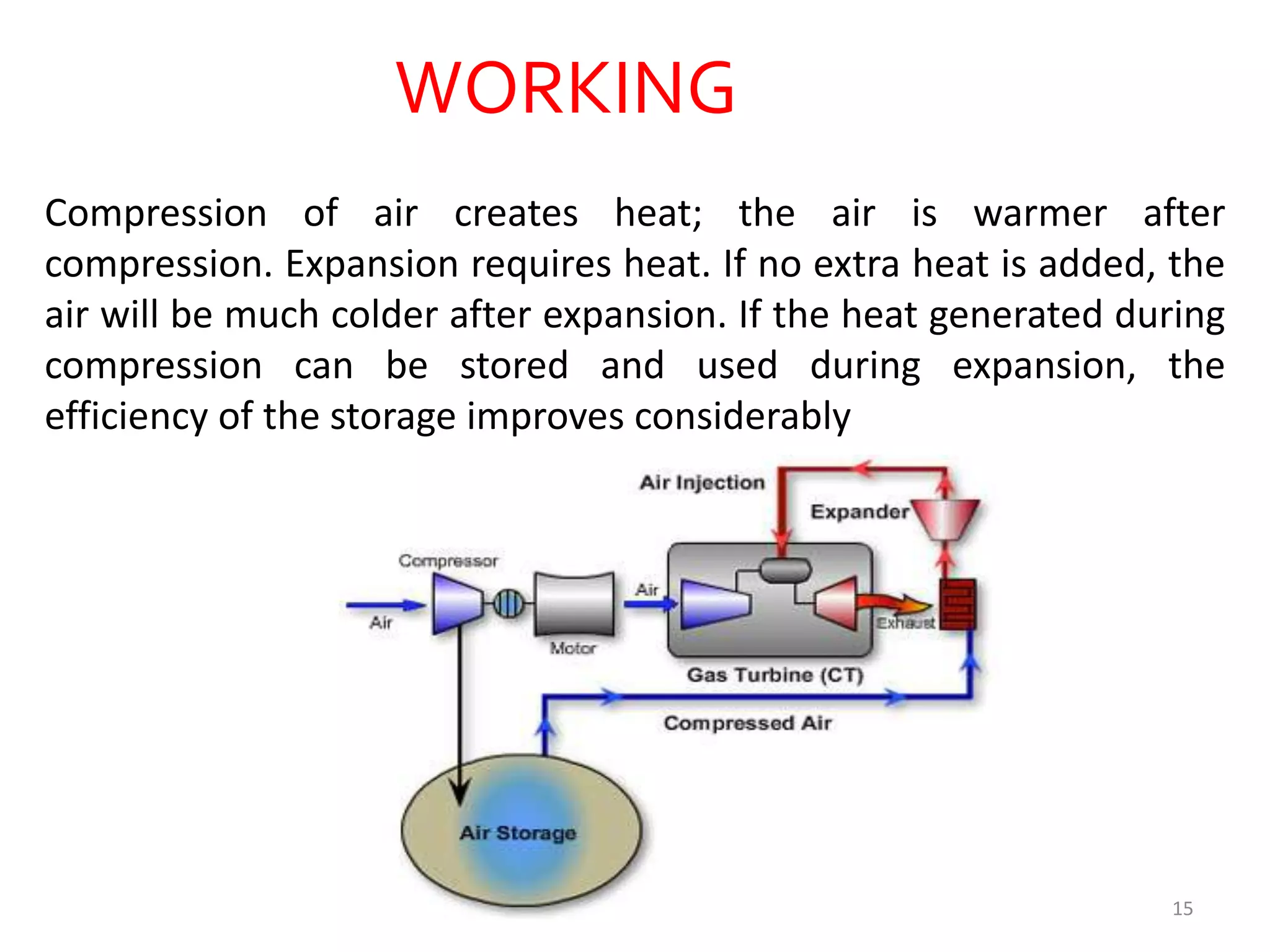
Compression of air creates heat; the air is warmer after
compression. Expansion requires heat. If no extra heat is added, the
air will be much colder after expansion. If the heat generated during
compression can be stored and used during expansion, the
efficiency of the storage improves considerably
15
Communication, Measurement and
Monitoring Technologies for Smart Grid
16
Real time pricing
“Real-time pricing" means tariffed retail charges for delivered
electric power and energy that vary hour-to-hour and are
determined from wholesale market prices using a methodology
approved by the Illinois Commerce Commission.”
In plain language, real-time pricing gives consumers information
about the actual cost of electricity at any given time. Electricity
prices change from hour to hour, but most consumers are forced to
pay the same price no matter when they use electricity. Real-time
pricing lets consumers adjust their electricity usage accordingly; for
example, scheduling usage during periods of low demand to pay
cheaper rates.
17
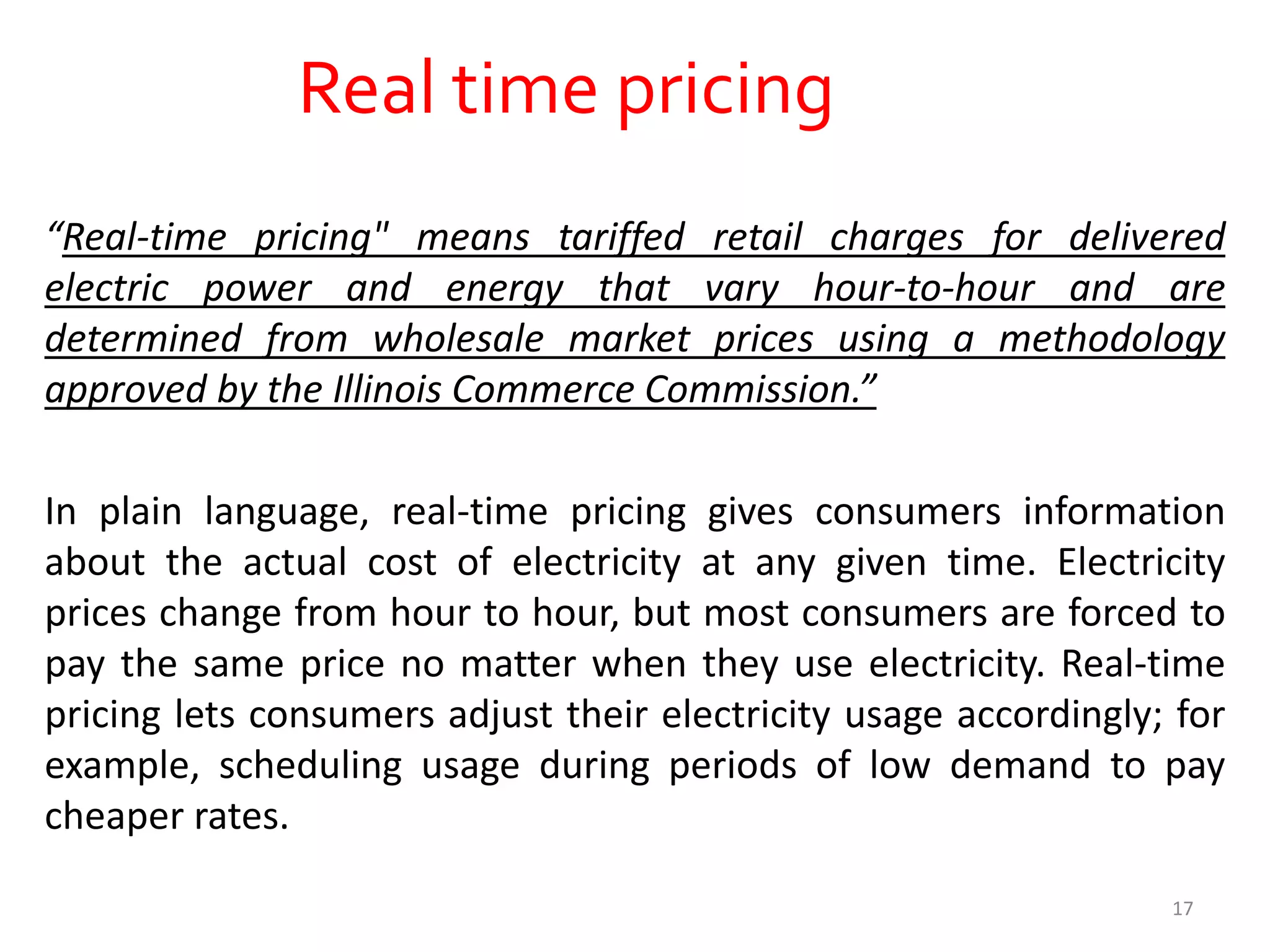
How does it work?
Real-time electricity pricing requires the installation of an electricity
smart meter that can send and receive information about electricity
costs and give consumers more information about their own usage.
18
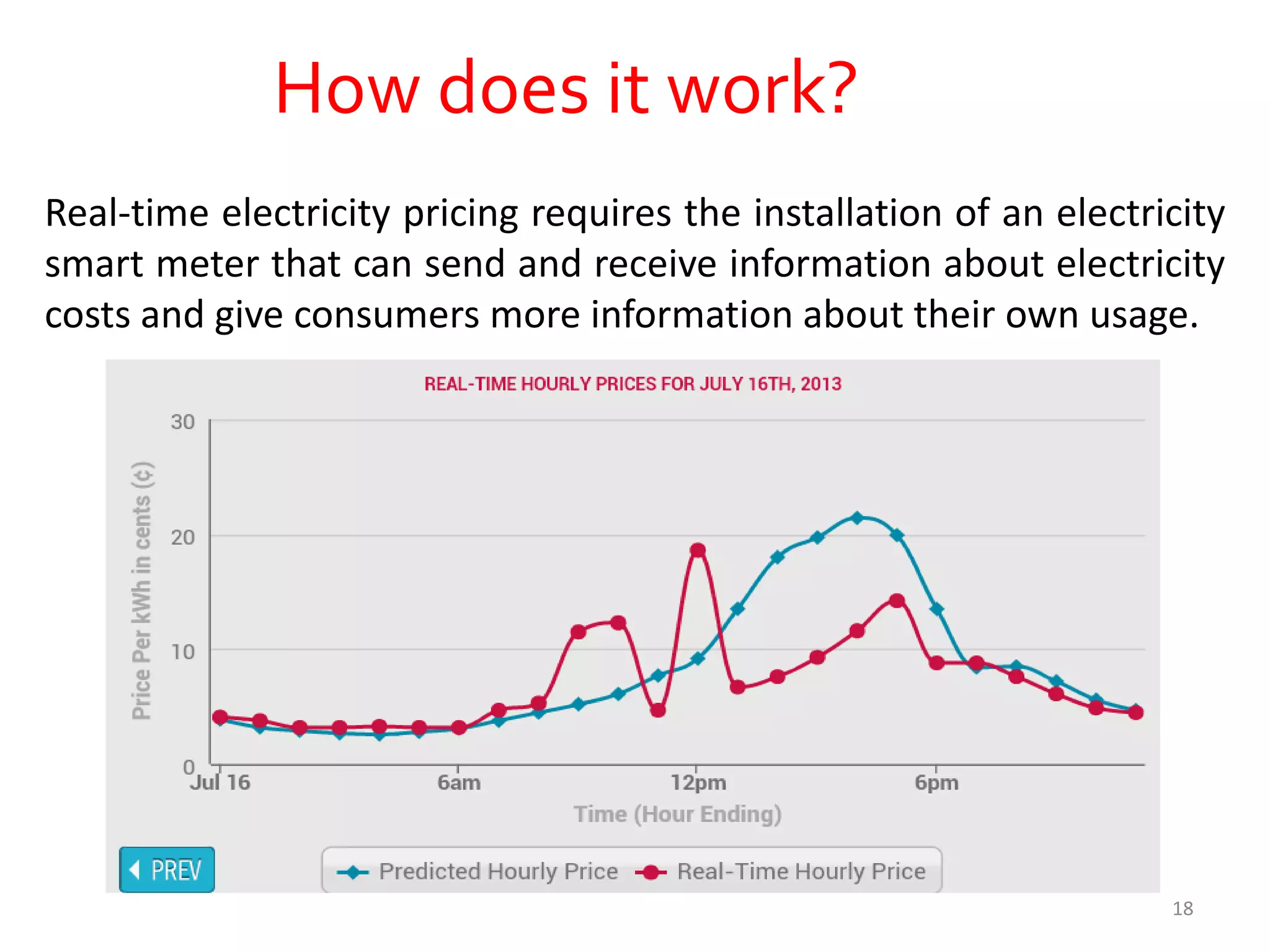
Smart Meters
A smart meter is an electronic device
that records consumption of electric
energy in intervals of an hour or less
and communicates that information at
least daily back to the utility for
monitoring and billing. Smart
meters enable two-way communication
between the meter and the central
system.
19
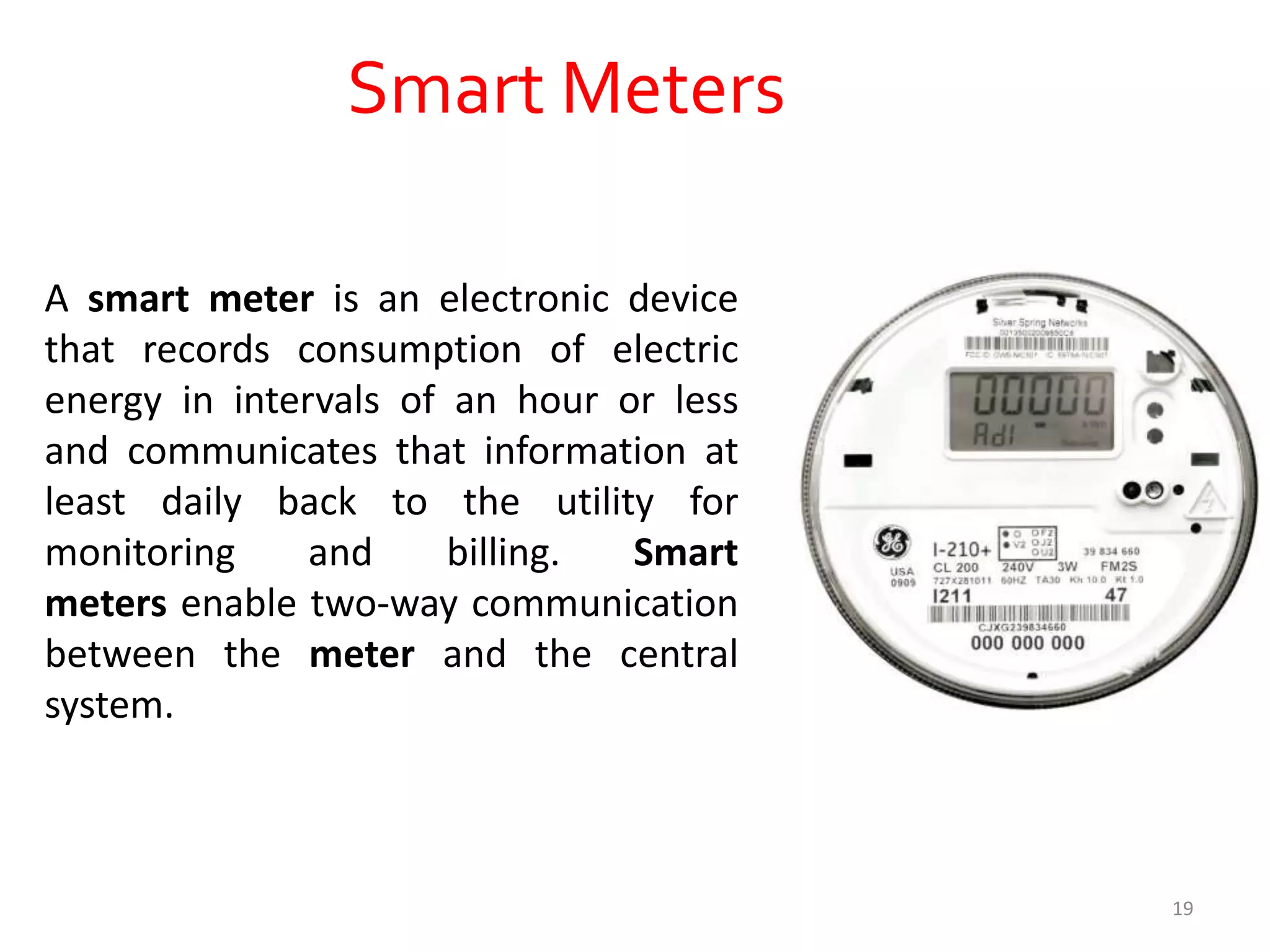
Advanced metering
infrastructure (AMI)
Advanced metering infrastructure (AMI) is an architecture for
automated, two-way communication between a smart utility meter
with an IP address and a utility company.
The goal of an AMI is to provides utility companies with real-time
data about power consumption and allow customers to make
informed choices about energy usage based on the price at the time
of use.
20
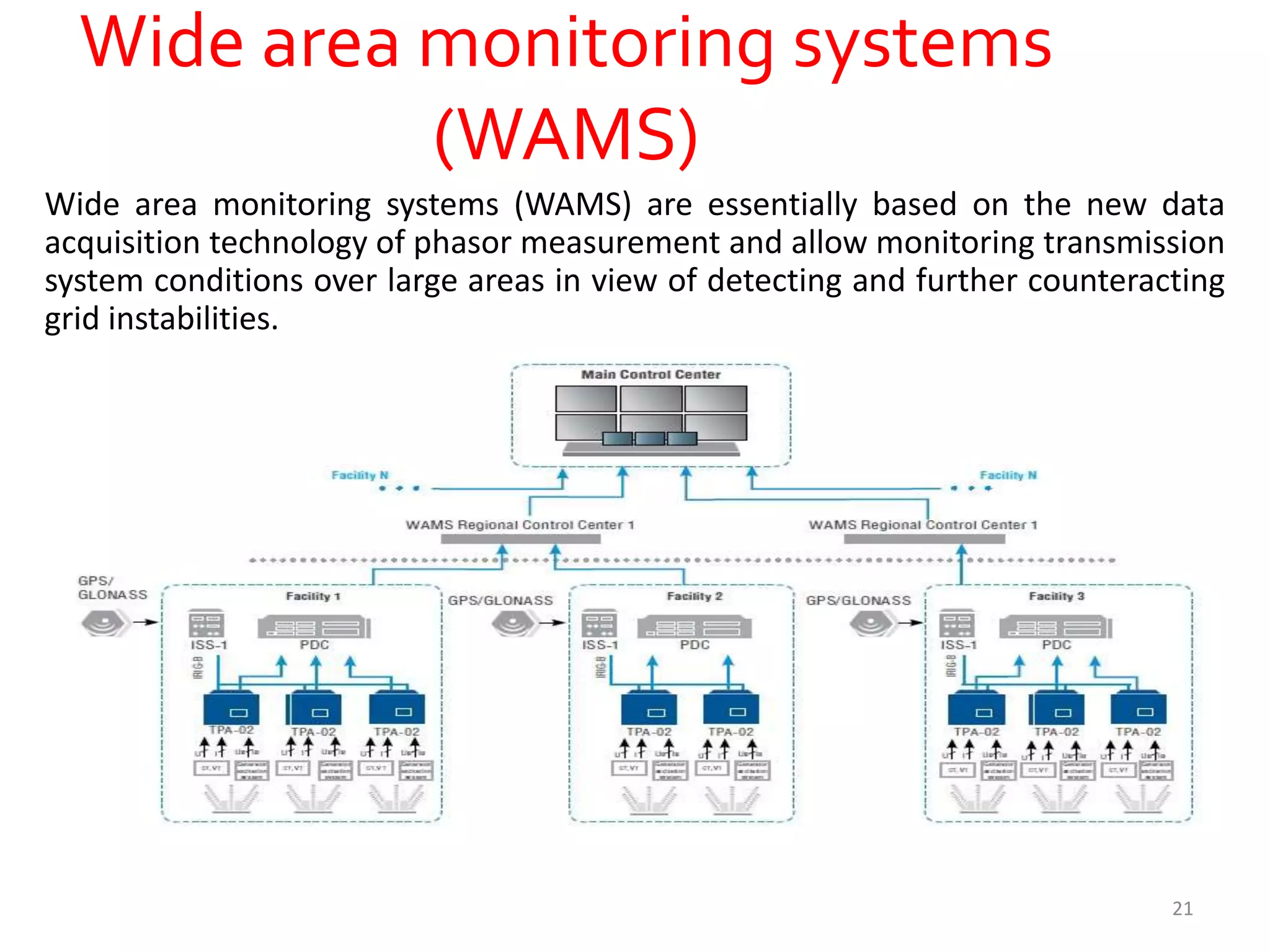
Wide area monitoring systems
(WAMS)
Wide area monitoring systems (WAMS) are essentially based on the new data
acquisition technology of phasor measurement and allow monitoring transmission
system conditions over large areas in view of detecting and further counteracting
grid instabilities.
21
How it works?
Current, voltage and frequency measurements are taken by Phasor
Measurement Units (PMUs) at selected locations in the power
system and stored in a data concentrator every 100 milliseconds.
The measured quantities include both magnitudes and phase angles,
and are time-synchronized via Global Positioning System (GPS)
receivers with an accuracy of one microsecond.
The phasors measured at the same instant provide snapshots of the
status of the monitored nodes. By comparing the snapshots with
each other, not only the steady state, but also the dynamic state of
critical nodes in transmission and sub-transmission networks can be
observed. Thereby, a dynamic monitoring of critical nodes in power
systems is achieved.
22
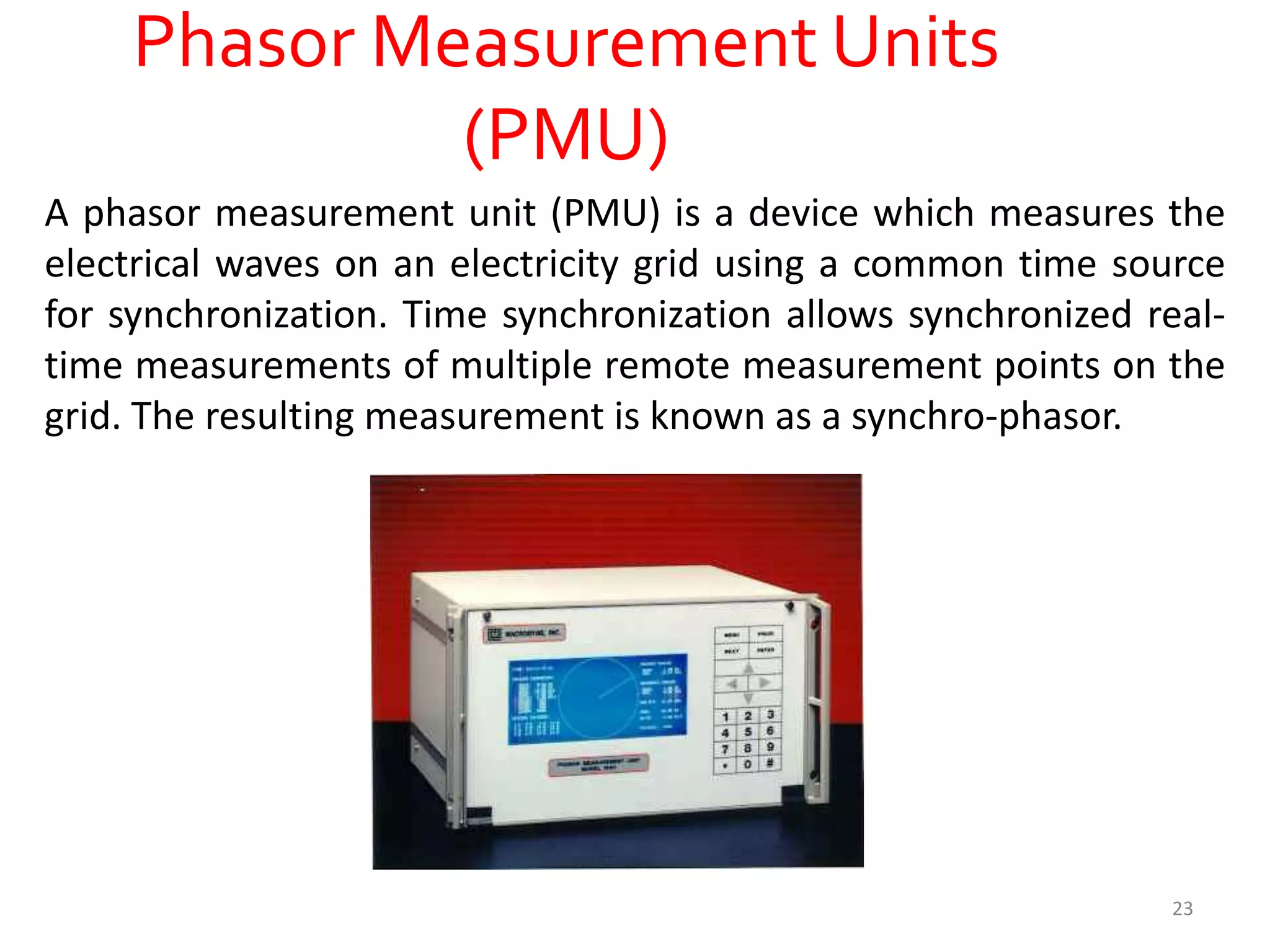
Phasor Measurement Units
(PMU)
A phasor measurement unit (PMU) is a device which measures the
electrical waves on an electricity grid using a common time source
for synchronization. Time synchronization allows synchronized real-
time measurements of multiple remote measurement points on the
grid. The resulting measurement is known as a synchro-phasor.
23
OPERATION
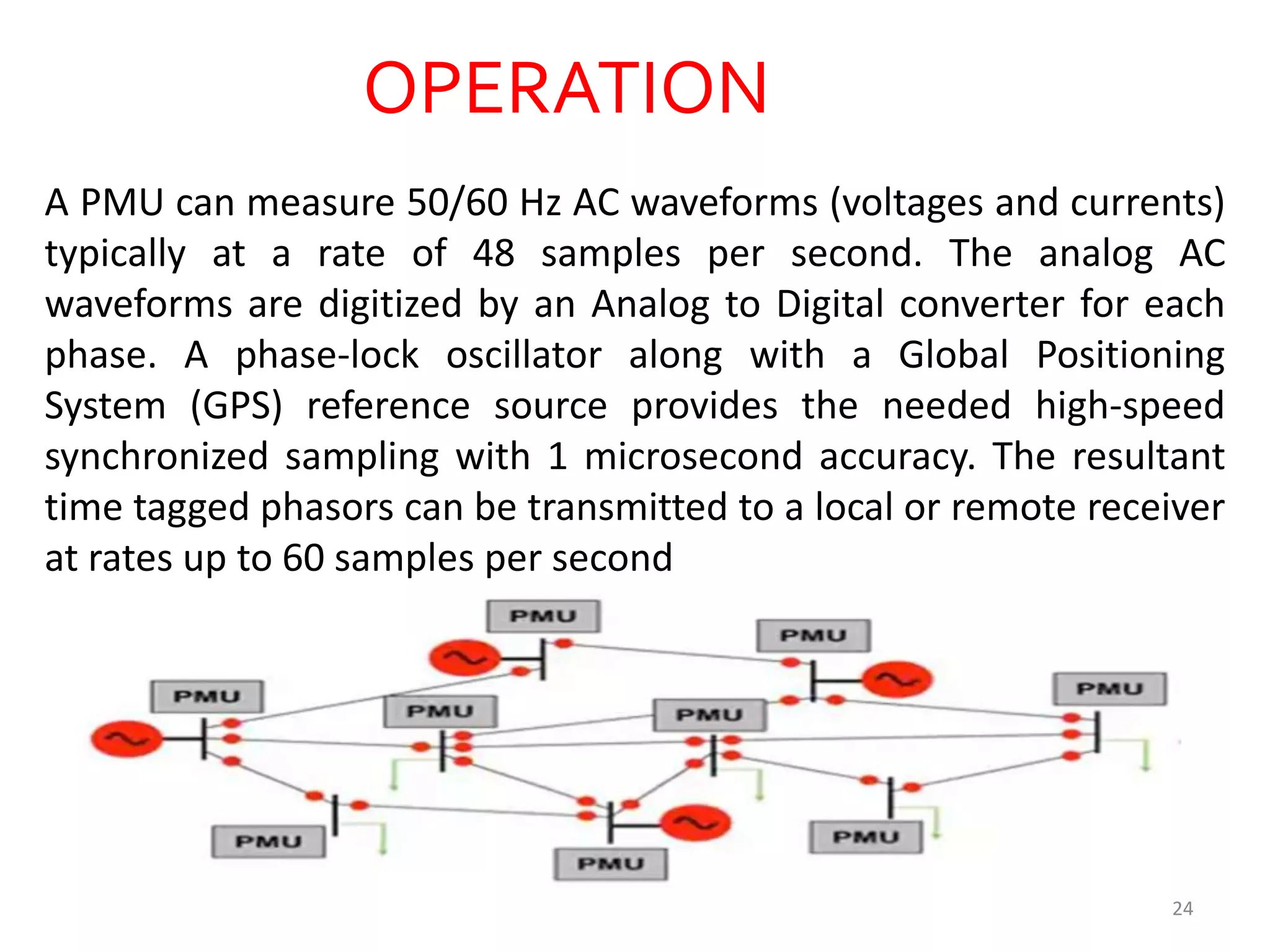
A PMU can measure 50/60 Hz AC waveforms (voltages and currents)
typically at a rate of 48 samples per second. The analog AC
waveforms are digitized by an Analog to Digital converter for each
phase. A phase-lock oscillator along with a Global Positioning
System (GPS) reference source provides the needed high-speed
synchronized sampling with 1 microsecond accuracy. The resultant
time tagged phasors can be transmitted to a local or remote receiver
at rates up to 60 samples per second
24
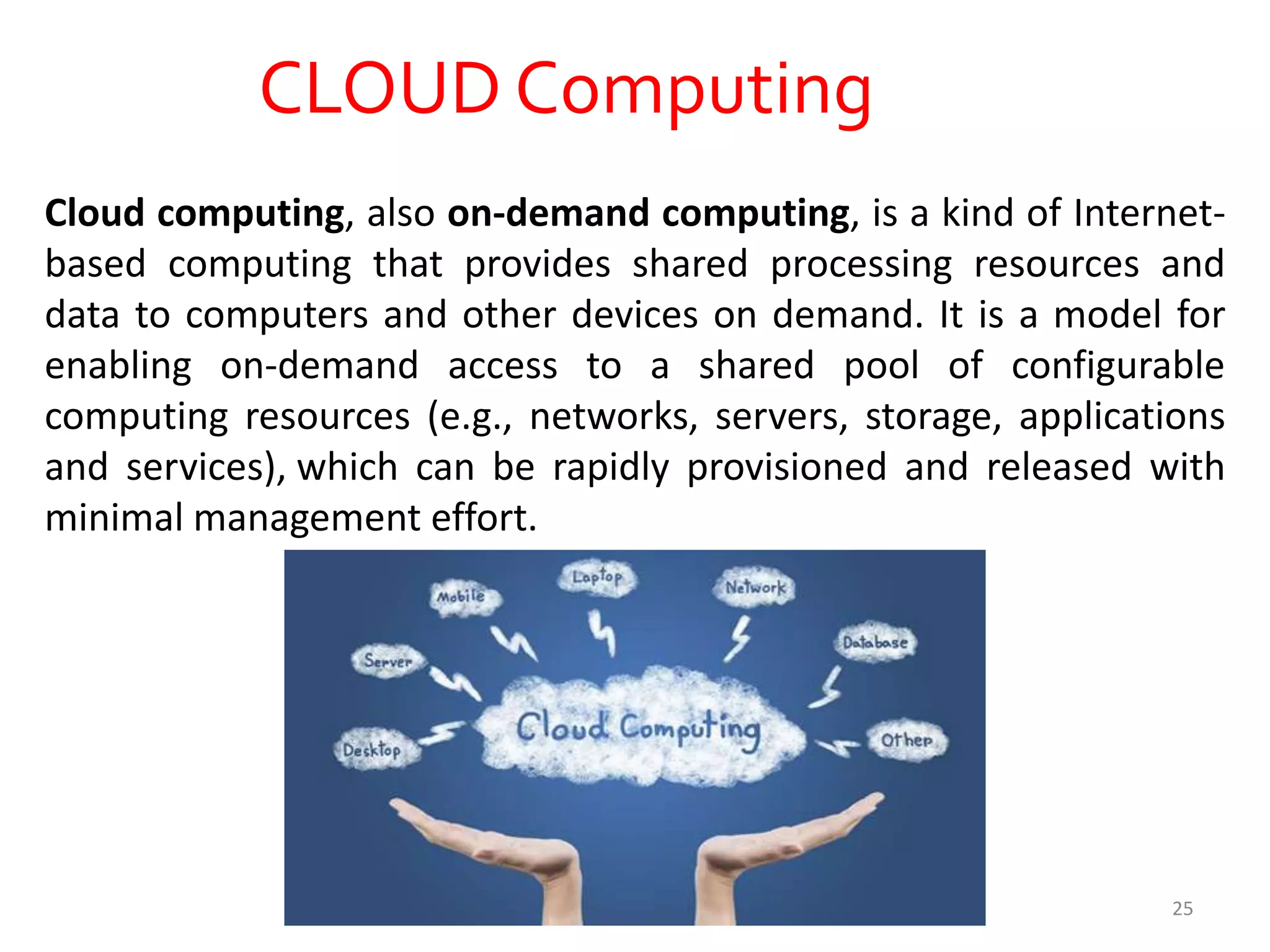
CLOUD Computing
Cloud computing, also on-demand computing, is a kind of Internet-
based computing that provides shared processing resources and
data to computers and other devices on demand. It is a model for
enabling on-demand access to a shared pool of configurable
computing resources (e.g., networks, servers, storage, applications
and services), which can be rapidly provisioned and released with
minimal management effort.
25
cyber security for smart grid
Cybersecurity threats exploit the increased complexity and
connectivity of critical infrastructure systems, placing the United
States security, economy, and public safety and health at risk. Similar
to financial and reputational risk, cybersecurity risk affects a
company’s bottom line. It can drive up costs and impact revenue,
harm an organization’s ability to innovate and impact its ability to
gain and retain customers.
26
cyber security for smart grid
The electric grid is critical to the economic and physical well-being of
the nation, and emerging cyber threats targeting the grid highlight
the need to integrate advanced cybersecurity to protect these
critical assets.
The major elements of the Smart Grid, in addition to the electric
grid, are information technology, industrial control systems, and the
communications infrastructure used to send command information
from generation to the distribution systems. These elements are also
used to exchange usage and billing information between utilities and
their consumers.
Key to the successful deployment of the Smart Grid infrastructure is
the development of a cybersecurity strategy. Cybersecurity needs to
be designed into the new systems supporting the Smart Grid, and
added into existing systems without extensively impacting
operations.
27

Storage In Smart Grids

  • 1.
  • 2.
    Role of storagein smart grid • When the sun is shining, solar cells produce a large amount of electricity that is then fed into the grid, where it needs to find consumers. However, if clouds appear, power output will drop suddenly. • In general, the more fluctuating energy sources, such as sun and wind power, are connected to the grid, the more difficult it is to ensure grid stability. Supply and demand have to be balanced at all times. If they are not, the resulting fluctuations in voltage and frequency can disrupt or even destroy electronic equipment. • In view of this, it is clear that energy storage systems will become increasingly important in the future. Storage units take in surplus electricity that is not needed at a given time and then feed it back into the grid when demand rises. • For decades now, efficient pumped-storage electrical power stations have been used for long-term storage needs. 2
  • 3.
    Different types ofstorage technologies  BATTERIES  SMES (SUPERCONDUCTING MAGNETIC ENERGY STORAGE)  PUMPED HYDRO  COMPRESSED AIR ENERGY STORAGE 3
  • 4.
  • 5.
    BATTERIES “Battery systems connectedto large solid-state converters have been used to stabilize power distribution networks”. For example, in Rico a system with a capacity of 20 megawatts for 15 minutes (5 megawatt hour) is used to stabilize the frequency of electric power produced on the island. A 27 megawatt 15-minute (6.75 megawatt hour) nickel-cadmium battery bank was installed at Fairbanks Alaska in 2003 to stabilize voltage at the end of a long transmission line. Another possible technology for large-scale storage is the use of specialist large-scale batteries such as flow and liquid metal and Sodium-Ion. Sodium-sulfur batteries could also be inexpensive to implement on a large scale and have been used for grid storage in Japan and in the United States. 5
  • 6.
    Battery storage powerstation A battery storage power plant is a form of storage power plant, which uses batteries on an electrochemical basis for energy storage. STORAGE CAPACITY- Unlike common storage power plants, such as the pumped storage power plants with capacities up to 1000 MW, the benefits of battery storage power plants move in the range of a few kW up to the low MW range. 6
  • 7.
    TYPES OF BATTERIES 1.FLOW BATTERIES 2. LIQUID METAL 3. SODIUM ION 4. LEAD ACID 5. SODIUM-SULFUR 6. Ni-Cd 7. Al-ion 8. Li-Ion 7
  • 8.
    Technology comparison forGrid-Level applications 8 Technology Moving Parts Operation at Room Temp Flammable Toxic Materials In production Rare metals flow Yes Yes No Yes No No liquid metal No No Yes No No No Sodium-Ion No No Yes No No No Lead-Acid No Yes No Yes Yes No Sodium- sulfur batteries No No No Yes Yes No Ni-Cd No Yes No Yes Yes Yes Al-ion No Yes No No No No Li-ion No Yes Yes No Yes No
  • 9.
    SMES (SUPERCONDUCTING MAGNETIC ENERGYSTORAGE) Superconducting Magnetic Energy Storage (SMES) systems store energy in the magnetic field created by the flow of direct current in a superconducting coil which has been cryogenically cooled to a temperature below its superconducting critical temperature. A typical SMES system includes three parts: • Superconducting coil, • Power conditioning system and • Cryogenically cooled refrigerator. Once the superconducting coil is charged, the current will not decay and the magnetic energy can be stored indefinitely. The stored energy can be released back to the network by discharging the coil. 9
  • 10.
    SMES It store electricalenergy in the magnetic field generated by Direct current flowing through a coiled wire. A SMES can recharge within minutes and can repeat the charge/discharge sequence thousand of times without any degradation of magnets. 10
  • 11.
    HOW ITWORKS? • Storeelectric energy in magnetic field. • Superconductors have zero resistance to DC at low temperature. • Very low ohmic heat dissipation. • Energy stored is given by: 11
  • 12.
    PUMPED HYDRO Pumped-storage hydroelectricity(PSH), or Pumped Hydroelectric Energy Storage (PHES), is a type of hydroelectric energy storage used by electric power systems for load balancing. The method stores energy in the form of gravitational potential energy of water, pumped from a lower elevation reservoir to a higher elevation. Low-cost off-peak electric power is used to run the pumps. During periods of high electrical demand, the stored water is released through turbines to produce electric power. Although the losses of the pumping process makes the plant a net consumer of energy overall, the system increases revenue by selling more electricity during periods of peak demand, when electricity prices are highest. 12
  • 13.
    PUMPED HYDRO Pumped storageis the largest-capacity form of grid energy storage available. At times of low electrical demand, excess generation capacity is used to pump water into the higher reservoir. When there is higher demand, water is released back into the lower reservoir through a turbine, generating electricity. Reversible turbine/generator assemblies act as pump and turbine (usually a Francis turbine design) 13
  • 14.
    COMPRESSEDAIR ENERGY STORAGE Compressed airenergy storage (CAES) is a way to store energy generated at one time for use at another time using compressed air. • At utility scale, energy generated during periods of low energy demand (off- peak) can be released to meet higher demand (peak load) periods. • Large scale applications must conserve the heat energy associated with compressing air; dissipating heat lowers the energy efficiency of the storage system. 14
  • 15.
    WORKING Compression of aircreates heat; the air is warmer after compression. Expansion requires heat. If no extra heat is added, the air will be much colder after expansion. If the heat generated during compression can be stored and used during expansion, the efficiency of the storage improves considerably 15
  • 16.
    Communication, Measurement and MonitoringTechnologies for Smart Grid 16
  • 17.
    Real time pricing “Real-timepricing" means tariffed retail charges for delivered electric power and energy that vary hour-to-hour and are determined from wholesale market prices using a methodology approved by the Illinois Commerce Commission.” In plain language, real-time pricing gives consumers information about the actual cost of electricity at any given time. Electricity prices change from hour to hour, but most consumers are forced to pay the same price no matter when they use electricity. Real-time pricing lets consumers adjust their electricity usage accordingly; for example, scheduling usage during periods of low demand to pay cheaper rates. 17
  • 18.
    How does itwork? Real-time electricity pricing requires the installation of an electricity smart meter that can send and receive information about electricity costs and give consumers more information about their own usage. 18
  • 19.
    Smart Meters A smartmeter is an electronic device that records consumption of electric energy in intervals of an hour or less and communicates that information at least daily back to the utility for monitoring and billing. Smart meters enable two-way communication between the meter and the central system. 19
  • 20.
    Advanced metering infrastructure (AMI) Advancedmetering infrastructure (AMI) is an architecture for automated, two-way communication between a smart utility meter with an IP address and a utility company. The goal of an AMI is to provides utility companies with real-time data about power consumption and allow customers to make informed choices about energy usage based on the price at the time of use. 20
  • 21.
    Wide area monitoringsystems (WAMS) Wide area monitoring systems (WAMS) are essentially based on the new data acquisition technology of phasor measurement and allow monitoring transmission system conditions over large areas in view of detecting and further counteracting grid instabilities. 21
  • 22.
    How it works? Current,voltage and frequency measurements are taken by Phasor Measurement Units (PMUs) at selected locations in the power system and stored in a data concentrator every 100 milliseconds. The measured quantities include both magnitudes and phase angles, and are time-synchronized via Global Positioning System (GPS) receivers with an accuracy of one microsecond. The phasors measured at the same instant provide snapshots of the status of the monitored nodes. By comparing the snapshots with each other, not only the steady state, but also the dynamic state of critical nodes in transmission and sub-transmission networks can be observed. Thereby, a dynamic monitoring of critical nodes in power systems is achieved. 22
  • 23.
    Phasor Measurement Units (PMU) Aphasor measurement unit (PMU) is a device which measures the electrical waves on an electricity grid using a common time source for synchronization. Time synchronization allows synchronized real- time measurements of multiple remote measurement points on the grid. The resulting measurement is known as a synchro-phasor. 23
  • 24.
    OPERATION A PMU canmeasure 50/60 Hz AC waveforms (voltages and currents) typically at a rate of 48 samples per second. The analog AC waveforms are digitized by an Analog to Digital converter for each phase. A phase-lock oscillator along with a Global Positioning System (GPS) reference source provides the needed high-speed synchronized sampling with 1 microsecond accuracy. The resultant time tagged phasors can be transmitted to a local or remote receiver at rates up to 60 samples per second 24
  • 25.
    CLOUD Computing Cloud computing,also on-demand computing, is a kind of Internet- based computing that provides shared processing resources and data to computers and other devices on demand. It is a model for enabling on-demand access to a shared pool of configurable computing resources (e.g., networks, servers, storage, applications and services), which can be rapidly provisioned and released with minimal management effort. 25
  • 26.
    cyber security forsmart grid Cybersecurity threats exploit the increased complexity and connectivity of critical infrastructure systems, placing the United States security, economy, and public safety and health at risk. Similar to financial and reputational risk, cybersecurity risk affects a company’s bottom line. It can drive up costs and impact revenue, harm an organization’s ability to innovate and impact its ability to gain and retain customers. 26
  • 27.
    cyber security forsmart grid The electric grid is critical to the economic and physical well-being of the nation, and emerging cyber threats targeting the grid highlight the need to integrate advanced cybersecurity to protect these critical assets. The major elements of the Smart Grid, in addition to the electric grid, are information technology, industrial control systems, and the communications infrastructure used to send command information from generation to the distribution systems. These elements are also used to exchange usage and billing information between utilities and their consumers. Key to the successful deployment of the Smart Grid infrastructure is the development of a cybersecurity strategy. Cybersecurity needs to be designed into the new systems supporting the Smart Grid, and added into existing systems without extensively impacting operations. 27