Welcome To Our Presentation
Prepared for:
Md. Mosfiqur Rahman
Senior Lecturer in Mathematics
Department of GED
Daffodil International University,
Bangladesh.
Prepared By:
 Md. Jannatul Nayim Giyem
 Md. Arifur Rahman
 Md. Arafat Sarkar
Course Title: Mathematics III
Course Code: MAT 131
Department Of EEE
Daffodil International University,
Bangladesh.
Application Of Differential Equation’s in Electrical &
electronics Engineering
Invention Of Differential Equations
In mathematics, the history of Differential Equations traces the
development of "differential equations" from calculus, which itself
was independently invented by English physicist Isaac Newton
and German mathematician Gottfried Leibniz.
The history of the subject of differential equations, in concise form
a synopsis of the recent article “The History Of Differential
Equations,1670-1950” “Differential Equations began with
Leibniz, the Bernoulli Brothers, and others from the 1680s, not
long after Newton’s ‘Fluxional Equations’ in the 1670s.”
Sir Isaac Newton
Gottfried Leibniz
A Differential Equation is an equation containing the derivative of one or more dependent
variables with respect to one or more independent variables.
For Example
ODE (Ordinary Differential Equation): An equation contains only ordinary derivatives of one or more
dependent variables of a single independent variable.
For example:
𝑑𝑦
𝑑𝑥
+ 5𝑦 = 𝑒 𝑥,
𝑑𝑥
𝑑𝑡
+
𝑑𝑦
𝑑𝑡
= 2𝑥 + 𝑦
PDE (Partial Differential Equation): An equation contains partial derivatives of one or more dependent
variables of two or more independent variables.
For example:
𝜕2 𝑢
𝜕𝑥2 +
𝜕2 𝑢
𝜕𝑡2 = 2
𝜕𝑢
𝜕𝑡
,
𝜕𝑢
𝜕𝑦
= −
𝜕𝑣
𝜕𝑥
Differential Equation’s
𝒅𝒚
𝒅𝒙
= 𝟐𝒙𝒚 𝒙
𝒅𝒚
𝒅𝒙
= 𝐲 − 𝟏
𝒅 𝟐
𝒚
𝒅𝒙 𝟐
+
𝒅𝒚
𝒅𝒙
+ 𝒚 = 𝟎
𝝏𝒖
𝝏𝒚
= −
𝝏𝒗
𝝏𝒙
𝝏𝒙
𝝏𝒚
+
𝝏𝒚
𝝏𝒙
+ 𝟐 = 𝟎
Types Of Differential Equation:
Application Of Differential Equation’s in EEE
❖Creating Software
❖Constraint Logic Programming
❖Creating games , Aspects Of Algorithms
❖Mother Nature
❖Artificial Intelligence
❖Networking
❖in Theories & explanations: ►Electric R-L Series Circuit
► Newton’s law of Cooling
► Radio Active Decay
► Gauss’s law In Electrostatics, Magnetism & Gravity Continuity
Equations- In Fluid Dynamics, Electromagnetism, Quantum Mechanics, Relativity Theory.
►Heat equation ►Wave equation
Application ( movement of electricity)
Simple analog circuit
Calculate the inductor current and voltage, move
switch, calculate the inductance total current
store in the circuit
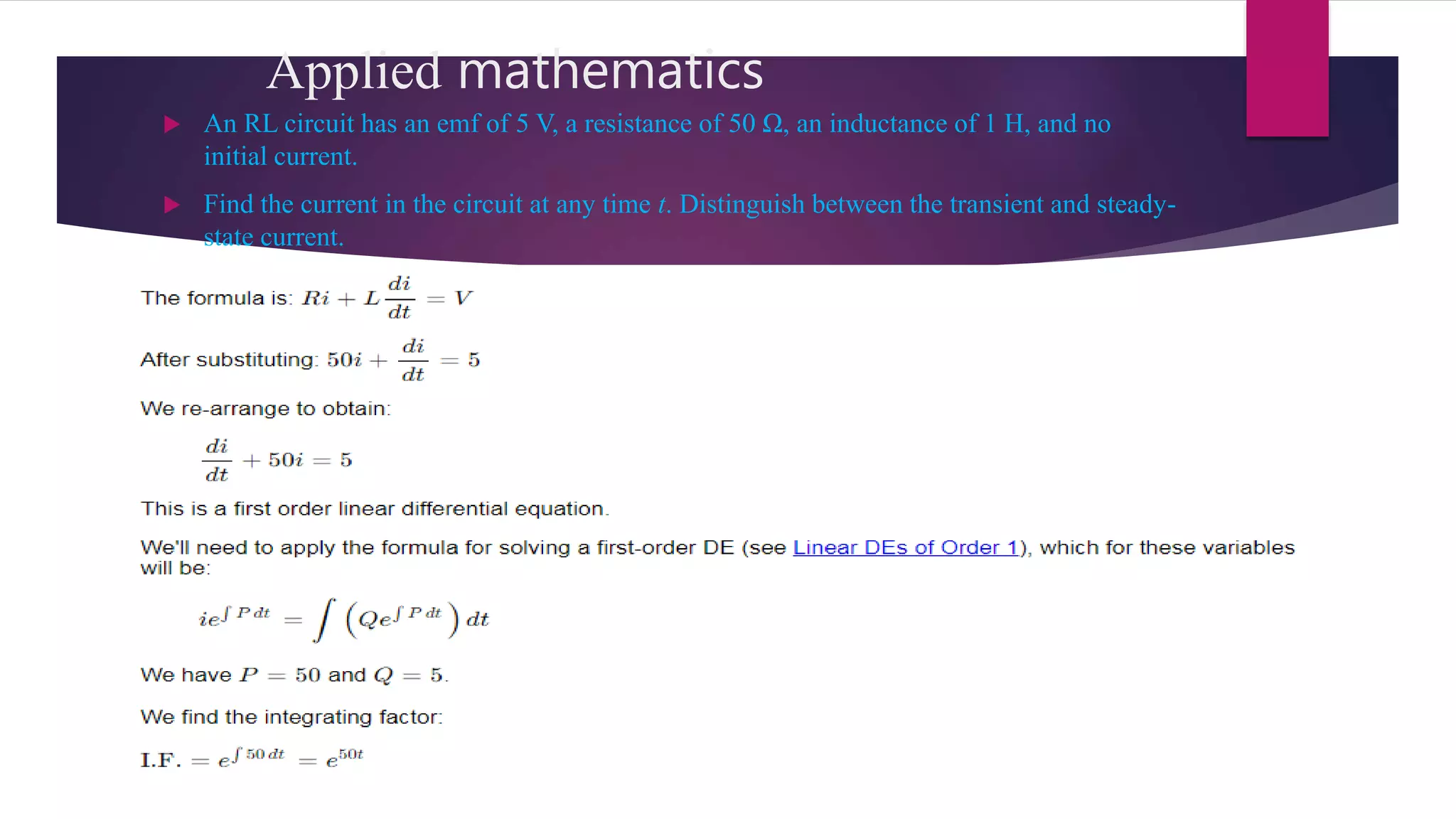
Applied mathematics
 An RL circuit has an emf of 5 V, a resistance of 50 Ω, an inductance of 1 H, and no
initial current.
 Find the current in the circuit at any time t. Distinguish between the transient and steady-
state current.
Radio Active Decay
Thank’s to Everyone

Mat 131

  • 1.
    Welcome To OurPresentation Prepared for: Md. Mosfiqur Rahman Senior Lecturer in Mathematics Department of GED Daffodil International University, Bangladesh. Prepared By:  Md. Jannatul Nayim Giyem  Md. Arifur Rahman  Md. Arafat Sarkar Course Title: Mathematics III Course Code: MAT 131 Department Of EEE Daffodil International University, Bangladesh.
  • 2.
    Application Of DifferentialEquation’s in Electrical & electronics Engineering
  • 3.
    Invention Of DifferentialEquations In mathematics, the history of Differential Equations traces the development of "differential equations" from calculus, which itself was independently invented by English physicist Isaac Newton and German mathematician Gottfried Leibniz. The history of the subject of differential equations, in concise form a synopsis of the recent article “The History Of Differential Equations,1670-1950” “Differential Equations began with Leibniz, the Bernoulli Brothers, and others from the 1680s, not long after Newton’s ‘Fluxional Equations’ in the 1670s.” Sir Isaac Newton Gottfried Leibniz
  • 4.
    A Differential Equationis an equation containing the derivative of one or more dependent variables with respect to one or more independent variables. For Example ODE (Ordinary Differential Equation): An equation contains only ordinary derivatives of one or more dependent variables of a single independent variable. For example: 𝑑𝑦 𝑑𝑥 + 5𝑦 = 𝑒 𝑥, 𝑑𝑥 𝑑𝑡 + 𝑑𝑦 𝑑𝑡 = 2𝑥 + 𝑦 PDE (Partial Differential Equation): An equation contains partial derivatives of one or more dependent variables of two or more independent variables. For example: 𝜕2 𝑢 𝜕𝑥2 + 𝜕2 𝑢 𝜕𝑡2 = 2 𝜕𝑢 𝜕𝑡 , 𝜕𝑢 𝜕𝑦 = − 𝜕𝑣 𝜕𝑥 Differential Equation’s 𝒅𝒚 𝒅𝒙 = 𝟐𝒙𝒚 𝒙 𝒅𝒚 𝒅𝒙 = 𝐲 − 𝟏 𝒅 𝟐 𝒚 𝒅𝒙 𝟐 + 𝒅𝒚 𝒅𝒙 + 𝒚 = 𝟎 𝝏𝒖 𝝏𝒚 = − 𝝏𝒗 𝝏𝒙 𝝏𝒙 𝝏𝒚 + 𝝏𝒚 𝝏𝒙 + 𝟐 = 𝟎 Types Of Differential Equation:
  • 5.
    Application Of DifferentialEquation’s in EEE ❖Creating Software ❖Constraint Logic Programming ❖Creating games , Aspects Of Algorithms ❖Mother Nature ❖Artificial Intelligence ❖Networking ❖in Theories & explanations: ►Electric R-L Series Circuit ► Newton’s law of Cooling ► Radio Active Decay ► Gauss’s law In Electrostatics, Magnetism & Gravity Continuity Equations- In Fluid Dynamics, Electromagnetism, Quantum Mechanics, Relativity Theory. ►Heat equation ►Wave equation
  • 6.
    Application ( movementof electricity) Simple analog circuit Calculate the inductor current and voltage, move switch, calculate the inductance total current store in the circuit
  • 7.
    Applied mathematics  AnRL circuit has an emf of 5 V, a resistance of 50 Ω, an inductance of 1 H, and no initial current.  Find the current in the circuit at any time t. Distinguish between the transient and steady- state current.
  • 9.
  • 11.