1
2
CONTENTS
3
One of the major issues in power system is the losses
occurring during the transmission and distribution of
electrical power.
The percentage of loss of power during transmission
and distribution is approximated as 26%.
The main reason for power loss during transmission
and distribution is the resistance of wires used in grid.
losses in the world – a whopping 27-40%.
Tesla has proposed methods of transmission of
electricity using electromagnetic induction.
INTRODUCTION
4
As the word wireless means “without wire”.
Wireless energy transfer or wireless power is the transmission of
electrical energy from a power source to an electric load without
interconnecting man made conductors.
Wireless transmission is useful in cases where interconnecting
wires are inconvenient, hazardous or impossible.
DEFINITION
5
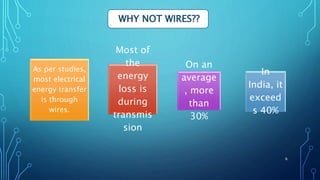
As per studies,
most electrical
energy transfer
is through
wires.
Most of
the
energy
loss is
during
transmis
sion
On an
average
, more
than
30%
In
India, it
exceed
s 40%
WHY NOT WIRES??
6
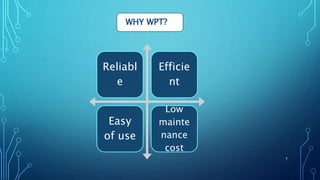
Reliabl
e
Efficie
nt
Easy
of use
Low
mainte
nance
cost
WHY WPT?
7
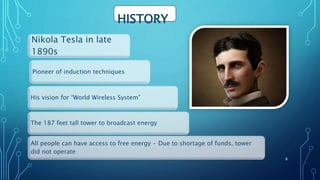
Nikola Tesla in late
1890s
Pioneer of induction techniques
His vision for “World Wireless System”
The 187 feet tall tower to broadcast energy
All people can have access to free energy • Due to shortage of funds, tower
did not operate
HISTORY
8
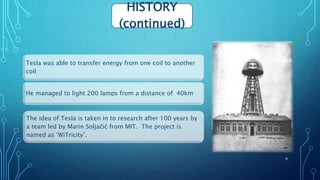
Tesla was able to transfer energy from one coil to another
coil
He managed to light 200 lamps from a distance of 40km
The idea of Tesla is taken in to research after 100 years by
a team led by Marin Soljačić from MIT. The project is
named as ‘WiTricity’.
HISTORY
(continued)
9
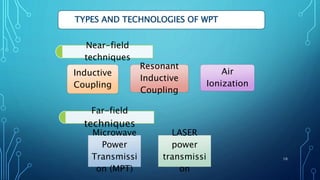
TYPES AND TECHNOLOGIES OF WPT
Microwave
Power
Transmissi
on (MPT)
LASER
power
transmissi
on
Inductive
Coupling
Resonant
Inductive
Coupling
Air
Ionization
Near-field
techniques
Far-field
techniques
10
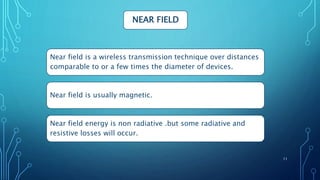
NEAR FIELD
Near field is a wireless transmission technique over distances
comparable to or a few times the diameter of devices.
Near field is usually magnetic.
Near field energy is non radiative .but some radiative and
resistive losses will occur.
11
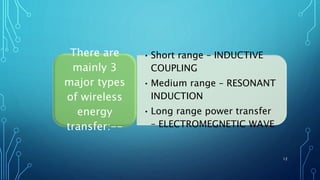
• Short range – INDUCTIVE
COUPLING
• Medium range – RESONANT
INDUCTION
• Long range power transfer
– ELECTROMEGNETIC WAVE
There are
mainly 3
major types
of wireless
energy
transfer:--
12
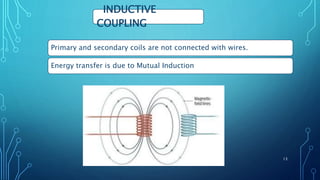
INDUCTIVE
COUPLING
Primary and secondary coils are not connected with wires.
Energy transfer is due to Mutual Induction
13
INDUCTIVE COUPLING(CONTD…)
Electric brush also charges using inductive coupling
The charging pad (primary coil) and the
device(secondary coil) have to be kept very near to each
other It is preferred
because it is
comfortable.
Less
use
of
wires
Sh
oc
k
pro
of
14
RESONANCE INDUCTIVE
COUPLING(RIC)
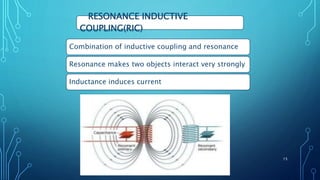
Combination of inductive coupling and resonance
Resonance makes two objects interact very strongly
Inductance induces current
15
AIR IONIZATION
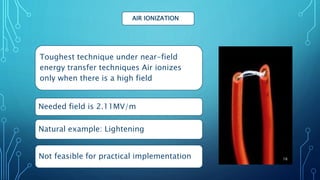
Toughest technique under near-field
energy transfer techniques Air ionizes
only when there is a high field
Needed field is 2.11MV/m
Natural example: Lightening
Not feasible for practical implementation 16
WiTricity
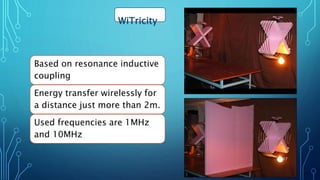
Based on resonance inductive
coupling
Energy transfer wirelessly for
a distance just more than 2m.
Used frequencies are 1MHz
and 10MHz
17
VIDEO ON WPT
18
ADVANTAGES OF NEAR-FIELD TECHNIQUE
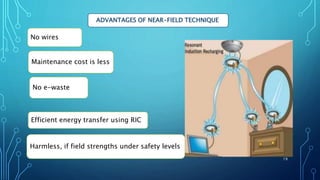
No wires
No e-waste
Efficient energy transfer using RIC
Harmless, if field strengths under safety levels
Maintenance cost is less
19
DISADVANTAGES
Distance constraint
Field strengths have to be under safety
levels
Initial cost is high
High frequency signals must be the supply
Air ionization technique is not feasible 20
FAR-FIELD ENERGY TRANSFER
Radiative
Needs line-of-sight
LASER or microwave
Aims at high power transfer
Tesla’s tower was built for this
21
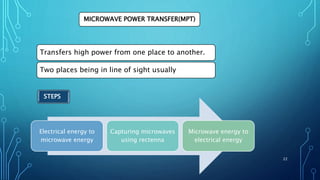
MICROWAVE POWER TRANSFER(MPT)
Transfers high power from one place to another.
Two places being in line of sight usually
Electrical energy to
microwave energy
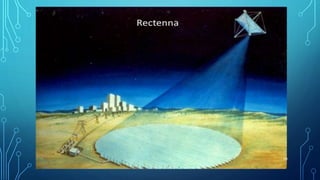
Capturing microwaves
using rectenna
Microwave energy to
electrical energy
STEPS
22
MP T
(CONTD…)
AC can not be directly converted to microwave
energy
AC is converted to DC first
DC is converted to microwaves using
magnetron
Transmitted waves are received at rectenna which
rectifies, gives DC as the output
DC is converted back to AC
23
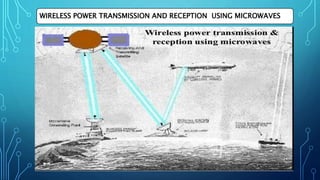
WIRELESS POWER TRANSMISSION AND RECEPTION USING MICROWAVES
24
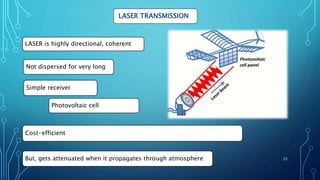
LASER TRANSMISSION
LASER is highly directional, coherent
Not dispersed for very long
But, gets attenuated when it propagates through atmosphere
Simple receiver
Photovoltaic cell
Cost-efficient
25
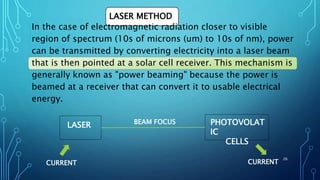
LASER METHOD
In the case of electromagnetic radiation closer to visible
region of spectrum (10s of microns (um) to 10s of nm), power
can be transmitted by converting electricity into a laser beam
that is then pointed at a solar cell receiver. This mechanism is
generally known as "power beaming" because the power is
beamed at a receiver that can convert it to usable electrical
energy.
LASER PHOTOVOLAT
IC
CELLS
BEAM FOCUS
CURRENT CURRENT
26
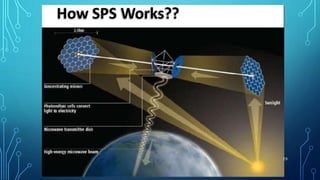
SOLAR POWER SATELLITES
(SPS)
To provide energy to earth’s increasing
energy need
To efficiently make use of renewable energy i.e.,
solar energy
SPS are placed in geostationary
orbits
27
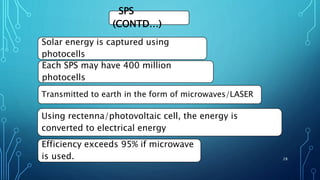
SPS
(CONTD…)
Solar energy is captured using
photocells
Each SPS may have 400 million
photocells
Using rectenna/photovoltaic cell, the energy is
converted to electrical energy
Efficiency exceeds 95% if microwave
is used.
Transmitted to earth in the form of microwaves/LASER
28
29
30
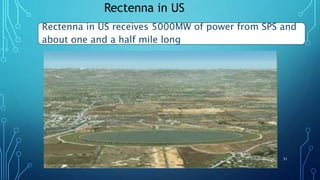
Rectenna in US
Rectenna in US receives 5000MW of power from SPS and
about one and a half mile long
31
FUTURE SCOPE OF
WITRICITYMIT's WiTricity is only 40 to 45% efficient and according to
Soljacic, they have to be twice as efficient to compete with the
traditional chemical batteries. The team's next aim is to get a
robotic vacuum or a laptop working, charging devices placed
anywhere in the room and even robots on factory floors. The
researchers are also currently working on the health issues related
to this concept and have said that in another three to five years’
time, they will come up with a WiTricity system for commercial
use.
if successful will definitely change the way we live. Imagine cell
phones, laptops, digital camera's getting self-charged! Wow! Let's
hope the researchers will be able to come up with the commercial
system soon.
32
ADVANTAGES OF FAR-FIELD ENERGY TRANSFER
Efficient
Easy
Need for grids, substations etc are
eliminated
Low maintenance cost
More effective when the transmitting and
receiving points are along a line-of-sight
Can reach the places which are
remote 33
DISADVANTAGES OF FAR-FIELD ENERGY TRASNFER
34
Radiative
Need line of sight
Initial cost is high
When LASER’S are used,
•Conversion is inefficient
•Absorption is High
When Microwaves are used,
•Interference may arised
APPLICATIONS
Solar Power Satellites
Energy to remote areas
Can broadcast energy
globally (in future)
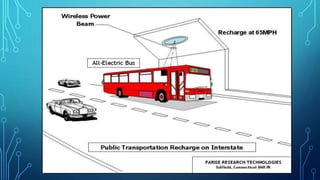
Electric automobile charging
Static and moving
Consumer electronics
Industrial purposes
Near-field energy
transfer
Far-field energy
transfer
35
36
APPLICATION
S
Consumer
Electronics
Industrial
Transport
ation
37
LIMITATIONS
The resonance condition should be satisfied and if any error
exists, there is no possibility of power transfer.
If there is any possibility of very strong ferromagnetic
material presence causes low power transfer due to radiation.
38
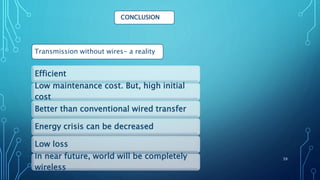
CONCLUSION
Efficient
Low maintenance cost. But, high initial
cost
Better than conventional wired transfer
Energy crisis can be decreased
Low loss
In near future, world will be completely
wireless
Transmission without wires- a reality
39
REFERENCES
S. Sheik Mohammed, K. Ramasamy, T. Shanmuganantham,” Wireless power
transmission – a next generation power transmission system”, International
Journal of Computer Applications (0975 – 8887) (Volume 1 – No. 13)
Peter Vaessen,” Wireless Power Transmission”, Leonardo Energy,
September 2009 u C.C. Leung, T.P. Chan, K.C. Lit, K.W. Tam and Lee Yi
Chow, “Wireless Power Transmission and Charging Pad”
David Schneider, “Electrons unplugged”, IEEE Spectrum, May 2010
Shahrzad Jalali Mazlouman, Alireza Mahanfar, Bozena Kaminska, “Mid-
range Wireless Energy Transfer Using Inductive Resonance for Wireless
Sensors”
Chunbo Zhu, Kai Liu, ChunlaiYu, Rui Ma, Hexiao Cheng, “Simulation and
Experimental Analysis on Wireless Energy Transfer Based on Magnetic
Resonances”, IEEE Vehicle Power and Propulsion Conference (VPPC),
September 3-5, 2008
40
41
42

wireless power Transmission

  • 1.
  • 2.
  • 3.
  • 4.
    One of themajor issues in power system is the losses occurring during the transmission and distribution of electrical power. The percentage of loss of power during transmission and distribution is approximated as 26%. The main reason for power loss during transmission and distribution is the resistance of wires used in grid. losses in the world – a whopping 27-40%. Tesla has proposed methods of transmission of electricity using electromagnetic induction. INTRODUCTION 4
  • 5.
    As the wordwireless means “without wire”. Wireless energy transfer or wireless power is the transmission of electrical energy from a power source to an electric load without interconnecting man made conductors. Wireless transmission is useful in cases where interconnecting wires are inconvenient, hazardous or impossible. DEFINITION 5
  • 6.
    As per studies, mostelectrical energy transfer is through wires. Most of the energy loss is during transmis sion On an average , more than 30% In India, it exceed s 40% WHY NOT WIRES?? 6
  • 7.
  • 8.
    Nikola Tesla inlate 1890s Pioneer of induction techniques His vision for “World Wireless System” The 187 feet tall tower to broadcast energy All people can have access to free energy • Due to shortage of funds, tower did not operate HISTORY 8
  • 9.
    Tesla was ableto transfer energy from one coil to another coil He managed to light 200 lamps from a distance of 40km The idea of Tesla is taken in to research after 100 years by a team led by Marin Soljačić from MIT. The project is named as ‘WiTricity’. HISTORY (continued) 9
  • 10.
    TYPES AND TECHNOLOGIESOF WPT Microwave Power Transmissi on (MPT) LASER power transmissi on Inductive Coupling Resonant Inductive Coupling Air Ionization Near-field techniques Far-field techniques 10
  • 11.
    NEAR FIELD Near fieldis a wireless transmission technique over distances comparable to or a few times the diameter of devices. Near field is usually magnetic. Near field energy is non radiative .but some radiative and resistive losses will occur. 11
  • 12.
    • Short range– INDUCTIVE COUPLING • Medium range – RESONANT INDUCTION • Long range power transfer – ELECTROMEGNETIC WAVE There are mainly 3 major types of wireless energy transfer:-- 12
  • 13.
    INDUCTIVE COUPLING Primary and secondarycoils are not connected with wires. Energy transfer is due to Mutual Induction 13
  • 14.
    INDUCTIVE COUPLING(CONTD…) Electric brushalso charges using inductive coupling The charging pad (primary coil) and the device(secondary coil) have to be kept very near to each other It is preferred because it is comfortable. Less use of wires Sh oc k pro of 14
  • 15.
    RESONANCE INDUCTIVE COUPLING(RIC) Combination ofinductive coupling and resonance Resonance makes two objects interact very strongly Inductance induces current 15
  • 16.
    AIR IONIZATION Toughest techniqueunder near-field energy transfer techniques Air ionizes only when there is a high field Needed field is 2.11MV/m Natural example: Lightening Not feasible for practical implementation 16
  • 17.
    WiTricity Based on resonanceinductive coupling Energy transfer wirelessly for a distance just more than 2m. Used frequencies are 1MHz and 10MHz 17
  • 18.
  • 19.
    ADVANTAGES OF NEAR-FIELDTECHNIQUE No wires No e-waste Efficient energy transfer using RIC Harmless, if field strengths under safety levels Maintenance cost is less 19
  • 20.
    DISADVANTAGES Distance constraint Field strengthshave to be under safety levels Initial cost is high High frequency signals must be the supply Air ionization technique is not feasible 20
  • 21.
    FAR-FIELD ENERGY TRANSFER Radiative Needsline-of-sight LASER or microwave Aims at high power transfer Tesla’s tower was built for this 21
  • 22.
    MICROWAVE POWER TRANSFER(MPT) Transfershigh power from one place to another. Two places being in line of sight usually Electrical energy to microwave energy Capturing microwaves using rectenna Microwave energy to electrical energy STEPS 22
  • 23.
    MP T (CONTD…) AC cannot be directly converted to microwave energy AC is converted to DC first DC is converted to microwaves using magnetron Transmitted waves are received at rectenna which rectifies, gives DC as the output DC is converted back to AC 23
  • 24.
    WIRELESS POWER TRANSMISSIONAND RECEPTION USING MICROWAVES 24
  • 25.
    LASER TRANSMISSION LASER ishighly directional, coherent Not dispersed for very long But, gets attenuated when it propagates through atmosphere Simple receiver Photovoltaic cell Cost-efficient 25
  • 26.
    LASER METHOD In thecase of electromagnetic radiation closer to visible region of spectrum (10s of microns (um) to 10s of nm), power can be transmitted by converting electricity into a laser beam that is then pointed at a solar cell receiver. This mechanism is generally known as "power beaming" because the power is beamed at a receiver that can convert it to usable electrical energy. LASER PHOTOVOLAT IC CELLS BEAM FOCUS CURRENT CURRENT 26
  • 27.
    SOLAR POWER SATELLITES (SPS) Toprovide energy to earth’s increasing energy need To efficiently make use of renewable energy i.e., solar energy SPS are placed in geostationary orbits 27
  • 28.
    SPS (CONTD…) Solar energy iscaptured using photocells Each SPS may have 400 million photocells Using rectenna/photovoltaic cell, the energy is converted to electrical energy Efficiency exceeds 95% if microwave is used. Transmitted to earth in the form of microwaves/LASER 28
  • 29.
  • 30.
  • 31.
    Rectenna in US Rectennain US receives 5000MW of power from SPS and about one and a half mile long 31
  • 32.
    FUTURE SCOPE OF WITRICITYMIT'sWiTricity is only 40 to 45% efficient and according to Soljacic, they have to be twice as efficient to compete with the traditional chemical batteries. The team's next aim is to get a robotic vacuum or a laptop working, charging devices placed anywhere in the room and even robots on factory floors. The researchers are also currently working on the health issues related to this concept and have said that in another three to five years’ time, they will come up with a WiTricity system for commercial use. if successful will definitely change the way we live. Imagine cell phones, laptops, digital camera's getting self-charged! Wow! Let's hope the researchers will be able to come up with the commercial system soon. 32
  • 33.
    ADVANTAGES OF FAR-FIELDENERGY TRANSFER Efficient Easy Need for grids, substations etc are eliminated Low maintenance cost More effective when the transmitting and receiving points are along a line-of-sight Can reach the places which are remote 33
  • 34.
    DISADVANTAGES OF FAR-FIELDENERGY TRASNFER 34 Radiative Need line of sight Initial cost is high When LASER’S are used, •Conversion is inefficient •Absorption is High When Microwaves are used, •Interference may arised
  • 35.
    APPLICATIONS Solar Power Satellites Energyto remote areas Can broadcast energy globally (in future) Electric automobile charging Static and moving Consumer electronics Industrial purposes Near-field energy transfer Far-field energy transfer 35
  • 36.
  • 37.
  • 38.
    LIMITATIONS The resonance conditionshould be satisfied and if any error exists, there is no possibility of power transfer. If there is any possibility of very strong ferromagnetic material presence causes low power transfer due to radiation. 38
  • 39.
    CONCLUSION Efficient Low maintenance cost.But, high initial cost Better than conventional wired transfer Energy crisis can be decreased Low loss In near future, world will be completely wireless Transmission without wires- a reality 39
  • 40.
    REFERENCES S. Sheik Mohammed,K. Ramasamy, T. Shanmuganantham,” Wireless power transmission – a next generation power transmission system”, International Journal of Computer Applications (0975 – 8887) (Volume 1 – No. 13) Peter Vaessen,” Wireless Power Transmission”, Leonardo Energy, September 2009 u C.C. Leung, T.P. Chan, K.C. Lit, K.W. Tam and Lee Yi Chow, “Wireless Power Transmission and Charging Pad” David Schneider, “Electrons unplugged”, IEEE Spectrum, May 2010 Shahrzad Jalali Mazlouman, Alireza Mahanfar, Bozena Kaminska, “Mid- range Wireless Energy Transfer Using Inductive Resonance for Wireless Sensors” Chunbo Zhu, Kai Liu, ChunlaiYu, Rui Ma, Hexiao Cheng, “Simulation and Experimental Analysis on Wireless Energy Transfer Based on Magnetic Resonances”, IEEE Vehicle Power and Propulsion Conference (VPPC), September 3-5, 2008 40
  • 41.
  • 42.