Sequential Circuit
16-03-2019 1
Dr Naim R Kidwai, Professor, Integral University, Lucknow
www.nrkidwai.wordpress.com
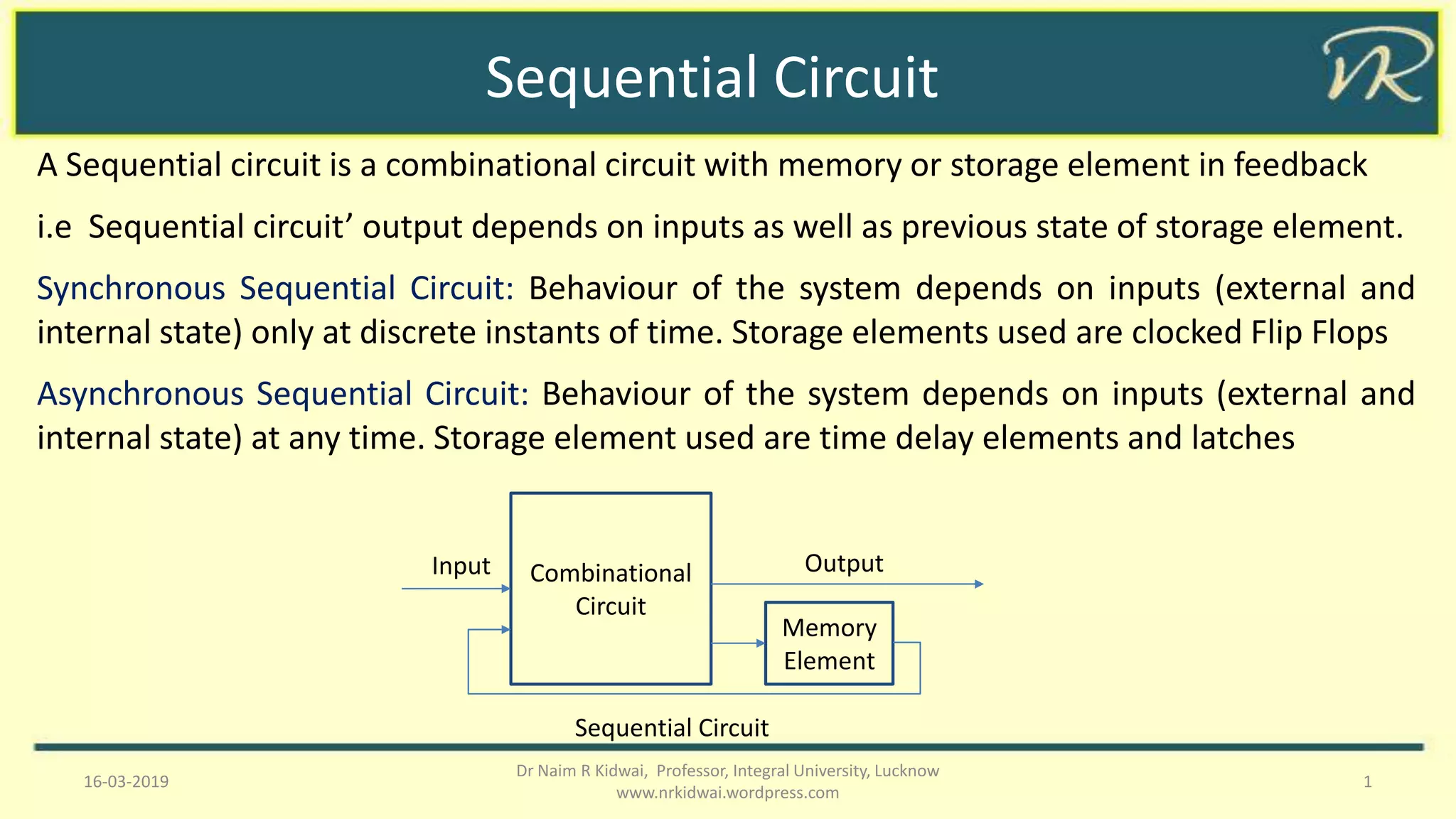
A Sequential circuit is a combinational circuit with memory or storage element in feedback
i.e Sequential circuit’ output depends on inputs as well as previous state of storage element.
Synchronous Sequential Circuit: Behaviour of the system depends on inputs (external and
internal state) only at discrete instants of time. Storage elements used are clocked Flip Flops
Asynchronous Sequential Circuit: Behaviour of the system depends on inputs (external and
internal state) at any time. Storage element used are time delay elements and latches
Combinational
Circuit
Memory
Element
Input Output
Sequential Circuit
Latch
16-03-2019 2
Dr Naim R Kidwai, Professor, Integral University, Lucknow
www.nrkidwai.wordpress.com
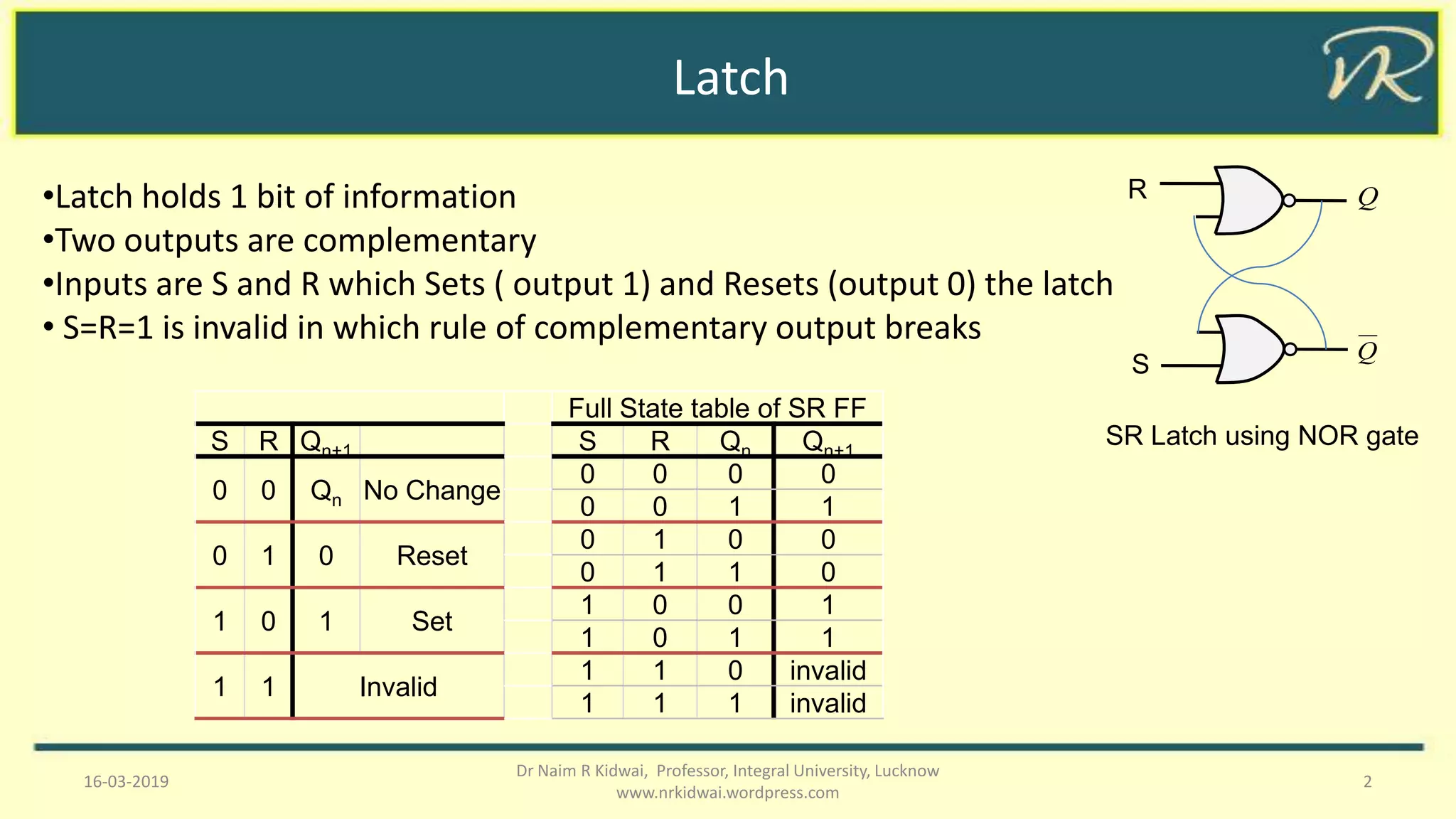
R
S
Q
Q
SR Latch using NOR gate
Full State table of SR FF
S R Qn+1 S R Qn Qn+1
0 0 Qn No Change
0 0 0 0
0 0 1 1
0 1 0 Reset
0 1 0 0
0 1 1 0
1 0 1 Set
1 0 0 1
1 0 1 1
1 1 Invalid
1 1 0 invalid
1 1 1 invalid
•Latch holds 1 bit of information
•Two outputs are complementary
•Inputs are S and R which Sets ( output 1) and Resets (output 0) the latch
• S=R=1 is invalid in which rule of complementary output breaks
SR Flip Flop
16-03-2019 3
Dr Naim R Kidwai, Professor, Integral University, Lucknow
www.nrkidwai.wordpress.com
Full State table of SR FF
S R Qn+1 S R Qn Qn+1
0 0 Qn No Change
0 0 0 0
0 0 1 1
0 1 0 Reset
0 1 0 0
0 1 1 0
1 0 1 Set
1 0 0 1
1 0 1 1
1 1 Invalid
1 1 0 invalid
1 1 1 invalid
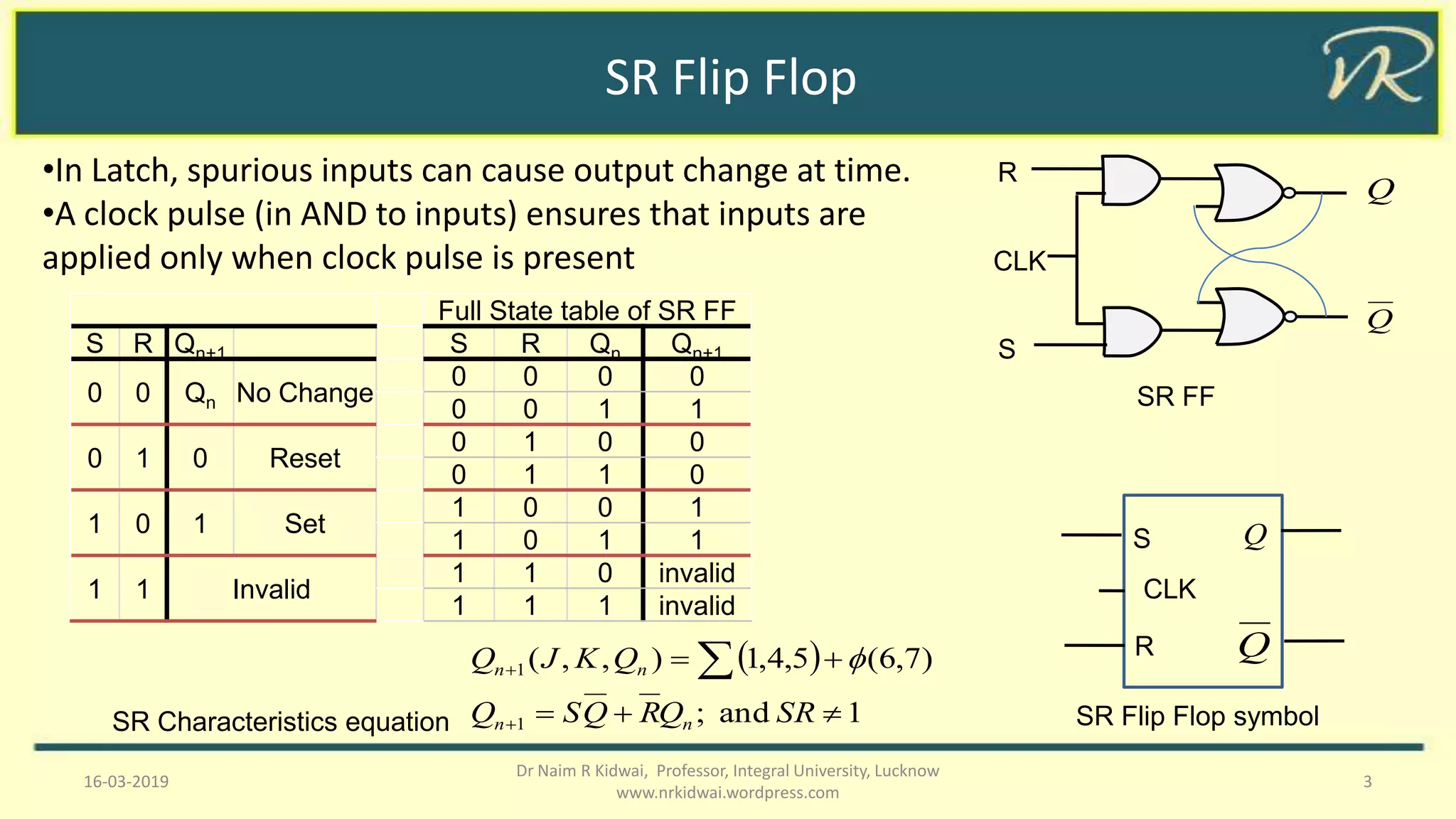
•In Latch, spurious inputs can cause output change at time.
•A clock pulse (in AND to inputs) ensures that inputs are
applied only when clock pulse is present
R
S
Q
Q
SR FF
CLK
R
S
CLK
Q
Q
SR Flip Flop symbol
 
1and;
)7,6(5,4,1),,(
1
1



 
SRQRQSQ
QKJQ
nn
nn 
SR Characteristics equation
JK Flip Flop
16-03-2019 4
Dr Naim R Kidwai, Professor, Integral University, Lucknow
www.nrkidwai.wordpress.com
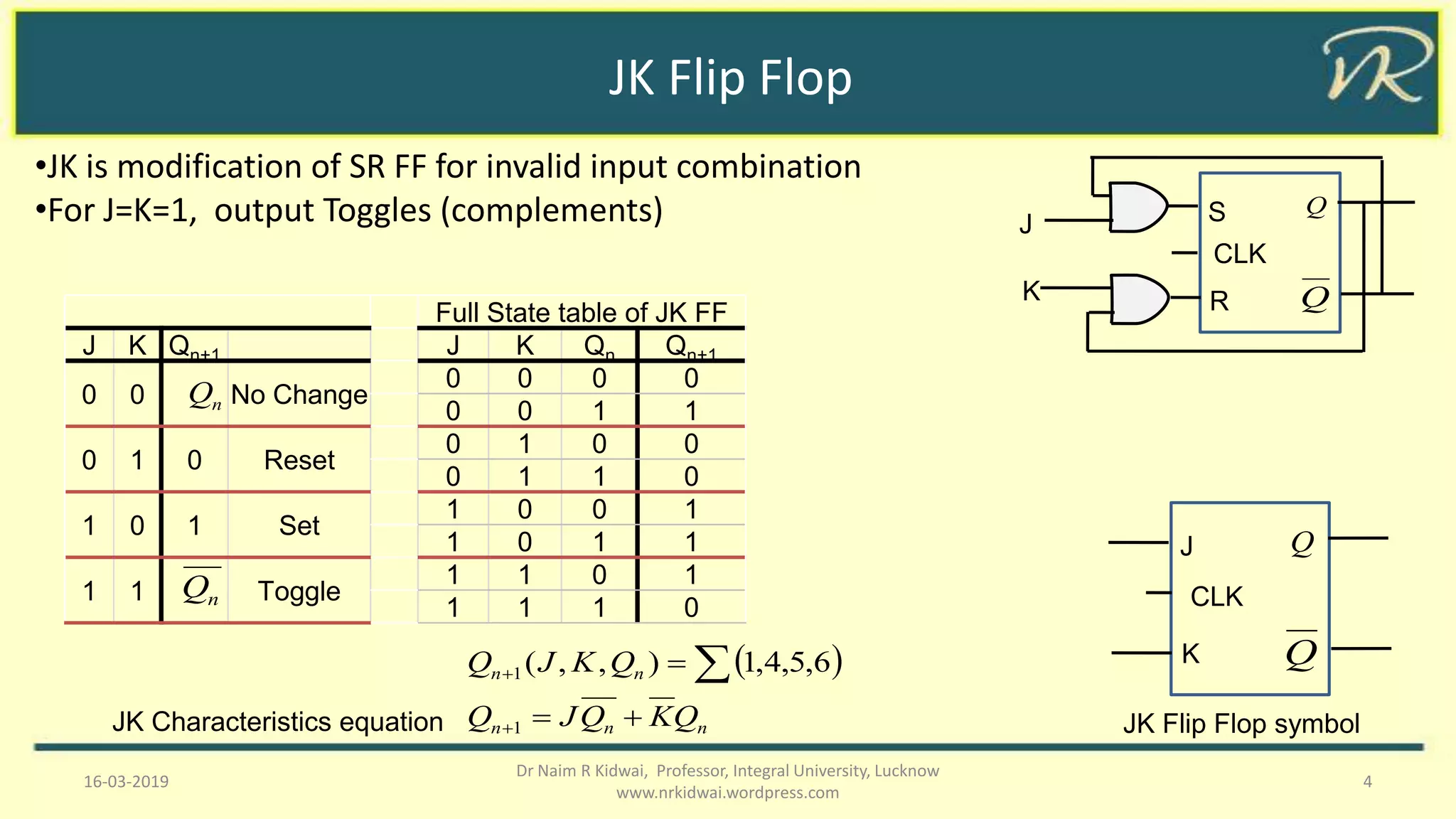
•JK is modification of SR FF for invalid input combination
•For J=K=1, output Toggles (complements)
K
J
CLK
Q
Q
JK Flip Flop symbol
R
S
CLK
Q
Q
J
K
nQ
nQ
 
nnn
nn
QKQJQ
QKJQ



 
1
1 6,5,4,1),,(
JK Characteristics equation
Full State table of JK FF
J K Qn+1 J K Qn Qn+1
0 0 No Change
0 0 0 0
0 0 1 1
0 1 0 Reset
0 1 0 0
0 1 1 0
1 0 1 Set
1 0 0 1
1 0 1 1
1 1 Toggle
1 1 0 1
1 1 1 0
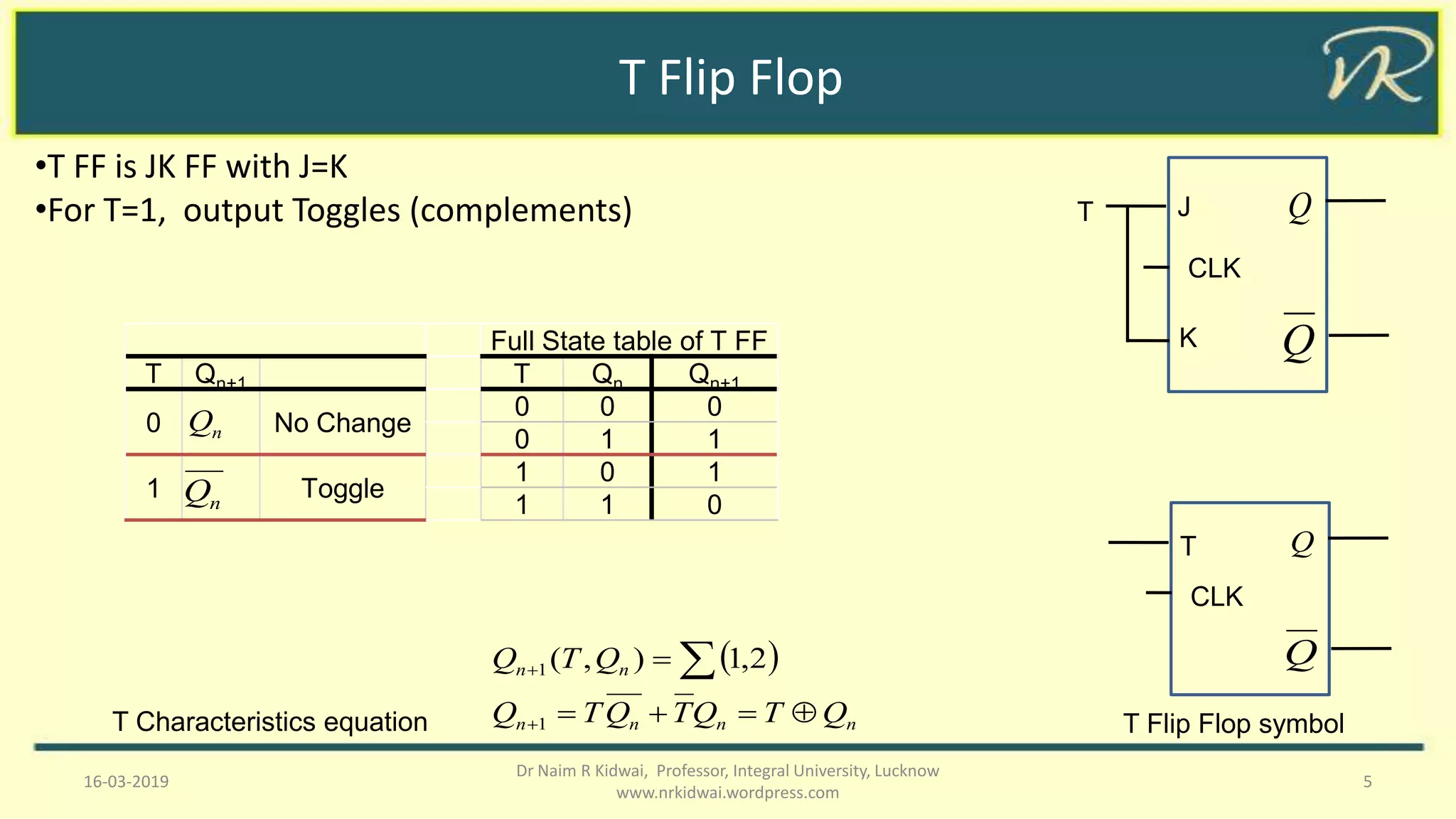
Full State table of T FF
T Qn+1 T Qn Qn+1
0 No Change
0 0 0
0 1 1
1 Toggle
1 0 1
1 1 0
T Flip Flop
16-03-2019 5
Dr Naim R Kidwai, Professor, Integral University, Lucknow
www.nrkidwai.wordpress.com
•T FF is JK FF with J=K
•For T=1, output Toggles (complements)
T
CLK
Q
Q
T Flip Flop symbol
nQ
nQ
 
nnnn
nn
QTQTQTQ
QTQ



 
1
1 2,1),(
T Characteristics equation
K
J
CLK
Q
Q
T
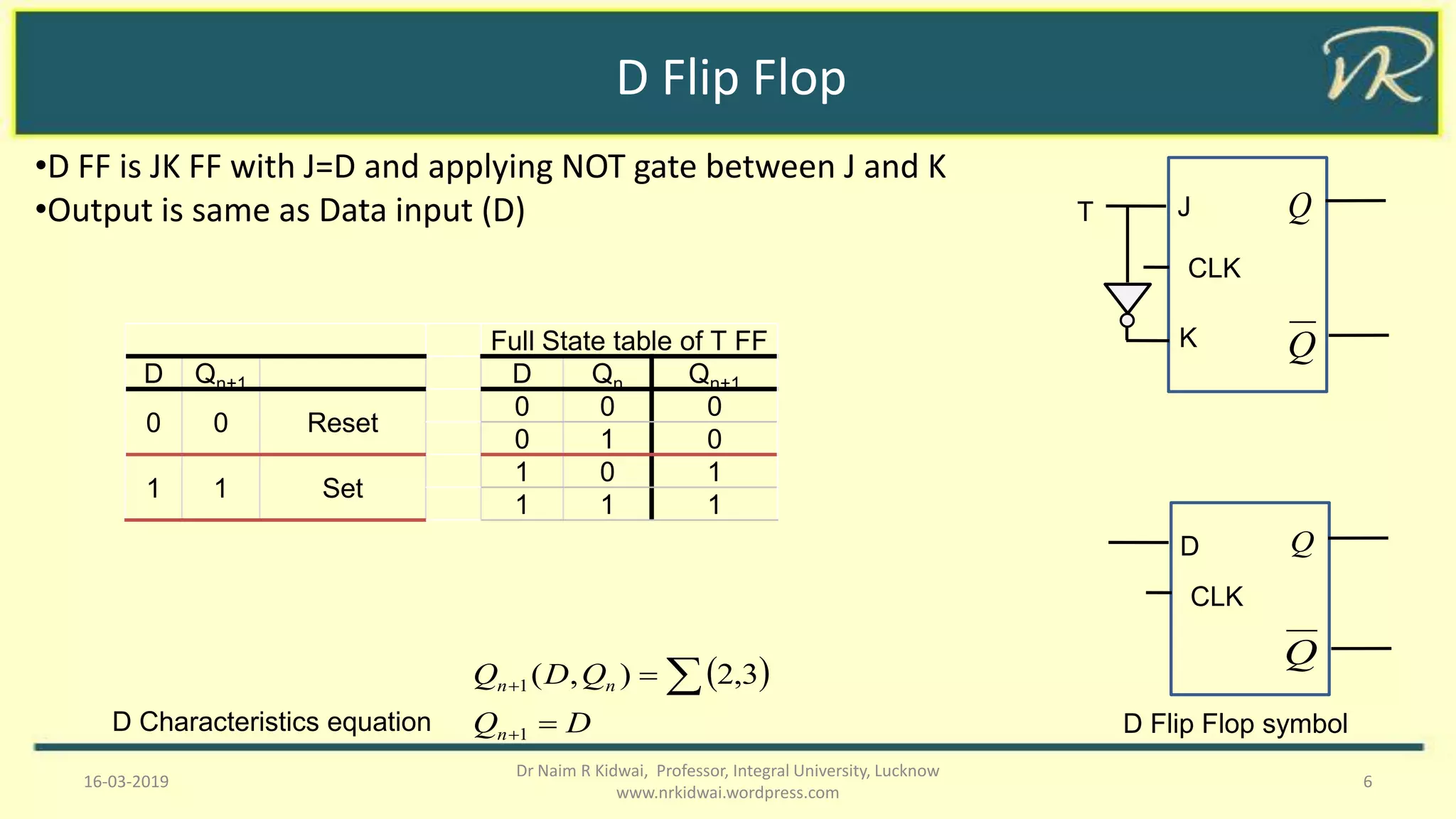
Full State table of T FF
D Qn+1 D Qn Qn+1
0 0 Reset
0 0 0
0 1 0
1 1 Set
1 0 1
1 1 1
D Flip Flop
16-03-2019 6
Dr Naim R Kidwai, Professor, Integral University, Lucknow
www.nrkidwai.wordpress.com
•D FF is JK FF with J=D and applying NOT gate between J and K
•Output is same as Data input (D)
D
CLK
Q
Q
D Flip Flop symbol
 
DQ
QDQ
n
nn



 
1
1 3,2),(
D Characteristics equation
K
J
CLK
Q
Q
T
JK Flip Flop: Race around condition
16-03-2019 7
Dr Naim R Kidwai, Professor, Integral University, Lucknow
www.nrkidwai.wordpress.com
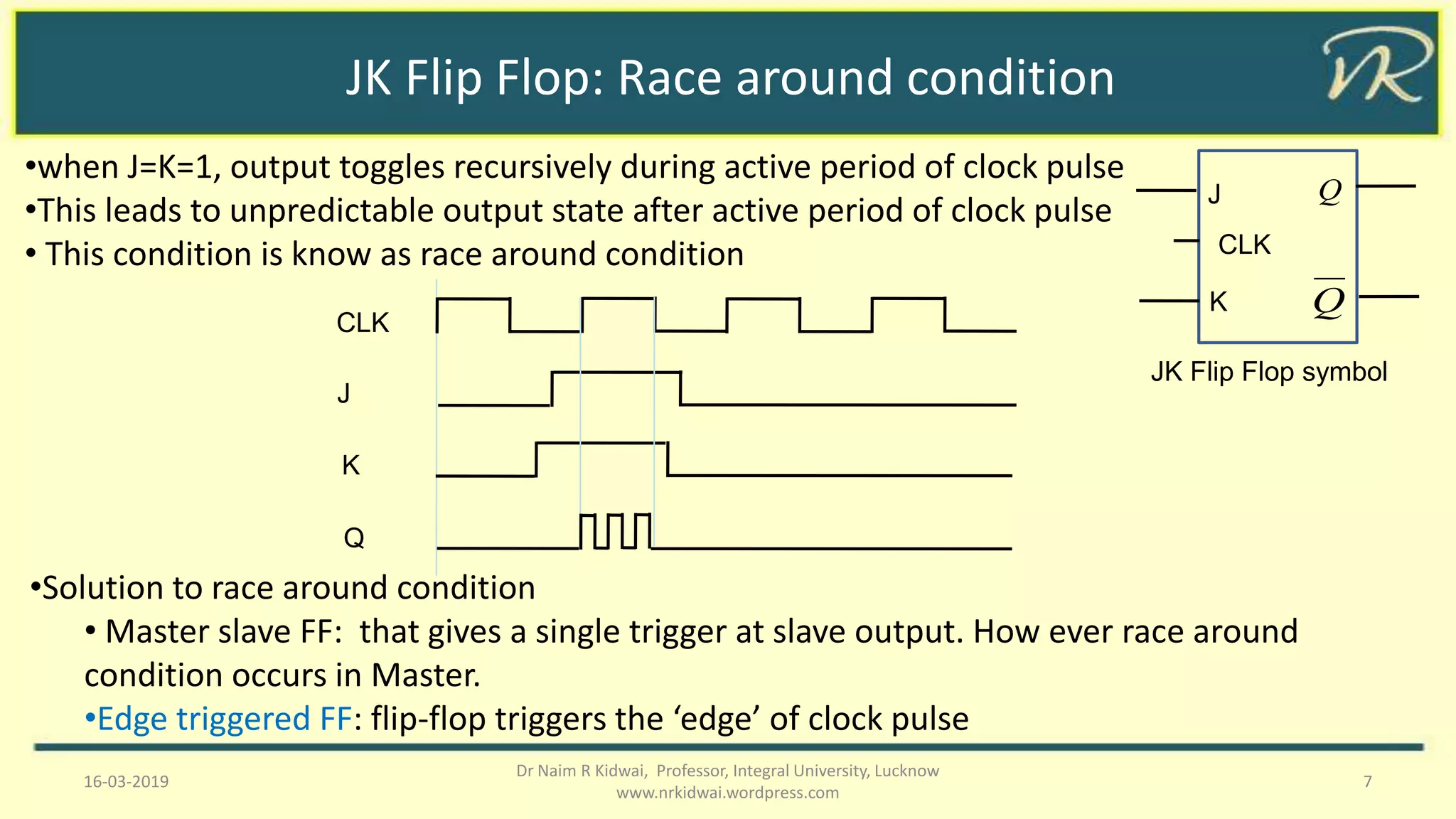
•when J=K=1, output toggles recursively during active period of clock pulse
•This leads to unpredictable output state after active period of clock pulse
• This condition is know as race around condition
K
J
CLK
Q
Q
JK Flip Flop symbol
CLK
J
K
Q
•Solution to race around condition
• Master slave FF: that gives a single trigger at slave output. How ever race around
condition occurs in Master.
•Edge triggered FF: flip-flop triggers the ‘edge’ of clock pulse
Edge Triggered Flip Flop
16-03-2019 8
Dr Naim R Kidwai, Professor, Integral University, Lucknow
www.nrkidwai.wordpress.com
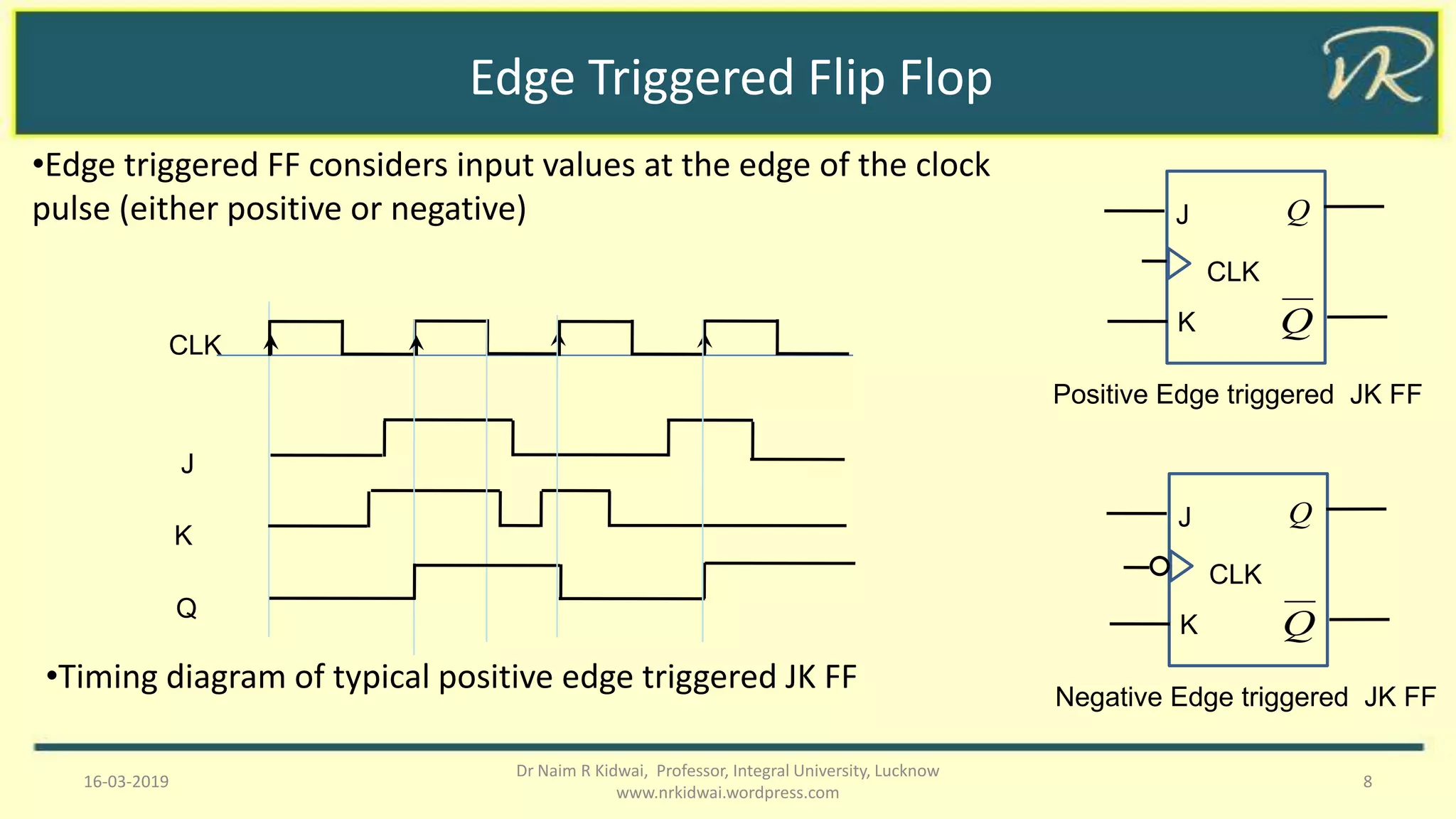
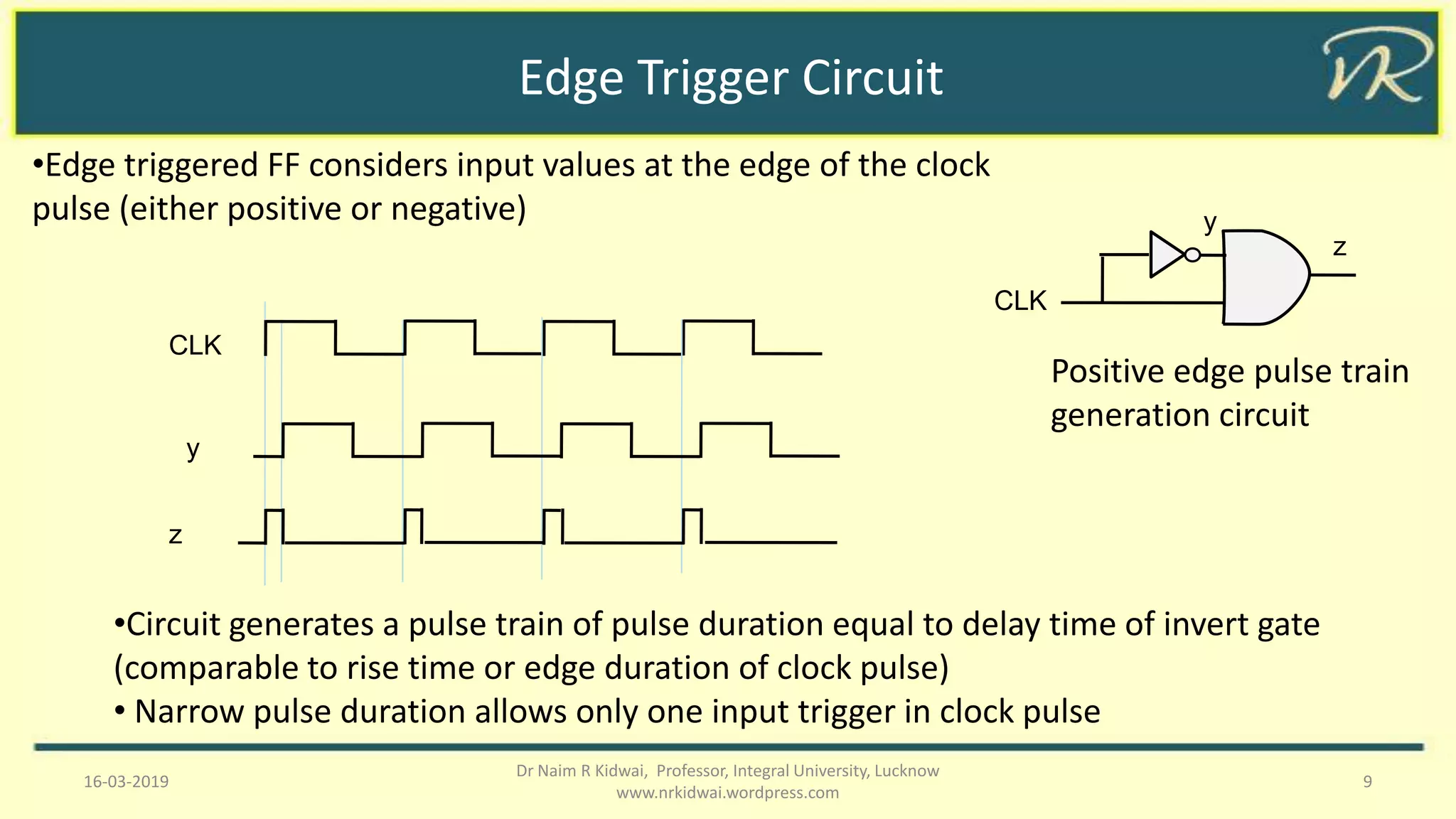
•Edge triggered FF considers input values at the edge of the clock
pulse (either positive or negative)
K
J
CLK
Q
Q
Positive Edge triggered JK FF
K
J
CLK
Q
Q
Negative Edge triggered JK FF
CLK
J
K
Q
•Timing diagram of typical positive edge triggered JK FF
Edge Trigger Circuit
16-03-2019 9
Dr Naim R Kidwai, Professor, Integral University, Lucknow
www.nrkidwai.wordpress.com
•Edge triggered FF considers input values at the edge of the clock
pulse (either positive or negative)
•Circuit generates a pulse train of pulse duration equal to delay time of invert gate
(comparable to rise time or edge duration of clock pulse)
• Narrow pulse duration allows only one input trigger in clock pulse
CLK
y
z
CLK
y
z
Positive edge pulse train
generation circuit
Conversion of Flip-flops
16-03-2019 10
Dr Naim R Kidwai, Professor, Integral University, Lucknow
www.nrkidwai.wordpress.com
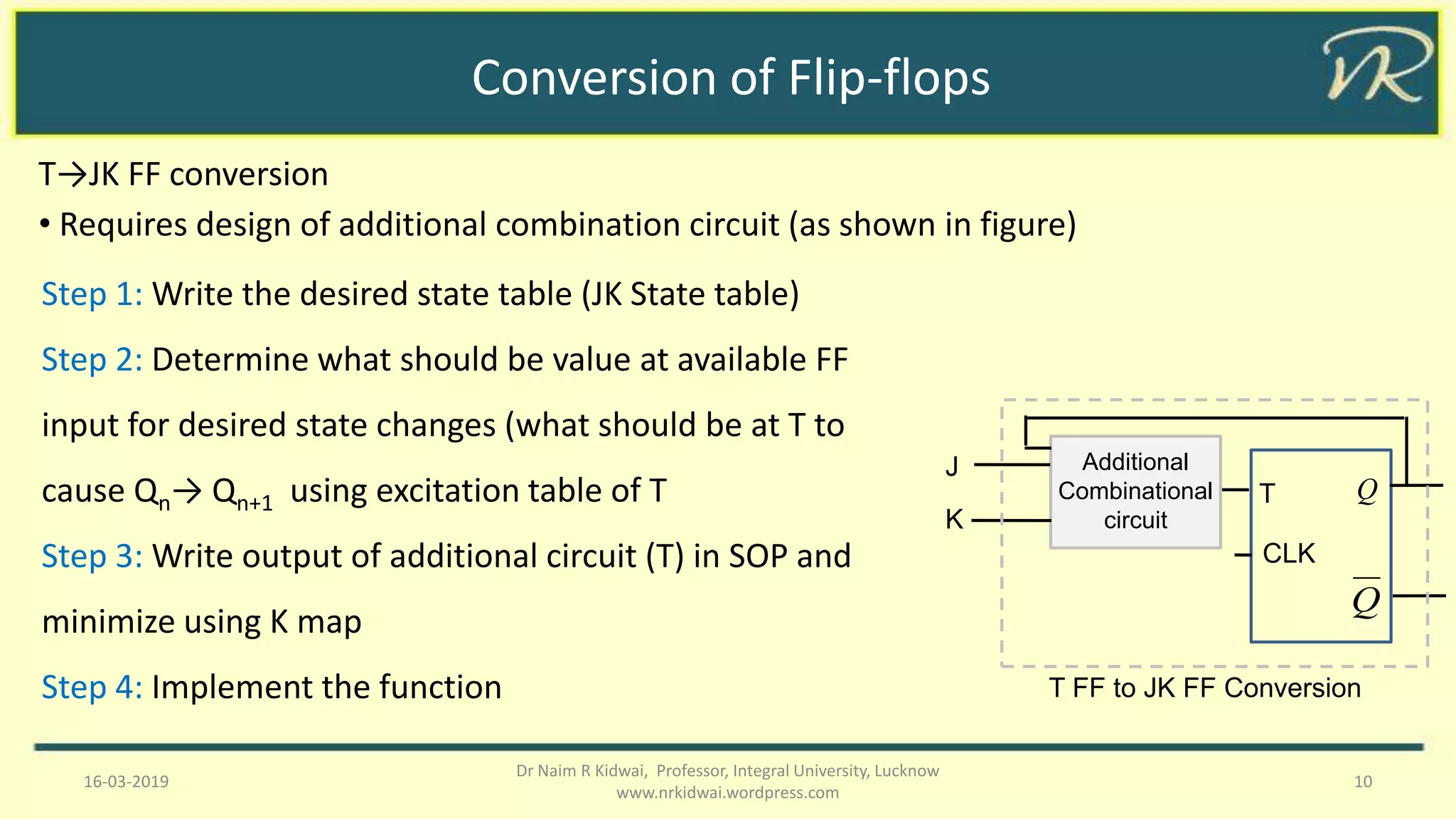
T→JK FF conversion
• Requires design of additional combination circuit (as shown in figure)
T
CLK
Q
Q
T FF to JK FF Conversion
Additional
Combinational
circuit
J
K
Step 1: Write the desired state table (JK State table)
Step 2: Determine what should be value at available FF
input for desired state changes (what should be at T to
cause Qn→ Qn+1 using excitation table of T
Step 3: Write output of additional circuit (T) in SOP and
minimize using K map
Step 4: Implement the function
Conversion of Flip-flops
16-03-2019 11
Dr Naim R Kidwai, Professor, Integral University, Lucknow
www.nrkidwai.wordpress.com
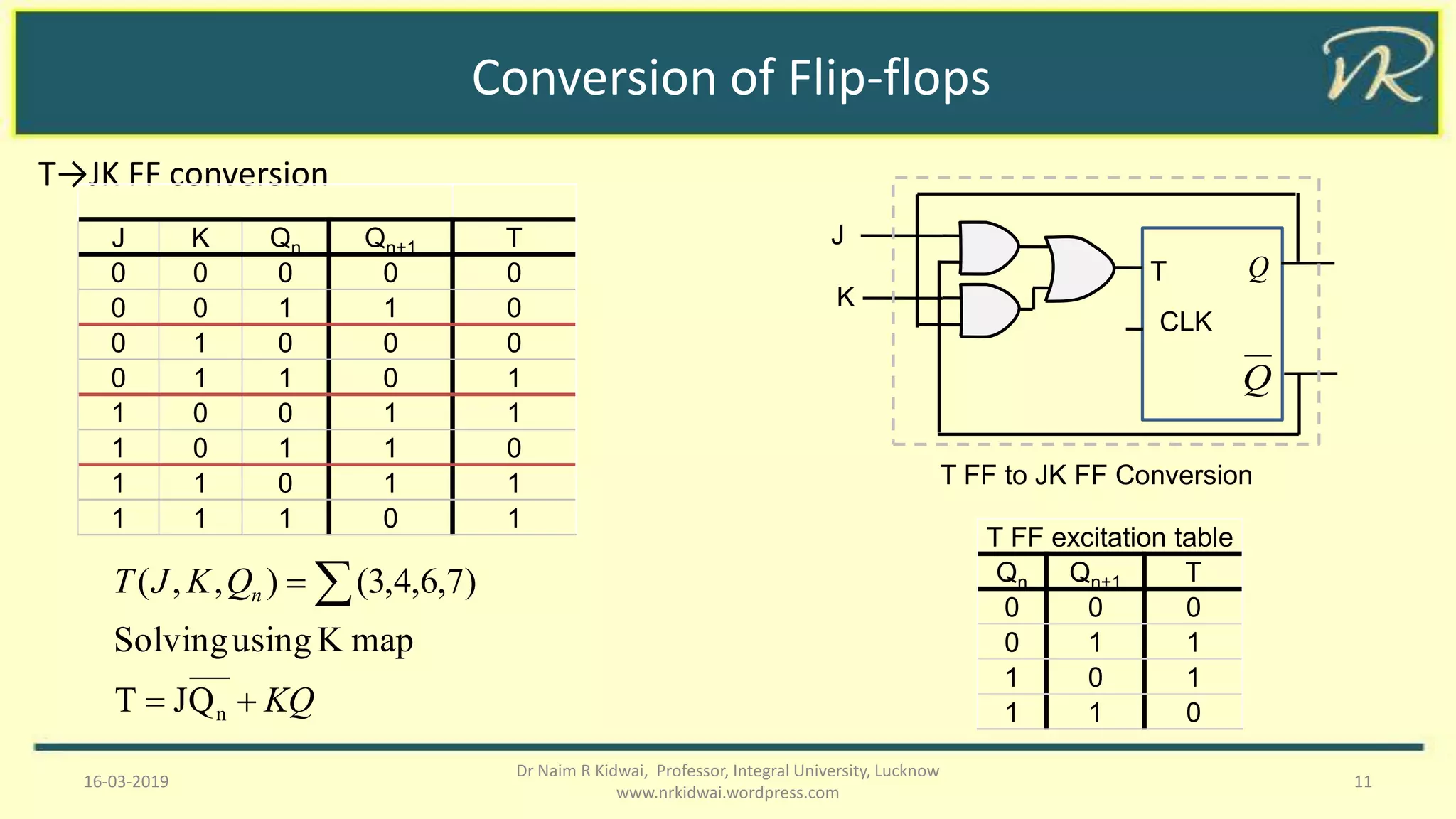
T→JK FF conversion
J K Qn Qn+1 T
0 0 0 0 0
0 0 1 1 0
0 1 0 0 0
0 1 1 0 1
1 0 0 1 1
1 0 1 1 0
1 1 0 1 1
1 1 1 0 1
T FF excitation table
Qn Qn+1 T
0 0 0
0 1 1
1 0 1
1 1 0KQ
QKJT n

 
nQJT
mapKusingSolving
)7,6,4,3(),,(
T
CLK
Q
Q
T FF to JK FF Conversion
J
K

Sequential circuit-flip flops

  • 1.
    Sequential Circuit 16-03-2019 1 DrNaim R Kidwai, Professor, Integral University, Lucknow www.nrkidwai.wordpress.com A Sequential circuit is a combinational circuit with memory or storage element in feedback i.e Sequential circuit’ output depends on inputs as well as previous state of storage element. Synchronous Sequential Circuit: Behaviour of the system depends on inputs (external and internal state) only at discrete instants of time. Storage elements used are clocked Flip Flops Asynchronous Sequential Circuit: Behaviour of the system depends on inputs (external and internal state) at any time. Storage element used are time delay elements and latches Combinational Circuit Memory Element Input Output Sequential Circuit
  • 2.
    Latch 16-03-2019 2 Dr NaimR Kidwai, Professor, Integral University, Lucknow www.nrkidwai.wordpress.com R S Q Q SR Latch using NOR gate Full State table of SR FF S R Qn+1 S R Qn Qn+1 0 0 Qn No Change 0 0 0 0 0 0 1 1 0 1 0 Reset 0 1 0 0 0 1 1 0 1 0 1 Set 1 0 0 1 1 0 1 1 1 1 Invalid 1 1 0 invalid 1 1 1 invalid •Latch holds 1 bit of information •Two outputs are complementary •Inputs are S and R which Sets ( output 1) and Resets (output 0) the latch • S=R=1 is invalid in which rule of complementary output breaks
  • 3.
    SR Flip Flop 16-03-20193 Dr Naim R Kidwai, Professor, Integral University, Lucknow www.nrkidwai.wordpress.com Full State table of SR FF S R Qn+1 S R Qn Qn+1 0 0 Qn No Change 0 0 0 0 0 0 1 1 0 1 0 Reset 0 1 0 0 0 1 1 0 1 0 1 Set 1 0 0 1 1 0 1 1 1 1 Invalid 1 1 0 invalid 1 1 1 invalid •In Latch, spurious inputs can cause output change at time. •A clock pulse (in AND to inputs) ensures that inputs are applied only when clock pulse is present R S Q Q SR FF CLK R S CLK Q Q SR Flip Flop symbol   1and; )7,6(5,4,1),,( 1 1      SRQRQSQ QKJQ nn nn  SR Characteristics equation
  • 4.
    JK Flip Flop 16-03-20194 Dr Naim R Kidwai, Professor, Integral University, Lucknow www.nrkidwai.wordpress.com •JK is modification of SR FF for invalid input combination •For J=K=1, output Toggles (complements) K J CLK Q Q JK Flip Flop symbol R S CLK Q Q J K nQ nQ   nnn nn QKQJQ QKJQ      1 1 6,5,4,1),,( JK Characteristics equation Full State table of JK FF J K Qn+1 J K Qn Qn+1 0 0 No Change 0 0 0 0 0 0 1 1 0 1 0 Reset 0 1 0 0 0 1 1 0 1 0 1 Set 1 0 0 1 1 0 1 1 1 1 Toggle 1 1 0 1 1 1 1 0
  • 5.
    Full State tableof T FF T Qn+1 T Qn Qn+1 0 No Change 0 0 0 0 1 1 1 Toggle 1 0 1 1 1 0 T Flip Flop 16-03-2019 5 Dr Naim R Kidwai, Professor, Integral University, Lucknow www.nrkidwai.wordpress.com •T FF is JK FF with J=K •For T=1, output Toggles (complements) T CLK Q Q T Flip Flop symbol nQ nQ   nnnn nn QTQTQTQ QTQ      1 1 2,1),( T Characteristics equation K J CLK Q Q T
  • 6.
    Full State tableof T FF D Qn+1 D Qn Qn+1 0 0 Reset 0 0 0 0 1 0 1 1 Set 1 0 1 1 1 1 D Flip Flop 16-03-2019 6 Dr Naim R Kidwai, Professor, Integral University, Lucknow www.nrkidwai.wordpress.com •D FF is JK FF with J=D and applying NOT gate between J and K •Output is same as Data input (D) D CLK Q Q D Flip Flop symbol   DQ QDQ n nn      1 1 3,2),( D Characteristics equation K J CLK Q Q T
  • 7.
    JK Flip Flop:Race around condition 16-03-2019 7 Dr Naim R Kidwai, Professor, Integral University, Lucknow www.nrkidwai.wordpress.com •when J=K=1, output toggles recursively during active period of clock pulse •This leads to unpredictable output state after active period of clock pulse • This condition is know as race around condition K J CLK Q Q JK Flip Flop symbol CLK J K Q •Solution to race around condition • Master slave FF: that gives a single trigger at slave output. How ever race around condition occurs in Master. •Edge triggered FF: flip-flop triggers the ‘edge’ of clock pulse
  • 8.
    Edge Triggered FlipFlop 16-03-2019 8 Dr Naim R Kidwai, Professor, Integral University, Lucknow www.nrkidwai.wordpress.com •Edge triggered FF considers input values at the edge of the clock pulse (either positive or negative) K J CLK Q Q Positive Edge triggered JK FF K J CLK Q Q Negative Edge triggered JK FF CLK J K Q •Timing diagram of typical positive edge triggered JK FF
  • 9.
    Edge Trigger Circuit 16-03-20199 Dr Naim R Kidwai, Professor, Integral University, Lucknow www.nrkidwai.wordpress.com •Edge triggered FF considers input values at the edge of the clock pulse (either positive or negative) •Circuit generates a pulse train of pulse duration equal to delay time of invert gate (comparable to rise time or edge duration of clock pulse) • Narrow pulse duration allows only one input trigger in clock pulse CLK y z CLK y z Positive edge pulse train generation circuit
  • 10.
    Conversion of Flip-flops 16-03-201910 Dr Naim R Kidwai, Professor, Integral University, Lucknow www.nrkidwai.wordpress.com T→JK FF conversion • Requires design of additional combination circuit (as shown in figure) T CLK Q Q T FF to JK FF Conversion Additional Combinational circuit J K Step 1: Write the desired state table (JK State table) Step 2: Determine what should be value at available FF input for desired state changes (what should be at T to cause Qn→ Qn+1 using excitation table of T Step 3: Write output of additional circuit (T) in SOP and minimize using K map Step 4: Implement the function
  • 11.
    Conversion of Flip-flops 16-03-201911 Dr Naim R Kidwai, Professor, Integral University, Lucknow www.nrkidwai.wordpress.com T→JK FF conversion J K Qn Qn+1 T 0 0 0 0 0 0 0 1 1 0 0 1 0 0 0 0 1 1 0 1 1 0 0 1 1 1 0 1 1 0 1 1 0 1 1 1 1 1 0 1 T FF excitation table Qn Qn+1 T 0 0 0 0 1 1 1 0 1 1 1 0KQ QKJT n    nQJT mapKusingSolving )7,6,4,3(),,( T CLK Q Q T FF to JK FF Conversion J K