Flip Flops and Registers 
BCA 5th Semester
FLIP FLOPS 
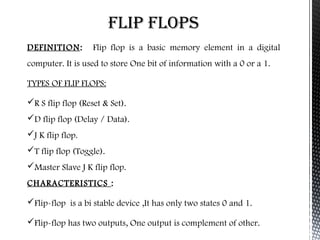
DEFINITION: Flip flop is a basic memory element in a digital 
computer. It is used to store One bit of information with a 0 or a 1. 
TYPES OF FLIP FLOPS: 
R S flip flop (Reset & Set). 
D flip flop (Delay / Data). 
J K flip flop. 
T flip flop (Toggle). 
Master Slave J K flip flop. 
CHARACTERISTICS : 
Flip-flop is a bi stable device ,It has only two states 0 and 1. 
Flip-flop has two outputs, One output is complement of other.
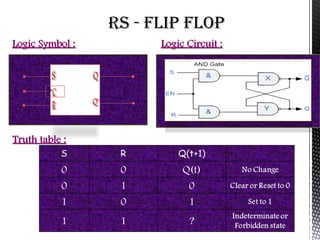
RS - FLIP FLOP 
LLooggiicc SSyymmbbooll :: LLooggiicc CCiirrccuuiitt :: 
TTrruutthh ttaabbllee ::
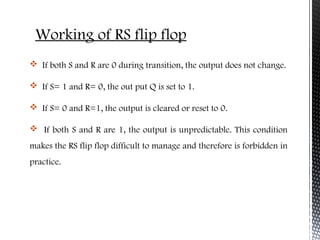
Working of RS flip flop 
 If both S and R are 0 during transition, the output does not change. 
 If S= 1 and R= 0, the out put Q is set to 1. 
 If S= 0 and R=1, the output is cleared or reset to 0. 
 If both S and R are 1, the output is unpredictable. This condition 
makes the RS flip flop difficult to manage and therefore is forbidden in 
practice.
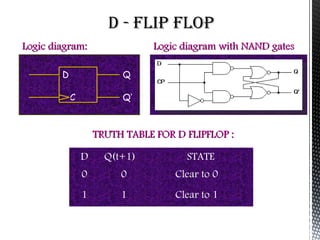
D - FLIP FLOP 
LLooggiicc ddiiaaggrraamm wwiitthh NNAANNDD ggaatteess 
TTRRUUTTHH TTAABBLLEE FFOORR DD FFLLIIPPFFLLOOPP :: 
D Q(t+1) STATE 
0 0 Clear to 0 
1 1 Clear to 1 
D 
C 
Q 
Q’ 
LLooggiicc ddiiaaggrraamm::
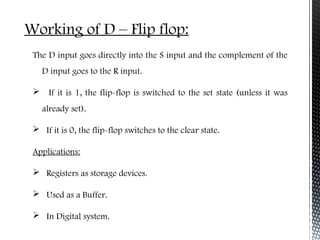
Working of D – Flip flop: 
The D input goes directly into the S input and the complement of the 
D input goes to the R input. 
 If it is 1, the flip-flop is switched to the set state (unless it was 
already set). 
 If it is 0, the flip-flop switches to the clear state. 
Applications: 
 Registers as storage devices. 
 Used as a Buffer. 
 In Digital system.
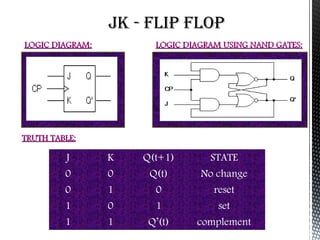
JK - FLIP FLOP 
LLOOGGIICC DDIIAAGGRRAAMM:: LLOOGGIICC DDIIAAGGRRAAMM UUSSIINNGG NNAANNDD GGAATTEESS:: 
TTRRUUTTHH TTAABBLLEE:: 
J K Q(t+1) STATE 
0 0 Q(t) No change 
0 1 0 reset 
1 0 1 set 
1 1 Q’(t) complement
Working of JK – Flip Flop : 
 When j and k both are 0, the data inputs have no effect on the outputs. 
 When j=0 and k=1, the flip flop is reset or cleared to 0. 
 When j=1 and k=0. the flip flop is set to 1. 
 When j and k are 1, if the state of flip flop was 0,applying a clock with 1and 
flip flop state was 1, it changes to 0.this on off state is TOGGLING. 
 Racing condition: Toggling between 0 to 1 and 1 to 0 alternatively for one 
clock cycle. 
APPLICATIONS: 
 Counters 
 Frequency Dividers
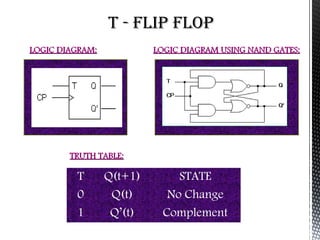
T - FLIP FLOP 
LLOOGGIICC DDIIAAGGRRAAMM:: LLOOGGIICC DDIIAAGGRRAAMM UUSSIINNGG NNAANNDD GGAATTEESS:: 
TTRRUUTTHH TTAABBLLEE:: 
T Q(t+1) STATE 
0 Q(t) No Change 
1 Q’(t) Complement
T - FLIP FLOP 
 The T - flip flop is also known as the TOGGLE - flip flop. The toggle 
mode of JK flip flop is used as T - Flip flop. 
 This Flip flop can be obtained from a JK flip flop when inputs J and K 
are connected to provide a single input designated by T. 
 The T flip-flop is a single input version of the JK flip - flop. The T flip-flop 
is obtained from the JK type if both inputs are tied together. The 
output of the T flip-flop "toggles" with each clock pulse.. 
 When t=0, (j=0, k=0) the clock transition does not change. 
 When t=1, (j=1, k=1) the clock transition complements the state.
Master slave jk - FlIP FlOP 
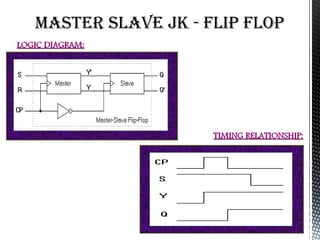
LLOOGGIICC DDIIAAGGRRAAMM:: 
TTIIMMIINNGG RREELLAATTIIOONNSSHHIIPP::
Master slave jk - FlIP FlOP 
 It is a Combination of 2 flip flops. Where, the first is the Master that 
responds to the positive edge of the clock and the second is the slave 
which responds to the negative level. 
 The output changes only during the negative edge transition of the 
clock. 
 Output triggers only for negative edge triggering. 
 This helps in avoiding the racing condition in JK flip flop where it can 
be triggered only once within a clock cycle. 
Master/Slave triggering has become obsolete. Newer flip flops use 
negative edge triggering.
aPPlICatIONs OF FlIP FlOPs: 
Flip flops have a wide variety of applications. They are: 
 REGISTERS 
 FREQUENCY DIVIDERS 
 DIGITAL COUNTERS
reGIsters 
 Collection of a group of flip flops and logic gates which affect 
their transition. 
 Basic function is to hold information. 
 It may have combinational gates that perform certain data 
processing tasks in addition to flip flops. 
 It consists of a group of flip flops and gates that effect their 
transition.
shIFt reGIsters 
 A REGISTER capable of shifting binary information in one or both 
directions. 
 Consists of a series of flip flops cascaded together with the output of one 
flip flop connected to the input of the other flip flop. 
 All flip flops receive common clock pulses that initiate the shift from one 
stage to the next. 
 They are generally provided with a Clear or Reset connection so that 
they can be "SET" or "RESET" as required. 
 Controlled with certain clock pulses by inhibiting the clock from the 
input of the register if shift is not required. 
 It is also able to provide extra circuits to control the shift operation 
through the D inputs of the flip flops rather than the clock input.
4 bit Shift REGiStERS 
 Common clock pulse. 
 Output of one is connected to other. 
 Serial input determines bit position shifting left. 
 Shifting information depends on connecting clock to AND gate.
ChaRaCtERiStiCS 
 Provide necessary input and output terminals for parallel data 
transfer. 
 An input for clock pulses to synchronize all operations. 
 A control state that leaves the information in the register 
unchanged even through clock pulses are applied continuously. 
Shift registers are of two types depending upon the direction 
of shift. They are: 
 Unidirectional: Capable of shifting only in one direction 
 Bidirectional: Capable of shifting in both directions
appliCationS 
 Used to interface digital systems. 
 Can be used as simple delay circuits. 
 They can be used to convert serial data to parallel data 
commonly in microprocessor based system. 
 It can also be used for multiplication by shifting left and division 
by shifting right.
8.flip flops and registers

8.flip flops and registers

  • 1.
    Flip Flops andRegisters BCA 5th Semester
  • 2.
    FLIP FLOPS DEFINITION:Flip flop is a basic memory element in a digital computer. It is used to store One bit of information with a 0 or a 1. TYPES OF FLIP FLOPS: R S flip flop (Reset & Set). D flip flop (Delay / Data). J K flip flop. T flip flop (Toggle). Master Slave J K flip flop. CHARACTERISTICS : Flip-flop is a bi stable device ,It has only two states 0 and 1. Flip-flop has two outputs, One output is complement of other.
  • 3.
    RS - FLIPFLOP LLooggiicc SSyymmbbooll :: LLooggiicc CCiirrccuuiitt :: TTrruutthh ttaabbllee ::
  • 4.
    Working of RSflip flop  If both S and R are 0 during transition, the output does not change.  If S= 1 and R= 0, the out put Q is set to 1.  If S= 0 and R=1, the output is cleared or reset to 0.  If both S and R are 1, the output is unpredictable. This condition makes the RS flip flop difficult to manage and therefore is forbidden in practice.
  • 5.
    D - FLIPFLOP LLooggiicc ddiiaaggrraamm wwiitthh NNAANNDD ggaatteess TTRRUUTTHH TTAABBLLEE FFOORR DD FFLLIIPPFFLLOOPP :: D Q(t+1) STATE 0 0 Clear to 0 1 1 Clear to 1 D C Q Q’ LLooggiicc ddiiaaggrraamm::
  • 6.
    Working of D– Flip flop: The D input goes directly into the S input and the complement of the D input goes to the R input.  If it is 1, the flip-flop is switched to the set state (unless it was already set).  If it is 0, the flip-flop switches to the clear state. Applications:  Registers as storage devices.  Used as a Buffer.  In Digital system.
  • 7.
    JK - FLIPFLOP LLOOGGIICC DDIIAAGGRRAAMM:: LLOOGGIICC DDIIAAGGRRAAMM UUSSIINNGG NNAANNDD GGAATTEESS:: TTRRUUTTHH TTAABBLLEE:: J K Q(t+1) STATE 0 0 Q(t) No change 0 1 0 reset 1 0 1 set 1 1 Q’(t) complement
  • 8.
    Working of JK– Flip Flop :  When j and k both are 0, the data inputs have no effect on the outputs.  When j=0 and k=1, the flip flop is reset or cleared to 0.  When j=1 and k=0. the flip flop is set to 1.  When j and k are 1, if the state of flip flop was 0,applying a clock with 1and flip flop state was 1, it changes to 0.this on off state is TOGGLING.  Racing condition: Toggling between 0 to 1 and 1 to 0 alternatively for one clock cycle. APPLICATIONS:  Counters  Frequency Dividers
  • 9.
    T - FLIPFLOP LLOOGGIICC DDIIAAGGRRAAMM:: LLOOGGIICC DDIIAAGGRRAAMM UUSSIINNGG NNAANNDD GGAATTEESS:: TTRRUUTTHH TTAABBLLEE:: T Q(t+1) STATE 0 Q(t) No Change 1 Q’(t) Complement
  • 10.
    T - FLIPFLOP  The T - flip flop is also known as the TOGGLE - flip flop. The toggle mode of JK flip flop is used as T - Flip flop.  This Flip flop can be obtained from a JK flip flop when inputs J and K are connected to provide a single input designated by T.  The T flip-flop is a single input version of the JK flip - flop. The T flip-flop is obtained from the JK type if both inputs are tied together. The output of the T flip-flop "toggles" with each clock pulse..  When t=0, (j=0, k=0) the clock transition does not change.  When t=1, (j=1, k=1) the clock transition complements the state.
  • 11.
    Master slave jk- FlIP FlOP LLOOGGIICC DDIIAAGGRRAAMM:: TTIIMMIINNGG RREELLAATTIIOONNSSHHIIPP::
  • 12.
    Master slave jk- FlIP FlOP  It is a Combination of 2 flip flops. Where, the first is the Master that responds to the positive edge of the clock and the second is the slave which responds to the negative level.  The output changes only during the negative edge transition of the clock.  Output triggers only for negative edge triggering.  This helps in avoiding the racing condition in JK flip flop where it can be triggered only once within a clock cycle. Master/Slave triggering has become obsolete. Newer flip flops use negative edge triggering.
  • 13.
    aPPlICatIONs OF FlIPFlOPs: Flip flops have a wide variety of applications. They are:  REGISTERS  FREQUENCY DIVIDERS  DIGITAL COUNTERS
  • 14.
    reGIsters  Collectionof a group of flip flops and logic gates which affect their transition.  Basic function is to hold information.  It may have combinational gates that perform certain data processing tasks in addition to flip flops.  It consists of a group of flip flops and gates that effect their transition.
  • 15.
    shIFt reGIsters A REGISTER capable of shifting binary information in one or both directions.  Consists of a series of flip flops cascaded together with the output of one flip flop connected to the input of the other flip flop.  All flip flops receive common clock pulses that initiate the shift from one stage to the next.  They are generally provided with a Clear or Reset connection so that they can be "SET" or "RESET" as required.  Controlled with certain clock pulses by inhibiting the clock from the input of the register if shift is not required.  It is also able to provide extra circuits to control the shift operation through the D inputs of the flip flops rather than the clock input.
  • 16.
    4 bit ShiftREGiStERS  Common clock pulse.  Output of one is connected to other.  Serial input determines bit position shifting left.  Shifting information depends on connecting clock to AND gate.
  • 17.
    ChaRaCtERiStiCS  Providenecessary input and output terminals for parallel data transfer.  An input for clock pulses to synchronize all operations.  A control state that leaves the information in the register unchanged even through clock pulses are applied continuously. Shift registers are of two types depending upon the direction of shift. They are:  Unidirectional: Capable of shifting only in one direction  Bidirectional: Capable of shifting in both directions
  • 18.
    appliCationS  Usedto interface digital systems.  Can be used as simple delay circuits.  They can be used to convert serial data to parallel data commonly in microprocessor based system.  It can also be used for multiplication by shifting left and division by shifting right.