Asynchronous Sequential Circuit Analysis
4/5/2019
Dr Naim R Kidwai, Professor, Integral University
lucknow, www.nrkidwai.wordpress.com
1
Learning Objectives:
1. To learn analysis of asynchronous Sequential Circuits
2. To learn map, transition table and flow table
3. To learn Design of asynchronous Sequential Circuit
4. To race conditions in asynchronous Sequential Circuit
Asynchronous Sequential Circuit
4/5/2019
Dr Naim R Kidwai, Professor, Integral University
lucknow, www.nrkidwai.wordpress.com
2
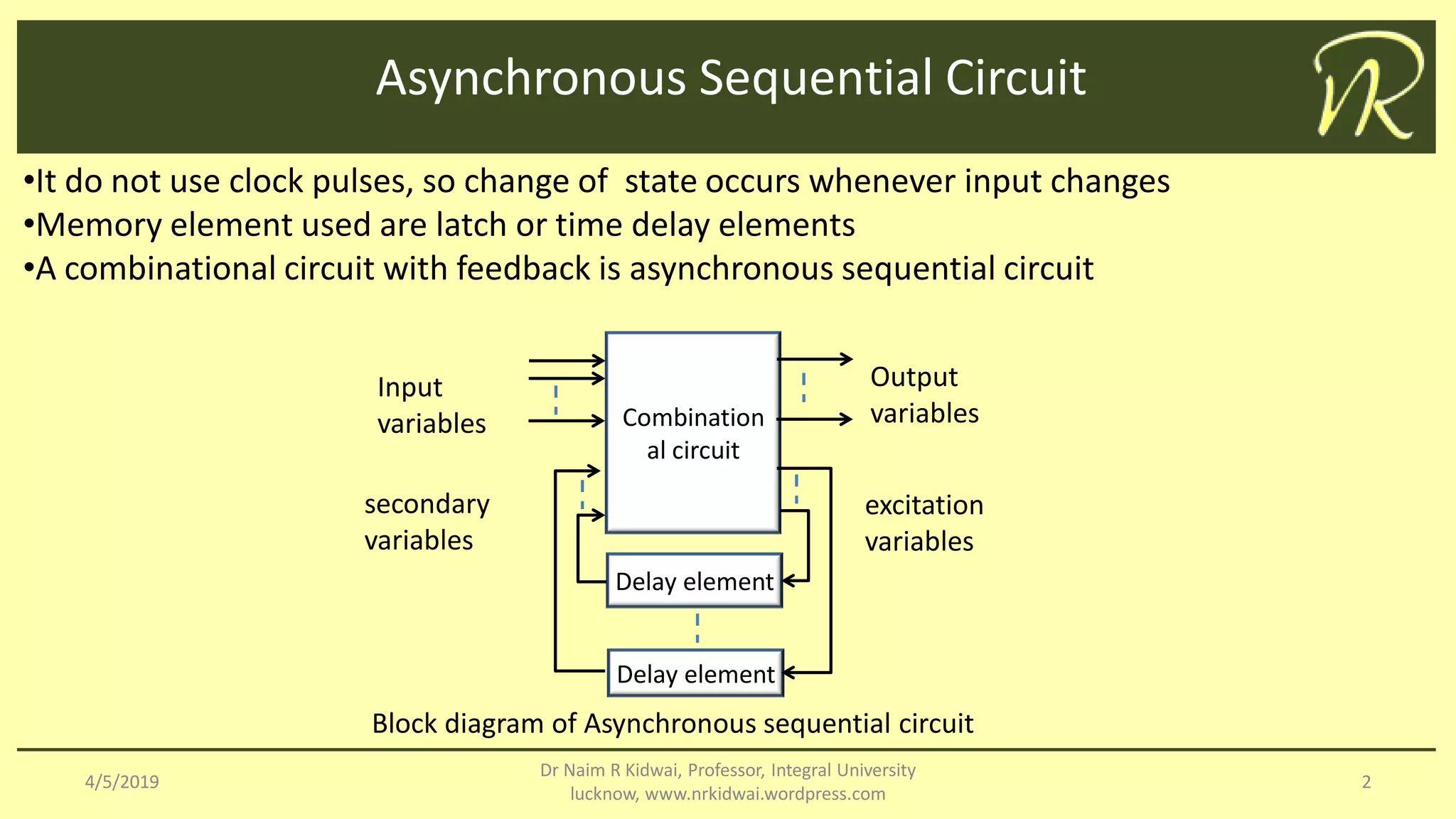
•It do not use clock pulses, so change of state occurs whenever input changes
•Memory element used are latch or time delay elements
•A combinational circuit with feedback is asynchronous sequential circuit
Combination
al circuit
Delay element
Delay element
Input
variables
secondary
variables
excitation
variables
Output
variables
Block diagram of Asynchronous sequential circuit
Asynchronous Sequential Circuit Analysis
4/5/2019
Dr Naim R Kidwai, Professor, Integral University
lucknow, www.nrkidwai.wordpress.com
3
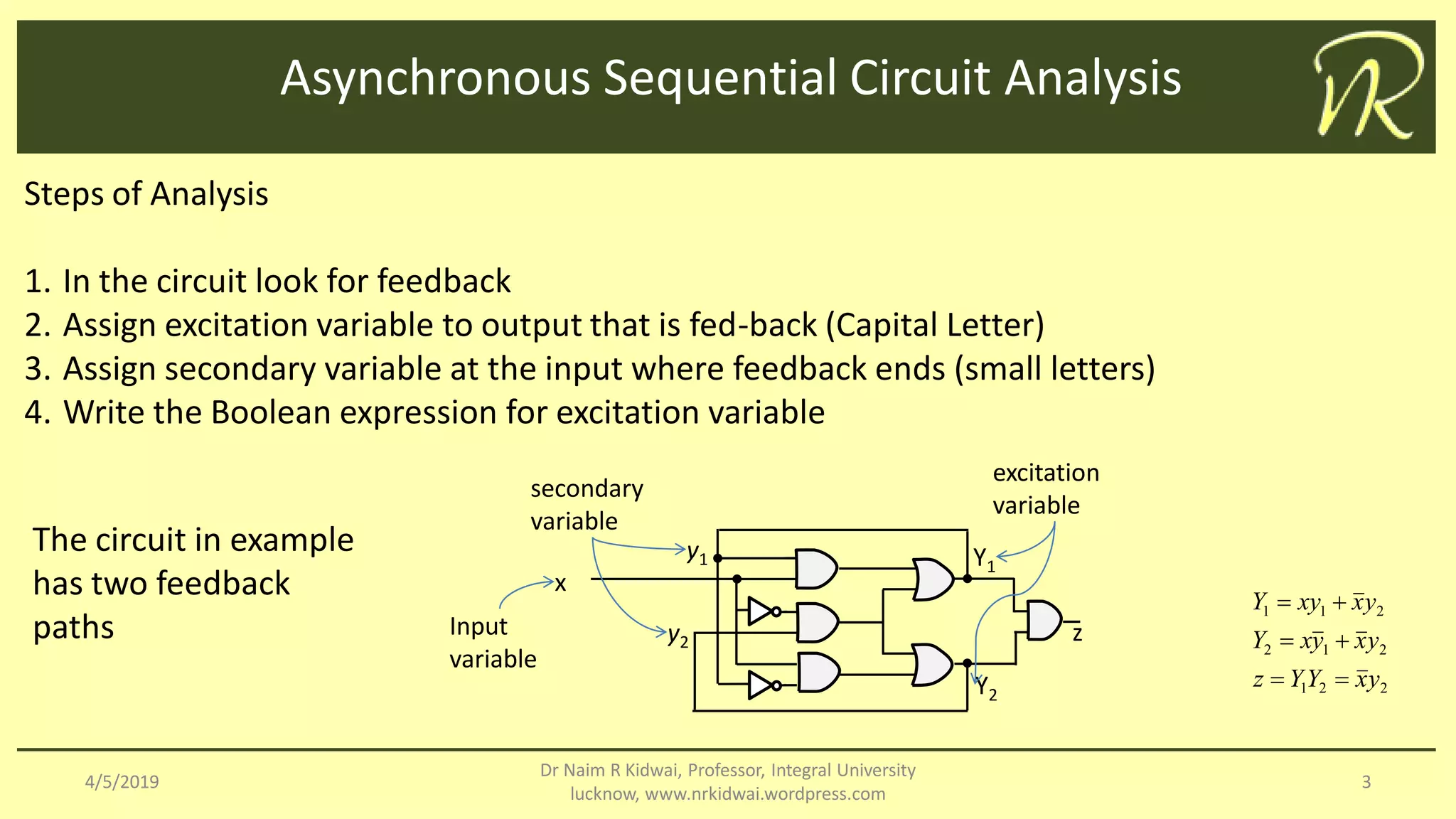
Steps of Analysis
1. In the circuit look for feedback
2. Assign excitation variable to output that is fed-back (Capital Letter)
3. Assign secondary variable at the input where feedback ends (small letters)
4. Write the Boolean expression for excitation variable
221
212
211
yxYYz
yxyxY
yxxyY



y1
y2
Y2
Y1
z
x
The circuit in example
has two feedback
paths Input
variable
secondary
variable
excitation
variable
Asynchronous Sequential Circuit Analysis
4/5/2019
Dr Naim R Kidwai, Professor, Integral University
lucknow, www.nrkidwai.wordpress.com
4
x
y1y2 0 1
00 0 0
01 1 0
11 1 1
10 0 1
Map of Y1
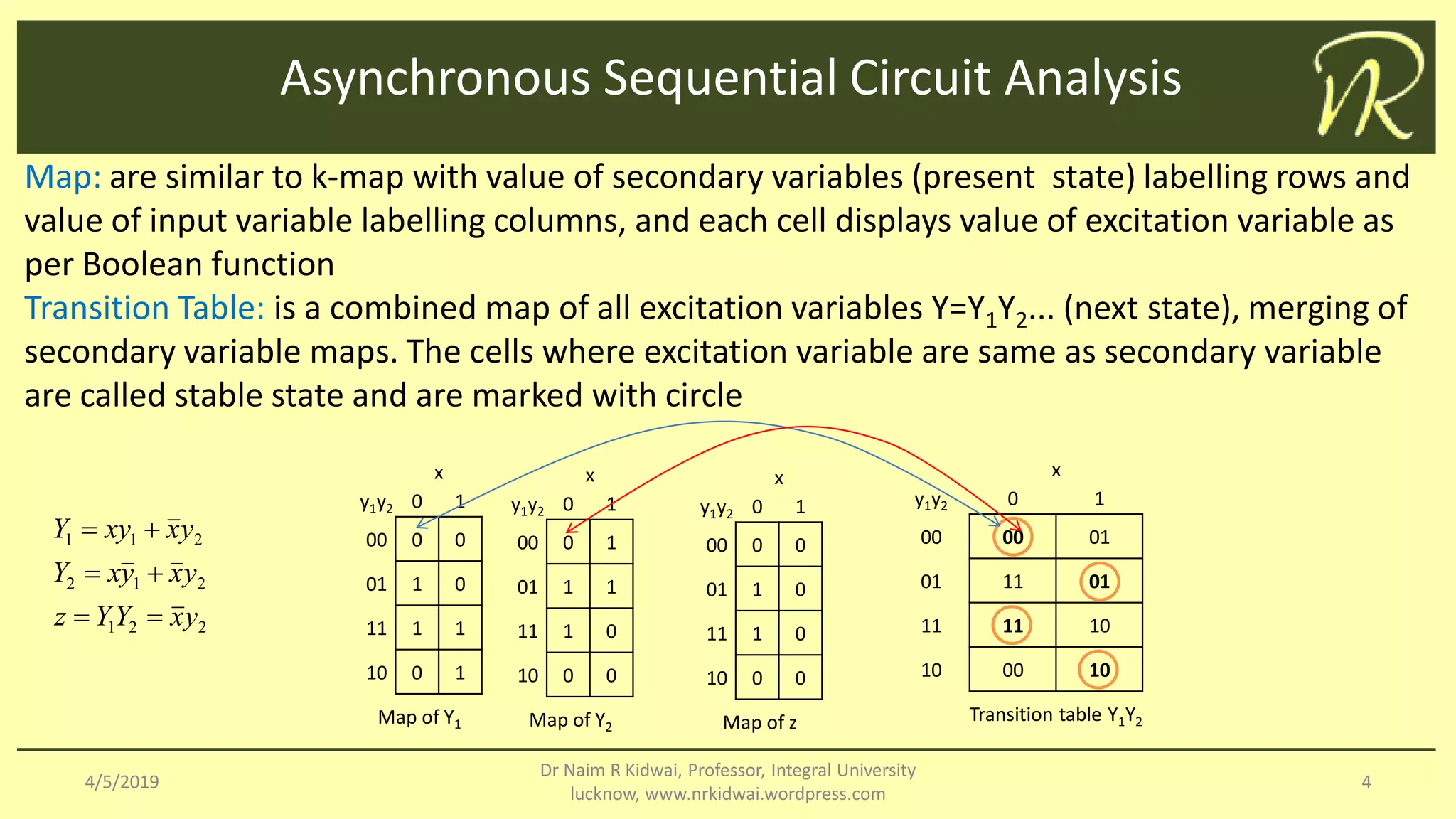
Map: are similar to k-map with value of secondary variables (present state) labelling rows and
value of input variable labelling columns, and each cell displays value of excitation variable as
per Boolean function
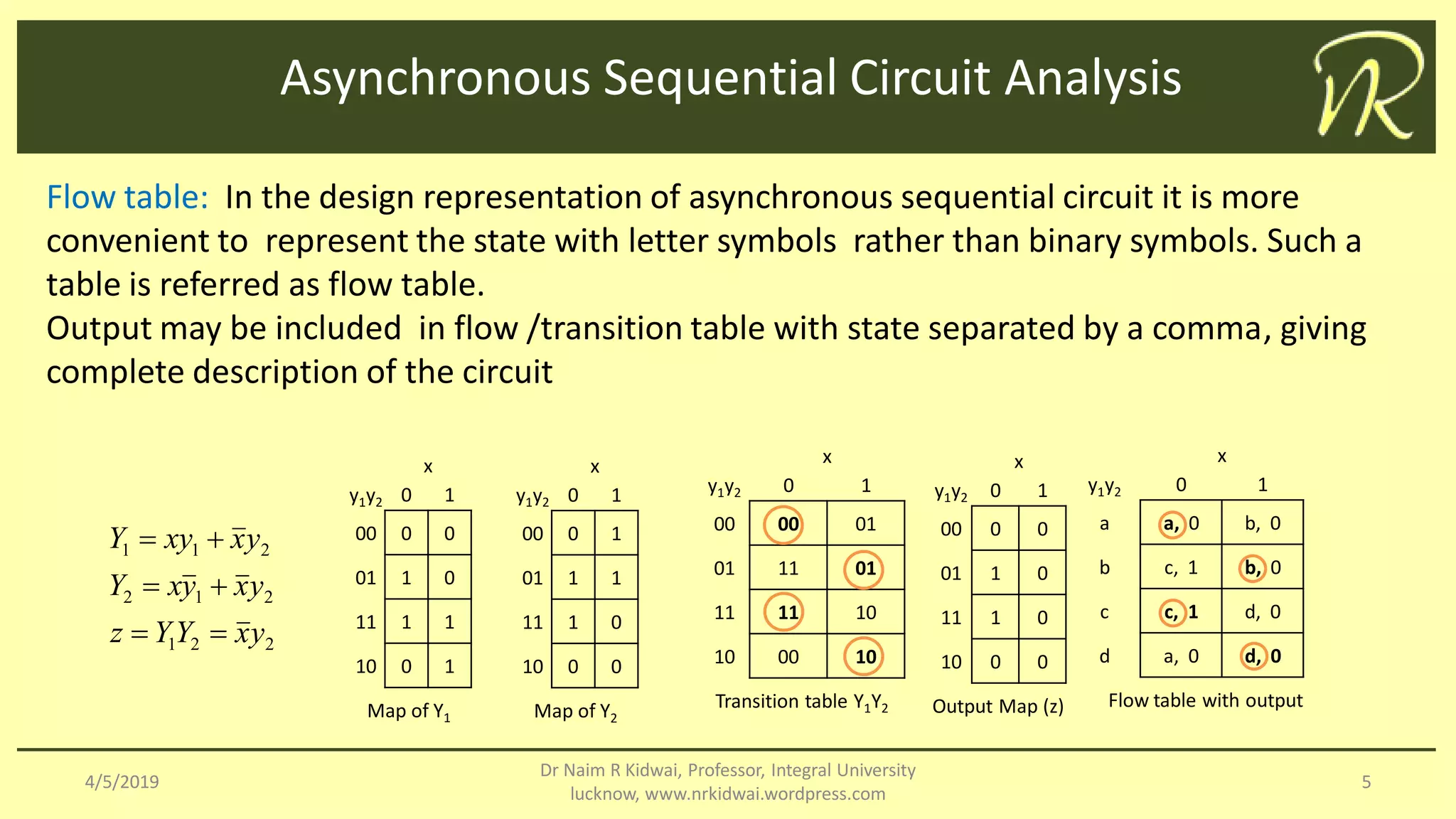
Transition Table: is a combined map of all excitation variables Y=Y1Y2... (next state), merging of
secondary variable maps. The cells where excitation variable are same as secondary variable
are called stable state and are marked with circle
x
y1y2 0 1
00 0 1
01 1 1
11 1 0
10 0 0
Map of Y2
x
y1y2 0 1
00 00 01
01 11 01
11 11 10
10 00 10
Transition table Y1Y2
x
y1y2 0 1
00 0 0
01 1 0
11 1 0
10 0 0
Map of z
221
212
211
yxYYz
yxyxY
yxxyY



Asynchronous Sequential Circuit Analysis
4/5/2019
Dr Naim R Kidwai, Professor, Integral University
lucknow, www.nrkidwai.wordpress.com
5
x
y1y2 0 1
00 0 0
01 1 0
11 1 1
10 0 1
Map of Y1
Flow table: In the design representation of asynchronous sequential circuit it is more
convenient to represent the state with letter symbols rather than binary symbols. Such a
table is referred as flow table.
Output may be included in flow /transition table with state separated by a comma, giving
complete description of the circuit
x
y1y2 0 1
00 0 1
01 1 1
11 1 0
10 0 0
Map of Y2
x
y1y2 0 1
00 00 01
01 11 01
11 11 10
10 00 10
Transition table Y1Y2
x
y1y2 0 1
00 0 0
01 1 0
11 1 0
10 0 0
Output Map (z)
x
y1y2 0 1
a a, 0 b, 0
b c, 1 b, 0
c c, 1 d, 0
d a, 0 d, 0
Flow table with output
221
212
211
yxYYz
yxyxY
yxxyY



Design from Flow table
4/5/2019
Dr Naim R Kidwai, Professor, Integral University
lucknow, www.nrkidwai.wordpress.com
6
00 01 11 10
a a , 0 a , 0 a , 0 b , 0
b a , 0 a , 0 b , 1 b , 0
Flow table with output
1. The circuit has two input variables (let x1 and x2), one
excitation variable Y (corresponding secondary variable y)
and one output z.
2. Assign binary values to state . a=0, b=1, then flow table
changes to transition table with outputx1x2
y 00 01 11 10
0 0 , 0 0 , 0 0 , 0 1 , 0
1 0 , 0 0 , 0 1 , 1 1 , 0
transition table with output
3. Separate map of Y and output map and find binary expression
for Y and z using k map
4. Implement the Boolean expressions using gates
x1x2
y 00 01 11 10
0 0 0 0 1
1 0 0 1 1
Map of Y
x1x2
y 00 01 11 10
0 0 0 0 0
1 0 0 1 0
Output map
yxxxY 121  yxxY 21
y
x2
Y
z
x1
Race Conditions
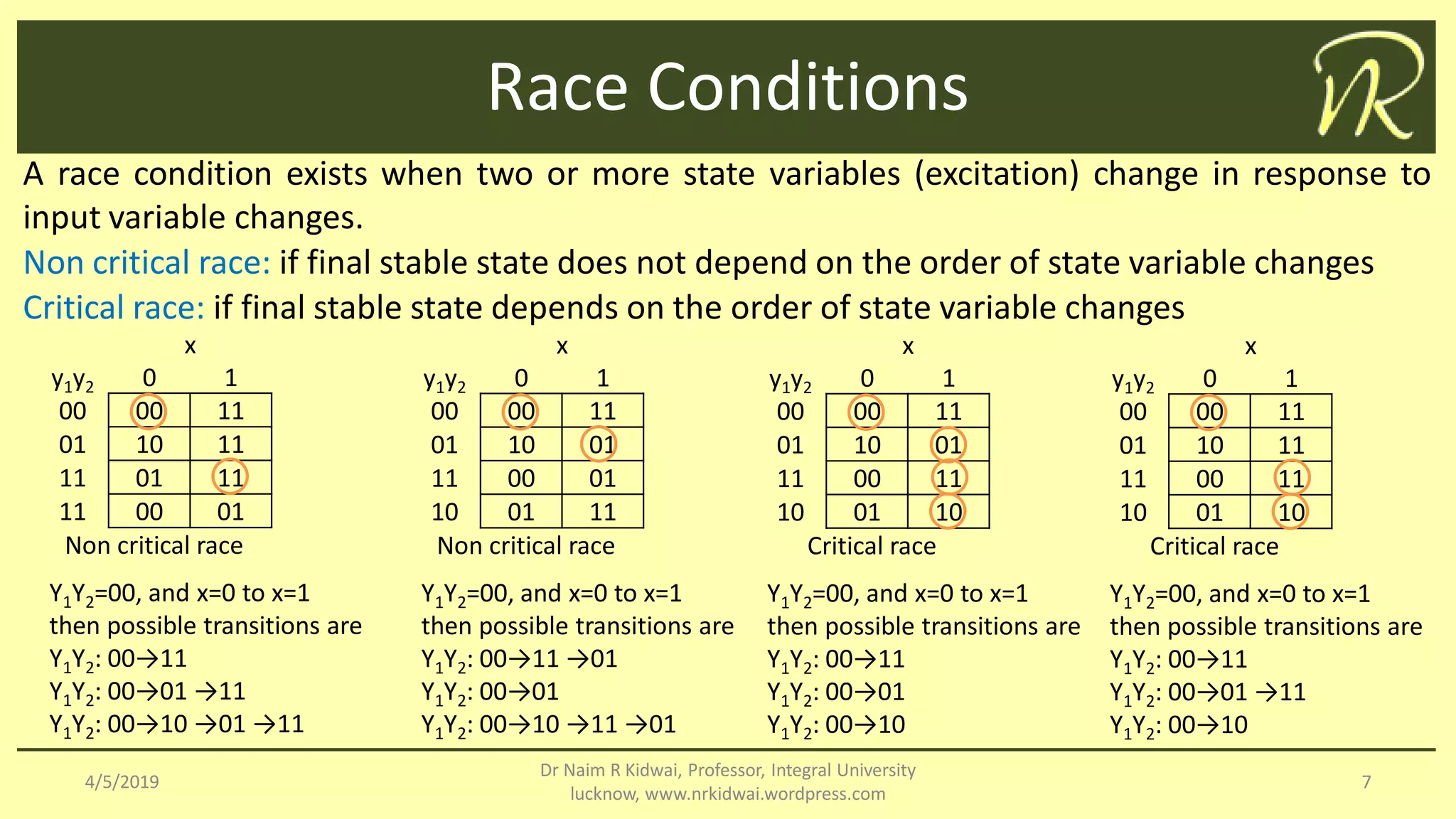
A race condition exists when two or more state variables (excitation) change in response to
input variable changes.
Non critical race: if final stable state does not depend on the order of state variable changes
Critical race: if final stable state depends on the order of state variable changes
4/5/2019
Dr Naim R Kidwai, Professor, Integral University
lucknow, www.nrkidwai.wordpress.com
7
x
y1y2 0 1
00 00 11
01 10 11
11 01 11
11 00 01
Non critical race
Y1Y2=00, and x=0 to x=1
then possible transitions are
Y1Y2: 00→11
Y1Y2: 00→01 →11
Y1Y2: 00→10 →01 →11
x
y1y2 0 1
00 00 11
01 10 01
11 00 01
10 01 11
Non critical race
Y1Y2=00, and x=0 to x=1
then possible transitions are
Y1Y2: 00→11 →01
Y1Y2: 00→01
Y1Y2: 00→10 →11 →01
x
y1y2 0 1
00 00 11
01 10 01
11 00 11
10 01 10
Critical race
Y1Y2=00, and x=0 to x=1
then possible transitions are
Y1Y2: 00→11
Y1Y2: 00→01
Y1Y2: 00→10
x
y1y2 0 1
00 00 11
01 10 11
11 00 11
10 01 10
Critical race
Y1Y2=00, and x=0 to x=1
then possible transitions are
Y1Y2: 00→11
Y1Y2: 00→01 →11
Y1Y2: 00→10

Asynchronous sequential circuit analysis

  • 1.
    Asynchronous Sequential CircuitAnalysis 4/5/2019 Dr Naim R Kidwai, Professor, Integral University lucknow, www.nrkidwai.wordpress.com 1 Learning Objectives: 1. To learn analysis of asynchronous Sequential Circuits 2. To learn map, transition table and flow table 3. To learn Design of asynchronous Sequential Circuit 4. To race conditions in asynchronous Sequential Circuit
  • 2.
    Asynchronous Sequential Circuit 4/5/2019 DrNaim R Kidwai, Professor, Integral University lucknow, www.nrkidwai.wordpress.com 2 •It do not use clock pulses, so change of state occurs whenever input changes •Memory element used are latch or time delay elements •A combinational circuit with feedback is asynchronous sequential circuit Combination al circuit Delay element Delay element Input variables secondary variables excitation variables Output variables Block diagram of Asynchronous sequential circuit
  • 3.
    Asynchronous Sequential CircuitAnalysis 4/5/2019 Dr Naim R Kidwai, Professor, Integral University lucknow, www.nrkidwai.wordpress.com 3 Steps of Analysis 1. In the circuit look for feedback 2. Assign excitation variable to output that is fed-back (Capital Letter) 3. Assign secondary variable at the input where feedback ends (small letters) 4. Write the Boolean expression for excitation variable 221 212 211 yxYYz yxyxY yxxyY    y1 y2 Y2 Y1 z x The circuit in example has two feedback paths Input variable secondary variable excitation variable
  • 4.
    Asynchronous Sequential CircuitAnalysis 4/5/2019 Dr Naim R Kidwai, Professor, Integral University lucknow, www.nrkidwai.wordpress.com 4 x y1y2 0 1 00 0 0 01 1 0 11 1 1 10 0 1 Map of Y1 Map: are similar to k-map with value of secondary variables (present state) labelling rows and value of input variable labelling columns, and each cell displays value of excitation variable as per Boolean function Transition Table: is a combined map of all excitation variables Y=Y1Y2... (next state), merging of secondary variable maps. The cells where excitation variable are same as secondary variable are called stable state and are marked with circle x y1y2 0 1 00 0 1 01 1 1 11 1 0 10 0 0 Map of Y2 x y1y2 0 1 00 00 01 01 11 01 11 11 10 10 00 10 Transition table Y1Y2 x y1y2 0 1 00 0 0 01 1 0 11 1 0 10 0 0 Map of z 221 212 211 yxYYz yxyxY yxxyY   
  • 5.
    Asynchronous Sequential CircuitAnalysis 4/5/2019 Dr Naim R Kidwai, Professor, Integral University lucknow, www.nrkidwai.wordpress.com 5 x y1y2 0 1 00 0 0 01 1 0 11 1 1 10 0 1 Map of Y1 Flow table: In the design representation of asynchronous sequential circuit it is more convenient to represent the state with letter symbols rather than binary symbols. Such a table is referred as flow table. Output may be included in flow /transition table with state separated by a comma, giving complete description of the circuit x y1y2 0 1 00 0 1 01 1 1 11 1 0 10 0 0 Map of Y2 x y1y2 0 1 00 00 01 01 11 01 11 11 10 10 00 10 Transition table Y1Y2 x y1y2 0 1 00 0 0 01 1 0 11 1 0 10 0 0 Output Map (z) x y1y2 0 1 a a, 0 b, 0 b c, 1 b, 0 c c, 1 d, 0 d a, 0 d, 0 Flow table with output 221 212 211 yxYYz yxyxY yxxyY   
  • 6.
    Design from Flowtable 4/5/2019 Dr Naim R Kidwai, Professor, Integral University lucknow, www.nrkidwai.wordpress.com 6 00 01 11 10 a a , 0 a , 0 a , 0 b , 0 b a , 0 a , 0 b , 1 b , 0 Flow table with output 1. The circuit has two input variables (let x1 and x2), one excitation variable Y (corresponding secondary variable y) and one output z. 2. Assign binary values to state . a=0, b=1, then flow table changes to transition table with outputx1x2 y 00 01 11 10 0 0 , 0 0 , 0 0 , 0 1 , 0 1 0 , 0 0 , 0 1 , 1 1 , 0 transition table with output 3. Separate map of Y and output map and find binary expression for Y and z using k map 4. Implement the Boolean expressions using gates x1x2 y 00 01 11 10 0 0 0 0 1 1 0 0 1 1 Map of Y x1x2 y 00 01 11 10 0 0 0 0 0 1 0 0 1 0 Output map yxxxY 121  yxxY 21 y x2 Y z x1
  • 7.
    Race Conditions A racecondition exists when two or more state variables (excitation) change in response to input variable changes. Non critical race: if final stable state does not depend on the order of state variable changes Critical race: if final stable state depends on the order of state variable changes 4/5/2019 Dr Naim R Kidwai, Professor, Integral University lucknow, www.nrkidwai.wordpress.com 7 x y1y2 0 1 00 00 11 01 10 11 11 01 11 11 00 01 Non critical race Y1Y2=00, and x=0 to x=1 then possible transitions are Y1Y2: 00→11 Y1Y2: 00→01 →11 Y1Y2: 00→10 →01 →11 x y1y2 0 1 00 00 11 01 10 01 11 00 01 10 01 11 Non critical race Y1Y2=00, and x=0 to x=1 then possible transitions are Y1Y2: 00→11 →01 Y1Y2: 00→01 Y1Y2: 00→10 →11 →01 x y1y2 0 1 00 00 11 01 10 01 11 00 11 10 01 10 Critical race Y1Y2=00, and x=0 to x=1 then possible transitions are Y1Y2: 00→11 Y1Y2: 00→01 Y1Y2: 00→10 x y1y2 0 1 00 00 11 01 10 11 11 00 11 10 01 10 Critical race Y1Y2=00, and x=0 to x=1 then possible transitions are Y1Y2: 00→11 Y1Y2: 00→01 →11 Y1Y2: 00→10