TOPIC 4
Latch & Flip-flop
Logic circuits
Combinational
 i.e NAND, NOR, AND, OR, etc
 Depend on present inputs
Combinational
 i.e NAND, NOR, AND, OR, etc
 Depend on present inputs
Sequential
 D FF, JK FF, RS FF, etc
 Depends on present and previous inputs
 Made up of an assembly of logic gates
Sequential
 D FF, JK FF, RS FF, etc
 Depends on present and previous inputs
 Made up of an assembly of logic gates
Introduction
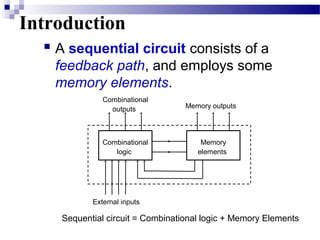
 A sequential circuit consists of a
feedback path, and employs some
memory elements.
Combinational
logic
Memory
elements
Combinational
outputs Memory outputs
External inputs
Sequential circuit = Combinational logic + Memory Elements
 There are two types of sequential circuits:
synchronous: outputs change only at specific time
asynchronous: outputs change at any time
 Multivibrator: a class of sequential circuits. They can be:
bistable (2 stable states : SET and RESET)
monostable or one-shot (1 stable state)
astable (no stable state)
 Bistable logic devices: latches and flip-flops.
 Latches and flip-flops differ in the method used for
changing their state.
Memory Elements
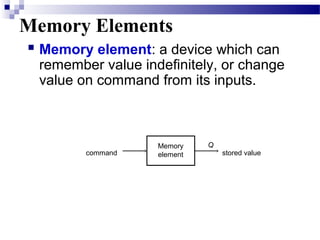
 Memory element: a device which can
remember value indefinitely, or change
value on command from its inputs.
command
Memory
element stored value
Q
Memory Elements
 Memory element with clock. Flip-flops
are memory elements that change
state on clock signals.
 Clock is usually a square wave.
command
Memory
element stored value
Q
clock
Positive edges Negative edges
Positive pulses
Memory Elements
 Two types of triggering/activation:
pulse-triggered
edge-triggered
 Pulse-triggered
latches
ON = 1, OFF = 0
 Edge-triggered
flip-flops
positive edge-triggered (ON = from 0 to 1; OFF = other
time)
negative edge-triggered (ON = from 1 to 0; OFF =
other time)
Set-Reset Latch (S-R)
SR Latch
 Latch is a type of bistable(2 stable state) / multivibrator.
The latch is type of temporary storage device that has two stable state
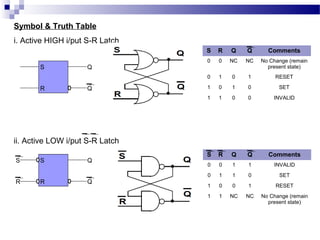
 Active HIGH i/put S-R formed with 2 cross-couple NOR gates.
 Active LOW i/put S-R formed with 2 cross-couple NAND gates.
 O/put of each gate is connected to an i/put of the opposite gate.
 Produces the regenerative f/back that is characteristic of all latches & FFs.
ii. Active LOW i/put S-R Latch
S
R
Q
Q
S
R
S R Q Q Comments
0 0 1 1 INVALID
0 1 1 0 SET
1 0 0 1 RESET
1 1 NC NC No Change (remain
present state)
Symbol & Truth Table
i. Active HIGH i/put S-R Latch
S
R
Q
Q
S R Q Q Comments
0 0 NC NC No Change (remain
present state)
0 1 0 1 RESET
1 0 1 0 SET
1 1 0 0 INVALID
Example 1
Determine the w/form that will be observed on the Q o/put. Assume that Q is initially
Low.
S
R
Q
Q
S
R
S
R
Q
1
0
1
0
1
0
Exercise 1
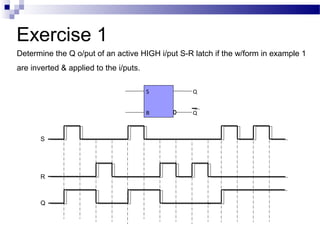
Determine the Q o/put of an active HIGH i/put S-R latch if the w/form in example 1
are inverted & applied to the i/puts.
S
R
Q
Q
S
R
Q
Exercise 2
S
R
Q
Q
>1
A
B
CA
B
C
The i/puts to an active HIGH S-R latch and the circuit diagram are given below.
Draw the timing diagram o/put Q, Q’ for the latch. Assume Q start with 0.
Flip-Flop (FF)
 In digital system, FF is an electronic circuit which has two
stable states and thereby is capable of serving as one bit of
memory, bit 1 or bit 0.
Synchronous means: O/put changes state at specified point
on the triggering i/put (called “CLOCK” - CLK). Clock (C) is
designated as a ctrl input.
Change in the o/put occur in synchronization with the clock.
Flip-Flop (FF)
Edge-triggered ff: changes state either at the +ve edge
(rising edge) / at –ve (falling edge) of the clock pulse &
sensitive to its i/put only at this transition of clock.
 3 types of ff: S-R, D & J-K.
whenever we refer to the the state of the flip flop, we refer
to the state of its normal output (Q)
Input 1
Input 2
Q
Q
C
Normal output
Inverted output
Symbol of FFs
S
R
Q
Q
C
S
R
Q
Q
C
D Q
Q
C
D Q
Q
C
J
K
Q
Q
C
J
K
Q
Q
C
+ve edge triggered (No bubble ‘C’ i/put)
-ve edge triggered (Bubble ‘C’ i/put)
C
 Dynamic i/put indicator
 Identifying an edge triggered ffs, small triangle inside at
clock (C) i/put
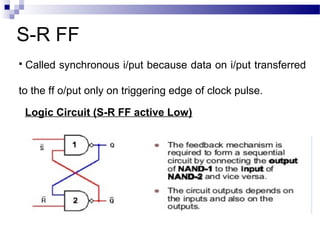
S-R FF
 Called synchronous i/put because data on i/put transferred
to the ff o/put only on triggering edge of clock pulse.
Logic Circuit (S-R FF active Low)
No Change condition
Set
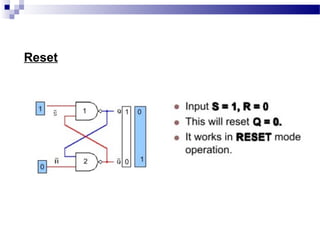
Reset
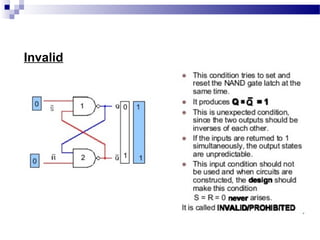
Invalid
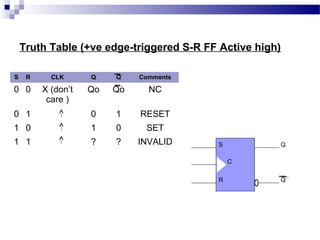
Truth Table (+ve edge-triggered S-R FF Active high)
S R CLK Q Q Comments
0 0 X (don’t
care )
Qo Qo NC
0 1 0 1 RESET
1 0 1 0 SET
1 1 ? ? INVALID S
R
Q
Q
C
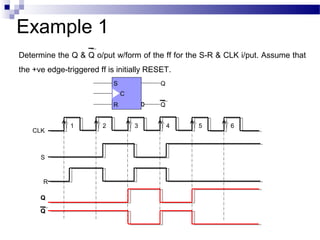
Example 1
Determine the Q & Q o/put w/form of the ff for the S-R & CLK i/put. Assume that
the +ve edge-triggered ff is initially RESET.
S
R
Q
Q
C
CLK
S
R
Q
Q
1 2 3 4 5 6
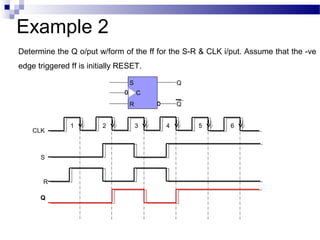
Example 2
Determine the Q o/put w/form of the ff for the S-R & CLK i/put. Assume that the -ve
edge triggered ff is initially RESET.
S
R
Q
Q
C
CLK
S
R
Q
1 2 3 4 5 6
Exercise 1
Figure indicates an Ex-OR logic gate is connected to an S-R ff. Based
on figure given, complete the truth table.
S
R
Q
Q
C
SET
CLR
A B S R Q Q’
0 0 1
0 1 0
1 0 0
1 1 1
R
0
1
1
0
Q
1
0
0
1
Q’
0
1
1
0
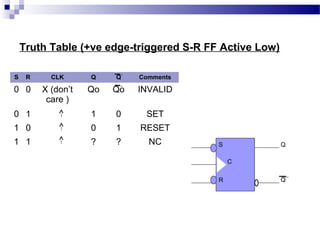
Truth Table (+ve edge-triggered S-R FF Active Low)
S R CLK Q Q Comments
0 0 X (don’t
care )
Qo Qo INVALID
0 1 1 0 SET
1 0 0 1 RESET
1 1 ? ? NC S
R
Q
Q
C
D FF
 Also known as Data FF
Can be constructed from SR FF or JK FF by addition of an
inverter.
Logic circuit for D FF
S
R
Q
Q
C
SET
CLR
D
CLK
D Q
Q
C
+ve edge-triggered D FF formed with S-R FF & inverter
Truth Table (+ve edge-triggered D FF)
D CLK Q Q Comments
1 1 0 SET (store 1)
0 0 1 RESET (store 0)
Q follow D at the active or triggering clock edge
Example 1
Given the w/form in figure for the D i/put & the clock, determine the Q o/put
w/form if the ff starts out RESET.
D Q
Q
C
1 2 3 4
CLK
D
Q
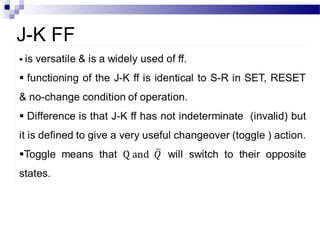
J-K FF
J-K FF
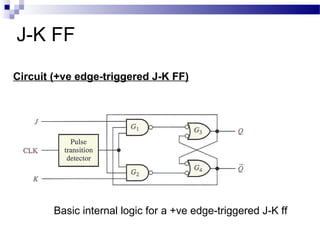
Circuit (+ve edge-triggered J-K FF)
Basic internal logic for a +ve edge-triggered J-K ff
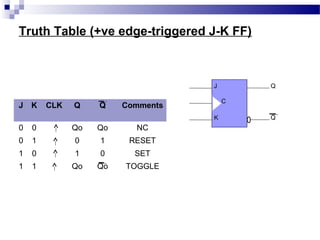
Truth Table (+ve edge-triggered J-K FF)
J K CLK Q Q Comments
0 0 Qo Qo NC
0 1 0 1 RESET
1 0 1 0 SET
1 1 Qo Qo TOGGLE
J
K
Q
Q
C
Example 1
The w/form in figure are applied to the J-K & clock i/put as
indicated. Determine the Q o/put, assuming that the ff in
initially RESET.
1 2 3 4
CLK
J
Q
5
J
K
Q
Q
C
K
Toggle NC Reset Set Set
The w/form in figure are applied to the ff as shown. Determine the Q o/put,
starting in initially RESET state.
Example 2
J
K
Q
Q
C
CLK
J
K
Q
1 2 3 4 5 6 7
NC Toggle Reset Set Set Toggle Reset
Exercise 1
CLK
J
K
Q
Redraw and complete the output of the timing diagram in figure for J-K ff.
Assume +ve edge ff.
Exercise 2
Figure given indicate an EX-OR logic gate connected to a J-K ff. O/put Q of J-K
is connected to i/put R of S-R ff. Based on figure, complete the truth table in table
given.
J
K
Q
Q
C
SET
CLR
S
R
Q
Q
C
SET
CLR
A B J K S R Q of SR ff
0 0 1 1
0 1 0 0
1 0 0 0
1 1 1 1
J
0
1
1
0
R
0
1
1
0
Q of SR ff
1
0
0
1
Asynchronous Preset & Clear I/put
 FF: (SR, D & JK – synchronous i/put)
- because data on these i/put transferred to ff o/put only on
triggering edge of clock pulse.
- that is, data are transferred synchronous with clock.
 Most integrated circuit ff also have asynchronous i/put.
 These are i/put that affect the state of the ff independent of the
clock.
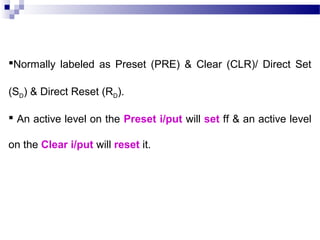
Normally labeled as Preset (PRE) & Clear (CLR)/ Direct Set
(SD) & Direct Reset (RD).
 An active level on the Preset i/put will set ff & an active level
on the Clear i/put will reset it.
 A logic symbol for J-K ff with Preset & Clear i/put as below:
 These i/put are active LOW, as indicated by the bubbles.
 In normal operation, Preset & Clear would not be LOW at the
same time.
J
K
Q
Q
C
PRE
CLR
J-K ff with active LOW Preset & Clear i/put
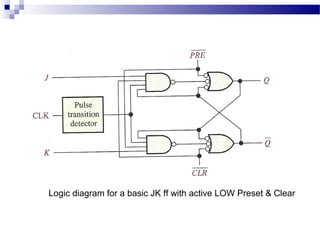
Logic diagram for a basic JK ff with active LOW Preset & Clear
Example 1
If interchange the PRE & CLR w/form in example 1, what will the Q o/put look
like?
J
K
Q
Q
C
PRE
CLR
HIGH
1 2 3 4 5 6 7 8 9
ToggleCLR active LOW
PRE active LOW
CLK
PRE
CLR
Q
Initial LOW

Ds flip flop

  • 1.
    TOPIC 4 Latch &Flip-flop
  • 2.
    Logic circuits Combinational  i.eNAND, NOR, AND, OR, etc  Depend on present inputs Combinational  i.e NAND, NOR, AND, OR, etc  Depend on present inputs Sequential  D FF, JK FF, RS FF, etc  Depends on present and previous inputs  Made up of an assembly of logic gates Sequential  D FF, JK FF, RS FF, etc  Depends on present and previous inputs  Made up of an assembly of logic gates
  • 3.
    Introduction  A sequentialcircuit consists of a feedback path, and employs some memory elements. Combinational logic Memory elements Combinational outputs Memory outputs External inputs Sequential circuit = Combinational logic + Memory Elements
  • 4.
     There aretwo types of sequential circuits: synchronous: outputs change only at specific time asynchronous: outputs change at any time  Multivibrator: a class of sequential circuits. They can be: bistable (2 stable states : SET and RESET) monostable or one-shot (1 stable state) astable (no stable state)  Bistable logic devices: latches and flip-flops.  Latches and flip-flops differ in the method used for changing their state.
  • 5.
    Memory Elements  Memoryelement: a device which can remember value indefinitely, or change value on command from its inputs. command Memory element stored value Q
  • 6.
    Memory Elements  Memoryelement with clock. Flip-flops are memory elements that change state on clock signals.  Clock is usually a square wave. command Memory element stored value Q clock Positive edges Negative edges Positive pulses
  • 7.
    Memory Elements  Twotypes of triggering/activation: pulse-triggered edge-triggered  Pulse-triggered latches ON = 1, OFF = 0  Edge-triggered flip-flops positive edge-triggered (ON = from 0 to 1; OFF = other time) negative edge-triggered (ON = from 1 to 0; OFF = other time)
  • 8.
    Set-Reset Latch (S-R) SRLatch  Latch is a type of bistable(2 stable state) / multivibrator. The latch is type of temporary storage device that has two stable state  Active HIGH i/put S-R formed with 2 cross-couple NOR gates.  Active LOW i/put S-R formed with 2 cross-couple NAND gates.  O/put of each gate is connected to an i/put of the opposite gate.  Produces the regenerative f/back that is characteristic of all latches & FFs.
  • 9.
    ii. Active LOWi/put S-R Latch S R Q Q S R S R Q Q Comments 0 0 1 1 INVALID 0 1 1 0 SET 1 0 0 1 RESET 1 1 NC NC No Change (remain present state) Symbol & Truth Table i. Active HIGH i/put S-R Latch S R Q Q S R Q Q Comments 0 0 NC NC No Change (remain present state) 0 1 0 1 RESET 1 0 1 0 SET 1 1 0 0 INVALID
  • 10.
    Example 1 Determine thew/form that will be observed on the Q o/put. Assume that Q is initially Low. S R Q Q S R S R Q 1 0 1 0 1 0
  • 11.
    Exercise 1 Determine theQ o/put of an active HIGH i/put S-R latch if the w/form in example 1 are inverted & applied to the i/puts. S R Q Q S R Q
  • 12.
    Exercise 2 S R Q Q >1 A B CA B C The i/putsto an active HIGH S-R latch and the circuit diagram are given below. Draw the timing diagram o/put Q, Q’ for the latch. Assume Q start with 0.
  • 13.
    Flip-Flop (FF)  Indigital system, FF is an electronic circuit which has two stable states and thereby is capable of serving as one bit of memory, bit 1 or bit 0. Synchronous means: O/put changes state at specified point on the triggering i/put (called “CLOCK” - CLK). Clock (C) is designated as a ctrl input. Change in the o/put occur in synchronization with the clock.
  • 14.
    Flip-Flop (FF) Edge-triggered ff:changes state either at the +ve edge (rising edge) / at –ve (falling edge) of the clock pulse & sensitive to its i/put only at this transition of clock.  3 types of ff: S-R, D & J-K. whenever we refer to the the state of the flip flop, we refer to the state of its normal output (Q) Input 1 Input 2 Q Q C Normal output Inverted output
  • 15.
    Symbol of FFs S R Q Q C S R Q Q C DQ Q C D Q Q C J K Q Q C J K Q Q C +ve edge triggered (No bubble ‘C’ i/put) -ve edge triggered (Bubble ‘C’ i/put) C  Dynamic i/put indicator  Identifying an edge triggered ffs, small triangle inside at clock (C) i/put
  • 16.
    S-R FF  Calledsynchronous i/put because data on i/put transferred to the ff o/put only on triggering edge of clock pulse. Logic Circuit (S-R FF active Low)
  • 17.
  • 18.
  • 19.
  • 20.
  • 21.
    Truth Table (+veedge-triggered S-R FF Active high) S R CLK Q Q Comments 0 0 X (don’t care ) Qo Qo NC 0 1 0 1 RESET 1 0 1 0 SET 1 1 ? ? INVALID S R Q Q C
  • 22.
    Example 1 Determine theQ & Q o/put w/form of the ff for the S-R & CLK i/put. Assume that the +ve edge-triggered ff is initially RESET. S R Q Q C CLK S R Q Q 1 2 3 4 5 6
  • 23.
    Example 2 Determine theQ o/put w/form of the ff for the S-R & CLK i/put. Assume that the -ve edge triggered ff is initially RESET. S R Q Q C CLK S R Q 1 2 3 4 5 6
  • 24.
    Exercise 1 Figure indicatesan Ex-OR logic gate is connected to an S-R ff. Based on figure given, complete the truth table. S R Q Q C SET CLR A B S R Q Q’ 0 0 1 0 1 0 1 0 0 1 1 1 R 0 1 1 0 Q 1 0 0 1 Q’ 0 1 1 0
  • 25.
    Truth Table (+veedge-triggered S-R FF Active Low) S R CLK Q Q Comments 0 0 X (don’t care ) Qo Qo INVALID 0 1 1 0 SET 1 0 0 1 RESET 1 1 ? ? NC S R Q Q C
  • 26.
    D FF  Alsoknown as Data FF Can be constructed from SR FF or JK FF by addition of an inverter. Logic circuit for D FF
  • 27.
    S R Q Q C SET CLR D CLK D Q Q C +ve edge-triggeredD FF formed with S-R FF & inverter Truth Table (+ve edge-triggered D FF) D CLK Q Q Comments 1 1 0 SET (store 1) 0 0 1 RESET (store 0) Q follow D at the active or triggering clock edge
  • 28.
    Example 1 Given thew/form in figure for the D i/put & the clock, determine the Q o/put w/form if the ff starts out RESET. D Q Q C 1 2 3 4 CLK D Q
  • 29.
  • 30.
    J-K FF Circuit (+veedge-triggered J-K FF) Basic internal logic for a +ve edge-triggered J-K ff
  • 31.
    Truth Table (+veedge-triggered J-K FF) J K CLK Q Q Comments 0 0 Qo Qo NC 0 1 0 1 RESET 1 0 1 0 SET 1 1 Qo Qo TOGGLE J K Q Q C
  • 32.
    Example 1 The w/formin figure are applied to the J-K & clock i/put as indicated. Determine the Q o/put, assuming that the ff in initially RESET. 1 2 3 4 CLK J Q 5 J K Q Q C K Toggle NC Reset Set Set
  • 33.
    The w/form infigure are applied to the ff as shown. Determine the Q o/put, starting in initially RESET state. Example 2 J K Q Q C CLK J K Q 1 2 3 4 5 6 7 NC Toggle Reset Set Set Toggle Reset
  • 34.
    Exercise 1 CLK J K Q Redraw andcomplete the output of the timing diagram in figure for J-K ff. Assume +ve edge ff.
  • 35.
    Exercise 2 Figure givenindicate an EX-OR logic gate connected to a J-K ff. O/put Q of J-K is connected to i/put R of S-R ff. Based on figure, complete the truth table in table given. J K Q Q C SET CLR S R Q Q C SET CLR A B J K S R Q of SR ff 0 0 1 1 0 1 0 0 1 0 0 0 1 1 1 1 J 0 1 1 0 R 0 1 1 0 Q of SR ff 1 0 0 1
  • 36.
    Asynchronous Preset &Clear I/put  FF: (SR, D & JK – synchronous i/put) - because data on these i/put transferred to ff o/put only on triggering edge of clock pulse. - that is, data are transferred synchronous with clock.  Most integrated circuit ff also have asynchronous i/put.  These are i/put that affect the state of the ff independent of the clock.
  • 37.
    Normally labeled asPreset (PRE) & Clear (CLR)/ Direct Set (SD) & Direct Reset (RD).  An active level on the Preset i/put will set ff & an active level on the Clear i/put will reset it.
  • 38.
     A logicsymbol for J-K ff with Preset & Clear i/put as below:  These i/put are active LOW, as indicated by the bubbles.  In normal operation, Preset & Clear would not be LOW at the same time. J K Q Q C PRE CLR J-K ff with active LOW Preset & Clear i/put
  • 39.
    Logic diagram fora basic JK ff with active LOW Preset & Clear
  • 40.
    Example 1 If interchangethe PRE & CLR w/form in example 1, what will the Q o/put look like? J K Q Q C PRE CLR HIGH 1 2 3 4 5 6 7 8 9 ToggleCLR active LOW PRE active LOW CLK PRE CLR Q Initial LOW

Editor's Notes

  • #25 0 1 0 1 0 1 1 0 1 0 1 0
  • #36 J R Q 0 0 1 1 1 0 1 1 0 0 0 1