Sequential Circuit
Digital Electronics
2
 Sequential Circuit
 Memory element
 S-R latch
 Flip-flop
Overview
3
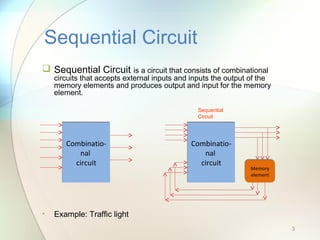
 Sequential Circuit is a circuit that consists of combinational
circuits that accepts external inputs and inputs the output of the
memory elements and produces output and input for the memory
element.
• Example: Traffic light
Sequential Circuit
Combinatio-
nal
circuit
Combinatio-
nal
circuit
Combinatio-
nal
circuit
Combinatio-
nal
circuit
Memory
element
Memory
element
Sequential
Circuit
• The basic memory element of a digital system is known as a latch or
flip-flop.
• A flip-flop or latch is made of NAND or NOR gate.
• Considering the NOR gate latch:
• Truth table:
• A B Out
0 0 1
0 1 0
1 0 0
1 1 0 [prohibited in memory cells]
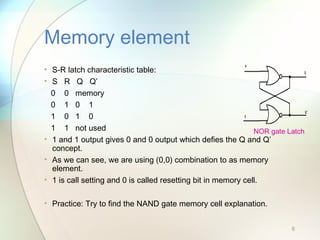
• In the figure, S=Set and R=Reset.
• Let, S=1, R=0 then Q’=0 and Q=1.
Memory element
4
NOR gate Latch
NAND gate Latch
=1
=0
0
1
0
11
This is also known as S-R Latch.
• Truth table:
• A B Out
0 0 1
0 1 0
1 0 0
1 1 0 [prohibited in memory cells]
• Let, S=0, R=0 then, Q’=0 and Q=1
• Let Again, R=1, S=0 then Q’=1 and Q=0
• Let Again, S=0, R=0 then Q’=1 and Q=0
• This represents that,
current output is
dependent on previous
output.
Memory element
5
NOR gate Latch
1
=0
=0
00
1
NOR gate Latch
1
0
01
00
00
0
0
1
• S-R latch characteristic table:
• S R Q Q’
0 0 memory
0 1 0 1
1 0 1 0
1 1 not used
• 1 and 1 output gives 0 and 0 output which defies the Q and Q’
concept.
• As we can see, we are using (0,0) combination to as memory
element.
• 1 is call setting and 0 is called resetting bit in memory cell.
• Practice: Try to find the NAND gate memory cell explanation.
Memory element
6
NOR gate Latch
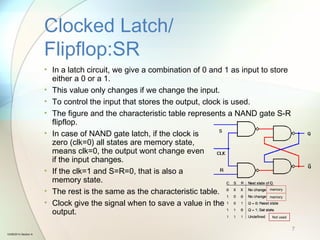
• In a latch circuit, we give a combination of 0 and 1 as input to store
either a 0 or a 1.
• This value only changes if we change the input.
• To control the input that stores the output, clock is used.
• The figure and the characteristic table represents a NAND gate S-R
flipflop.
• In case of NAND gate latch, if the clock is
zero (clk=0) all states are memory state,
means clk=0, the output wont change even
if the input changes.
• If the clk=1 and S=R=0, that is also a
memory state.
• The rest is the same as the characteristic table.
• Clock give the signal when to save a value in the
output.
Clocked Latch/
Flipflop:SR
7
Not used
memory
memory
10/08/2014 Section A
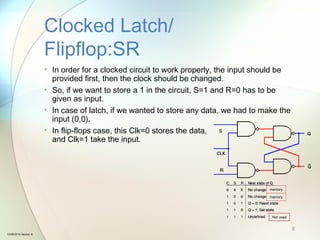
• In order for a clocked circuit to work properly, the input should be
provided first, then the clock should be changed.
• So, if we want to store a 1 in the circuit, S=1 and R=0 has to be
given as input.
• In case of latch, if we wanted to store any data, we had to make the
input (0,0).
• In flip-flops case, this Clk=0 stores the data,
and Clk=1 take the input.
Clocked Latch/
Flipflop:SR
8
Not used
memory
memory
10/08/2014 Section A
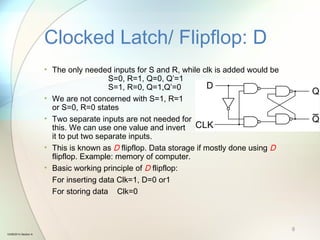
• The only needed inputs for S and R, while clk is added would be
S=0, R=1, Q=0, Q’=1
S=1, R=0, Q=1,Q’=0
• We are not concerned with S=1, R=1
or S=0, R=0 states
• Two separate inputs are not needed for
this. We can use one value and invert
it to put two separate inputs.
• This is known as D flipflop. Data storage if mostly done using D
flipflop. Example: memory of computer.
• Basic working principle of D flipflop:
For inserting data Clk=1, D=0 or1
For storing data Clk=0
Clocked Latch/ Flipflop: D
9
10/08/2014 Section A
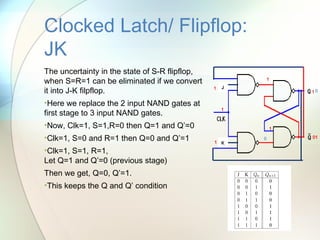
The uncertainty in the state of S-R flipflop,
when S=R=1 can be eliminated if we convert
it into J-K filpflop.
•Here we replace the 2 input NAND gates at
first stage to 3 input NAND gates.
•Now, Clk=1, S=1,R=0 then Q=1 and Q’=0
•Clk=1, S=0 and R=1 then Q=0 and Q’=1
•Clk=1, S=1, R=1,
Let Q=1 and Q’=0 (previous stage)
Then we get, Q=0, Q’=1.
•This keeps the Q and Q’ condition
Clocked Latch/ Flipflop:
JK
1
1
0
J
K
1
1
1
1
0
0 11

Sequential circuit-Digital Electronics

  • 1.
  • 2.
    2  Sequential Circuit Memory element  S-R latch  Flip-flop Overview
  • 3.
    3  Sequential Circuitis a circuit that consists of combinational circuits that accepts external inputs and inputs the output of the memory elements and produces output and input for the memory element. • Example: Traffic light Sequential Circuit Combinatio- nal circuit Combinatio- nal circuit Combinatio- nal circuit Combinatio- nal circuit Memory element Memory element Sequential Circuit
  • 4.
    • The basicmemory element of a digital system is known as a latch or flip-flop. • A flip-flop or latch is made of NAND or NOR gate. • Considering the NOR gate latch: • Truth table: • A B Out 0 0 1 0 1 0 1 0 0 1 1 0 [prohibited in memory cells] • In the figure, S=Set and R=Reset. • Let, S=1, R=0 then Q’=0 and Q=1. Memory element 4 NOR gate Latch NAND gate Latch =1 =0 0 1 0 11 This is also known as S-R Latch.
  • 5.
    • Truth table: •A B Out 0 0 1 0 1 0 1 0 0 1 1 0 [prohibited in memory cells] • Let, S=0, R=0 then, Q’=0 and Q=1 • Let Again, R=1, S=0 then Q’=1 and Q=0 • Let Again, S=0, R=0 then Q’=1 and Q=0 • This represents that, current output is dependent on previous output. Memory element 5 NOR gate Latch 1 =0 =0 00 1 NOR gate Latch 1 0 01 00 00 0 0 1
  • 6.
    • S-R latchcharacteristic table: • S R Q Q’ 0 0 memory 0 1 0 1 1 0 1 0 1 1 not used • 1 and 1 output gives 0 and 0 output which defies the Q and Q’ concept. • As we can see, we are using (0,0) combination to as memory element. • 1 is call setting and 0 is called resetting bit in memory cell. • Practice: Try to find the NAND gate memory cell explanation. Memory element 6 NOR gate Latch
  • 7.
    • In alatch circuit, we give a combination of 0 and 1 as input to store either a 0 or a 1. • This value only changes if we change the input. • To control the input that stores the output, clock is used. • The figure and the characteristic table represents a NAND gate S-R flipflop. • In case of NAND gate latch, if the clock is zero (clk=0) all states are memory state, means clk=0, the output wont change even if the input changes. • If the clk=1 and S=R=0, that is also a memory state. • The rest is the same as the characteristic table. • Clock give the signal when to save a value in the output. Clocked Latch/ Flipflop:SR 7 Not used memory memory 10/08/2014 Section A
  • 8.
    • In orderfor a clocked circuit to work properly, the input should be provided first, then the clock should be changed. • So, if we want to store a 1 in the circuit, S=1 and R=0 has to be given as input. • In case of latch, if we wanted to store any data, we had to make the input (0,0). • In flip-flops case, this Clk=0 stores the data, and Clk=1 take the input. Clocked Latch/ Flipflop:SR 8 Not used memory memory 10/08/2014 Section A
  • 9.
    • The onlyneeded inputs for S and R, while clk is added would be S=0, R=1, Q=0, Q’=1 S=1, R=0, Q=1,Q’=0 • We are not concerned with S=1, R=1 or S=0, R=0 states • Two separate inputs are not needed for this. We can use one value and invert it to put two separate inputs. • This is known as D flipflop. Data storage if mostly done using D flipflop. Example: memory of computer. • Basic working principle of D flipflop: For inserting data Clk=1, D=0 or1 For storing data Clk=0 Clocked Latch/ Flipflop: D 9 10/08/2014 Section A
  • 10.
    The uncertainty inthe state of S-R flipflop, when S=R=1 can be eliminated if we convert it into J-K filpflop. •Here we replace the 2 input NAND gates at first stage to 3 input NAND gates. •Now, Clk=1, S=1,R=0 then Q=1 and Q’=0 •Clk=1, S=0 and R=1 then Q=0 and Q’=1 •Clk=1, S=1, R=1, Let Q=1 and Q’=0 (previous stage) Then we get, Q=0, Q’=1. •This keeps the Q and Q’ condition Clocked Latch/ Flipflop: JK 1 1 0 J K 1 1 1 1 0 0 11

Editor's Notes

  • #6 R=1 S=0 starts from Q=0.