Naveen Kumar
M.E., ECE (Regular)
Outline
    Web Security
    Introduction to SSL/TLS
    Secure Socket Layer (SSL)
      Where, What and How about SSL

      Architecture
      The Four Protocols

      Simple Handshake process

    Transport Layer Security (TLS)
      TLS Overview
      Public Key Certificates

    Implementation & Applications of SSL/TLS
    Summary
    References

December 1, 2012                       NITTTR, Chandigarh   2
“Use your mentality, Wake up to reality”
---From the song, “I've got you under my skin”
by Cole Porter


December 1, 2012        NITTTR, Chandigarh       3
Reality!!!


December 1, 2012   NITTTR, Chandigarh   4
Web security
     Web is now widely used by businesses, government firms
      and individuals.
     but Internet & Web space are vulnerable.
     have a variety of threats related to
       Integrity : Someone might alter content

       Confidentiality : Anyone can see content

       Denial of service

       Authentication : Not clear who you are talking with
     need added security mechanisms

December 1, 2012                  NITTTR, Chandigarh           5
Introduction (contd.)
     Secure Sockets Layer (SSL)
      Developed by Netscape Corporation

      Versions 1, 2, and 3 (released in 1996)

     Transport Layer Security (TLS)
      Successor of SSL

      IETF standards track protocol, based on SSL 3.0

       Last updated in RFC 5246 (2008)

December 1, 2012            NITTTR, Chandigarh           6
Introduction (contd.)
     Transport    Layer   Security              (TLS)   and   its
      predecessor, Secure Sockets Layer (SSL), are
      cryptographic protocols that provide security for
      communications over networks such as the
      Internet.
     TLS and SSL encrypt the segments of network
      connections at the Transport Layer end-to-end.


December 1, 2012            NITTTR, Chandigarh                       7
SECURE
                   SOCKET LAYER
                       (SSL)


December 1, 2012        NITTTR, Chandigarh   8
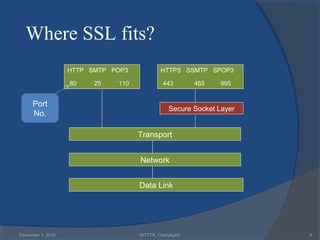
Where SSL fits?
                   HTTP SMTP POP3            HTTPS SSMTP SPOP3

                   80    25   110             443        465   995


     Port
                                                Secure Socket Layer
     No.

                                    Transport


                                    Network


                                    Data Link


December 1, 2012                    NITTTR, Chandigarh                9
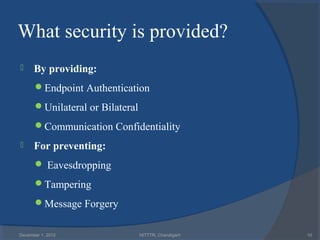
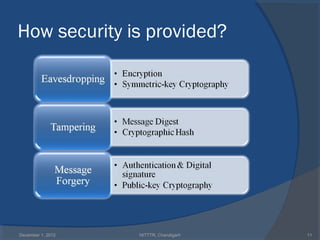
What security is provided?
     By providing:
      Endpoint Authentication

      Unilateral or Bilateral

      Communication Confidentiality
     For preventing:
       Eavesdropping

      Tampering

      Message Forgery


December 1, 2012                 NITTTR, Chandigarh   10
How security is provided?


December 1, 2012   NITTTR, Chandigarh   11
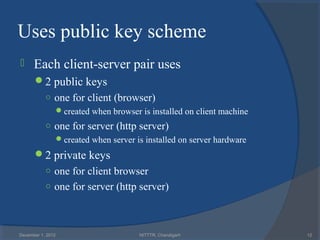
Uses public key scheme
     Each client-server pair uses
      2 public keys
           ○ one for client (browser)
              created when browser is installed on client machine
           ○ one for server (http server)
              created when server is installed on server hardware
      2 private keys
           ○ one for client browser
           ○ one for server (http server)


December 1, 2012                    NITTTR, Chandigarh               12
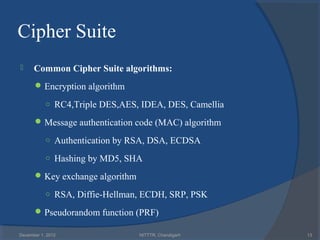
Cipher Suite
     Common Cipher Suite algorithms:
       Encryption algorithm

           ○ RC4,Triple DES,AES, IDEA, DES, Camellia

       Message authentication code (MAC) algorithm

           ○ Authentication by RSA, DSA, ECDSA

           ○ Hashing by MD5, SHA

       Key exchange algorithm

           ○ RSA, Diffie-Hellman, ECDH, SRP, PSK

       Pseudorandom function (PRF)

December 1, 2012                 NITTTR, Chandigarh    13
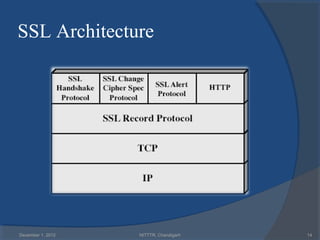
SSL Architecture


December 1, 2012   NITTTR, Chandigarh   14
SSL Architecture (Contd.)
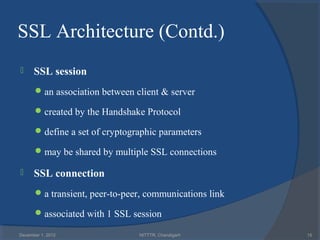
     SSL session
       an association between client & server

       created by the Handshake Protocol

       define a set of cryptographic parameters

       may be shared by multiple SSL connections

     SSL connection
       a transient, peer-to-peer, communications link

       associated with 1 SSL session

December 1, 2012                NITTTR, Chandigarh       15
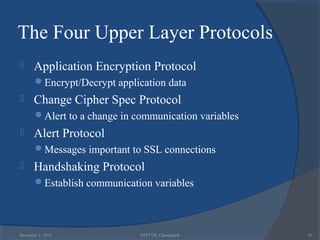
The Four Upper Layer Protocols
      Application Encryption Protocol
       Encrypt/Decrypt application data
      Change Cipher Spec Protocol
       Alert to a change in communication variables
      Alert Protocol
       Messages important to SSL connections
      Handshaking Protocol
       Establish communication variables


December 1, 2012              NITTTR, Chandigarh       16
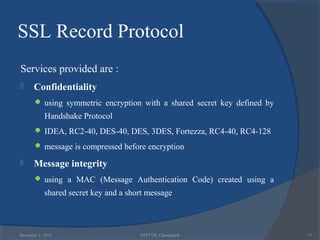
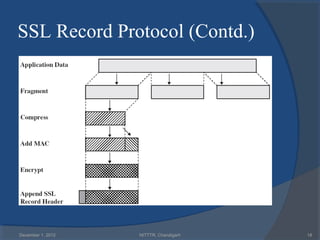
SSL Record Protocol
Services provided are :
      Confidentiality
        using symmetric encryption with a shared secret key defined by
            Handshake Protocol
        IDEA, RC2-40, DES-40, DES, 3DES, Fortezza, RC4-40, RC4-128

        message is compressed before encryption

      Message integrity
        using a MAC (Message Authentication Code) created using a
            shared secret key and a short message


December 1, 2012                       NITTTR, Chandigarh                 17
SSL Record Protocol (Contd.)


December 1, 2012   NITTTR, Chandigarh   18
SSL Change Cipher Spec Protocol
     one of 3 SSL specific protocols which use the
      SSL Record protocol
     a single message
     Purpose of message
      Cause copy of pending state to current state.

      Updates cipher suite to be used on the current

           connection .

December 1, 2012            NITTTR, Chandigarh          19
SSL Alert Protocol
      conveys SSL-related alerts to peer entity
      Consists of two bytes
        1st byte : warning or fatal
        2nd byte: code for specific alerts

      specific alert types
        unexpected message, bad record mac, decompression failure,

            handshake failure, illegal parameter
        close notify, no certificate, bad certificate, unsupported certificate,

            certificate revoked, certificate expired, certificate unknown

      compressed & encrypted like all SSL data

December 1, 2012                         NITTTR, Chandigarh                        20
SSL Handshake Protocol (1/10)
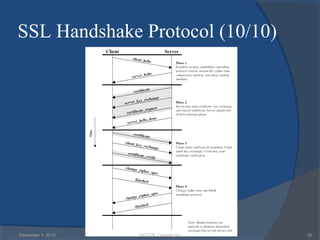
     The most complex part of SSL.
     allows server & client to:
      authenticate each other
      to negotiate encryption & MAC algorithms
      to negotiate cryptographic keys to be used
     comprises a series of messages in phases
      Establish Security Capabilities
      Server Authentication and Key Exchange
      Client Authentication and Key Exchange
      Finish


December 1, 2012             NITTTR, Chandigarh     21
Simple Handshake process (2/10)

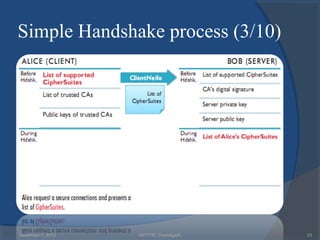
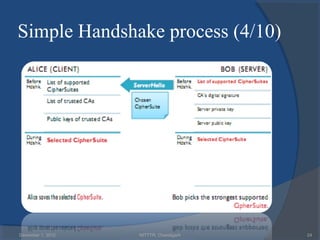
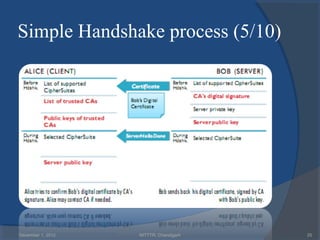
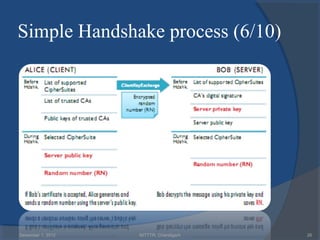
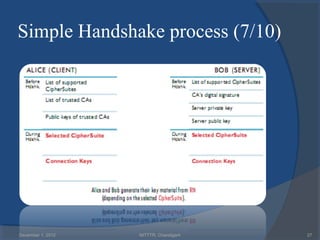
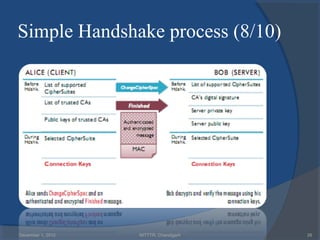
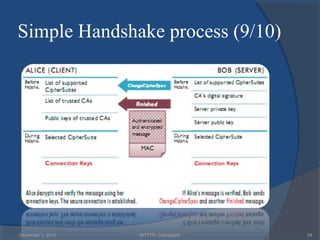
     The client(Alice) and server(Bob) must agree on various

      parameters to establish the connection
       Alice request a secure connections and presents a list of Cipher Suites

       Bob picks the strongest supported Cipher Suite

       Bob sends back his digital certificate

           ○ Including the certificate authority and his public key

       By encrypting using the server’s public key, Alice send a random

           number to Bob securely
       Alice and Bob generate key material from the random number

       Secure connection established

December 1, 2012                            NITTTR, Chandigarh                    22
Simple Handshake process (3/10)


December 1, 2012   NITTTR, Chandigarh   23
Simple Handshake process (4/10)


December 1, 2012   NITTTR, Chandigarh   24
Simple Handshake process (5/10)


December 1, 2012   NITTTR, Chandigarh   25
Simple Handshake process (6/10)


December 1, 2012   NITTTR, Chandigarh   26
Simple Handshake process (7/10)


December 1, 2012   NITTTR, Chandigarh   27
Simple Handshake process (8/10)


December 1, 2012   NITTTR, Chandigarh   28
Simple Handshake process (9/10)


December 1, 2012   NITTTR, Chandigarh   29
SSL Handshake Protocol (10/10)


December 1, 2012   NITTTR, Chandigarh   30
TLS (Transport Layer Security)
     IETF standard RFC 2246 similar to SSLv3
     with minor differences
      in record format version number
      uses HMAC for MAC
      a pseudo-random function expands secrets
      has additional alert codes
      some changes in supported ciphers
      changes in certificate negotiations
      changes in use of padding


December 1, 2012              NITTTR, Chandigarh   31
Changes from SSL 3.0 to TLS
       Fortezza removed
       Additional Alerts added
       Modification to hash calculations
       Protocol version 3.1 in ClientHello,
        ServerHello


32
 December 1, 2012            NITTTR, Chandigarh
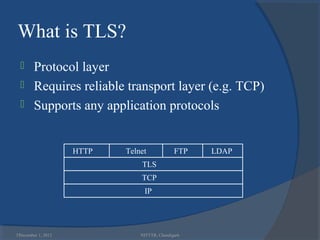
What is TLS?
   Protocol layer
   Requires reliable transport layer (e.g. TCP)
   Supports any application protocols


                    HTTP   Telnet             FTP   LDAP
                               TLS
                               TCP
                                IP


33
 December 1, 2012              NITTTR, Chandigarh
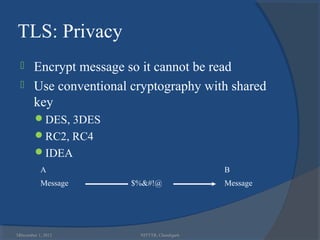
TLS: Privacy
   Encrypt message so it cannot be read
   Use conventional cryptography with shared
    key
        DES, 3DES
        RC2, RC4
        IDEA
           A                                B
           Message   $%&#!@                 Message


34
 December 1, 2012      NITTTR, Chandigarh
TLS:Key Exchange
   Need secure method to exchange secret key
   Use public key encryption for this
        “key pair” is used - either one can encrypt and
         then the other can decrypt
        slower than conventional cryptography
        share one key, keep the other private
       Choices are RSA or Diffie-Hellman


35
 December 1, 2012             NITTTR, Chandigarh
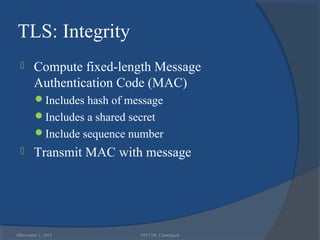
TLS: Integrity
       Compute fixed-length Message
        Authentication Code (MAC)
        Includes hash of message
        Includes a shared secret
        Include sequence number
       Transmit MAC with message


36
 December 1, 2012            NITTTR, Chandigarh
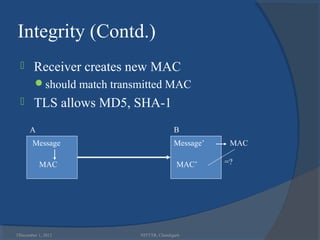
Integrity (Contd.)
       Receiver creates new MAC
        should match transmitted MAC
       TLS allows MD5, SHA-1
      A                                   B
       Message                            Message’    MAC

          MAC                              MAC’      =?


37
 December 1, 2012          NITTTR, Chandigarh
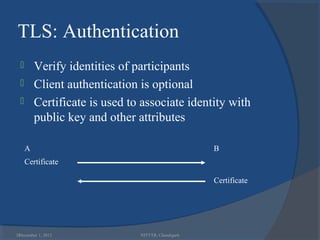
TLS: Authentication
         Verify identities of participants
         Client authentication is optional
         Certificate is used to associate identity with
          public key and other attributes

      A                                              B
      Certificate

                                                     Certificate


38
 December 1, 2012               NITTTR, Chandigarh
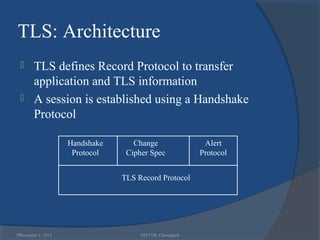
TLS: Architecture
       TLS defines Record Protocol to transfer
        application and TLS information
       A session is established using a Handshake
        Protocol

                    Handshake      Change                  Alert
                     Protocol    Cipher Spec              Protocol


                                TLS Record Protocol


39
 December 1, 2012                    NITTTR, Chandigarh
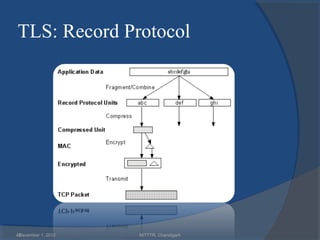
TLS: Record Protocol


40
 December 1, 2012   NITTTR, Chandigarh
TLS: Handshake
       Negotiate Cipher-Suite Algorithms
        Symmetric cipher to use
        Key exchange method
        Message digest function
   Establish and share master secret
   Optionally authenticate server and/or client


41
 December 1, 2012           NITTTR, Chandigarh
Handshake Phases
       Hello messages
       Certificate and Key Exchange messages
       Change Cipher Spec and Finished messages


42
 December 1, 2012          NITTTR, Chandigarh
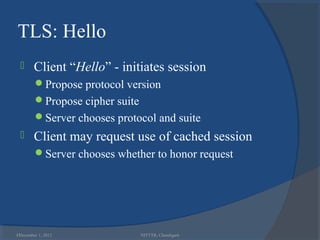
TLS: Hello
       Client “Hello” - initiates session
        Propose protocol version
        Propose cipher suite
        Server chooses protocol and suite
       Client may request use of cached session
        Server chooses whether to honor request


43
 December 1, 2012               NITTTR, Chandigarh
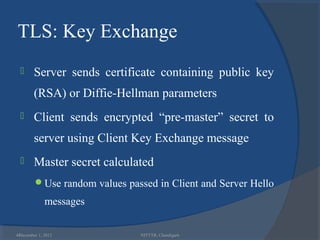
TLS: Key Exchange
       Server sends certificate containing public key
        (RSA) or Diffie-Hellman parameters
       Client sends encrypted “pre-master” secret to
        server using Client Key Exchange message
       Master secret calculated
        Use random values passed in Client and Server Hello

             messages

44
 December 1, 2012              NITTTR, Chandigarh
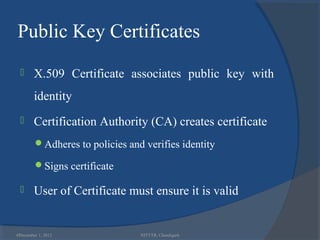
Public Key Certificates
       X.509 Certificate associates public key with
        identity
       Certification Authority (CA) creates certificate
        Adheres to policies and verifies identity

        Signs certificate

       User of Certificate must ensure it is valid


45
 December 1, 2012               NITTTR, Chandigarh
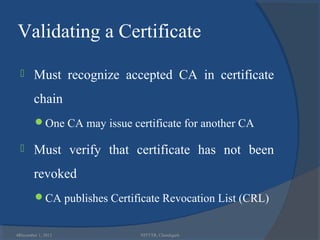
Validating a Certificate

       Must recognize accepted CA in certificate
        chain
        One CA may issue certificate for another CA

       Must verify that certificate has not been
        revoked
        CA publishes Certificate Revocation List (CRL)


46
 December 1, 2012            NITTTR, Chandigarh
X.509 Certificate Issues
       Certificate Administration is complex
        Hierarchy of Certification Authorities
        Mechanisms for requesting, issuing, revoking
             certificates
   X.500 names are complicated
   Description  formats are                       cumbersome
    (ASN.1)


47
 December 1, 2012             NITTTR, Chandigarh
TLS: HTTP Application
       HTTP is most common TLS application
        https://
   Requires TLS-capable web server
   Requires TLS-capable web browser
        Netscape Navigator
        Internet Explorer
        Cryptozilla
             ○ Netscape Mozilla sources with SSLeay


48
 December 1, 2012                NITTTR, Chandigarh
TLS “Alternatives”
   S-HTTP: secure HTTP protocol, shttp://
   IPSec: secure IP
   SET: Secure Electronic Transaction
        Protocol and infrastructure for bank card
             payments
       SASL: Simple Authentication and Security
        Layer (RFC 2222)


49
 December 1, 2012             NITTTR, Chandigarh
Implementation of SSL/TLS
      SSL and TLS have been widely implemented
        Open source software projects

            ○ OpenSSL, NSS, or GnuTLS

        Microsoft Windows

            ○ Part of its Secure Channel

        Browsers

            ○ Apple Safari

            ○ Mozilla Firefox (2+)

            ○ Internet Explorer, etc.

December 1, 2012                        NITTTR, Chandigarh   50
Application of SSL/TLS
      On top of the Transport Layer protocols
       Primarily with TCP

       Datagram Transport Layer Security(DTLS) for UDP

      Encapsulating the application protocols
       HTTP (HTTPS)

       for securing WWW traffic

       FTP (FTPS), SMTP, NNTP, etc.


December 1, 2012               NITTTR, Chandigarh         51
Summary
       SSL/TLS addresses the need for security in
        Internet communications
        Privacy - conventional encryption

        Integrity - Message Authentication Codes

        Authentication - X.509 certificates

       SSL in use today with web browsers and
        servers

52
 December 1, 2012               NITTTR, Chandigarh
References
      William Stallings, 5th Edition, “Transport-Level
       Security”, Chapter 16, Pages : 509-543
      www.cse.buffalo.edu/DBGROUP/nachi/ecopre
       s/fengmei.ppt
      http://www.slideshare.net/leethree/ssl-intro


December 1, 2012            NITTTR, Chandigarh            53
December 1, 2012   NITTTR, Chandigarh   54