Secure Electronic
Transaction (SET)
Credit and Debit Cards on the Internet
• Problem: communicate credit and debit card
  and purchasing data securely to gain consumer
  trust
   – Authentication of buyer and merchant
   – Confidential transmissions
• Systems vary by
   – Type of public-key encryption
   – Type of symmetric encryption
   – Message digest algorithm
   – Number of parties having private keys
   – Number of parties having certificates
Secure Electronic Transaction (SET)

• Developed by Visa and MasterCard
• Designed to protect credit and debit
  card transactions
• Confidentiality: all messages encrypted
• Trust: all parties must have digital
  certificates
• Privacy: information made available
  only when and where necessary
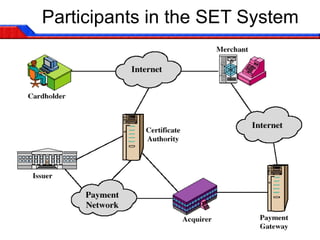
Participants in the SET System
SET Business Requirements (1)

• Provide confidentiality of payment and
  ordering information
• Ensure the integrity of all transmitted data
• Provide authentication that a cardholder is
  a legitimate user of a credit or debit card
  account
• Provide authentication that a merchant
  can accept credit or debit card
  transactions through its relationship with a
  financial institution
SET Business Requirements (2)

• Ensure the use of the best security
  practices and system design techniques
  to protect all legitimate parties in an
  electronic commerce transaction
• Create a protocol that neither depends on
  transport security mechanisms nor
  prevents their use
• Facilitate and encourage interoperability
  among software and network providers
SET Transactions (1)
SET Transactions (2)
• The customer opens an account with a
  card issuer.
   – MasterCard, Visa, etc.
• The customer receives a digital certificate
  signed by a bank.
• A merchant who accepts a certain brand of
  card must possess two digital certificates.
   – One for signing & one for key exchange
• The customer places an order for a product
  or service with a merchant.
• The merchant sends a copy of its certificate
  for verification.
SET Transactions (3)
• The customer sends order and payment
  information to the merchant.
• The merchant requests payment
  authorization from the payment gateway
  prior to shipment.
• The merchant confirms order to the
  customer.
• The merchant provides the goods or
  service to the customer.
• The merchant requests payment from
  the payment gateway.
SET Supported Transactions
  •   card holder registration
  •   merchant registration
  •   purchase request
  •   payment authorization
  •   payment capture
  •   certificate query
  •   purchase inquiry
  •   purchase notification
  •   sale transaction
  •   authorization reversal
  •   capture reversal
  •   credit / payment reversal
Key Technologies of SET

• Confidentiality of information: 3DES
• Integrity of data: RSA digital signatures
  with SHA-1 hash codes
• Cardholder account authentication:
  digital certificates with RSA signatures
• Merchant authentication: digital
  certificates with RSA signatures
• Privacy: separation of order and
  payment information using dual
  signatures

Secure electronic transaction (set)

  • 1.
  • 2.
    Credit and DebitCards on the Internet • Problem: communicate credit and debit card and purchasing data securely to gain consumer trust – Authentication of buyer and merchant – Confidential transmissions • Systems vary by – Type of public-key encryption – Type of symmetric encryption – Message digest algorithm – Number of parties having private keys – Number of parties having certificates
  • 3.
    Secure Electronic Transaction(SET) • Developed by Visa and MasterCard • Designed to protect credit and debit card transactions • Confidentiality: all messages encrypted • Trust: all parties must have digital certificates • Privacy: information made available only when and where necessary
  • 4.
  • 5.
    SET Business Requirements(1) • Provide confidentiality of payment and ordering information • Ensure the integrity of all transmitted data • Provide authentication that a cardholder is a legitimate user of a credit or debit card account • Provide authentication that a merchant can accept credit or debit card transactions through its relationship with a financial institution
  • 6.
    SET Business Requirements(2) • Ensure the use of the best security practices and system design techniques to protect all legitimate parties in an electronic commerce transaction • Create a protocol that neither depends on transport security mechanisms nor prevents their use • Facilitate and encourage interoperability among software and network providers
  • 7.
  • 8.
    SET Transactions (2) •The customer opens an account with a card issuer. – MasterCard, Visa, etc. • The customer receives a digital certificate signed by a bank. • A merchant who accepts a certain brand of card must possess two digital certificates. – One for signing & one for key exchange • The customer places an order for a product or service with a merchant. • The merchant sends a copy of its certificate for verification.
  • 9.
    SET Transactions (3) •The customer sends order and payment information to the merchant. • The merchant requests payment authorization from the payment gateway prior to shipment. • The merchant confirms order to the customer. • The merchant provides the goods or service to the customer. • The merchant requests payment from the payment gateway.
  • 10.
    SET Supported Transactions • card holder registration • merchant registration • purchase request • payment authorization • payment capture • certificate query • purchase inquiry • purchase notification • sale transaction • authorization reversal • capture reversal • credit / payment reversal
  • 11.
    Key Technologies ofSET • Confidentiality of information: 3DES • Integrity of data: RSA digital signatures with SHA-1 hash codes • Cardholder account authentication: digital certificates with RSA signatures • Merchant authentication: digital certificates with RSA signatures • Privacy: separation of order and payment information using dual signatures