The document discusses proxy servers, specifically HTTP and FTP proxy servers. It defines a proxy server as a server that acts as an intermediary for requests from clients to other servers. It describes the main purposes of proxy servers as keeping machines behind it anonymous for security purposes and speeding up access to resources via caching. It also provides details on the mechanisms, types, protocols (HTTP and FTP), and functions of proxy servers.

AGENDA Introduction Whatis a proxy server? Purpose of proxy server Types of proxy server Mechanism of proxy server Understanding briefly about http and ftp protocol Understanding http and ftp proxy servers
4.
PROTOCOL A protocolis set of rules for data representation, authentication, and error detection.
5.
INTRODUCTION TO HTTPHypertext Transfer Protocol (HTTP) is an application-level protocol for distributed, collaborative, hypermedia information systems.
6.
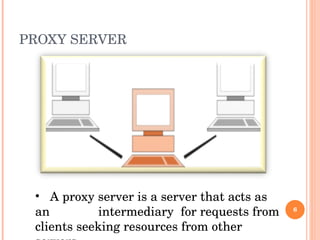
PROXY SERVER Aproxy server is a server that acts as an intermediary for requests from clients seeking resources from other servers.
7.
PURPOSE OF PROXYSERVER Proxy servers have two main purposes: To keep machines behind it anonymous (mainly for security) To speed up access to a resource (via caching). It is commonly used to cache web pages from a web server.
TYPES OF PROXYSERVERS Caching proxy server Web proxy server Content-filtering web proxy Anonymizing proxy server
10.
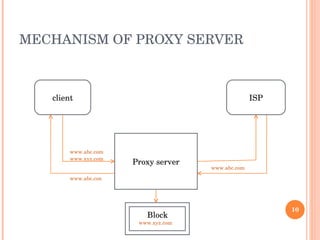
MECHANISM OF PROXYSERVER Proxy server client ISP Block www.xyz.com www.abc.com www.xyz.com www.abc.com www.abc.com
11.
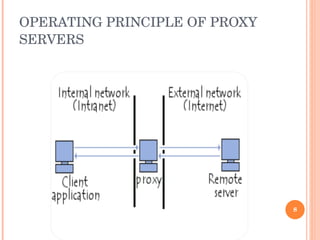
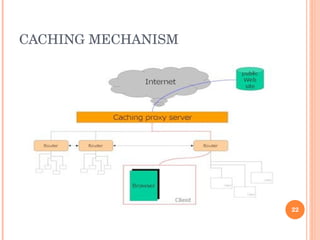
MECHANISM OF PROXYSERVER Proxy server accepts request from client. It generates response based on two conditions. If the document exits in the local cache, proxy server itself provides the required retrieval to the client.
12.
MECHANISM OF PROXYSERVER If there is a cache miss then the request is been forwarded to the original server. The proxy server transfers the replies to the client and also being caches them. The proxy server thus acts both as the client and the server.
13.
HYPER TEXT TRANSFERPROTOCOL(HTTP) Used to access data in WWW. to transfer data in the form of hypertext, plaintext, audio, video. It functions like a combination of FTP and SMTP.
14.
HYPER TEXT TRANSFERPROTOCOL(HTTP) It is similar to FTP because it transfers files and uses the services of TCP. It is simpler than FTP as it uses only one TCP connection on a well known port 80.
15.
HTTP (CONT…) Itis similar to SMTP since data are transferred from client and the server. Http differs from SMTP in the way messages are sent. Http are not destined to be read by humans They are read and interpreted by the http server and http client. Client sends a request which look like mail to the server. The server sends the response which looks like a mail reply to the client. Http itself is a stateless protocol.
16.
HTTP (CONT..) Clientsends a request which look like mail to the server. The server sends the response which looks like a mail reply to the client. Http itself is a stateless protocol.
17.
FILE TRANSFER PROTOCOL(FTP) It is a standard mechanism provided by the internet for copying a file from one host to another. There are many difficulties in file transfer. It establishes two TCP connections between the client and the server.
18.
FILE TRANSFER PROTOCOL(FTP) One connection for data transfer other for control information(commands and response). It is more efficient and the control connection is simpler whereas the data connection is complex.
19.
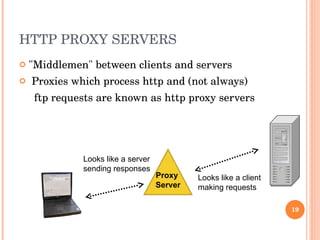
HTTP PROXY SERVERS"Middlemen" between clients and servers Proxies which process http and (not always) ftp requests are known as http proxy servers Proxy Server Looks like a server sending responses Looks like a client making requests
20.
KEY FEATURES OFHTTP PROXY SERVERS It may rewrite the client’s requests It Provides Anonymity and Security It is a Caching Proxy server Serves as content filter Multithreading
21.
ANONYMITY OF AHTTP PROXY HTTP proxy servers have several anonymity levels Based on Anonymity degree, they are classified as: Transparent Anonymous Distorting Highly Anonymous
FUNCTIONS OF HTTPPROXY SERVER Caching Reduces Latency Reduces Traffic on the web Bandwidth Conservation Increases accessibility firewalling and filtering connection sharing
24.
ADVANTAGES OFHTTP PROXY SERVERS Better Performance Less trafficking Reduces latency Conserves bandwidth Good at logging
25.
DISADVANTAGES OF HTTPPROXY SERVERS Proxy services lag behind nonproxied services Proxy services may require different servers for each service Proxy services usually require modifications to clients, procedures, or both Proxy services don't protect you from all protocol weaknesses Proxy services are not workable for some services
26.
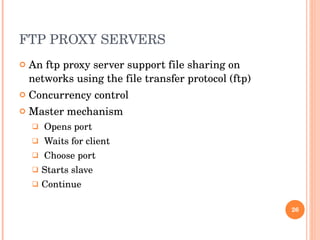
FTP PROXY SERVERSAn ftp proxy server support file sharing on networks using the file transfer protocol (ftp) Concurrency control Master mechanism Opens port Waits for client Choose port Starts slave Continue
27.
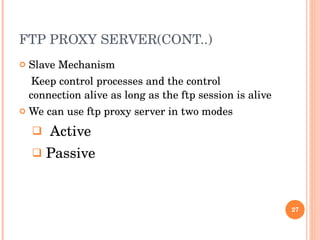
FTP PROXY SERVER(CONT..)Slave Mechanism Keep control processes and the control connection alive as long as the ftp session is alive We can use ftp proxy server in two modes Active Passive