PROXY SERVERS Rajavardhan  Rishabh  Rishikesh  Siddharth  Sriniketan
AGENDA Introduction How it works Types & Functions Performance aspects Advantages/Disadvantages Demo
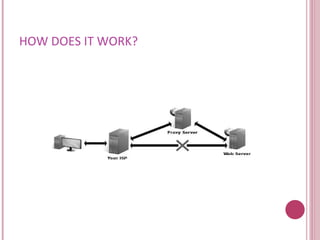
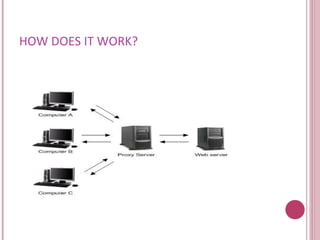
INTRODUCTION A proxy server is a server that acts as an intermediary between a workstation user and the Internet so that the enterprise can ensure security, administrative control, and caching service. By using the proxy server you can hide, conceal and make your network id anonymous by hiding your IP address A server that sits between a client application, such as a Web browser, and a real server 
HOW DOES IT WORK?
HOW DOES IT WORK?
TYPES AND FUNCTIONS Caching Proxy :  A caching proxy server accelerates service requests by retrieving content saved from a previous request made by the same client or even other clients  Web proxy :  A proxy that focuses on World Wide Web traffic is called a "web proxy". The most common use of a web proxy is to serve as a web cache.  Content-filtering web proxy :  A content-filtering web proxy server provides administrative control over the content that may be relayed through the proxy. It is commonly used in both commercial and non-commercial organizations (especially schools) to ensure that Internet usage conforms to acceptable use policy
TYPES AND FUNCTIONS Anonymizing proxy :  An anonymous proxy server (sometimes called a web proxy) generally attempts to anonymize web surfing.  Intercepting proxy :  An intercepting proxy combines a proxy server with a gateway or router .Connections made by client browsers through the gateway are diverted to the proxy without client-side configuration.
TRANSPARENT / OPAQUE SERVERS Transparent – both parties (local/remote) are unaware that the connection is being proxied Zorp  - application layer proxy is transparent Opaque – the local party must configure client software to use the proxy client software must be proxy-aware software Netscape proxy server is opaque With all of the things modern firewalls can do in the area of redirection you could configure the firewall to redirect all http requests to a proxy no user configuration required (transparent)
PERFORMANCE ASPECTS Caching By keeping local copies of frequently accessed file the proxy can serve those files back to a requesting browser without going to the external site each time, this dramatically improves the performance seen by the end user Only makes sense to implement this at the ISP rather than the small business level because of the number of pages available  Because of dynamic content many pages are invalidated in the cache right away Load balancing (Reverse Proxy) A proxy can be used in a reverse direction to balance the load amongst a set of identical servers (servers inside the firewall and users outside) Used especially with web dynamic content (.asp, .php,.cfm,.jsp)
SECURITY ADVANTAGES Hide internal clients from external network Blocking of dangerous URLs Filter dangerous content Eliminate need for transport layer routing between networks Single point of access, control and logging
PROXY LIABILITIES Single point of failure if the proxy dies , no one can get to the external network Client software must usually be designed to use a proxy Doesn’t protect the OS proxies run at the application level Usually optimized for performance rather than security WINGATE was installed to be easy to configure; opened a winsock proxy to the external interface, which let hackers essentially hijack the machine Create a service bottleneck solved via parallelism (more proxies, and load balance)
Softwares Invisible IP Map Windows 2000 to Vista Compatible Linux Compatible Works without a considerable drop in performance Invisible Browsing  Windows XP to Windows 7 compatible Mac OS X compatible Wide variety of proxy servers.
References www.publicproxyservers.com www.sourceparadise.org www.wikipedia.com/proxyservers www.howstuffworks.com/firewall www.slideshare.com/proxyservers www.isaserver.org
Acknowledgments  We would like to thank our guide for the project Mr. Raja Ram Gowda for his support and our professor Mr. Siddesh S. for giving us the opportunity to work on the same.
APPLAUSE THANK YOU FOR LISTENING!

Proxy Servers

  • 1.
    PROXY SERVERS Rajavardhan Rishabh Rishikesh Siddharth Sriniketan
  • 2.
    AGENDA Introduction Howit works Types & Functions Performance aspects Advantages/Disadvantages Demo
  • 3.
    INTRODUCTION A proxyserver is a server that acts as an intermediary between a workstation user and the Internet so that the enterprise can ensure security, administrative control, and caching service. By using the proxy server you can hide, conceal and make your network id anonymous by hiding your IP address A server that sits between a client application, such as a Web browser, and a real server 
  • 4.
  • 5.
  • 6.
    TYPES AND FUNCTIONSCaching Proxy : A caching proxy server accelerates service requests by retrieving content saved from a previous request made by the same client or even other clients Web proxy : A proxy that focuses on World Wide Web traffic is called a "web proxy". The most common use of a web proxy is to serve as a web cache. Content-filtering web proxy : A content-filtering web proxy server provides administrative control over the content that may be relayed through the proxy. It is commonly used in both commercial and non-commercial organizations (especially schools) to ensure that Internet usage conforms to acceptable use policy
  • 7.
    TYPES AND FUNCTIONSAnonymizing proxy : An anonymous proxy server (sometimes called a web proxy) generally attempts to anonymize web surfing. Intercepting proxy : An intercepting proxy combines a proxy server with a gateway or router .Connections made by client browsers through the gateway are diverted to the proxy without client-side configuration.
  • 8.
    TRANSPARENT / OPAQUESERVERS Transparent – both parties (local/remote) are unaware that the connection is being proxied Zorp - application layer proxy is transparent Opaque – the local party must configure client software to use the proxy client software must be proxy-aware software Netscape proxy server is opaque With all of the things modern firewalls can do in the area of redirection you could configure the firewall to redirect all http requests to a proxy no user configuration required (transparent)
  • 9.
    PERFORMANCE ASPECTS CachingBy keeping local copies of frequently accessed file the proxy can serve those files back to a requesting browser without going to the external site each time, this dramatically improves the performance seen by the end user Only makes sense to implement this at the ISP rather than the small business level because of the number of pages available Because of dynamic content many pages are invalidated in the cache right away Load balancing (Reverse Proxy) A proxy can be used in a reverse direction to balance the load amongst a set of identical servers (servers inside the firewall and users outside) Used especially with web dynamic content (.asp, .php,.cfm,.jsp)
  • 10.
    SECURITY ADVANTAGES Hideinternal clients from external network Blocking of dangerous URLs Filter dangerous content Eliminate need for transport layer routing between networks Single point of access, control and logging
  • 11.
    PROXY LIABILITIES Singlepoint of failure if the proxy dies , no one can get to the external network Client software must usually be designed to use a proxy Doesn’t protect the OS proxies run at the application level Usually optimized for performance rather than security WINGATE was installed to be easy to configure; opened a winsock proxy to the external interface, which let hackers essentially hijack the machine Create a service bottleneck solved via parallelism (more proxies, and load balance)
  • 12.
    Softwares Invisible IPMap Windows 2000 to Vista Compatible Linux Compatible Works without a considerable drop in performance Invisible Browsing Windows XP to Windows 7 compatible Mac OS X compatible Wide variety of proxy servers.
  • 13.
    References www.publicproxyservers.com www.sourceparadise.orgwww.wikipedia.com/proxyservers www.howstuffworks.com/firewall www.slideshare.com/proxyservers www.isaserver.org
  • 14.
    Acknowledgments Wewould like to thank our guide for the project Mr. Raja Ram Gowda for his support and our professor Mr. Siddesh S. for giving us the opportunity to work on the same.
  • 15.
    APPLAUSE THANK YOUFOR LISTENING!