Research Proposal
in
ANTENNA DESIGN
Presented By : Naveen Kumar
Outline
 Introduction
• Antennas for Mobile Handheld Devices
• Planar Inverted-F Antenna (PIFA) Structure
• Comparison between various antenna structures
 Problem Definition & Proposed Work
 Simulation Results with Conclusion
 Research Proposal
 Objectives
 Design Methodology
Introduction
 An Antenna converts electromagnetic radiation into electric current, or
vice versa.
 Need of Antenna :
 For transmission and reception of the radio signal.
 Antennas are required by any radio receiver or transmitter to couple its
electrical connection to the electromagnetic field.
 For electromagnetic waves carry signals through the air (or through
space) at the speed of light with almost no transmission loss.
 Wireless performance is completely dependent on a high performance
antenna design and implementation.
Antennas for Mobile devices
 The type of antenna that is used with a particular type of phone is normally
determined by dimensional considerations and specific absorption rate (SAR)
regulations.
 One has to make some kind of compromise among volume, impedance
bandwidth and radiation characteristics of an antenna while making the smallest
possible antenna.
 Antenna used in mobile handheld devices supporting several frequency bands
can have one of the following structure :
• Single band Antenna
• Multiband Antenna
• Reconfigurable antenna
Antennas for Mobile devices (Contd.)
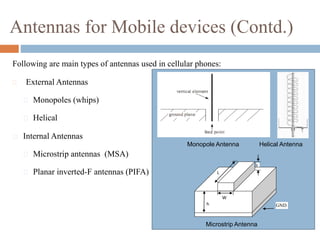
Following are main types of antennas used in cellular phones:
 External Antennas
 Monopoles (whips)
 Helical
 Internal Antennas
 Microstrip antennas (MSA)
 Planar inverted-F antennas (PIFA)
t
GND
L
W
h
Monopole Antenna Helical Antenna
Microstrip Antenna
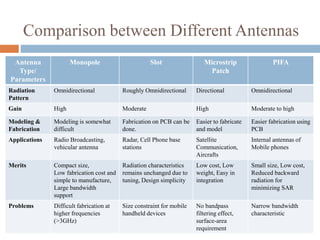
Comparison between Different Antennas
Antenna
Type/
Parameters
Monopole Slot Microstrip
Patch
PIFA
Radiation
Pattern
Omnidirectional Roughly Omnidirectional Directional Omnidirectional
Gain High Moderate High Moderate to high
Modeling &
Fabrication
Modeling is somewhat
difficult
Fabrication on PCB can be
done.
Easier to fabricate
and model
Easier fabrication using
PCB
Applications Radio Broadcasting,
vehicular antenna
Radar, Cell Phone base
stations
Satellite
Communication,
Aircrafts
Internal antennas of
Mobile phones
Merits Compact size,
Low fabrication cost and
simple to manufacture,
Large bandwidth
support
Radiation characteristics
remains unchanged due to
tuning, Design simplicity
Low cost, Low
weight, Easy in
integration
Small size, Low cost,
Reduced backward
radiation for
minimizing SAR
Problems Difficult fabrication at
higher frequencies
(>3GHz)
Size constraint for mobile
handheld devices
No bandpass
filtering effect,
surface-area
requirement
Narrow bandwidth
characteristic
Planar Inverted-F Antenna
(PIFA)
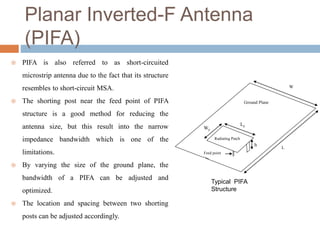
 PIFA is also referred to as short-circuited
microstrip antenna due to the fact that its structure
resembles to short-circuit MSA.
 The shorting post near the feed point of PIFA
structure is a good method for reducing the
antenna size, but this result into the narrow
impedance bandwidth which is one of the
limitations.
 By varying the size of the ground plane, the
bandwidth of a PIFA can be adjusted and
optimized.
 The location and spacing between two shorting
posts can be adjusted accordingly.
L
W
Ground Plane
Radiating Patch
Feed point
h
Lp
Wp
Typical PIFA
Structure
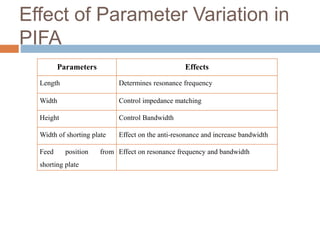
Effect of Parameter Variation in
PIFA
Parameters Effects
Length Determines resonance frequency
Width Control impedance matching
Height Control Bandwidth
Width of shorting plate Effect on the anti-resonance and increase bandwidth
Feed position from
shorting plate
Effect on resonance frequency and bandwidth
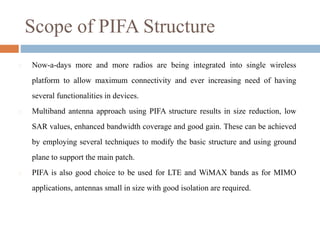
Scope of PIFA Structure
 Now-a-days more and more radios are being integrated into single wireless
platform to allow maximum connectivity and ever increasing need of having
several functionalities in devices.
 Multiband antenna approach using PIFA structure results in size reduction, low
SAR values, enhanced bandwidth coverage and good gain. These can be achieved
by employing several techniques to modify the basic structure and using ground
plane to support the main patch.
 PIFA is also good choice to be used for LTE and WiMAX bands as for MIMO
applications, antennas small in size with good isolation are required.
Problem Definition
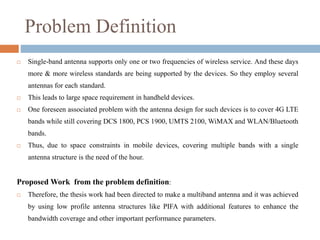
 Single-band antenna supports only one or two frequencies of wireless service. And these days
more & more wireless standards are being supported by the devices. So they employ several
antennas for each standard.
 This leads to large space requirement in handheld devices.
 One foreseen associated problem with the antenna design for such devices is to cover 4G LTE
bands while still covering DCS 1800, PCS 1900, UMTS 2100, WiMAX and WLAN/Bluetooth
bands.
 Thus, due to space constraints in mobile devices, covering multiple bands with a single
antenna structure is the need of the hour.
Proposed Work from the problem definition:
 Therefore, the thesis work had been directed to make a multiband antenna and it was achieved
by using low profile antenna structures like PIFA with additional features to enhance the
bandwidth coverage and other important performance parameters.
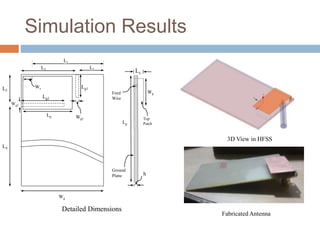
Simulation Results
Detailed Dimensions
3D View in HFSS
Wp
Ls
Lg
h
Feed
Wire
Ground
Plane
Top
Patch
L2
L1
Wg
L3
Wg2
L4
L5
Wg1
Lg1
Lp
Lg2
Ws
Fabricated Antenna
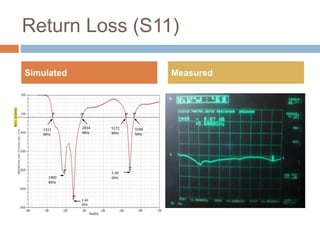
Return Loss (S11)
Simulated Measured
1900
MHz
1311
MHz
2834
MHz
5172
MHz
5596
MHz
2.40
GHz
5.40
GHz
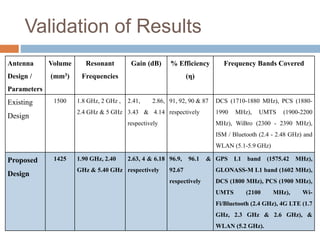
Validation of Results
Antenna
Design /
Parameters
Volume
(mm3)
Resonant
Frequencies
Gain (dB) % Efficiency
(η)
Frequency Bands Covered
Existing
Design
1500 1.8 GHz, 2 GHz ,
2.4 GHz & 5 GHz
2.41, 2.86,
3.43 & 4.14
respectively
91, 92, 90 & 87
respectively
DCS (1710-1880 MHz), PCS (1880-
1990 MHz), UMTS (1900-2200
MHz), WiBro (2300 - 2390 MHz),
ISM / Bluetooth (2.4 - 2.48 GHz) and
WLAN (5.1-5.9 GHz)
Proposed
Design
1425 1.90 GHz, 2.40
GHz & 5.40 GHz
2.63, 4 & 6.18
respectively
96.9, 96.1 &
92.67
respectively
GPS L1 band (1575.42 MHz),
GLONASS-M L1 band (1602 MHz),
DCS (1800 MHz), PCS (1900 MHz),
UMTS (2100 MHz), Wi-
Fi/Bluetooth (2.4 GHz), 4G LTE (1.7
GHz, 2.3 GHz & 2.6 GHz), &
WLAN (5.2 GHz).
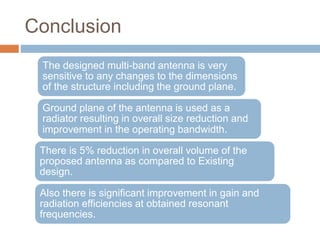
Conclusion
The designed multi-band antenna is very
sensitive to any changes to the dimensions
of the structure including the ground plane.
Ground plane of the antenna is used as a
radiator resulting in overall size reduction and
improvement in the operating bandwidth.
There is 5% reduction in overall volume of the
proposed antenna as compared to Existing
design.
Also there is significant improvement in gain and
radiation efficiencies at obtained resonant
frequencies.
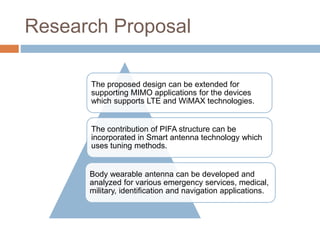
Research Proposal
The proposed design can be extended for
supporting MIMO applications for the devices
which supports LTE and WiMAX technologies.
The contribution of PIFA structure can be
incorporated in Smart antenna technology which
uses tuning methods.
Body wearable antenna can be developed and
analyzed for various emergency services, medical,
military, identification and navigation applications.
Objectives
To design the required antenna
according to desired application.
Reduce Overall Size
Improve Gain
Good Radiation Pattern
Design Methodology
Selection of Design parameters.
Modeling of Antenna structure.
Simulating & Optimizing Design Parameters
Fabrication & Testing of Antenna
Comparison & Result Validation
Ph.D Research proposal

Ph.D Research proposal

  • 1.
  • 2.
    Outline  Introduction • Antennasfor Mobile Handheld Devices • Planar Inverted-F Antenna (PIFA) Structure • Comparison between various antenna structures  Problem Definition & Proposed Work  Simulation Results with Conclusion  Research Proposal  Objectives  Design Methodology
  • 3.
    Introduction  An Antennaconverts electromagnetic radiation into electric current, or vice versa.  Need of Antenna :  For transmission and reception of the radio signal.  Antennas are required by any radio receiver or transmitter to couple its electrical connection to the electromagnetic field.  For electromagnetic waves carry signals through the air (or through space) at the speed of light with almost no transmission loss.  Wireless performance is completely dependent on a high performance antenna design and implementation.
  • 4.
    Antennas for Mobiledevices  The type of antenna that is used with a particular type of phone is normally determined by dimensional considerations and specific absorption rate (SAR) regulations.  One has to make some kind of compromise among volume, impedance bandwidth and radiation characteristics of an antenna while making the smallest possible antenna.  Antenna used in mobile handheld devices supporting several frequency bands can have one of the following structure : • Single band Antenna • Multiband Antenna • Reconfigurable antenna
  • 5.
    Antennas for Mobiledevices (Contd.) Following are main types of antennas used in cellular phones:  External Antennas  Monopoles (whips)  Helical  Internal Antennas  Microstrip antennas (MSA)  Planar inverted-F antennas (PIFA) t GND L W h Monopole Antenna Helical Antenna Microstrip Antenna
  • 6.
    Comparison between DifferentAntennas Antenna Type/ Parameters Monopole Slot Microstrip Patch PIFA Radiation Pattern Omnidirectional Roughly Omnidirectional Directional Omnidirectional Gain High Moderate High Moderate to high Modeling & Fabrication Modeling is somewhat difficult Fabrication on PCB can be done. Easier to fabricate and model Easier fabrication using PCB Applications Radio Broadcasting, vehicular antenna Radar, Cell Phone base stations Satellite Communication, Aircrafts Internal antennas of Mobile phones Merits Compact size, Low fabrication cost and simple to manufacture, Large bandwidth support Radiation characteristics remains unchanged due to tuning, Design simplicity Low cost, Low weight, Easy in integration Small size, Low cost, Reduced backward radiation for minimizing SAR Problems Difficult fabrication at higher frequencies (>3GHz) Size constraint for mobile handheld devices No bandpass filtering effect, surface-area requirement Narrow bandwidth characteristic
  • 7.
    Planar Inverted-F Antenna (PIFA) PIFA is also referred to as short-circuited microstrip antenna due to the fact that its structure resembles to short-circuit MSA.  The shorting post near the feed point of PIFA structure is a good method for reducing the antenna size, but this result into the narrow impedance bandwidth which is one of the limitations.  By varying the size of the ground plane, the bandwidth of a PIFA can be adjusted and optimized.  The location and spacing between two shorting posts can be adjusted accordingly. L W Ground Plane Radiating Patch Feed point h Lp Wp Typical PIFA Structure
  • 8.
    Effect of ParameterVariation in PIFA Parameters Effects Length Determines resonance frequency Width Control impedance matching Height Control Bandwidth Width of shorting plate Effect on the anti-resonance and increase bandwidth Feed position from shorting plate Effect on resonance frequency and bandwidth
  • 9.
    Scope of PIFAStructure  Now-a-days more and more radios are being integrated into single wireless platform to allow maximum connectivity and ever increasing need of having several functionalities in devices.  Multiband antenna approach using PIFA structure results in size reduction, low SAR values, enhanced bandwidth coverage and good gain. These can be achieved by employing several techniques to modify the basic structure and using ground plane to support the main patch.  PIFA is also good choice to be used for LTE and WiMAX bands as for MIMO applications, antennas small in size with good isolation are required.
  • 10.
    Problem Definition  Single-bandantenna supports only one or two frequencies of wireless service. And these days more & more wireless standards are being supported by the devices. So they employ several antennas for each standard.  This leads to large space requirement in handheld devices.  One foreseen associated problem with the antenna design for such devices is to cover 4G LTE bands while still covering DCS 1800, PCS 1900, UMTS 2100, WiMAX and WLAN/Bluetooth bands.  Thus, due to space constraints in mobile devices, covering multiple bands with a single antenna structure is the need of the hour. Proposed Work from the problem definition:  Therefore, the thesis work had been directed to make a multiband antenna and it was achieved by using low profile antenna structures like PIFA with additional features to enhance the bandwidth coverage and other important performance parameters.
  • 11.
    Simulation Results Detailed Dimensions 3DView in HFSS Wp Ls Lg h Feed Wire Ground Plane Top Patch L2 L1 Wg L3 Wg2 L4 L5 Wg1 Lg1 Lp Lg2 Ws Fabricated Antenna
  • 12.
    Return Loss (S11) SimulatedMeasured 1900 MHz 1311 MHz 2834 MHz 5172 MHz 5596 MHz 2.40 GHz 5.40 GHz
  • 13.
    Validation of Results Antenna Design/ Parameters Volume (mm3) Resonant Frequencies Gain (dB) % Efficiency (η) Frequency Bands Covered Existing Design 1500 1.8 GHz, 2 GHz , 2.4 GHz & 5 GHz 2.41, 2.86, 3.43 & 4.14 respectively 91, 92, 90 & 87 respectively DCS (1710-1880 MHz), PCS (1880- 1990 MHz), UMTS (1900-2200 MHz), WiBro (2300 - 2390 MHz), ISM / Bluetooth (2.4 - 2.48 GHz) and WLAN (5.1-5.9 GHz) Proposed Design 1425 1.90 GHz, 2.40 GHz & 5.40 GHz 2.63, 4 & 6.18 respectively 96.9, 96.1 & 92.67 respectively GPS L1 band (1575.42 MHz), GLONASS-M L1 band (1602 MHz), DCS (1800 MHz), PCS (1900 MHz), UMTS (2100 MHz), Wi- Fi/Bluetooth (2.4 GHz), 4G LTE (1.7 GHz, 2.3 GHz & 2.6 GHz), & WLAN (5.2 GHz).
  • 14.
    Conclusion The designed multi-bandantenna is very sensitive to any changes to the dimensions of the structure including the ground plane. Ground plane of the antenna is used as a radiator resulting in overall size reduction and improvement in the operating bandwidth. There is 5% reduction in overall volume of the proposed antenna as compared to Existing design. Also there is significant improvement in gain and radiation efficiencies at obtained resonant frequencies.
  • 15.
    Research Proposal The proposeddesign can be extended for supporting MIMO applications for the devices which supports LTE and WiMAX technologies. The contribution of PIFA structure can be incorporated in Smart antenna technology which uses tuning methods. Body wearable antenna can be developed and analyzed for various emergency services, medical, military, identification and navigation applications.
  • 16.
    Objectives To design therequired antenna according to desired application. Reduce Overall Size Improve Gain Good Radiation Pattern
  • 17.
    Design Methodology Selection ofDesign parameters. Modeling of Antenna structure. Simulating & Optimizing Design Parameters Fabrication & Testing of Antenna Comparison & Result Validation