A MULTIBAND PIFA ANTENNA
FOR MOBILE DEVICES

Presented By :

Under the Guidance of :

Naveen Kumar

Garima Saini

M.E. ECE (Regular 2011)

Assistant Professor , ECE Deptt.

NITTTR, Chandigarh

NITTTR, Chandigarh
Outline


Introduction



Planar Inverted-F Antenna (PIFA) Structure




Antennas for Mobile Handheld Devices
Comparison between various antenna structures

Literature Survey


Inferences Drawn



Problem Definition



Objectives



Design Methodology



Simulations & Results



Conclusion



Future Scope



Publications



References
National Institute of Technical Teacher's Training & Research, Chandigarh

December 14, 2013
Introduction

National Institute of Technical Teacher's Training & Research, Chandigarh

December 14, 2013
Introduction


An Antenna converts electromagnetic radiation into electric current, or
vice versa.



Need of Antenna :


For transmission and reception of the radio signal.



Antennas are required by any radio receiver or transmitter to couple its
electrical connection to the electromagnetic field.



For electromagnetic waves carry signals through the air (or through
space) at the speed of light with almost no transmission loss.



Wireless performance is completely dependent on a high performance
antenna design and implementation.

National Institute of Technical Teacher's Training & Research, Chandigarh

December 14, 2013
Antennas for Mobile devices


The type of antenna that is used with a particular type of phone is normally
determined by dimensional considerations and specific absorption rate (SAR)
regulations.



One has to make some kind of compromise among volume, impedance
bandwidth and radiation characteristics of an antenna while making the smallest
possible antenna.



Antenna used in mobile handheld devices supporting several frequency bands
can have one of the following structure :


Single band Antenna



Multiband Antenna



Reconfigurable antenna

National Institute of Technical Teacher's Training & Research, Chandigarh

December 14, 2013
Antennas for Mobile devices (Contd.)
Following are main types of antennas used in cellular phones:


External Antennas





Monopoles (whips)
Helical

Internal Antennas


Microstrip antennas (MSA)



Planar inverted-F antennas (PIFA)

National Institute of Technical Teacher's Training & Research, Chandigarh

December 14, 2013
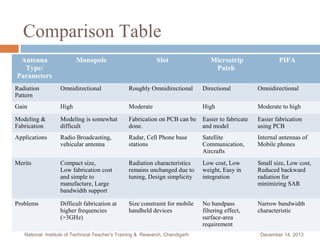
Comparison Table
Antenna
Type/
Parameters

Monopole

Slot

Microstrip
Patch

PIFA

Radiation
Pattern

Omnidirectional

Roughly Omnidirectional

Directional

Omnidirectional

Gain

High

Moderate

High

Moderate to high

Modeling &
Fabrication

Modeling is somewhat
difficult

Fabrication on PCB can be
done.

Easier to fabricate
and model

Easier fabrication
using PCB

Applications

Radio Broadcasting,
vehicular antenna

Radar, Cell Phone base
stations

Satellite
Communication,
Aircrafts

Internal antennas of
Mobile phones

Merits

Compact size,
Low fabrication cost
and simple to
manufacture, Large
bandwidth support

Radiation characteristics
remains unchanged due to
tuning, Design simplicity

Low cost, Low
weight, Easy in
integration

Small size, Low cost,
Reduced backward
radiation for
minimizing SAR

Problems

Difficult fabrication at
higher frequencies
(>3GHz)

Size constraint for mobile
handheld devices

No bandpass
filtering effect,
surface-area
requirement

Narrow bandwidth
characteristic

National Institute of Technical Teacher's Training & Research, Chandigarh

December 14, 2013
Planar Inverted-F Antenna
(PIFA)


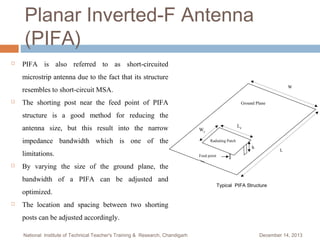
PIFA is also referred to as short-circuited
microstrip antenna due to the fact that its structure
W

resembles to short-circuit MSA.


The shorting post near the feed point of PIFA

Ground Plane

structure is a good method for reducing the
antenna size, but this result into the narrow
impedance bandwidth which is one of the
limitations.


Radiating Patch

h

L

Feed point

By varying the size of the ground plane, the
bandwidth of a PIFA can be adjusted and
optimized.



Lp

Wp

Typical PIFA Structure

The location and spacing between two shorting
posts can be adjusted accordingly.
National Institute of Technical Teacher's Training & Research, Chandigarh

December 14, 2013
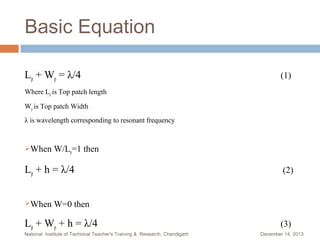
Basic Equation
Lp + Wp = λ/4

(1)

Where Lp is Top patch length
Wp is Top patch Width
λ is wavelength corresponding to resonant frequency

When

W/Lp=1 then

Lp + h = λ/4
When

(2)

W=0 then

Lp + Wp + h = λ/4
National Institute of Technical Teacher's Training & Research, Chandigarh

(3)
December 14, 2013
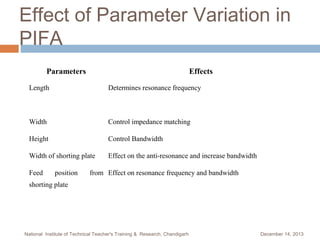
Effect of Parameter Variation in
PIFA
Parameters

Effects

Length

Determines resonance frequency

Width

Control impedance matching

Height

Control Bandwidth

Width of shorting plate

Effect on the anti-resonance and increase bandwidth

Feed

position

from Effect on resonance frequency and bandwidth

shorting plate

National Institute of Technical Teacher's Training & Research, Chandigarh

December 14, 2013
Literature Survey

National Institute of Technical Teacher's Training & Research, Chandigarh

December 14, 2013
Literature Survey [1]

1.pdf

Rashid Ahmad Bhatti, Ngoc-Anh Nguyen, Viet-Anh Nguyen and Seong ook Park, “Design of
a Compact Internal Antenna for Multi-Band Personal Communication Handsets”, IEEE
Proceedings of Asia-Pacific Microwave Conference, Page(s):1-4, 2007.
●

Authors proposed a compact multiband antenna with reduced height.

●

Proposed antenna operates at DCS, PCS, UMTS, WiBro, ISM/Bluetooth and WLAN 5
GHz bands.

●

F-shaped slot is created on the top radiating patch and its dimensions are optimized to
enhance band coverage of 5 GHz band.

●

The total volume of the antenna is 1.5 cm3.



Conclusion :

●

Use of extra shorting strip enhances bandwidth at lower band while slot on the patch
enhances bandwidth at higher band. The height of the PIFA is less compared to
conventional structures thus, reducing overall volume.

National Institute of Technical Teacher's Training & Research, Chandigarh

December 14, 2013
Literature Survey [2]

2.pdf

A. Cabedo, J. Anguera, C. Picher, M. Ribo and C. Puente , “Multiband Handset Antenna
Combining a PIFA, Slots, and Ground Plane Modes”, IEEE Transactions On Antennas
And Propagation, Vol. 57, No. 9, Page(s): 2526 – 2533, 2009.


Authors proposed PIFA structure along with slots on the ground plane.



Antenna covers low frequencies (GSM 850/900) & high frequencies (DCS, PCS,
Bluetooth, UMTS).



Three slots are used which has two functions mainly i.e. to tune the ground plane
resonance at low frequencies & to act as parasitic radiator at high frequencies.

Conclusion


:

Use of slots on ground plane enhances bandwidth both at low & high frequencies
without increase in the volume of the antenna.

National Institute of Technical Teacher's Training & Research, Chandigarh

December 14, 2013
Literature Survey [3]

3.pdf

Sinhyung Jeon, Hyengcheul Choi, and Hyeongdong Kim, “Hybrid Planar Inverted-F
Antenna with a T-shaped slot on the ground plane”, ETRI Journal, Vol. 31, No. 5,
Page(s): 616-618, 2009.
●A

novel antenna was proposed by authors. The structure make use of T-shaped ground

plane along with rectangular patch to achieve resonance at desired frequencies.
●The

frequency bands covered by the antenna are DCS, WiBro, Bluetooth and S-DMB

bands.
Conclusion
●The

:

structure of top patch is simple in construction and introduction of T-shaped slot on

ground plane resulted in resonance at 2.4 GHz band with enhanced bandwidth coverage.

National Institute of Technical Teacher's Training & Research, Chandigarh

December 14, 2013
Literature Survey [4]

4.pdf

H.F. Abu Tarboush, R. Nilavalan, T. Peter and S.W. Cheung, “Multiband Inverted-F
Antenna With Independent Bands for Small and Slim Cellular Mobile Handsets”,
IEEE Transactions On Antennas And Propagation, Vol. 59, No. 7, Page(s): 2636 – 2645,
2011.


Proposed antenna design have independent control on the resonant frequency bands
which are UMTS(2.09 GHz), m-WiMax(3.74 GHz) & WLAN (5 GHz).



The structure consists of slotted radiator supported by shorting walls and small
ground plane.

Conclusion


:

Ground plane of the antenna has minimal effect on performance and it is also not
too sensitive to human hand and phone housing.



Electronics components can be placed closer to the antenna resulting in overall size
even more compact and thin.

National Institute of Technical Teacher's Training & Research, Chandigarh

December 14, 2013
Literature Survey [5]

5.pdf

C. Picher, J. Angueral, A. Andújar, C. Puente1, and S. Kahng, “Analysis of the Human
Head Interaction in Handset Antennas with Slotted Ground Planes”, IEEE Antennas
and Propagation Magazine, Vol. 54, No. 2, Page(s): 36 – 56, 2012.
●Authors

studied and analyzed different configurations of slotted ground plane for human

head interaction.
●Results

showed that the slots on the ground plane are useful in increasing bandwidth

coverage and efficiency of the antenna structure.
●Authors

observed that interaction of human head with the antenna adds losses to antenna

affecting efficiency and radiation patterns.
Conclusion
●Analysis

:

showed that PIFA with two open ended slots performs well as compared to PIFA

without slots covering more number of frequency bands.
National Institute of Technical Teacher's Training & Research, Chandigarh

December 14, 2013
Inferences Drawn


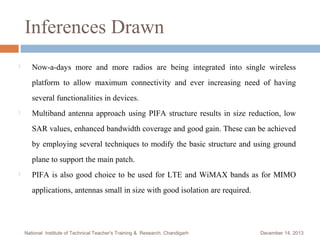
Now-a-days more and more radios are being integrated into single wireless
platform to allow maximum connectivity and ever increasing need of having
several functionalities in devices.



Multiband antenna approach using PIFA structure results in size reduction, low
SAR values, enhanced bandwidth coverage and good gain. These can be achieved
by employing several techniques to modify the basic structure and using ground
plane to support the main patch.



PIFA is also good choice to be used for LTE and WiMAX bands as for MIMO
applications, antennas small in size with good isolation are required.

National Institute of Technical Teacher's Training & Research, Chandigarh

December 14, 2013
Problem Definition


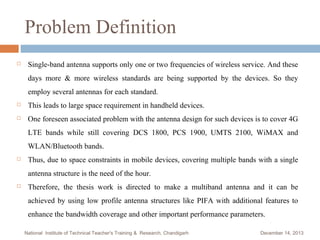
Single-band antenna supports only one or two frequencies of wireless service. And these
days more & more wireless standards are being supported by the devices. So they
employ several antennas for each standard.



This leads to large space requirement in handheld devices.



One foreseen associated problem with the antenna design for such devices is to cover 4G
LTE bands while still covering DCS 1800, PCS 1900, UMTS 2100, WiMAX and
WLAN/Bluetooth bands.



Thus, due to space constraints in mobile devices, covering multiple bands with a single
antenna structure is the need of the hour.



Therefore, the thesis work is directed to make a multiband antenna and it can be
achieved by using low profile antenna structures like PIFA with additional features to
enhance the bandwidth coverage and other important performance parameters.
National Institute of Technical Teacher's Training & Research, Chandigarh

December 14, 2013
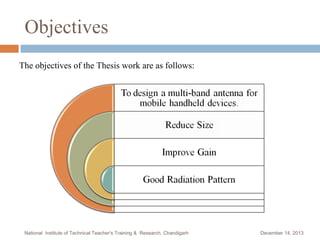
Objectives
The objectives of the Thesis work are as follows:

National Institute of Technical Teacher's Training & Research, Chandigarh

December 14, 2013
Design Methodology

National Institute of Technical Teacher's Training & Research, Chandigarh

December 14, 2013
Selection of Design Parameters


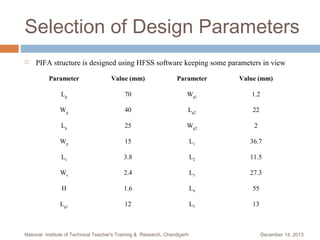
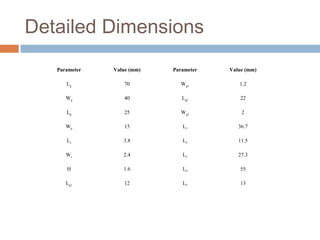
PIFA structure is designed using HFSS software keeping some parameters in view
Parameter

Value (mm)

Parameter

Value (mm)

Lg

70

Wg1

1.2

Wg

40

Lg2

22

Lp

25

Wg2

2

Wp

15

L1

36.7

Ls

3.8

L2

11.5

Ws

2.4

L3

27.3

H

1.6

L4

55

Lg1

12

L5

13

National Institute of Technical Teacher's Training & Research, Chandigarh

December 14, 2013
Simulations & Results

National Institute of Technical Teacher's Training & Research, Chandigarh

December 14, 2013
Proposed Designs


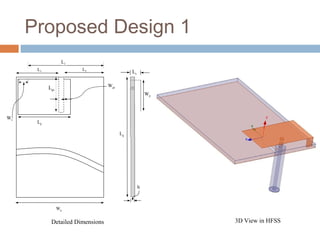
Proposed Design 1



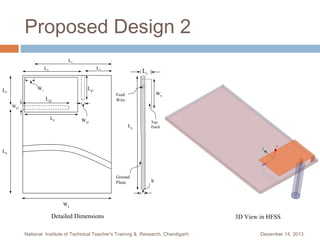
Proposed Design 2
Proposed Design 1
L1
L2

L3

Wgs

Lgs

Ws

Ls

Wp

Lp
Lg

h

Wg

Detailed Dimensions

3D View in HFSS
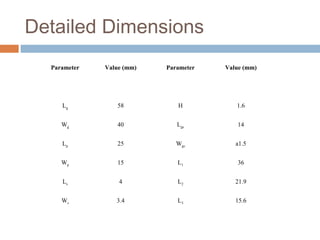
Detailed Dimensions
Parameter

Value (mm)

Parameter

Value (mm)

Lg

58

H

1.6

Wg

40

Lgs

14

Lp

25

Wgs

a1.5

Wp

15

L1

36

Ls

4

L2

21.9

Ws

3.4

L3

15.6
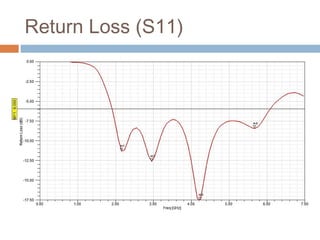
Return Loss (S11)
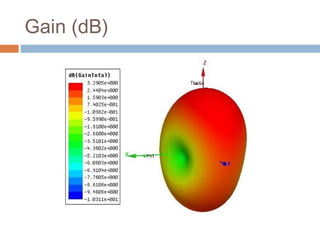
Gain (dB)
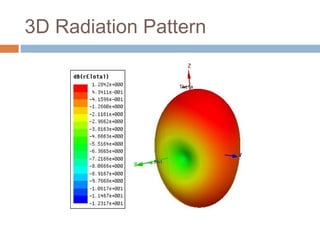
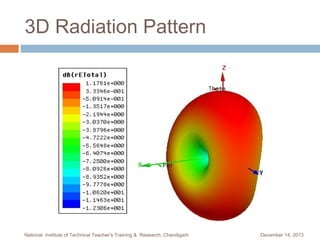
3D Radiation Pattern
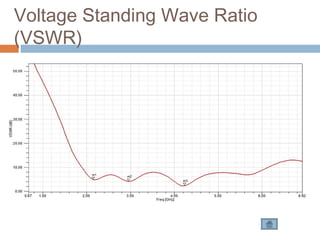
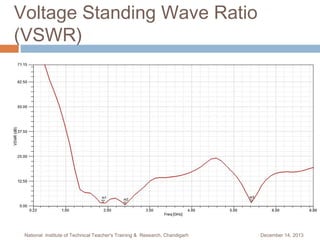
Voltage Standing Wave Ratio
(VSWR)
Proposed Design 2
L1
L2

L3

Lg1

Ws

L5

Lg2

Ls

Wp

Feed
Wire

Wg2

Lp

Wg1

Lg

Top
Patch

L4

Ground
Plane

h

Wg

Detailed Dimensions
National Institute of Technical Teacher's Training & Research, Chandigarh

3D View in HFSS
December 14, 2013
Detailed Dimensions
Parameter

Value (mm)

Parameter

Value (mm)

Lg

70

Wg1

1.2

Wg

40

Lg2

22

Lp

25

Wg2

2

Wp

15

L1

36.7

Ls

3.8

L2

11.5

Ws

2.4

L3

27.3

H

1.6

L4

55

Lg1

12

L5

13
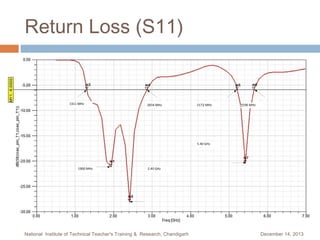
Return Loss (S11)

1311 MHz

2834 MHz

5172 MHz

5596 MHz

5.40 GHz

1900 MHz

2.40 GHz

National Institute of Technical Teacher's Training & Research, Chandigarh

December 14, 2013
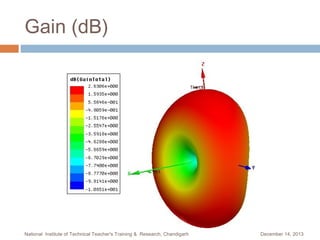
Gain (dB)

National Institute of Technical Teacher's Training & Research, Chandigarh

December 14, 2013
3D Radiation Pattern

National Institute of Technical Teacher's Training & Research, Chandigarh

December 14, 2013
Voltage Standing Wave Ratio
(VSWR)

National Institute of Technical Teacher's Training & Research, Chandigarh

December 14, 2013
Validation of Results

National Institute of Technical Teacher's Training & Research, Chandigarh

December 14, 2013
Validation of Results
Antenna

Volume

Resonant

Design/

(mm3)

Gain (dB)

% Efficiency

Frequencies

Frequency Bands Covered

(η)

Parameters
Design in [10]

1500

1.8 GHz, 2

2.41, 2.86, 91, 92, 90 & 87

DCS

(1710-1880

MHz),

PCS

GHz , 2.4 GHz

3.43 & 4.14 respectively

(1880-1990 MHz), UMTS (1900-

& 5 GHz

respectively

2200 MHz), WiBro (2300 - 2390
MHz), ISM / Bluetooth (2.4 - 2.48
GHz) and WLAN (5.1-5.9 GHz)

Proposed Design

1425

1.94 GHz, 2.42

2.63, 4 & 96.9,

96.1

GHz & 5.42

6.18

GHz

respectively respectively

92.67

& GPS L1 band (1575.42 MHz),
GLONASS-M L1 band (1602
MHz), DCS (1800 MHz), PCS
(1900 MHz), UMTS (2100 MHz),
Wi-Fi/Bluetooth (2.4 GHz), 4G
LTE (1.7 GHz, 2.3 GHz & 2.6
GHz), & WLAN (5.2 GHz).

National Institute of Technical Teacher's Training & Research, Chandigarh

December 14, 2013
Conclusion

National Institute of Technical Teacher's Training & Research, Chandigarh

December 14, 2013
Conclusion
There are few conclusions that can be drawn from this thesis work:


The designed multi-band antenna, built on PIFA structure, is very sensitive to any
changes to the dimensions of the structure including the ground plane.



Ground plane of the antenna is used as a radiator resulting in overall size reduction
and improvement in the operating bandwidth.



There is 5% reduction in overall volume of the proposed antenna as compared to
design in [10].



Also there is significant improvement in gain and radiation efficiencies at obtained
resonant frequencies.

National Institute of Technical Teacher's Training & Research, Chandigarh

December 14, 2013
Future Scope of the Work


The antenna prototype can be developed which can be used to study the
performance of the antenna with human interaction and investigate the Specific
Absorption Rate (SAR) value by employing human model testing.



The antenna structure can be placed inside a handheld device casing and it can be
analyzed using an Anechoic chamber.



The design proposed in this thesis work can be extended for supporting MIMO
applications for the devices which supports LTE and WiMAX technologies.

National Institute of Technical Teacher's Training & Research, Chandigarh

December 14, 2013
Publications


Naveen Kumar, Garima Saini, “A Novel Low Profile Planar Inverted-F Antenna
(PIFA) for Mobile Handsets”, International Journal of Scientific and Research
Publications (IJSRP), Volume 3, Issue 3, March 2013.



Naveen Kumar, Garima Saini, “A Compact Planar Inverted-F Antenna with
Slotted Ground Plane”, International Journal of Electronics & Communication
Technology (IJECT), Volume 4, Issue 2 Ver. 3, Page(s): 399-401, June 2013.



Naveen Kumar, Garima Saini, “A Multiband PIFA with Slotted Ground Plane for
Personal

Communication

Handheld

Devices”,

International

Journal

of

Engineering Research and Development (IJERD), Volume 7, Issue 11, Page(s): 7074, July 2013.

National Institute of Technical Teacher's Training & Research, Chandigarh

December 14, 2013
References
1) Kin-Lu Wong, “Planar Antennas for Wireless Communication”, Published by John Wiley & Sons, Inc., Chapter: 2, Pages: 26-65, 2003.
2) C. Rowell, E.Y. Lam, “Mobile-phone antenna design”, IEEE Antennas and Propagation Magazine, Vol. 54, No. 4, Page(s): 14 – 34, 2012.
3) W. Geyi, Q. Rao, S. Ali, and D. Wang, “Handset Antenna Design: Practice and Theory”, Progress in Electromagnetic Research Journal
(PIER), Vol. 80, Pages: 123–160, 2008.

4) Hang Wong, Kwai-Man Luk, Chi Hou Chan, Quan Xue, Kwok Kan So, Hau Wah Lai, “Small antennas in Wireless Communications”,
Proceedings of the IEEE Journal, Vol. 100, No. 7, Page(s): 2109 – 2121, 2012.

5) R. Vaughan, “Model and results for single mode PIFA antenna”, IEEE Antennas and Propagation Society International Symposium, Vol. 4,
Page(s): 4028 – 4031, 2004.

6) Taeho Son, “Feeding point determination for PIFA type mobile phone handset internal antenna”, IEEE Antennas and Propagation Society
International Symposium, Vol. 1A, Page(s): 475 – 478, 2005.

7) J.A. Ray, S.R.B. Chaudhuri, “A review of PIFA technology”, IEEE Indian Antenna week (IAW), Page(s): 1 – 4, 2011.
8) Y. Belhadef, N. Boukli Hacene, “PIFAs antennas design for mobile communications”, 7 th IEEE International Workshop on Systems, Signal
Processing and their Applications, Page(s): 119 – 122, 2011.

9) Hassan Tariq Chattha, Yi Huang, Xu Zhu, and Yang Lu, “An empirical equation for predicting the resonant frequency of planar inverted-F
antennas”, IEEE Antennas and Wireless Propagation Letters, Vol.8, Page(s): 856 – 860, 2009.

10) Rashid Ahmad Bhatti, Ngoc-Anh Nguyen, Viet-Anh Nguyen and Seong ook Park, “Design of a Compact Internal Antenna for Multi-Band
Personal Communication Handsets”, IEEE Proceedings of Asia-Pacific Microwave Conference, Page(s):1-4, 2007.

11) Viet-Anh Nguyen, Manh-Tuan Dao, Yun Tack Lim, and Seong-Ook Park, “A Compact Tunable Internal Antenna for Personal
Communication Handsets”, IEEE Antennas And Wireless Propagation Letters, Vol. 7, Page(s): 569 – 572, 2008.
National Institute of Technical Teacher's Training & Research, Chandigarh

December 14, 2013
References Contd.
12)

Ya-Chung Yu and Jenn-Hwan Tarng, “A Novel Modified Multiband Planar Inverted-F Antenna”, IEEE Antennas and Wireless Propagation Letters, Vol.
8, Page(s): 189 – 192, 2009.

13)

J. Cho, C.W. Jung and K. Kim , “Frequency-reconfigurable two-port antenna for mobile phone operating over multiple service bands”, IEEE Electronics
Letters, Vol. 45 No. 20, Page(s): 1009 – 1011, 2009.

14)

A. Cabedo, J. Anguera, C. Picher, M. Ribo, C. Puente, “Multiband Handset Antenna Combining a PIFA, Slots, and Ground Plane Modes”, IEEE
Transactions On Antennas And Propagation, Vol. 57, No. 9, Page(s): 2526 – 2533, 2009.

15)

H. Rhyu, J. Byun, F.J. Harackiewicz, M.J. Park, K. Jung, D. Kim, N. Kim, T. Kim, B. Lee, “Multi-band hybrid antenna for ultra-thin mobile phone
applications”, IEEE Electronics Letters, Vol. 45, No. 15, Page(s): 773 – 774, 2009.

16)

Chih-Hsien Wu and Kin-Lu Wong, “Ultra wideband PIFA with a Capacitive Feed for Penta-Band Folder-Type Mobile Phone Antenna”, IEEE
Transactions on Antennas and Propagation, Vol. 57, No. 8, Page(s): 2461 – 2464, 2009.

17)

Sinhyung Jeon, Hyengcheul Choi, and Hyeongdong Kim, “Hybrid Planar Inverted-F Antenna with a T-shaped slot on the ground plane”, ETRI Journal,
Vol. 31, No. 5, Page(s): 616-618, 2009.

18)

Houda Halheit, Andre’ Vander Vorst, “A Simple Wideband Antenna for Mobile Handset”, 3 rd IEEE European Conference on Antennas and Propagation,
Page(s): 553-555, 2009.

19)

Xingyu Zhang and Anping Zhao, “Enhanced-bandwidth PIFA Antenna with a Slot on Ground Plane”, Progress in Electromagnetic Research Journal
Symposium (PIERS) Proceedings, Page(s): 1268-1272, 2009.

20)

Qinjiang Rao and Dong Wang, “A Compact Dual-Port Diversity Antenna for Long-Term Evolution Handheld Devices”, IEEE Transactions on
Vehicular Technology, Vol. 59, No. 3, Page(s): 1319 – 1329, 2010.

21)

Jong-Hyuk Lim, Gyu-Tae Back, Young-Il Ko, Chang-Wook Song, Tae-Yeoul Yun, “A Reconfigurable PIFA Using a Switchable PIN-Diode and a FineTuning Varactor for USPCS/WCDMA/m-WiMAX/WLAN”, IEEE Transactions On Antennas And Propagation, Vol. 58, No. 7, Page(s): 2404 – 2411,
2010.

National Institute of Technical Teacher's Training & Research, Chandigarh

December 14, 2013
References Contd.
22)

Do-Gu Kang and Y. Sung, “Compact Hexaband PIFA Antenna for Mobile Handset Applications”, IEEE Antennas and Wireless Propagation Letters,
Vol. 9, Page(s): 1127 – 1130, 2010.

23)

H.T. Chattha, Y. Huang, X. Zhu and Y. Lu, “Dual-feed PIFA diversity antenna for wireless applications”, IEEE Electronics Letters, Vol. 46, No. 3,
Page(s): 189 – 190, 2010.

24)

D. Kearney, M. John, M.J. Ammann, “Miniature Ceramic PIFA for UWB Band Groups 3 and 6”, IEEE Antennas and Wireless Propagation Letters, Vol.
9, Page(s): 28 – 31, 2010.

25)

Hattan F. AbuTarboush, R. Nilavalan, T. Peter and S. W. Chuang, “Small and Thin Inverted-F Antenna with Insensitive Ground Plane for Mobile
Handsets”, IEEE Loughborough Antennas and Propagation Conference, Page(s): 109 – 112, 2010.

26)

Wen Xing Li, Xing Liu, Si Li, “Design of A Broadband and Multiband Planar Inverted-F Antenna”, IEEE International Conference on Communications
and Mobile Computing, Page(s): 90 – 93, 2010.

27)

Yamina Belhadef, Nourediene Boukli Hacene, “Design of New Multiband Slotted PIFA Antennas”, International Journal of Computer Science Issues
(IJCSI), Vol. 8, No. 4, Page(s): 325-330, 2011.

28)

Jong-Hyuk Lim, Zhe-Jun Jin, and Tae-Yeoul Yun, “A Frequency Reconfigurable PIFA Using a PIN Diode for Mobile-WiMAX Applications”, IEEE
Intelligent Radio for Future Personal Terminals, International Microwave Workshop Series, Page(s): 1 – 2, 2011.

29)

David Kearney, Matthias John, and Max J. Ammann, “Miniature Ceramic Dual-PIFA Antenna to Support Band Group 1 UWB Functionality in Mobile
Handset”, IEEE Transactions On Antennas And Propagation, Vol. 59, No. 1, Page(s): 336 – 339, 2011.

30)

H.F. Abu Tarboush, R. Nilavalan, T. Peter, S.W. Cheung, “Multiband Inverted-F Antenna with Independent Bands for Small and Slim Cellular Mobile
Handsets”, IEEE Transactions on Antennas and Propagation, Vol. 59, No. 7, Page(s): 2636 – 2645, 2011.

31)

H.I. Hraga, C.H. See, R.A. Abd-Alhameed, D. Zhou, S. Adnan, I.T.E. Elfergani, F. Elmegri, P.S. Excell, “PIFA Antenna for UWB Applications with
WLAN Band Rejection using Spiral Slots”, Proceedings of the 5th European Conference, IEEE Antennas and Propagation, Page(s): 2226 – 2229, 2011.

National Institute of Technical Teacher's Training & Research, Chandigarh

December 14, 2013
References Contd.
32) Dong-xiang Lv, Li-guo Liu, Ai-qun Long, “Research and Simulation Design on Ultrathin Tri-band RF Antenna”, 13 th IEEE International
Conference on Communication Technology, Page(s): 315-318, 2011.

33) C. Picher, J. Angueral, A. Andújar, C. Puente1, and S. Kahng, “Analysis of the Human Head Interaction in Handset Antennas with Slotted
Ground Planes”, IEEE Antennas and Propagation Magazine, Vol. 54, No. 2, Page(s): 36 – 56, 2012.

34) Manoj K. Meshram, Reza K. Animeh, Ankur T. Pimpale, and Natalia K. Nikolova, “A Novel Quad-Band Diversity Antenna for LTE and
Wi-Fi Applications With High Isolation”, IEEE Transactions On Antennas And Propagation, Vol. 60, No. 9, Page(s): 4360 – 4371, 2012.

35) Y. K. Park and Y. Sung, “A Reconfigurable Antenna for Quad-Band Mobile Handset Applications”, IEEE Transactions On Antennas And
Propagation, Vol. 60, No. 6, Page(s): 3003 – 3006, 2012.

36) C.H. See, R.A. Abd-Alhameed, D. Zhou, H.I. Hraga, P.S. Excell, “Broadband dual planar inverted F-antenna for wireless local area
networks/worldwide interoperability for microwave access and lower-band ultra wideband wireless applications”, IET Microwaves,
Antennas & Propagation, Vol. 5 , No. 6, Page(s): 644 – 650, 2012.

National Institute of Technical Teacher's Training & Research, Chandigarh

December 14, 2013
Thesis on PIFA

Thesis on PIFA

  • 1.
    A MULTIBAND PIFAANTENNA FOR MOBILE DEVICES Presented By : Under the Guidance of : Naveen Kumar Garima Saini M.E. ECE (Regular 2011) Assistant Professor , ECE Deptt. NITTTR, Chandigarh NITTTR, Chandigarh
  • 2.
    Outline  Introduction   Planar Inverted-F Antenna(PIFA) Structure   Antennas for Mobile Handheld Devices Comparison between various antenna structures Literature Survey  Inferences Drawn  Problem Definition  Objectives  Design Methodology  Simulations & Results  Conclusion  Future Scope  Publications  References National Institute of Technical Teacher's Training & Research, Chandigarh December 14, 2013
  • 3.
    Introduction National Institute ofTechnical Teacher's Training & Research, Chandigarh December 14, 2013
  • 4.
    Introduction  An Antenna convertselectromagnetic radiation into electric current, or vice versa.  Need of Antenna :  For transmission and reception of the radio signal.  Antennas are required by any radio receiver or transmitter to couple its electrical connection to the electromagnetic field.  For electromagnetic waves carry signals through the air (or through space) at the speed of light with almost no transmission loss.  Wireless performance is completely dependent on a high performance antenna design and implementation. National Institute of Technical Teacher's Training & Research, Chandigarh December 14, 2013
  • 5.
    Antennas for Mobiledevices  The type of antenna that is used with a particular type of phone is normally determined by dimensional considerations and specific absorption rate (SAR) regulations.  One has to make some kind of compromise among volume, impedance bandwidth and radiation characteristics of an antenna while making the smallest possible antenna.  Antenna used in mobile handheld devices supporting several frequency bands can have one of the following structure :  Single band Antenna  Multiband Antenna  Reconfigurable antenna National Institute of Technical Teacher's Training & Research, Chandigarh December 14, 2013
  • 6.
    Antennas for Mobiledevices (Contd.) Following are main types of antennas used in cellular phones:  External Antennas    Monopoles (whips) Helical Internal Antennas  Microstrip antennas (MSA)  Planar inverted-F antennas (PIFA) National Institute of Technical Teacher's Training & Research, Chandigarh December 14, 2013
  • 7.
    Comparison Table Antenna Type/ Parameters Monopole Slot Microstrip Patch PIFA Radiation Pattern Omnidirectional Roughly Omnidirectional Directional Omnidirectional Gain High Moderate High Moderateto high Modeling & Fabrication Modeling is somewhat difficult Fabrication on PCB can be done. Easier to fabricate and model Easier fabrication using PCB Applications Radio Broadcasting, vehicular antenna Radar, Cell Phone base stations Satellite Communication, Aircrafts Internal antennas of Mobile phones Merits Compact size, Low fabrication cost and simple to manufacture, Large bandwidth support Radiation characteristics remains unchanged due to tuning, Design simplicity Low cost, Low weight, Easy in integration Small size, Low cost, Reduced backward radiation for minimizing SAR Problems Difficult fabrication at higher frequencies (>3GHz) Size constraint for mobile handheld devices No bandpass filtering effect, surface-area requirement Narrow bandwidth characteristic National Institute of Technical Teacher's Training & Research, Chandigarh December 14, 2013
  • 8.
    Planar Inverted-F Antenna (PIFA)  PIFAis also referred to as short-circuited microstrip antenna due to the fact that its structure W resembles to short-circuit MSA.  The shorting post near the feed point of PIFA Ground Plane structure is a good method for reducing the antenna size, but this result into the narrow impedance bandwidth which is one of the limitations.  Radiating Patch h L Feed point By varying the size of the ground plane, the bandwidth of a PIFA can be adjusted and optimized.  Lp Wp Typical PIFA Structure The location and spacing between two shorting posts can be adjusted accordingly. National Institute of Technical Teacher's Training & Research, Chandigarh December 14, 2013
  • 9.
    Basic Equation Lp +Wp = λ/4 (1) Where Lp is Top patch length Wp is Top patch Width λ is wavelength corresponding to resonant frequency When W/Lp=1 then Lp + h = λ/4 When (2) W=0 then Lp + Wp + h = λ/4 National Institute of Technical Teacher's Training & Research, Chandigarh (3) December 14, 2013
  • 10.
    Effect of ParameterVariation in PIFA Parameters Effects Length Determines resonance frequency Width Control impedance matching Height Control Bandwidth Width of shorting plate Effect on the anti-resonance and increase bandwidth Feed position from Effect on resonance frequency and bandwidth shorting plate National Institute of Technical Teacher's Training & Research, Chandigarh December 14, 2013
  • 11.
    Literature Survey National Instituteof Technical Teacher's Training & Research, Chandigarh December 14, 2013
  • 12.
    Literature Survey [1] 1.pdf RashidAhmad Bhatti, Ngoc-Anh Nguyen, Viet-Anh Nguyen and Seong ook Park, “Design of a Compact Internal Antenna for Multi-Band Personal Communication Handsets”, IEEE Proceedings of Asia-Pacific Microwave Conference, Page(s):1-4, 2007. ● Authors proposed a compact multiband antenna with reduced height. ● Proposed antenna operates at DCS, PCS, UMTS, WiBro, ISM/Bluetooth and WLAN 5 GHz bands. ● F-shaped slot is created on the top radiating patch and its dimensions are optimized to enhance band coverage of 5 GHz band. ● The total volume of the antenna is 1.5 cm3.  Conclusion : ● Use of extra shorting strip enhances bandwidth at lower band while slot on the patch enhances bandwidth at higher band. The height of the PIFA is less compared to conventional structures thus, reducing overall volume. National Institute of Technical Teacher's Training & Research, Chandigarh December 14, 2013
  • 13.
    Literature Survey [2] 2.pdf A.Cabedo, J. Anguera, C. Picher, M. Ribo and C. Puente , “Multiband Handset Antenna Combining a PIFA, Slots, and Ground Plane Modes”, IEEE Transactions On Antennas And Propagation, Vol. 57, No. 9, Page(s): 2526 – 2533, 2009.  Authors proposed PIFA structure along with slots on the ground plane.  Antenna covers low frequencies (GSM 850/900) & high frequencies (DCS, PCS, Bluetooth, UMTS).  Three slots are used which has two functions mainly i.e. to tune the ground plane resonance at low frequencies & to act as parasitic radiator at high frequencies. Conclusion  : Use of slots on ground plane enhances bandwidth both at low & high frequencies without increase in the volume of the antenna. National Institute of Technical Teacher's Training & Research, Chandigarh December 14, 2013
  • 14.
    Literature Survey [3] 3.pdf SinhyungJeon, Hyengcheul Choi, and Hyeongdong Kim, “Hybrid Planar Inverted-F Antenna with a T-shaped slot on the ground plane”, ETRI Journal, Vol. 31, No. 5, Page(s): 616-618, 2009. ●A novel antenna was proposed by authors. The structure make use of T-shaped ground plane along with rectangular patch to achieve resonance at desired frequencies. ●The frequency bands covered by the antenna are DCS, WiBro, Bluetooth and S-DMB bands. Conclusion ●The : structure of top patch is simple in construction and introduction of T-shaped slot on ground plane resulted in resonance at 2.4 GHz band with enhanced bandwidth coverage. National Institute of Technical Teacher's Training & Research, Chandigarh December 14, 2013
  • 15.
    Literature Survey [4] 4.pdf H.F.Abu Tarboush, R. Nilavalan, T. Peter and S.W. Cheung, “Multiband Inverted-F Antenna With Independent Bands for Small and Slim Cellular Mobile Handsets”, IEEE Transactions On Antennas And Propagation, Vol. 59, No. 7, Page(s): 2636 – 2645, 2011.  Proposed antenna design have independent control on the resonant frequency bands which are UMTS(2.09 GHz), m-WiMax(3.74 GHz) & WLAN (5 GHz).  The structure consists of slotted radiator supported by shorting walls and small ground plane. Conclusion  : Ground plane of the antenna has minimal effect on performance and it is also not too sensitive to human hand and phone housing.  Electronics components can be placed closer to the antenna resulting in overall size even more compact and thin. National Institute of Technical Teacher's Training & Research, Chandigarh December 14, 2013
  • 16.
    Literature Survey [5] 5.pdf C.Picher, J. Angueral, A. Andújar, C. Puente1, and S. Kahng, “Analysis of the Human Head Interaction in Handset Antennas with Slotted Ground Planes”, IEEE Antennas and Propagation Magazine, Vol. 54, No. 2, Page(s): 36 – 56, 2012. ●Authors studied and analyzed different configurations of slotted ground plane for human head interaction. ●Results showed that the slots on the ground plane are useful in increasing bandwidth coverage and efficiency of the antenna structure. ●Authors observed that interaction of human head with the antenna adds losses to antenna affecting efficiency and radiation patterns. Conclusion ●Analysis : showed that PIFA with two open ended slots performs well as compared to PIFA without slots covering more number of frequency bands. National Institute of Technical Teacher's Training & Research, Chandigarh December 14, 2013
  • 17.
    Inferences Drawn  Now-a-days moreand more radios are being integrated into single wireless platform to allow maximum connectivity and ever increasing need of having several functionalities in devices.  Multiband antenna approach using PIFA structure results in size reduction, low SAR values, enhanced bandwidth coverage and good gain. These can be achieved by employing several techniques to modify the basic structure and using ground plane to support the main patch.  PIFA is also good choice to be used for LTE and WiMAX bands as for MIMO applications, antennas small in size with good isolation are required. National Institute of Technical Teacher's Training & Research, Chandigarh December 14, 2013
  • 18.
    Problem Definition  Single-band antennasupports only one or two frequencies of wireless service. And these days more & more wireless standards are being supported by the devices. So they employ several antennas for each standard.  This leads to large space requirement in handheld devices.  One foreseen associated problem with the antenna design for such devices is to cover 4G LTE bands while still covering DCS 1800, PCS 1900, UMTS 2100, WiMAX and WLAN/Bluetooth bands.  Thus, due to space constraints in mobile devices, covering multiple bands with a single antenna structure is the need of the hour.  Therefore, the thesis work is directed to make a multiband antenna and it can be achieved by using low profile antenna structures like PIFA with additional features to enhance the bandwidth coverage and other important performance parameters. National Institute of Technical Teacher's Training & Research, Chandigarh December 14, 2013
  • 19.
    Objectives The objectives ofthe Thesis work are as follows: National Institute of Technical Teacher's Training & Research, Chandigarh December 14, 2013
  • 20.
    Design Methodology National Instituteof Technical Teacher's Training & Research, Chandigarh December 14, 2013
  • 21.
    Selection of DesignParameters  PIFA structure is designed using HFSS software keeping some parameters in view Parameter Value (mm) Parameter Value (mm) Lg 70 Wg1 1.2 Wg 40 Lg2 22 Lp 25 Wg2 2 Wp 15 L1 36.7 Ls 3.8 L2 11.5 Ws 2.4 L3 27.3 H 1.6 L4 55 Lg1 12 L5 13 National Institute of Technical Teacher's Training & Research, Chandigarh December 14, 2013
  • 22.
    Simulations & Results NationalInstitute of Technical Teacher's Training & Research, Chandigarh December 14, 2013
  • 23.
    Proposed Designs  Proposed Design1  Proposed Design 2
  • 24.
  • 25.
    Detailed Dimensions Parameter Value (mm) Parameter Value(mm) Lg 58 H 1.6 Wg 40 Lgs 14 Lp 25 Wgs a1.5 Wp 15 L1 36 Ls 4 L2 21.9 Ws 3.4 L3 15.6
  • 26.
  • 27.
  • 28.
  • 29.
  • 30.
    Proposed Design 2 L1 L2 L3 Lg1 Ws L5 Lg2 Ls Wp Feed Wire Wg2 Lp Wg1 Lg Top Patch L4 Ground Plane h Wg DetailedDimensions National Institute of Technical Teacher's Training & Research, Chandigarh 3D View in HFSS December 14, 2013
  • 31.
    Detailed Dimensions Parameter Value (mm) Parameter Value(mm) Lg 70 Wg1 1.2 Wg 40 Lg2 22 Lp 25 Wg2 2 Wp 15 L1 36.7 Ls 3.8 L2 11.5 Ws 2.4 L3 27.3 H 1.6 L4 55 Lg1 12 L5 13
  • 32.
    Return Loss (S11) 1311MHz 2834 MHz 5172 MHz 5596 MHz 5.40 GHz 1900 MHz 2.40 GHz National Institute of Technical Teacher's Training & Research, Chandigarh December 14, 2013
  • 33.
    Gain (dB) National Instituteof Technical Teacher's Training & Research, Chandigarh December 14, 2013
  • 34.
    3D Radiation Pattern NationalInstitute of Technical Teacher's Training & Research, Chandigarh December 14, 2013
  • 35.
    Voltage Standing WaveRatio (VSWR) National Institute of Technical Teacher's Training & Research, Chandigarh December 14, 2013
  • 36.
    Validation of Results NationalInstitute of Technical Teacher's Training & Research, Chandigarh December 14, 2013
  • 37.
    Validation of Results Antenna Volume Resonant Design/ (mm3) Gain(dB) % Efficiency Frequencies Frequency Bands Covered (η) Parameters Design in [10] 1500 1.8 GHz, 2 2.41, 2.86, 91, 92, 90 & 87 DCS (1710-1880 MHz), PCS GHz , 2.4 GHz 3.43 & 4.14 respectively (1880-1990 MHz), UMTS (1900- & 5 GHz respectively 2200 MHz), WiBro (2300 - 2390 MHz), ISM / Bluetooth (2.4 - 2.48 GHz) and WLAN (5.1-5.9 GHz) Proposed Design 1425 1.94 GHz, 2.42 2.63, 4 & 96.9, 96.1 GHz & 5.42 6.18 GHz respectively respectively 92.67 & GPS L1 band (1575.42 MHz), GLONASS-M L1 band (1602 MHz), DCS (1800 MHz), PCS (1900 MHz), UMTS (2100 MHz), Wi-Fi/Bluetooth (2.4 GHz), 4G LTE (1.7 GHz, 2.3 GHz & 2.6 GHz), & WLAN (5.2 GHz). National Institute of Technical Teacher's Training & Research, Chandigarh December 14, 2013
  • 38.
    Conclusion National Institute ofTechnical Teacher's Training & Research, Chandigarh December 14, 2013
  • 39.
    Conclusion There are fewconclusions that can be drawn from this thesis work:  The designed multi-band antenna, built on PIFA structure, is very sensitive to any changes to the dimensions of the structure including the ground plane.  Ground plane of the antenna is used as a radiator resulting in overall size reduction and improvement in the operating bandwidth.  There is 5% reduction in overall volume of the proposed antenna as compared to design in [10].  Also there is significant improvement in gain and radiation efficiencies at obtained resonant frequencies. National Institute of Technical Teacher's Training & Research, Chandigarh December 14, 2013
  • 40.
    Future Scope ofthe Work  The antenna prototype can be developed which can be used to study the performance of the antenna with human interaction and investigate the Specific Absorption Rate (SAR) value by employing human model testing.  The antenna structure can be placed inside a handheld device casing and it can be analyzed using an Anechoic chamber.  The design proposed in this thesis work can be extended for supporting MIMO applications for the devices which supports LTE and WiMAX technologies. National Institute of Technical Teacher's Training & Research, Chandigarh December 14, 2013
  • 41.
    Publications  Naveen Kumar, GarimaSaini, “A Novel Low Profile Planar Inverted-F Antenna (PIFA) for Mobile Handsets”, International Journal of Scientific and Research Publications (IJSRP), Volume 3, Issue 3, March 2013.  Naveen Kumar, Garima Saini, “A Compact Planar Inverted-F Antenna with Slotted Ground Plane”, International Journal of Electronics & Communication Technology (IJECT), Volume 4, Issue 2 Ver. 3, Page(s): 399-401, June 2013.  Naveen Kumar, Garima Saini, “A Multiband PIFA with Slotted Ground Plane for Personal Communication Handheld Devices”, International Journal of Engineering Research and Development (IJERD), Volume 7, Issue 11, Page(s): 7074, July 2013. National Institute of Technical Teacher's Training & Research, Chandigarh December 14, 2013
  • 42.
    References 1) Kin-Lu Wong,“Planar Antennas for Wireless Communication”, Published by John Wiley & Sons, Inc., Chapter: 2, Pages: 26-65, 2003. 2) C. Rowell, E.Y. Lam, “Mobile-phone antenna design”, IEEE Antennas and Propagation Magazine, Vol. 54, No. 4, Page(s): 14 – 34, 2012. 3) W. Geyi, Q. Rao, S. Ali, and D. Wang, “Handset Antenna Design: Practice and Theory”, Progress in Electromagnetic Research Journal (PIER), Vol. 80, Pages: 123–160, 2008. 4) Hang Wong, Kwai-Man Luk, Chi Hou Chan, Quan Xue, Kwok Kan So, Hau Wah Lai, “Small antennas in Wireless Communications”, Proceedings of the IEEE Journal, Vol. 100, No. 7, Page(s): 2109 – 2121, 2012. 5) R. Vaughan, “Model and results for single mode PIFA antenna”, IEEE Antennas and Propagation Society International Symposium, Vol. 4, Page(s): 4028 – 4031, 2004. 6) Taeho Son, “Feeding point determination for PIFA type mobile phone handset internal antenna”, IEEE Antennas and Propagation Society International Symposium, Vol. 1A, Page(s): 475 – 478, 2005. 7) J.A. Ray, S.R.B. Chaudhuri, “A review of PIFA technology”, IEEE Indian Antenna week (IAW), Page(s): 1 – 4, 2011. 8) Y. Belhadef, N. Boukli Hacene, “PIFAs antennas design for mobile communications”, 7 th IEEE International Workshop on Systems, Signal Processing and their Applications, Page(s): 119 – 122, 2011. 9) Hassan Tariq Chattha, Yi Huang, Xu Zhu, and Yang Lu, “An empirical equation for predicting the resonant frequency of planar inverted-F antennas”, IEEE Antennas and Wireless Propagation Letters, Vol.8, Page(s): 856 – 860, 2009. 10) Rashid Ahmad Bhatti, Ngoc-Anh Nguyen, Viet-Anh Nguyen and Seong ook Park, “Design of a Compact Internal Antenna for Multi-Band Personal Communication Handsets”, IEEE Proceedings of Asia-Pacific Microwave Conference, Page(s):1-4, 2007. 11) Viet-Anh Nguyen, Manh-Tuan Dao, Yun Tack Lim, and Seong-Ook Park, “A Compact Tunable Internal Antenna for Personal Communication Handsets”, IEEE Antennas And Wireless Propagation Letters, Vol. 7, Page(s): 569 – 572, 2008. National Institute of Technical Teacher's Training & Research, Chandigarh December 14, 2013
  • 43.
    References Contd. 12) Ya-Chung Yuand Jenn-Hwan Tarng, “A Novel Modified Multiband Planar Inverted-F Antenna”, IEEE Antennas and Wireless Propagation Letters, Vol. 8, Page(s): 189 – 192, 2009. 13) J. Cho, C.W. Jung and K. Kim , “Frequency-reconfigurable two-port antenna for mobile phone operating over multiple service bands”, IEEE Electronics Letters, Vol. 45 No. 20, Page(s): 1009 – 1011, 2009. 14) A. Cabedo, J. Anguera, C. Picher, M. Ribo, C. Puente, “Multiband Handset Antenna Combining a PIFA, Slots, and Ground Plane Modes”, IEEE Transactions On Antennas And Propagation, Vol. 57, No. 9, Page(s): 2526 – 2533, 2009. 15) H. Rhyu, J. Byun, F.J. Harackiewicz, M.J. Park, K. Jung, D. Kim, N. Kim, T. Kim, B. Lee, “Multi-band hybrid antenna for ultra-thin mobile phone applications”, IEEE Electronics Letters, Vol. 45, No. 15, Page(s): 773 – 774, 2009. 16) Chih-Hsien Wu and Kin-Lu Wong, “Ultra wideband PIFA with a Capacitive Feed for Penta-Band Folder-Type Mobile Phone Antenna”, IEEE Transactions on Antennas and Propagation, Vol. 57, No. 8, Page(s): 2461 – 2464, 2009. 17) Sinhyung Jeon, Hyengcheul Choi, and Hyeongdong Kim, “Hybrid Planar Inverted-F Antenna with a T-shaped slot on the ground plane”, ETRI Journal, Vol. 31, No. 5, Page(s): 616-618, 2009. 18) Houda Halheit, Andre’ Vander Vorst, “A Simple Wideband Antenna for Mobile Handset”, 3 rd IEEE European Conference on Antennas and Propagation, Page(s): 553-555, 2009. 19) Xingyu Zhang and Anping Zhao, “Enhanced-bandwidth PIFA Antenna with a Slot on Ground Plane”, Progress in Electromagnetic Research Journal Symposium (PIERS) Proceedings, Page(s): 1268-1272, 2009. 20) Qinjiang Rao and Dong Wang, “A Compact Dual-Port Diversity Antenna for Long-Term Evolution Handheld Devices”, IEEE Transactions on Vehicular Technology, Vol. 59, No. 3, Page(s): 1319 – 1329, 2010. 21) Jong-Hyuk Lim, Gyu-Tae Back, Young-Il Ko, Chang-Wook Song, Tae-Yeoul Yun, “A Reconfigurable PIFA Using a Switchable PIN-Diode and a FineTuning Varactor for USPCS/WCDMA/m-WiMAX/WLAN”, IEEE Transactions On Antennas And Propagation, Vol. 58, No. 7, Page(s): 2404 – 2411, 2010. National Institute of Technical Teacher's Training & Research, Chandigarh December 14, 2013
  • 44.
    References Contd. 22) Do-Gu Kangand Y. Sung, “Compact Hexaband PIFA Antenna for Mobile Handset Applications”, IEEE Antennas and Wireless Propagation Letters, Vol. 9, Page(s): 1127 – 1130, 2010. 23) H.T. Chattha, Y. Huang, X. Zhu and Y. Lu, “Dual-feed PIFA diversity antenna for wireless applications”, IEEE Electronics Letters, Vol. 46, No. 3, Page(s): 189 – 190, 2010. 24) D. Kearney, M. John, M.J. Ammann, “Miniature Ceramic PIFA for UWB Band Groups 3 and 6”, IEEE Antennas and Wireless Propagation Letters, Vol. 9, Page(s): 28 – 31, 2010. 25) Hattan F. AbuTarboush, R. Nilavalan, T. Peter and S. W. Chuang, “Small and Thin Inverted-F Antenna with Insensitive Ground Plane for Mobile Handsets”, IEEE Loughborough Antennas and Propagation Conference, Page(s): 109 – 112, 2010. 26) Wen Xing Li, Xing Liu, Si Li, “Design of A Broadband and Multiband Planar Inverted-F Antenna”, IEEE International Conference on Communications and Mobile Computing, Page(s): 90 – 93, 2010. 27) Yamina Belhadef, Nourediene Boukli Hacene, “Design of New Multiband Slotted PIFA Antennas”, International Journal of Computer Science Issues (IJCSI), Vol. 8, No. 4, Page(s): 325-330, 2011. 28) Jong-Hyuk Lim, Zhe-Jun Jin, and Tae-Yeoul Yun, “A Frequency Reconfigurable PIFA Using a PIN Diode for Mobile-WiMAX Applications”, IEEE Intelligent Radio for Future Personal Terminals, International Microwave Workshop Series, Page(s): 1 – 2, 2011. 29) David Kearney, Matthias John, and Max J. Ammann, “Miniature Ceramic Dual-PIFA Antenna to Support Band Group 1 UWB Functionality in Mobile Handset”, IEEE Transactions On Antennas And Propagation, Vol. 59, No. 1, Page(s): 336 – 339, 2011. 30) H.F. Abu Tarboush, R. Nilavalan, T. Peter, S.W. Cheung, “Multiband Inverted-F Antenna with Independent Bands for Small and Slim Cellular Mobile Handsets”, IEEE Transactions on Antennas and Propagation, Vol. 59, No. 7, Page(s): 2636 – 2645, 2011. 31) H.I. Hraga, C.H. See, R.A. Abd-Alhameed, D. Zhou, S. Adnan, I.T.E. Elfergani, F. Elmegri, P.S. Excell, “PIFA Antenna for UWB Applications with WLAN Band Rejection using Spiral Slots”, Proceedings of the 5th European Conference, IEEE Antennas and Propagation, Page(s): 2226 – 2229, 2011. National Institute of Technical Teacher's Training & Research, Chandigarh December 14, 2013
  • 45.
    References Contd. 32) Dong-xiangLv, Li-guo Liu, Ai-qun Long, “Research and Simulation Design on Ultrathin Tri-band RF Antenna”, 13 th IEEE International Conference on Communication Technology, Page(s): 315-318, 2011. 33) C. Picher, J. Angueral, A. Andújar, C. Puente1, and S. Kahng, “Analysis of the Human Head Interaction in Handset Antennas with Slotted Ground Planes”, IEEE Antennas and Propagation Magazine, Vol. 54, No. 2, Page(s): 36 – 56, 2012. 34) Manoj K. Meshram, Reza K. Animeh, Ankur T. Pimpale, and Natalia K. Nikolova, “A Novel Quad-Band Diversity Antenna for LTE and Wi-Fi Applications With High Isolation”, IEEE Transactions On Antennas And Propagation, Vol. 60, No. 9, Page(s): 4360 – 4371, 2012. 35) Y. K. Park and Y. Sung, “A Reconfigurable Antenna for Quad-Band Mobile Handset Applications”, IEEE Transactions On Antennas And Propagation, Vol. 60, No. 6, Page(s): 3003 – 3006, 2012. 36) C.H. See, R.A. Abd-Alhameed, D. Zhou, H.I. Hraga, P.S. Excell, “Broadband dual planar inverted F-antenna for wireless local area networks/worldwide interoperability for microwave access and lower-band ultra wideband wireless applications”, IET Microwaves, Antennas & Propagation, Vol. 5 , No. 6, Page(s): 644 – 650, 2012. National Institute of Technical Teacher's Training & Research, Chandigarh December 14, 2013