SELECTION OF
AR MODEL ORDER

           Presented by:

           Naveen Kumar
           M.E. ECE
           Roll No. : 112610
Introduction
 In the model-based approach, the spectrum estimation
  procedure consists of two steps.

(i) We estimate the parameters{ak}and{bk} of the model.

(ii) From these estimates, we compute the power           spectrum
  estimate.
 There are three types of models :-

 AR Model

 MA Model

 ARMA Model
What is AR Model?
 A model which depends only on the previous outputs of the

  system is called an autoregressive model (AR).
 Note that:-

    AR model is based on frequency-domain analysis.

    AR model has only poles while the MA model has only zeros.
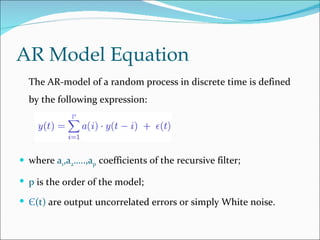
AR Model Equation
  The AR-model of a random process in discrete time is defined
  by the following expression:


 where a1,a2…..,ap coefficients of the recursive filter;

 p is the order of the model;

 Є(t) are output uncorrelated errors or simply White noise.
Need for selection of model order
 An order selection criterion is used to determine the
  appropriate order for the AR model.
 The model parameters are found by solving a set of linear

  equation obtained by minimizing the mean squared error.
 The characteristic of this error is that it decreases as the order
  of the AR model is increased.
Need…
 One of the most important consideration is the choice of the

  number of terms in the AR model, this is known as its order p.
 If a model with too low an order, We obtain a highly smoothed

  spectrum.
 If a model with too high an order, There is risk of introducing
  spurious low-level peaks in the spectrum.
AR Model Order Selection
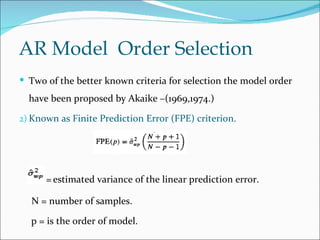
 Two of the better known criteria for selection the model order
  have been proposed by Akaike –(1969,1974.)

2) Known as Finite Prediction Error (FPE) criterion.


      = estimated variance of the linear prediction error.

  N = number of samples.

  p = is the order of model.
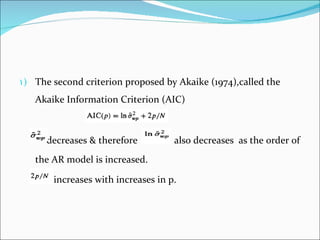
1) The second criterion proposed by Akaike (1974),called the
   Akaike Information Criterion (AIC)


      decreases & therefore         also decreases as the order of
   the AR model is increased.

       increases with increases in p.
Difference between FPE & AIC
(i) FPE (p)
   Is recommended for longer data records.
   It never exceeds model order selected by AIC


(ii) AIC (p)
    Is recommended for short data records.
1) An alternative information criterion, proposed by Rissanen
   (1983),is based on selecting the order that minimizes the
   description length :-
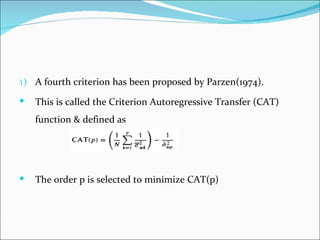
1) A fourth criterion has been proposed by Parzen(1974).

   This is called the Criterion Autoregressive Transfer (CAT)
    function & defined as


   The order p is selected to minimize CAT(p)
Applications
 Texture modelling of visual content.
 Speech processing.
 Models for future sample predictions
Drawback
 AR models linearly relate the signal samples which is not valid

  for many real-life applications, where there may be many non-
  linearity.
Conclusion
 The experimental results, just indicate that the model-order

  selection criteria do not yields definitive results.
 The FPE(p) criterion tends to underestimate the model order.
 The AIC criterion is statistically inconsistent as N→∞.
 The MDL information criterion is statistically consistent.
References
 Proakis John G. , “ Digital Signal Processing “ 4rd edition

 Comparison of Criteria for Estimating the Order of

Autoregressive Process: www.eurojournals.com/ejsr.htm
 http://www.hindawi.com/journals/asp/2009/475147/
AR model

AR model

  • 1.
    SELECTION OF AR MODELORDER Presented by: Naveen Kumar M.E. ECE Roll No. : 112610
  • 2.
    Introduction  In themodel-based approach, the spectrum estimation procedure consists of two steps. (i) We estimate the parameters{ak}and{bk} of the model. (ii) From these estimates, we compute the power spectrum estimate.  There are three types of models :-  AR Model  MA Model  ARMA Model
  • 3.
    What is ARModel?  A model which depends only on the previous outputs of the system is called an autoregressive model (AR).  Note that:-  AR model is based on frequency-domain analysis.  AR model has only poles while the MA model has only zeros.
  • 4.
    AR Model Equation The AR-model of a random process in discrete time is defined by the following expression:  where a1,a2…..,ap coefficients of the recursive filter;  p is the order of the model;  Є(t) are output uncorrelated errors or simply White noise.
  • 5.
    Need for selectionof model order  An order selection criterion is used to determine the appropriate order for the AR model.  The model parameters are found by solving a set of linear equation obtained by minimizing the mean squared error.  The characteristic of this error is that it decreases as the order of the AR model is increased.
  • 6.
    Need…  One ofthe most important consideration is the choice of the number of terms in the AR model, this is known as its order p.  If a model with too low an order, We obtain a highly smoothed spectrum.  If a model with too high an order, There is risk of introducing spurious low-level peaks in the spectrum.
  • 7.
    AR Model OrderSelection  Two of the better known criteria for selection the model order have been proposed by Akaike –(1969,1974.) 2) Known as Finite Prediction Error (FPE) criterion. = estimated variance of the linear prediction error. N = number of samples. p = is the order of model.
  • 8.
    1) The secondcriterion proposed by Akaike (1974),called the Akaike Information Criterion (AIC) decreases & therefore also decreases as the order of the AR model is increased. increases with increases in p.
  • 9.
    Difference between FPE& AIC (i) FPE (p)  Is recommended for longer data records.  It never exceeds model order selected by AIC (ii) AIC (p)  Is recommended for short data records.
  • 10.
    1) An alternativeinformation criterion, proposed by Rissanen (1983),is based on selecting the order that minimizes the description length :-
  • 11.
    1) A fourthcriterion has been proposed by Parzen(1974).  This is called the Criterion Autoregressive Transfer (CAT) function & defined as  The order p is selected to minimize CAT(p)
  • 12.
    Applications  Texture modellingof visual content.  Speech processing.  Models for future sample predictions
  • 13.
    Drawback  AR modelslinearly relate the signal samples which is not valid for many real-life applications, where there may be many non- linearity.
  • 14.
    Conclusion  The experimentalresults, just indicate that the model-order selection criteria do not yields definitive results.  The FPE(p) criterion tends to underestimate the model order.  The AIC criterion is statistically inconsistent as N→∞.  The MDL information criterion is statistically consistent.
  • 15.
    References  Proakis JohnG. , “ Digital Signal Processing “ 4rd edition  Comparison of Criteria for Estimating the Order of Autoregressive Process: www.eurojournals.com/ejsr.htm  http://www.hindawi.com/journals/asp/2009/475147/