WEBSENSE EMAIL SECURITY

SOLUTIONS OVERVIEW
Websense Email Security Solutions Overview
Challenge
The nature of email threats has changed over the past few years. Gone are the days when email security, better
known as anti-spam, was primarily tasked with blocking based on volume and scanning for email-borne viruses. The
signature-based techniques used in early solutions, while still a viable part of a multi-layered strategy, are simply not
capable of protecting organizations from the highly targeted, blended attacks of today. In February 2012 IDC stated,
“Signature-based tools are only effective against 30–50% of current security threats.”

Solution
Read the cybercrime blogs and it’s evident that email is still a major attack vector. But read further and you’ll find
that a large percentage of the attacks are actually perpetrated via the web. The takeaway is email facilitates the
attack and web actually performs the actions. A modern security approach therefore requires both web and email
channels be evaluated with a strong cross-pollination of information between the two.
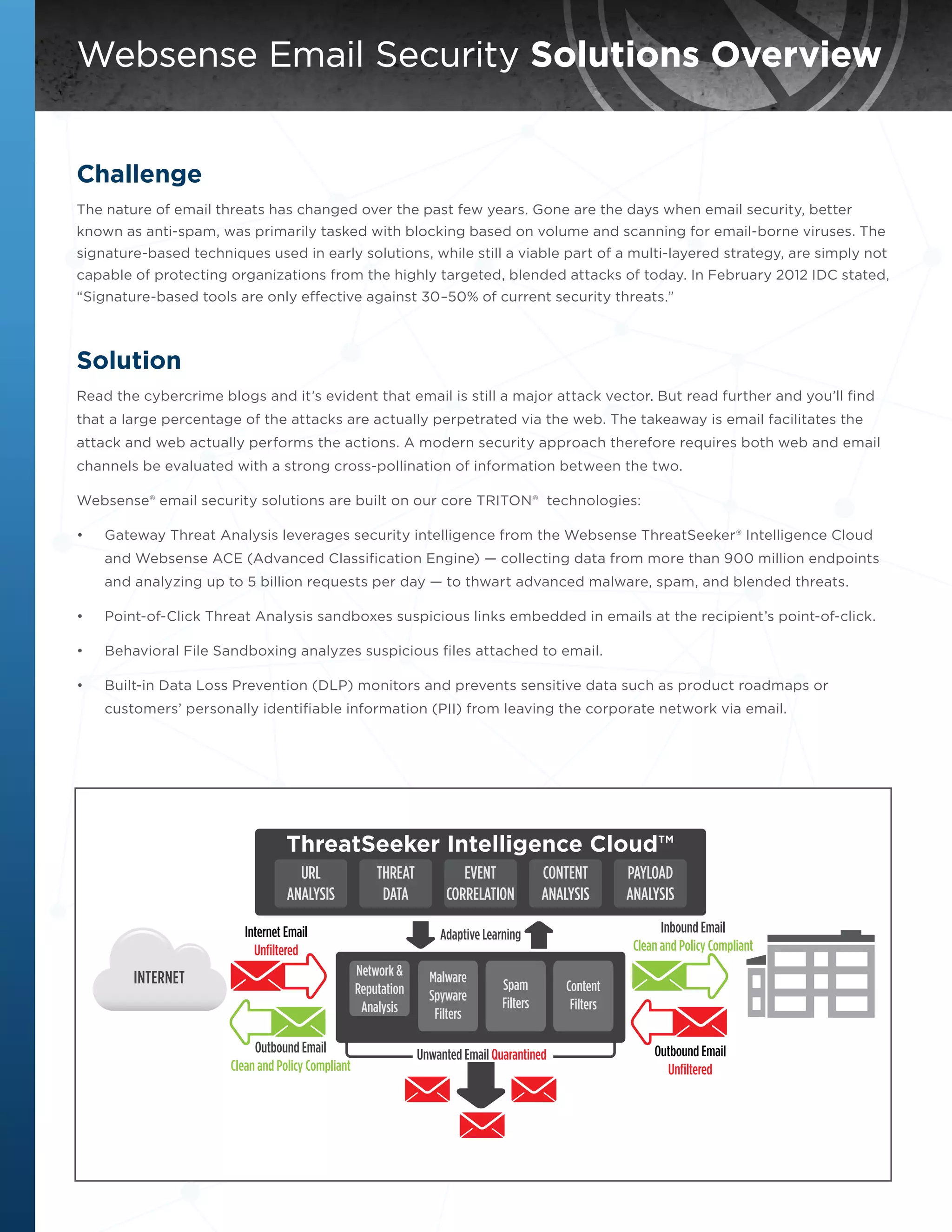
Websense® email security solutions are built on our core TRITON® technologies:
•	

Gateway Threat Analysis leverages security intelligence from the Websense ThreatSeeker® Intelligence Cloud
and Websense ACE (Advanced Classification Engine) — collecting data from more than 900 million endpoints
and analyzing up to 5 billion requests per day — to thwart advanced malware, spam, and blended threats.

•	

Point-of-Click Threat Analysis sandboxes suspicious links embedded in emails at the recipient’s point-of-click.

•	

Behavioral File Sandboxing analyzes suspicious files attached to email.

•	

Built-in Data Loss Prevention (DLP) monitors and prevents sensitive data such as product roadmaps or
customers’ personally identifiable information (PII) from leaving the corporate network via email.

ThreatSeeker Intelligence Cloud™
URL
ANALYSIS

THREAT
DATA

Internet Email
Unfiltered

Outbound Email
Clean and Policy Compliant

CONTENT
ANALYSIS

Malware
Spyware
Filters

Spam
Filters

Unwanted Email Quarantined

PAYLOAD
ANALYSIS
Inbound Email
Clean and Policy Compliant

Adaptive Learning
Network &
Reputation
Analysis

INTERNET

EVENT
CORRELATION

Content
Filters
Outbound Email
Unfiltered
Websense Email Security Solutions Overview
										 	
Features
The Websense Difference
ACE uses composite scoring with predictive
analysis. Combined with classifiers for real-time
security, data and content analysis — the result of

point to dynamic-IP botnets or web pages that
host dynamic code — two techniques that may
elude even the most robust gateway malware
analysis.

years of research and development — they enable

For example, an email sent at midnight may

ACE to detect more threats than traditional anti-

contain a link to a web page that was harmless on

virus engines every day (the proof is updated

the initial security scan at the gateway. However,

weekly at securitylabs.websense.com). ACE is the

the same web page may include injected

primary engine behind all TRITON solutions, and

malicious code when the recipient clicks on the

is supported by the ThreatSeeker Intelligence

link the following morning. URL Sandboxing

Cloud, which collects data from more than 900

helps thwart web pages hosting dynamic code

million endpoints and analyzes up to 5 billion

injections that have bypassed initial gateway

requests every day.

analysis.

Gateway Threat Analysis

Behavioral File Sandboxing

Advanced Malware Protection

Email File Sandboxing

ACE analyzes inbound and outbound email for

Suspicious file attachments are scanned in a

malware, spyware, and targeted and blended

cloud-based behavioral sandbox to protect

threats. With real-time composite risk scoring,

against the latest, and most dangerous, zero-day

anti-malware engines, and security intelligence

and advanced persistent threats (APTs).

from the ThreatSeeker Intelligence Cloud,
protection is provided against known and
unknown threats within email.

Accurate Spam Detection
Websense provides highly accurate spam

Forensic Reporting
Actionable reports that describe the system
changes made and network communications
used by the malware are automatically delivered
to administrators.

blocking with very low false positives that
is backed by a 99 percent or higher SLA. A
combination of identification technologies is
used, including: sender reputation, connection
management, adaptive learning, URL analysis,
heuristics, suspicious PDF identification and
optical recognition of image spam.

Built-in Data Loss
Prevention (DLP)
Policy Templates and Dictionaries
Pre-defined dictionaries in multiple topics and
languages plus built-in PCI-DSS and data privacy

Point-of-Click Threat
Analysis

templates help you quickly identify and stop

URL Sandboxing

Flexible Encryption

Isolates suspicious links embedded in emails and

Protect sensitive and regulated data by securing

analyzes the payload of the corresponding web

email through TLS encryption for server-to-

page at the recipient’s point-of-click. Modern

server protection. Advanced Email Encryption

phishing attacks succeed primarily because

(optional) secures the email and any attachments

phishing emails now contain embedded links that

from sender to recipient.

email policy violations and meet regulatory
requirements.
Websense Email Security Solutions Overview
							 Deployment Models
Websense offers multiple deployment models for email security, so that you get to choose which
method makes the most sense for your organization.

Cloud
Cloud: An in-the-cloud email security solution saves time and money with
no equipment to install or maintain, built-in resilience, predictable costs
and reduced administrative overhead.
Protecting email with Websense is easy. Simply point MX records to the
Websense data centers and email is cleansed before it reaches your
network, saving bandwidth by removing spam and threats in the cloud.
Websense data centers are
•	

Load balanced

•	

Redundant

•	

Located worldwide

The service provides an SLA-backed availability of 99.999 percent and is
certified to ISO27001 standards to provide the highest degree of global
and localized security, privacy and confidentiality.

Appliance
Appliance: Maximum control of all policies and reporting with an
on-premises appliance.
The Websense V-Series™ appliances are high-performance, preconfigured,
security-hardened hardware platforms designed to support flexible
deployment of the leading Websense web, email, and data security solutions.
The physical appliances are available in two models:
•	

Websense V10000:
For headquarters and large office deployments.

•	

Websense V5000:
For branch office and medium business deployments.

A virtual appliance is also available:
•	

Websense ESGv – Virtual appliance in OVF format.

Hybrid
Hybrid: Integrates in-the-cloud deployment with an appliance for an
optimal balance between scalability and control.
Websense Email Security Solutions Overview
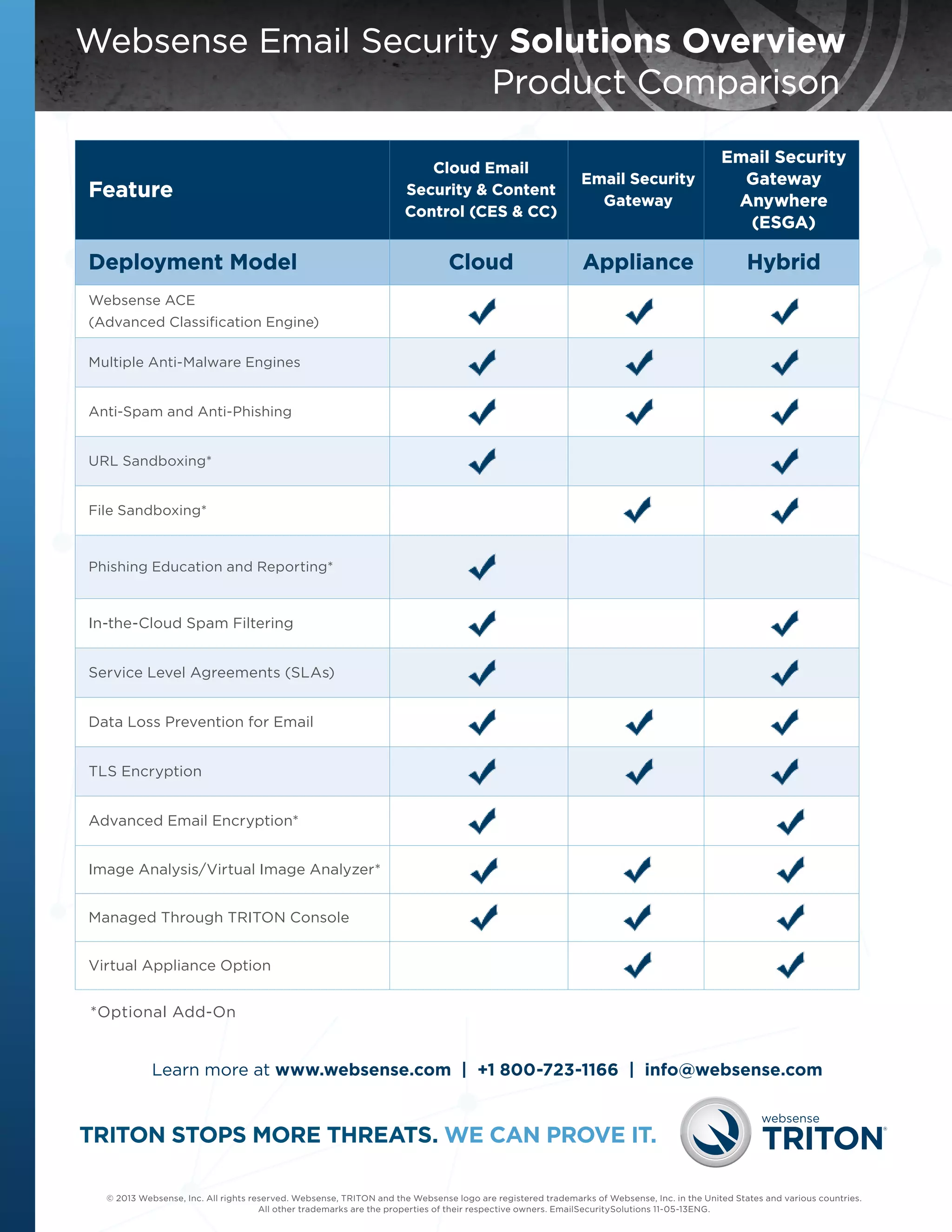
							 Product Comparison
Feature
Deployment Model

Cloud Email
Security & Content
Control (CES & CC)

Email Security
Gateway

Email Security
Gateway
Anywhere
(ESGA)

Cloud

Appliance

Hybrid

Websense ACE
(Advanced Classification Engine)
Multiple Anti-Malware Engines
Anti-Spam and Anti-Phishing
URL Sandboxing*
File Sandboxing*

Phishing Education and Reporting*

In-the-Cloud Spam Filtering
Service Level Agreements (SLAs)
Data Loss Prevention for Email
TLS Encryption
Advanced Email Encryption*
Image Analysis/Virtual Image Analyzer*
Managed Through TRITON Console
Virtual Appliance Option

*Optional Add-On

Learn more at www.websense.com | +1 800-723-1166 | info@websense.com

TRITON STOPS MORE THREATS. WE CAN PROVE IT.
© 2013 Websense, Inc. All rights reserved. Websense, TRITON and the Websense logo are registered trademarks of Websense, Inc. in the United States and various countries.
All other trademarks are the properties of their respective owners. EmailSecuritySolutions 11-05-13ENG.

Email Security Overview

  • 1.
  • 2.
    Websense Email SecuritySolutions Overview Challenge The nature of email threats has changed over the past few years. Gone are the days when email security, better known as anti-spam, was primarily tasked with blocking based on volume and scanning for email-borne viruses. The signature-based techniques used in early solutions, while still a viable part of a multi-layered strategy, are simply not capable of protecting organizations from the highly targeted, blended attacks of today. In February 2012 IDC stated, “Signature-based tools are only effective against 30–50% of current security threats.” Solution Read the cybercrime blogs and it’s evident that email is still a major attack vector. But read further and you’ll find that a large percentage of the attacks are actually perpetrated via the web. The takeaway is email facilitates the attack and web actually performs the actions. A modern security approach therefore requires both web and email channels be evaluated with a strong cross-pollination of information between the two. Websense® email security solutions are built on our core TRITON® technologies: • Gateway Threat Analysis leverages security intelligence from the Websense ThreatSeeker® Intelligence Cloud and Websense ACE (Advanced Classification Engine) — collecting data from more than 900 million endpoints and analyzing up to 5 billion requests per day — to thwart advanced malware, spam, and blended threats. • Point-of-Click Threat Analysis sandboxes suspicious links embedded in emails at the recipient’s point-of-click. • Behavioral File Sandboxing analyzes suspicious files attached to email. • Built-in Data Loss Prevention (DLP) monitors and prevents sensitive data such as product roadmaps or customers’ personally identifiable information (PII) from leaving the corporate network via email. ThreatSeeker Intelligence Cloud™ URL ANALYSIS THREAT DATA Internet Email Unfiltered Outbound Email Clean and Policy Compliant CONTENT ANALYSIS Malware Spyware Filters Spam Filters Unwanted Email Quarantined PAYLOAD ANALYSIS Inbound Email Clean and Policy Compliant Adaptive Learning Network & Reputation Analysis INTERNET EVENT CORRELATION Content Filters Outbound Email Unfiltered
  • 3.
    Websense Email SecuritySolutions Overview Features The Websense Difference ACE uses composite scoring with predictive analysis. Combined with classifiers for real-time security, data and content analysis — the result of point to dynamic-IP botnets or web pages that host dynamic code — two techniques that may elude even the most robust gateway malware analysis. years of research and development — they enable For example, an email sent at midnight may ACE to detect more threats than traditional anti- contain a link to a web page that was harmless on virus engines every day (the proof is updated the initial security scan at the gateway. However, weekly at securitylabs.websense.com). ACE is the the same web page may include injected primary engine behind all TRITON solutions, and malicious code when the recipient clicks on the is supported by the ThreatSeeker Intelligence link the following morning. URL Sandboxing Cloud, which collects data from more than 900 helps thwart web pages hosting dynamic code million endpoints and analyzes up to 5 billion injections that have bypassed initial gateway requests every day. analysis. Gateway Threat Analysis Behavioral File Sandboxing Advanced Malware Protection Email File Sandboxing ACE analyzes inbound and outbound email for Suspicious file attachments are scanned in a malware, spyware, and targeted and blended cloud-based behavioral sandbox to protect threats. With real-time composite risk scoring, against the latest, and most dangerous, zero-day anti-malware engines, and security intelligence and advanced persistent threats (APTs). from the ThreatSeeker Intelligence Cloud, protection is provided against known and unknown threats within email. Accurate Spam Detection Websense provides highly accurate spam Forensic Reporting Actionable reports that describe the system changes made and network communications used by the malware are automatically delivered to administrators. blocking with very low false positives that is backed by a 99 percent or higher SLA. A combination of identification technologies is used, including: sender reputation, connection management, adaptive learning, URL analysis, heuristics, suspicious PDF identification and optical recognition of image spam. Built-in Data Loss Prevention (DLP) Policy Templates and Dictionaries Pre-defined dictionaries in multiple topics and languages plus built-in PCI-DSS and data privacy Point-of-Click Threat Analysis templates help you quickly identify and stop URL Sandboxing Flexible Encryption Isolates suspicious links embedded in emails and Protect sensitive and regulated data by securing analyzes the payload of the corresponding web email through TLS encryption for server-to- page at the recipient’s point-of-click. Modern server protection. Advanced Email Encryption phishing attacks succeed primarily because (optional) secures the email and any attachments phishing emails now contain embedded links that from sender to recipient. email policy violations and meet regulatory requirements.
  • 4.
    Websense Email SecuritySolutions Overview Deployment Models Websense offers multiple deployment models for email security, so that you get to choose which method makes the most sense for your organization. Cloud Cloud: An in-the-cloud email security solution saves time and money with no equipment to install or maintain, built-in resilience, predictable costs and reduced administrative overhead. Protecting email with Websense is easy. Simply point MX records to the Websense data centers and email is cleansed before it reaches your network, saving bandwidth by removing spam and threats in the cloud. Websense data centers are • Load balanced • Redundant • Located worldwide The service provides an SLA-backed availability of 99.999 percent and is certified to ISO27001 standards to provide the highest degree of global and localized security, privacy and confidentiality. Appliance Appliance: Maximum control of all policies and reporting with an on-premises appliance. The Websense V-Series™ appliances are high-performance, preconfigured, security-hardened hardware platforms designed to support flexible deployment of the leading Websense web, email, and data security solutions. The physical appliances are available in two models: • Websense V10000: For headquarters and large office deployments. • Websense V5000: For branch office and medium business deployments. A virtual appliance is also available: • Websense ESGv – Virtual appliance in OVF format. Hybrid Hybrid: Integrates in-the-cloud deployment with an appliance for an optimal balance between scalability and control.
  • 5.
    Websense Email SecuritySolutions Overview Product Comparison Feature Deployment Model Cloud Email Security & Content Control (CES & CC) Email Security Gateway Email Security Gateway Anywhere (ESGA) Cloud Appliance Hybrid Websense ACE (Advanced Classification Engine) Multiple Anti-Malware Engines Anti-Spam and Anti-Phishing URL Sandboxing* File Sandboxing* Phishing Education and Reporting* In-the-Cloud Spam Filtering Service Level Agreements (SLAs) Data Loss Prevention for Email TLS Encryption Advanced Email Encryption* Image Analysis/Virtual Image Analyzer* Managed Through TRITON Console Virtual Appliance Option *Optional Add-On Learn more at www.websense.com | +1 800-723-1166 | info@websense.com TRITON STOPS MORE THREATS. WE CAN PROVE IT. © 2013 Websense, Inc. All rights reserved. Websense, TRITON and the Websense logo are registered trademarks of Websense, Inc. in the United States and various countries. All other trademarks are the properties of their respective owners. EmailSecuritySolutions 11-05-13ENG.