1

Hypothesis Testing and P Value
BY DR ZAHID KHAN
SENIOR LECTURER KING FAISAL UNIVERSITY,
KSA
Two ways to learn
about a population


Confidence intervals



Hypothesis testing

2
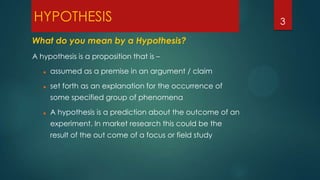
HYPOTHESIS
What do you mean by a Hypothesis?
A hypothesis is a proposition that is –


assumed as a premise in an argument / claim



set forth as an explanation for the occurrence of
some specified group of phenomena



A hypothesis is a prediction about the outcome of an
experiment. In market research this could be the
result of the out come of a focus or field study

3
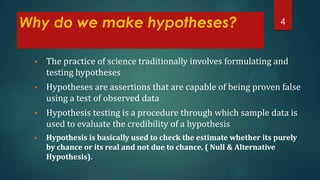
Why do we make hypotheses?

4



The practice of science traditionally involves formulating and
testing hypotheses



Hypotheses are assertions that are capable of being proven false
using a test of observed data



Hypothesis testing is a procedure through which sample data is
used to evaluate the credibility of a hypothesis



Hypothesis is basically used to check the estimate whether its purely
by chance or its real and not due to chance. ( Null & Alternative
Hypothesis).
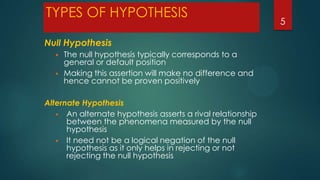
TYPES OF HYPOTHESIS
Null Hypothesis



The null hypothesis typically corresponds to a
general or default position
Making this assertion will make no difference and
hence cannot be proven positively

Alternate Hypothesis
 An alternate hypothesis asserts a rival relationship
between the phenomena measured by the null
hypothesis
 It need not be a logical negation of the null
hypothesis as it only helps in rejecting or not
rejecting the null hypothesis

5
Dependant and independent
variables


Customers going to shops playing music spend
more.



Independent Variable:
 Music



in the shops

Dependent Variable:
 Amount

spent in shops

6
Null & Alternative Hypothesis


Null Hypothesis.



There is no difference between spending of customers in music
playing shops and music playing shops and any difference is by
chance.



Alternative Hypothesis.



The difference between customers spending in music playing shops
is higher than non-music playing shops and the difference is real, its
not by chance.

7
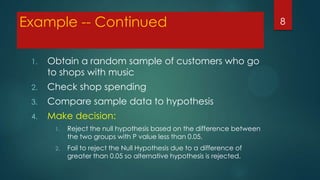
Example -- Continued
1.

Obtain a random sample of customers who go
to shops with music

2.

Check shop spending

3.

Compare sample data to hypothesis

4.

Make decision:
1.

Reject the null hypothesis based on the difference between
the two groups with P value less than 0.05.

2.

Fail to reject the Null Hypothesis due to a difference of
greater than 0.05 so alternative hypothesis is rejected.

8
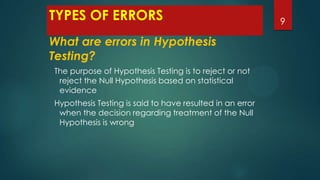
TYPES OF ERRORS
What are errors in Hypothesis
Testing?
The purpose of Hypothesis Testing is to reject or not
reject the Null Hypothesis based on statistical
evidence
Hypothesis Testing is said to have resulted in an error
when the decision regarding treatment of the Null
Hypothesis is wrong

9
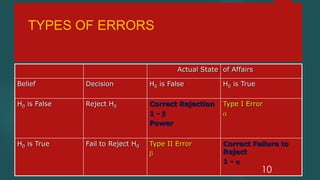
TYPES OF ERRORS
Actual State of Affairs
Belief

Decision

H0 is False

H0 is True

H0 is False

Reject H0

Correct Rejection
1-
Power

Type I Error


H0 is True

Fail to Reject H0

Type II Error


Correct Failure to
Reject
1-

10
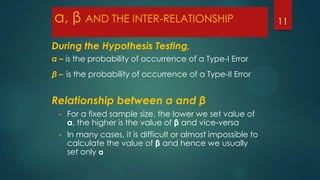
α, β AND THE INTER-RELATIONSHIP
During the Hypothesis Testing,
α – is the probability of occurrence of a Type-I Error
β – is the probability of occurrence of a Type-II Error

Relationship between α and β




For a fixed sample size, the lower we set value of
α, the higher is the value of β and vice-versa
In many cases, it is difficult or almost impossible to
calculate the value of β and hence we usually
set only α

11
Jury’s Decision
Did Not Commit Crime

Committed Crime

Guilty

Type I Error
Convict Innocent
Person

Correct Verdict
Convict Guilty
Person

Not Guilty

Correct Acquittal
Type II Error
Fail to Convict Innocent Fail to Convict
Person
Guilty Person

12
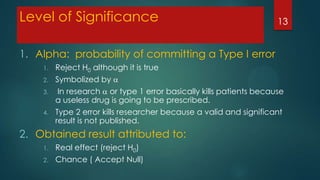
Level of Significance

13

1. Alpha: probability of committing a Type I error
1.
2.

3.
4.

Reject H0 although it is true
Symbolized by 
In research  or type 1 error basically kills patients because
a useless drug is going to be prescribed.
Type 2 error kills researcher because a valid and significant
result is not published.

2. Obtained result attributed to:
1.
2.

Real effect (reject H0)
Chance ( Accept Null)
Statistical Power
1.

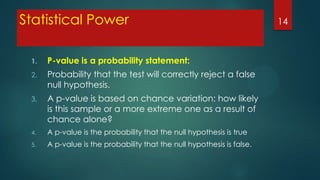
P-value is a probability statement:

2.

Probability that the test will correctly reject a false
null hypothesis.

3.

A p-value is based on chance variation: how likely
is this sample or a more extreme one as a result of
chance alone?

4.

A p-value is the probability that the null hypothesis is true

5.

A p-value is the probability that the null hypothesis is false.

14
INTERPRETING RESULTS

15

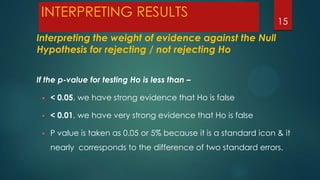
Interpreting the weight of evidence against the Null
Hypothesis for rejecting / not rejecting Ho
If the p-value for testing Ho is less than –


< 0.05, we have strong evidence that Ho is false



< 0.01, we have very strong evidence that Ho is false



P value is taken as 0.05 or 5% because it is a standard icon & it
nearly corresponds to the difference of two standard errors.
Decision Rule used with P-Value to
Make Conclusions


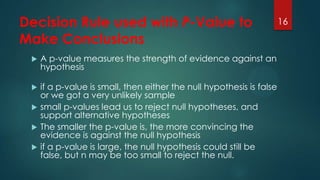
A p-value measures the strength of evidence against an
hypothesis



if a p-value is small, then either the null hypothesis is false
or we got a very unlikely sample
small p-values lead us to reject null hypotheses, and
support alternative hypotheses
The smaller the p-value is, the more convincing the
evidence is against the null hypothesis
if a p-value is large, the null hypothesis could still be
false, but n may be too small to reject the null.





16
One Sided & Two Sided Tests


Consider two means A & B.



One sided test only tells you that A > B.



Two sided tests tells you that either A>B or A <B so leaving you with
two options.



Mostly Two sided tests are used except in cases of equivalence tests
like Lumpectomy done for Breast surgery as well as radical
Mastectomy.



One sided test would be whether Lumpectomy is worst for survival
than Radical Mastectomy and we don't bother about better survival
results.



One sided tests can also be applied for variables which will only go
in one direction like Height, Age etc.

17
Relationships between confidence interval,
alpha & P Values.


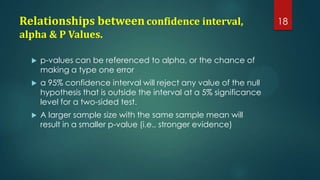
p-values can be referenced to alpha, or the chance of
making a type one error



a 95% confidence interval will reject any value of the null
hypothesis that is outside the interval at a 5% significance
level for a two-sided test.



A larger sample size with the same sample mean will
result in a smaller p-value (i.e., stronger evidence)

18
Cautions and Limitations










19

p-values are about data, not parameters
A null hypothesis is right or wrong, one or the other
A p-value indicates that there may be an effect and how
strong the evidence is that there is an effect. It does not tell
how large an effect there is.
A p-value is only as good as your data. The error involved may
be due to sampling.
large samples can lead to small p-values without resulting in
practical significance (e.g., statistical significance does not
imply practical significance)
Interpreting a p-value (or its implication) is relative to the
context or consequence of the problem (and data).
There is nothing sacred about .05
Any Questions !!!!

Thank

You.

20

Hypothesis testing and p values 06

  • 1.
    1 Hypothesis Testing andP Value BY DR ZAHID KHAN SENIOR LECTURER KING FAISAL UNIVERSITY, KSA
  • 2.
    Two ways tolearn about a population  Confidence intervals  Hypothesis testing 2
  • 3.
    HYPOTHESIS What do youmean by a Hypothesis? A hypothesis is a proposition that is –  assumed as a premise in an argument / claim  set forth as an explanation for the occurrence of some specified group of phenomena  A hypothesis is a prediction about the outcome of an experiment. In market research this could be the result of the out come of a focus or field study 3
  • 4.
    Why do wemake hypotheses? 4  The practice of science traditionally involves formulating and testing hypotheses  Hypotheses are assertions that are capable of being proven false using a test of observed data  Hypothesis testing is a procedure through which sample data is used to evaluate the credibility of a hypothesis  Hypothesis is basically used to check the estimate whether its purely by chance or its real and not due to chance. ( Null & Alternative Hypothesis).
  • 5.
    TYPES OF HYPOTHESIS NullHypothesis   The null hypothesis typically corresponds to a general or default position Making this assertion will make no difference and hence cannot be proven positively Alternate Hypothesis  An alternate hypothesis asserts a rival relationship between the phenomena measured by the null hypothesis  It need not be a logical negation of the null hypothesis as it only helps in rejecting or not rejecting the null hypothesis 5
  • 6.
    Dependant and independent variables  Customersgoing to shops playing music spend more.  Independent Variable:  Music  in the shops Dependent Variable:  Amount spent in shops 6
  • 7.
    Null & AlternativeHypothesis  Null Hypothesis.  There is no difference between spending of customers in music playing shops and music playing shops and any difference is by chance.  Alternative Hypothesis.  The difference between customers spending in music playing shops is higher than non-music playing shops and the difference is real, its not by chance. 7
  • 8.
    Example -- Continued 1. Obtaina random sample of customers who go to shops with music 2. Check shop spending 3. Compare sample data to hypothesis 4. Make decision: 1. Reject the null hypothesis based on the difference between the two groups with P value less than 0.05. 2. Fail to reject the Null Hypothesis due to a difference of greater than 0.05 so alternative hypothesis is rejected. 8
  • 9.
    TYPES OF ERRORS Whatare errors in Hypothesis Testing? The purpose of Hypothesis Testing is to reject or not reject the Null Hypothesis based on statistical evidence Hypothesis Testing is said to have resulted in an error when the decision regarding treatment of the Null Hypothesis is wrong 9
  • 10.
    TYPES OF ERRORS ActualState of Affairs Belief Decision H0 is False H0 is True H0 is False Reject H0 Correct Rejection 1- Power Type I Error  H0 is True Fail to Reject H0 Type II Error  Correct Failure to Reject 1- 10
  • 11.
    α, β ANDTHE INTER-RELATIONSHIP During the Hypothesis Testing, α – is the probability of occurrence of a Type-I Error β – is the probability of occurrence of a Type-II Error Relationship between α and β   For a fixed sample size, the lower we set value of α, the higher is the value of β and vice-versa In many cases, it is difficult or almost impossible to calculate the value of β and hence we usually set only α 11
  • 12.
    Jury’s Decision Did NotCommit Crime Committed Crime Guilty Type I Error Convict Innocent Person Correct Verdict Convict Guilty Person Not Guilty Correct Acquittal Type II Error Fail to Convict Innocent Fail to Convict Person Guilty Person 12
  • 13.
    Level of Significance 13 1.Alpha: probability of committing a Type I error 1. 2. 3. 4. Reject H0 although it is true Symbolized by  In research  or type 1 error basically kills patients because a useless drug is going to be prescribed. Type 2 error kills researcher because a valid and significant result is not published. 2. Obtained result attributed to: 1. 2. Real effect (reject H0) Chance ( Accept Null)
  • 14.
    Statistical Power 1. P-value isa probability statement: 2. Probability that the test will correctly reject a false null hypothesis. 3. A p-value is based on chance variation: how likely is this sample or a more extreme one as a result of chance alone? 4. A p-value is the probability that the null hypothesis is true 5. A p-value is the probability that the null hypothesis is false. 14
  • 15.
    INTERPRETING RESULTS 15 Interpreting theweight of evidence against the Null Hypothesis for rejecting / not rejecting Ho If the p-value for testing Ho is less than –  < 0.05, we have strong evidence that Ho is false  < 0.01, we have very strong evidence that Ho is false  P value is taken as 0.05 or 5% because it is a standard icon & it nearly corresponds to the difference of two standard errors.
  • 16.
    Decision Rule usedwith P-Value to Make Conclusions  A p-value measures the strength of evidence against an hypothesis  if a p-value is small, then either the null hypothesis is false or we got a very unlikely sample small p-values lead us to reject null hypotheses, and support alternative hypotheses The smaller the p-value is, the more convincing the evidence is against the null hypothesis if a p-value is large, the null hypothesis could still be false, but n may be too small to reject the null.    16
  • 17.
    One Sided &Two Sided Tests  Consider two means A & B.  One sided test only tells you that A > B.  Two sided tests tells you that either A>B or A <B so leaving you with two options.  Mostly Two sided tests are used except in cases of equivalence tests like Lumpectomy done for Breast surgery as well as radical Mastectomy.  One sided test would be whether Lumpectomy is worst for survival than Radical Mastectomy and we don't bother about better survival results.  One sided tests can also be applied for variables which will only go in one direction like Height, Age etc. 17
  • 18.
    Relationships between confidenceinterval, alpha & P Values.  p-values can be referenced to alpha, or the chance of making a type one error  a 95% confidence interval will reject any value of the null hypothesis that is outside the interval at a 5% significance level for a two-sided test.  A larger sample size with the same sample mean will result in a smaller p-value (i.e., stronger evidence) 18
  • 19.
    Cautions and Limitations        19 p-valuesare about data, not parameters A null hypothesis is right or wrong, one or the other A p-value indicates that there may be an effect and how strong the evidence is that there is an effect. It does not tell how large an effect there is. A p-value is only as good as your data. The error involved may be due to sampling. large samples can lead to small p-values without resulting in practical significance (e.g., statistical significance does not imply practical significance) Interpreting a p-value (or its implication) is relative to the context or consequence of the problem (and data). There is nothing sacred about .05
  • 20.