PSY 2335 – Statistics for Professional Practice
PSY 2335
How to Report
Test Results (APA)
PSY 2335 – Statistics for Professional Practice
Purpose
• Readers are interested in the subject of the research, but not
in the process of carrying out the tests.
• Therefore, the report should NOT speak about the hypotheses
or rejecting and retaining them.
• When you have rejected the null hypothesis, use the word
significant. When you retained the null hypothesis, use the
phrase not significant.
• Use the “sandwich method” to write your paragraph:
– A plain-English opening sentence (like bread)
– All the numeric results in good order (the fillings)
– A plain English closing sentence (the other bread slice)
PSY 2335 – Statistics for Professional Practice
What numeric information to report?
• Descriptive statistics:
– The mean of each sample or group
– The standard deviation (computed for a sample) of each
sample or group
– Number of cases
• Test results
– Test statistic (t, F, 2, etc.)
– Degrees of Freedom
– p-value
– If significant result, a measure of Effect Size
PSY 2335 – Statistics for Professional Practice
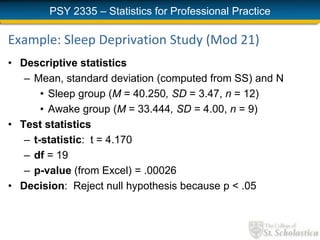
Example: Sleep Deprivation Study (Mod 21)
• Descriptive statistics
– Mean, standard deviation (computed from SS) and N
• Sleep group (M = 40.250, SD = 3.47, n = 12)
• Awake group (M = 33.444, SD = 4.00, n = 9)
• Test statistics
– t-statistic: t = 4.170
– df = 19
– p-value (from Excel) = .00026
• Decision: Reject null hypothesis because p < .05
PSY 2335 – Statistics for Professional Practice
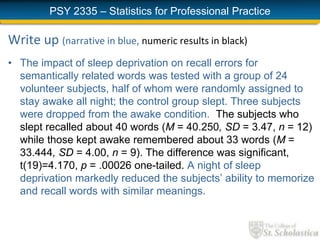
Write up (narrative in blue, numeric results in black)
• The impact of sleep deprivation on recall errors for
semantically related words was tested with a group of 24
volunteer subjects, half of whom were randomly assigned to
stay awake all night; the control group slept. Three subjects
were dropped from the awake condition. The subjects who
slept recalled about 40 words (M = 40.250, SD = 3.47, n = 12)
while those kept awake remembered about 33 words (M =
33.444, SD = 4.00, n = 9). The difference was significant,
t(19)=4.170, p = .00026 one-tailed. A night of sleep
deprivation markedly reduced the subjects’ ability to memorize
and recall words with similar meanings.
PSY 2335 – Statistics for Professional Practice
PSY 2335
How to Report
Test Results (APA)

How to Report Test Results

  • 1.
    PSY 2335 –Statistics for Professional Practice PSY 2335 How to Report Test Results (APA)
  • 2.
    PSY 2335 –Statistics for Professional Practice Purpose • Readers are interested in the subject of the research, but not in the process of carrying out the tests. • Therefore, the report should NOT speak about the hypotheses or rejecting and retaining them. • When you have rejected the null hypothesis, use the word significant. When you retained the null hypothesis, use the phrase not significant. • Use the “sandwich method” to write your paragraph: – A plain-English opening sentence (like bread) – All the numeric results in good order (the fillings) – A plain English closing sentence (the other bread slice)
  • 3.
    PSY 2335 –Statistics for Professional Practice What numeric information to report? • Descriptive statistics: – The mean of each sample or group – The standard deviation (computed for a sample) of each sample or group – Number of cases • Test results – Test statistic (t, F, 2, etc.) – Degrees of Freedom – p-value – If significant result, a measure of Effect Size
  • 4.
    PSY 2335 –Statistics for Professional Practice Example: Sleep Deprivation Study (Mod 21) • Descriptive statistics – Mean, standard deviation (computed from SS) and N • Sleep group (M = 40.250, SD = 3.47, n = 12) • Awake group (M = 33.444, SD = 4.00, n = 9) • Test statistics – t-statistic: t = 4.170 – df = 19 – p-value (from Excel) = .00026 • Decision: Reject null hypothesis because p < .05
  • 5.
    PSY 2335 –Statistics for Professional Practice Write up (narrative in blue, numeric results in black) • The impact of sleep deprivation on recall errors for semantically related words was tested with a group of 24 volunteer subjects, half of whom were randomly assigned to stay awake all night; the control group slept. Three subjects were dropped from the awake condition. The subjects who slept recalled about 40 words (M = 40.250, SD = 3.47, n = 12) while those kept awake remembered about 33 words (M = 33.444, SD = 4.00, n = 9). The difference was significant, t(19)=4.170, p = .00026 one-tailed. A night of sleep deprivation markedly reduced the subjects’ ability to memorize and recall words with similar meanings.
  • 6.
    PSY 2335 –Statistics for Professional Practice PSY 2335 How to Report Test Results (APA)