Sampling 
Hypothesis Testing
Census & Sample- 
 Census/Complete Enumeration survey 
method, data are collected for each 
and every unit of the population/ 
universe which is the complete set of 
items which are of interest in any 
particular situation. 
 Sample is used to describe a portion 
chosen from sample.
Sampling 
 Study of sample is sampling. 
 In sampling technique instead of 
every unit of the population only a 
part of the population is studied and 
the conclusions are drawn on that 
basis for the entire universe. 
 A process of learning about the 
population on the basis of a sample 
drawn from it.
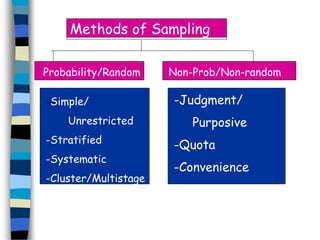
Methods of Sampling 
Probability/Random Non-Prob/Non-random 
-Simple/ 
Unrestricted 
-Stratified 
-Systematic 
-Cluster/Multistage 
-Judgment/ 
Purposive 
-Quota 
-Convenience
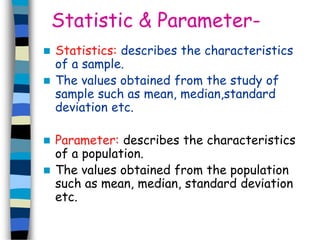
Statistic & Parameter- 
 Statistics: describes the characteristics 
of a sample. 
 The values obtained from the study of 
sample such as mean, median,standard 
deviation etc. 
 Parameter: describes the characteristics 
of a population. 
 The values obtained from the population 
such as mean, median, standard deviation 
etc.
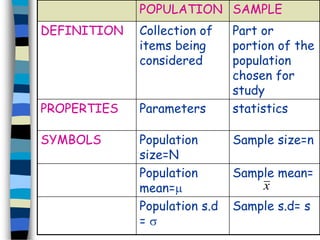
POPULATION SAMPLE 
DEFINITION Collection of 
items being 
considered 
Part or 
portion of the 
population 
chosen for 
study 
PROPERTIES Parameters statistics 
SYMBOLS Population 
size=N 
Sample size=n 
Population 
mean= 
Sample mean= 
Population s.d 
=  
x 
Sample s.d= s
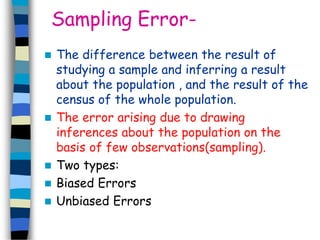
Sampling Error- 
 The difference between the result of 
studying a sample and inferring a result 
about the population , and the result of the 
census of the whole population. 
 The error arising due to drawing 
inferences about the population on the 
basis of few observations(sampling). 
 Two types: 
 Biased Errors 
 Unbiased Errors
 Sampling error is non-existent in 
complete enumeration survey. 
 Non-sampling errors: errors that 
occur in acquiring, recording or 
tabulating statistical data that cant 
be ascribed to sampling error. 
 They may arise in either a census or 
sample.
Statistical hypothesis 
A statement about the population 
parameter. 
Assertion or assumption, that we make 
about a population parameter, which may 
or may not be valid, but is used as a basis 
for reasoning. 
Hypothesis testing: A process of testing 
a statement or belief about a population 
parameter by the use of information 
collected from a sample(s).
Hypothesis Testing 
 Null Hypothesis: It means that there 
is no real difference in the sample 
and the population in the particular 
matter under consideration. 
 Denoted by Ho.
Null hypothesis 
• States that the “null” condition exists 
• There is nothing new happening 
• The old standard is correct 
• The old theory is still true 
• The system is in control. 
Key word- difference is not significant
Alternative hypothesis 
Alternative hypothesis is complementary 
to null hypothesis and specifies those 
values that the researcher believes to 
hold true. 
Denoted by Ha 
The two hypothesis are such that if one 
is accepted, the other is rejected.
Alternative hypothesis 
 The new theory is true 
 Something is happening. 
 There are new standards 
 The system is out-of-control, 
Key word- difference is significant 
i.e results of the experiment is unlikely due to 
chance, reject null hypothesis.
CASELETS 
 Flour packaged by a manufacturer is 
supposed to weigh on an average 40 
ounces. 
 The manufacturer wants to test the 
packaging process 
Null hypothesis: the average weight of the 
Packages is 40 ounces(no problem). 
Alternative hypothesis: the average is not 40 
ounces (process is out-of control)
 A Company has found mean life time of 
fluorescent light bulbs are 1600 hrs. 
 Due to improvement in technical effort, 
officials believe that now, life time of bulbs 
is greater than 1600 hrs. 
NULL HYPOTHESIS: 
Life time of bulbs is still 1600 hrs (OLD IDEA) 
ALTERNATE HYPOTHESIS: 
Life time of bulbs is greater than 1600 hrs. 
(NEW THEORY)
• You are investigating the effects of a 
new pain reliever. 
• Hope the new drug relieves pains longer 
than the leading pain reliever. 
Null hypothesis: the new pain reliever is 
no better than the leading pain reliever. 
Alternate hypothesis: the new pain reliever 
lasts longer than the leading pain reliever.
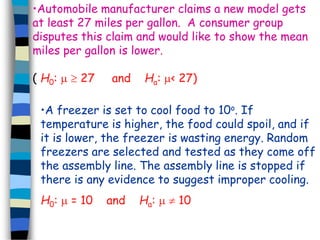
•Automobile manufacturer claims a new model gets 
at least 27 miles per gallon. A consumer group 
disputes this claim and would like to show the mean 
miles per gallon is lower. 
( H0:   27 and Ha: < 27) 
•A freezer is set to cool food to 10o. If 
temperature is higher, the food could spoil, and if 
it is lower, the freezer is wasting energy. Random 
freezers are selected and tested as they come off 
the assembly line. The assembly line is stopped if 
there is any evidence to suggest improper cooling. 
H0:  = 10 and Ha:   10
Level of Significance 
 To test the validity of Ho against that of 
Ha at as certain level of significance. 
 The risk with which an experimenter 
rejects or retains- a null hypothesis 
depends upon the significance level 
adopted. 
 5%: Prob. of rejecting the null hypothesis 
if it is true. 
 Denoted by  - is specified before the 
samples are drawn.
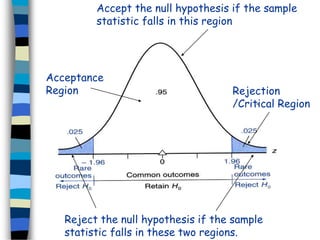
Accept the null hypothesis if the sample 
statistic falls in this region 
Rejection 
/Critical Region 
Acceptance 
Region 
Reject the null hypothesis if the sample 
statistic falls in these two regions.
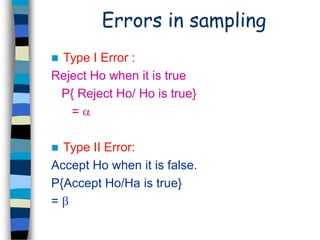
Errors in sampling 
 Type I Error : 
Reject Ho when it is true 
P{ Reject Ho/ Ho is true} 
=  
 Type II Error: 
Accept Ho when it is false. 
P{Accept Ho/Ha is true} 
= 
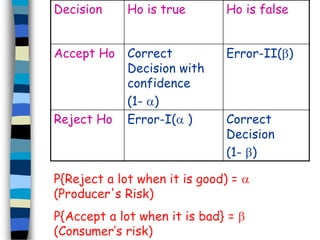
Decision Ho is true Ho is false 
Accept Ho Correct 
Decision with 
confidence 
(1- ) 
Error-II() 
Reject Ho Error-I( ) Correct 
Decision 
(1- ) 
P{Reject a lot when it is good) =  
(Producer's Risk) 
P{Accept a lot when it is bad} =  
(Consumer’s risk)
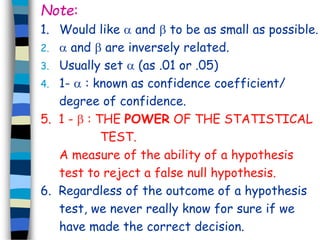
Note: 
1. Would like  and  to be as small as possible. 
2.  and  are inversely related. 
3. Usually set  (as .01 or .05) 
4. 1-  : known as confidence coefficient/ 
degree of confidence. 
5. 1 -  : THE POWER OF THE STATISTICAL 
TEST. 
A measure of the ability of a hypothesis 
test to reject a false null hypothesis. 
6. Regardless of the outcome of a hypothesis 
test, we never really know for sure if we 
have made the correct decision.
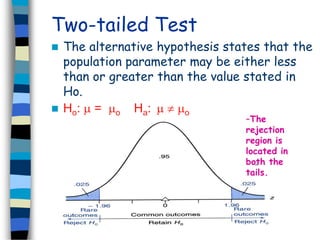
Two-tailed Test 
 The alternative hypothesis states that the 
population parameter may be either less 
than or greater than the value stated in 
Ho. 
 Ho:  = o Ha:   o 
–The 
rejection 
region is 
located in 
both the 
tails.
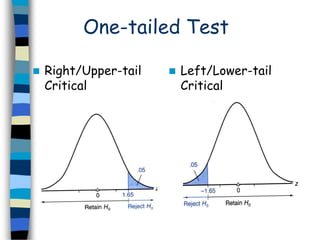
One-tailed Test 
 The alternative hypothesis states 
that the population parameter differs 
from the value stated in H0 in one 
particular direction. 
 Ho:   o Ha:  > o (Right Tailed test) 
 Ho:  o Ha:  < o (Left Tailed test) 
– The critical region is located only in one 
tail of the sampling distribution.
One-tailed Test 
 Right/Upper-tail 
Critical 
 Left/Lower-tail 
Critical
Critical values/Significant values 
Value of test statistic which separates 
The critical (rejection) region and the 
Acceptance region. Depends on 
1) Level of significance 
2) Type of tail
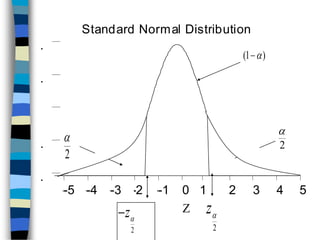
Standard Normal Distribution 
z 
2 
z 
2 
(1 ) 
 
2 
--5 --4 --3 -2 --1 0 1 2 3 4 5 
. 
. 
. 
. 
Z 
 
2
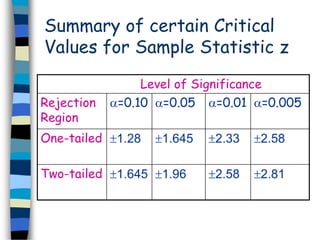
Summary of certain Critical 
Values for Sample Statistic z 
Level of Significance 
Rejection 
Region 
=0.10 =0.05 =0.01 =0.005 
One-tailed 1.28 1.645 2.33 2.58 
Two-tailed 1.645 1.96 2.58 2.81
Sampling Distribution of 
a Statistic 
Probability distribution of all possible 
values statistic may assume, when 
computed from random samples of same 
size, drawn from a specified population.
• Draw ‘k’ samples of size n from given 
finite population of size N. 
• Compute some statistic like mean, 
variance etc.. for each of these k 
samples. 
• The set of the values of the statistic 
so obtained (one for each sample) 
constitutes the ‘sampling distribution 
of the statistic’
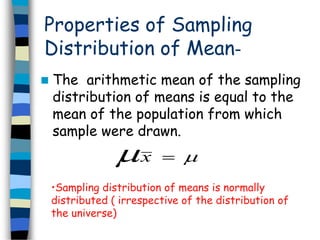
Properties of Sampling 
Distribution of Mean- 
 The arithmetic mean of the sampling 
distribution of means is equal to the 
mean of the population from which 
sample were drawn. 
x   
•Sampling distribution of means is normally 
distributed ( irrespective of the distribution of 
the universe)
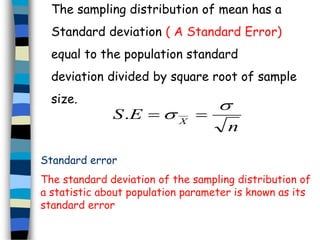
The sampling distribution of mean has a 
Standard deviation ( A Standard Error) 
equal to the population standard 
deviation divided by square root of sample 
size. 
n 
S E X 
 
.   
Standard error 
The standard deviation of the sampling distribution of 
a statistic about population parameter is known as its 
standard error
Test of Significance for 
single mean (Large Samples) 
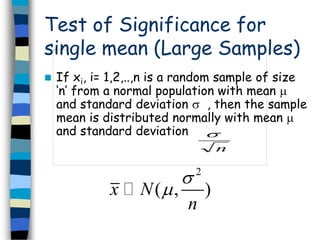
 If xi, i= 1,2,..,n is a random sample of size 
‘n’ from a normal population with mean  
and standard deviation  , then the sample 
mean is distributed normally with mean  
and standard deviation 
 
n 
2 
 
x N( , ) 
n 

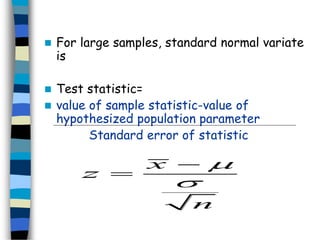
 For large samples, standard normal variate 
is 
 Test statistic= 
 value of sample statistic-value of 
hypothesized population parameter 
Standard error of statistic 
x 
z 
 
 
 
n 

Procedure in hypothesis 
testing 
 Formulate a Hypothesis 
 Set up suitable significance level 
 Select test criterion 
 Compute ‘z’ 
 Make decisions.
Case-Let 
 A company manufacturing automobile tyres 
finds that tyre life is normally distributed 
with a mean of 40,000 km and standard 
deviation of 3000 km. It is believed that a 
change in the production process will result 
in a better product and the company has 
developed a new tyre. A sample of 100 new 
tyres has been selected.The company has 
found that the mean life of these new 
tyres is 40,900 km.Can it be concluded 
that the new tyre is significantly better 
than the old one, using the significance 
level of 0.01?
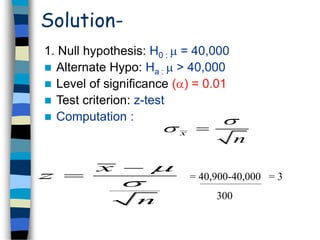
Solution- 
1. Null hypothesis: H0 :  = 40,000 
 Alternate Hypo: Ha :  > 40,000 
 Level of significance () = 0.01 
 Test criterion: z-test 
 Computation : 
x 
 
n 
  
x 
z 
 
 
 = 40,900-40,000 = 3 
 
n 
300
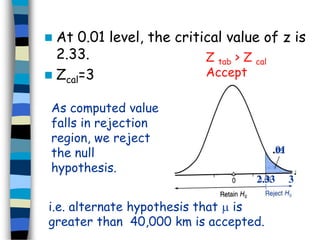
 At 0.01 level, the critical value of z is 
2.33. 
 Zcal=3 
.01 
2.33 
As computed value 
falls in rejection 
region, we reject 
the null 
hypothesis. 
i.e. alternate hypothesis that  is 
greater than 40,000 km is accepted. 
3 
Z tab > Z cal 
Accept
Case let 
 An ambulance service claims that it takes, 
on the average 8.9 minutes to reach its 
destination in emergency calls.To check on 
this claim, the agency which licenses 
ambulance services has then timed on 50 
emergency calls, getting a mean of 9.3 
minutes with a standard deviation of 1.8 
minutes.Does this constitute evidence that 
the figure claimed is not right at 1% level 
of significance? 
Hint: Ho: = 8.9; Ha: 8.9, Zcal = 1.574 ; 
Ho accepted.
 A random sample of boots worn by 40 
combat soldiers in a desert region showed 
an average life of 1.08 yrs with a standard 
deviation of 0.05.Under the standard 
conditions,the boots are known to have an 
average life of 1.28 yrs.Is there reason to 
assert at a level of significance of 0.05 
that use in the desert causes the mean life 
of such boots to decrease? 
Hint: Ho:  = 1.28, Ha: <1.28 ,Zcal= -28.57 
Ho rejected.
 Hinton Press hypothesizes that the 
average life of its largest web press 
is 14,500 hrs.They know that the 
standard deviation of press life is 
2100 hrs.From a sample of 25 
presses, the company finds a sample 
mean of 13000 hrs. At a 0.01 
significance level, should the company 
conclude that the average life of the 
presses is less than the hypothesized 
14,500 hours? 
 Ans: Ho rejected.
 ABC company is engaged in the 
packaging of a superior quality tea in 
jars of 500 gm each.The company is 
of the view that as long as jars 
contain 500 gm of tea, the process is 
in control.The standard deviation is 
50 gm.A sample of 225 jars is taken 
at random and the sample average is 
found to be 510 gm.Has the process 
gone out of control? 
Hint:  =500, 500; Zcal = 3; 
Ho rejected
Case let 
 American Theaters knows that a 
certain hit movie ran an average of 
84 days in each city, and the 
corresponding standard deviation was 
10 days.The manager of the 
southeastern district was interested 
in comparing the movie;s popularity in 
his region with that in all of 
American’s other theaters. He 
randomly chose 75 theaters in his 
region and found that they ran the 
movie an average of 81.5 days.
 State appropriate hypothesis for 
testing whether there was a 
significant difference in the length of 
the picture’s run between theaters in 
the southeastern district and all of 
American’s other theaters. 
 At a 1% significance level, test these 
hypothesis. 
 (Ans: Accept Ho)
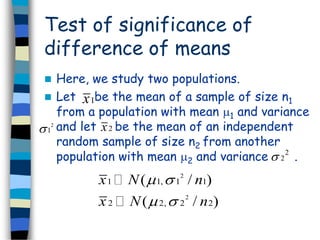
Test of significance of 
difference of means 
 Here, we study two populations. 
 Let x 
1 be the mean of a sample of size n1 
from a population with mean 1 and variance 
and let be the mean of an independent 
random sample of size n2 from another 
population with mean 2 and variance . 
2 x 2 
1 
2 
2  
2 
x N n 
x N n 
(   
/ ) 
(   
/ ) 
1 1, 1 1 
2 
2 2, 2 2
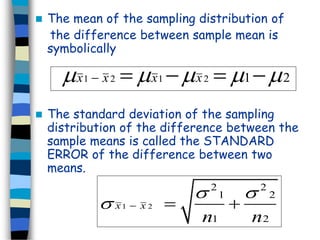
 The mean of the sampling distribution of 
the difference between sample mean is 
symbolically 
x1  x 2 x1x 2 12 x1  x 2 x1x 2 12 
 The standard deviation of the sampling 
distribution of the difference between the 
sample means is called the STANDARD 
ERROR of the difference between two 
means. 
 1  2 
  
2 2 
1 2 
  
1 2 
x x 
n n
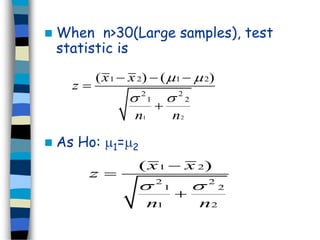
 When n>30(Large samples), test 
statistic is 
(x  x )  (  
) 
  
1 2 1 2 
  
 As Ho: 1=2 
2 2 
1 2 
1 2 
z 
n n 
 
 
(x 1  
x 2 
) 
2 2 
  
1 2 
1 2 
z 
n n 
 

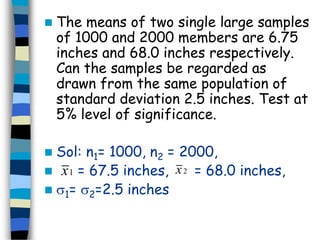
 The means of two single large samples 
of 1000 and 2000 members are 6.75 
inches and 68.0 inches respectively. 
Can the samples be regarded as 
drawn from the same population of 
standard deviation 2.5 inches. Test at 
5% level of significance. 
 Sol: n1= 1000, n2 = 2000, 
 x1 = 67.5 inches, x2 
= 68.0 inches, 
 1= 2=2.5 inches
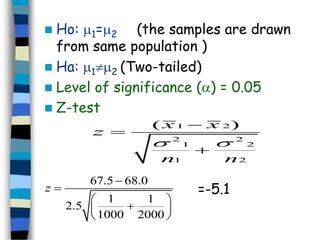
 Ho: 1=2 (the samples are drawn 
from same population ) 
 Ha: 12 (Two-tailed) 
 Level of significance () = 0.05 
 Z-test 
(x 1  
x 2 
) 
2 2 
  
1 2 
1 2 
z 
n n 
 
 
67.5 68.0 
1 1 
2.5 
1000 2000 
z 
 
 
=-5.1 
  
   
 
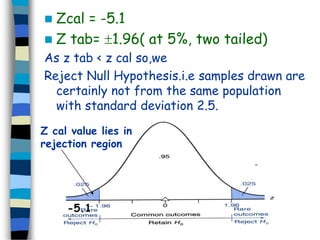
 Zcal = -5.1 
 Z tab= 1.96( at 5%, two tailed) 
As z tab < z cal so,we 
Reject Null Hypothesis.i.e samples drawn are 
certainly not from the same population 
with standard deviation 2.5. 
Z cal value lies in 
rejection region 
-5.1
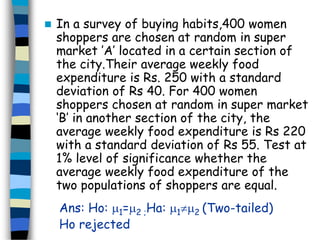
 In a survey of buying habits,400 women 
shoppers are chosen at random in super 
market ’A’ located in a certain section of 
the city.Their average weekly food 
expenditure is Rs. 250 with a standard 
deviation of Rs 40. For 400 women 
shoppers chosen at random in super market 
‘B’ in another section of the city, the 
average weekly food expenditure is Rs 220 
with a standard deviation of Rs 55. Test at 
1% level of significance whether the 
average weekly food expenditure of the 
two populations of shoppers are equal. 
Ans: Ho: 1=2 ;Ha: 12 (Two-tailed) 
Ho rejected
 The average hourly wage of a sample of 
150 workers in a plant ‘A’ was Rs 2.56 with 
a standard deviation of Rs 1.08. The 
average hourly wage of a sample of 200 
workers in plant ‘B’ was Rs 2.87 with a 
standard deviation of Rs 1.28.Can an 
applicant safely assume that the hourly 
wages paid by plant ‘B’ are higher than 
those paid by plant ‘A’? 
Ans: Ho: 1=2 ;Ha: 1<2 (Left-tailed) 
Ho rejected
 In 1993,Financial accounting Standard 
Boards(FASB) was considering a proposal to 
require companies to report the potential effect 
of employees stock options on earning per 
share(EPS). A random sample of 41 High tech 
firms revealed that the new proposal will reduce 
EPS by an average of 13.8 %,with a s.d. of 18.9%.A 
random sample of 35 producers of consumer goods 
would reduce EPS by 9.1% on average, with a s.d. 
of 8.7%.On the basis of these samples,is it 
reasonable to conduct (at 10% level of 
significance) that the FASB proposal will cause 
greater reduction in EPS for high-tech firms than 
for producers of consumer goods? 
Ans: Ho: 1=2 ;Ha: 1>2 (Right-tailed) 
Ho rejected
Que: Two independent samples of 
observations were collected.for the first 
sample of 60 elements,the mean was 86 
and the standard deviation 6.The second 
sample of 75 elements had a mean of 
82and a standard deviation of 9. 
 Compute the standard error of the 
difference between means. 
 Using =0.01,test whether the two samples 
can reasonably be considered to have come 
from populations with the same mean.
 A potential buyer wants to decide which of 
the two brands of electric bulbs he should 
buy as he has to buy them in bulk.As a 
specimen, he buys 100 bulbs of each of the 
two brands-A and B.On using these bulbs, 
he finds that brand A has a mean life of 
1200 hrs with a standard deviation of 50 
hrs and Brand B has a mean life of 1150 
hrs with a s.d. of 40 hrs.Do the two brands 
differ significantly in quality? (Use  = 
0.05) 
Ans: Ho: 1=2 ;Ha: 12 (Two-tailed) 
Ho rejected
Test of Significance for Single 
Proportion- 
 Suppose we take a sample of n 
persons from a population and if x of 
these persons are possessing a 
particular characteristic(say 
educated) then the sample proportion 
p =x/n 
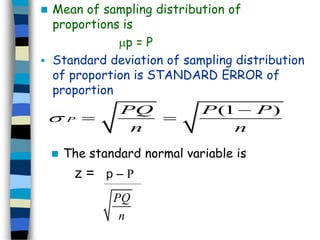
 Population proportion = P
 Mean of sampling distribution of 
proportions is 
p = P 
 Standard deviation of sampling distribution 
of proportion is STANDARD ERROR of 
proportion 
(1 ) 
P 
PQ P P 
n n 
 
 
  
 The standard normal variable is 
z = p – P 
PQ 
n
 Q: A company engaged in the 
manufacture of superior quality 
diaries, which are primarily meant for 
senior executives in the corporate 
world.It claims that 75% of the 
executives employed in Delhi use its 
diaries. A random sample of 800 
executives was taken and it was found 
that 570 executives did use its diary 
when the survey was 
undertaken.Verify the company’s 
claim, using 5% level of significance
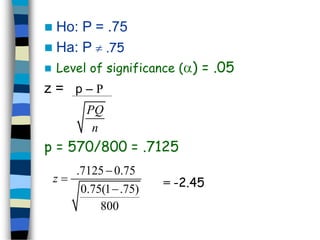
 Ho: P = .75 
 Ha: P  .75 
 Level of significance () = .05 
z = p – P 
PQ 
n 
p = 570/800 = .7125 
.7125 0.75 
0.75(1 .75) 
800 
z 
 
 
 
= -2.45
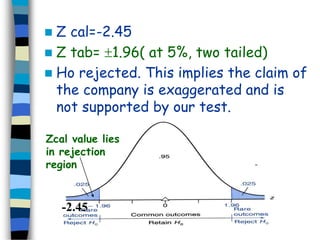
 Z cal=-2.45 
 Z tab= 1.96( at 5%, two tailed) 
 Ho rejected. This implies the claim of 
the company is exaggerated and is 
not supported by our test. 
Zcal value lies 
in rejection 
region 
-2.45
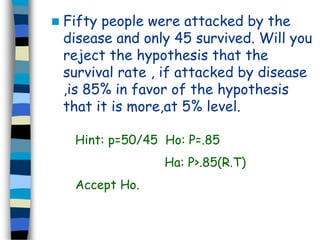
 Fifty people were attacked by the 
disease and only 45 survived. Will you 
reject the hypothesis that the 
survival rate , if attacked by disease 
,is 85% in favor of the hypothesis 
that it is more,at 5% level. 
Hint: p=50/45 Ho: P=.85 
Ha: P>.85(R.T) 
Accept Ho.
 A ketch-up manufacturer is in the process 
of deciding whether to produce a new 
extra-spicy brand.The company’s marketing 
research department used a national 
telephone survey of 6000 households and 
found that the extra-spicy ketchup would 
be purchased by 335 of them. A much more 
extensive study made 2 years ago showed 
that 5% of the households would purchase 
the brand then.At a 2% significance level, 
should the company conclude that there is 
an increased interest in the extra-spicy 
flavor? 
Hint: p=.055 Ho: P=0.05 Ha:P>0.05 
Ho rejected.
 A manufacturer claims that at least 
95% of the equipments which he 
supplied to a factory conformed to 
the specification.An examination of 
the sample of 200 pieces of 
equipment revealed that 18 were 
faulty.Test the claim of the 
manufacturer. 
Hint: Ho:P=.95 Ha:P<.95 p=1-18/100=.91 
Ho rejected.

10. sampling and hypotehsis

  • 1.
  • 2.
    Census & Sample-  Census/Complete Enumeration survey method, data are collected for each and every unit of the population/ universe which is the complete set of items which are of interest in any particular situation.  Sample is used to describe a portion chosen from sample.
  • 3.
    Sampling  Studyof sample is sampling.  In sampling technique instead of every unit of the population only a part of the population is studied and the conclusions are drawn on that basis for the entire universe.  A process of learning about the population on the basis of a sample drawn from it.
  • 4.
    Methods of Sampling Probability/Random Non-Prob/Non-random -Simple/ Unrestricted -Stratified -Systematic -Cluster/Multistage -Judgment/ Purposive -Quota -Convenience
  • 5.
    Statistic & Parameter-  Statistics: describes the characteristics of a sample.  The values obtained from the study of sample such as mean, median,standard deviation etc.  Parameter: describes the characteristics of a population.  The values obtained from the population such as mean, median, standard deviation etc.
  • 6.
    POPULATION SAMPLE DEFINITIONCollection of items being considered Part or portion of the population chosen for study PROPERTIES Parameters statistics SYMBOLS Population size=N Sample size=n Population mean= Sample mean= Population s.d =  x Sample s.d= s
  • 7.
    Sampling Error- The difference between the result of studying a sample and inferring a result about the population , and the result of the census of the whole population.  The error arising due to drawing inferences about the population on the basis of few observations(sampling).  Two types:  Biased Errors  Unbiased Errors
  • 8.
     Sampling erroris non-existent in complete enumeration survey.  Non-sampling errors: errors that occur in acquiring, recording or tabulating statistical data that cant be ascribed to sampling error.  They may arise in either a census or sample.
  • 9.
    Statistical hypothesis Astatement about the population parameter. Assertion or assumption, that we make about a population parameter, which may or may not be valid, but is used as a basis for reasoning. Hypothesis testing: A process of testing a statement or belief about a population parameter by the use of information collected from a sample(s).
  • 10.
    Hypothesis Testing Null Hypothesis: It means that there is no real difference in the sample and the population in the particular matter under consideration.  Denoted by Ho.
  • 11.
    Null hypothesis •States that the “null” condition exists • There is nothing new happening • The old standard is correct • The old theory is still true • The system is in control. Key word- difference is not significant
  • 12.
    Alternative hypothesis Alternativehypothesis is complementary to null hypothesis and specifies those values that the researcher believes to hold true. Denoted by Ha The two hypothesis are such that if one is accepted, the other is rejected.
  • 13.
    Alternative hypothesis The new theory is true  Something is happening.  There are new standards  The system is out-of-control, Key word- difference is significant i.e results of the experiment is unlikely due to chance, reject null hypothesis.
  • 14.
    CASELETS  Flourpackaged by a manufacturer is supposed to weigh on an average 40 ounces.  The manufacturer wants to test the packaging process Null hypothesis: the average weight of the Packages is 40 ounces(no problem). Alternative hypothesis: the average is not 40 ounces (process is out-of control)
  • 15.
     A Companyhas found mean life time of fluorescent light bulbs are 1600 hrs.  Due to improvement in technical effort, officials believe that now, life time of bulbs is greater than 1600 hrs. NULL HYPOTHESIS: Life time of bulbs is still 1600 hrs (OLD IDEA) ALTERNATE HYPOTHESIS: Life time of bulbs is greater than 1600 hrs. (NEW THEORY)
  • 16.
    • You areinvestigating the effects of a new pain reliever. • Hope the new drug relieves pains longer than the leading pain reliever. Null hypothesis: the new pain reliever is no better than the leading pain reliever. Alternate hypothesis: the new pain reliever lasts longer than the leading pain reliever.
  • 17.
    •Automobile manufacturer claimsa new model gets at least 27 miles per gallon. A consumer group disputes this claim and would like to show the mean miles per gallon is lower. ( H0:   27 and Ha: < 27) •A freezer is set to cool food to 10o. If temperature is higher, the food could spoil, and if it is lower, the freezer is wasting energy. Random freezers are selected and tested as they come off the assembly line. The assembly line is stopped if there is any evidence to suggest improper cooling. H0:  = 10 and Ha:   10
  • 18.
    Level of Significance  To test the validity of Ho against that of Ha at as certain level of significance.  The risk with which an experimenter rejects or retains- a null hypothesis depends upon the significance level adopted.  5%: Prob. of rejecting the null hypothesis if it is true.  Denoted by  - is specified before the samples are drawn.
  • 19.
    Accept the nullhypothesis if the sample statistic falls in this region Rejection /Critical Region Acceptance Region Reject the null hypothesis if the sample statistic falls in these two regions.
  • 20.
    Errors in sampling  Type I Error : Reject Ho when it is true P{ Reject Ho/ Ho is true} =   Type II Error: Accept Ho when it is false. P{Accept Ho/Ha is true} = 
  • 21.
    Decision Ho istrue Ho is false Accept Ho Correct Decision with confidence (1- ) Error-II() Reject Ho Error-I( ) Correct Decision (1- ) P{Reject a lot when it is good) =  (Producer's Risk) P{Accept a lot when it is bad} =  (Consumer’s risk)
  • 22.
    Note: 1. Wouldlike  and  to be as small as possible. 2.  and  are inversely related. 3. Usually set  (as .01 or .05) 4. 1-  : known as confidence coefficient/ degree of confidence. 5. 1 -  : THE POWER OF THE STATISTICAL TEST. A measure of the ability of a hypothesis test to reject a false null hypothesis. 6. Regardless of the outcome of a hypothesis test, we never really know for sure if we have made the correct decision.
  • 23.
    Two-tailed Test The alternative hypothesis states that the population parameter may be either less than or greater than the value stated in Ho.  Ho:  = o Ha:   o –The rejection region is located in both the tails.
  • 24.
    One-tailed Test The alternative hypothesis states that the population parameter differs from the value stated in H0 in one particular direction.  Ho:   o Ha:  > o (Right Tailed test)  Ho:  o Ha:  < o (Left Tailed test) – The critical region is located only in one tail of the sampling distribution.
  • 25.
    One-tailed Test Right/Upper-tail Critical  Left/Lower-tail Critical
  • 26.
    Critical values/Significant values Value of test statistic which separates The critical (rejection) region and the Acceptance region. Depends on 1) Level of significance 2) Type of tail
  • 27.
    Standard Normal Distribution z 2 z 2 (1 )  2 --5 --4 --3 -2 --1 0 1 2 3 4 5 . . . . Z  2
  • 28.
    Summary of certainCritical Values for Sample Statistic z Level of Significance Rejection Region =0.10 =0.05 =0.01 =0.005 One-tailed 1.28 1.645 2.33 2.58 Two-tailed 1.645 1.96 2.58 2.81
  • 29.
    Sampling Distribution of a Statistic Probability distribution of all possible values statistic may assume, when computed from random samples of same size, drawn from a specified population.
  • 30.
    • Draw ‘k’samples of size n from given finite population of size N. • Compute some statistic like mean, variance etc.. for each of these k samples. • The set of the values of the statistic so obtained (one for each sample) constitutes the ‘sampling distribution of the statistic’
  • 31.
    Properties of Sampling Distribution of Mean-  The arithmetic mean of the sampling distribution of means is equal to the mean of the population from which sample were drawn. x   •Sampling distribution of means is normally distributed ( irrespective of the distribution of the universe)
  • 32.
    The sampling distributionof mean has a Standard deviation ( A Standard Error) equal to the population standard deviation divided by square root of sample size. n S E X  .   Standard error The standard deviation of the sampling distribution of a statistic about population parameter is known as its standard error
  • 33.
    Test of Significancefor single mean (Large Samples)  If xi, i= 1,2,..,n is a random sample of size ‘n’ from a normal population with mean  and standard deviation  , then the sample mean is distributed normally with mean  and standard deviation  n 2  x N( , ) n 
  • 34.
     For largesamples, standard normal variate is  Test statistic=  value of sample statistic-value of hypothesized population parameter Standard error of statistic x z    n 
  • 35.
    Procedure in hypothesis testing  Formulate a Hypothesis  Set up suitable significance level  Select test criterion  Compute ‘z’  Make decisions.
  • 36.
    Case-Let  Acompany manufacturing automobile tyres finds that tyre life is normally distributed with a mean of 40,000 km and standard deviation of 3000 km. It is believed that a change in the production process will result in a better product and the company has developed a new tyre. A sample of 100 new tyres has been selected.The company has found that the mean life of these new tyres is 40,900 km.Can it be concluded that the new tyre is significantly better than the old one, using the significance level of 0.01?
  • 37.
    Solution- 1. Nullhypothesis: H0 :  = 40,000  Alternate Hypo: Ha :  > 40,000  Level of significance () = 0.01  Test criterion: z-test  Computation : x  n   x z    = 40,900-40,000 = 3  n 300
  • 38.
     At 0.01level, the critical value of z is 2.33.  Zcal=3 .01 2.33 As computed value falls in rejection region, we reject the null hypothesis. i.e. alternate hypothesis that  is greater than 40,000 km is accepted. 3 Z tab > Z cal Accept
  • 39.
    Case let An ambulance service claims that it takes, on the average 8.9 minutes to reach its destination in emergency calls.To check on this claim, the agency which licenses ambulance services has then timed on 50 emergency calls, getting a mean of 9.3 minutes with a standard deviation of 1.8 minutes.Does this constitute evidence that the figure claimed is not right at 1% level of significance? Hint: Ho: = 8.9; Ha: 8.9, Zcal = 1.574 ; Ho accepted.
  • 40.
     A randomsample of boots worn by 40 combat soldiers in a desert region showed an average life of 1.08 yrs with a standard deviation of 0.05.Under the standard conditions,the boots are known to have an average life of 1.28 yrs.Is there reason to assert at a level of significance of 0.05 that use in the desert causes the mean life of such boots to decrease? Hint: Ho:  = 1.28, Ha: <1.28 ,Zcal= -28.57 Ho rejected.
  • 41.
     Hinton Presshypothesizes that the average life of its largest web press is 14,500 hrs.They know that the standard deviation of press life is 2100 hrs.From a sample of 25 presses, the company finds a sample mean of 13000 hrs. At a 0.01 significance level, should the company conclude that the average life of the presses is less than the hypothesized 14,500 hours?  Ans: Ho rejected.
  • 42.
     ABC companyis engaged in the packaging of a superior quality tea in jars of 500 gm each.The company is of the view that as long as jars contain 500 gm of tea, the process is in control.The standard deviation is 50 gm.A sample of 225 jars is taken at random and the sample average is found to be 510 gm.Has the process gone out of control? Hint:  =500, 500; Zcal = 3; Ho rejected
  • 43.
    Case let American Theaters knows that a certain hit movie ran an average of 84 days in each city, and the corresponding standard deviation was 10 days.The manager of the southeastern district was interested in comparing the movie;s popularity in his region with that in all of American’s other theaters. He randomly chose 75 theaters in his region and found that they ran the movie an average of 81.5 days.
  • 44.
     State appropriatehypothesis for testing whether there was a significant difference in the length of the picture’s run between theaters in the southeastern district and all of American’s other theaters.  At a 1% significance level, test these hypothesis.  (Ans: Accept Ho)
  • 45.
    Test of significanceof difference of means  Here, we study two populations.  Let x 1 be the mean of a sample of size n1 from a population with mean 1 and variance and let be the mean of an independent random sample of size n2 from another population with mean 2 and variance . 2 x 2 1 2 2  2 x N n x N n (   / ) (   / ) 1 1, 1 1 2 2 2, 2 2
  • 46.
     The meanof the sampling distribution of the difference between sample mean is symbolically x1  x 2 x1x 2 12 x1  x 2 x1x 2 12  The standard deviation of the sampling distribution of the difference between the sample means is called the STANDARD ERROR of the difference between two means.  1  2   2 2 1 2   1 2 x x n n
  • 47.
     When n>30(Largesamples), test statistic is (x  x )  (  )   1 2 1 2    As Ho: 1=2 2 2 1 2 1 2 z n n   (x 1  x 2 ) 2 2   1 2 1 2 z n n  
  • 48.
     The meansof two single large samples of 1000 and 2000 members are 6.75 inches and 68.0 inches respectively. Can the samples be regarded as drawn from the same population of standard deviation 2.5 inches. Test at 5% level of significance.  Sol: n1= 1000, n2 = 2000,  x1 = 67.5 inches, x2 = 68.0 inches,  1= 2=2.5 inches
  • 49.
     Ho: 1=2(the samples are drawn from same population )  Ha: 12 (Two-tailed)  Level of significance () = 0.05  Z-test (x 1  x 2 ) 2 2   1 2 1 2 z n n   67.5 68.0 1 1 2.5 1000 2000 z   =-5.1       
  • 50.
     Zcal =-5.1  Z tab= 1.96( at 5%, two tailed) As z tab < z cal so,we Reject Null Hypothesis.i.e samples drawn are certainly not from the same population with standard deviation 2.5. Z cal value lies in rejection region -5.1
  • 51.
     In asurvey of buying habits,400 women shoppers are chosen at random in super market ’A’ located in a certain section of the city.Their average weekly food expenditure is Rs. 250 with a standard deviation of Rs 40. For 400 women shoppers chosen at random in super market ‘B’ in another section of the city, the average weekly food expenditure is Rs 220 with a standard deviation of Rs 55. Test at 1% level of significance whether the average weekly food expenditure of the two populations of shoppers are equal. Ans: Ho: 1=2 ;Ha: 12 (Two-tailed) Ho rejected
  • 52.
     The averagehourly wage of a sample of 150 workers in a plant ‘A’ was Rs 2.56 with a standard deviation of Rs 1.08. The average hourly wage of a sample of 200 workers in plant ‘B’ was Rs 2.87 with a standard deviation of Rs 1.28.Can an applicant safely assume that the hourly wages paid by plant ‘B’ are higher than those paid by plant ‘A’? Ans: Ho: 1=2 ;Ha: 1<2 (Left-tailed) Ho rejected
  • 53.
     In 1993,Financialaccounting Standard Boards(FASB) was considering a proposal to require companies to report the potential effect of employees stock options on earning per share(EPS). A random sample of 41 High tech firms revealed that the new proposal will reduce EPS by an average of 13.8 %,with a s.d. of 18.9%.A random sample of 35 producers of consumer goods would reduce EPS by 9.1% on average, with a s.d. of 8.7%.On the basis of these samples,is it reasonable to conduct (at 10% level of significance) that the FASB proposal will cause greater reduction in EPS for high-tech firms than for producers of consumer goods? Ans: Ho: 1=2 ;Ha: 1>2 (Right-tailed) Ho rejected
  • 54.
    Que: Two independentsamples of observations were collected.for the first sample of 60 elements,the mean was 86 and the standard deviation 6.The second sample of 75 elements had a mean of 82and a standard deviation of 9.  Compute the standard error of the difference between means.  Using =0.01,test whether the two samples can reasonably be considered to have come from populations with the same mean.
  • 55.
     A potentialbuyer wants to decide which of the two brands of electric bulbs he should buy as he has to buy them in bulk.As a specimen, he buys 100 bulbs of each of the two brands-A and B.On using these bulbs, he finds that brand A has a mean life of 1200 hrs with a standard deviation of 50 hrs and Brand B has a mean life of 1150 hrs with a s.d. of 40 hrs.Do the two brands differ significantly in quality? (Use  = 0.05) Ans: Ho: 1=2 ;Ha: 12 (Two-tailed) Ho rejected
  • 56.
    Test of Significancefor Single Proportion-  Suppose we take a sample of n persons from a population and if x of these persons are possessing a particular characteristic(say educated) then the sample proportion p =x/n  Population proportion = P
  • 57.
     Mean ofsampling distribution of proportions is p = P  Standard deviation of sampling distribution of proportion is STANDARD ERROR of proportion (1 ) P PQ P P n n      The standard normal variable is z = p – P PQ n
  • 58.
     Q: Acompany engaged in the manufacture of superior quality diaries, which are primarily meant for senior executives in the corporate world.It claims that 75% of the executives employed in Delhi use its diaries. A random sample of 800 executives was taken and it was found that 570 executives did use its diary when the survey was undertaken.Verify the company’s claim, using 5% level of significance
  • 59.
     Ho: P= .75  Ha: P  .75  Level of significance () = .05 z = p – P PQ n p = 570/800 = .7125 .7125 0.75 0.75(1 .75) 800 z    = -2.45
  • 60.
     Z cal=-2.45  Z tab= 1.96( at 5%, two tailed)  Ho rejected. This implies the claim of the company is exaggerated and is not supported by our test. Zcal value lies in rejection region -2.45
  • 61.
     Fifty peoplewere attacked by the disease and only 45 survived. Will you reject the hypothesis that the survival rate , if attacked by disease ,is 85% in favor of the hypothesis that it is more,at 5% level. Hint: p=50/45 Ho: P=.85 Ha: P>.85(R.T) Accept Ho.
  • 62.
     A ketch-upmanufacturer is in the process of deciding whether to produce a new extra-spicy brand.The company’s marketing research department used a national telephone survey of 6000 households and found that the extra-spicy ketchup would be purchased by 335 of them. A much more extensive study made 2 years ago showed that 5% of the households would purchase the brand then.At a 2% significance level, should the company conclude that there is an increased interest in the extra-spicy flavor? Hint: p=.055 Ho: P=0.05 Ha:P>0.05 Ho rejected.
  • 63.
     A manufacturerclaims that at least 95% of the equipments which he supplied to a factory conformed to the specification.An examination of the sample of 200 pieces of equipment revealed that 18 were faulty.Test the claim of the manufacturer. Hint: Ho:P=.95 Ha:P<.95 p=1-18/100=.91 Ho rejected.