FALSE POSITION METHOD
Name– Dinesh Kumar and Himanshu Sharma
Roll No. – 16032 and 16026 respectively
Submitted To : - Mr. Jitendra Singh
Finding roots / solving
equations
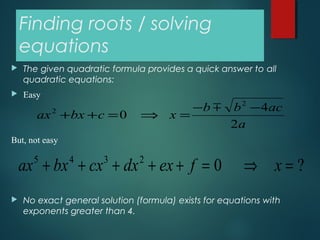
 The given quadratic formula provides a quick answer to all
quadratic equations:
 Easy
But, not easy
 No exact general solution (formula) exists for equations with
exponents greater than 4.
a
acbb
xcbxax
2
4
0
2
2 −−
=⇒=++

?02345
=⇒=+++++ xfexdxcxbxax
Finding roots…
 For this reason, we have to find out the root to
solve the equation.
 However we can say how accurate our solution is
as compared to the “exact” solution.
 One of the method is FALSE POSITION.
The False-Position Method (Regula-Falsi)
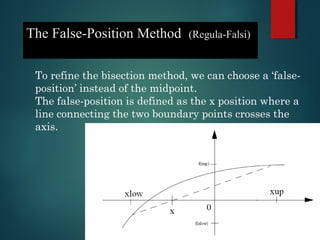
To refine the bisection method, we can choose a ‘false-
position’ instead of the midpoint.
The false-position is defined as the x position where a
line connecting the two boundary points crosses the
axis.
Regula Falsi
 For example, if f(xlow) is much closer to
zero than f(xup), it is likely that the root is
closer to xlow than to xup.
False position method is an alternative
approach where f(xlow) and f(xup) are
joined by a straight line; the
intersection of which with the x-axis
represents and improved estimate of
the root.
The intersection of this line with the x
axis represents an improved estimate
of the root.
Linear Interpolation
Method
 The fact that the replacement of the curve by a
straight line gives the false position of the root is
the origin of the name, method of false position,
or in Latin, Regula Falsi.
 It is also called the Linear Interpolation Method.
False Position formulae
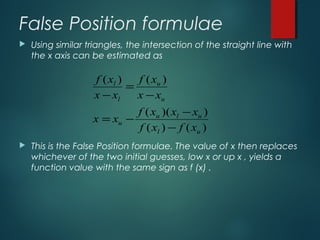
 Using similar triangles, the intersection of the straight line with
the x axis can be estimated as
 This is the False Position formulae. The value of x then replaces
whichever of the two initial guesses, low x or up x , yields a
function value with the same sign as f (x) .
)()(
))((
)()(
ul
ulu
u
u
u
l
l
xfxf
xxxf
xx
xx
xf
xx
xf
−
−
−=
−
=
−
Algorithm
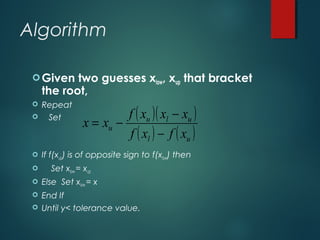
Given two guesses xlow, xup that bracket
the root,
 Repeat
 Set
 If f(xup) is of opposite sign to f(xlow) then
 Set xlow = xup
 Else Set xlow = x
 End If
 Until y< tolerance value.
( )( )
( ) ( )ul
ulu
u
xfxf
xxxf
xx
−
−
−=
Example
Lets look for a solution to the equation x3
-2x-3=0.
We consider the function f(x)=x3
-2x-3
On the interval [0,2] the function is negative at 0 and positive at 2. This
means that a=0 and b=2 (i.e. f(0)f(2)=(-3)(1)=-3<0, this means we can
apply the algorithm).
( )
2
3
4
6
31
)2(3
)0()2(
02)0(
0 =
−
−=
−−
−
−=
−
−
−=
ff
f
xrfp
8
21
2
3
)(
−
=





= fxf rfp
This is negative and we will make the a
=3/2 and b is the same and apply the
same thing to the interval [3/2,2].
( )( )
( )
( )
29
54
58
21
2
3
12
3
)2(
2
2
3
8
21
2
1
8
21
2
3
2
3
2
3
=+=
−
−=
−
−
−= −
−
ff
f
xrfp
267785.0
29
54
)( −=





= fxf rfp
This is negative and we will make the a
=54/29 and b is the same and apply the
same thing to the interval [54/29,2].
Merits & Demerits
 Merits
As the interval becomes small, the interior
point generally becomes much closer to root.
Faster convergence than bisection.
Often superior to bisection.
Demerits
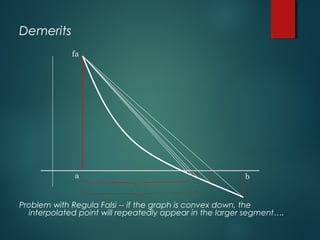
Problem with Regula Falsi -- if the graph is convex down, the
interpolated point will repeatedly appear in the larger segment….
a b
fa
Demerits
 Demerits
It can’t predict number of iterations to reach
a give precision.
It can be less precise than bisection – no strict
precision guarantee.
 Though the difference between Bisection and
False Position Method is little but for some cases
False Position Method is useful and for some
problems Bisection method is effective….
 In fact they both are necessary to solve any
equation by ‘Bracketing method’.
THE END
THANK YOU

Regulafalsi_bydinesh

  • 1.
    FALSE POSITION METHOD Name–Dinesh Kumar and Himanshu Sharma Roll No. – 16032 and 16026 respectively Submitted To : - Mr. Jitendra Singh
  • 2.
    Finding roots /solving equations  The given quadratic formula provides a quick answer to all quadratic equations:  Easy But, not easy  No exact general solution (formula) exists for equations with exponents greater than 4. a acbb xcbxax 2 4 0 2 2 −− =⇒=++  ?02345 =⇒=+++++ xfexdxcxbxax
  • 3.
    Finding roots…  Forthis reason, we have to find out the root to solve the equation.  However we can say how accurate our solution is as compared to the “exact” solution.  One of the method is FALSE POSITION.
  • 4.
    The False-Position Method(Regula-Falsi) To refine the bisection method, we can choose a ‘false- position’ instead of the midpoint. The false-position is defined as the x position where a line connecting the two boundary points crosses the axis.
  • 5.
    Regula Falsi  Forexample, if f(xlow) is much closer to zero than f(xup), it is likely that the root is closer to xlow than to xup. False position method is an alternative approach where f(xlow) and f(xup) are joined by a straight line; the intersection of which with the x-axis represents and improved estimate of the root. The intersection of this line with the x axis represents an improved estimate of the root.
  • 6.
    Linear Interpolation Method  Thefact that the replacement of the curve by a straight line gives the false position of the root is the origin of the name, method of false position, or in Latin, Regula Falsi.  It is also called the Linear Interpolation Method.
  • 7.
    False Position formulae Using similar triangles, the intersection of the straight line with the x axis can be estimated as  This is the False Position formulae. The value of x then replaces whichever of the two initial guesses, low x or up x , yields a function value with the same sign as f (x) . )()( ))(( )()( ul ulu u u u l l xfxf xxxf xx xx xf xx xf − − −= − = −
  • 8.
    Algorithm Given two guessesxlow, xup that bracket the root,  Repeat  Set  If f(xup) is of opposite sign to f(xlow) then  Set xlow = xup  Else Set xlow = x  End If  Until y< tolerance value. ( )( ) ( ) ( )ul ulu u xfxf xxxf xx − − −=
  • 9.
    Example Lets look fora solution to the equation x3 -2x-3=0. We consider the function f(x)=x3 -2x-3 On the interval [0,2] the function is negative at 0 and positive at 2. This means that a=0 and b=2 (i.e. f(0)f(2)=(-3)(1)=-3<0, this means we can apply the algorithm). ( ) 2 3 4 6 31 )2(3 )0()2( 02)0( 0 = − −= −− − −= − − −= ff f xrfp 8 21 2 3 )( − =      = fxf rfp This is negative and we will make the a =3/2 and b is the same and apply the same thing to the interval [3/2,2]. ( )( ) ( ) ( ) 29 54 58 21 2 3 12 3 )2( 2 2 3 8 21 2 1 8 21 2 3 2 3 2 3 =+= − −= − − −= − − ff f xrfp 267785.0 29 54 )( −=      = fxf rfp This is negative and we will make the a =54/29 and b is the same and apply the same thing to the interval [54/29,2].
  • 10.
    Merits & Demerits Merits As the interval becomes small, the interior point generally becomes much closer to root. Faster convergence than bisection. Often superior to bisection.
  • 11.
    Demerits Problem with RegulaFalsi -- if the graph is convex down, the interpolated point will repeatedly appear in the larger segment…. a b fa
  • 12.
    Demerits  Demerits It can’tpredict number of iterations to reach a give precision. It can be less precise than bisection – no strict precision guarantee.
  • 13.
     Though thedifference between Bisection and False Position Method is little but for some cases False Position Method is useful and for some problems Bisection method is effective….  In fact they both are necessary to solve any equation by ‘Bracketing method’.
  • 14.