NEWTON RAPHSON
METHOD
Newton-Raphson method, is a method for finding
successively better approximations to the roots(or
zeroes) of a real-valued function.
X:f(x)=0.
The Newton-Raphson method in one variable is
implemented as follows:
The method starts with a function f defined over the real
no. x ,the function’s derivative f, and an initial guess x0
for a root of the function satisfies the assumptions made
in the derivation of the formula and the initial guess is
close, then a better approximation x1 is
x1=x0-f(x0)/ f’(x0)
Features of Newton-Raphson
method
 Efficient for small molecules, converges
quickly
 Calculation and inversion is computationally
difficult for large molecules
 Approximation of quadratic surface poor,
particularly far from minimum
 Order of convergence is 2
Advantages of
Newton-Raphson Method
o One of the fastest convergences to the root.
o Converges on the root quadratic.
o Near a root, the number of significant digits
approximately doubles with each step.
o This leads to the ability of the Newton-Raphson
Method to “polish” a root from another
convergences technique.
o Easy to convert to multiple dimensions.
o Can be used to “polish” a root found by other
methods.
Disadvantages of
Newton-Raphson Method
o Must find the derivative
o Poor global convergence properties
o Dependent on initial guess
 May be too far from local root
 May encounter a zero derivative
 May loop indefinitely
Newton- Raphson Method
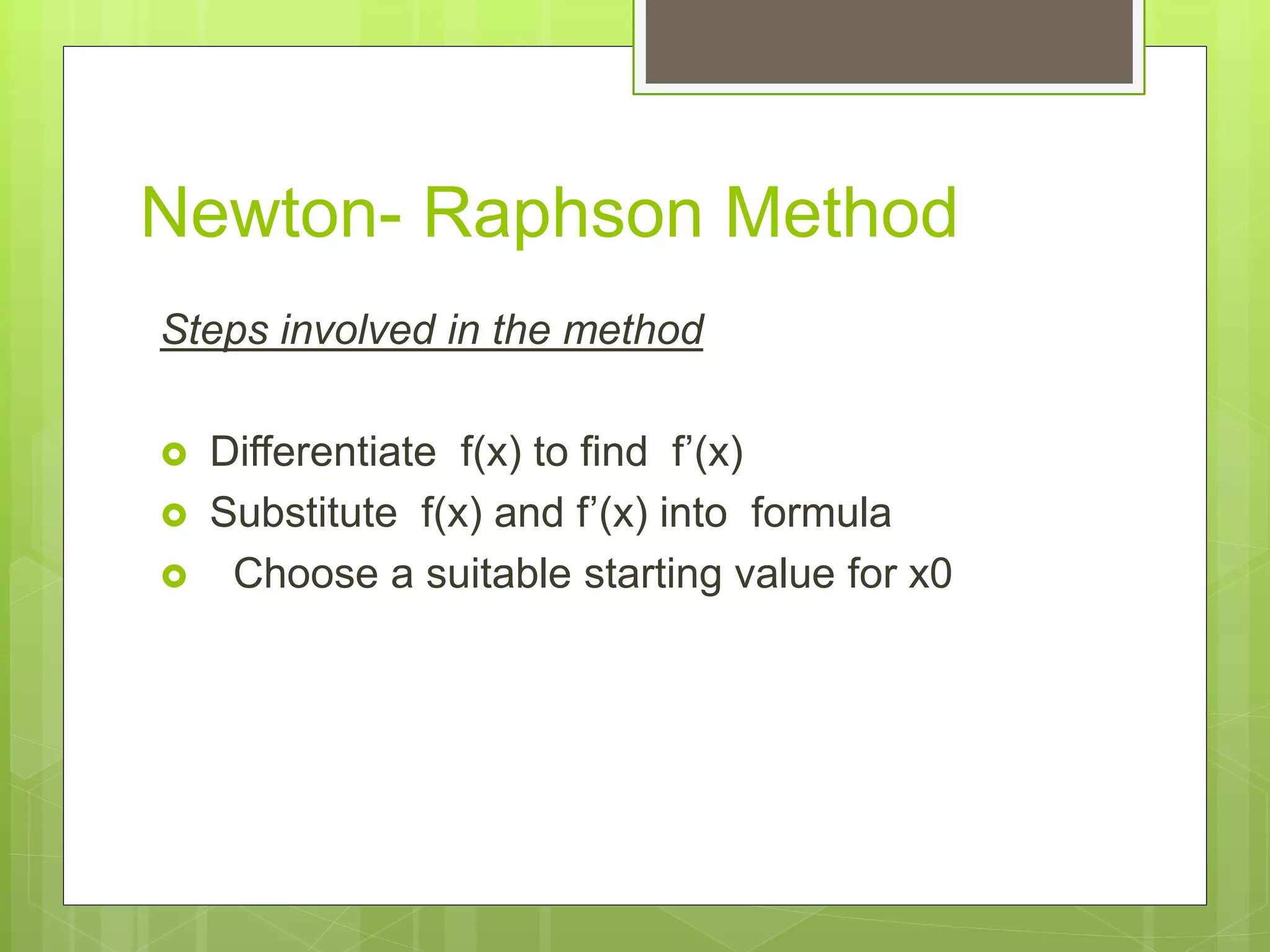
Steps involved in the method
 Differentiate f(x) to find f’(x)
 Substitute f(x) and f’(x) into formula
 Choose a suitable starting value for x0
Example..
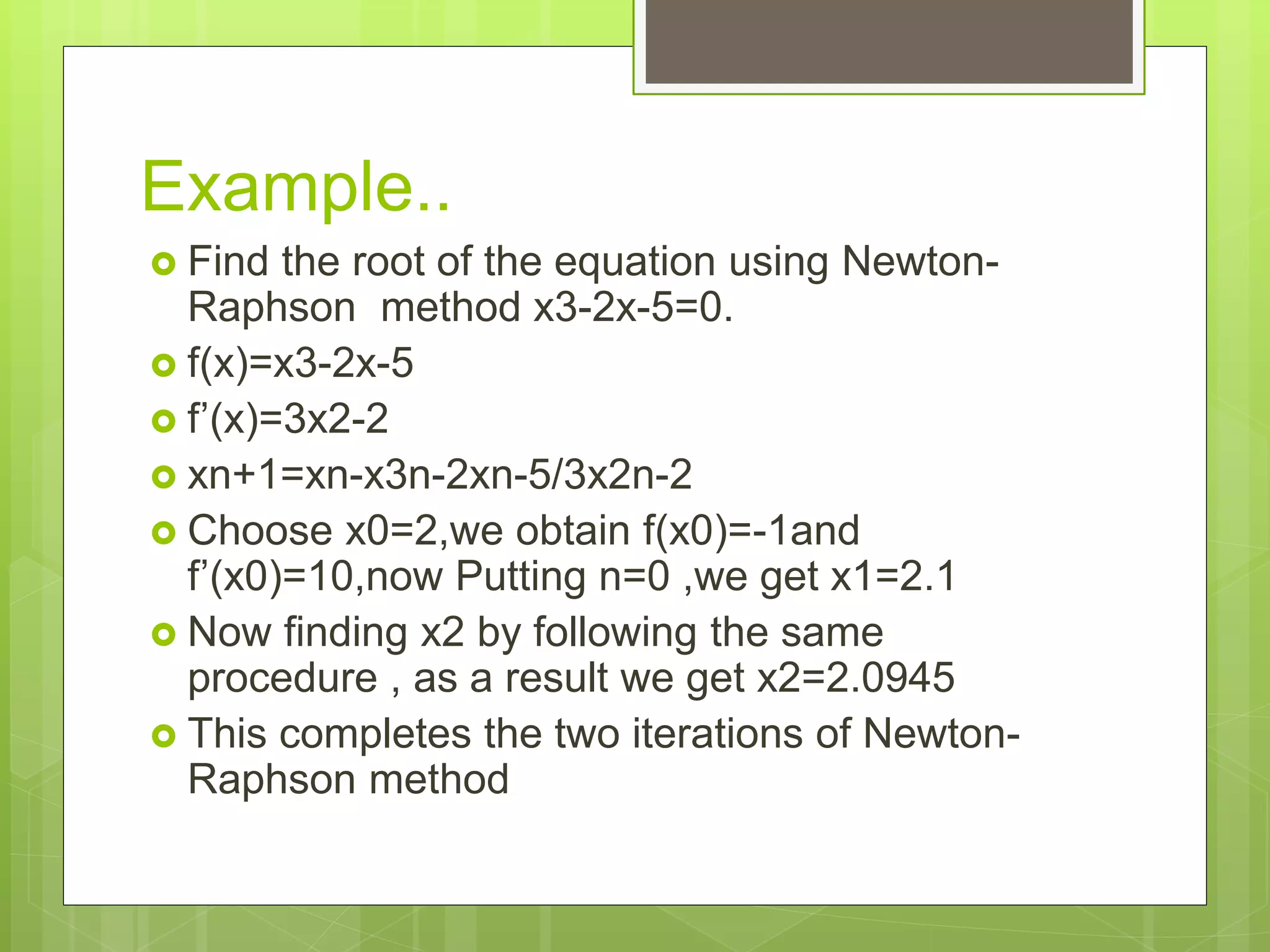
 Find the root of the equation using Newton-
Raphson method x3-2x-5=0.
 f(x)=x3-2x-5
 f’(x)=3x2-2
 xn+1=xn-x3n-2xn-5/3x2n-2
 Choose x0=2,we obtain f(x0)=-1and
f’(x0)=10,now Putting n=0 ,we get x1=2.1
 Now finding x2 by following the same
procedure , as a result we get x2=2.0945
 This completes the two iterations of Newton-
Raphson method
Newton Raphson Method

Newton Raphson Method

  • 2.
    NEWTON RAPHSON METHOD Newton-Raphson method,is a method for finding successively better approximations to the roots(or zeroes) of a real-valued function. X:f(x)=0. The Newton-Raphson method in one variable is implemented as follows: The method starts with a function f defined over the real no. x ,the function’s derivative f, and an initial guess x0 for a root of the function satisfies the assumptions made in the derivation of the formula and the initial guess is close, then a better approximation x1 is x1=x0-f(x0)/ f’(x0)
  • 3.
    Features of Newton-Raphson method Efficient for small molecules, converges quickly  Calculation and inversion is computationally difficult for large molecules  Approximation of quadratic surface poor, particularly far from minimum  Order of convergence is 2
  • 4.
    Advantages of Newton-Raphson Method oOne of the fastest convergences to the root. o Converges on the root quadratic. o Near a root, the number of significant digits approximately doubles with each step. o This leads to the ability of the Newton-Raphson Method to “polish” a root from another convergences technique. o Easy to convert to multiple dimensions. o Can be used to “polish” a root found by other methods.
  • 5.
    Disadvantages of Newton-Raphson Method oMust find the derivative o Poor global convergence properties o Dependent on initial guess  May be too far from local root  May encounter a zero derivative  May loop indefinitely
  • 6.
    Newton- Raphson Method Stepsinvolved in the method  Differentiate f(x) to find f’(x)  Substitute f(x) and f’(x) into formula  Choose a suitable starting value for x0
  • 7.
    Example..  Find theroot of the equation using Newton- Raphson method x3-2x-5=0.  f(x)=x3-2x-5  f’(x)=3x2-2  xn+1=xn-x3n-2xn-5/3x2n-2  Choose x0=2,we obtain f(x0)=-1and f’(x0)=10,now Putting n=0 ,we get x1=2.1  Now finding x2 by following the same procedure , as a result we get x2=2.0945  This completes the two iterations of Newton- Raphson method