ROOTS OF EQUATIONS
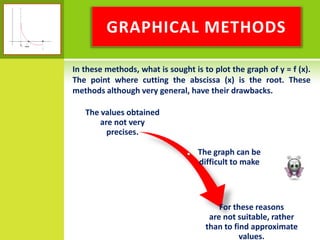
GRAPHICAL METHODS In these methods, what is sought is to plot the graph of y = f (x). The point where cutting the abscissa (x) is the root. These methods although very general, have their drawbacks.  
INTERVAL METHODS
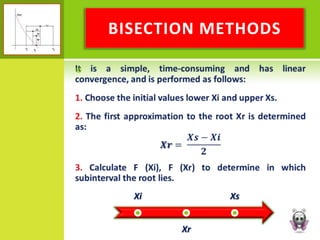
It is a simple, time-consuming and has linear convergence, and is performed as follows:1. Choose the initial values lower Xi and upper Xs.2. The first approximation to the root Xr is determined as:𝑿𝒓= 𝑿𝒔−𝑿𝒊𝟐3. Calculate F (Xi), F (Xr) to determine in which subinterval the root lies.   BISECTION METHODS
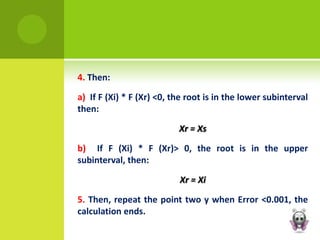
4.Then:a)  If F (Xi) * F (Xr) <0, the root is in the lower subinterval then:Xr= Xsb) If F (Xi) * F (Xr)> 0, the root is in the upper subinterval, then:Xr= Xi5.Then, repeat the pointtwo y when Error <0.001, the calculation ends.
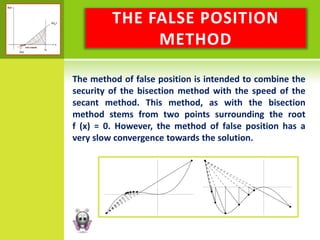
THE FALSE POSITION METHODThe method of false position is intended to combine the security of the bisection method with the speed of the secant method. This method, as with the bisection method stems from two points surrounding the root        f (x) = 0. However, the method of false position has a very slow convergence towards the solution.
Usingthetwo-pointform of theline:with, using                ,  and solvingforthereforegivestheiteration.
OPEN METHODS
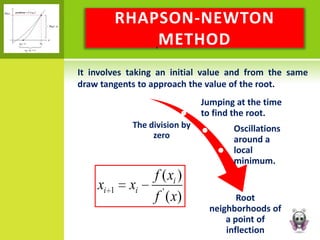
RHAPSON-NEWTON METHODIt involves taking an initial value and from the same draw tangents to approach the value of the root.
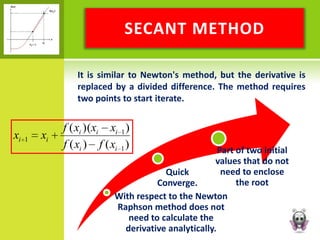
SECANT METHODIt is similar to Newton's method, but the derivative is replaced by a divided difference. The method requires two points to start iterate.
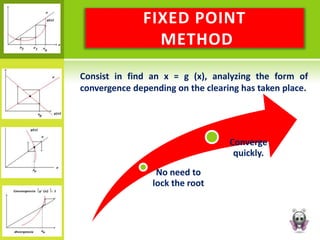
FIXED POINT   METHODConsist in find an x = g (x), analyzing the form of convergence depending on the clearing has taken place.
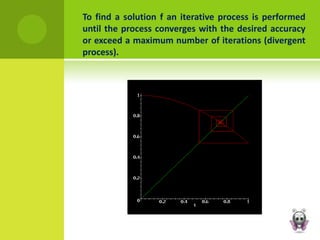
To find a solution f an iterative process is performed until the process converges with the desired accuracy or exceed a maximum number of iterations (divergent process).
BIBLIOGRAPHYhttp://html.rincondelvago.com/0003061310.pnghttp://www.uv.mx/anmarin/images/puntofijo.gif

Root Equations Methods

  • 1.
  • 2.
    GRAPHICAL METHODS Inthese methods, what is sought is to plot the graph of y = f (x). The point where cutting the abscissa (x) is the root. These methods although very general, have their drawbacks.  
  • 3.
  • 4.
    It is asimple, time-consuming and has linear convergence, and is performed as follows:1. Choose the initial values lower Xi and upper Xs.2. The first approximation to the root Xr is determined as:𝑿𝒓= 𝑿𝒔−𝑿𝒊𝟐3. Calculate F (Xi), F (Xr) to determine in which subinterval the root lies.   BISECTION METHODS
  • 5.
    4.Then:a) IfF (Xi) * F (Xr) <0, the root is in the lower subinterval then:Xr= Xsb) If F (Xi) * F (Xr)> 0, the root is in the upper subinterval, then:Xr= Xi5.Then, repeat the pointtwo y when Error <0.001, the calculation ends.
  • 6.
    THE FALSE POSITIONMETHODThe method of false position is intended to combine the security of the bisection method with the speed of the secant method. This method, as with the bisection method stems from two points surrounding the root f (x) = 0. However, the method of false position has a very slow convergence towards the solution.
  • 7.
    Usingthetwo-pointform of theline:with,using , and solvingforthereforegivestheiteration.
  • 8.
  • 9.
    RHAPSON-NEWTON METHODIt involvestaking an initial value and from the same draw tangents to approach the value of the root.
  • 10.
    SECANT METHODIt issimilar to Newton's method, but the derivative is replaced by a divided difference. The method requires two points to start iterate.
  • 11.
    FIXED POINT METHODConsist in find an x = g (x), analyzing the form of convergence depending on the clearing has taken place.
  • 12.
    To find asolution f an iterative process is performed until the process converges with the desired accuracy or exceed a maximum number of iterations (divergent process).
  • 13.