Download as PDF, PPTX
![Background of Regula Falsi Method Derivation of the Regula Falsi Method Regula Falsi Algorithm to find approximate
Application of Regula Falsi Method
Question
Find a root of xex
= 1 on I = [0, 1] using Regula Falsi method.](https://image.slidesharecdn.com/falseposition-200912111052/85/Regula-Falsi-False-position-Method-2-320.jpg)

![Background of Regula Falsi Method Derivation of the Regula Falsi Method Regula Falsi Algorithm to find approximate
Background of Regula Falsi Method
Introduction
• It is one of the bracketing iterative methods in finding
roots of a nonlinear equations.
• The approximated root is found by the use of straight
lines or slopes.
• It is also noted to be based on Bolzano’s theorem for
continuous functions.
Theorem (Bolzano)
If a function f (x) is continuous on an interval [a, b] and
f (a) · f (b) < 0, then a value c ∈ (a, b) exists for which
f (c) = 0.](https://image.slidesharecdn.com/falseposition-200912111052/85/Regula-Falsi-False-position-Method-4-320.jpg)
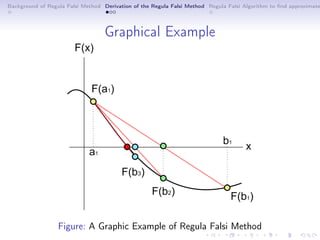
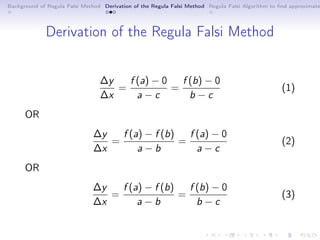
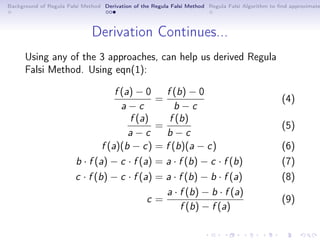

![Background of Regula Falsi Method Derivation of the Regula Falsi Method Regula Falsi Algorithm to find approximate
Application of Regula Falsi Method
Example 1
Find a root of xex
= 1 on I = [0, 1] using Regula Falsi method.
Solution
Considering our f (x) = xex
− 1 = 0 and a1 = 0, b1 = 1
f (0) = 0 · e0
− 1 = −1
f (1) = 1 · e1
− 1 = 1.7183
f (0) · f (1) < 0, hence c ∈ [0, 1].
c1 =
a · f (b) − b · f (a)
f (b) − f (a)
= 0.3679 (10)
f (c1) = −0.4685 (11)
choose [a2, b2] = [0.3679, 1]](https://image.slidesharecdn.com/falseposition-200912111052/85/Regula-Falsi-False-position-Method-9-320.jpg)
![Background of Regula Falsi Method Derivation of the Regula Falsi Method Regula Falsi Algorithm to find approximate
Solution Continue...
c2 =
a2 · f (b2) − b2 · f (a2)
f (b2) − f (a2)
= 0.5033 (12)
f (c2) = −0.1674 (13)
choose [a3, b3] = [0.5033, 1]
c3 =
a3 · f (b3) − b3 · f (a3)
f (b3) − f (a3)
= 0.5474 (14)
f (c3) = −0.0536 (15)
choose [a4, b4] = [0.5474, 1]](https://image.slidesharecdn.com/falseposition-200912111052/85/Regula-Falsi-False-position-Method-10-320.jpg)
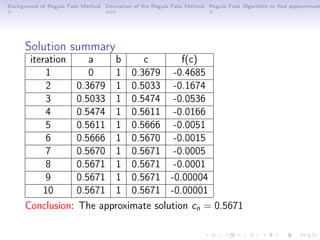


The document discusses the Regula Falsi (false position) method, a bracketing iterative technique for finding roots of nonlinear equations based on Bolzano's theorem. It includes the derivation and algorithm for the method, as well as a detailed example of finding a root for the function xex = 1 within the interval [0, 1]. The iterative process is summarized, demonstrating convergence to an approximate solution of 0.5671.


