Numerical Computing
Lecture # 11
Regula Falsi Method
By Nasima Akhtar
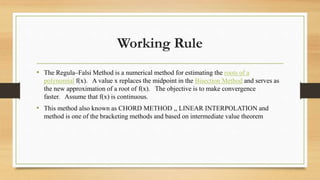
Working Rule
• The Regula–Falsi Method is a numerical method for estimating the roots of a
polynomial f(x). A value x replaces the midpoint in the Bisection Method and serves as
the new approximation of a root of f(x). The objective is to make convergence
faster. Assume that f(x) is continuous.
• This method also known as CHORD METHOD ,, LINEAR INTERPOLATION and
method is one of the bracketing methods and based on intermediate value theorem
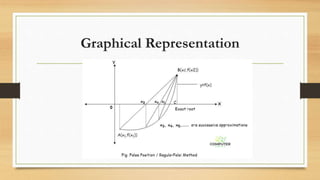
Graphical Representation
Derivation
• Equation Of line gives us:
•
𝑦 − 𝑦1
𝑥 − 𝑥1
=
𝑦2− 𝑦1
𝑥2− 𝑥1
• 𝑦 − 𝑦1 =
𝑦2− 𝑦1
𝑥2− 𝑥1
(𝑥 − 𝑥1)
• (𝑥1, 𝑦1)=(a,f(a)), (𝑥2, 𝑦2)=(b,f(b)), (𝑥 , 𝑦 )=(𝑥0, 𝑦0)
• y- f(a) =
f(b)−f(a)
b− 𝑎
(𝑥 −a)
• 0- f(a) =
f(b)−f(a)
b− 𝑎
(𝑥 −a) at x-axis y=0
• 0- f(a) =
f(b)−f(a)
b− 𝑎
(𝑥 −a)
•
(b− 𝑎)(− f(a) )
f(b)−f(a)
=x-a
• a +
(b− 𝑎)(− f(a) )
f(b)−f(a)
=x
•
𝑎(f(b)−f(a))+(b− 𝑎)(− f(a) )
f(b)−f(a)
=x `
•
𝑎(f(b))−a(f(a))−b(f(a) )+a(f(a) )
f(b)−f(a)
=x `
•
𝑎(f(b)) −b(f(a) )
f(b)−f(a)
=x `
• X=
𝑎(f(b)) −b(f(a) )
f(b)−f(a)
`
Algorithm
1.Find points a and b such that a < b and f(a) * f(b) < 0.
2.Take the interval [a, b] and determine the next value of x1.
3.If f(x1) = 0 then x1 is an exact root, else if f(x1) * f(b) < 0 then let a = x1,
else if f(a) * f(x1) < 0 then let b = x1.
4.Repeat steps 2 & 3 until f(xi) = 0 or |f(xi)|  tolerance
Example Numerical
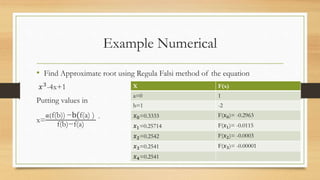
• Find Approximate root using Regula Falsi method of the equation
𝑥3-4x+1
Putting values in
x=
𝑎(f(b)) −b(f(a) )
f(b)−f(a)
`
X F(x)
a=0 1
b=1 -2
𝑥0=0.3333 F(𝑥0)= -0.2963
𝑥1=0.25714 F(𝑥1)= -0.0115
𝑥2=0.2542 F(𝑥2)= -0.0003
𝑥3=0.2541 F(𝑥3)= -0.00001
𝑥4=0.2541
Pros and Cons
Advantages
• 1. It always converges.
• 2. It does not require the derivative.
• 3. It is a quick method.
Disadvantages
• 1. One of the interval definitions can get stuck.
• 2. It may slowdown in unfavourable situations.
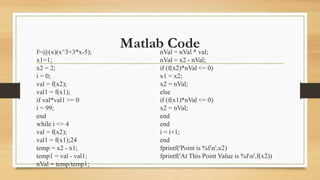
Matlab Code
f=@(x)(x^3+3*x-5);
x1=1;
x2 = 2;
i = 0;
val = f(x2);
val1 = f(x1);
if val*val1 >= 0
i = 99;
end
while i <= 4
val = f(x2);
val1 = f(x1);24
temp = x2 - x1;
temp1 = val - val1;
nVal = temp/temp1;
nVal = nVal * val;
nVal = x2 - nVal;
if (f(x2)*nVal <= 0)
x1 = x2;
x2 = nVal;
else
if (f(x1)*nVal <= 0)
x2 = nVal;
end
end
i = i+1;
end
fprintf('Point is %fn',x2)
fprintf('At This Point Value is %fn',f(x2))

False Point Method / Regula falsi method

  • 1.
    Numerical Computing Lecture #11 Regula Falsi Method By Nasima Akhtar
  • 2.
    Working Rule • TheRegula–Falsi Method is a numerical method for estimating the roots of a polynomial f(x). A value x replaces the midpoint in the Bisection Method and serves as the new approximation of a root of f(x). The objective is to make convergence faster. Assume that f(x) is continuous. • This method also known as CHORD METHOD ,, LINEAR INTERPOLATION and method is one of the bracketing methods and based on intermediate value theorem
  • 3.
  • 4.
    Derivation • Equation Ofline gives us: • 𝑦 − 𝑦1 𝑥 − 𝑥1 = 𝑦2− 𝑦1 𝑥2− 𝑥1 • 𝑦 − 𝑦1 = 𝑦2− 𝑦1 𝑥2− 𝑥1 (𝑥 − 𝑥1) • (𝑥1, 𝑦1)=(a,f(a)), (𝑥2, 𝑦2)=(b,f(b)), (𝑥 , 𝑦 )=(𝑥0, 𝑦0) • y- f(a) = f(b)−f(a) b− 𝑎 (𝑥 −a) • 0- f(a) = f(b)−f(a) b− 𝑎 (𝑥 −a) at x-axis y=0 • 0- f(a) = f(b)−f(a) b− 𝑎 (𝑥 −a) • (b− 𝑎)(− f(a) ) f(b)−f(a) =x-a • a + (b− 𝑎)(− f(a) ) f(b)−f(a) =x • 𝑎(f(b)−f(a))+(b− 𝑎)(− f(a) ) f(b)−f(a) =x ` • 𝑎(f(b))−a(f(a))−b(f(a) )+a(f(a) ) f(b)−f(a) =x ` • 𝑎(f(b)) −b(f(a) ) f(b)−f(a) =x ` • X= 𝑎(f(b)) −b(f(a) ) f(b)−f(a) `
  • 5.
    Algorithm 1.Find points aand b such that a < b and f(a) * f(b) < 0. 2.Take the interval [a, b] and determine the next value of x1. 3.If f(x1) = 0 then x1 is an exact root, else if f(x1) * f(b) < 0 then let a = x1, else if f(a) * f(x1) < 0 then let b = x1. 4.Repeat steps 2 & 3 until f(xi) = 0 or |f(xi)|  tolerance
  • 6.
    Example Numerical • FindApproximate root using Regula Falsi method of the equation 𝑥3-4x+1 Putting values in x= 𝑎(f(b)) −b(f(a) ) f(b)−f(a) ` X F(x) a=0 1 b=1 -2 𝑥0=0.3333 F(𝑥0)= -0.2963 𝑥1=0.25714 F(𝑥1)= -0.0115 𝑥2=0.2542 F(𝑥2)= -0.0003 𝑥3=0.2541 F(𝑥3)= -0.00001 𝑥4=0.2541
  • 7.
    Pros and Cons Advantages •1. It always converges. • 2. It does not require the derivative. • 3. It is a quick method. Disadvantages • 1. One of the interval definitions can get stuck. • 2. It may slowdown in unfavourable situations.
  • 8.
    Matlab Code f=@(x)(x^3+3*x-5); x1=1; x2 =2; i = 0; val = f(x2); val1 = f(x1); if val*val1 >= 0 i = 99; end while i <= 4 val = f(x2); val1 = f(x1);24 temp = x2 - x1; temp1 = val - val1; nVal = temp/temp1; nVal = nVal * val; nVal = x2 - nVal; if (f(x2)*nVal <= 0) x1 = x2; x2 = nVal; else if (f(x1)*nVal <= 0) x2 = nVal; end end i = i+1; end fprintf('Point is %fn',x2) fprintf('At This Point Value is %fn',f(x2))