Protein Targeting
M.Prasad Naidu
MSc Medical Biochemistry,
Ph.D.Research Scholar
Each eukaryotic cell is
subdivided into
functionally distinct,
membrane-bound
compartments –
organelles
 Each compartment has
its own distinct set of
proteins = functions
 A complex distribution
system moves proteins
from the place of
synthesis to its proper
destination
Protein targeting
 Protein has to be correctly localized to perform proper
function.
 Receptors – plasma membrane
 DNA polymerase – nucleus
 Catalase – peroxisomes
 Insulin – outside
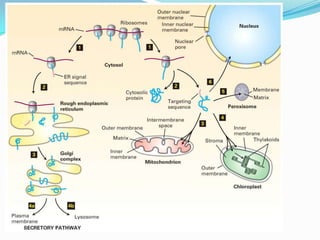
 All proteins begin to be synthesized on cytosolic
ribosomes.
 Sorting or translocation can occur
 Co-translational
 Post-translational
 If the protein is for cytosolic functins, the synthesis
will be finished on free ribosomes and the peptide is
released into the cytosol.
 If the protein is destined for nucleus,
mitochondria or peroxisomes the synthesis is
also finished on cytoplasmic ribosomes and the
peptide is released to the cytosol (to be sorted later or
post-translationally).
 If the protein is going to be secreted from the cell or it
destined for the membranes the ribosome with the
nascent peptide is targeted to the ER (ER becomes
rough) and sorting is done during translation (co-
translationally).
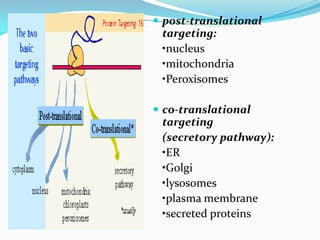
 post-translational
targeting:
•nucleus
•mitochondria
•Peroxisomes
 co-translational
targeting
(secretory pathway):
•ER
•Golgi
•lysosomes
•plasma membrane
•secreted proteins
Targeting sequence
 Characteristic for the destination not the protein
 Part of the polypeptide
 Can be cleaved later by signal peptidase or remain
permanent part of protein
 Can be located on N-, C-terminus or in the middle of
the protein
( GUENTER BLOBEL – NP –
1999 )
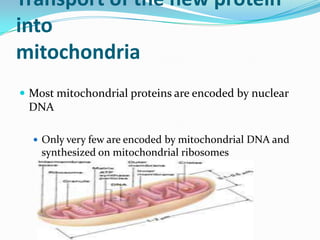
Transport of the new protein
into
mitochondria
 Most mitochondrial proteins are encoded by nuclear
DNA
 Only very few are encoded by mitochondrial DNA and
synthesized on mitochondrial ribosomes
Mitochondrial targeting signals
 Usually located at N-terminus of precursor
polypeptide
 Usually removed in mitochondrial matrix
Receptor/translocation channels
in
mitochondria
 Tom – translocase of the outer mitochondrial
membrane
 Tim - translocase of the inner mitochondrial
membrane
 Mitochondrial proteins are synthesized in cytosol as
precursors
 Bind to cytosolic chaperones(Hsp 70) to keep them
unfolded until they ready to be translocated
 Energy from ATP
 Some outer membrane proteins insert themselves in
the membrane while in transit
 Intermembrane space proteins remain there and fold
 Protein destined to matrix passes through Tom 40 and
then Tim (inner membrane translocon)
Peroxisomes
 Single membrane organelle
 Matrix contains oxidative enzymes
 Lipid oxidation without ATP production
 Proteins encoded by nuclear DNA (all have to be
imported).
Transport into peroxisomes
 Proteins are synthesized and fully folded in cytosol
 Fully functional, fully folded protein is transported!
 Import requires ATP hydrolysis
 Peroxisome targeting sequences
 PTS1 on C-terminus, very conserved
 PTS2 on N-terminus, just few proteins
 Peroxins - peroxisome transport receptors
 Bind to proteins with PTS1 and dock to the
translocation channel
 The complex is transported through the
membrane
 Protein is released
 Peroxin is recycled
Transport into the nucleus
 All proteins found in the nucleus are synthesized in
the cytoplasm
 Examples:
 Histones
 Ribosomal proteins
 DNA and RNA polymerases
 Transcription factors
 Transport requires nuclear localization sequences
(NLS)
 Transport occurs through the nuclear pores
 Nuclear import receptor (Importin α and β)
 Energy from GTP
 GTPase Ran
 Fully folded proteins are transported
 Importin α and β bind to the protein to be transported
 Nuclear localization signal binds to importin α
 The complex is translocated through the nuclear
membrane
 Activated Ran (GTP) causes the complex to dissociate
 Ran transports importin β back to cytosol
 Importin α becomes a part of export receptor
and their co-translational
translocation across the ER
membrane
 ER signal sequence emerges
 The binding by a signal-recongition particles
(SRP)
 SRP delivers the ribosome/nascent polypeptide
complex to the SRP receptor in the ER
membrane, and GTP binding
synthesized on
the rough ER
Diseases due to defective
protein targeting
1. ZELLWEGER SYNDROME
2. PRIMARY HYPEROXALURIA
3. FAMILIAL HYPERCHOLESTROLEMIA
4. CYSTIC FIBROSIS
5. INCLUSION CELL DISEASE
Thank you

Protein targeting

  • 1.
    Protein Targeting M.Prasad Naidu MScMedical Biochemistry, Ph.D.Research Scholar
  • 2.
    Each eukaryotic cellis subdivided into functionally distinct, membrane-bound compartments – organelles  Each compartment has its own distinct set of proteins = functions  A complex distribution system moves proteins from the place of synthesis to its proper destination
  • 3.
    Protein targeting  Proteinhas to be correctly localized to perform proper function.  Receptors – plasma membrane  DNA polymerase – nucleus  Catalase – peroxisomes  Insulin – outside
  • 4.
     All proteinsbegin to be synthesized on cytosolic ribosomes.  Sorting or translocation can occur  Co-translational  Post-translational  If the protein is for cytosolic functins, the synthesis will be finished on free ribosomes and the peptide is released into the cytosol.
  • 5.
     If theprotein is destined for nucleus, mitochondria or peroxisomes the synthesis is also finished on cytoplasmic ribosomes and the peptide is released to the cytosol (to be sorted later or post-translationally).  If the protein is going to be secreted from the cell or it destined for the membranes the ribosome with the nascent peptide is targeted to the ER (ER becomes rough) and sorting is done during translation (co- translationally).
  • 6.
     post-translational targeting: •nucleus •mitochondria •Peroxisomes  co-translational targeting (secretorypathway): •ER •Golgi •lysosomes •plasma membrane •secreted proteins
  • 8.
    Targeting sequence  Characteristicfor the destination not the protein  Part of the polypeptide  Can be cleaved later by signal peptidase or remain permanent part of protein  Can be located on N-, C-terminus or in the middle of the protein
  • 9.
    ( GUENTER BLOBEL– NP – 1999 )
  • 10.
    Transport of thenew protein into mitochondria  Most mitochondrial proteins are encoded by nuclear DNA  Only very few are encoded by mitochondrial DNA and synthesized on mitochondrial ribosomes
  • 11.
    Mitochondrial targeting signals Usually located at N-terminus of precursor polypeptide  Usually removed in mitochondrial matrix
  • 12.
    Receptor/translocation channels in mitochondria  Tom– translocase of the outer mitochondrial membrane  Tim - translocase of the inner mitochondrial membrane
  • 13.
     Mitochondrial proteinsare synthesized in cytosol as precursors  Bind to cytosolic chaperones(Hsp 70) to keep them unfolded until they ready to be translocated  Energy from ATP
  • 15.
     Some outermembrane proteins insert themselves in the membrane while in transit  Intermembrane space proteins remain there and fold  Protein destined to matrix passes through Tom 40 and then Tim (inner membrane translocon)
  • 16.
    Peroxisomes  Single membraneorganelle  Matrix contains oxidative enzymes  Lipid oxidation without ATP production  Proteins encoded by nuclear DNA (all have to be imported).
  • 17.
    Transport into peroxisomes Proteins are synthesized and fully folded in cytosol  Fully functional, fully folded protein is transported!  Import requires ATP hydrolysis  Peroxisome targeting sequences  PTS1 on C-terminus, very conserved  PTS2 on N-terminus, just few proteins
  • 18.
     Peroxins -peroxisome transport receptors  Bind to proteins with PTS1 and dock to the translocation channel  The complex is transported through the membrane  Protein is released  Peroxin is recycled
  • 20.
    Transport into thenucleus  All proteins found in the nucleus are synthesized in the cytoplasm  Examples:  Histones  Ribosomal proteins  DNA and RNA polymerases  Transcription factors
  • 21.
     Transport requiresnuclear localization sequences (NLS)  Transport occurs through the nuclear pores  Nuclear import receptor (Importin α and β)  Energy from GTP  GTPase Ran  Fully folded proteins are transported
  • 22.
     Importin αand β bind to the protein to be transported  Nuclear localization signal binds to importin α  The complex is translocated through the nuclear membrane
  • 23.
     Activated Ran(GTP) causes the complex to dissociate  Ran transports importin β back to cytosol  Importin α becomes a part of export receptor
  • 25.
    and their co-translational translocationacross the ER membrane  ER signal sequence emerges  The binding by a signal-recongition particles (SRP)  SRP delivers the ribosome/nascent polypeptide complex to the SRP receptor in the ER membrane, and GTP binding
  • 27.
  • 29.
    Diseases due todefective protein targeting 1. ZELLWEGER SYNDROME 2. PRIMARY HYPEROXALURIA 3. FAMILIAL HYPERCHOLESTROLEMIA 4. CYSTIC FIBROSIS 5. INCLUSION CELL DISEASE
  • 30.