CHAPERONES
ANJU ANTHARJANAM V.S.
DEPARTMENT OF BIOCHEMISTRY
UNIVERSITY OF KERALA
KARIAVATTOM CAMPUS
INTRODUCTION
• The three dimensional conformation of proteins
is important for their biological functions. so how
polypeptide chains ultimately fold into their final
conformation is also an important topic.
• Some of the proteins can spontaneously generate
the correct functionally active conformation.
• However a vast majority of proteins can attain
correct conformation only through the assistance
of certain proteins referred to as chaperones.
2avs
CHAPERONES
• Chaperones are proteins that interact with unfolded,
partially folded or improperly folded polypeptides
facilitating correct folding pathways or providing
microenvironments in which folding can occur.
• The chaperones are evolutionary conserved.They are
found in all organisms from bacteria to humans and
some are homologs with high sequence similarity that
use almost identical mechanisms to assist protein
folding.
• Chaperones have ATPase activity (binding,hydrolysis
and exchange of ATP essential for their function).
3avs
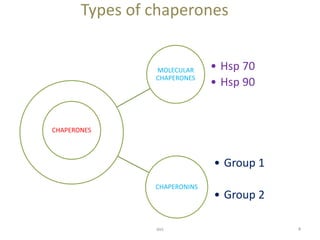
Types of chaperones
CHAPERONES
MOLECULAR
CHAPERONES
• Hsp 70
• Hsp 90
CHAPERONINS
• Group 1
• Group 2
4avs
Some chaperone homologs and their location
 Hsp 60 (chaperone 60 family)
 GroEL in bacterial cytosol
 Hsp 60 in mitochondrial matrix
 RubisCo binding protein in chloroplasts
 Hsp 70(stress70) proteins
 Hsp 70 in mammalian cytosol
 Bip in ER of eukaryotes
 Grp 75 in mitochondria
 DnaK in bacterial cytosol
 Hsp 90(stress 90) proteins
 Hsp 83 in eukaryotic cytosol
 Grp 94 in mammalian ER
 Htgp in bacterial cytosol
avs 5
Molecular chaperones
Hsp 70 &Hsp 90
• They bind to a short segment of a protein
substrate and stabilize unfolded or partly folded
proteins thereby preventing these proteins from
aggregating and being degraded.
• Hsp 70 family
• The heat shock protein Hsp 70 (Hsp-heat shock
protein,70-ml.wt-70,000)and its homologs are
the major chaperones in all organisms.
• They were first identified by their rapid
appearance after a cell has been stressed by heat
shock.
6avs
Molecular chaperones cntd..
• Hsp 70 proteins bind to regions of unfolded
polypeptides that are rich in hydrophobic
residues,preventing inappropriate
aggregation.
• Hsp 70 proteins also block the folding of
certain proteins that must remain unfolded
until they have been translocated across a
membrane.
7avs
• The Hsp 70 proteins bind to and release
polypeptides in a cycle that uses energy from ATP
hydrolysis and involves several other co-
chaperones.
• Co-chaperones
• Hsp 40 in eukaryotes and DnaJ in bacteria help to
increase efficiency of Hsp 70 mediated folding of
many proteins by stimulating substrate binding
and hydrolysis of ATP.
• Other examples are GrpE(in bacteria),BAG,HspBP
and Hsp 110(in eukaryotes).
8avs
9avs
• Hsp 90 family
• They are present in all organisms except archaea.
• They ensure the activation and functional regulation of
of their substrates usually called ‘clients’.
• Hsp 90 function as a dimer in a cycle in which ATP
binding ,hydrolysis,and ADP release are coupled to
conformational changes and to binding,activation,and
release of clients.
• Hsp 90s can help cells recognize misfolded proteins
that are unable to refold and facilitate their
degradation.
10avs
11avs
CHAPERONINS
• They form small folding chambers into which all
or part of an unfolded protein can be
sequestered giving it time and an appropriate
environment to fold properly.
• They are also called Hsp 60s.
• They are huge cylindrical supramolecular
assemblies formed from two rings of oligomers.
• There are two distinct groups of chaperonins-
Group 1 and Group 2 that differ in their
structures,molecular mechanism and locations.
12avs
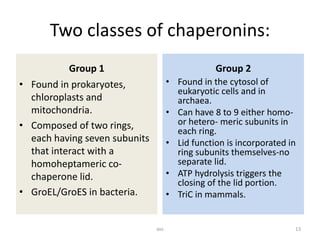
Two classes of chaperonins:
Group 1
• Found in prokaryotes,
chloroplasts and
mitochondria.
• Composed of two rings,
each having seven subunits
that interact with a
homoheptameric co-
chaperone lid.
• GroEL/GroES in bacteria.
Group 2
• Found in the cytosol of
eukaryotic cells and in
archaea.
• Can have 8 to 9 either homo-
or hetero- meric subunits in
each ring.
• Lid function is incorporated in
ring subunits themselves-no
separate lid.
• ATP hydrolysis triggers the
closing of the lid portion.
• TriC in mammals.
13avs
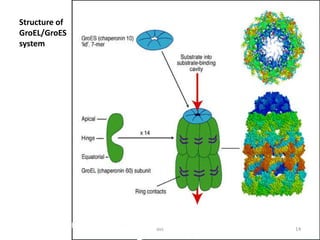
Structure of
GroEL/GroES
system
14avs
• Chaperonin in protein folding- 15avs
16avs
REFERENCES
• Text Book Of Molecular Cell Biology ,7th
Edition,by Arnold Berk, Harvey Lodish
Et.Al.,Macmillan.
• Lehninger Principles Of Biochemistry ,5th
Edition,Michael M.Cox And David L.Nelson.
• Textbook Of Biochemistry,4th
Edition,U.Sathyanarayana And U.Chakrapani.
• Hsp 70 Chaperones:cellular Functions And
Molecular Mechanism,M.P.Mayer And B.Bukau
17avs
Thank you…
18avs

Molecular chaperones

  • 1.
    CHAPERONES ANJU ANTHARJANAM V.S. DEPARTMENTOF BIOCHEMISTRY UNIVERSITY OF KERALA KARIAVATTOM CAMPUS
  • 2.
    INTRODUCTION • The threedimensional conformation of proteins is important for their biological functions. so how polypeptide chains ultimately fold into their final conformation is also an important topic. • Some of the proteins can spontaneously generate the correct functionally active conformation. • However a vast majority of proteins can attain correct conformation only through the assistance of certain proteins referred to as chaperones. 2avs
  • 3.
    CHAPERONES • Chaperones areproteins that interact with unfolded, partially folded or improperly folded polypeptides facilitating correct folding pathways or providing microenvironments in which folding can occur. • The chaperones are evolutionary conserved.They are found in all organisms from bacteria to humans and some are homologs with high sequence similarity that use almost identical mechanisms to assist protein folding. • Chaperones have ATPase activity (binding,hydrolysis and exchange of ATP essential for their function). 3avs
  • 4.
    Types of chaperones CHAPERONES MOLECULAR CHAPERONES •Hsp 70 • Hsp 90 CHAPERONINS • Group 1 • Group 2 4avs
  • 5.
    Some chaperone homologsand their location  Hsp 60 (chaperone 60 family)  GroEL in bacterial cytosol  Hsp 60 in mitochondrial matrix  RubisCo binding protein in chloroplasts  Hsp 70(stress70) proteins  Hsp 70 in mammalian cytosol  Bip in ER of eukaryotes  Grp 75 in mitochondria  DnaK in bacterial cytosol  Hsp 90(stress 90) proteins  Hsp 83 in eukaryotic cytosol  Grp 94 in mammalian ER  Htgp in bacterial cytosol avs 5
  • 6.
    Molecular chaperones Hsp 70&Hsp 90 • They bind to a short segment of a protein substrate and stabilize unfolded or partly folded proteins thereby preventing these proteins from aggregating and being degraded. • Hsp 70 family • The heat shock protein Hsp 70 (Hsp-heat shock protein,70-ml.wt-70,000)and its homologs are the major chaperones in all organisms. • They were first identified by their rapid appearance after a cell has been stressed by heat shock. 6avs
  • 7.
    Molecular chaperones cntd.. •Hsp 70 proteins bind to regions of unfolded polypeptides that are rich in hydrophobic residues,preventing inappropriate aggregation. • Hsp 70 proteins also block the folding of certain proteins that must remain unfolded until they have been translocated across a membrane. 7avs
  • 8.
    • The Hsp70 proteins bind to and release polypeptides in a cycle that uses energy from ATP hydrolysis and involves several other co- chaperones. • Co-chaperones • Hsp 40 in eukaryotes and DnaJ in bacteria help to increase efficiency of Hsp 70 mediated folding of many proteins by stimulating substrate binding and hydrolysis of ATP. • Other examples are GrpE(in bacteria),BAG,HspBP and Hsp 110(in eukaryotes). 8avs
  • 9.
  • 10.
    • Hsp 90family • They are present in all organisms except archaea. • They ensure the activation and functional regulation of of their substrates usually called ‘clients’. • Hsp 90 function as a dimer in a cycle in which ATP binding ,hydrolysis,and ADP release are coupled to conformational changes and to binding,activation,and release of clients. • Hsp 90s can help cells recognize misfolded proteins that are unable to refold and facilitate their degradation. 10avs
  • 11.
  • 12.
    CHAPERONINS • They formsmall folding chambers into which all or part of an unfolded protein can be sequestered giving it time and an appropriate environment to fold properly. • They are also called Hsp 60s. • They are huge cylindrical supramolecular assemblies formed from two rings of oligomers. • There are two distinct groups of chaperonins- Group 1 and Group 2 that differ in their structures,molecular mechanism and locations. 12avs
  • 13.
    Two classes ofchaperonins: Group 1 • Found in prokaryotes, chloroplasts and mitochondria. • Composed of two rings, each having seven subunits that interact with a homoheptameric co- chaperone lid. • GroEL/GroES in bacteria. Group 2 • Found in the cytosol of eukaryotic cells and in archaea. • Can have 8 to 9 either homo- or hetero- meric subunits in each ring. • Lid function is incorporated in ring subunits themselves-no separate lid. • ATP hydrolysis triggers the closing of the lid portion. • TriC in mammals. 13avs
  • 14.
  • 15.
    • Chaperonin inprotein folding- 15avs
  • 16.
  • 17.
    REFERENCES • Text BookOf Molecular Cell Biology ,7th Edition,by Arnold Berk, Harvey Lodish Et.Al.,Macmillan. • Lehninger Principles Of Biochemistry ,5th Edition,Michael M.Cox And David L.Nelson. • Textbook Of Biochemistry,4th Edition,U.Sathyanarayana And U.Chakrapani. • Hsp 70 Chaperones:cellular Functions And Molecular Mechanism,M.P.Mayer And B.Bukau 17avs
  • 18.