Presentation on
protein
targetting
ARCHANA SONI
ASSISTANT PROFESSOR
SSMV, JUNWANI BHILAI
2 Protein Targeting pathways
Protein synthesis always
begins on free ribosomes
In cytoplasm
1) Post -translational: proteins
of plastids, mitochondria,
peroxisomes and nuclei
2) Endomembrane system
proteins are imported
co-translationally
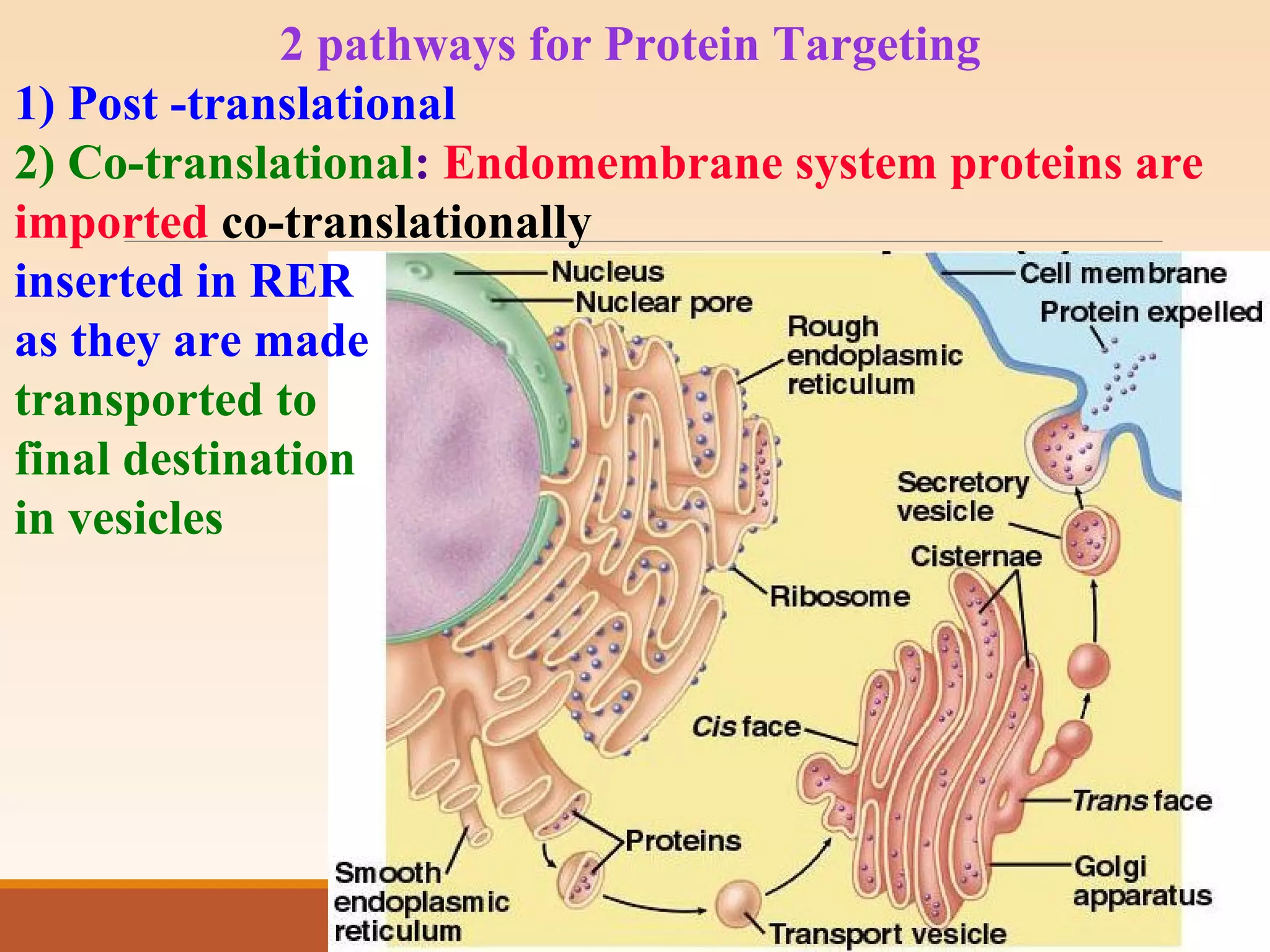
2 pathways for Protein Targeting
1) Post -translational
2) Co-translational: Endomembrane system proteins are
imported co-translationally
inserted in RER
as they are made
transported to
final destination
in vesicles
SIGNAL HYPOTHESIS
Protein synthesis begins on free ribosomes in cytoplasm
endomembrane proteins have "signal sequence"that
directs them to RER
“attached” ribosomes are
tethered to RER by
the signal sequence
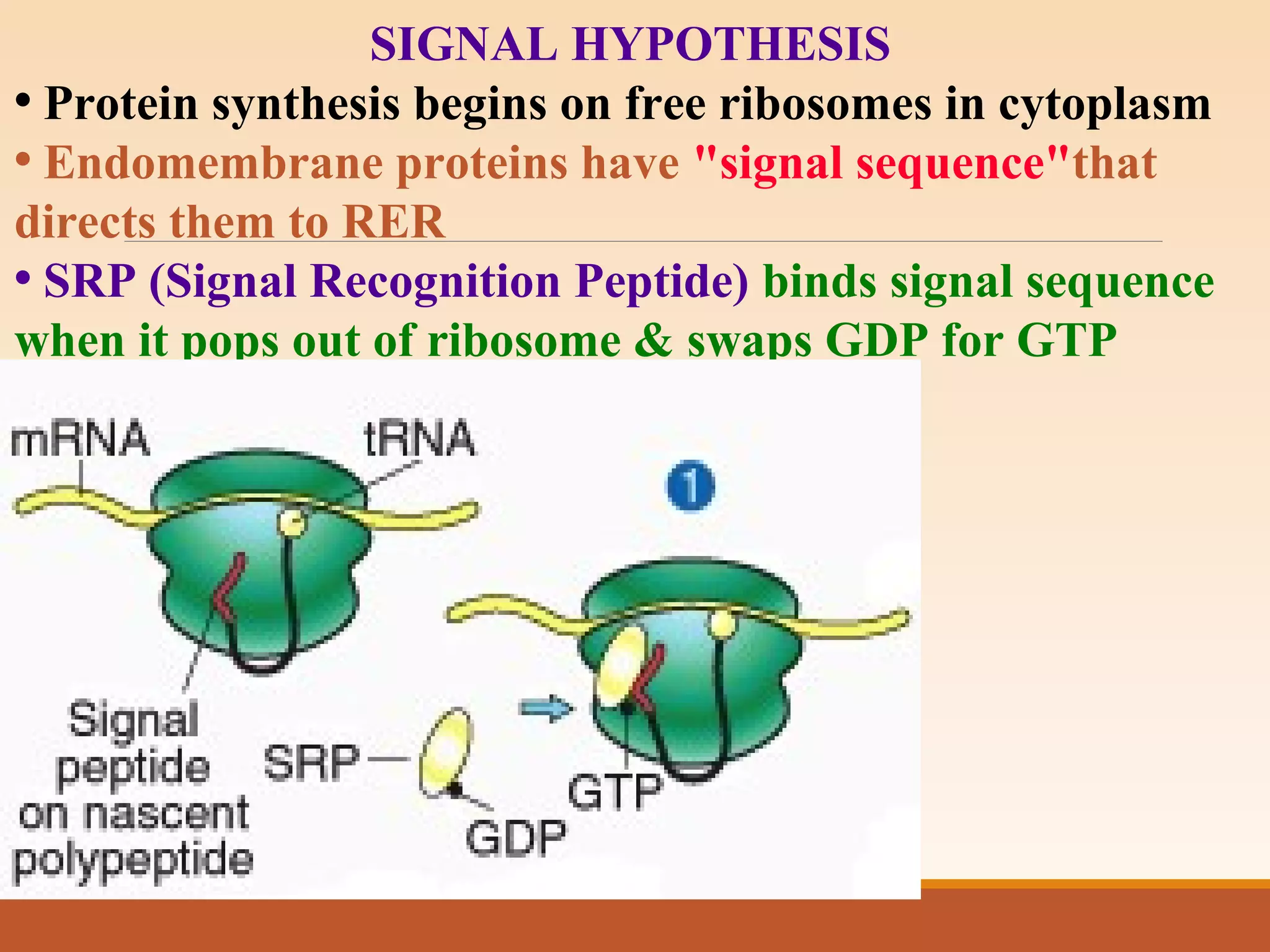
SIGNAL HYPOTHESIS
• Protein synthesis begins on free ribosomes in cytoplasm
• Endomembrane proteins have "signal sequence"that
directs them to RER
• SRP (Signal Recognition Peptide) binds signal sequence
when it pops out of ribosome & swaps GDP for GTP
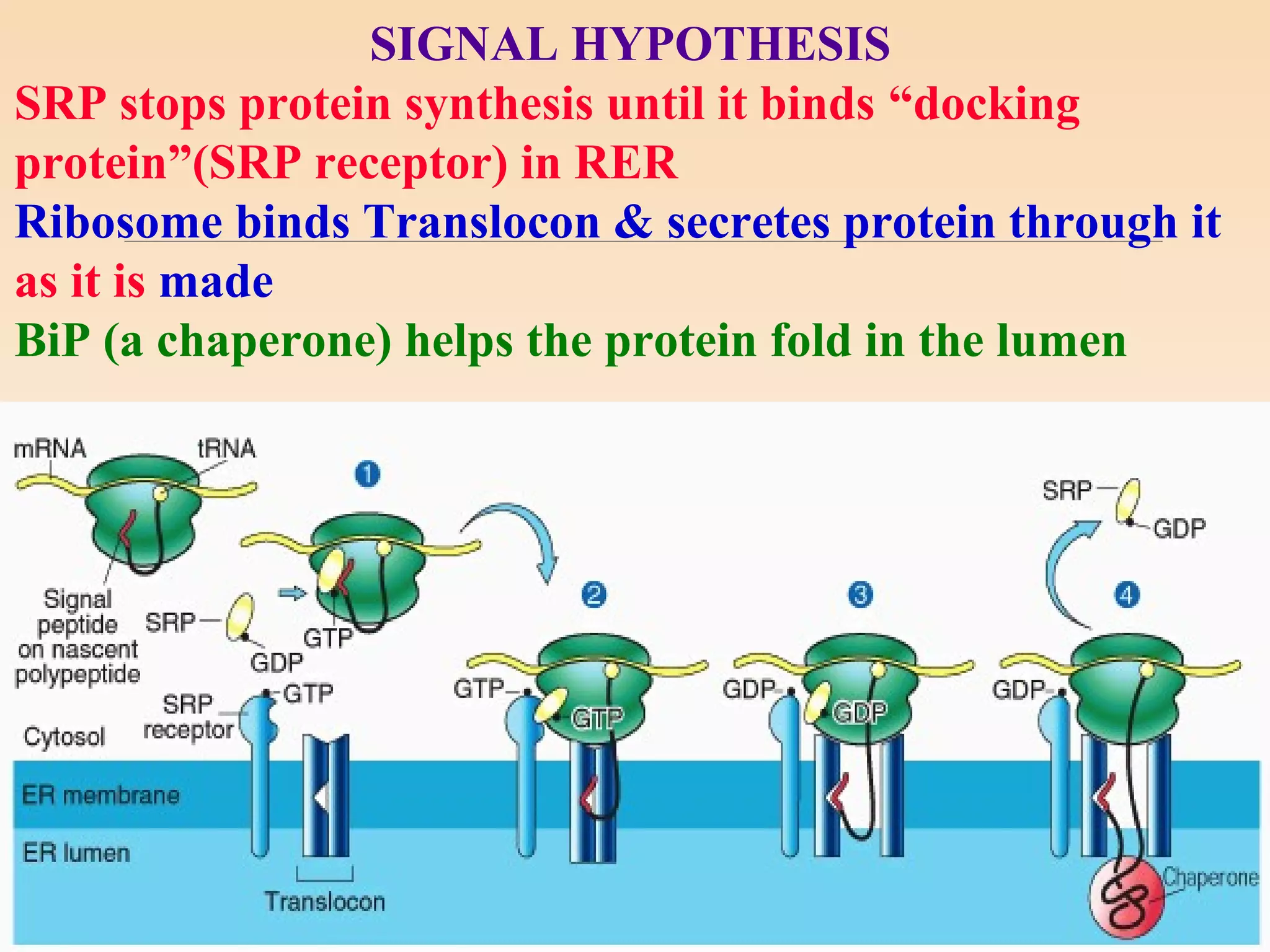
SIGNAL HYPOTHESIS
SRP stops protein synthesis until it binds “docking
protein”(SRP receptor) in RER
Ribosome binds Translocon & secretes protein through it
as it is made
BiP (a chaperone) helps the protein fold in the lumen
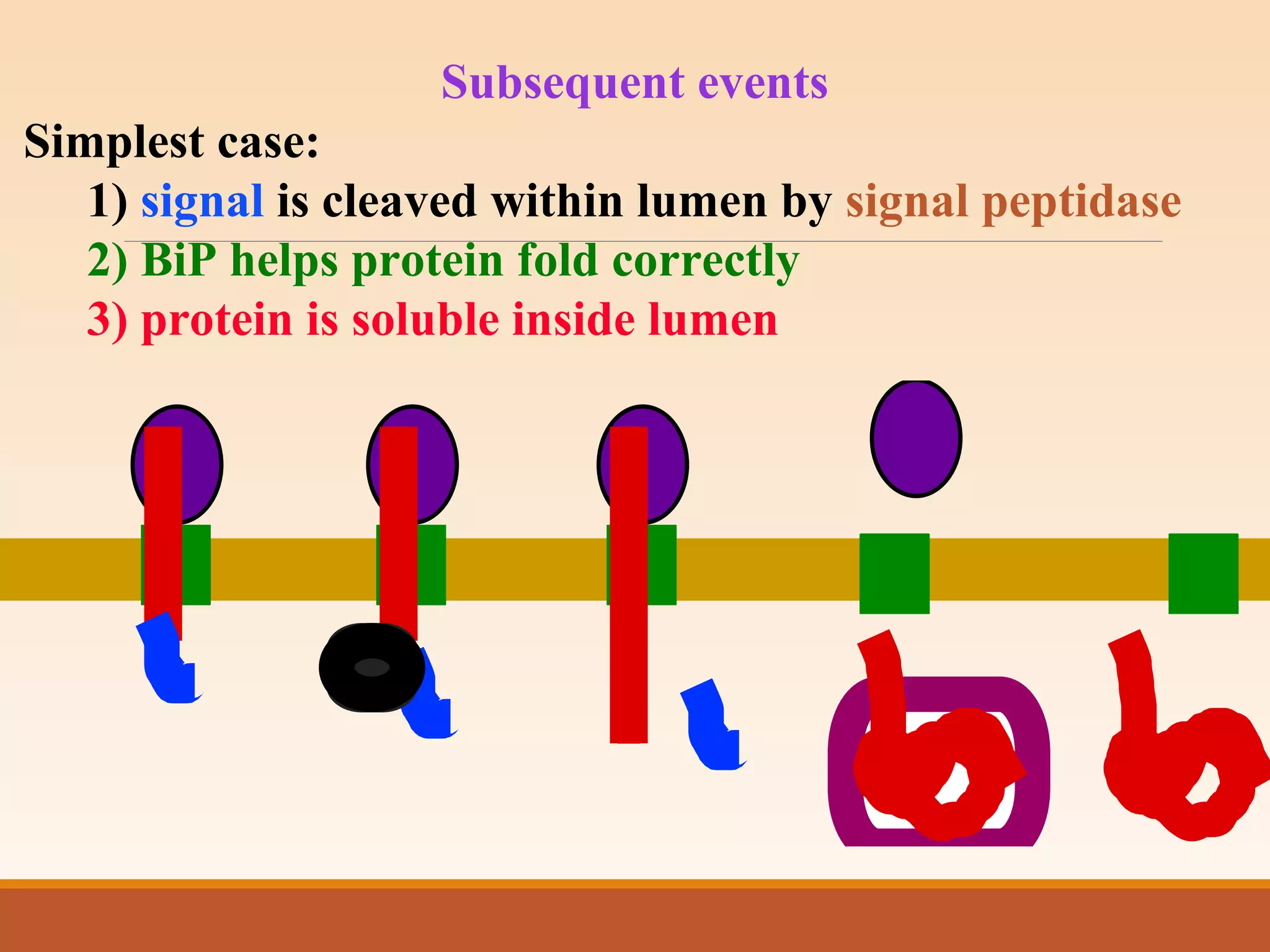
Subsequent events
Simplest case:
1) signal is cleaved within lumen by signal peptidase
2) BiP helps protein fold correctly
3) protein is soluble inside lumen
Subsequent events
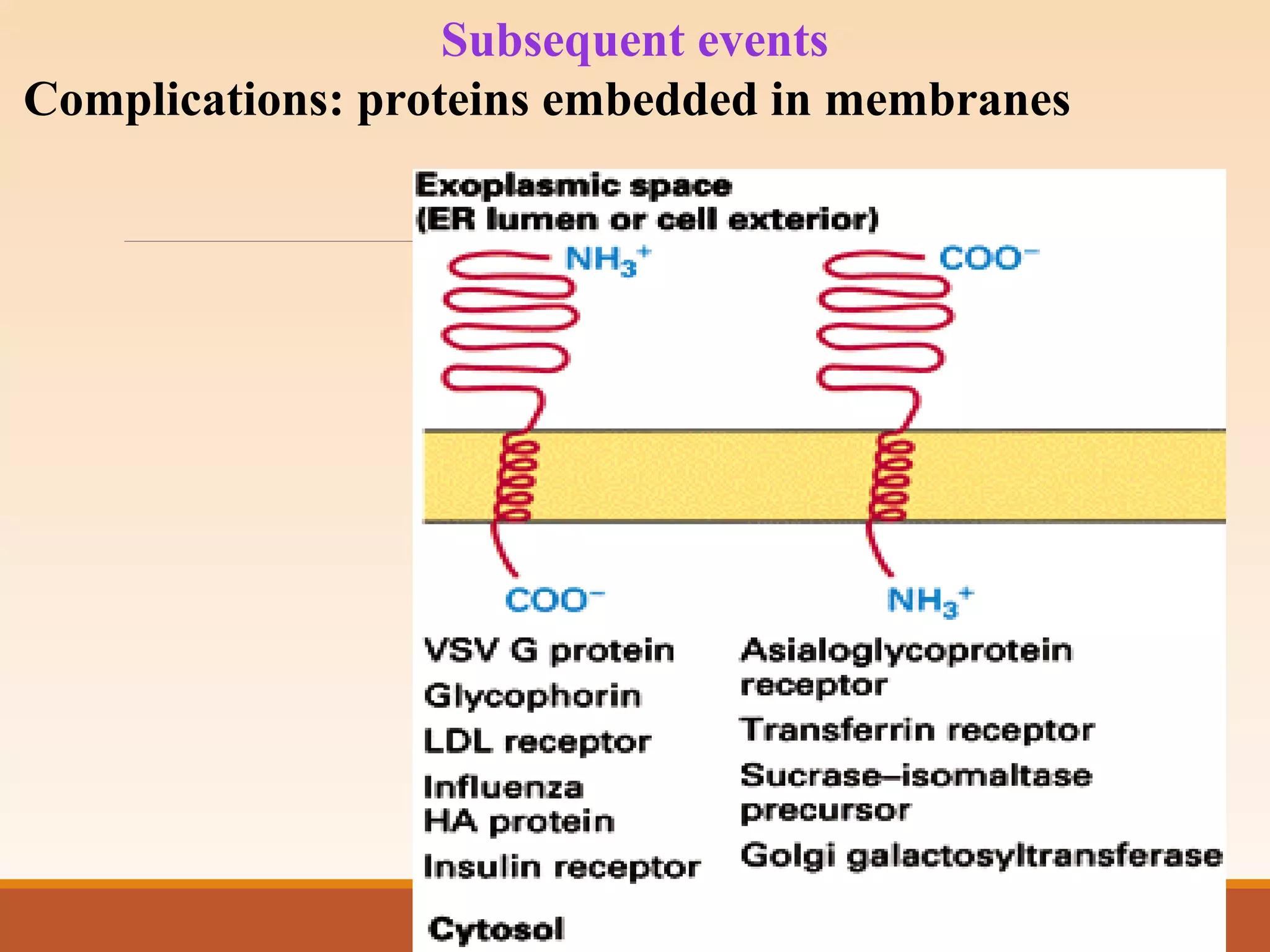
Complications: proteins embedded in membranes
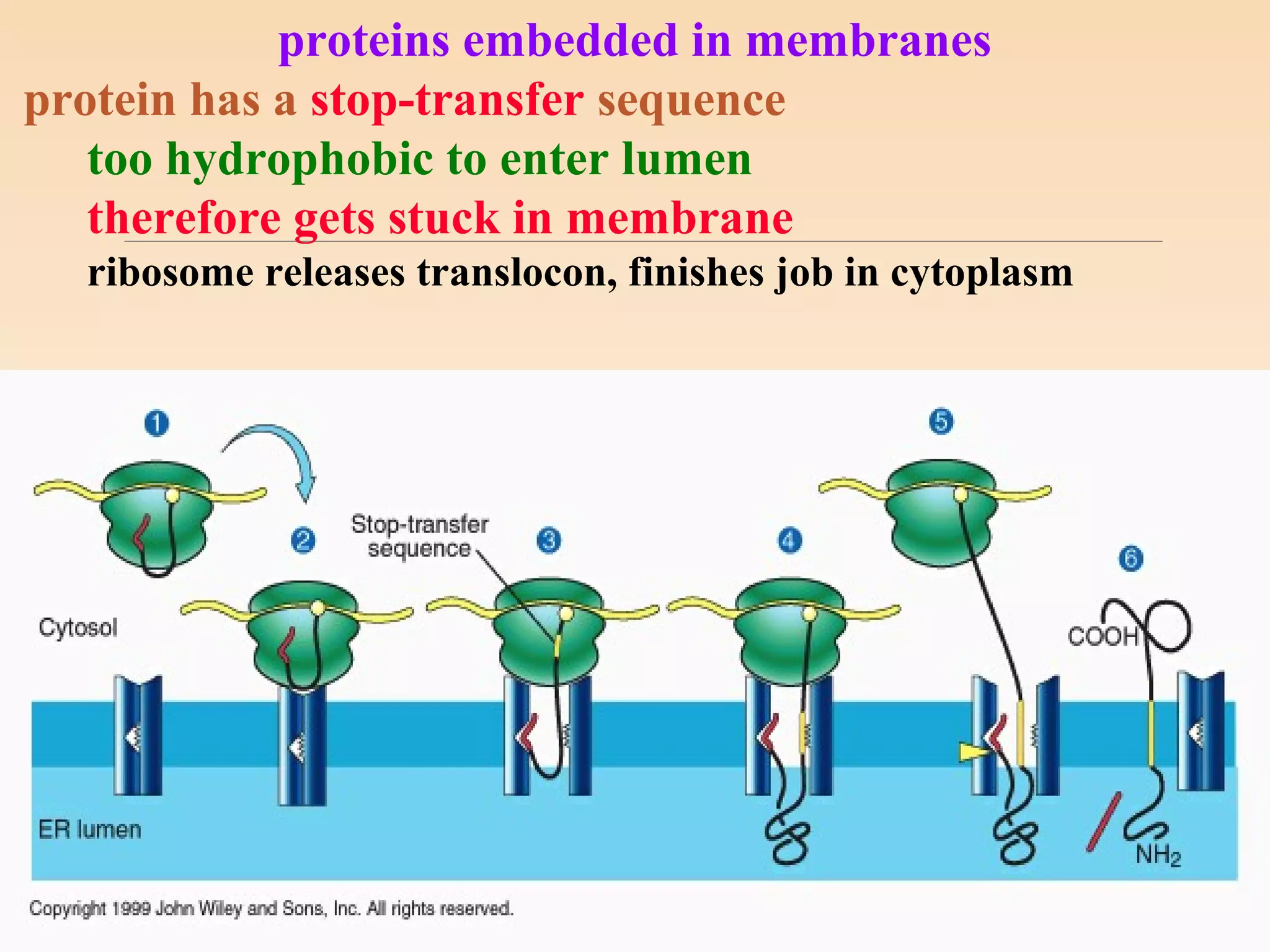
proteins embedded in membranes
protein has a stop-transfer sequence
too hydrophobic to enter aqueous lumen
proteins embedded in membranes
protein has a stop-transfer sequence
too hydrophobic to enter lumen
therefore gets stuck in membrane
ribosome releases translocon, finishes job in cytoplasm
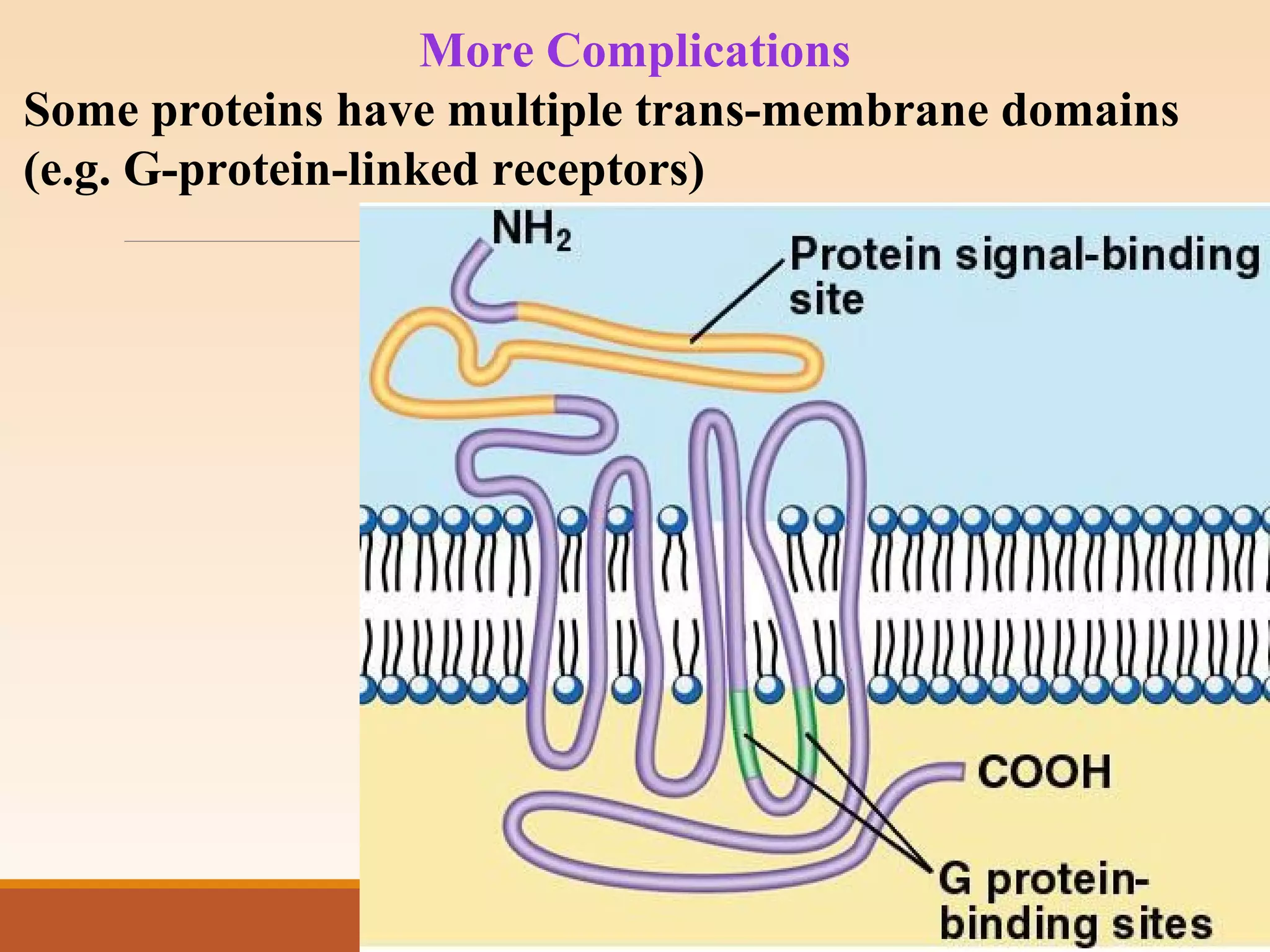
More Complications
Some proteins have multiple trans-membrane domains
(e.g. G-protein-linked receptors)
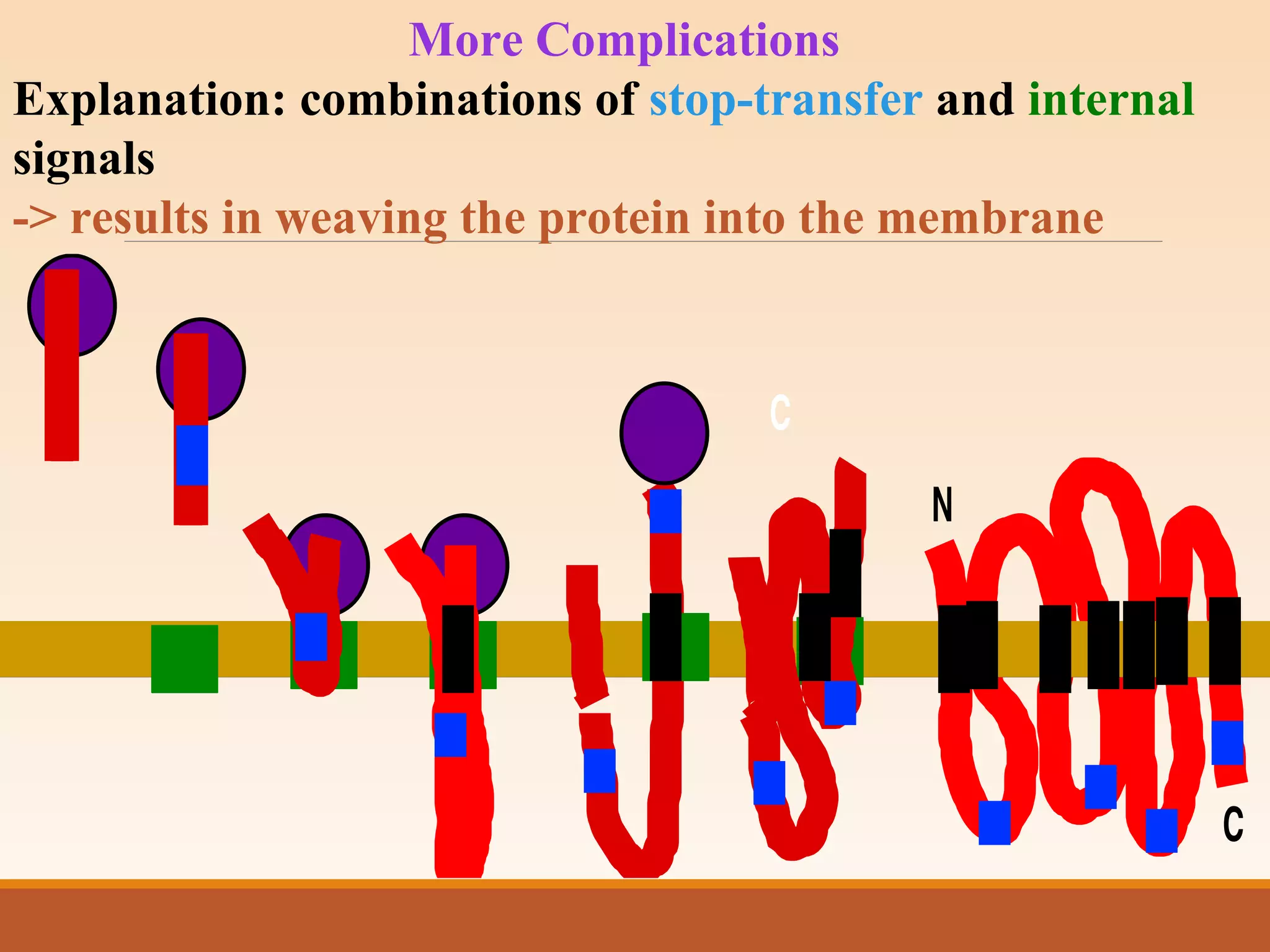
More Complications
Explanation: combinations of stop-transfer and internal
signals
-> results in weaving the protein into the membrane
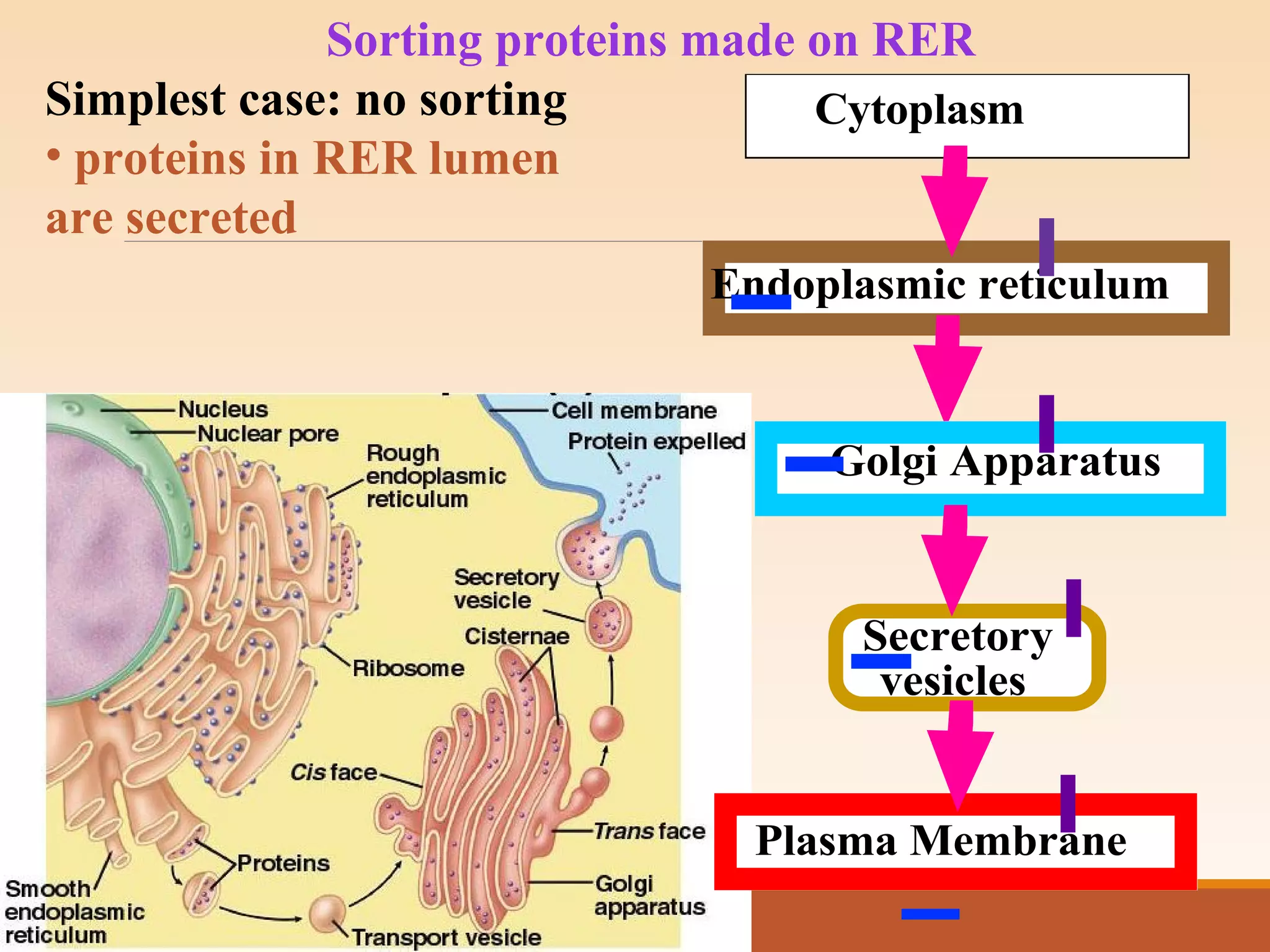
Sorting proteins made on RER
Simplest case: no sorting
• proteins in RER lumen
are secreted
Cytoplasm
Endoplasmic reticulum
Golgi Apparatus
Plasma Membrane
Secretory
vesicles
Sorting proteins made on RER
Simplest case: no sorting
• proteins in RER lumen
are secreted
• embedded proteins
go to plasma membrane
Cytoplasm
Endoplasmic reticulum
Golgi Apparatus
Plasma Membrane
Secretory
vesicles
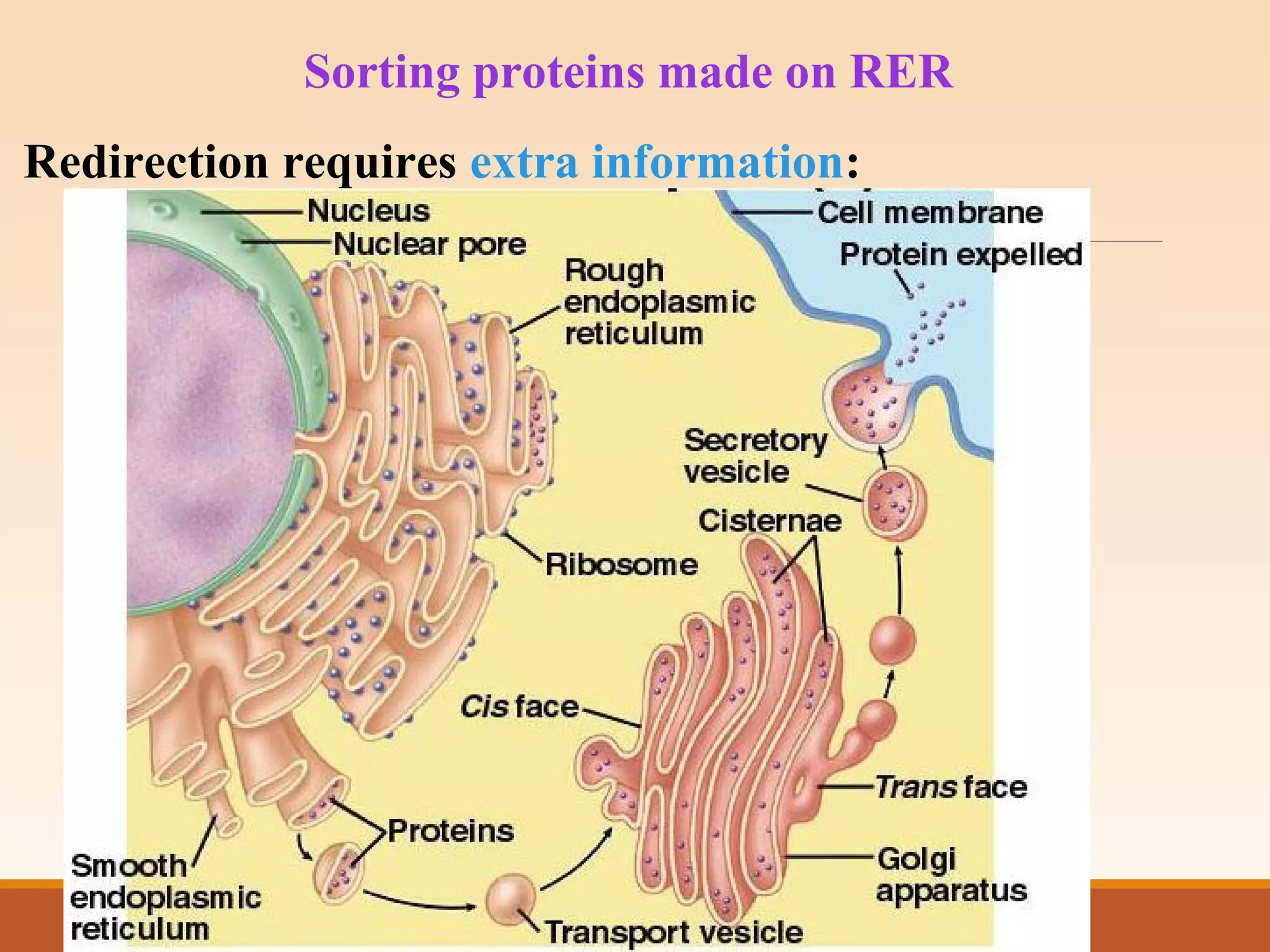
Sorting proteins made on RER
Redirection requires extra information:
Sorting proteins made on RER
Redirection requires extra information:
1) specific motif
2) receptors
Sorting proteins made on RER
ER lumen proteins have KDEL (Lys-Asp-Glu-Leu) motif
Receptor in Golgi binds & returns these proteins
ER membrane proteins
have KKXX motif Cytoplasm
Endoplasmic reticulum
Golgi Apparatus
Sorting proteins made on RER
Golgi membrane proteins
• cis- or medial- golgi proteins are
marked by sequences in the
membrane-spanning domain
• trans-golgi proteins have a
tyrosine-rich sequence in their
cytoplasmic C-terminus
Cytoplasm
Endoplasmic reticulum
cis- Golgi
trans- Golgi
medial- Golgi
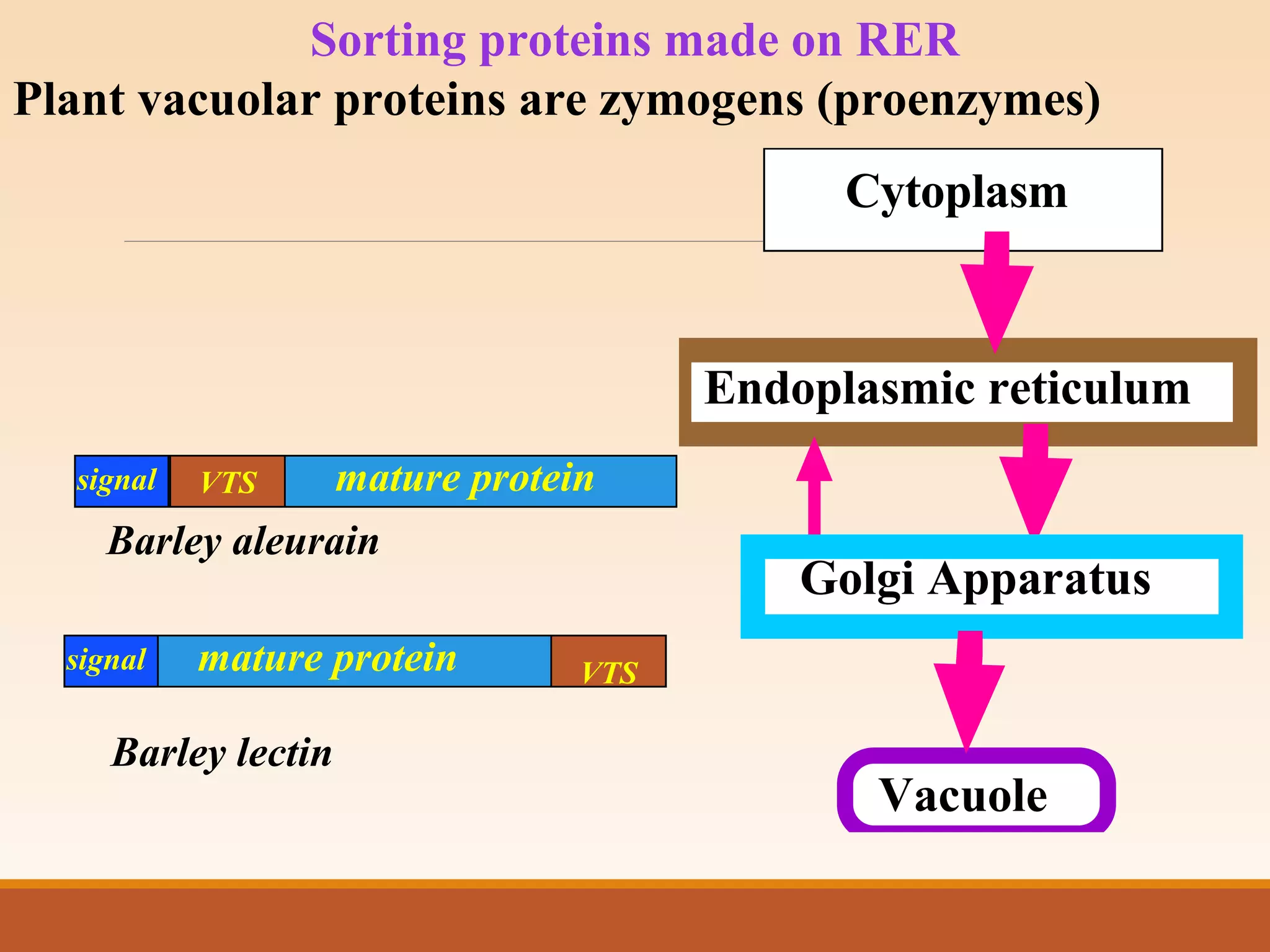
Sorting proteins made on RER
Plant vacuolar proteins are zymogens (proenzymes)
Cytoplasm
Endoplasmic reticulum
Golgi Apparatus
Vacuole
signal
signal
VTS
VTS
Barley aleurain
Barley lectin
mature protein
mature protein
Sorting proteins made on RER
Plant vacuolar proteins are zymogens (proenzymes),
cleaved to mature form on arrival
• targeting motif may be
at either end of protein
Cytoplasm
Endoplasmic reticulum
Golgi Apparatus
Vacuole
signal
signal
VTS
VTS
Barley aleurain
Barley lectin
mature protein
mature protein
Sorting proteins made on RER
lysosomal proteins are targeted by
mannose 6-phosphate
M 6-P receptors in trans-Golgi
direct protein to lysosomes (via
endosomes)
M 6-P is added in Golgi by enzyme
that recognizes lysosomal motif
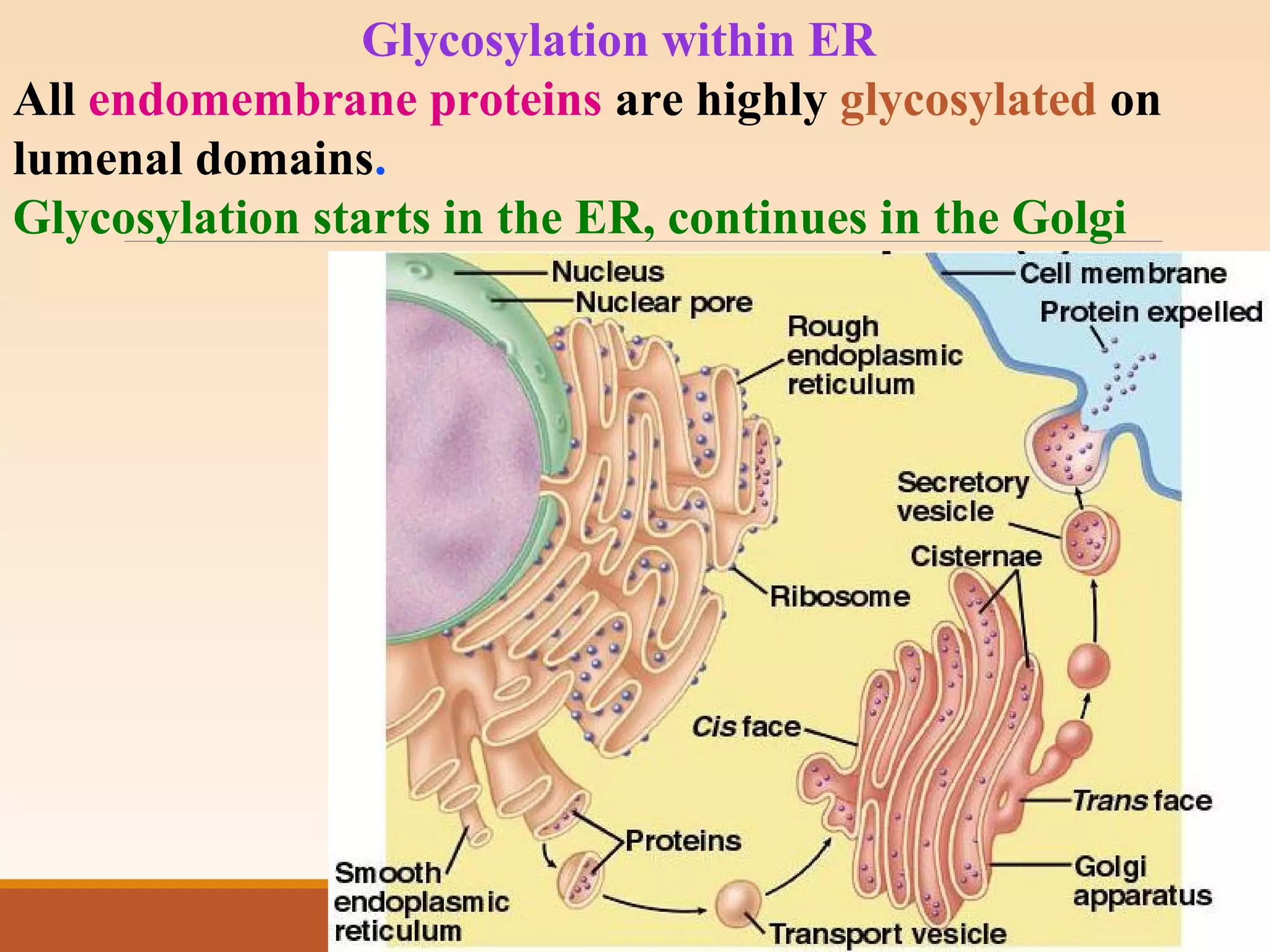
Glycosylation within ER
All endomembrane proteins are highly glycosylated on
lumenal domains.
Glycosylation starts in the ER, continues in the Golgi
Glycosylation within ER
All endomembrane proteins are highly glycosylated on
lumenal domains.
Glycosylation starts in ER, continues in Golgi
makes proteins more hydrophilic
essential for proper function
tunicamycin poisons cells
Glycosylation mutants are even sicker
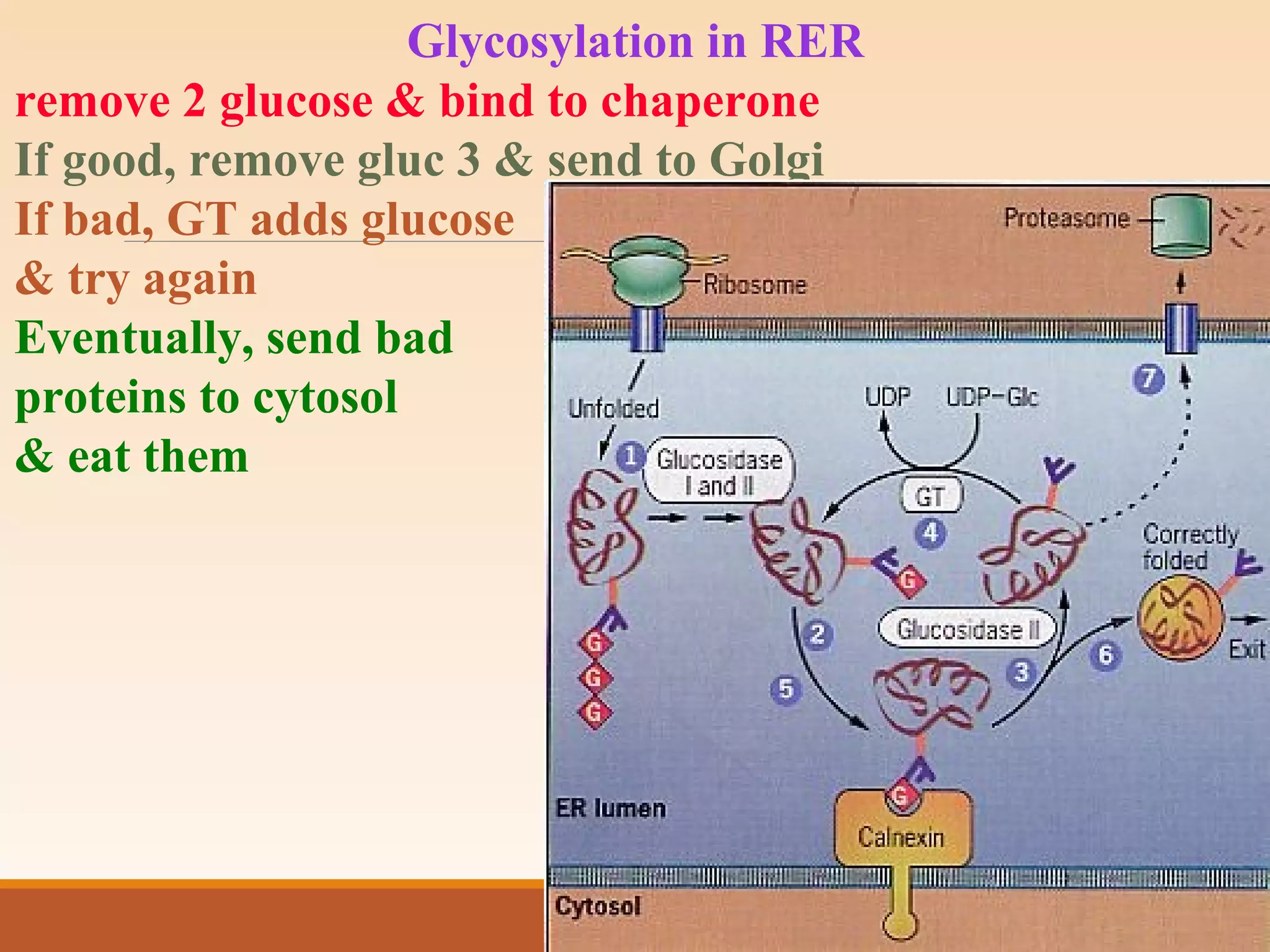
Glycosylation in RER
remove 2 glucose & bind to chaperone
If good, remove gluc 3 & send to Golgi
If bad, GT adds glucose
& try again
Eventually, send bad
proteins to cytosol
& eat them
Cytoplasm
Post-Translational
Pathway
Chloroplasts
Mitochondria
Peroxisomes
Nuclei
Co-Translational
Pathway
Endoplasmic reticulum
Golgi Apparatus
Plasma Membrane
Secretory
vesicles
Lysosome
Endosome
Post-translational
protein targeting
Key features
1) imported after
synthesis
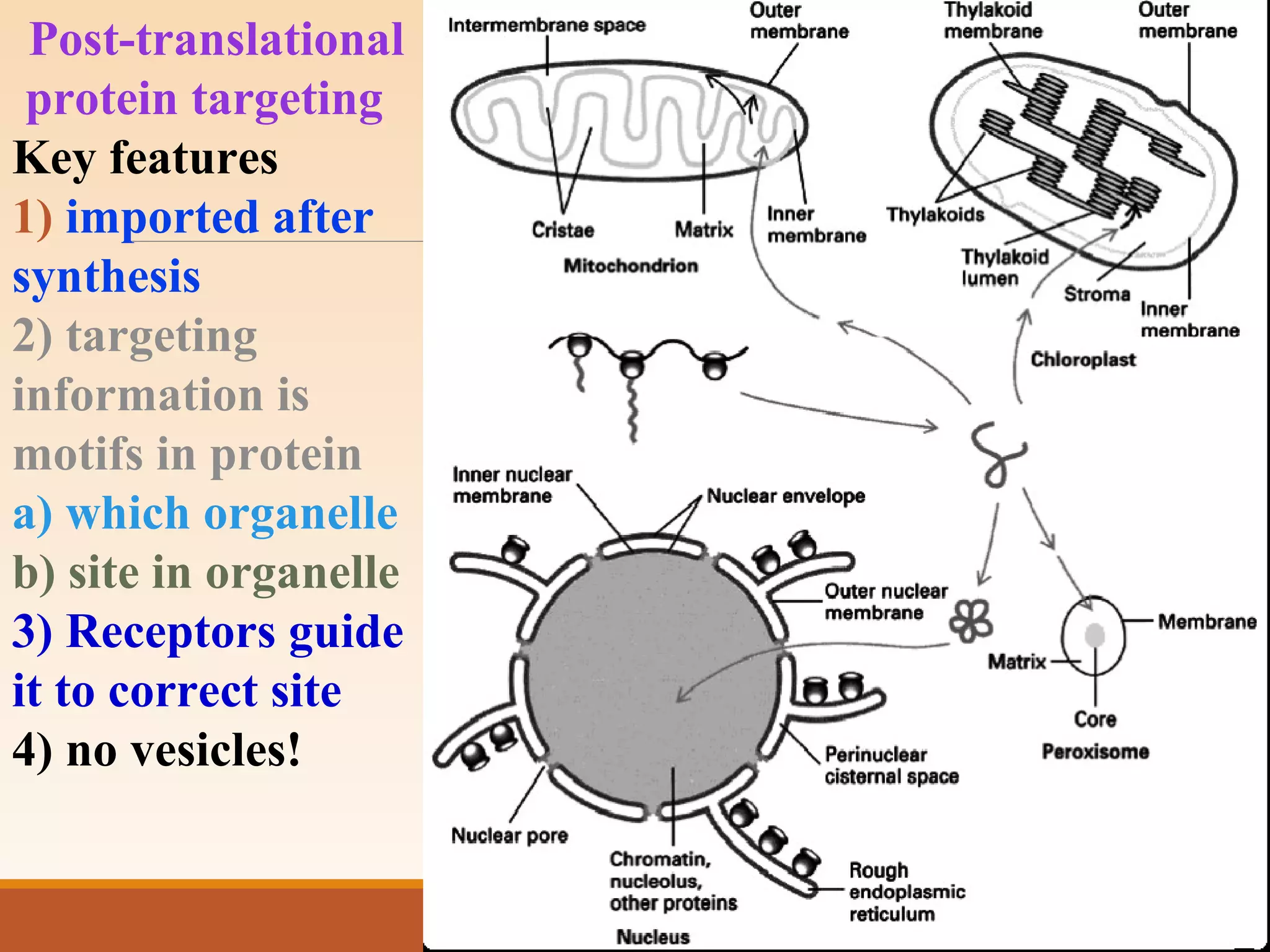
Post-translational
protein targeting
Key features
1) imported after
synthesis
2) targeting
information is
motifs in protein
a) which organelle
b) site in organelle
3) Receptors guide
it to correct site
4) no vesicles!
Protein targeting in Post-translational pathway
SKL (ser/lys/leu) at C terminus targets most peroxisomal
matrix proteins = PTS1
In humans 3 are targeted by 9 aa at N terminus = PTS2
Defective PTS2 receptor causes Rhizomelic
chondrodysplasia punctata
N CSKL
N CPTS2
Targeting peroxisomal proteins
• Bind receptor in cytoplasm
• Dock with peroxisomal receptors
• Import
protein w/o
unfolding it!
• Recycle
receptors
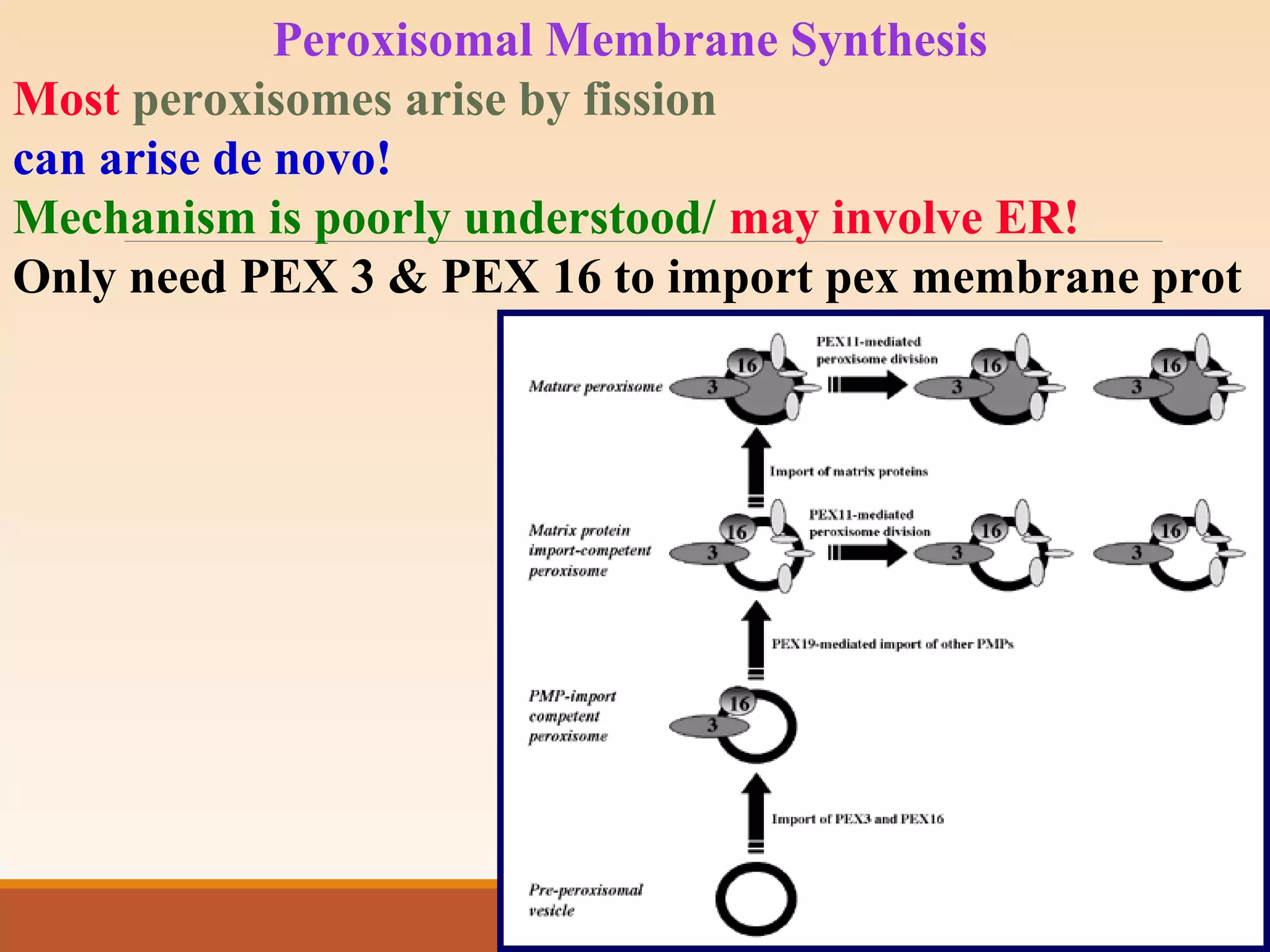
Peroxisomal Membrane Synthesis
Most peroxisomes arise by fission
can arise de novo!
Mechanism is poorly understood/ may involve ER!
Only need PEX 3 & PEX 16 to import pex membrane prot
Protein import into nuclei
nuclear proteins are targeted by internal motifs
necessary & sufficient to target cytoplasmic proteins
to nucleus
Protein import into nuclei
nuclear proteins are targeted by internal motifs
as in golgi, are not specific
shapes cf sequences
Receptors bind objects of the right shape!
Protein import into nuclei
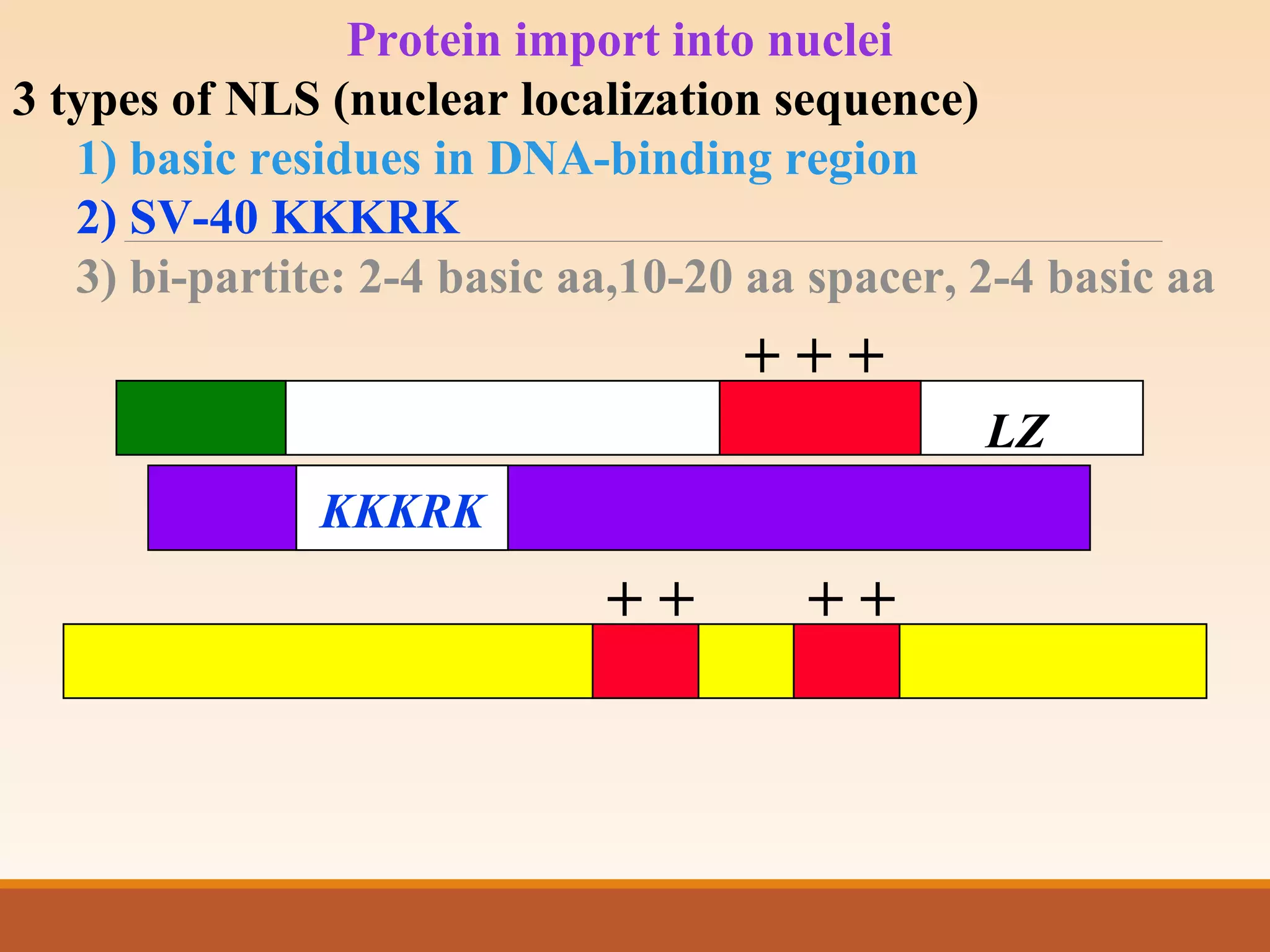
3 types of NLS (nuclear localization sequence)
1) basic residues in DNA-binding region
+ + +
LZ
Protein import into nuclei
3 types of NLS (nuclear localization sequence)
1) basic residues in DNA-binding region
2) SV-40 KKKRK
KKKRK
+ + +
LZ
Protein import into nuclei
3 types of NLS (nuclear localization sequence)
1) basic residues in DNA-binding region
2) SV-40 KKKRK
3) bi-partite: 2-4 basic aa,10-20 aa spacer, 2-4 basic aa
KKKRK
+ + +
LZ
+ ++ +
Protein import into nuclei
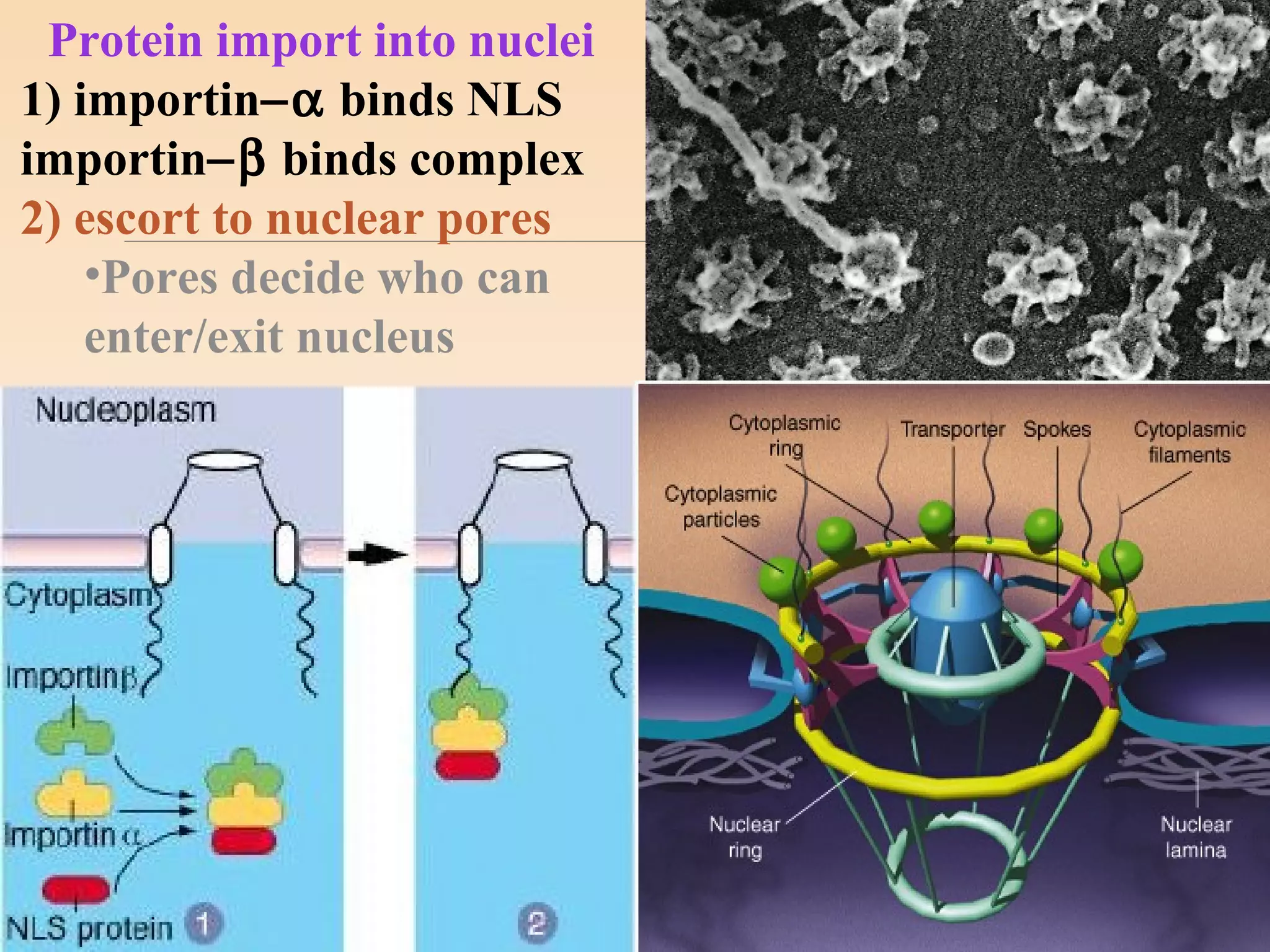
1) importin−α binds NLS
importin−β binds complex
2) escort to nuclear pores
•Pores decide who can
enter/exit nucleus
Protein import into nuclei
1) importin−α binds NLS, importin−β binds complex
2) escort to nuclear pores
3) transporter changes shape, lets complex enter
4) nuclear Ran-GTP dissociates complex
5) Ran-GTP returns β−importin to cytoplasm, becomes
Ran-GDP. GTP -> GDP = nuclear import energy source
6) Exportins return α−importin & other cytoplasmic prot
Thank you

Protein targetting

  • 1.
  • 2.
    2 Protein Targetingpathways Protein synthesis always begins on free ribosomes In cytoplasm 1) Post -translational: proteins of plastids, mitochondria, peroxisomes and nuclei 2) Endomembrane system proteins are imported co-translationally
  • 3.
    2 pathways forProtein Targeting 1) Post -translational 2) Co-translational: Endomembrane system proteins are imported co-translationally inserted in RER as they are made transported to final destination in vesicles
  • 4.
    SIGNAL HYPOTHESIS Protein synthesisbegins on free ribosomes in cytoplasm endomembrane proteins have "signal sequence"that directs them to RER “attached” ribosomes are tethered to RER by the signal sequence
  • 5.
    SIGNAL HYPOTHESIS • Proteinsynthesis begins on free ribosomes in cytoplasm • Endomembrane proteins have "signal sequence"that directs them to RER • SRP (Signal Recognition Peptide) binds signal sequence when it pops out of ribosome & swaps GDP for GTP
  • 6.
    SIGNAL HYPOTHESIS SRP stopsprotein synthesis until it binds “docking protein”(SRP receptor) in RER Ribosome binds Translocon & secretes protein through it as it is made BiP (a chaperone) helps the protein fold in the lumen
  • 7.
    Subsequent events Simplest case: 1)signal is cleaved within lumen by signal peptidase 2) BiP helps protein fold correctly 3) protein is soluble inside lumen
  • 8.
  • 9.
    proteins embedded inmembranes protein has a stop-transfer sequence too hydrophobic to enter aqueous lumen
  • 10.
    proteins embedded inmembranes protein has a stop-transfer sequence too hydrophobic to enter lumen therefore gets stuck in membrane ribosome releases translocon, finishes job in cytoplasm
  • 11.
    More Complications Some proteinshave multiple trans-membrane domains (e.g. G-protein-linked receptors)
  • 12.
    More Complications Explanation: combinationsof stop-transfer and internal signals -> results in weaving the protein into the membrane
  • 13.
    Sorting proteins madeon RER Simplest case: no sorting • proteins in RER lumen are secreted Cytoplasm Endoplasmic reticulum Golgi Apparatus Plasma Membrane Secretory vesicles
  • 14.
    Sorting proteins madeon RER Simplest case: no sorting • proteins in RER lumen are secreted • embedded proteins go to plasma membrane Cytoplasm Endoplasmic reticulum Golgi Apparatus Plasma Membrane Secretory vesicles
  • 15.
    Sorting proteins madeon RER Redirection requires extra information:
  • 16.
    Sorting proteins madeon RER Redirection requires extra information: 1) specific motif 2) receptors
  • 17.
    Sorting proteins madeon RER ER lumen proteins have KDEL (Lys-Asp-Glu-Leu) motif Receptor in Golgi binds & returns these proteins ER membrane proteins have KKXX motif Cytoplasm Endoplasmic reticulum Golgi Apparatus
  • 18.
    Sorting proteins madeon RER Golgi membrane proteins • cis- or medial- golgi proteins are marked by sequences in the membrane-spanning domain • trans-golgi proteins have a tyrosine-rich sequence in their cytoplasmic C-terminus Cytoplasm Endoplasmic reticulum cis- Golgi trans- Golgi medial- Golgi
  • 19.
    Sorting proteins madeon RER Plant vacuolar proteins are zymogens (proenzymes) Cytoplasm Endoplasmic reticulum Golgi Apparatus Vacuole signal signal VTS VTS Barley aleurain Barley lectin mature protein mature protein
  • 20.
    Sorting proteins madeon RER Plant vacuolar proteins are zymogens (proenzymes), cleaved to mature form on arrival • targeting motif may be at either end of protein Cytoplasm Endoplasmic reticulum Golgi Apparatus Vacuole signal signal VTS VTS Barley aleurain Barley lectin mature protein mature protein
  • 21.
    Sorting proteins madeon RER lysosomal proteins are targeted by mannose 6-phosphate M 6-P receptors in trans-Golgi direct protein to lysosomes (via endosomes) M 6-P is added in Golgi by enzyme that recognizes lysosomal motif
  • 22.
    Glycosylation within ER Allendomembrane proteins are highly glycosylated on lumenal domains. Glycosylation starts in the ER, continues in the Golgi
  • 23.
    Glycosylation within ER Allendomembrane proteins are highly glycosylated on lumenal domains. Glycosylation starts in ER, continues in Golgi makes proteins more hydrophilic essential for proper function tunicamycin poisons cells Glycosylation mutants are even sicker
  • 24.
    Glycosylation in RER remove2 glucose & bind to chaperone If good, remove gluc 3 & send to Golgi If bad, GT adds glucose & try again Eventually, send bad proteins to cytosol & eat them
  • 25.
  • 26.
  • 27.
    Post-translational protein targeting Key features 1)imported after synthesis 2) targeting information is motifs in protein a) which organelle b) site in organelle 3) Receptors guide it to correct site 4) no vesicles!
  • 28.
    Protein targeting inPost-translational pathway SKL (ser/lys/leu) at C terminus targets most peroxisomal matrix proteins = PTS1 In humans 3 are targeted by 9 aa at N terminus = PTS2 Defective PTS2 receptor causes Rhizomelic chondrodysplasia punctata N CSKL N CPTS2
  • 29.
    Targeting peroxisomal proteins •Bind receptor in cytoplasm • Dock with peroxisomal receptors • Import protein w/o unfolding it! • Recycle receptors
  • 30.
    Peroxisomal Membrane Synthesis Mostperoxisomes arise by fission can arise de novo! Mechanism is poorly understood/ may involve ER! Only need PEX 3 & PEX 16 to import pex membrane prot
  • 31.
    Protein import intonuclei nuclear proteins are targeted by internal motifs necessary & sufficient to target cytoplasmic proteins to nucleus
  • 32.
    Protein import intonuclei nuclear proteins are targeted by internal motifs as in golgi, are not specific shapes cf sequences Receptors bind objects of the right shape!
  • 33.
    Protein import intonuclei 3 types of NLS (nuclear localization sequence) 1) basic residues in DNA-binding region + + + LZ
  • 34.
    Protein import intonuclei 3 types of NLS (nuclear localization sequence) 1) basic residues in DNA-binding region 2) SV-40 KKKRK KKKRK + + + LZ
  • 35.
    Protein import intonuclei 3 types of NLS (nuclear localization sequence) 1) basic residues in DNA-binding region 2) SV-40 KKKRK 3) bi-partite: 2-4 basic aa,10-20 aa spacer, 2-4 basic aa KKKRK + + + LZ + ++ +
  • 36.
    Protein import intonuclei 1) importin−α binds NLS importin−β binds complex 2) escort to nuclear pores •Pores decide who can enter/exit nucleus
  • 37.
    Protein import intonuclei 1) importin−α binds NLS, importin−β binds complex 2) escort to nuclear pores 3) transporter changes shape, lets complex enter 4) nuclear Ran-GTP dissociates complex 5) Ran-GTP returns β−importin to cytoplasm, becomes Ran-GDP. GTP -> GDP = nuclear import energy source 6) Exportins return α−importin & other cytoplasmic prot
  • 38.