Protein splicing
analogous to mRNA splicing
k. k.gupta
INTRODUCTION
• Protein is an array of amino acids .
• Once synthesized , it may have some intervening
sequences which are not needed in the final protein
product .
• So it has to be removed from the pre pro protein form.
• Protein splicing is a process of removal of these intervening
/ interrupted sequences .
• These intervening sequence is called as Intein .
• It is just similar to post transcription process so it is better
referred as post translational process .
• After translation, a protein is heterogenous /splitted
consisting alternate two segments like Hn RNA .These are :-
• An intein is a segment of a protein that is able to excise itself and
join the remaining portions (the exteins) with a peptide bond
• .Inteins have also been called "protein introns". The concerned
protein splicing process is thus called as Intein-mediated Protein
splicing occurs after the intein-containing mRNA has
been translated into a protein.
• This precursor protein contains three segments—an N-
extein followed by the intein followed by a C-extein.
• After splicing has taken place, the resulting protein contains the N-
extein linked to the C-extein; this splicing product is also termed an
extein which determine the structure and function as per folding
state..
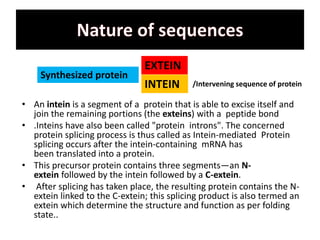
Synthesized protein
EXTEIN
INTEIN /Intervening sequence of protein
Splitted Protein
DNA
Potential intein reactions
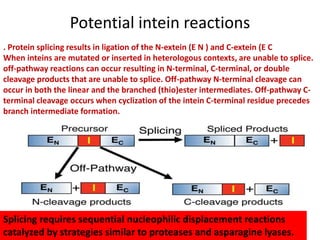
. Protein splicing results in ligation of the N-extein (E N ) and C-extein (E C
When inteins are mutated or inserted in heterologous contexts, are unable to splice.
off-pathway reactions can occur resulting in N-terminal, C-terminal, or double
cleavage products that are unable to splice. Off-pathway N-terminal cleavage can
occur in both the linear and the branched (thio)ester intermediates. Off-pathway C-
terminal cleavage occurs when cyclization of the intein C-terminal residue precedes
branch intermediate formation.
Splicing requires sequential nucleophilic displacement reactions
catalyzed by strategies similar to proteases and asparagine lyases.
Types of intein
• Based on their domain structure, inteins are categorized in four
classes:
• full-length inteins,
• mini-inteins,
• split-inteins and
• alanine-inteins .
• Most inteins are full-length inteins expressed within a single
polypeptide chain.
• They are bifunctional proteins that include two structural domains -
the intein domain responsible for protein splicing out of the
precursor polypeptide chain, and a homing endonuclease (HE)
domain with a role in DNA-cutting and insertion of the associated
mobile genetic element into the precursor protein-coding gene
The HE domain splits the
splicing domain into N and C-
terminal splicing domains.
Splicing domain
• The splicing domain consists of conserved blocks A, B, F
and G, while blocks C, D, and E are present in the HE
domains. Blocks C and E contain conserved endonuclease
active sites with catalytic residues Asp, Glu or Lys
• Blocks A, and B, localize near the N-terminus of the intein, while blocks F and G are
located near the C-terminus Conserved amino acids important for the splicing
process (Cys, Ser or Thr) are present both at the intein N-terminus as well as on the
C-extein fragment near the intein-extein junction
Types of intein
• For example when first intein was discovered in
1988 through sequence comparison of ATPase
gene of Neurospora crassa (with Intein) and
carrot vacuolar (without intein) it was found that
final product is similar i.e Intein has been
removed from the neurospora.
• A similar homologous gene in yeast (with intein)
was also described called putative calcium ion
transporter protein.
Mechanism
• autocatalytic and naturally process i.e intein itself
mediate splicing. involved bond transfer and no input
of energy .
• chemically generate medium-sized proteins called
native chemical ligation from the long sized pro protein
.This reaction requires specific amino acids sequence
which is located at the junction of extein- intein and
involve three nucleophiles as splicing domain which
are conserved in such pro-protein
• Ser, Thr or Cys at the intein N-terminus
• Asn or Gln at the intein C-terminus; and
• Ser, Thr or Cys at the beginning of the C-extein
Steps I: N-O shift
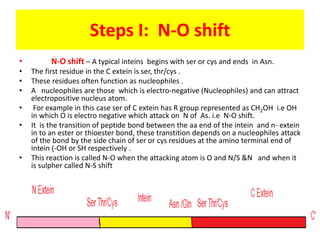
• N-O shift – A typical inteins begins with ser or cys and ends in Asn.
• The first residue in the C extein is ser, thr/cys .
• These residues often function as nucleophiles .
• A nucleophiles are those which is electro-negative (Nucleophiles) and can attract
electropositive nucleus atom.
• For example in this case ser of C extein has R group represented as CH2OH i.e OH
in which O is electro negative which attack on N of As. i.e N-O shift.
• It is the transition of peptide bond between the aa end of the intein and n- extein
in to an ester or thioester bond, these transtition depends on a nucleophiles attack
of the bond by the side chain of ser or cys residues at the amino terminal end of
intein (-OH or SH respectively .
• This reaction is called N-O when the attacking atom is O and N/S &N and when it
is sulpher called N-S shift
Class 1 inteins with a C-terminal Asn and a Cys,
Ser, or Thr at the first position in both the intein
and the C-extein splice using the standard four-
step protein splicing mechanism .
X represents an oxygen or a sulfur atom. For clarity, tetrahedral
intermediates and residues facilitating each step are omitted.
Although the definition of an intein is the excised sequence
Trans esterification
• In this step the side chain of the first residue
of the C extein attacks the ester /thioester
bond at the amino end of the intein .
• Here too, the attack is by a polar side chain of
a ser/ thr or cys.
• This leads to a trans esterification and
formation of thioester bond between N
extein and C extein
3rd steps -Asn cyclisation
• cyclisation of the Asn side chain leads to cleavage
of the peptide bond between the intein and the c
extein (c terminal splice junction).
• This reaction removes intein from the ligated
extein which are linked together at the ester
bond .
4th steps O-N shift – This step of protein
splicing is spontaneous and is the reverse N-O/N-S
shift taking place and peptide bond formation occurs
between N-C exteins
Mechanism
a nucleophile is a
chemical species that
forms bonds
with electrophiles by
donating an elctron pair
. All molecules and ions
with a free pair of
electrons or at least one
pi bond can act as
nucleophiles. Because
nucleophiles donate
electrons, they
are Lewis bases.
Protein splicing
Protein splicing

Protein splicing

  • 1.
    Protein splicing analogous tomRNA splicing k. k.gupta
  • 2.
    INTRODUCTION • Protein isan array of amino acids . • Once synthesized , it may have some intervening sequences which are not needed in the final protein product . • So it has to be removed from the pre pro protein form. • Protein splicing is a process of removal of these intervening / interrupted sequences . • These intervening sequence is called as Intein . • It is just similar to post transcription process so it is better referred as post translational process . • After translation, a protein is heterogenous /splitted consisting alternate two segments like Hn RNA .These are :-
  • 3.
    • An inteinis a segment of a protein that is able to excise itself and join the remaining portions (the exteins) with a peptide bond • .Inteins have also been called "protein introns". The concerned protein splicing process is thus called as Intein-mediated Protein splicing occurs after the intein-containing mRNA has been translated into a protein. • This precursor protein contains three segments—an N- extein followed by the intein followed by a C-extein. • After splicing has taken place, the resulting protein contains the N- extein linked to the C-extein; this splicing product is also termed an extein which determine the structure and function as per folding state.. Synthesized protein EXTEIN INTEIN /Intervening sequence of protein
  • 4.
  • 5.
    Potential intein reactions .Protein splicing results in ligation of the N-extein (E N ) and C-extein (E C When inteins are mutated or inserted in heterologous contexts, are unable to splice. off-pathway reactions can occur resulting in N-terminal, C-terminal, or double cleavage products that are unable to splice. Off-pathway N-terminal cleavage can occur in both the linear and the branched (thio)ester intermediates. Off-pathway C- terminal cleavage occurs when cyclization of the intein C-terminal residue precedes branch intermediate formation. Splicing requires sequential nucleophilic displacement reactions catalyzed by strategies similar to proteases and asparagine lyases.
  • 6.
    Types of intein •Based on their domain structure, inteins are categorized in four classes: • full-length inteins, • mini-inteins, • split-inteins and • alanine-inteins . • Most inteins are full-length inteins expressed within a single polypeptide chain. • They are bifunctional proteins that include two structural domains - the intein domain responsible for protein splicing out of the precursor polypeptide chain, and a homing endonuclease (HE) domain with a role in DNA-cutting and insertion of the associated mobile genetic element into the precursor protein-coding gene The HE domain splits the splicing domain into N and C- terminal splicing domains.
  • 7.
    Splicing domain • Thesplicing domain consists of conserved blocks A, B, F and G, while blocks C, D, and E are present in the HE domains. Blocks C and E contain conserved endonuclease active sites with catalytic residues Asp, Glu or Lys • Blocks A, and B, localize near the N-terminus of the intein, while blocks F and G are located near the C-terminus Conserved amino acids important for the splicing process (Cys, Ser or Thr) are present both at the intein N-terminus as well as on the C-extein fragment near the intein-extein junction
  • 8.
  • 9.
    • For examplewhen first intein was discovered in 1988 through sequence comparison of ATPase gene of Neurospora crassa (with Intein) and carrot vacuolar (without intein) it was found that final product is similar i.e Intein has been removed from the neurospora. • A similar homologous gene in yeast (with intein) was also described called putative calcium ion transporter protein.
  • 10.
    Mechanism • autocatalytic andnaturally process i.e intein itself mediate splicing. involved bond transfer and no input of energy . • chemically generate medium-sized proteins called native chemical ligation from the long sized pro protein .This reaction requires specific amino acids sequence which is located at the junction of extein- intein and involve three nucleophiles as splicing domain which are conserved in such pro-protein • Ser, Thr or Cys at the intein N-terminus • Asn or Gln at the intein C-terminus; and • Ser, Thr or Cys at the beginning of the C-extein
  • 11.
    Steps I: N-Oshift • N-O shift – A typical inteins begins with ser or cys and ends in Asn. • The first residue in the C extein is ser, thr/cys . • These residues often function as nucleophiles . • A nucleophiles are those which is electro-negative (Nucleophiles) and can attract electropositive nucleus atom. • For example in this case ser of C extein has R group represented as CH2OH i.e OH in which O is electro negative which attack on N of As. i.e N-O shift. • It is the transition of peptide bond between the aa end of the intein and n- extein in to an ester or thioester bond, these transtition depends on a nucleophiles attack of the bond by the side chain of ser or cys residues at the amino terminal end of intein (-OH or SH respectively . • This reaction is called N-O when the attacking atom is O and N/S &N and when it is sulpher called N-S shift
  • 12.
    Class 1 inteinswith a C-terminal Asn and a Cys, Ser, or Thr at the first position in both the intein and the C-extein splice using the standard four- step protein splicing mechanism . X represents an oxygen or a sulfur atom. For clarity, tetrahedral intermediates and residues facilitating each step are omitted. Although the definition of an intein is the excised sequence
  • 13.
    Trans esterification • Inthis step the side chain of the first residue of the C extein attacks the ester /thioester bond at the amino end of the intein . • Here too, the attack is by a polar side chain of a ser/ thr or cys. • This leads to a trans esterification and formation of thioester bond between N extein and C extein
  • 14.
    3rd steps -Asncyclisation • cyclisation of the Asn side chain leads to cleavage of the peptide bond between the intein and the c extein (c terminal splice junction). • This reaction removes intein from the ligated extein which are linked together at the ester bond . 4th steps O-N shift – This step of protein splicing is spontaneous and is the reverse N-O/N-S shift taking place and peptide bond formation occurs between N-C exteins
  • 15.
    Mechanism a nucleophile isa chemical species that forms bonds with electrophiles by donating an elctron pair . All molecules and ions with a free pair of electrons or at least one pi bond can act as nucleophiles. Because nucleophiles donate electrons, they are Lewis bases.