Protein Stability
MOLECULAR BIOLOGY
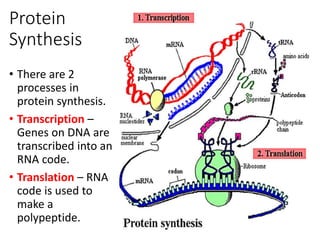
Protein
Synthesis
• There are 2
processes in
protein synthesis.
• Transcription –
Genes on DNA are
transcribed into an
RNA code.
• Translation – RNA
code is used to
make a
polypeptide.
Gopalasamudram Narayana Ramachandran, or
G.N. Ramachandran
(8 October 1922 – 7 April 2001) was an Indian physicist
who was known for his work that led to his creation of
the Ramachandran plot for understanding peptide
structure.
The result of his work on structure of proteins in 1962, -
now commonly known as the Ramachandran plot - was
published in the Journal of Molecular Biology in 1963 and
has become an essential tool in the field of protein
conformation.
Protein Stability
• Protein stability is the net balance of forces, which
determine whether a protein will be in its native folded
conformation or a denatured state.
• Protein stability normally refers to the physical
(thermodynamic) stability, not the chemical stability.
• Structural stability of protein is largely understood by
studying various structures and conformations of protein
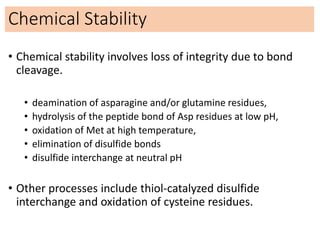
Chemical Stability
• Chemical stability involves loss of integrity due to bond
cleavage.
• deamination of asparagine and/or glutamine residues,
• hydrolysis of the peptide bond of Asp residues at low pH,
• oxidation of Met at high temperature,
• elimination of disulfide bonds
• disulfide interchange at neutral pH
• Other processes include thiol-catalyzed disulfide
interchange and oxidation of cysteine residues.
Protein Stability - Importance
• Protein stability is important for many reasons:
• Providing an understanding of the basic thermodynamics of the
process of folding.
• Increased protein stability may be a value in food and drug
processing, and in biotechnology and protein drugs.
• Treatments and drugs that can specifically induce and sustain a
strong chaperone and protease activity in cells
Factors Affecting Protein Stability
1) pH: proteins are most stable in the vicinity of their isoelectric
point, pI. In general, electrostatic interactions are believed to
contribute to a small amount of the stability of the native state;
however, there may be exceptions.
2) Ligand binding: It has been known for a long time that
binding ligands, e.g. inhibitors to enzymes, increases the stability of
the protein. This also applies to ion binding --- many proteins bind
anions in their functional sites.
Factors Affecting Protein Stability
3) Disulfide bonds:
• For many proteins, if their disulfides are broken (i.e. reduced) and
then carboxymethylated with iodoacetate, the resulting protein is
denatured, i.e. unfolded, or mostly unfolded.
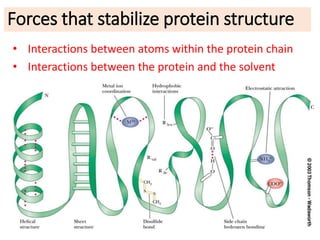
Forces that stabilize protein structure
• Interactions between atoms within the protein chain
• Interactions between the protein and the solvent
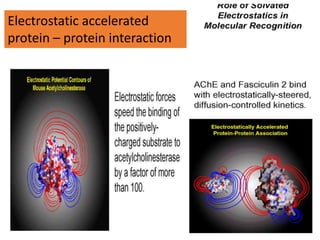
Electrostatic accelerated
protein – protein interaction
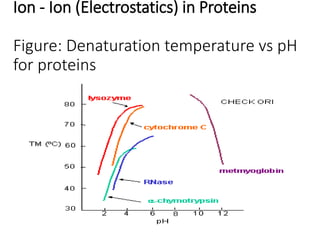
Ion - Ion (Electrostatics) in Proteins
Figure: Denaturation temperature vs pH
for proteins
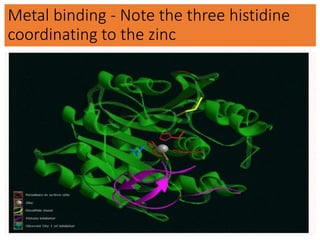
Metal binding - Note the three histidine
coordinating to the zinc
Evolution and Protein Stability
• Why are most proteins only stable to the range of 5-15
kcal/mol ?
•REASON
• If a protein accumulates a stabilizing mutation without evolutionary
pressure to keep it stable, it will soon accumulate another destabilizing
mutation.
• If this protein accumulates a destabilizing mutation which compromises its
ability to function, natural selection will rapidly remove it.
• One example suggestive of this is on the mutation of the barnase to a
close homolog called binase (Serrano et al, 1993). These proteins have 17
differences out of 110 amino-acids, and highly superimposable structures.
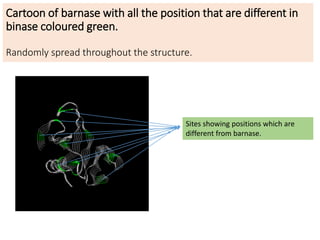
Cartoon of barnase with all the position that are different in
binase coloured green.
Randomly spread throughout the structure.
Sites showing positions which are
different from barnase.
Evolution and Protein Stability
• In the research it was observed that each individual mutation was
made from barnase to binase and each of these point mutations
only affected stability by between +1.1 and -1.1 kcal/mol.
• Which suggested that drift from one protein to another has stability
remarkably constant. This is consistent with the hypothesis that
destabilizing mutations are selected against by reversion or
compensation, and stabilizing mutations are not kept, as they are
not necessary for function.
Another reason for the narrow window of stability observed in the binase / barnase
case is that activity and stability are inversely related, that in order for an enzyme to
be an efficient catalyst, it must be flexible, which leads to a decrease in stability.
This view has been proposed based on the observation that enzymes from hyper-
thermophilic organisms have low activity at mesophilic temperatures (e.g. Hensel,
1993).
Protein stability associated functions
• Controlling the stability of cellular proteins is a
fundamental way by which cells
• regulate growth,
• differentiation,
• survival, and
• development.
Measuring the turnover rate of a protein is often the first step in
assessing whether or not the function of a protein is regulated by
proteolysis under specific physiological conditions.
Factors affecting protein stability in cell
• A network of highly conserved molecular chaperones and chaperone-related
proteases controls the fold-quality of proteins in the cell.
• Most molecular chaperones can prevent protein aggregation by binding
misfolding intermediates (for example, the GroEL/GroES or the DnaK/DnaJ/GrpE
system).
• Some molecular chaperones and chaperone-related proteases, such as the
proteasome, can also hydrolyse ATP to forcefully convert stable harmful protein
aggregates into harmless natively refoldable, or protease-degradable,
polypeptides.
• Molecular chaperones and chaperone-related proteases thus control the delicate
balance between natively folded functional proteins and aggregation-prone
misfolded proteins eventually affecting the stability of protein, which may form
during the lifetime and lead to cell death.
Therapeutic approaches include treatments and drugs that can specifically induce and sustain
a strong chaperone and protease activity in cells and tissues prone to toxic protein
aggregations.
Molecular chaperones and the proteases are major clearance mechanisms to remove toxic
protein aggregates from cells, delaying the onset and the outcome of protein-misfolding
diseases.
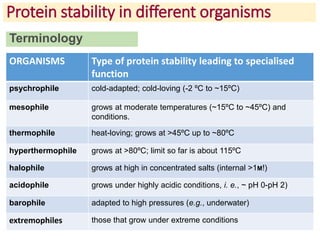
Protein stability in different organisms
Terminology
ORGANISMS Type of protein stability leading to specialised
function
psychrophile cold-adapted; cold-loving (-2 ºC to ~15ºC)
mesophile grows at moderate temperatures (~15ºC to ~45ºC) and
conditions.
thermophile heat-loving; grows at >45ºC up to ~80ºC
hyperthermophile grows at >80ºC; limit so far is about 115ºC
halophile grows at high in concentrated salts (internal >1M!)
acidophile grows under highly acidic conditions, i. e., ~ pH 0-pH 2)
barophile adapted to high pressures (e.g., underwater)
extremophiles those that grow under extreme conditions
protein stability
protein stability

protein stability

  • 1.
  • 2.
    Protein Synthesis • There are2 processes in protein synthesis. • Transcription – Genes on DNA are transcribed into an RNA code. • Translation – RNA code is used to make a polypeptide.
  • 3.
    Gopalasamudram Narayana Ramachandran,or G.N. Ramachandran (8 October 1922 – 7 April 2001) was an Indian physicist who was known for his work that led to his creation of the Ramachandran plot for understanding peptide structure. The result of his work on structure of proteins in 1962, - now commonly known as the Ramachandran plot - was published in the Journal of Molecular Biology in 1963 and has become an essential tool in the field of protein conformation.
  • 4.
    Protein Stability • Proteinstability is the net balance of forces, which determine whether a protein will be in its native folded conformation or a denatured state. • Protein stability normally refers to the physical (thermodynamic) stability, not the chemical stability. • Structural stability of protein is largely understood by studying various structures and conformations of protein
  • 5.
    Chemical Stability • Chemicalstability involves loss of integrity due to bond cleavage. • deamination of asparagine and/or glutamine residues, • hydrolysis of the peptide bond of Asp residues at low pH, • oxidation of Met at high temperature, • elimination of disulfide bonds • disulfide interchange at neutral pH • Other processes include thiol-catalyzed disulfide interchange and oxidation of cysteine residues.
  • 6.
    Protein Stability -Importance • Protein stability is important for many reasons: • Providing an understanding of the basic thermodynamics of the process of folding. • Increased protein stability may be a value in food and drug processing, and in biotechnology and protein drugs. • Treatments and drugs that can specifically induce and sustain a strong chaperone and protease activity in cells
  • 7.
    Factors Affecting ProteinStability 1) pH: proteins are most stable in the vicinity of their isoelectric point, pI. In general, electrostatic interactions are believed to contribute to a small amount of the stability of the native state; however, there may be exceptions. 2) Ligand binding: It has been known for a long time that binding ligands, e.g. inhibitors to enzymes, increases the stability of the protein. This also applies to ion binding --- many proteins bind anions in their functional sites.
  • 8.
    Factors Affecting ProteinStability 3) Disulfide bonds: • For many proteins, if their disulfides are broken (i.e. reduced) and then carboxymethylated with iodoacetate, the resulting protein is denatured, i.e. unfolded, or mostly unfolded.
  • 9.
    Forces that stabilizeprotein structure • Interactions between atoms within the protein chain • Interactions between the protein and the solvent
  • 10.
  • 11.
    Ion - Ion(Electrostatics) in Proteins Figure: Denaturation temperature vs pH for proteins
  • 12.
    Metal binding -Note the three histidine coordinating to the zinc
  • 13.
    Evolution and ProteinStability • Why are most proteins only stable to the range of 5-15 kcal/mol ? •REASON • If a protein accumulates a stabilizing mutation without evolutionary pressure to keep it stable, it will soon accumulate another destabilizing mutation. • If this protein accumulates a destabilizing mutation which compromises its ability to function, natural selection will rapidly remove it. • One example suggestive of this is on the mutation of the barnase to a close homolog called binase (Serrano et al, 1993). These proteins have 17 differences out of 110 amino-acids, and highly superimposable structures.
  • 14.
    Cartoon of barnasewith all the position that are different in binase coloured green. Randomly spread throughout the structure. Sites showing positions which are different from barnase.
  • 15.
    Evolution and ProteinStability • In the research it was observed that each individual mutation was made from barnase to binase and each of these point mutations only affected stability by between +1.1 and -1.1 kcal/mol. • Which suggested that drift from one protein to another has stability remarkably constant. This is consistent with the hypothesis that destabilizing mutations are selected against by reversion or compensation, and stabilizing mutations are not kept, as they are not necessary for function. Another reason for the narrow window of stability observed in the binase / barnase case is that activity and stability are inversely related, that in order for an enzyme to be an efficient catalyst, it must be flexible, which leads to a decrease in stability. This view has been proposed based on the observation that enzymes from hyper- thermophilic organisms have low activity at mesophilic temperatures (e.g. Hensel, 1993).
  • 16.
    Protein stability associatedfunctions • Controlling the stability of cellular proteins is a fundamental way by which cells • regulate growth, • differentiation, • survival, and • development. Measuring the turnover rate of a protein is often the first step in assessing whether or not the function of a protein is regulated by proteolysis under specific physiological conditions.
  • 17.
    Factors affecting proteinstability in cell • A network of highly conserved molecular chaperones and chaperone-related proteases controls the fold-quality of proteins in the cell. • Most molecular chaperones can prevent protein aggregation by binding misfolding intermediates (for example, the GroEL/GroES or the DnaK/DnaJ/GrpE system). • Some molecular chaperones and chaperone-related proteases, such as the proteasome, can also hydrolyse ATP to forcefully convert stable harmful protein aggregates into harmless natively refoldable, or protease-degradable, polypeptides. • Molecular chaperones and chaperone-related proteases thus control the delicate balance between natively folded functional proteins and aggregation-prone misfolded proteins eventually affecting the stability of protein, which may form during the lifetime and lead to cell death. Therapeutic approaches include treatments and drugs that can specifically induce and sustain a strong chaperone and protease activity in cells and tissues prone to toxic protein aggregations. Molecular chaperones and the proteases are major clearance mechanisms to remove toxic protein aggregates from cells, delaying the onset and the outcome of protein-misfolding diseases.
  • 18.
    Protein stability indifferent organisms Terminology ORGANISMS Type of protein stability leading to specialised function psychrophile cold-adapted; cold-loving (-2 ºC to ~15ºC) mesophile grows at moderate temperatures (~15ºC to ~45ºC) and conditions. thermophile heat-loving; grows at >45ºC up to ~80ºC hyperthermophile grows at >80ºC; limit so far is about 115ºC halophile grows at high in concentrated salts (internal >1M!) acidophile grows under highly acidic conditions, i. e., ~ pH 0-pH 2) barophile adapted to high pressures (e.g., underwater) extremophiles those that grow under extreme conditions