WOBBLE HYPOTHESIS
Subhananthini jeyamurugan,
18py17, department of microbiology.
ANJA college, sivakasi
INTRODUCTION
■ Crick (1996) proposed the 'wobble hypothesis' to explain the degeneracy of the
genetic code.
■ Except for tryptophan and methionine, more than one codons direct the
synthesis of one amino acid.
■ There are 61codons that synthesis amino acids, therefore, there must be 61
tRNAs each having different anticodons. But the total number of tRNAs is less
than 61.
What is this?
■ This may be explained that the anticodons of some tRNA read more than one
codon.
■ In addition identity of the third codon seems to be unimportant.
For example, CGU, CGC, CGA and CGG all code for arginine.
■ It appears that CG specifies arginine and the third letter is not important.
Conventionally the codons are written from 5'end to 3'end.
■ Therefore the first and second bases specify amino acids in some cases.
■ According to the wobble hypothesis only the first and second bases of
the triple codon 5‘→3' mRNA pair with the bases of the anticodon of
tRNA, i.e., A with U or G with C.
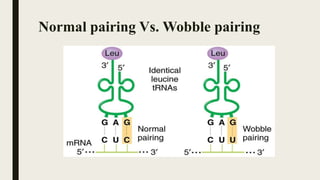
■ The pairing of the third base varies according to the base at this position
for example G may pair with C the convention pairing [A =U , G=C]
is known as watson - Crick pairing and the second abnormal pairing
is called wobble pairing.
■ This was observed from the discovery that the anticodon of Yeast alanine
tRNA contains the nucleoside inosine in the first position[ 5'→3'] that
paired with the third base of the codon [5'→3'].
■ Inosine was also found at the first position in other tRNA. e.g. isoleucine
and serine.
■ The purine inosine is a wobble nucleotide and is similar to guanine which
normally pairs with A, U,G, and C.
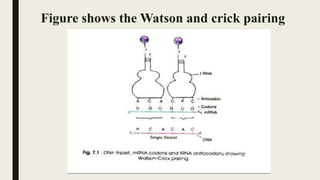
Figure shows the Watson and crick pairing
Normal pairing Vs. Wobble pairing
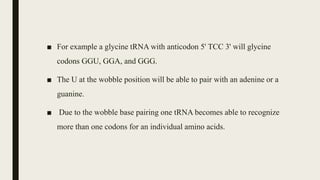
■ For example a glycine tRNA with anticodon 5' TCC 3' will glycine
codons GGU, GGA, and GGG.
■ The U at the wobble position will be able to pair with an adenine or a
guanine.
■ Due to the wobble base pairing one tRNA becomes able to recognize
more than one codons for an individual amino acids.
■ By direct sequence of several tRNA molecules the wobble hypothesis is
confirmed which explain the pattern of redundancy in genetic code in
some anticodon [e.g. the anticodons containing U,I, and G in the first
position in 5'→3' direction.]
■ Generally Watson-Crick pairing occurs between AGC and GCU.
however in AGU and GCU pairing hydrogen bonds are formed between
G and U.
■ Such abnormal pairing called wobble pairing.
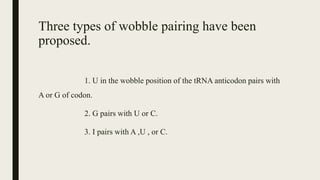
Three types of wobble pairing have been
proposed.
1. U in the wobble position of the tRNA anticodon pairs with
A or G of codon.
2. G pairs with U or C.
3. I pairs with A ,U , or C.
Thank you

Wobble hypothesis

  • 1.
    WOBBLE HYPOTHESIS Subhananthini jeyamurugan, 18py17,department of microbiology. ANJA college, sivakasi
  • 2.
    INTRODUCTION ■ Crick (1996)proposed the 'wobble hypothesis' to explain the degeneracy of the genetic code. ■ Except for tryptophan and methionine, more than one codons direct the synthesis of one amino acid. ■ There are 61codons that synthesis amino acids, therefore, there must be 61 tRNAs each having different anticodons. But the total number of tRNAs is less than 61.
  • 3.
    What is this? ■This may be explained that the anticodons of some tRNA read more than one codon. ■ In addition identity of the third codon seems to be unimportant. For example, CGU, CGC, CGA and CGG all code for arginine. ■ It appears that CG specifies arginine and the third letter is not important. Conventionally the codons are written from 5'end to 3'end.
  • 4.
    ■ Therefore thefirst and second bases specify amino acids in some cases. ■ According to the wobble hypothesis only the first and second bases of the triple codon 5‘→3' mRNA pair with the bases of the anticodon of tRNA, i.e., A with U or G with C. ■ The pairing of the third base varies according to the base at this position for example G may pair with C the convention pairing [A =U , G=C] is known as watson - Crick pairing and the second abnormal pairing is called wobble pairing.
  • 5.
    ■ This wasobserved from the discovery that the anticodon of Yeast alanine tRNA contains the nucleoside inosine in the first position[ 5'→3'] that paired with the third base of the codon [5'→3']. ■ Inosine was also found at the first position in other tRNA. e.g. isoleucine and serine. ■ The purine inosine is a wobble nucleotide and is similar to guanine which normally pairs with A, U,G, and C.
  • 6.
    Figure shows theWatson and crick pairing
  • 7.
    Normal pairing Vs.Wobble pairing
  • 8.
    ■ For examplea glycine tRNA with anticodon 5' TCC 3' will glycine codons GGU, GGA, and GGG. ■ The U at the wobble position will be able to pair with an adenine or a guanine. ■ Due to the wobble base pairing one tRNA becomes able to recognize more than one codons for an individual amino acids.
  • 9.
    ■ By directsequence of several tRNA molecules the wobble hypothesis is confirmed which explain the pattern of redundancy in genetic code in some anticodon [e.g. the anticodons containing U,I, and G in the first position in 5'→3' direction.] ■ Generally Watson-Crick pairing occurs between AGC and GCU. however in AGU and GCU pairing hydrogen bonds are formed between G and U. ■ Such abnormal pairing called wobble pairing.
  • 10.
    Three types ofwobble pairing have been proposed. 1. U in the wobble position of the tRNA anticodon pairs with A or G of codon. 2. G pairs with U or C. 3. I pairs with A ,U , or C.
  • 11.