Mr. Balaji S. Thorat
Regd. No: ADPM/15/ 2418
Discipline: Genetics & Plant breeding.
Dept. : Agrl. Botany, College of Agriculture, Dapoli.
Introduction:
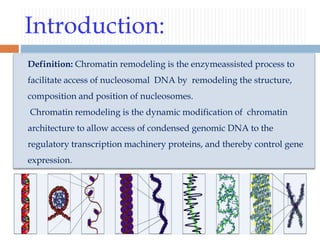
Definition: Chromatin remodeling is the enzymeassisted process to
facilitate access of nucleosomal DNA by remodeling the structure,
composition and position of nucleosomes.
Chromatin remodeling is the dynamic modification of chromatin
architecture to allow access of condensed genomic DNA to the
regulatory transcription machinery proteins, and thereby control gene
expression.
Why do Cells Require chromatin Remodeling
 Binding of the DNA to the histone octamer and the bending
of the molecule on the protein surface present a strong
barrier to sequence specific recognition of the nucleosomal
DNA molecule.
 That’s why the packaging of DNA into nucleosomes and
higher order structure is generally inhibitory to all kind of
DNA dependent processes.
 To overcome DNA sequence accessibility problems, cells
have developed mechanisms to open higher order structures
of chromatin and to disrupt nucleosomes allowing the
binding of sequence specific regulators.
Types Of Chromatin Remodeling
There are two types namely,
1. Covalent histone modification.
2. ATP dependent chromatin remodeling
1. Covalent histone modification:
Specific protein complexes, known as Histone- Modifyieng
complexes catalyze addition or removal of various chemical
elements on histones.
2. ATP dependent chromatin remodeling
ATP dependent chromatin remodeling complexes regulate
gene expression by either moving, ejecting or restructuring
nucleosomes.
 These protein complexes have a common ATPase domain
and energy from the hydrolysis of ATP allows these
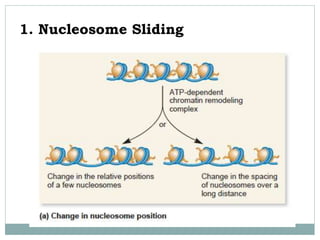
remodeling complexes to reposition (slide, twist or loop)
nucleosomes along the DNA, expel histones away from DNA
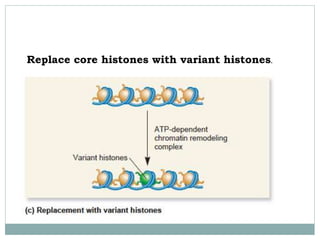
or facilitate exchange of histone variants thus creating
nucleosome free regions of DNA for gene activation.
Chromatin
Remodeling
Complexes
SWI/SNF
family
ISWI
family
CHD familyINO80
family
1. SWI/SNF family
remodelers.
 The SWI/SNF (switching defective/sucrose nonfermenting)
family remodelers were initially purified from Saccharomyces
cerevisiae and are composed of 8 to 14 subunits.
SWI/SNF remodelers are highly conserved across different
species, including Saccharomyces cerevisiae, Drosophila
melanogaster and Homo sapiens.
This family has many activities, and it slides and ejects
nucleosomes at many loci and for diverse processes but lacks
roles in chromatin assembly.
2. ISWI family
remodelers.
The ISWI (imitation switch) family remodelers contain 2 to 4
subunits.
 Most eukaryotes build multiple ISWI family complexes using
one or two different catalytic subunits, with specialized
attendant proteins.
Specialized attendant proteins impart many domains, including
DNA-binding histone fold motifs, plant homeodomain (PHD),
bromodomains , and additional DNA-binding motifs.
3. CHD family remodelers
The 1st CHD (Chromodomain, Helicase, DNA binding) family
remodeler identified was Mi-2, combine 1 to 10 subunits and
were first purified from Xenopus laevis.
Characteristic feature include two tandemly arranged chromo -
domains on the N terminus of the catalytic subunit.
The catalytic subunit is monomeric in lower eukaryotes but can
be in large complexes in vertebrates .
Certain CHD remodelers slide or eject nucleosomes to promote
transcription.
4. INO80 family remodelers.
The INO80 (inositol requiring 80) family remodelers contain more than 10 subunits,
include the SWR1-related complexes and were initially purified from S. cerevisiae.
 The defining feature is a “split” ATPase domain, with a long insertion present in the
middle of the ATPase domain, to which the helicase-related (AAA-ATPase) Rvb1/2
proteins and one ARP protein bind.
INO80 has diverse functions, including promoting transcriptional activation and
DNA repair. Although highly related to INO80, SWR1 is unique in its ability to
restructure the nucleosome by removing canonical H2A-H2B dimers and replacing
them with H2A.Z-H2B dimers, thereby inserting the histone H2A variant H2A.Z.
Domains, proteins, and modifications that
regulate remodelers
Shared characteristics of chromatin
remodeling complexes:
 They bind to nucleosomes
 They are DNA-dependent ATPases
 They recognize histone modifications
 Their ATPase activity can be regulated
 They interact with other proteins
One
• Nucleosome Sliding
Two
• Ejection of histone octamers
Three
• Removal of H2A-H2B dimers
Four
• Replacement of dimers
Loop formation mechanism during chromatin remodeling
1. Nucleosome Sliding
Removal of histones from the DNA
Replace core histones with variant histones.
CHROMOSOMAL PROCESSES
REQUIRING REMODELERS
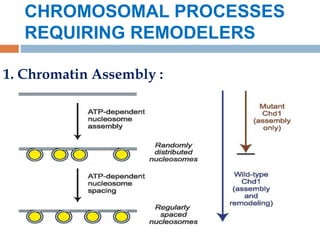
1. Chromatin Assembly :
2. Dosage Compensation :
 In Drosophila dosage compensation, the hyperacetylation at
H4K16 of the male X by dMOF, a component of the Drosophila
dosage compensation complex .
 Acetylation of H4K16 inhibits chromatin compaction in
two ways: H4K16ac inhibits fiber formation and reduces,
ISWI remodeling activity. The result is a finely tuned balance:
H4K16ac promotes the twofold increase in transcription and
impaired ISWI function
3. DNA Repair
 DNA lesions occur often and threaten genome integrity,
requiring a rapid recognition of sites of damage within
chromatin.
 However, chromatin actually facilitates repair, with one of the
fastest cellular responses to damage being the phosphorylation
of serine 129 of H2A in yeast or serine 139 of H2A.X in
vertebrates.
 This phosphorylation helps recruit DNA repair factors as well
as chromatin remodelers of the SWI/SNF and INO80 families,
likely to facilitate access to DNA ends for repair enzymes.
4.Chromosome Segregation
 Remodeler plays an important role in chromosome segregation.
 hATRX a SNF2-related protein, binds to centromeric heterochromatin at
meiotic onset, promoting a bipolar meiotic spindle and proper chromosome
alignment .
 In humans, an hSNF2H family remodeler mediates cohesin loading. Also, the
SWI/SNF family remodeler yRSC is constitutively present at the centromeres
and promotes proper kinetochore function and chromosome segregation .
 yRSC associates with chromosome arms and interacts directly with cohesin to
preserve chromosome cohesion and promote proper chromosome segregation.
Case studies
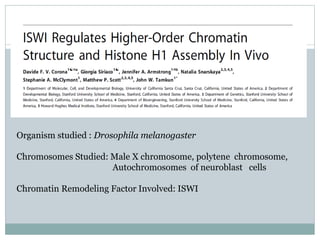
Organism studied : Drosophila melanogaster
Chromosomes Studied: Male X chromosome, polytene chromosome,
Autochromosomes of neuroblast cells
Chromatin Remodeling Factor Involved: ISWI
 Interactions between histone-modifying and
chromatin remodeling enzymes can have profound
effects on higher order chromatin structure as
illustrated by recent studies of the Drosophila
chromatin-remodeling factor ISWI.
 ISWI functions as the ATPase subunit of at least
three distinct chromatin-remodeling complexes: ACF,
CHRAC, and NURF.
 The loss of Iswi function leads to the dramatic
decondensation of a specific chromosome: the male X
Figure 1. ISWI Plays a Global Role in Chromosome Compaction In
Vivo.
Polytene chromosomes( A,B),
X Chromosome( C,D,E,F)
chromosomes of neuroblast cells
3. Loss of ISWI Results in loss of Histone H1
Assembly
Inference:
ISWI is a global regulator of polytene chromosome
structure.
ISWI is required for the generation, maintenance of
higher order chromatin structure in diploid cells.
ISWI plays relatively global roles in transcriptional
activation and repression in vivo.
ISWI Promotes the Association of the Linker
Histone H1 with Chromatin
 The conserved histone variant H2AZ has an important role in the regulation of
gene expression.
Swr1, a Swi2/Snf2-related adenosine triphosphatase, is the catalytic core of a
multisubunit, histone-variant exchanger that efficiently replaces conventional
histone H2A with histone H2AZ in nucleosome arrays.
 Swr1 is required for the deposition of histone H2AZ at specific chromosome
locations in vivo and Swr1 and H2AZ commonly regulate a subset of yeast genes.
 These findings define a previously unknown role for the adenosine triphosphate–
dependent chromatin remodeling machinery
Material and Methods
Organism studied: Saccharomyces cerevisiae
Method: Immuno purification from whole-yeast
extracts for the purification of native Swr1.
followed by SDS –PAGE and glycerol
gradient centrifugation.
SWR1 complex exchanges nucleosomal H2A with Htz1. (A)
SDS-PAGE and silver staining showing histones
retained on immobilized nucleosome arrays before (lane 1)
and after (lane 2) Htz1 transfer.
Inference:
 A multicomponent SWR1 complex containing H2AZ
(Htz1) indicates association between H2AZ and
SWR1
 Chromatin binding of Htz1 in vivo requires Swr1.
 SWR1 complex catalyzes replacement of H2A with
Htz1 in vitro.
CONCLUSION
 Chromosomal biology involves a dynamic balance between
genome packaging and genome access.
 Remodelers are needed to fully package the genome, to
specialize chromatin regions, and to provide regulated
DNA accessibility in packaged regions.
 Chromatin modifiers and remodelers work in concert to
direct nucleosome dynamics. Nucleosome determinants
and covalent modifications are recognized by remodelers
and may be used both for targeting and regulating the
remodeling reaction.
REFERENCES:
 1.Allfrey VG, Faulkner R, Mirsky AE,1964.,. Acetylation and
methylation of histones and their possible role in the
regulation of RNA synthesis. Proc Natl Acad Sci USA ; 51:786-794.
 2. Corona DF, Tamkun JW. 2004., Multiple roles for ISWI in
transcription, chromosome organization and DNA replication.
Biochim. Biophys. Acta 1677:113–19
 3.Corona DFV, Siriaco G, Armstrong JA, Snarskaya N, McClymont
SA, et al. (2007) ISWI regulates higher-order chromatin structure
and histone H1 assembly in vivo. PLoS Biol 5(9): e232.
doi:10.1371/journal.pbio.0050232
 4. Jaskiewicz M , Conrath U , Peterha¨nsel C.2011.,Chromatin
modification acts as a memory for systemic acquired resistance in
the plant stress response, 50–55. doi:10.1038/embor.2010.186.

36
Thank You..

Cromatin Remodeling

  • 1.
    Mr. Balaji S.Thorat Regd. No: ADPM/15/ 2418 Discipline: Genetics & Plant breeding. Dept. : Agrl. Botany, College of Agriculture, Dapoli.
  • 2.
    Introduction: Definition: Chromatin remodelingis the enzymeassisted process to facilitate access of nucleosomal DNA by remodeling the structure, composition and position of nucleosomes. Chromatin remodeling is the dynamic modification of chromatin architecture to allow access of condensed genomic DNA to the regulatory transcription machinery proteins, and thereby control gene expression.
  • 3.
    Why do CellsRequire chromatin Remodeling  Binding of the DNA to the histone octamer and the bending of the molecule on the protein surface present a strong barrier to sequence specific recognition of the nucleosomal DNA molecule.  That’s why the packaging of DNA into nucleosomes and higher order structure is generally inhibitory to all kind of DNA dependent processes.  To overcome DNA sequence accessibility problems, cells have developed mechanisms to open higher order structures of chromatin and to disrupt nucleosomes allowing the binding of sequence specific regulators.
  • 4.
    Types Of ChromatinRemodeling There are two types namely, 1. Covalent histone modification. 2. ATP dependent chromatin remodeling 1. Covalent histone modification: Specific protein complexes, known as Histone- Modifyieng complexes catalyze addition or removal of various chemical elements on histones.
  • 6.
    2. ATP dependentchromatin remodeling ATP dependent chromatin remodeling complexes regulate gene expression by either moving, ejecting or restructuring nucleosomes.  These protein complexes have a common ATPase domain and energy from the hydrolysis of ATP allows these remodeling complexes to reposition (slide, twist or loop) nucleosomes along the DNA, expel histones away from DNA or facilitate exchange of histone variants thus creating nucleosome free regions of DNA for gene activation.
  • 7.
  • 8.
    1. SWI/SNF family remodelers. The SWI/SNF (switching defective/sucrose nonfermenting) family remodelers were initially purified from Saccharomyces cerevisiae and are composed of 8 to 14 subunits. SWI/SNF remodelers are highly conserved across different species, including Saccharomyces cerevisiae, Drosophila melanogaster and Homo sapiens. This family has many activities, and it slides and ejects nucleosomes at many loci and for diverse processes but lacks roles in chromatin assembly.
  • 9.
    2. ISWI family remodelers. TheISWI (imitation switch) family remodelers contain 2 to 4 subunits.  Most eukaryotes build multiple ISWI family complexes using one or two different catalytic subunits, with specialized attendant proteins. Specialized attendant proteins impart many domains, including DNA-binding histone fold motifs, plant homeodomain (PHD), bromodomains , and additional DNA-binding motifs.
  • 10.
    3. CHD familyremodelers The 1st CHD (Chromodomain, Helicase, DNA binding) family remodeler identified was Mi-2, combine 1 to 10 subunits and were first purified from Xenopus laevis. Characteristic feature include two tandemly arranged chromo - domains on the N terminus of the catalytic subunit. The catalytic subunit is monomeric in lower eukaryotes but can be in large complexes in vertebrates . Certain CHD remodelers slide or eject nucleosomes to promote transcription.
  • 11.
    4. INO80 familyremodelers. The INO80 (inositol requiring 80) family remodelers contain more than 10 subunits, include the SWR1-related complexes and were initially purified from S. cerevisiae.  The defining feature is a “split” ATPase domain, with a long insertion present in the middle of the ATPase domain, to which the helicase-related (AAA-ATPase) Rvb1/2 proteins and one ARP protein bind. INO80 has diverse functions, including promoting transcriptional activation and DNA repair. Although highly related to INO80, SWR1 is unique in its ability to restructure the nucleosome by removing canonical H2A-H2B dimers and replacing them with H2A.Z-H2B dimers, thereby inserting the histone H2A variant H2A.Z.
  • 12.
    Domains, proteins, andmodifications that regulate remodelers
  • 13.
    Shared characteristics ofchromatin remodeling complexes:  They bind to nucleosomes  They are DNA-dependent ATPases  They recognize histone modifications  Their ATPase activity can be regulated  They interact with other proteins
  • 14.
    One • Nucleosome Sliding Two •Ejection of histone octamers Three • Removal of H2A-H2B dimers Four • Replacement of dimers
  • 15.
    Loop formation mechanismduring chromatin remodeling
  • 17.
  • 18.
    Removal of histonesfrom the DNA
  • 19.
    Replace core histoneswith variant histones.
  • 20.
  • 21.
    2. Dosage Compensation:  In Drosophila dosage compensation, the hyperacetylation at H4K16 of the male X by dMOF, a component of the Drosophila dosage compensation complex .  Acetylation of H4K16 inhibits chromatin compaction in two ways: H4K16ac inhibits fiber formation and reduces, ISWI remodeling activity. The result is a finely tuned balance: H4K16ac promotes the twofold increase in transcription and impaired ISWI function
  • 22.
    3. DNA Repair DNA lesions occur often and threaten genome integrity, requiring a rapid recognition of sites of damage within chromatin.  However, chromatin actually facilitates repair, with one of the fastest cellular responses to damage being the phosphorylation of serine 129 of H2A in yeast or serine 139 of H2A.X in vertebrates.  This phosphorylation helps recruit DNA repair factors as well as chromatin remodelers of the SWI/SNF and INO80 families, likely to facilitate access to DNA ends for repair enzymes.
  • 23.
    4.Chromosome Segregation  Remodelerplays an important role in chromosome segregation.  hATRX a SNF2-related protein, binds to centromeric heterochromatin at meiotic onset, promoting a bipolar meiotic spindle and proper chromosome alignment .  In humans, an hSNF2H family remodeler mediates cohesin loading. Also, the SWI/SNF family remodeler yRSC is constitutively present at the centromeres and promotes proper kinetochore function and chromosome segregation .  yRSC associates with chromosome arms and interacts directly with cohesin to preserve chromosome cohesion and promote proper chromosome segregation.
  • 24.
  • 25.
    Organism studied :Drosophila melanogaster Chromosomes Studied: Male X chromosome, polytene chromosome, Autochromosomes of neuroblast cells Chromatin Remodeling Factor Involved: ISWI
  • 26.
     Interactions betweenhistone-modifying and chromatin remodeling enzymes can have profound effects on higher order chromatin structure as illustrated by recent studies of the Drosophila chromatin-remodeling factor ISWI.  ISWI functions as the ATPase subunit of at least three distinct chromatin-remodeling complexes: ACF, CHRAC, and NURF.  The loss of Iswi function leads to the dramatic decondensation of a specific chromosome: the male X
  • 27.
    Figure 1. ISWIPlays a Global Role in Chromosome Compaction In Vivo. Polytene chromosomes( A,B), X Chromosome( C,D,E,F) chromosomes of neuroblast cells
  • 28.
    3. Loss ofISWI Results in loss of Histone H1 Assembly
  • 29.
    Inference: ISWI is aglobal regulator of polytene chromosome structure. ISWI is required for the generation, maintenance of higher order chromatin structure in diploid cells. ISWI plays relatively global roles in transcriptional activation and repression in vivo. ISWI Promotes the Association of the Linker Histone H1 with Chromatin
  • 30.
     The conservedhistone variant H2AZ has an important role in the regulation of gene expression. Swr1, a Swi2/Snf2-related adenosine triphosphatase, is the catalytic core of a multisubunit, histone-variant exchanger that efficiently replaces conventional histone H2A with histone H2AZ in nucleosome arrays.  Swr1 is required for the deposition of histone H2AZ at specific chromosome locations in vivo and Swr1 and H2AZ commonly regulate a subset of yeast genes.  These findings define a previously unknown role for the adenosine triphosphate– dependent chromatin remodeling machinery
  • 31.
    Material and Methods Organismstudied: Saccharomyces cerevisiae Method: Immuno purification from whole-yeast extracts for the purification of native Swr1. followed by SDS –PAGE and glycerol gradient centrifugation.
  • 32.
    SWR1 complex exchangesnucleosomal H2A with Htz1. (A) SDS-PAGE and silver staining showing histones retained on immobilized nucleosome arrays before (lane 1) and after (lane 2) Htz1 transfer.
  • 33.
    Inference:  A multicomponentSWR1 complex containing H2AZ (Htz1) indicates association between H2AZ and SWR1  Chromatin binding of Htz1 in vivo requires Swr1.  SWR1 complex catalyzes replacement of H2A with Htz1 in vitro.
  • 34.
    CONCLUSION  Chromosomal biologyinvolves a dynamic balance between genome packaging and genome access.  Remodelers are needed to fully package the genome, to specialize chromatin regions, and to provide regulated DNA accessibility in packaged regions.  Chromatin modifiers and remodelers work in concert to direct nucleosome dynamics. Nucleosome determinants and covalent modifications are recognized by remodelers and may be used both for targeting and regulating the remodeling reaction.
  • 35.
    REFERENCES:  1.Allfrey VG,Faulkner R, Mirsky AE,1964.,. Acetylation and methylation of histones and their possible role in the regulation of RNA synthesis. Proc Natl Acad Sci USA ; 51:786-794.  2. Corona DF, Tamkun JW. 2004., Multiple roles for ISWI in transcription, chromosome organization and DNA replication. Biochim. Biophys. Acta 1677:113–19  3.Corona DFV, Siriaco G, Armstrong JA, Snarskaya N, McClymont SA, et al. (2007) ISWI regulates higher-order chromatin structure and histone H1 assembly in vivo. PLoS Biol 5(9): e232. doi:10.1371/journal.pbio.0050232  4. Jaskiewicz M , Conrath U , Peterha¨nsel C.2011.,Chromatin modification acts as a memory for systemic acquired resistance in the plant stress response, 50–55. doi:10.1038/embor.2010.186. 
  • 36.