The document outlines key principles of classical conditioning, including acquisition, extinction, spontaneous recovery, stimulus generalization, and discrimination, using examples like a parrot's response to a doorbell. It highlights real-world applications of classical conditioning in dog training and anxiety treatment in educational settings. The text concludes that while human responses may differ from Pavlov's dogs, classical conditioning techniques can effectively address behaviors and fears.
Introduction to classical conditioning and its principles including acquisition, extinction, spontaneous recovery, stimulus generalization, and discrimination.
Acquisition
Acquisition refers tothe initial stage of the learning or
conditioning process. In this stage, particular response
is being associated with a particular stimulus to the
point where we can say the organism has
"acquired" the response.
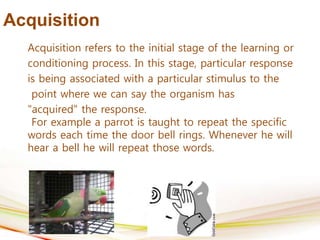
For example a parrot is taught to repeat the specific
words each time the door bell rings. Whenever he will
hear a bell he will repeat those words.
3.
Extinction
Extinction is whenthe occurrences of a conditioned
response decrease or disappear. In classical
conditioning, this happens when a conditioned
stimulus is no longer paired with an unconditioned
stimulus.
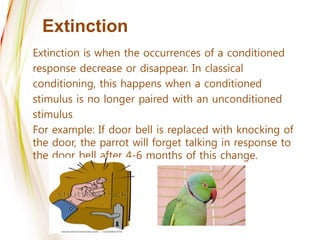
For example: If door bell is replaced with knocking of
the door, the parrot will forget talking in response to
the door bell after 4-6 months of this change.
4.
Spontaneous Recovery
Spontaneous Recoveryis the reappearance of the
conditioned response after a rest period or period of
lessened response.
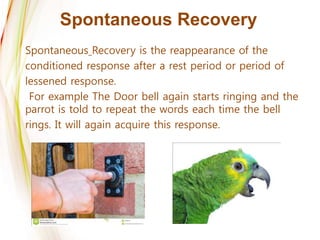
For example The Door bell again starts ringing and the
parrot is told to repeat the words each time the bell
rings. It will again acquire this response.
5.
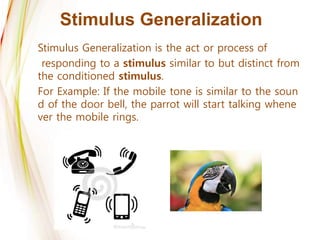
Stimulus Generalization
Stimulus Generalizationis the act or process of
responding to a stimulus similar to but distinct from
the conditioned stimulus.
For Example: If the mobile tone is similar to the soun
d of the door bell, the parrot will start talking whene
ver the mobile rings.
6.
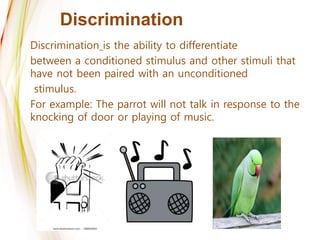
Discrimination
Discrimination is theability to differentiate
between a conditioned stimulus and other stimuli that
have not been paired with an unconditioned
stimulus.
For example: The parrot will not talk in response to the
knocking of door or playing of music.
7.
conclusion
In reality, peopledo not respond exactly like
Pavlov's dogs. There are, however, numerous real-worl
d applications for classical conditioning. For example,
many dog trainers use classical conditioning technique
s to help people train their pets.
These techniques are also useful in the treatment of ph
obias or anxiety problems. Teachers are able to apply c
lassical conditioning in the class by creating a positive
classroom environment to help students overcome anxi
ety or fear. Pairing an anxiety-provoking situation, such
as performing in front of a group, with pleasant surrou
ndings helps the student learn new associations