Lesson 5: Applications of classical
conditioning
VCE Psychology Units 3 & 4
From last lesson………….
Outline the following for Pavlov’s experiments
•Unconditioned Stimulus -
•Unconditioned Response -
•Conditioned Stimulus -
•Conditioned Response -
•Neutral stimulus -
Answer
•Unconditioned Stimulus – Food
•Unconditioned Response - Salivation
•Conditioned Stimulus - Bell
•Conditioned Response - Salivation
•Neutral stimulus - Bell
What is classical conditioning?
Classical conditioning
Refers to a type of
learning that occurs through
the repeated association of
two (or more) different
stimuli.
Learning is only said to
have occurred when a
particular stimulus
consistently produces a
response that it did not
previously produce.
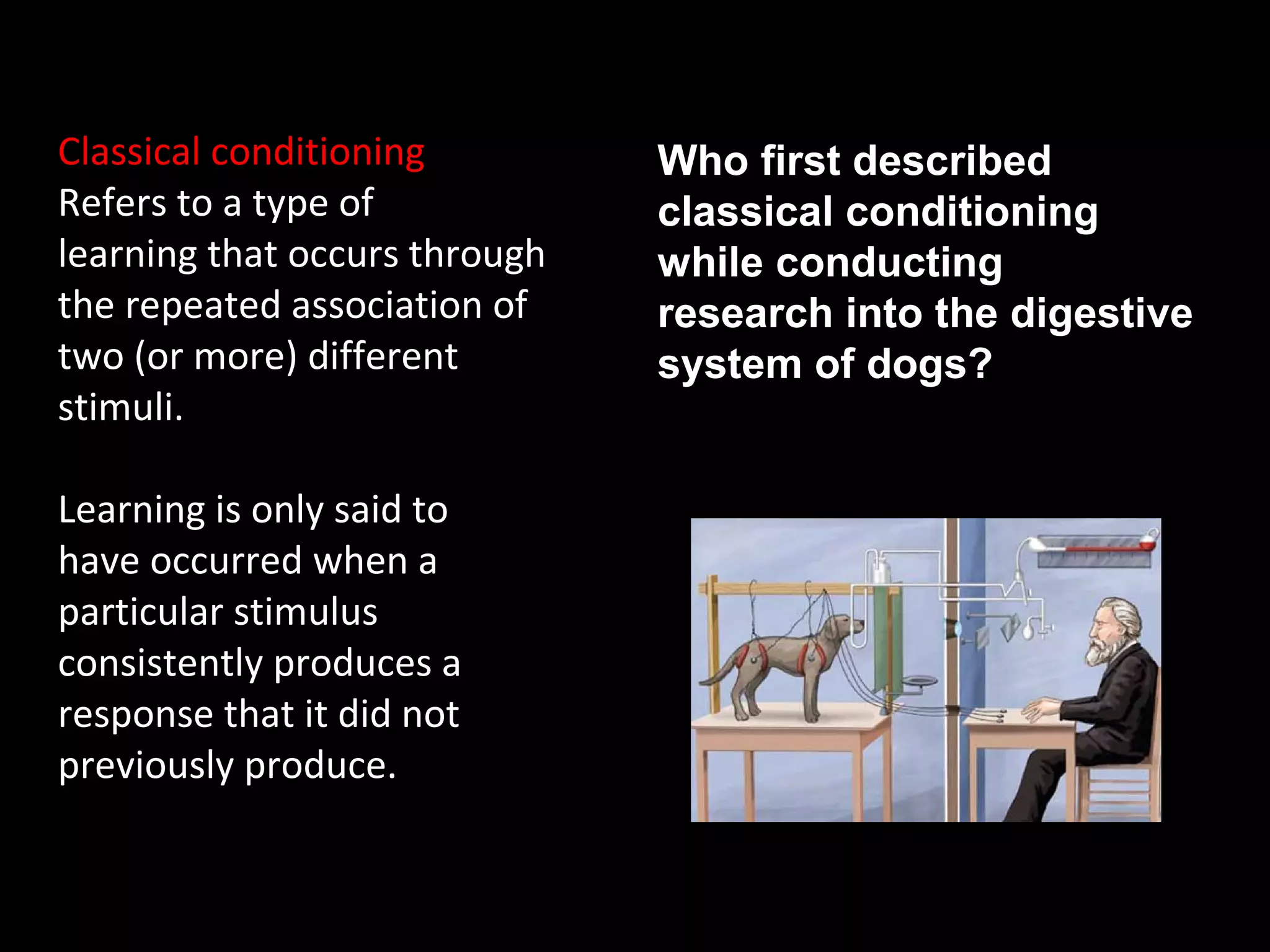
Who first described
classical conditioning
while conducting
research into the digestive
system of dogs?
Applications of classical conditioning
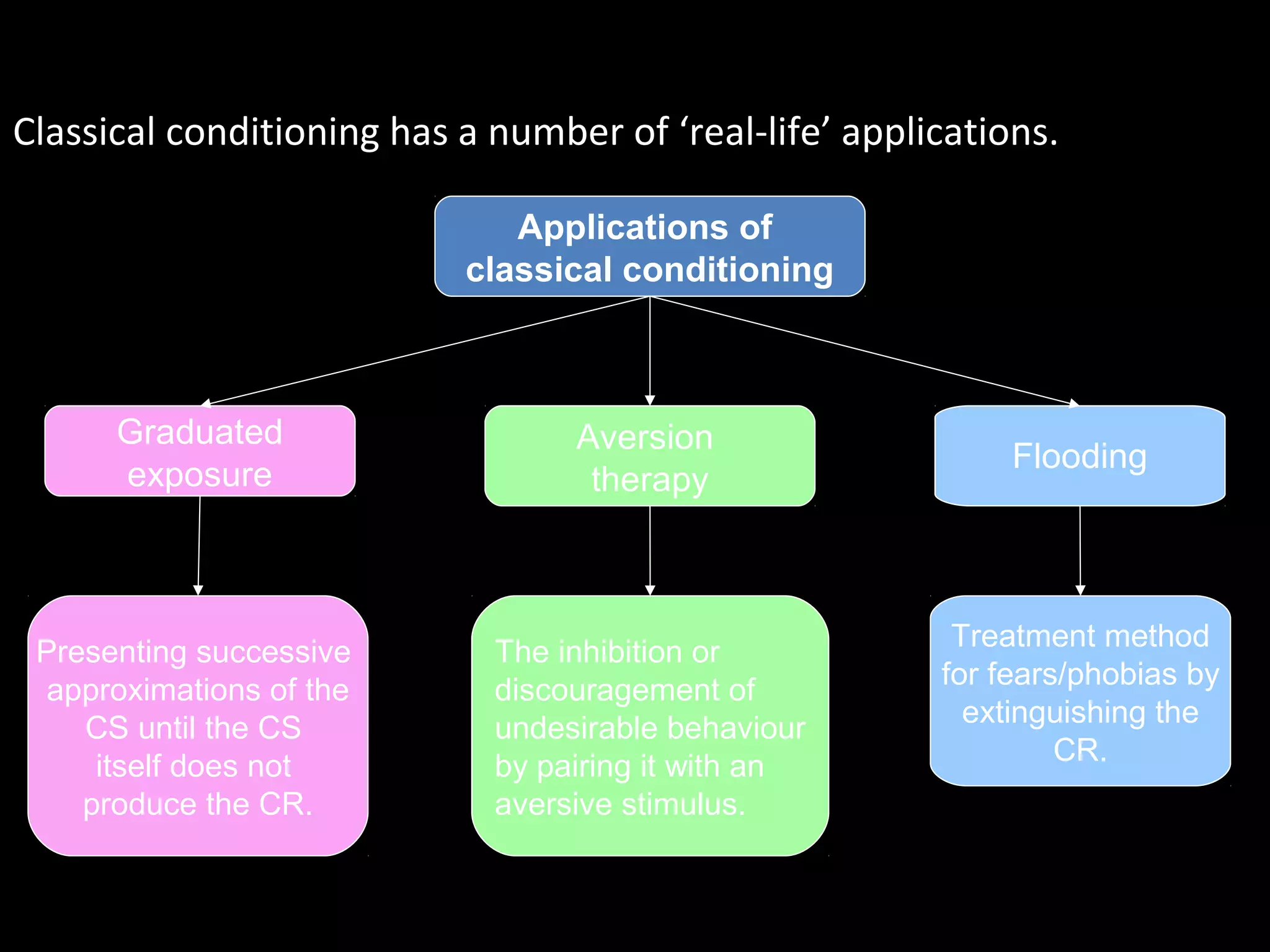
Classical conditioning has a number of ‘real-life’ applications.
Applications of
classical conditioning
Graduated
exposure
Aversion
therapy
Presenting successive
approximations of the
CS until the CS
itself does not
produce the CR.
The inhibition or
discouragement of
undesirable behaviour
by pairing it with an
aversive stimulus.
Flooding
Treatment method
for fears/phobias by
extinguishing the
CR.
Graduated exposure involves
gradually presenting
successive approximations of
the CS until the CS itself
does not produce the CR.
It is a process that involves
the extinction of the
association between the CS
and the CR.
It is also known as
‘systematic desensitisation’.
Graduated exposure
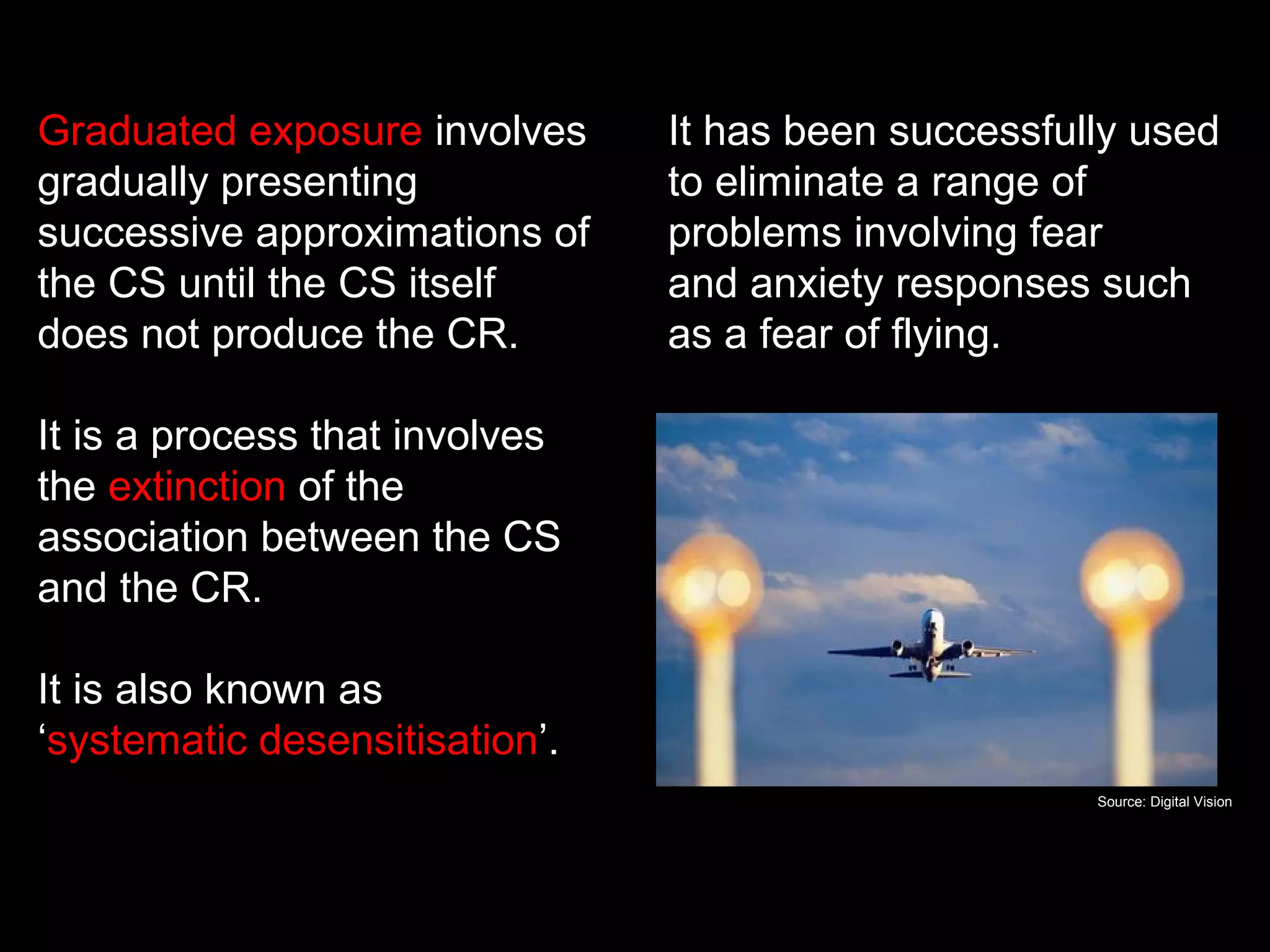
It has been successfully used
to eliminate a range of
problems involving fear
and anxiety responses such
as a fear of flying.
Source: Digital Vision
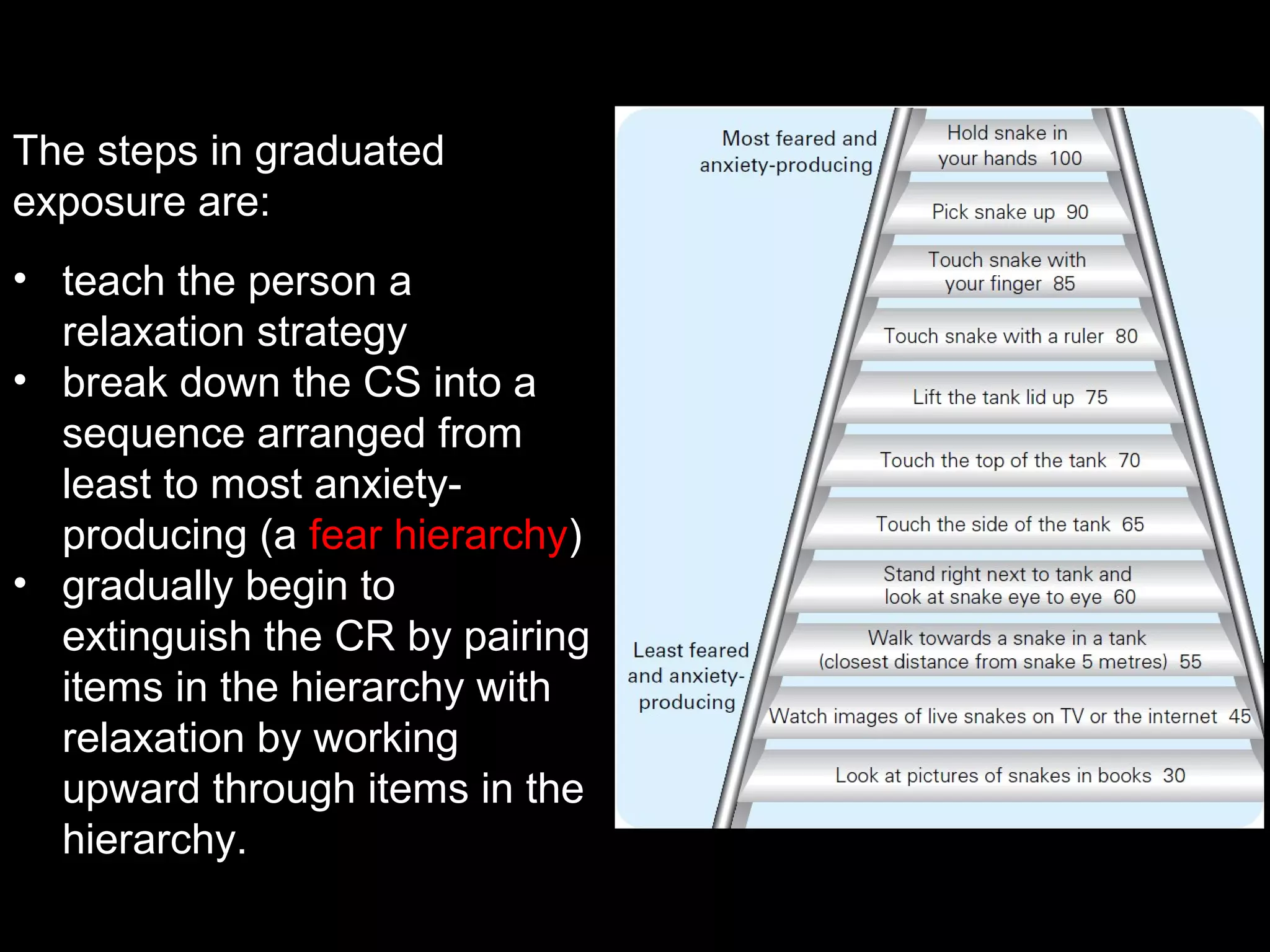
• teach the person a
relaxation strategy
• break down the CS into a
sequence arranged from
least to most anxiety-
producing (a fear hierarchy)
• gradually begin to
extinguish the CR by pairing
items in the hierarchy with
relaxation by working
upward through items in the
hierarchy.
Graduated exposure
The steps in graduated
exposure are:
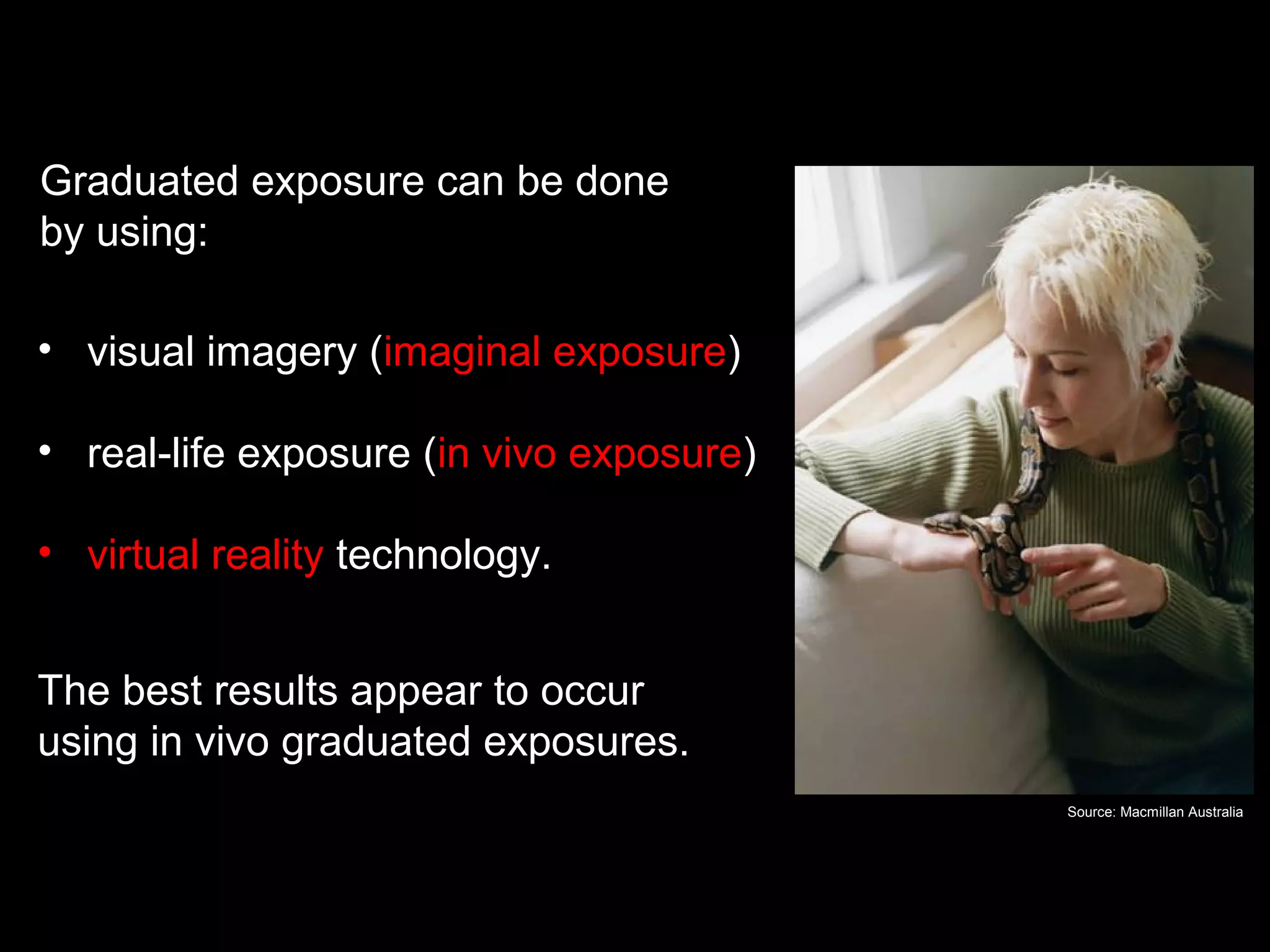
• visual imagery (imaginal exposure)
• real-life exposure (in vivo exposure)
• virtual reality technology.
Graduated exposure
Source: Macmillan Australia
Graduated exposure can be done
by using:
The best results appear to occur
using in vivo graduated exposures.
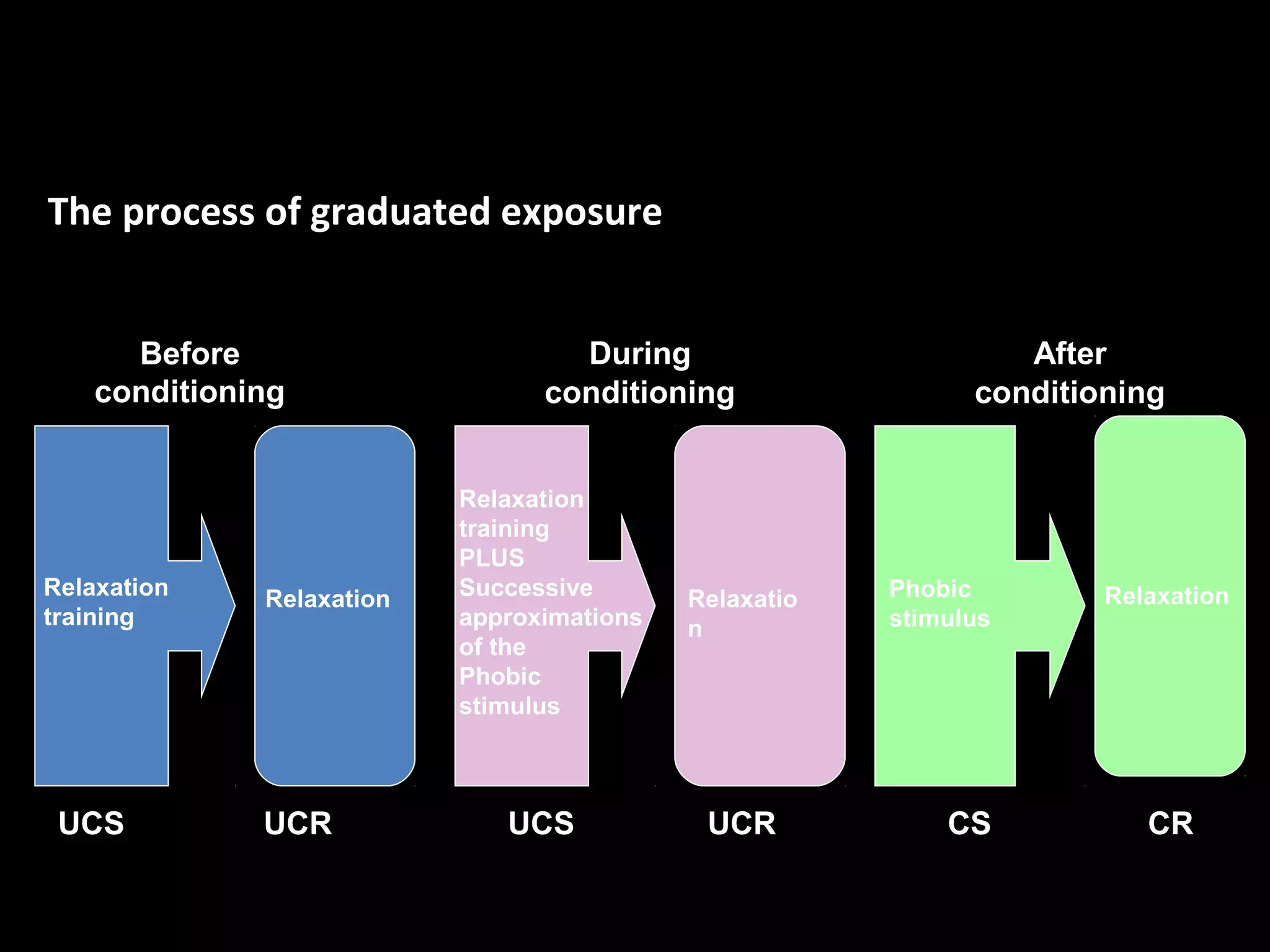
The process of graduated exposure
Graduated exposure
Before
conditioning
During
conditioning
After
conditioning
UCS UCR UCS UCR CS CR
Relaxation
training
Relaxation
Relaxation
training
PLUS
Successive
approximations
of the
Phobic
stimulus
Relaxatio
n
Phobic
stimulus
Relaxation
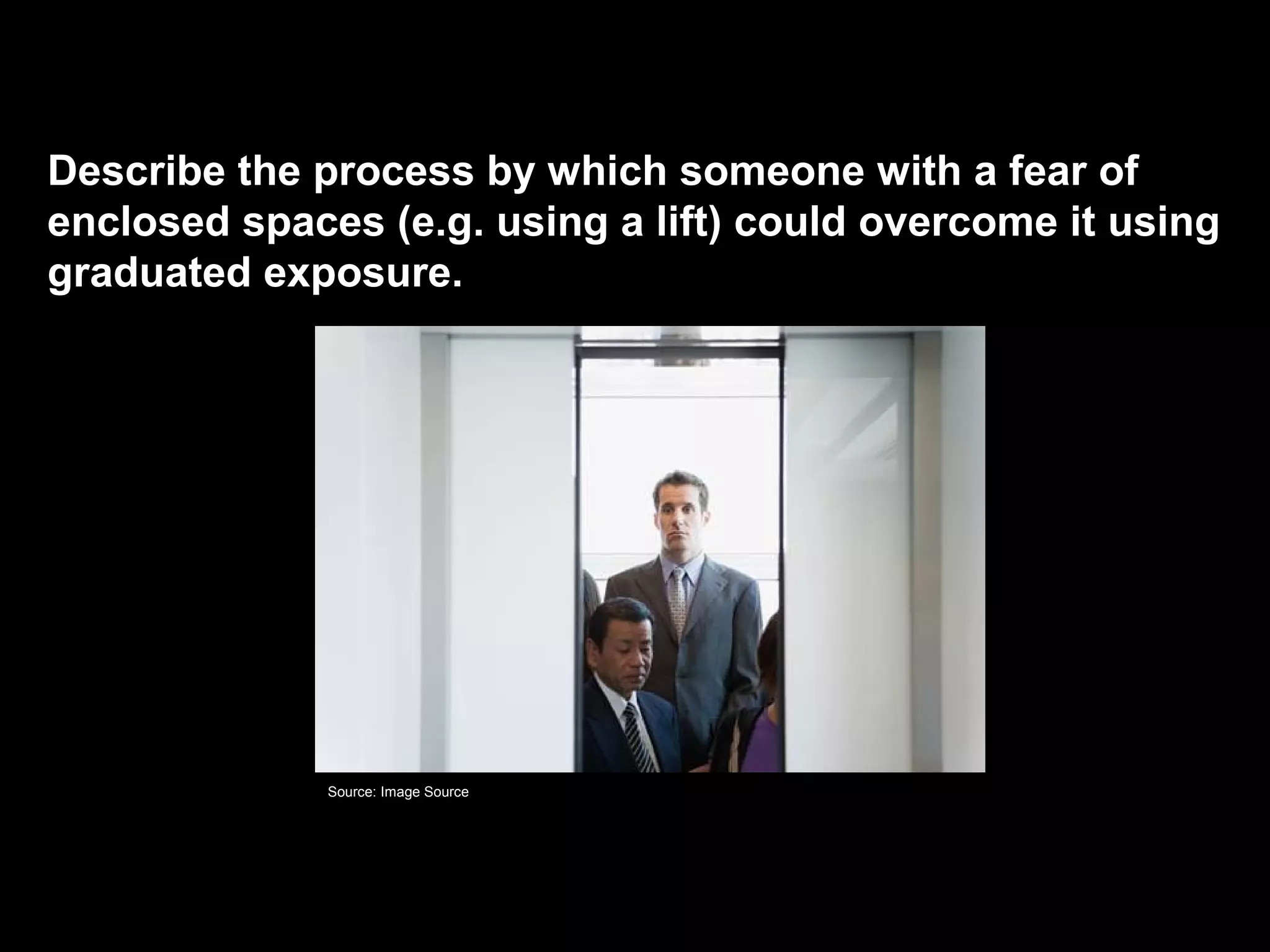
Describe the process by which someone with a fear of
enclosed spaces (e.g. using a lift) could overcome it using
graduated exposure.
Graduated exposure
Source: Image Source
Aversion therapy inhibits
(blocks) or discourages
undesirable behaviour by
pairing it with an aversive
stimulus.
It has been used successfully
to treat many different
behaviours such as
alcoholism, drug
dependence, nail biting,
gambling, inappropriate
sexual behaviours.
What is aversion therapy?
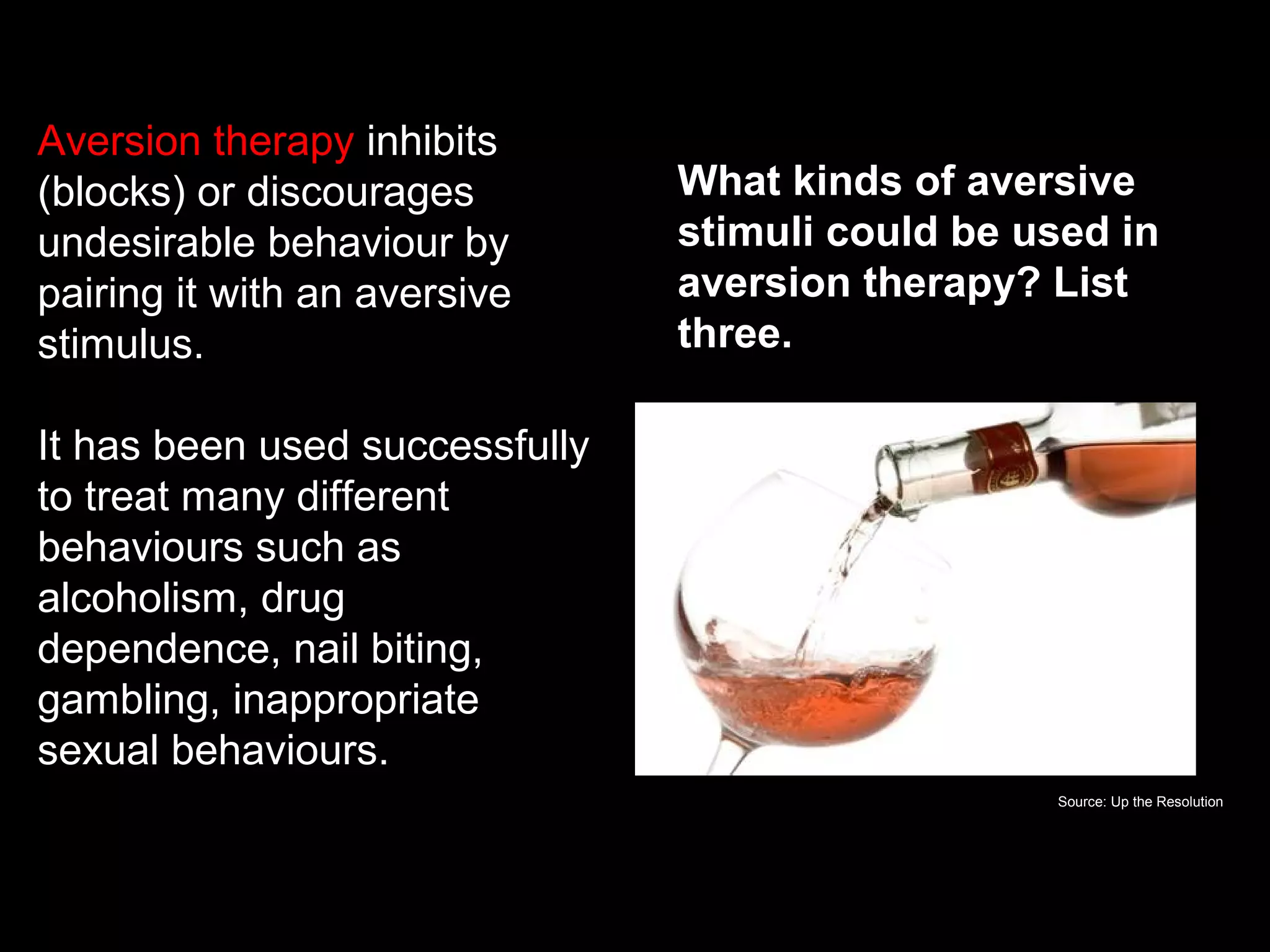
What kinds of aversive
stimuli could be used in
aversion therapy? List
three.
Source: Up the Resolution
Aversion therapy was
used in Anthony Burgess‘s
book A Clockwork
Orange (1962), which was
adapted as a film by
Stanley Kubrick in 1971.
Alex de Large is offered
freedom from a long jail
sentence if he is prepared to
undergo aversion therapy
for his violence:
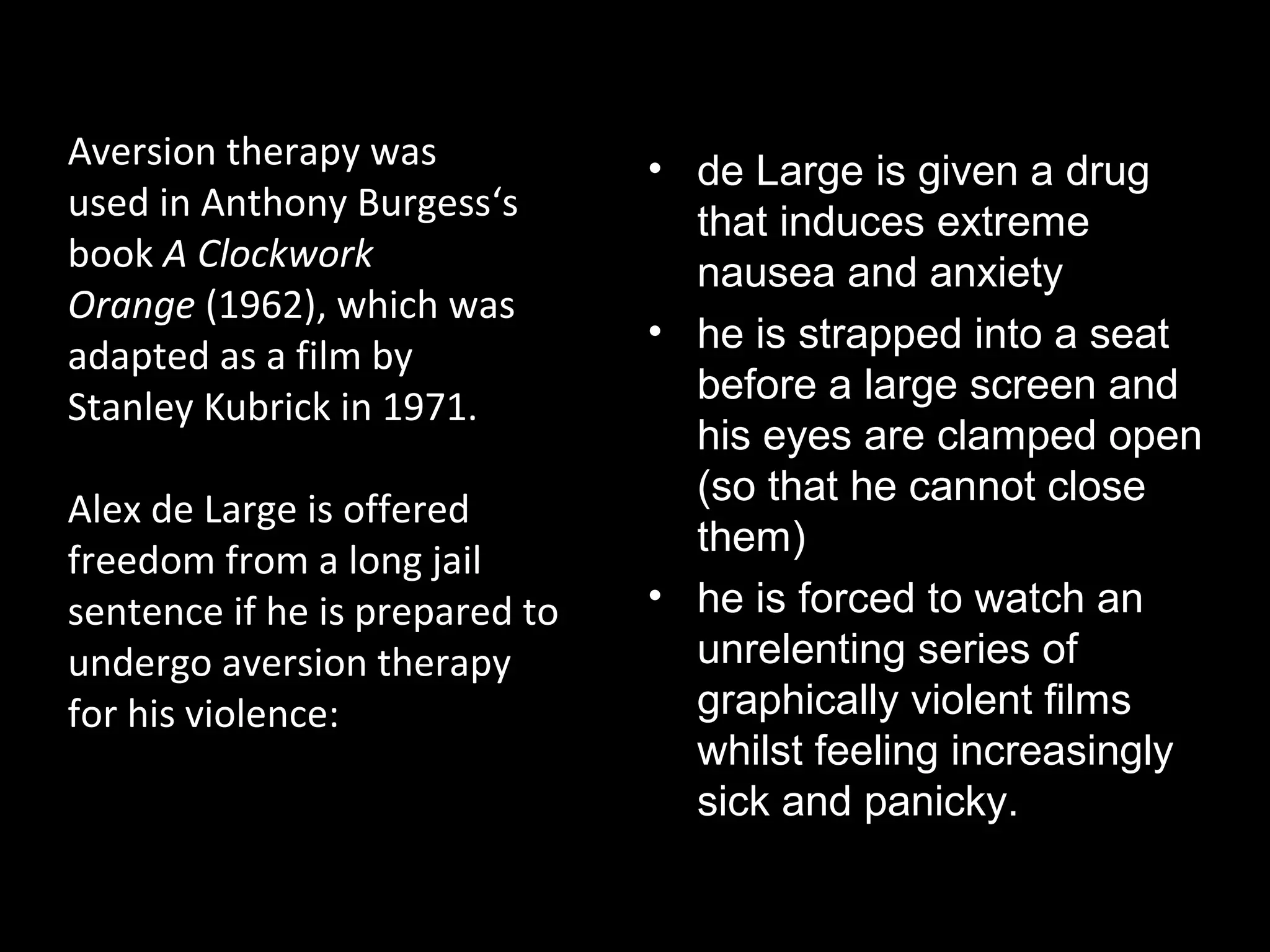
Aversion therapy at the movies
• de Large is given a drug
that induces extreme
nausea and anxiety
• he is strapped into a seat
before a large screen and
his eyes are clamped open
(so that he cannot close
them)
• he is forced to watch an
unrelenting series of
graphically violent films
whilst feeling increasingly
sick and panicky.
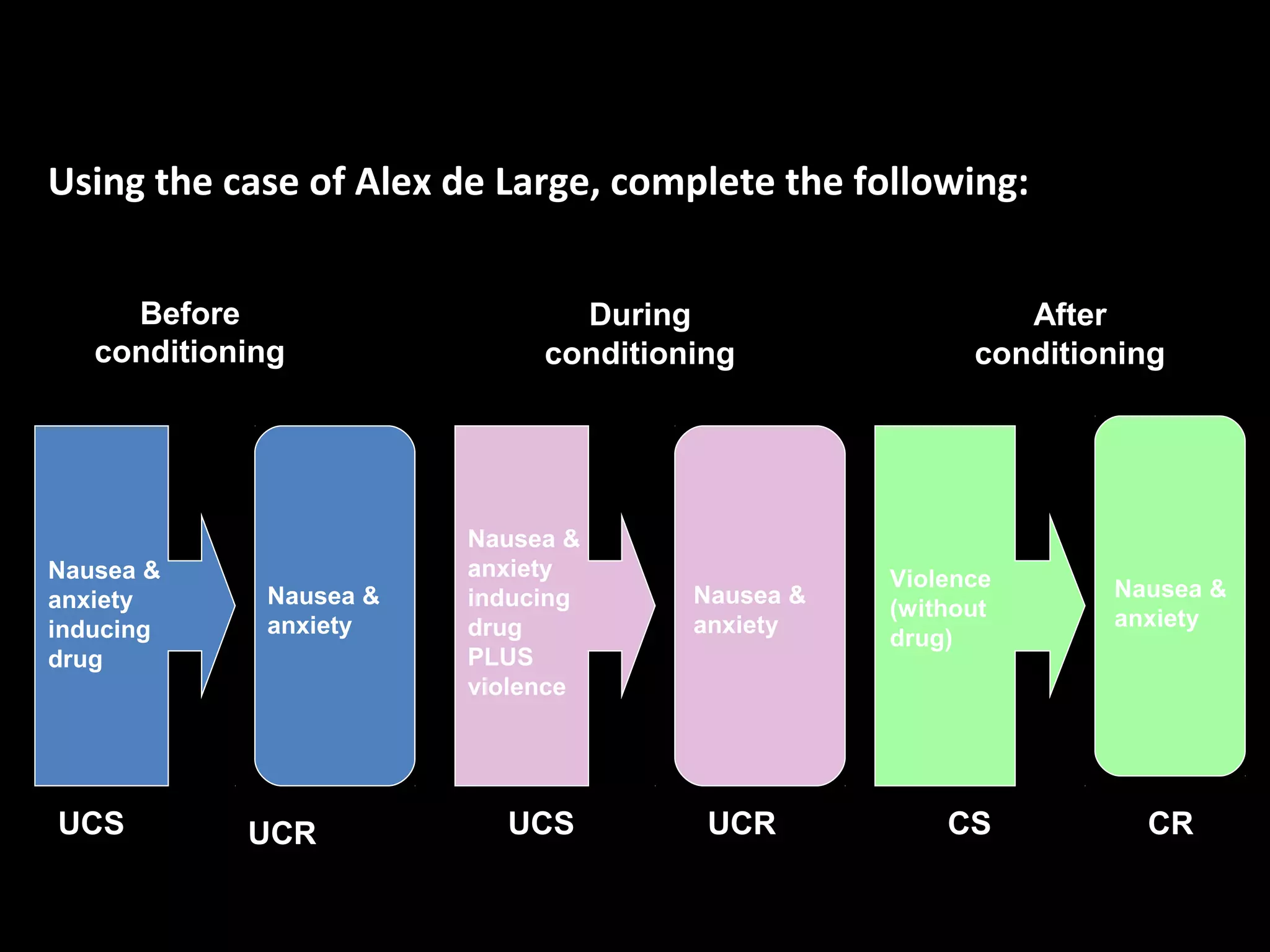
Using the case of Alex de Large, complete the following:
Aversion therapy at the movies
Before
conditioning
During
conditioning
After
conditioning
UCS UCR UCS UCR CS CR
Nausea &
anxiety
inducing
drug
Nausea &
anxiety
Nausea &
anxiety
inducing
drug
PLUS
violence
Nausea &
anxiety
Violence
(without
drug)
Nausea &
anxiety
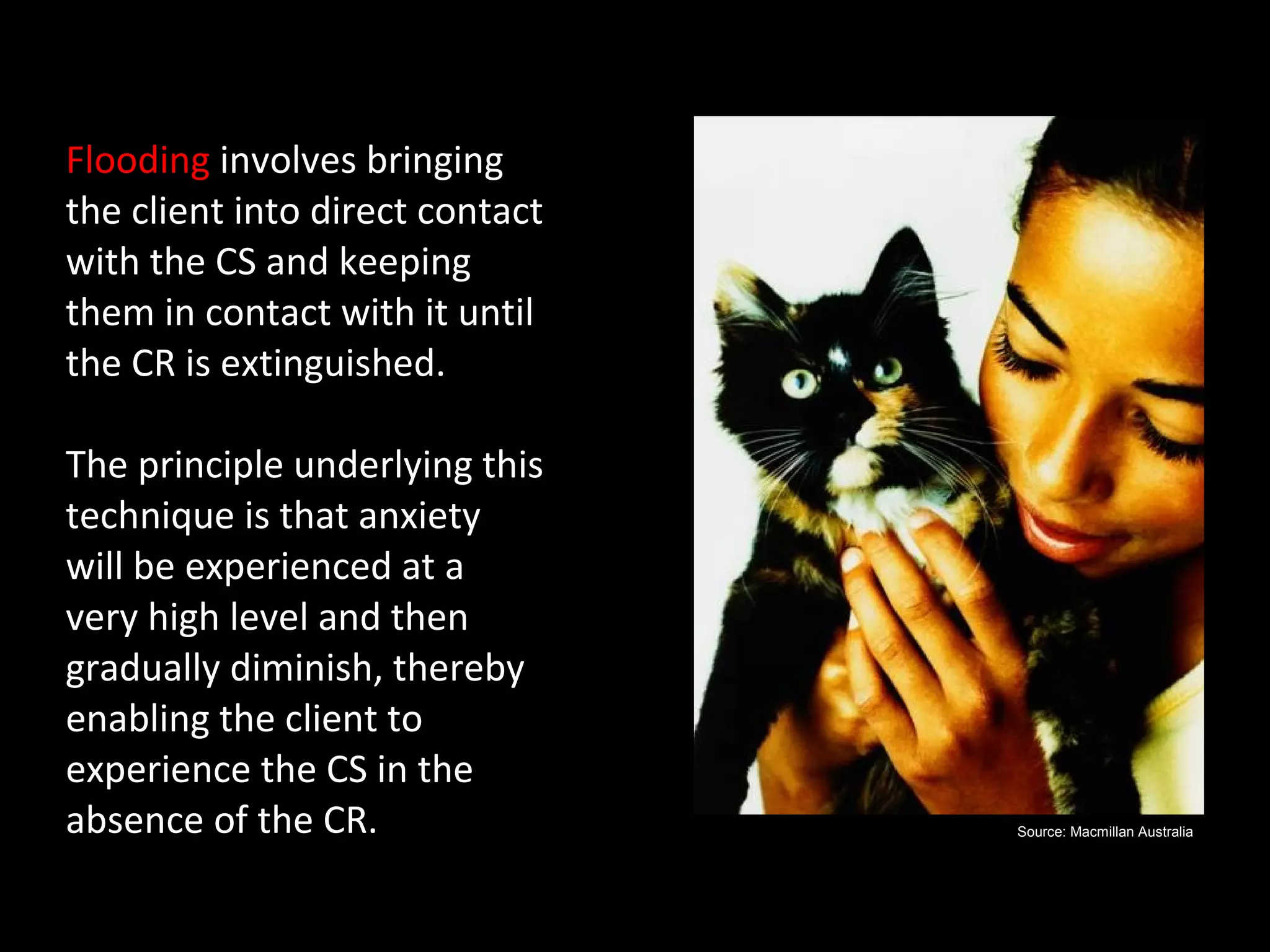
Flooding involves bringing
the client into direct contact
with the CS and keeping
them in contact with it until
the CR is extinguished.
The principle underlying this
technique is that anxiety
will be experienced at a
very high level and then
gradually diminish, thereby
enabling the client to
experience the CS in the
absence of the CR.
Flooding
Source: Macmillan Australia
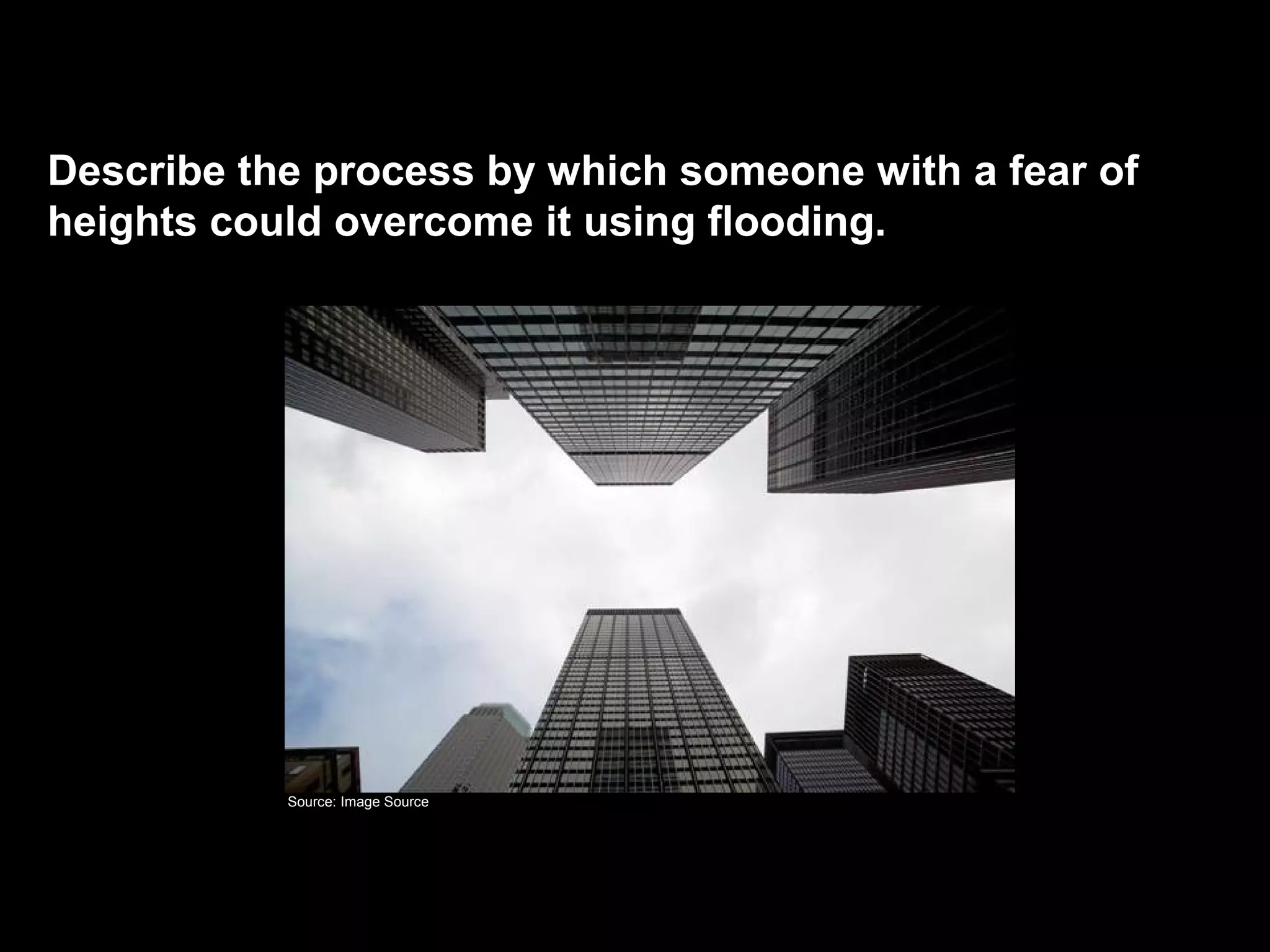
Describe the process by which someone with a fear of
heights could overcome it using flooding.
Flooding
Source: Image Source
Quick quiz
• Question 1: What does graduated exposure involve?
• Answer: Gradually presenting successive approximations of the CS until the CS
itself does not produce the CR.
• Question 2: The best results when using graduated exposure appear to occur via
imaginal exposure. True or false?
• Answer: False, best results are using in vivo graduated exposures.
• Question 3: What does aversion therapy involve?
• Answer: Inhibiting or discouraging an undesirable behaviour by pairing it with an
aversive stimulus.
• Question 4: The idea behind aversion therapy is that the undesired behaviour
becomes the CS. True or false?
• Answer: True.
• Question 5: Name one behaviour that can be treated by aversion therapy.
• Answer: Alcoholism, drug dependence, nail biting, gambling, sexual behaviours.
• Question 6: Flooding involves bringing the client into direct contact with the CS in
order to strengthen the association with the CR. True or false?
• Answer: False, it is designed to extinguish the association with the CR.
• Question 7: What is the underlying principle of flooding?
• Answer: That anxiety will be experienced at a very
high level and then gradually diminish.

Lesson 3 applications of classical conditioning 2013

  • 1.
    Lesson 5: Applicationsof classical conditioning VCE Psychology Units 3 & 4
  • 2.
    From last lesson…………. Outlinethe following for Pavlov’s experiments •Unconditioned Stimulus - •Unconditioned Response - •Conditioned Stimulus - •Conditioned Response - •Neutral stimulus -
  • 3.
    Answer •Unconditioned Stimulus –Food •Unconditioned Response - Salivation •Conditioned Stimulus - Bell •Conditioned Response - Salivation •Neutral stimulus - Bell
  • 4.
    What is classicalconditioning? Classical conditioning Refers to a type of learning that occurs through the repeated association of two (or more) different stimuli. Learning is only said to have occurred when a particular stimulus consistently produces a response that it did not previously produce. Who first described classical conditioning while conducting research into the digestive system of dogs?
  • 5.
    Applications of classicalconditioning Classical conditioning has a number of ‘real-life’ applications. Applications of classical conditioning Graduated exposure Aversion therapy Presenting successive approximations of the CS until the CS itself does not produce the CR. The inhibition or discouragement of undesirable behaviour by pairing it with an aversive stimulus. Flooding Treatment method for fears/phobias by extinguishing the CR.
  • 6.
    Graduated exposure involves graduallypresenting successive approximations of the CS until the CS itself does not produce the CR. It is a process that involves the extinction of the association between the CS and the CR. It is also known as ‘systematic desensitisation’. Graduated exposure It has been successfully used to eliminate a range of problems involving fear and anxiety responses such as a fear of flying. Source: Digital Vision
  • 7.
    • teach theperson a relaxation strategy • break down the CS into a sequence arranged from least to most anxiety- producing (a fear hierarchy) • gradually begin to extinguish the CR by pairing items in the hierarchy with relaxation by working upward through items in the hierarchy. Graduated exposure The steps in graduated exposure are:
  • 8.
    • visual imagery(imaginal exposure) • real-life exposure (in vivo exposure) • virtual reality technology. Graduated exposure Source: Macmillan Australia Graduated exposure can be done by using: The best results appear to occur using in vivo graduated exposures.
  • 9.
    The process ofgraduated exposure Graduated exposure Before conditioning During conditioning After conditioning UCS UCR UCS UCR CS CR Relaxation training Relaxation Relaxation training PLUS Successive approximations of the Phobic stimulus Relaxatio n Phobic stimulus Relaxation
  • 10.
    Describe the processby which someone with a fear of enclosed spaces (e.g. using a lift) could overcome it using graduated exposure. Graduated exposure Source: Image Source
  • 11.
    Aversion therapy inhibits (blocks)or discourages undesirable behaviour by pairing it with an aversive stimulus. It has been used successfully to treat many different behaviours such as alcoholism, drug dependence, nail biting, gambling, inappropriate sexual behaviours. What is aversion therapy? What kinds of aversive stimuli could be used in aversion therapy? List three. Source: Up the Resolution
  • 12.
    Aversion therapy was usedin Anthony Burgess‘s book A Clockwork Orange (1962), which was adapted as a film by Stanley Kubrick in 1971. Alex de Large is offered freedom from a long jail sentence if he is prepared to undergo aversion therapy for his violence: Aversion therapy at the movies • de Large is given a drug that induces extreme nausea and anxiety • he is strapped into a seat before a large screen and his eyes are clamped open (so that he cannot close them) • he is forced to watch an unrelenting series of graphically violent films whilst feeling increasingly sick and panicky.
  • 13.
    Using the caseof Alex de Large, complete the following: Aversion therapy at the movies Before conditioning During conditioning After conditioning UCS UCR UCS UCR CS CR Nausea & anxiety inducing drug Nausea & anxiety Nausea & anxiety inducing drug PLUS violence Nausea & anxiety Violence (without drug) Nausea & anxiety
  • 14.
    Flooding involves bringing theclient into direct contact with the CS and keeping them in contact with it until the CR is extinguished. The principle underlying this technique is that anxiety will be experienced at a very high level and then gradually diminish, thereby enabling the client to experience the CS in the absence of the CR. Flooding Source: Macmillan Australia
  • 15.
    Describe the processby which someone with a fear of heights could overcome it using flooding. Flooding Source: Image Source
  • 16.
    Quick quiz • Question1: What does graduated exposure involve? • Answer: Gradually presenting successive approximations of the CS until the CS itself does not produce the CR. • Question 2: The best results when using graduated exposure appear to occur via imaginal exposure. True or false? • Answer: False, best results are using in vivo graduated exposures. • Question 3: What does aversion therapy involve? • Answer: Inhibiting or discouraging an undesirable behaviour by pairing it with an aversive stimulus. • Question 4: The idea behind aversion therapy is that the undesired behaviour becomes the CS. True or false? • Answer: True. • Question 5: Name one behaviour that can be treated by aversion therapy. • Answer: Alcoholism, drug dependence, nail biting, gambling, sexual behaviours. • Question 6: Flooding involves bringing the client into direct contact with the CS in order to strengthen the association with the CR. True or false? • Answer: False, it is designed to extinguish the association with the CR. • Question 7: What is the underlying principle of flooding? • Answer: That anxiety will be experienced at a very high level and then gradually diminish.

Editor's Notes

  • #5 Ivan Pavlov (1849–1936)
  • #7 Systematic desensitisation as it is used in the treatment of specific phobias. Chapter 13 also discusses graduated exposure specifically in relation to phobias on page 662.
  • #11 An anxiety-producing situation such as using a lift could be broken down into a sequence of steps that could include: standing and looking at lifts (watching them come and go) standing in a stationary lift for increasing periods of time with a support person standing in a stationary lift alone for increasing periods of time travelling up or down one floor with a support person then gradually extending the number of floors travelled, first with a support person, then alone with the support person waiting outside the lift, and finally travelling on a lift alone without a support person nearby. The person would be using their relaxation strategies at every step of the hierarchy and progression would not be made to the next step until the person successfully manages the previous step.
  • #12 Aversive stimuli could take the form of: electric shocks foul odours nasty tastes loud noises pain nausea-inducing drugs The idea is that alcohol, which was originally neutral with respect to nausea, becomes the conditioned stimulus.
  • #13 NOTE: There are clips on YouTube showing Alex de Large receiving aversion therapy (the ‘Ludovico technique’) however these are NOT appropriate to show in class, as one of the graphically violent films he has to watch includes a short gang rape scene. It would be OK however to show a still image of him with the apparatus which clamps his eyes open (this can be accessed via Google images). This could lead into a discussion about the ethics of aversion therapy as a treatment, as the apparatus used to clamp his eyes open is quite gruesome.
  • #16 The person with a fear of heights would be taken to the very top of the Rialto Towers and made to stand near the highest window and look down. The person would be made to stand there until their anxiety completely subsides:(this could take a few hours and the person would be extremely distressed. It is expected that they would at first experience very intense and high levels of anxiety but that over time their anxiety levels would gradually diminish.