PRESENTATION ON SKINNER’S
THEORY
LEARNING BEHAVIOR
Kalik Dev &
Ajay Singh Rathore
Applied Criminology
 B.F. Skinner
(1904-1990)
 Operant
Conditioning
Operant Behavior Is Voluntary &
Directed
by Consequences.
 Edward Thorndike’s Law of Effect:
 The relationship between behavior and its
consequences.
 So named because behavior becomes more
or less likely based on the effect it has in
producing desirable or undesirable
consequences.
 Rewarded behavior is likely to recur. Behavior
followed by a negative consequence is less
likely to recur.
 B. F. Skinnermade the law of effect the
cornerstone for his influential theory of
learning, called “Operant Conditioning”.
 According to Skinner, the organism’s
behavior is “operating” on the
environment to achieve some desired
goal.
 Operant conditioning: learning in which
behavior is strengthened if followed by
reinforcement and weakened if followed by
Operant Behavior Is Voluntary &
Directed
by Consequences.
A Reinforcer Increases the
Probability
of the Behavior It Follows-
 The fundamental principle of behaviorism is
that rewarded behavior is likely to be
repeated.
 This is known as reinforcement in operant
conditioning.
 It also states the positive side of Thorndike’s
Law of Effect.
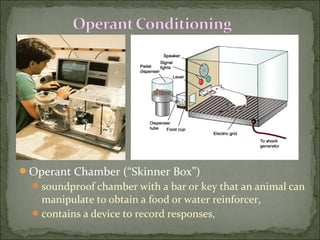
Operant Chamber (“Skinner Box”)
soundproof chamber with a bar or key that an animal can
manipulate to obtain a food or water reinforcer,
contains a device to record responses,
A Reinforcer Increases the
Probability
of the Behavior It Follows-
 Primary versus secondary reinforcers.
 Primary reinforcers: innately reinforcing—
satisfy biological needs.
 Secondary reinforcers: learned and become
reinforcing when associated with a primary
reinforcer.
A Reinforcer Increases the
Probability
of the Behavior It Follows-
 Positive and negative reinforcers.
 Positive reinforcers: strengthen a response by
presenting a positive stimulus after a
response.
 Negative reinforcer: strengthens a response
by removing an aversive stimulus after a
response.
Different Reinforcement Schedules
Lead to Different Learning and
Performance Rates.
 Continuous reinforcement leads to the
fastest learning.
 The biggest problem with continuous
reinforcement is that when it ends,
extinction occurs rapidly.
Different Reinforcement Schedules
Lead to Different Learning and
Performance Rates.
 Partial reinforcement has an important
effect on your continued performance
because being reinforced only once in a
while keeps you responding vigorously for
longer periods of time than does continuous
reinforcement.
Accidental Reinforcement Can
Cause Superstitious Behavior.
 Superstitious behavior: learned because it
happened to be followed by a reinforcer, even
though this behavior was not the cause of the
reinforcer.
 Skinner trained superstitious behavior in
hungry pigeons.
He reasoned that when reinforcement
occurred, it would be paired with whatever
response the pigeons had just performed.
Instances of accidental reinforcement
triggering superstitious behavior is common
among people.
Punishment Should Be Used Only
under Certain Circumstances.
 Punishment: The process by which a
consequence de cre ase s the probability of the
behavior that it follows.
Applications of Operant Conditioning.
 Structure and feedback in learning –
immediate reinforcement.
 Defined performance goals and immediate
reinforcement at work.
 Parenting – reward good behavior, ignore
whining, time-out.
Any Query ?

BF Skinner- Operant Conditioning

  • 1.
    PRESENTATION ON SKINNER’S THEORY LEARNINGBEHAVIOR Kalik Dev & Ajay Singh Rathore Applied Criminology
  • 2.
  • 3.
    Operant Behavior IsVoluntary & Directed by Consequences.  Edward Thorndike’s Law of Effect:  The relationship between behavior and its consequences.  So named because behavior becomes more or less likely based on the effect it has in producing desirable or undesirable consequences.  Rewarded behavior is likely to recur. Behavior followed by a negative consequence is less likely to recur.
  • 4.
     B. F.Skinnermade the law of effect the cornerstone for his influential theory of learning, called “Operant Conditioning”.  According to Skinner, the organism’s behavior is “operating” on the environment to achieve some desired goal.  Operant conditioning: learning in which behavior is strengthened if followed by reinforcement and weakened if followed by Operant Behavior Is Voluntary & Directed by Consequences.
  • 5.
    A Reinforcer Increasesthe Probability of the Behavior It Follows-  The fundamental principle of behaviorism is that rewarded behavior is likely to be repeated.  This is known as reinforcement in operant conditioning.  It also states the positive side of Thorndike’s Law of Effect.
  • 6.
    Operant Chamber (“SkinnerBox”) soundproof chamber with a bar or key that an animal can manipulate to obtain a food or water reinforcer, contains a device to record responses,
  • 7.
    A Reinforcer Increasesthe Probability of the Behavior It Follows-  Primary versus secondary reinforcers.  Primary reinforcers: innately reinforcing— satisfy biological needs.  Secondary reinforcers: learned and become reinforcing when associated with a primary reinforcer.
  • 8.
    A Reinforcer Increasesthe Probability of the Behavior It Follows-  Positive and negative reinforcers.  Positive reinforcers: strengthen a response by presenting a positive stimulus after a response.  Negative reinforcer: strengthens a response by removing an aversive stimulus after a response.
  • 10.
    Different Reinforcement Schedules Leadto Different Learning and Performance Rates.  Continuous reinforcement leads to the fastest learning.  The biggest problem with continuous reinforcement is that when it ends, extinction occurs rapidly.
  • 11.
    Different Reinforcement Schedules Leadto Different Learning and Performance Rates.  Partial reinforcement has an important effect on your continued performance because being reinforced only once in a while keeps you responding vigorously for longer periods of time than does continuous reinforcement.
  • 12.
    Accidental Reinforcement Can CauseSuperstitious Behavior.  Superstitious behavior: learned because it happened to be followed by a reinforcer, even though this behavior was not the cause of the reinforcer.  Skinner trained superstitious behavior in hungry pigeons. He reasoned that when reinforcement occurred, it would be paired with whatever response the pigeons had just performed. Instances of accidental reinforcement triggering superstitious behavior is common among people.
  • 13.
    Punishment Should BeUsed Only under Certain Circumstances.  Punishment: The process by which a consequence de cre ase s the probability of the behavior that it follows.
  • 14.
    Applications of OperantConditioning.  Structure and feedback in learning – immediate reinforcement.  Defined performance goals and immediate reinforcement at work.  Parenting – reward good behavior, ignore whining, time-out.
  • 16.