Behavior
Operant Conditioning
!
!
!
!
How do we learn behavior?
Learning: a relatively permanent change in behavior
brought about by experience.
One way we learn behavior is
through classical conditioning:
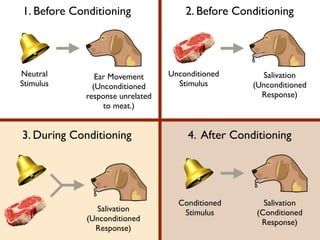
when a neutral stimulus (like a
bell) brings about a reaction
that is not naturally related to
that stimulus (like drooling)
because the two have been
paired together and associated
with each other in the brain.
1. Before Conditioning 2. Before Conditioning
3. During Conditioning 4. After Conditioning
Neutral 	

Stimulus
Ear Movement	

(Unconditioned 	

response unrelated 	

to meat.)
Unconditioned 	

Stimulus
Salivation	

(Unconditioned 	

Response)
Salivation	

(Unconditioned 	

Response)
Salivation	

(Conditioned 	

Response)
Conditioned 	

Stimulus
The “Little Albert Experiment”
In the 1920s, John B.Watson classically conditioned a
human baby to experience fear at the sight of white rats,
and as a result of stimulus generalization, at the sight of
other small furry animals. He achieved this by loudly
banging a hammer every time Albert touched the animal.
Operant Conditioning
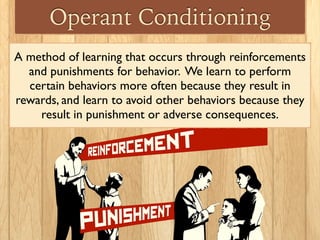
A method of learning that occurs through reinforcements
and punishments for behavior. We learn to perform
certain behaviors more often because they result in
rewards, and learn to avoid other behaviors because they
result in punishment or adverse consequences.
Operant Conditioning
Negative and positive experiences shape 	

our future behavior choices, even if we 	

don’t realize it is happening.
Classical Conditioning Operant Conditioning
!
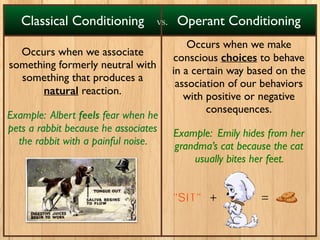
Occurs when we associate 	

something formerly neutral with
something that produces a
natural reaction.	

!
Example: Albert feels fear when he 	

pets a rabbit because he associates 	

the rabbit with a painful noise. 	

!
!
!
!
!
!
!
Occurs when we make
conscious choices to behave 	

in a certain way based on the
association of our behaviors
with positive or negative
consequences.	

!
Example: Emily hides from her
grandma’s cat because the cat 	

usually bites her feet. 	

!
!
!
!
!
!
+ =
vs.
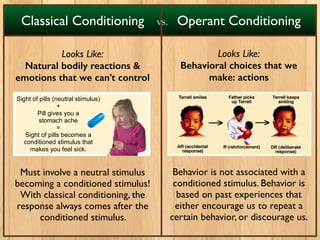
Classical Conditioning Operant Conditioning
!
Looks Like:	

Natural bodily reactions &
emotions that we can’t control
!
!
!
!
!
!
!
Must involve a neutral stimulus
becoming a conditioned stimulus!	

With classical conditioning, the
response always comes after the
conditioned stimulus. 	

!
Looks Like:	

Behavioral choices that we
make: actions
!
!
!
!
!
!
!
Behavior is not associated with a
conditioned stimulus. Behavior is
based on past experiences that
either encourage us to repeat a
certain behavior, or discourage us.	

!
vs.
Sight of pills (neutral stimulus)
+
Pill gives you a
stomach ache
=
Sight of pills becomes a
conditioned stimulus that
makes you feel sick.
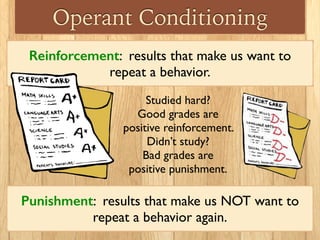
Operant Conditioning
Reinforcement: results that make us want to
repeat a behavior.
Punishment: results that make us NOT want to
repeat a behavior again.
Studied hard?	

Good grades are	

positive reinforcement. 	

Didn’t study?	

Bad grades are 	

positive punishment.
Negative Reinforcement
Reinforcement = Do it again!	

Negative = Taking something (bad) away	

!
!
!
!
!
Positive Reinforcement
Reinforcement = Do it again!	

Positive = Adding something (good)	

!
!
!
!
!
Positive Punishment
Punishment = Don’t do it again!	

Positive = Adding something (bad)	

!
!
!
!
!
Negative Punishment
Punishment = Don’t do it again!	

Negative = Taking something (good) away	

!
!
!
!
!
!
“Positive”
Positive punishment and reinforcement are easier to remember.
Positive does not mean “good” - it means something is added
to your environment.
“Negative”
Negative punishment and reinforcement are more
challenging to understand because the term “negative
reinforcement” is used outside of Psychology to mean the
opposite of “positive reinforcement.”
In Psychology,“negative” does not mean “bad”: it means
something is removed from your environment. If something
good is removed, it will make you sad and cause you to not
want to repeat the behavior that led to its removal. If
something bad is removed, it will make you happy, causing
you to want to repeat the behavior.
The “Which Type of
Operant Conditioning Is
It?” Game!!
Directions:	

For each example, decide what behavior 	

is being conditioned, or modified. 	

Next, decide the method being used:
positive/negative reinforcement or
punishment.
The “Which Type of
Operant Conditioning Is
It?” Game!!
If you write down all of your answers on a
document and email them to me after the
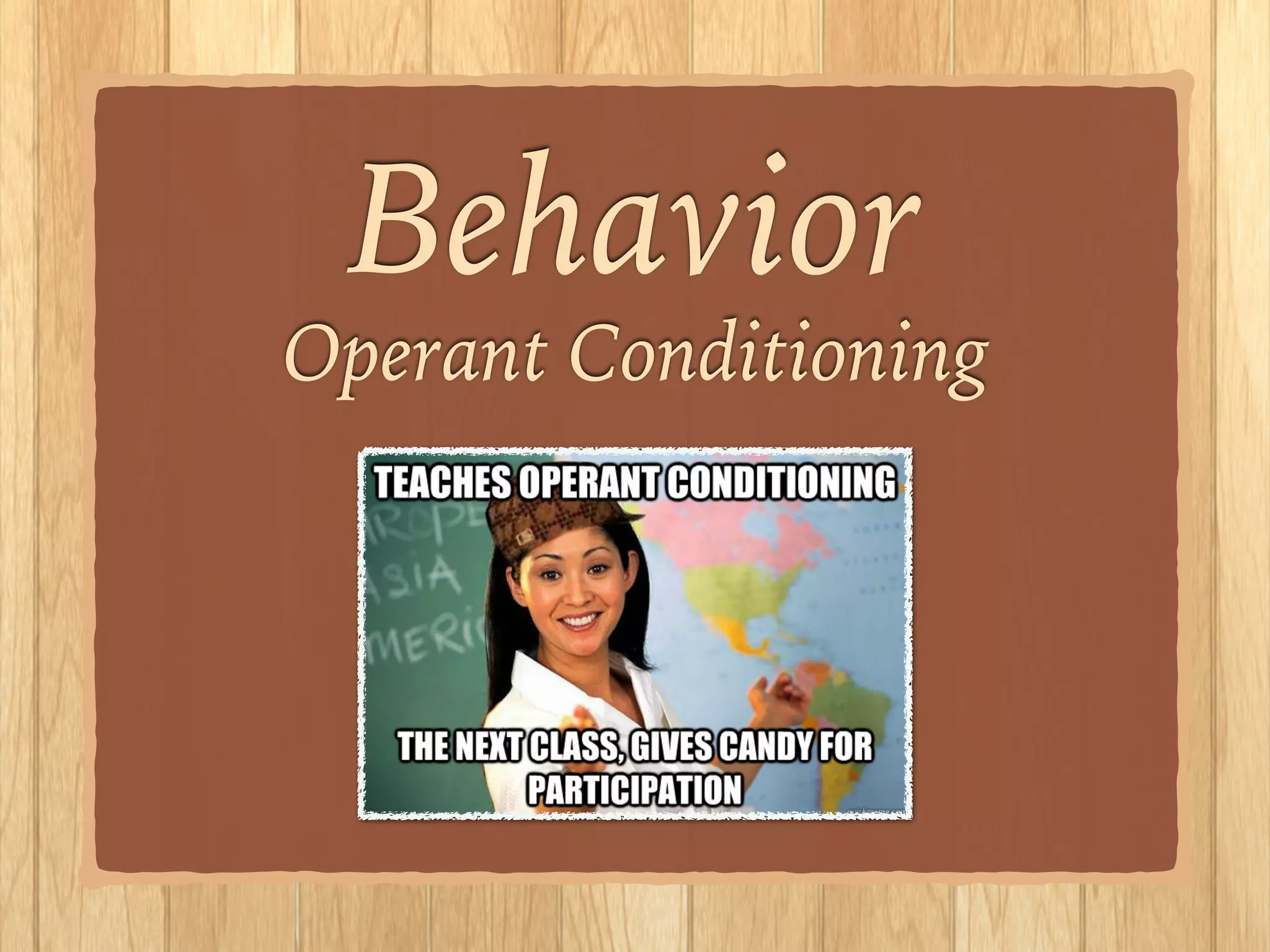
game, you will get a piece of candy next time
in class! 	

(Number your document 1-12). If you get
one wrong, just type the correct answer next
to your wrong one.
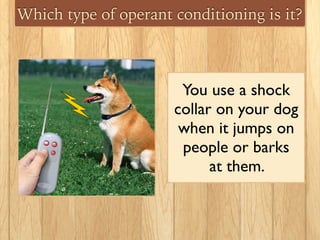
Which type of operant conditioning is it?
You use a shock
collar on your dog
when it jumps on
people or barks
at them.
Which type of operant conditioning is it?
Your boss
removes all the
coffee machines
from the office
until your team
increases sales.
Which type of operant conditioning is it?
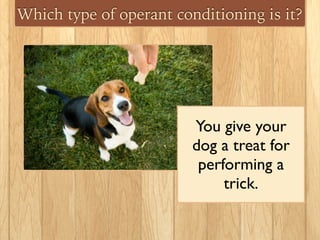
You give your 	

dog a treat for
performing a 	

trick.
Which type of operant conditioning is it?
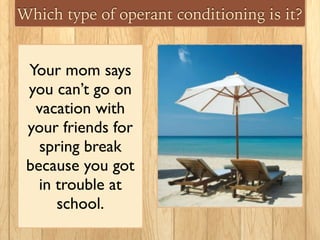
Your mom says
you can’t go on
vacation with
your friends for
spring break
because you got
in trouble at
school.
Which type of operant conditioning is it?
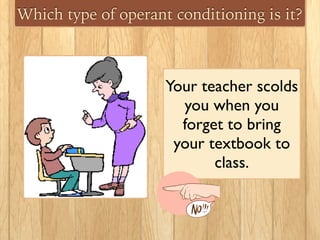
Your teacher scolds
you when you
forget to bring
your textbook to
class.
Which type of operant conditioning is it?
Your teacher
gives out candy 	

to students who
participate the
most.
Which type of operant conditioning is it?
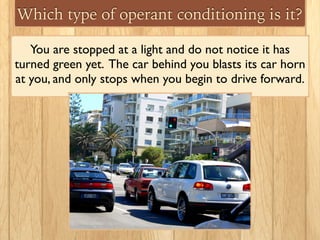
You are stopped at a light and do not notice it has
turned green yet. The car behind you blasts its car horn
at you, and only stops when you begin to drive forward.
Which type of operant conditioning is it?
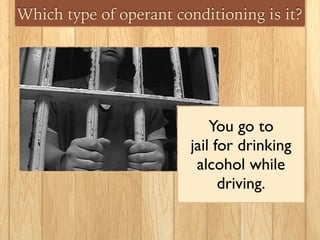
You go to 	

jail for drinking
alcohol while
driving.
Which type of operant conditioning is it?
Your boss posts a list of which 	

employees have made the most and 	

fewest sales each month.
Which type of operant conditioning is it?
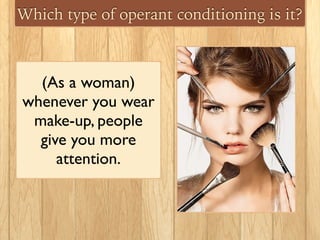
(As a woman)
whenever you wear
make-up, people 	

give you more
attention.
Which type of operant conditioning is it?
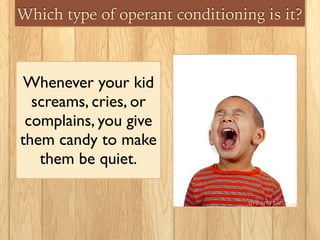
Whenever your kid
screams, cries, or
complains, you give
them candy to make
them be quiet.
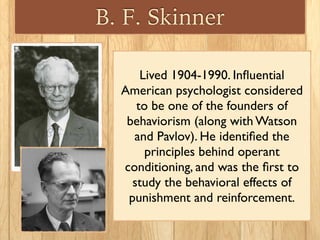
B. F. Skinner
Lived 1904-1990. Influential
American psychologist considered
to be one of the founders of
behaviorism (along with Watson 	

and Pavlov). He identified the
principles behind operant
conditioning, and was the first to
study the behavioral effects of
punishment and reinforcement.
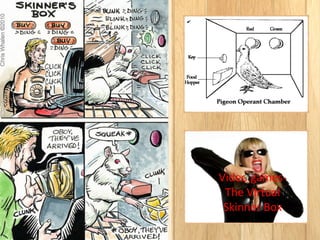
The Skinner Box
Skinner’s operant conditioning chamber (also called a
Skinner Box) was designed to teach rats how to push a
lever. This behavior is not natural to rats, so operant
conditioning with positive and negative reinforcement
were performed in order to teach the behavior.
Positive Reinforcement:	

A rat was awarded with food
when he pressed the lever.	

!
Negative Reinforcement:	

A rat was able to turn off
electric shocks produced by the
floor by pressing the lever.
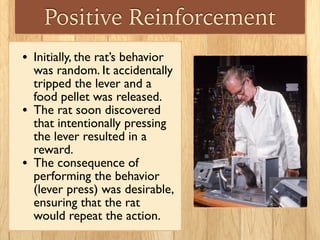
Positive Reinforcement
• Initially, the rat’s behavior
was random. It accidentally
tripped the lever and a
food pellet was released.	

• The rat soon discovered
that intentionally pressing
the lever resulted in a
reward.	

• The consequence of
performing the behavior
(lever press) was desirable,
ensuring that the rat
would repeat the action.
Negative Reinforcement
• An unpleasant electric
current ran through the
floor of the rat’s cage.	

• Initially, accidental lever
pushing turned off the
electric current.	

• The consequence of
avoiding something painful
(removal of an unpleasant
stimulus) ensured that the
rat continued to push
the lever.
Variable Schedule of Reinforcement
Skinner learned that behaviors become the most
frequent when rewards are not given on a consistent
schedule. Rather, rewards that are given at variable
times cause behaviors to increase greatly.
Wow! Slot
machines are so
addictive!
Video 1
Video 2

Operant Conditioning

  • 1.
  • 2.
    How do welearn behavior? Learning: a relatively permanent change in behavior brought about by experience. One way we learn behavior is through classical conditioning: when a neutral stimulus (like a bell) brings about a reaction that is not naturally related to that stimulus (like drooling) because the two have been paired together and associated with each other in the brain.
  • 3.
    1. Before Conditioning2. Before Conditioning 3. During Conditioning 4. After Conditioning Neutral Stimulus Ear Movement (Unconditioned response unrelated to meat.) Unconditioned Stimulus Salivation (Unconditioned Response) Salivation (Unconditioned Response) Salivation (Conditioned Response) Conditioned Stimulus
  • 4.
    The “Little AlbertExperiment” In the 1920s, John B.Watson classically conditioned a human baby to experience fear at the sight of white rats, and as a result of stimulus generalization, at the sight of other small furry animals. He achieved this by loudly banging a hammer every time Albert touched the animal.
  • 5.
    Operant Conditioning A methodof learning that occurs through reinforcements and punishments for behavior. We learn to perform certain behaviors more often because they result in rewards, and learn to avoid other behaviors because they result in punishment or adverse consequences.
  • 6.
    Operant Conditioning Negative andpositive experiences shape our future behavior choices, even if we don’t realize it is happening.
  • 7.
    Classical Conditioning OperantConditioning ! Occurs when we associate something formerly neutral with something that produces a natural reaction. ! Example: Albert feels fear when he pets a rabbit because he associates the rabbit with a painful noise. ! ! ! ! ! ! ! Occurs when we make conscious choices to behave in a certain way based on the association of our behaviors with positive or negative consequences. ! Example: Emily hides from her grandma’s cat because the cat usually bites her feet. ! ! ! ! ! ! + = vs.
  • 8.
    Classical Conditioning OperantConditioning ! Looks Like: Natural bodily reactions & emotions that we can’t control ! ! ! ! ! ! ! Must involve a neutral stimulus becoming a conditioned stimulus! With classical conditioning, the response always comes after the conditioned stimulus. ! Looks Like: Behavioral choices that we make: actions ! ! ! ! ! ! ! Behavior is not associated with a conditioned stimulus. Behavior is based on past experiences that either encourage us to repeat a certain behavior, or discourage us. ! vs. Sight of pills (neutral stimulus) + Pill gives you a stomach ache = Sight of pills becomes a conditioned stimulus that makes you feel sick.
  • 9.
    Operant Conditioning Reinforcement: resultsthat make us want to repeat a behavior. Punishment: results that make us NOT want to repeat a behavior again. Studied hard? Good grades are positive reinforcement. Didn’t study? Bad grades are positive punishment.
  • 10.
    Negative Reinforcement Reinforcement =Do it again! Negative = Taking something (bad) away ! ! ! ! ! Positive Reinforcement Reinforcement = Do it again! Positive = Adding something (good) ! ! ! ! ! Positive Punishment Punishment = Don’t do it again! Positive = Adding something (bad) ! ! ! ! ! Negative Punishment Punishment = Don’t do it again! Negative = Taking something (good) away ! ! ! ! ! !
  • 11.
    “Positive” Positive punishment andreinforcement are easier to remember. Positive does not mean “good” - it means something is added to your environment.
  • 12.
    “Negative” Negative punishment andreinforcement are more challenging to understand because the term “negative reinforcement” is used outside of Psychology to mean the opposite of “positive reinforcement.” In Psychology,“negative” does not mean “bad”: it means something is removed from your environment. If something good is removed, it will make you sad and cause you to not want to repeat the behavior that led to its removal. If something bad is removed, it will make you happy, causing you to want to repeat the behavior.
  • 13.
    The “Which Typeof Operant Conditioning Is It?” Game!! Directions: For each example, decide what behavior is being conditioned, or modified. Next, decide the method being used: positive/negative reinforcement or punishment.
  • 14.
    The “Which Typeof Operant Conditioning Is It?” Game!! If you write down all of your answers on a document and email them to me after the game, you will get a piece of candy next time in class! (Number your document 1-12). If you get one wrong, just type the correct answer next to your wrong one.
  • 15.
    Which type ofoperant conditioning is it? You use a shock collar on your dog when it jumps on people or barks at them.
  • 16.
    Which type ofoperant conditioning is it? Your boss removes all the coffee machines from the office until your team increases sales.
  • 17.
    Which type ofoperant conditioning is it? You give your dog a treat for performing a trick.
  • 18.
    Which type ofoperant conditioning is it? Your mom says you can’t go on vacation with your friends for spring break because you got in trouble at school.
  • 19.
    Which type ofoperant conditioning is it? Your teacher scolds you when you forget to bring your textbook to class.
  • 20.
    Which type ofoperant conditioning is it? Your teacher gives out candy to students who participate the most.
  • 21.
    Which type ofoperant conditioning is it? You are stopped at a light and do not notice it has turned green yet. The car behind you blasts its car horn at you, and only stops when you begin to drive forward.
  • 22.
    Which type ofoperant conditioning is it?
  • 23.
    Which type ofoperant conditioning is it? You go to jail for drinking alcohol while driving.
  • 24.
    Which type ofoperant conditioning is it? Your boss posts a list of which employees have made the most and fewest sales each month.
  • 25.
    Which type ofoperant conditioning is it? (As a woman) whenever you wear make-up, people give you more attention.
  • 26.
    Which type ofoperant conditioning is it? Whenever your kid screams, cries, or complains, you give them candy to make them be quiet.
  • 27.
    B. F. Skinner Lived1904-1990. Influential American psychologist considered to be one of the founders of behaviorism (along with Watson and Pavlov). He identified the principles behind operant conditioning, and was the first to study the behavioral effects of punishment and reinforcement.
  • 28.
    The Skinner Box Skinner’soperant conditioning chamber (also called a Skinner Box) was designed to teach rats how to push a lever. This behavior is not natural to rats, so operant conditioning with positive and negative reinforcement were performed in order to teach the behavior. Positive Reinforcement: A rat was awarded with food when he pressed the lever. ! Negative Reinforcement: A rat was able to turn off electric shocks produced by the floor by pressing the lever.
  • 29.
    Positive Reinforcement • Initially,the rat’s behavior was random. It accidentally tripped the lever and a food pellet was released. • The rat soon discovered that intentionally pressing the lever resulted in a reward. • The consequence of performing the behavior (lever press) was desirable, ensuring that the rat would repeat the action.
  • 30.
    Negative Reinforcement • Anunpleasant electric current ran through the floor of the rat’s cage. • Initially, accidental lever pushing turned off the electric current. • The consequence of avoiding something painful (removal of an unpleasant stimulus) ensured that the rat continued to push the lever.
  • 32.
    Variable Schedule ofReinforcement Skinner learned that behaviors become the most frequent when rewards are not given on a consistent schedule. Rather, rewards that are given at variable times cause behaviors to increase greatly. Wow! Slot machines are so addictive!
  • 33.
  • 34.