Structure of Intellect

• Originated in Guilford’s Multiple Intelligence
  Theory.

• It is used as an assessment tool for students.

• It can determined learning disabilities as well as
  enrichment for gifted students.

• Basically, this learning theory focuses on one’s
  ability to think and show it visually.
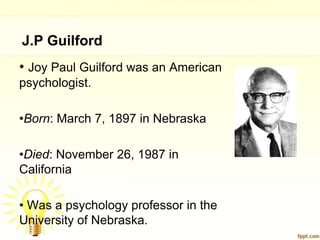
J.P Guilford
• Joy Paul Guilford was an American
psychologist.

•Born: March 7, 1897 in Nebraska

•Died: November 26, 1987 in
California

• Was a psychology professor in the
University of Nebraska.
J.P Guilford and U.S Army

• In 1941, he entered the U.S. Army as a
  Lieutenant Colonel and served as Director of
  Psychological Research Unit No. 3 at Santa Ana
  Army Air Base. There he worked on the
  selection and ranking of aircrew trainees as the
  Army Air Force investigated why a sizable
  proportion of trainees was not graduating.
J.P Guilford and U.S Army
• Promoted to Chief of the Psychological
  Research Unit at the U.S. Army Air Forces
  Training Command Headquarters in Fort Worth,
  Guilford oversaw the "Stanines Project" which
  identified eight specific intellectual abilities
  crucial to flying a plane. (Stanines, now a
  common term in educational psychology, was
  coined during Guilford's project). Over the
  course of World War II, Guilford's use of these
  eight factors in the development of the two-day
  Classification Test Battery was significant in
  increasing graduation rates for aircrew trainees.
J.P Guilford and U.S Army

• After the war, Guilford continued to work on the
  intelligence tests, focusing particularly on
  divergent thinking and creativity. He designed
  numerous tests that measured creative thinking.
Structure of Intellect
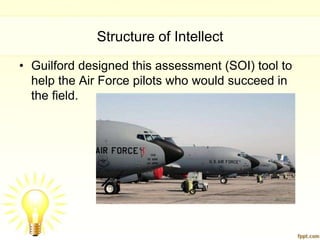
• Guilford designed this assessment (SOI) tool to
  help the Air Force pilots who would succeed in
  the field.
Structure of Intellect

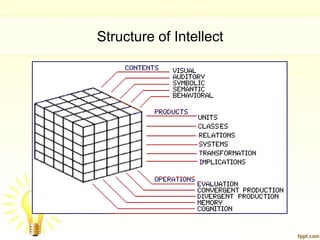
• Guilford identified three fundamental
  components of intelligence. These were:
   – Contents (5 kinds)
   – Products (6 kinds)
   – Operations (5 kinds)
Structure of Intelligence

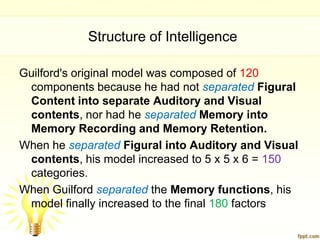
Guilford's original model was composed of 120
 components because he had not separated Figural
 Content into separate Auditory and Visual
 contents, nor had he separated Memory into
 Memory Recording and Memory Retention.
When he separated Figural into Auditory and Visual
 contents, his model increased to 5 x 5 x 6 = 150
 categories.
When Guilford separated the Memory functions, his
 model finally increased to the final 180 factors
Structure of Intellect

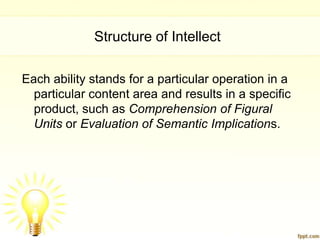
Each ability stands for a particular operation in a
  particular content area and results in a specific
  product, such as Comprehension of Figural
  Units or Evaluation of Semantic Implications.
Structure of Intellect

                    Content
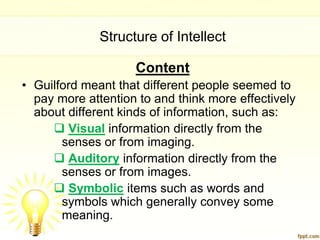
• Guilford meant that different people seemed to
  pay more attention to and think more effectively
  about different kinds of information, such as:
      Visual information directly from the
       senses or from imaging.
      Auditory information directly from the
       senses or from images.
      Symbolic items such as words and
       symbols which generally convey some
       meaning.
Content

 Semantic meanings often, but not always,
  associated with words.

 Behavioral information about the mental states
 and behavior of observed individuals. (Note:
 This type of content was added to the model
 based on abilities that emerged from his testing.)
 Daniel Goleman (1995) has popularized this as
 “social intelligence”.
Situations:
• An artist might excel at processing visual
  information, but be poor at processing words,
  numbers and other symbolic content.

• A researcher who excels at processing symbolic
  content such as words and numbers and
  semantic meaning, might be very poor at
  processing behavioral data and thus relate
  poorly with people.
Structure of Intellect
                    Products
• This dimension relates to the kinds of
  information we process from the content types:
 Units refers to the ability to perceive units in a
  content area. This might be symbolic units such
  as words, visual units such as shapes, or
  behavioral units such as facial expressions.
 Classes refers to the ability to organize units
  into meaningful groups or to sort units into the
  right groups.
Products

Relations pertains to the ability to sense the
 relationships between pairs of units.
 Systems consist of the relationships among
 more than two units.
 Transformations is the ability to understand
 changes in information, such as rotation of visual
 figures, or jokes and puns in the semantic area.
 Implications refers to expectation. Given a
 certain set of information, one might expect
 certain other information to be true.
Structure of Intellect

With the two dimensions of content and product
 we can sort out all the kinds of information
 people can think about.

People can talk about the implications of a
  symbolic series, the relationship of two sounds,
  or behavioral transformations such as changes
  in emotions.
Structure of Intellect

                  Operations
• This dimension describes what the brain does
  with and to these types of information:
    Cognition has to do with the ability to
     perceive the various items.
    Memory has to do with the ability to store
     and retrieve various kinds of information.
Operations

 Divergent Production has to do with the ability to
  access memory. It refers to the ability to find large
  numbers of things which fit certain simple criteria.
 Convergent Production is the search of memory
  for the single answer to a question or situation. This
  area includes most areas of logic type problem
  solving. It differs from divergence in the constraint of
  one right answer. It seems likely that performance
  on convergent tasks is actually the result of
  divergent production and evaluation, but it is an
  often tested for skill, and the one most often
  associated with IQ.
Operations

 Evaluation is the ability to make judgments
 about the various kinds of information,
 judgments such as which items are identical in
 some way, which items are better, and what
 qualities are shared by various items.
Situations:

• The cognition of semantic units has to do with one's
  ability to recognize words, i.e. one's vocabulary.
• Cognition of Behavioral Transformations would be
  the ability to perceive changes in the expressions of
  an individual.
• People differ in their abilities to remember not only
  from other people, but also among various kinds of
  information.
• Some people who are poor at remembering faces
  (behavioral units) may be excellent at remembering
  puns (semantic transformations).
Situations:

• For example, the ability to divergently produce
  visual units includes the ability to list a great
  many images which include a circle.
• Divergence in behavioral transformations would
  include the ability to revise stories about people.
• Divergence in Symbolic Implications would
  include the ability to list various equations which
  can be deduced from given equations.
Criticism
Various researchers have criticized the statistical
  techniques used by Guilford.
• According to Jensen (1998), Guilford's
  contention that a g-factor was untenable was
  influenced by his observation that cognitive tests
  of U.S. Air Force personnel did not show
  correlations significantly different from zero.
• According to one reanalysis, this resulted from
  artifacts and methodological errors. Applying
  more robust methodologies, the correlations in
  Guilford's data sets are positive.
Criticism

• In another reanalysis, randomly generated
  models were found to be as well supported as
  Guilford's own theory.
Criticism
• Guilford's Structure-of-Intellect model of human
  abilities has few supporters today. Carroll (1993)
  summarized the view of later researchers:
   "Guilford's SOI model must, therefore, be
     marked down as a somewhat eccentric
     aberration in the history of intelligence
     models; that so much attention has been paid
     to it is disturbing, to the extent that textbooks
     and other treatments of it have given the
     impression that the model is valid and widely
     accepted, when clearly it is not."
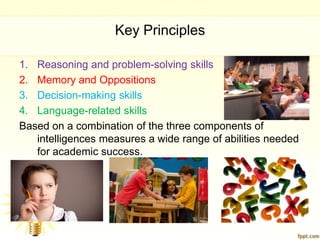
Key Principles

1. Reasoning and problem-solving skills
2. Memory and Oppositions
3. Decision-making skills
4. Language-related skills
Based on a combination of the three components of
   intelligences measures a wide range of abilities needed
   for academic success.
Implications for Education

The Structure of Intellect’s philosophy is that
   intelligence is not fixed.
Intelligence can be learnt.
IQ tests implements narrow abilities where the
SI measures a wide variety of abilities.
Need to consider all students are different.
“Psychology should be the chief basic science upon which the
practices of education depend. It should have supplied
education with the information it needs concerning the
processes of understanding, learning, and thinking, among
other things. One of the difficulties has been that such theory
as has been developed has been based primarily upon studies
of behavior of rats and pigeons. As someone has said, some
of the theory thus developed has been an insult even to the
rat.”

               J.P. GUILFORD,
        The Nature of Human Intelligence
Structure of Intellect
References:

• Gardner, H. (1983). Frames of Mind: The Theory of Multiple
  Intelligences. New York: Basic Books.
• Guilford, J. (1950). Creativity. American Psychologist , 5, 444-454.
• Guilford, J. (1967). The Nature of Human Intelligence. New York:
  McGraw-Hill.
• Guilford, J. (1977). Way beyond the IQ. Buffalo, NY: Creative
  Education Formation.

•   http://www.instructionaldesign.org/theories/intellect.html
•   http://www.lifecircles-inc.com/Learningtheories/guilford.html
•   http://www.youtube.com/watch?v=DR-lAzk66YU
•   http://www.youtube.com/watch?v=OsxqOIR9mzA&feature=related
•   http://www.youtube.com/watch?v=eN3e2GLP0Ns
•   http://www.youtube.com/watch?v=tDgeTqHtUf0

Structure of intelligence

  • 1.
  • 2.
    Structure of Intellect •Originated in Guilford’s Multiple Intelligence Theory. • It is used as an assessment tool for students. • It can determined learning disabilities as well as enrichment for gifted students. • Basically, this learning theory focuses on one’s ability to think and show it visually.
  • 3.
    J.P Guilford • JoyPaul Guilford was an American psychologist. •Born: March 7, 1897 in Nebraska •Died: November 26, 1987 in California • Was a psychology professor in the University of Nebraska.
  • 4.
    J.P Guilford andU.S Army • In 1941, he entered the U.S. Army as a Lieutenant Colonel and served as Director of Psychological Research Unit No. 3 at Santa Ana Army Air Base. There he worked on the selection and ranking of aircrew trainees as the Army Air Force investigated why a sizable proportion of trainees was not graduating.
  • 5.
    J.P Guilford andU.S Army • Promoted to Chief of the Psychological Research Unit at the U.S. Army Air Forces Training Command Headquarters in Fort Worth, Guilford oversaw the "Stanines Project" which identified eight specific intellectual abilities crucial to flying a plane. (Stanines, now a common term in educational psychology, was coined during Guilford's project). Over the course of World War II, Guilford's use of these eight factors in the development of the two-day Classification Test Battery was significant in increasing graduation rates for aircrew trainees.
  • 6.
    J.P Guilford andU.S Army • After the war, Guilford continued to work on the intelligence tests, focusing particularly on divergent thinking and creativity. He designed numerous tests that measured creative thinking.
  • 7.
    Structure of Intellect •Guilford designed this assessment (SOI) tool to help the Air Force pilots who would succeed in the field.
  • 8.
    Structure of Intellect •Guilford identified three fundamental components of intelligence. These were: – Contents (5 kinds) – Products (6 kinds) – Operations (5 kinds)
  • 9.
    Structure of Intelligence Guilford'soriginal model was composed of 120 components because he had not separated Figural Content into separate Auditory and Visual contents, nor had he separated Memory into Memory Recording and Memory Retention. When he separated Figural into Auditory and Visual contents, his model increased to 5 x 5 x 6 = 150 categories. When Guilford separated the Memory functions, his model finally increased to the final 180 factors
  • 10.
    Structure of Intellect Eachability stands for a particular operation in a particular content area and results in a specific product, such as Comprehension of Figural Units or Evaluation of Semantic Implications.
  • 11.
  • 12.
    Structure of Intellect Content • Guilford meant that different people seemed to pay more attention to and think more effectively about different kinds of information, such as:  Visual information directly from the senses or from imaging.  Auditory information directly from the senses or from images.  Symbolic items such as words and symbols which generally convey some meaning.
  • 13.
    Content  Semantic meaningsoften, but not always, associated with words.  Behavioral information about the mental states and behavior of observed individuals. (Note: This type of content was added to the model based on abilities that emerged from his testing.) Daniel Goleman (1995) has popularized this as “social intelligence”.
  • 14.
    Situations: • An artistmight excel at processing visual information, but be poor at processing words, numbers and other symbolic content. • A researcher who excels at processing symbolic content such as words and numbers and semantic meaning, might be very poor at processing behavioral data and thus relate poorly with people.
  • 15.
    Structure of Intellect Products • This dimension relates to the kinds of information we process from the content types:  Units refers to the ability to perceive units in a content area. This might be symbolic units such as words, visual units such as shapes, or behavioral units such as facial expressions.  Classes refers to the ability to organize units into meaningful groups or to sort units into the right groups.
  • 16.
    Products Relations pertains tothe ability to sense the relationships between pairs of units.  Systems consist of the relationships among more than two units.  Transformations is the ability to understand changes in information, such as rotation of visual figures, or jokes and puns in the semantic area.  Implications refers to expectation. Given a certain set of information, one might expect certain other information to be true.
  • 17.
    Structure of Intellect Withthe two dimensions of content and product we can sort out all the kinds of information people can think about. People can talk about the implications of a symbolic series, the relationship of two sounds, or behavioral transformations such as changes in emotions.
  • 18.
    Structure of Intellect Operations • This dimension describes what the brain does with and to these types of information:  Cognition has to do with the ability to perceive the various items.  Memory has to do with the ability to store and retrieve various kinds of information.
  • 19.
    Operations  Divergent Productionhas to do with the ability to access memory. It refers to the ability to find large numbers of things which fit certain simple criteria.  Convergent Production is the search of memory for the single answer to a question or situation. This area includes most areas of logic type problem solving. It differs from divergence in the constraint of one right answer. It seems likely that performance on convergent tasks is actually the result of divergent production and evaluation, but it is an often tested for skill, and the one most often associated with IQ.
  • 20.
    Operations  Evaluation isthe ability to make judgments about the various kinds of information, judgments such as which items are identical in some way, which items are better, and what qualities are shared by various items.
  • 21.
    Situations: • The cognitionof semantic units has to do with one's ability to recognize words, i.e. one's vocabulary. • Cognition of Behavioral Transformations would be the ability to perceive changes in the expressions of an individual. • People differ in their abilities to remember not only from other people, but also among various kinds of information. • Some people who are poor at remembering faces (behavioral units) may be excellent at remembering puns (semantic transformations).
  • 22.
    Situations: • For example,the ability to divergently produce visual units includes the ability to list a great many images which include a circle. • Divergence in behavioral transformations would include the ability to revise stories about people. • Divergence in Symbolic Implications would include the ability to list various equations which can be deduced from given equations.
  • 23.
    Criticism Various researchers havecriticized the statistical techniques used by Guilford. • According to Jensen (1998), Guilford's contention that a g-factor was untenable was influenced by his observation that cognitive tests of U.S. Air Force personnel did not show correlations significantly different from zero. • According to one reanalysis, this resulted from artifacts and methodological errors. Applying more robust methodologies, the correlations in Guilford's data sets are positive.
  • 24.
    Criticism • In anotherreanalysis, randomly generated models were found to be as well supported as Guilford's own theory.
  • 25.
    Criticism • Guilford's Structure-of-Intellectmodel of human abilities has few supporters today. Carroll (1993) summarized the view of later researchers: "Guilford's SOI model must, therefore, be marked down as a somewhat eccentric aberration in the history of intelligence models; that so much attention has been paid to it is disturbing, to the extent that textbooks and other treatments of it have given the impression that the model is valid and widely accepted, when clearly it is not."
  • 26.
    Key Principles 1. Reasoningand problem-solving skills 2. Memory and Oppositions 3. Decision-making skills 4. Language-related skills Based on a combination of the three components of intelligences measures a wide range of abilities needed for academic success.
  • 27.
    Implications for Education TheStructure of Intellect’s philosophy is that intelligence is not fixed. Intelligence can be learnt. IQ tests implements narrow abilities where the SI measures a wide variety of abilities. Need to consider all students are different.
  • 28.
    “Psychology should bethe chief basic science upon which the practices of education depend. It should have supplied education with the information it needs concerning the processes of understanding, learning, and thinking, among other things. One of the difficulties has been that such theory as has been developed has been based primarily upon studies of behavior of rats and pigeons. As someone has said, some of the theory thus developed has been an insult even to the rat.” J.P. GUILFORD, The Nature of Human Intelligence
  • 29.
  • 30.
    References: • Gardner, H.(1983). Frames of Mind: The Theory of Multiple Intelligences. New York: Basic Books. • Guilford, J. (1950). Creativity. American Psychologist , 5, 444-454. • Guilford, J. (1967). The Nature of Human Intelligence. New York: McGraw-Hill. • Guilford, J. (1977). Way beyond the IQ. Buffalo, NY: Creative Education Formation. • http://www.instructionaldesign.org/theories/intellect.html • http://www.lifecircles-inc.com/Learningtheories/guilford.html • http://www.youtube.com/watch?v=DR-lAzk66YU • http://www.youtube.com/watch?v=OsxqOIR9mzA&feature=related • http://www.youtube.com/watch?v=eN3e2GLP0Ns • http://www.youtube.com/watch?v=tDgeTqHtUf0