PSYCHOLOGY
Chapter 6 LEARNING
PowerPoint Image Slideshow
LEARNING
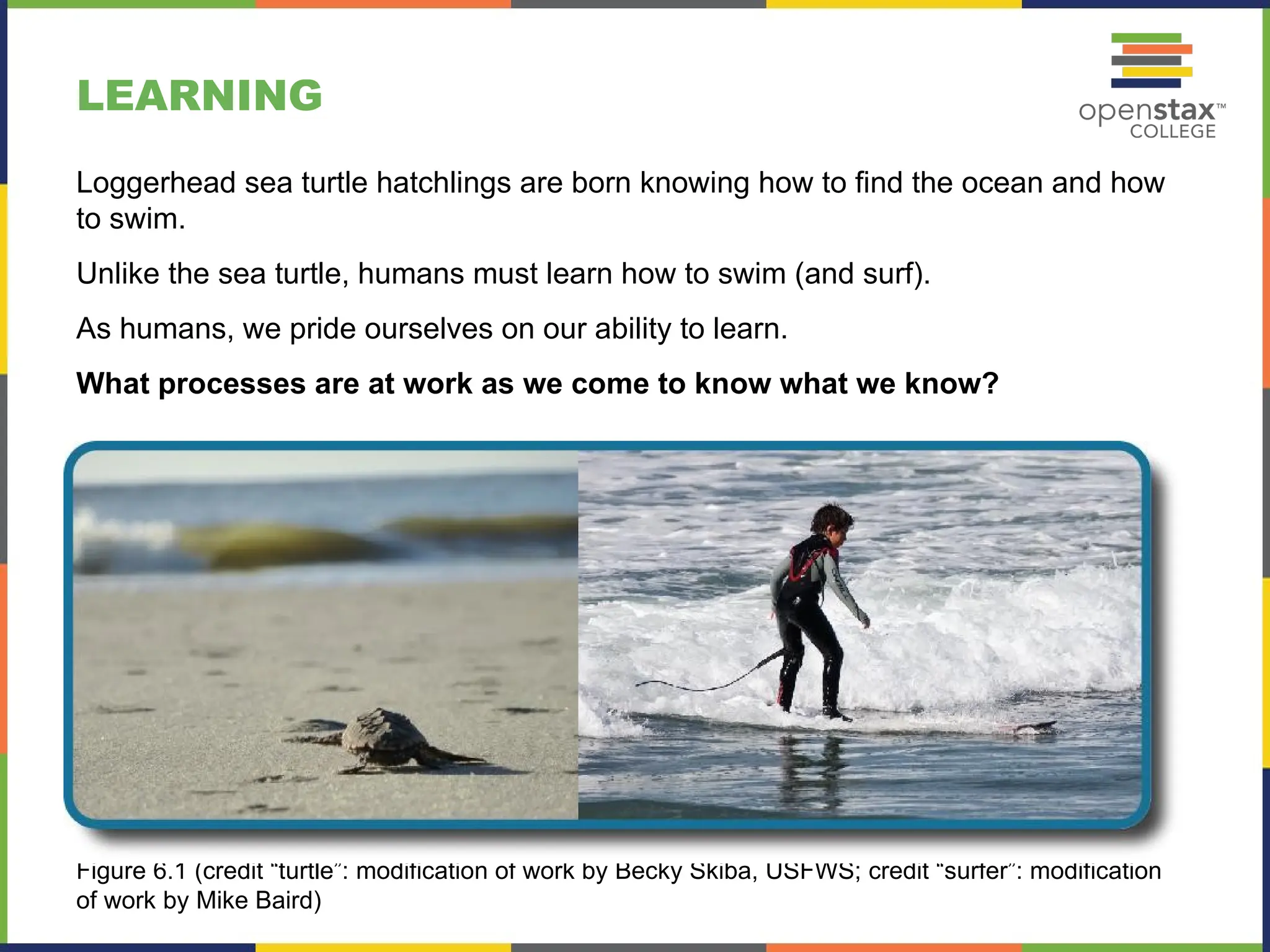
Figure 6.1 (credit “turtle”: modification of work by Becky Skiba, USFWS; credit “surfer”: modification
of work by Mike Baird)
Loggerhead sea turtle hatchlings are born knowing how to find the ocean and how
to swim.
Unlike the sea turtle, humans must learn how to swim (and surf).
As humans, we pride ourselves on our ability to learn.
What processes are at work as we come to know what we know?
UNLEARNED BEHAVIORS
Instincts and Reflexes
Instincts and reflexes are innate behaviors that organisms are born with.
- Help organisms adapt to their environment.
Reflexes – motor/neural reactions to a specific stimulus.
- Simpler than instincts.
- Involve activity of specific body parts.
- Involve primitive centers of the CNS (e.g., spinal cord and medulla).
- E.g. Human babies are born with a sucking reflex.
Instincts – behaviors triggered by a broader range of events (e.g., aging, change of
seasons).
- More complex.
- Involve movement of the organism as a whole (e.g., sexual activity, migration).
- Involve higher brain centers.
WHAT IS LEARNING?
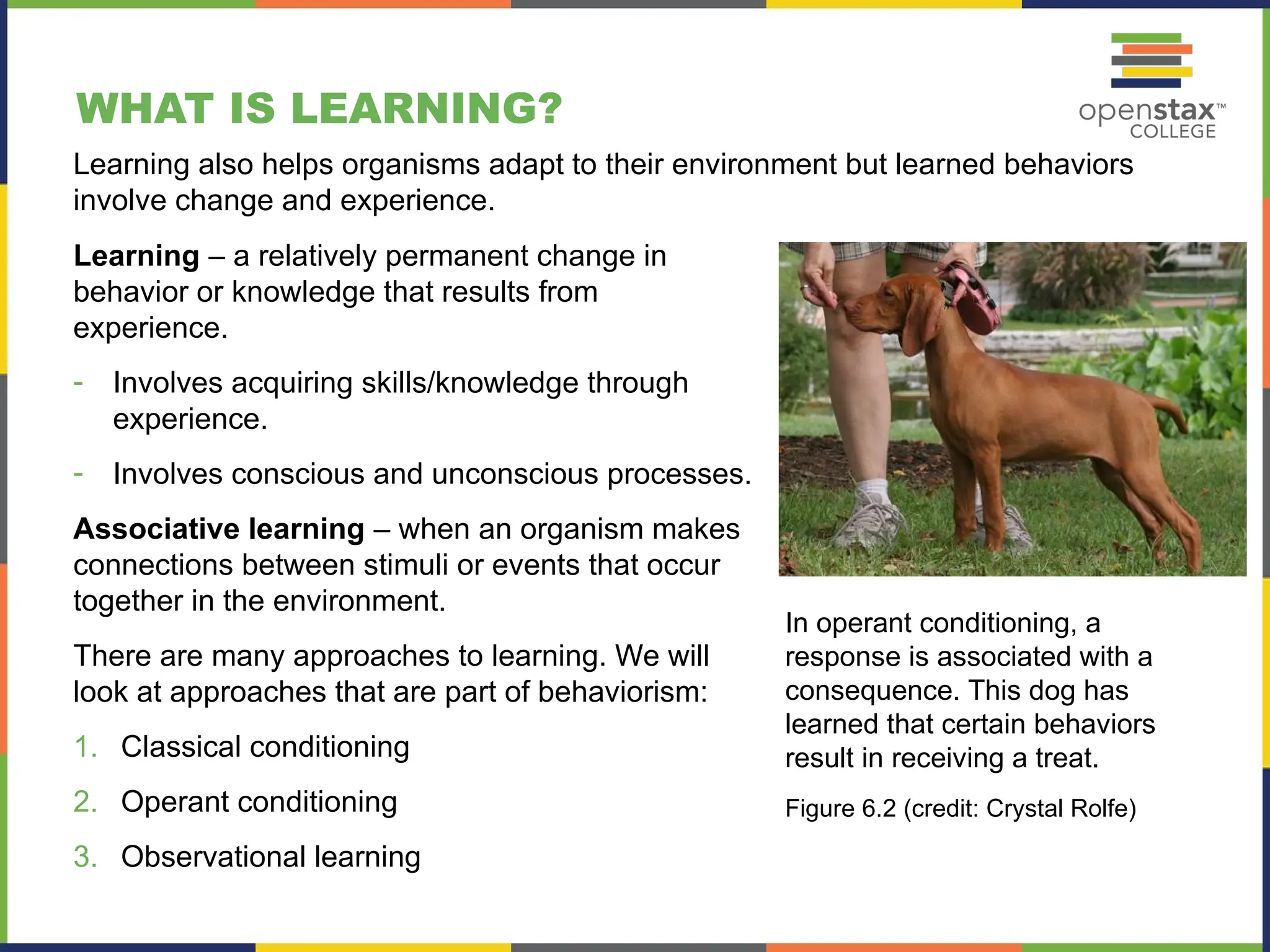
In operant conditioning, a
response is associated with a
consequence. This dog has
learned that certain behaviors
result in receiving a treat.
Figure 6.2 (credit: Crystal Rolfe)
Learning – a relatively permanent change in
behavior or knowledge that results from
experience.
- Involves acquiring skills/knowledge through
experience.
- Involves conscious and unconscious processes.
Associative learning – when an organism makes
connections between stimuli or events that occur
together in the environment.
There are many approaches to learning. We will
look at approaches that are part of behaviorism:
1. Classical conditioning
2. Operant conditioning
3. Observational learning
Learning also helps organisms adapt to their environment but learned behaviors
involve change and experience.
CLASSICAL CONDITIONING
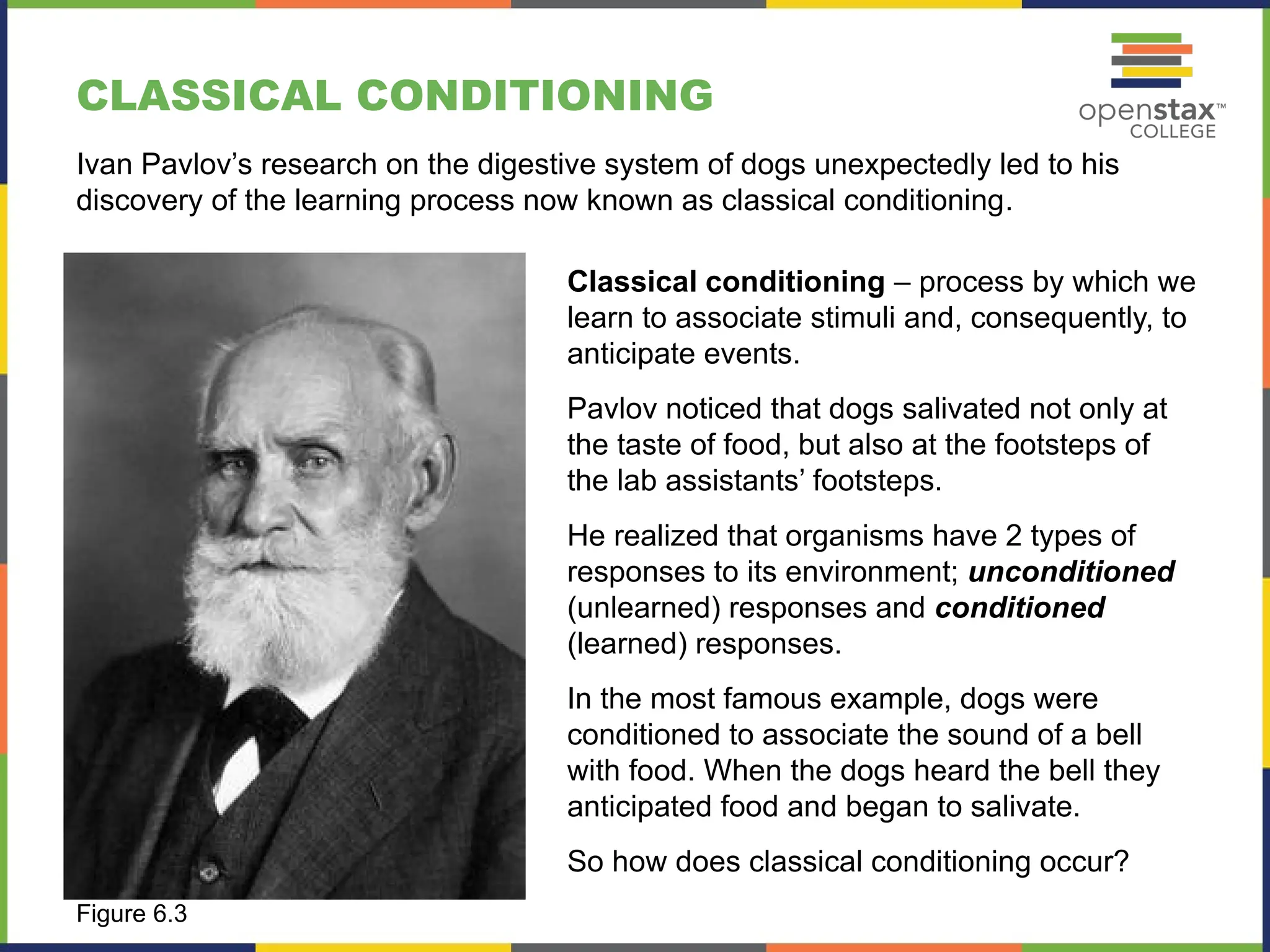
Classical conditioning – process by which we
learn to associate stimuli and, consequently, to
anticipate events.
Pavlov noticed that dogs salivated not only at
the taste of food, but also at the footsteps of
the lab assistants’ footsteps.
He realized that organisms have 2 types of
responses to its environment; unconditioned
(unlearned) responses and conditioned
(learned) responses.
In the most famous example, dogs were
conditioned to associate the sound of a bell
with food. When the dogs heard the bell they
anticipated food and began to salivate.
So how does classical conditioning occur?
Figure 6.3
Ivan Pavlov’s research on the digestive system of dogs unexpectedly led to his
discovery of the learning process now known as classical conditioning.
CLASSICAL CONDITIONING
Before Conditioning
Unconditioned stimulus (UCS) – stimulus that elicits a reflexive response (food).
Unconditioned response –UCR) – a natural unlearned reaction to a stimulus
(salivation in response to food).
Food (UCS) → Salivation (UCR)
During Conditioning
Neutral stimulus (NS) – stimulus that does not naturally elicit a response (ringing a
bell – does not cause salivation by itself prior to conditioning).
- The NS and UCS are paired repeatedly.
Bell (NS) + Food (UCS) → Salivation (UCR)
After Conditioning
Conditioned stimulus (CS) – stimulus that elicits a response after repeatedly being
paired with an unconditioned stimulus.
Conditioned response (CR) – the behavior caused by the conditioned stimulus.
Bell (CS) → Salivation (CR)
CLASSICAL CONDITIONING
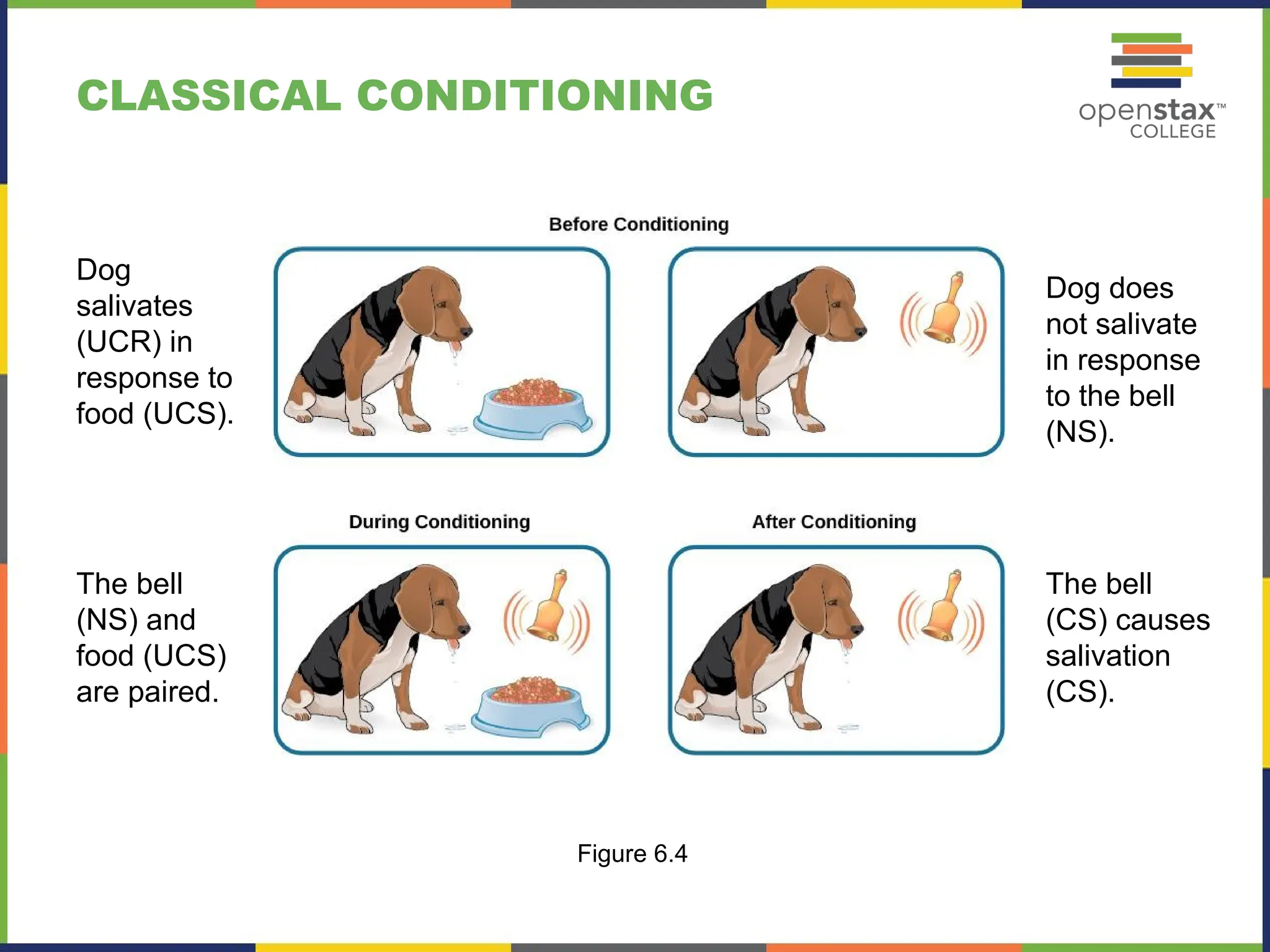
Figure 6.4
Dog
salivates
(UCR) in
response to
food (UCS).
Dog does
not salivate
in response
to the bell
(NS).
The bell
(NS) and
food (UCS)
are paired.
The bell
(CS) causes
salivation
(CS).
HIGHER-ORDER CONDITIONING
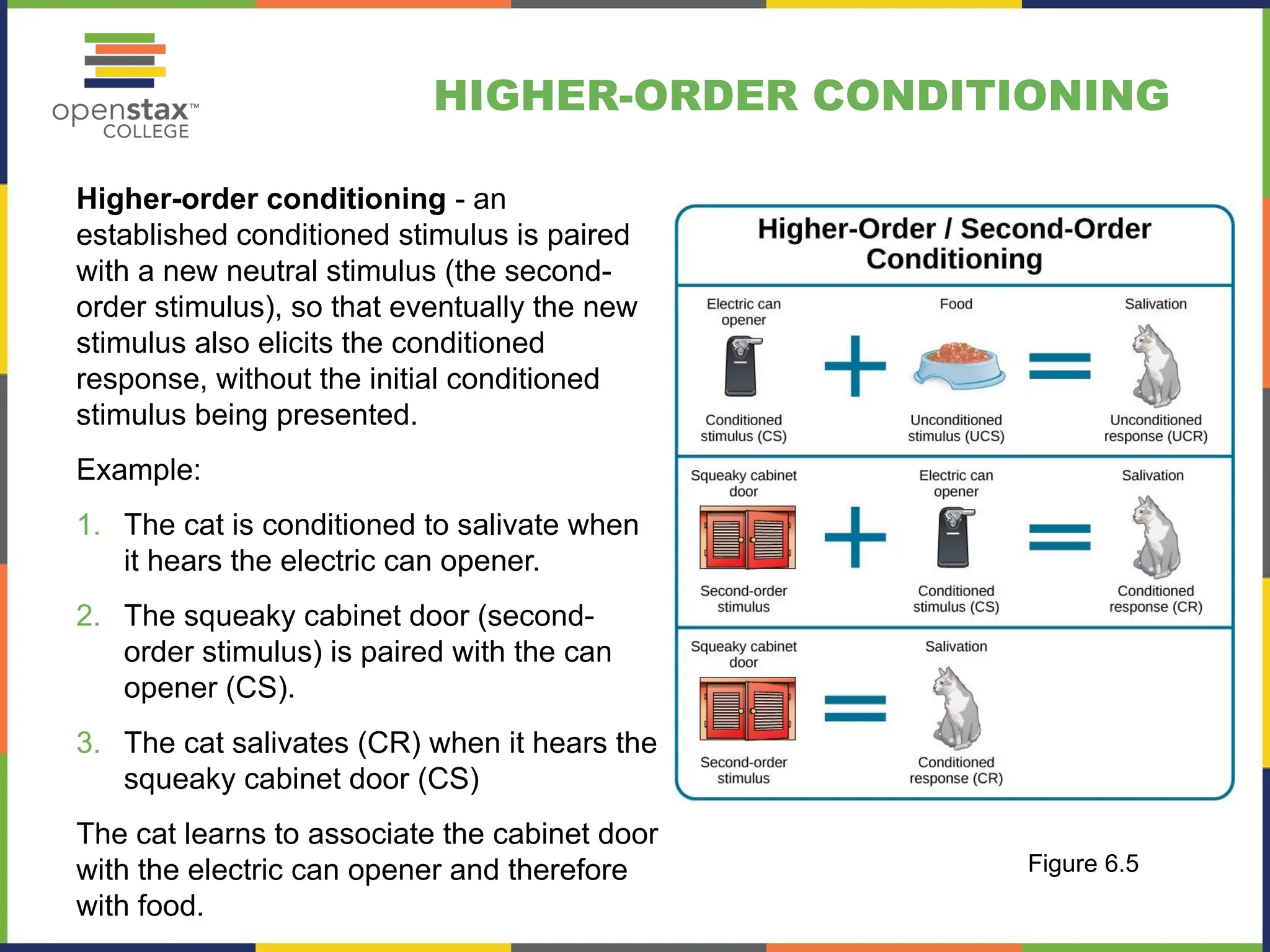
Higher-order conditioning - an
established conditioned stimulus is paired
with a new neutral stimulus (the second-
order stimulus), so that eventually the new
stimulus also elicits the conditioned
response, without the initial conditioned
stimulus being presented.
Example:
1. The cat is conditioned to salivate when
it hears the electric can opener.
2. The squeaky cabinet door (second-
order stimulus) is paired with the can
opener (CS).
3. The cat salivates (CR) when it hears the
squeaky cabinet door (CS)
The cat learns to associate the cabinet door
with the electric can opener and therefore
with food.
Figure 6.5
GENERAL PROCESSES IN
CLASSICAL CONDITIONING
Acquisition – The initial period of learning when an organism learns to connect a
neutral stimulus and an unconditioned stimulus.
- Usually this requires there to be a very short time interval between the NS and
the UCS and for the pairing to repeated multiple times.
- Sometimes conditioning can occur when the interval is up to several hours and
the pairing occurs only once (e.g. taste aversion).
Extinction – decrease in the conditioned response when the UCS is no longer
presented with the CS.
- If food stops being presented with the sound of the bell then eventually the dog
will stop responding to the bell.
Spontaneous recovery – the return of a previously extinguished conditioned
response following a rest period.
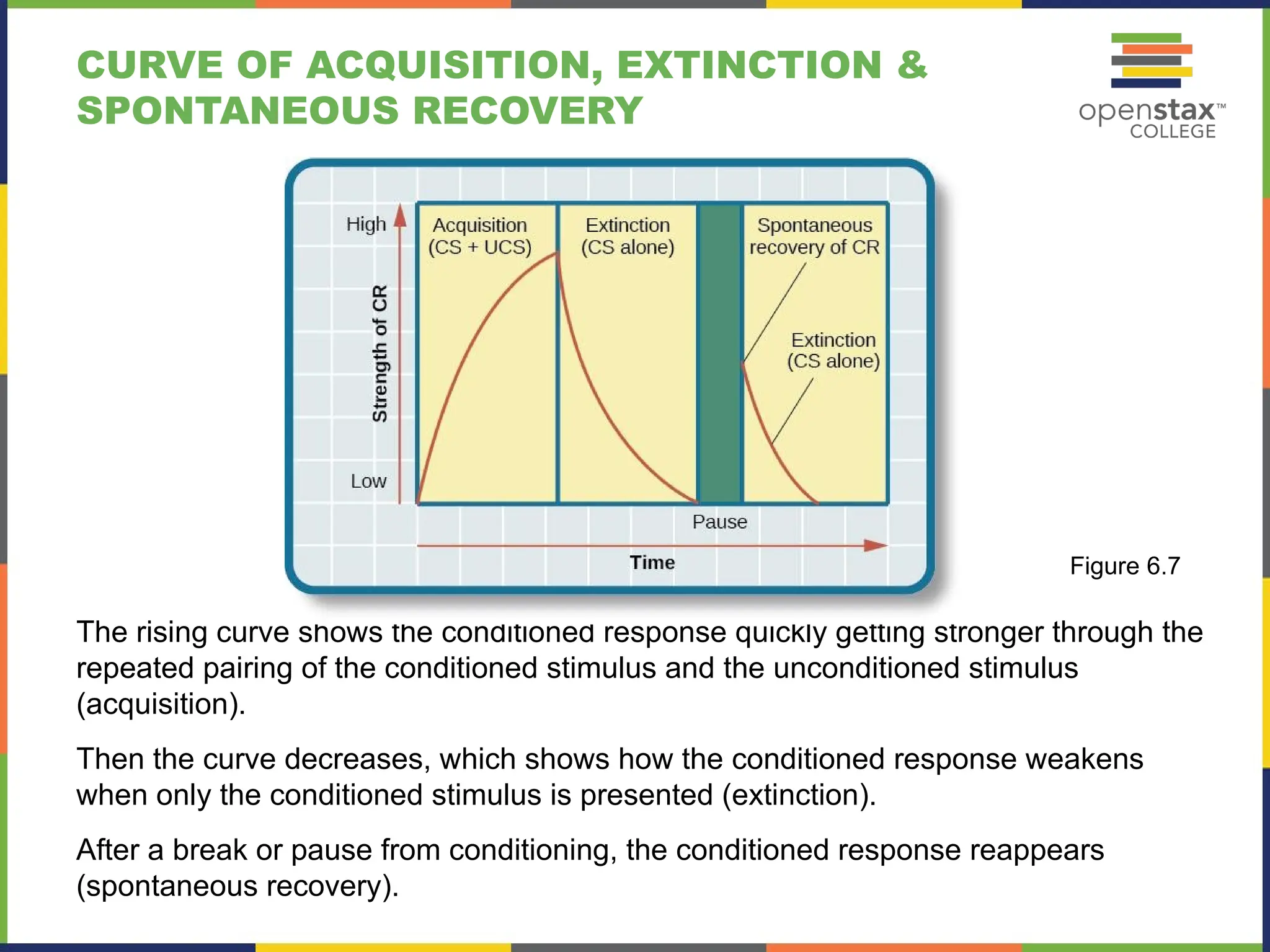
CURVE OF ACQUISITION, EXTINCTION &
SPONTANEOUS RECOVERY
The rising curve shows the conditioned response quickly getting stronger through the
repeated pairing of the conditioned stimulus and the unconditioned stimulus
(acquisition).
Then the curve decreases, which shows how the conditioned response weakens
when only the conditioned stimulus is presented (extinction).
After a break or pause from conditioning, the conditioned response reappears
(spontaneous recovery).
Figure 6.7
DISTINGUISHING BETWEEN STIMULI
Organisms need to be able to distinguish between different stimuli in order to respond
appropriately.
Stimulus discrimination – when an organism learns to respond differently to various
stimuli that are similar.
- The dog can discriminate between the specific bell sound that signals food and a
similar bell sound that does not signal food.
Stimulus generalization – when an organism demonstrates the conditioned
response to stimuli that are similar to the conditioned stimulus.
- If an individual learns to dislike a specific spider, they will usually then dislike all
spiders.
Classical conditioning can also lead to habituation.
Habituation – learning not to respond to a stimulus that is presented repeatedly
without change.
- As a stimulus is repeated, we learn not to focus our attention on it.
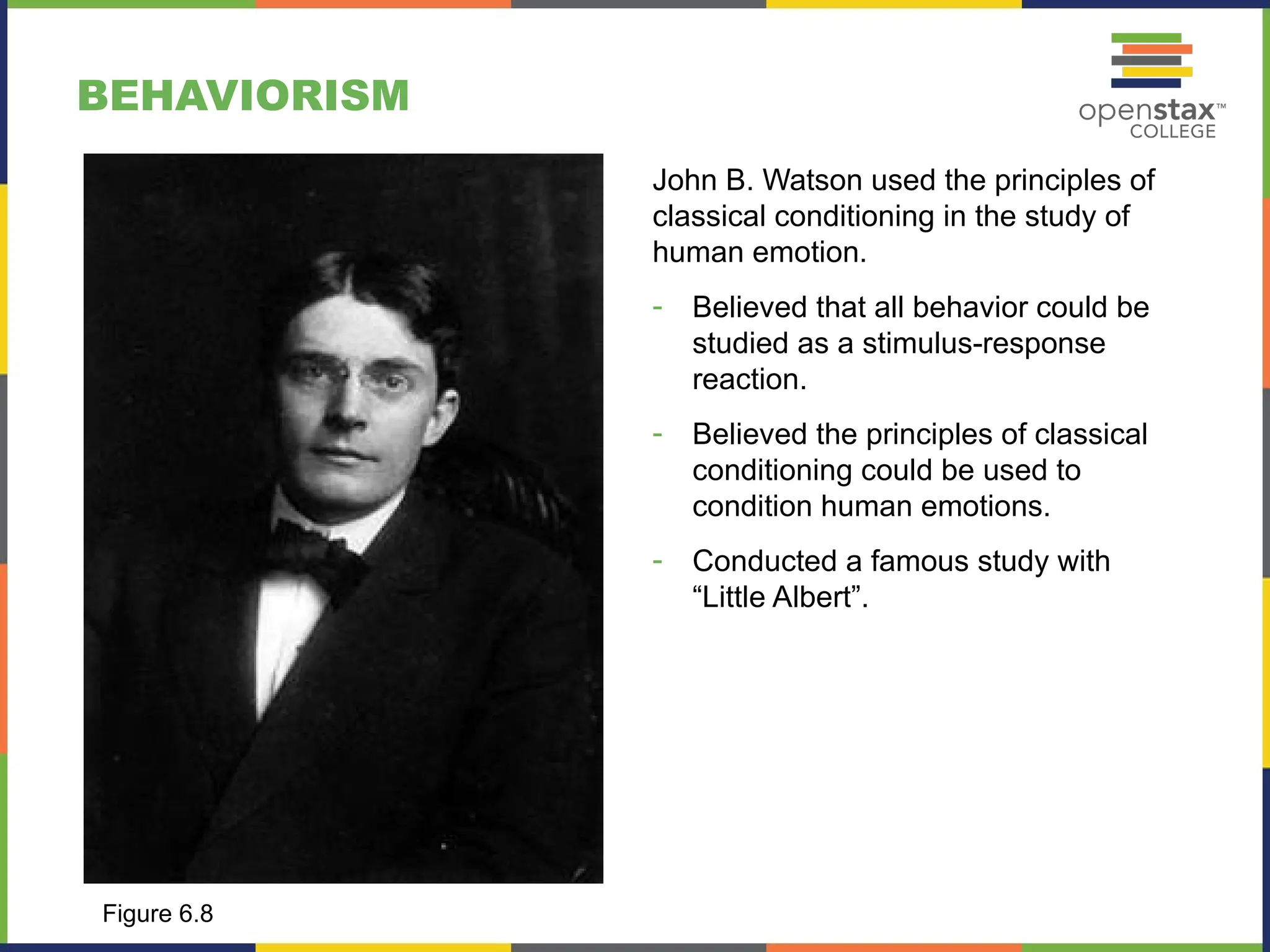
BEHAVIORISM
John B. Watson used the principles of
classical conditioning in the study of
human emotion.
- Believed that all behavior could be
studied as a stimulus-response
reaction.
- Believed the principles of classical
conditioning could be used to
condition human emotions.
- Conducted a famous study with
“Little Albert”.
Figure 6.8
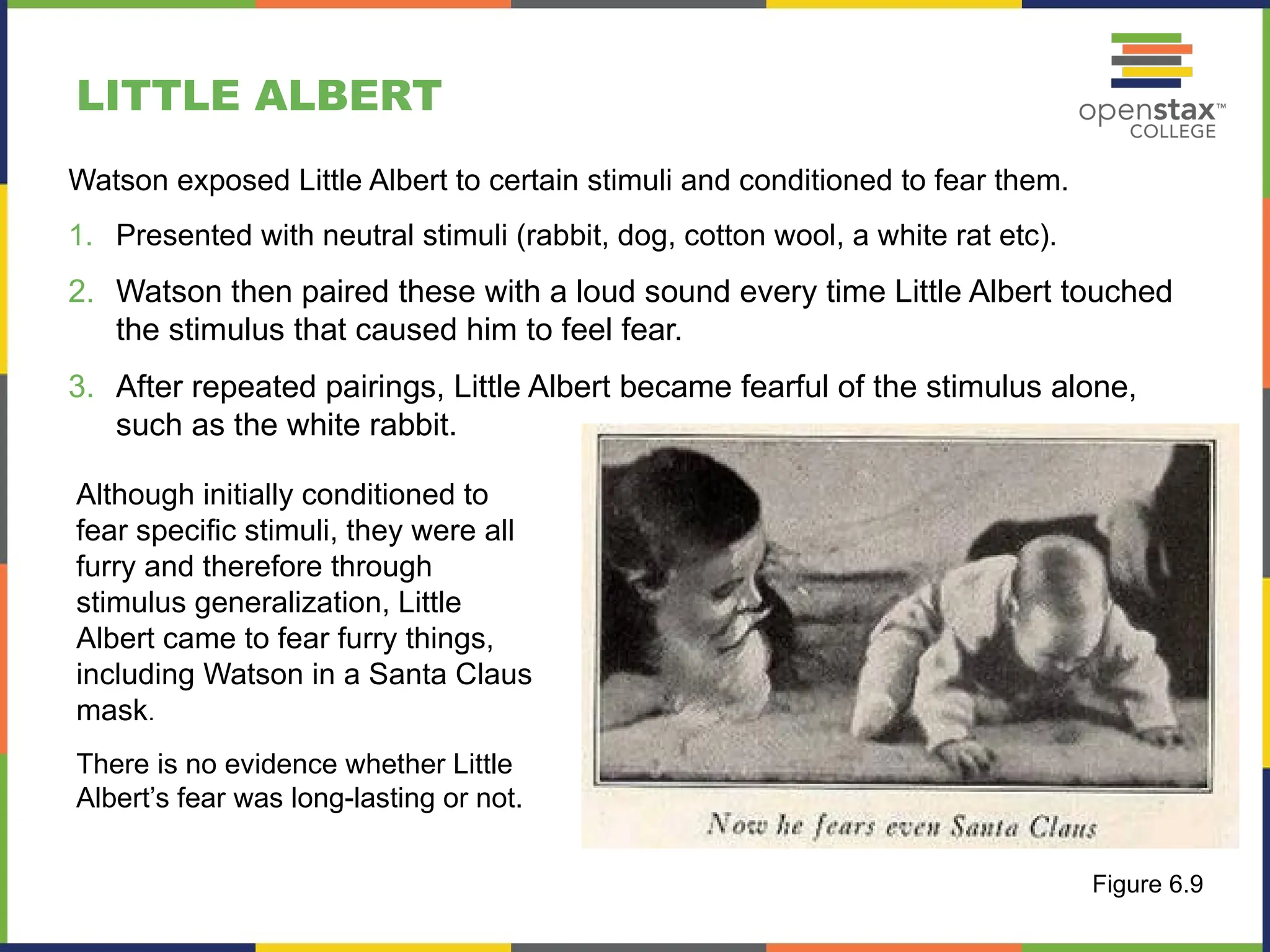
LITTLE ALBERT
Although initially conditioned to
fear specific stimuli, they were all
furry and therefore through
stimulus generalization, Little
Albert came to fear furry things,
including Watson in a Santa Claus
mask.
There is no evidence whether Little
Albert’s fear was long-lasting or not.
Figure 6.9
Watson exposed Little Albert to certain stimuli and conditioned to fear them.
1. Presented with neutral stimuli (rabbit, dog, cotton wool, a white rat etc).
2. Watson then paired these with a loud sound every time Little Albert touched
the stimulus that caused him to feel fear.
3. After repeated pairings, Little Albert became fearful of the stimulus alone,
such as the white rabbit.
OPERANT CONDITIONING
Operant conditioning is a theory proposed by B.F. Skinner.
In operant conditioning, organisms learn to associate a behavior and its
consequences (reinforcement or punishment).
- Based on the law of effect.
Pleasant consequence/desired result → behavior is more likely to occur again.
Unpleasant consequence/undesired result → behavior is less likely to occur again.
- E.g. When we show up to work (behavior), we get paid (pleasant consequence) so
we continue to show up to work.
Skinner conducted experiments (mainly with rats and pigeons) to determine how
learning occurs through operant conditioning.
Operant Conditioning Terminology
Positive – to add something.
Negative– to take something away.
Reinforcement – increasing a behavior.
Punishment – decreasing a behavior.
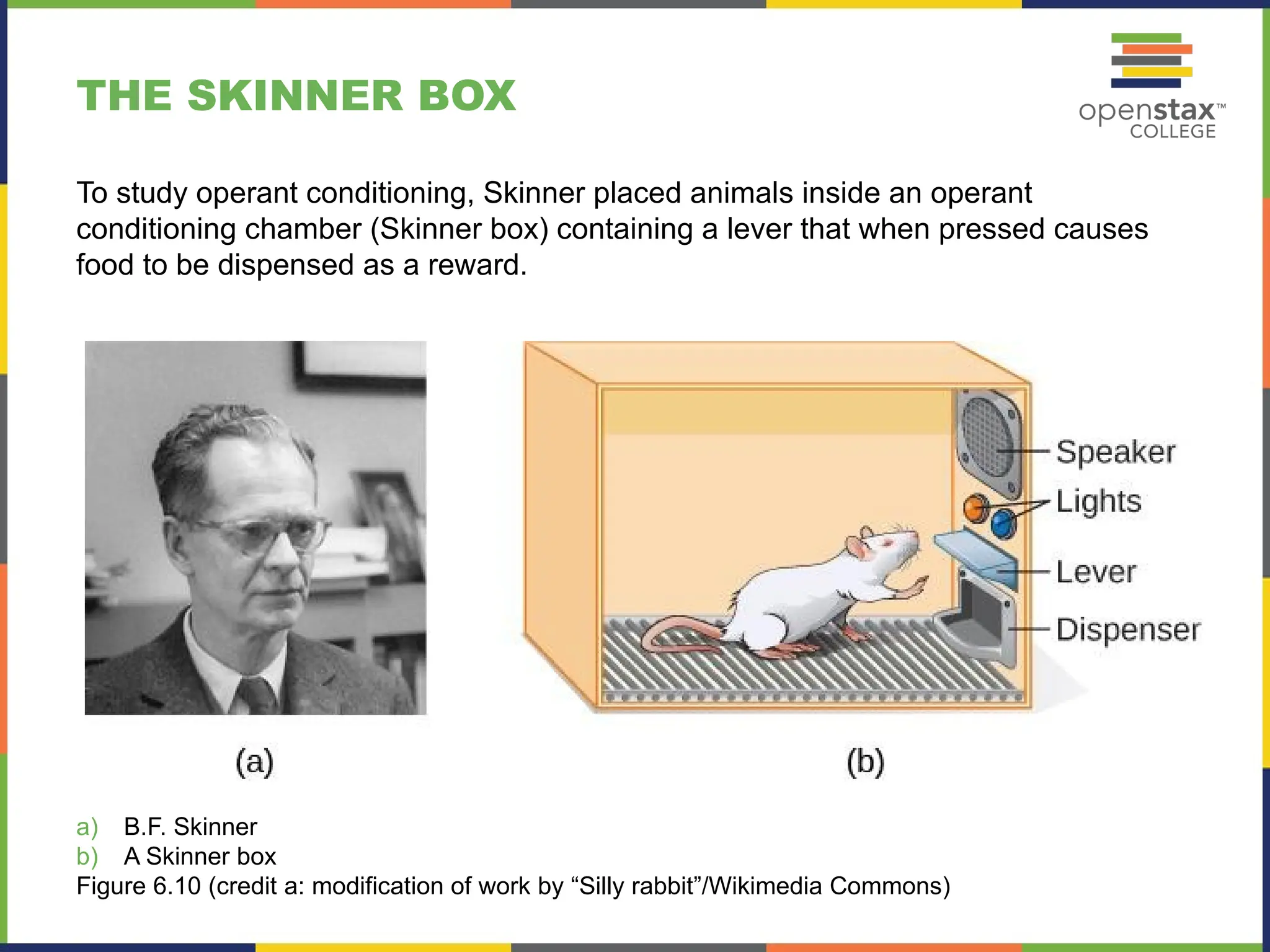
THE SKINNER BOX
To study operant conditioning, Skinner placed animals inside an operant
conditioning chamber (Skinner box) containing a lever that when pressed causes
food to be dispensed as a reward.
a) B.F. Skinner
b) A Skinner box
Figure 6.10 (credit a: modification of work by “Silly rabbit”/Wikimedia Commons)
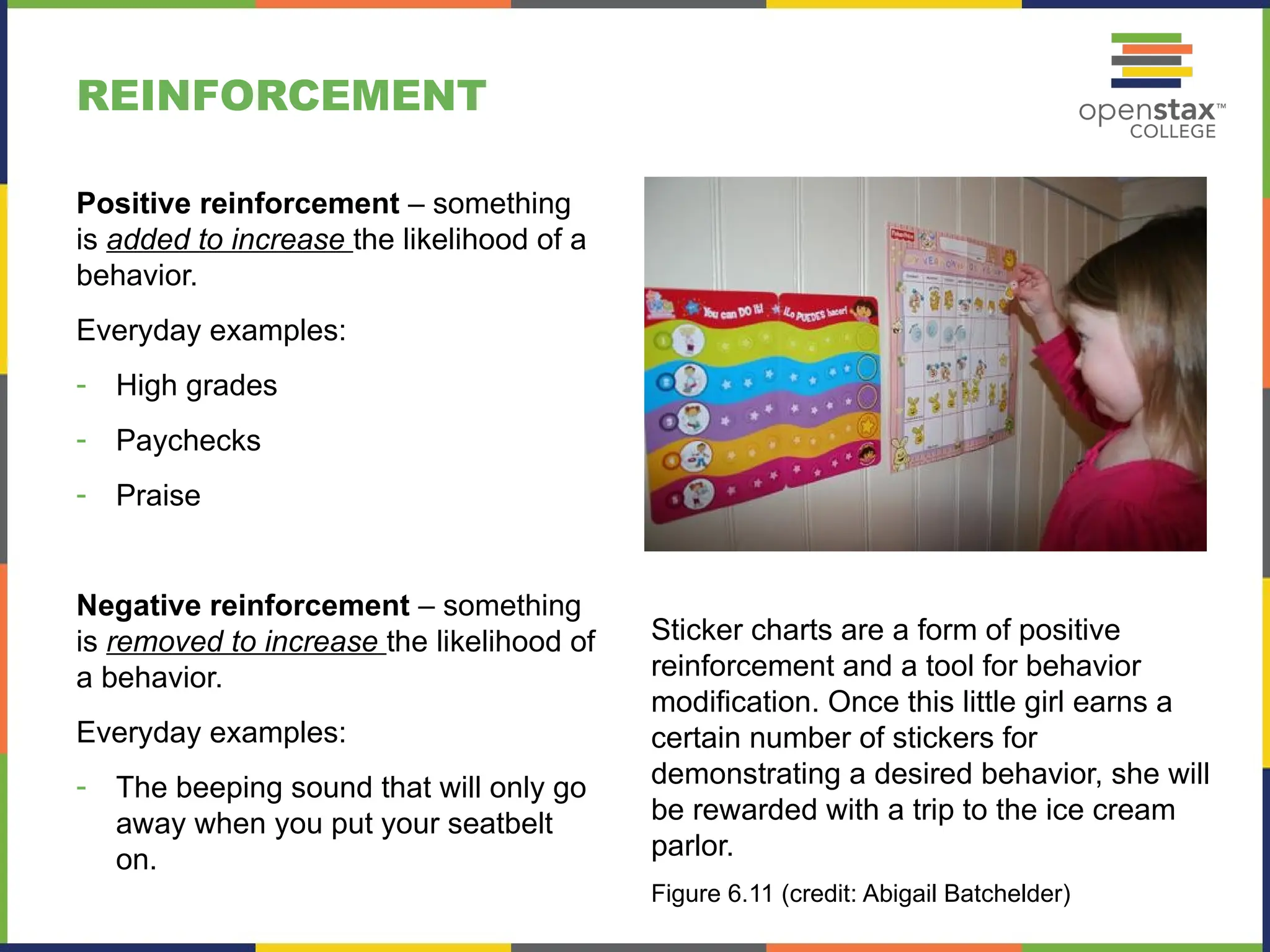
REINFORCEMENT
Sticker charts are a form of positive
reinforcement and a tool for behavior
modification. Once this little girl earns a
certain number of stickers for
demonstrating a desired behavior, she will
be rewarded with a trip to the ice cream
parlor.
Figure 6.11 (credit: Abigail Batchelder)
Positive reinforcement – something
is added to increase the likelihood of a
behavior.
Everyday examples:
- High grades
- Paychecks
- Praise
Negative reinforcement – something
is removed to increase the likelihood of
a behavior.
Everyday examples:
- The beeping sound that will only go
away when you put your seatbelt
on.
PUNISHMENT
Time-out is a popular form of negative punishment used by caregivers. When a child
misbehaves, he or she is removed from a desirable activity in an effort to decrease the
unwanted behavior. For example, (a) a child might be playing on the playground with friends
and push another child; (b) the child who misbehaved would then be removed from the activity
for a short period of time.
Figure 6.12 (credit a: modification of work by Simone Ramella; credit b: modification of work by “JefferyTurner”/Flickr)
Positive punishment – something is added to decrease the likelihood of a behavior.
- Scolding a student for texting in class.
Negative punishment – something is removed to decrease the likelihood of a
behavior.
- Taking away a favorite toy when a child misbehaves.
SHAPING
Shaping is a tool used in operant conditioning.
In shaping, instead of rewarding only the target behavior, we reward successive
approximations of a target behavior.
- Behaviors are broken down into many small, achievable steps.
- Useful when teaching a complex chain of events.
- Commonly used by animal trainers.
1. Reinforce any response that resembles the desired behavior.
2. Then reinforce the response that more closely resembles the desired behavior
(no longer reinforce previously reinforced response).
3. Then begin to reinforce the response that even more closely resembles the
desired behavior.
4. Continue to do this until only the desired behavior is reinforced.
PRIMARY & SECONDARY REINFORCERS
Rewards to reinforce behavior can come in many forms (praise, stickers, money,
toys etc).
Primary reinforcers - those that have innate reinforcing qualities (e.g. food,
water, sleep, sex, pleasure). The value of these reinforcers does not need to be
learned.
Secondary reinforcers – those that have no inherent value. There value is learnt
and becomes reinforcing when linked with a primary reinforcer.
- Praise, a secondary reinforcer is linked with affection, a primary reinforcer.
- Money is only reinforcing when it can be used to buy other things such as
things that satisfy basic needs (food) or other secondary reinforcers.
- Tokens are a secondary reinforcer that can be exchanged for other things.
- Token economies are used in many settings to encourage correct
behavior such as prisons, schools and mental institutions.
REINFORCEMENT SCHEDULES
The best way to teach a behavior is with positive reinforcement. However, there
are many ways that positive reinforcement can be administered.
Continuous reinforcement – when an organism receives a reinforcer each time
it displays a behavior.
- Quickest way to teach a behavior.
- E.g. a dog receives a treat every time it sits when told to.
- Timing is important - the treat must be presented immediately after sitting in
order for the dog to associate the target behavior with the consequence.
However, if the trainer suddenly stops providing treats, the dog will stop sitting so
another type of reinforcement is then used once the behavior is learnt.
Partial reinforcement – the organism does not get reinforced everytime they
display the desired behavior (they are reinforced intermittently).
- There are several types of partial reinforcement schedules.
PARTIAL REINFORCEMENT SCALES
Fixed vs Variable
Fixed – the number of responses between reinforcements or the amount of time
between reinforcements is set and unchanging.
Variable – the number of responses between reinforcements or the amount of time
between reinforcements varies or changes.
Interval vs Ratio
Interval – the schedule is based on the time between reinforcements.
Ratio – the schedule is based on the number of responses between reinforcements.
• Fixed interval – reinforcement is delivered at predictable time intervals (patients take
pain relief medication at set times).
• Variable interval – reinforcement is delivered at unpredictable time intervals
(checking facebook).
• Fixed ratio – reinforcement is delivered after a predictable number of responses
(facotry workers being paid for every x number of items manufactured).
• Variable ratio – reinforcement is delivered after an unpredictable number of
responses (gambling).
PARTIAL REINFORCEMENT SCHEDULES
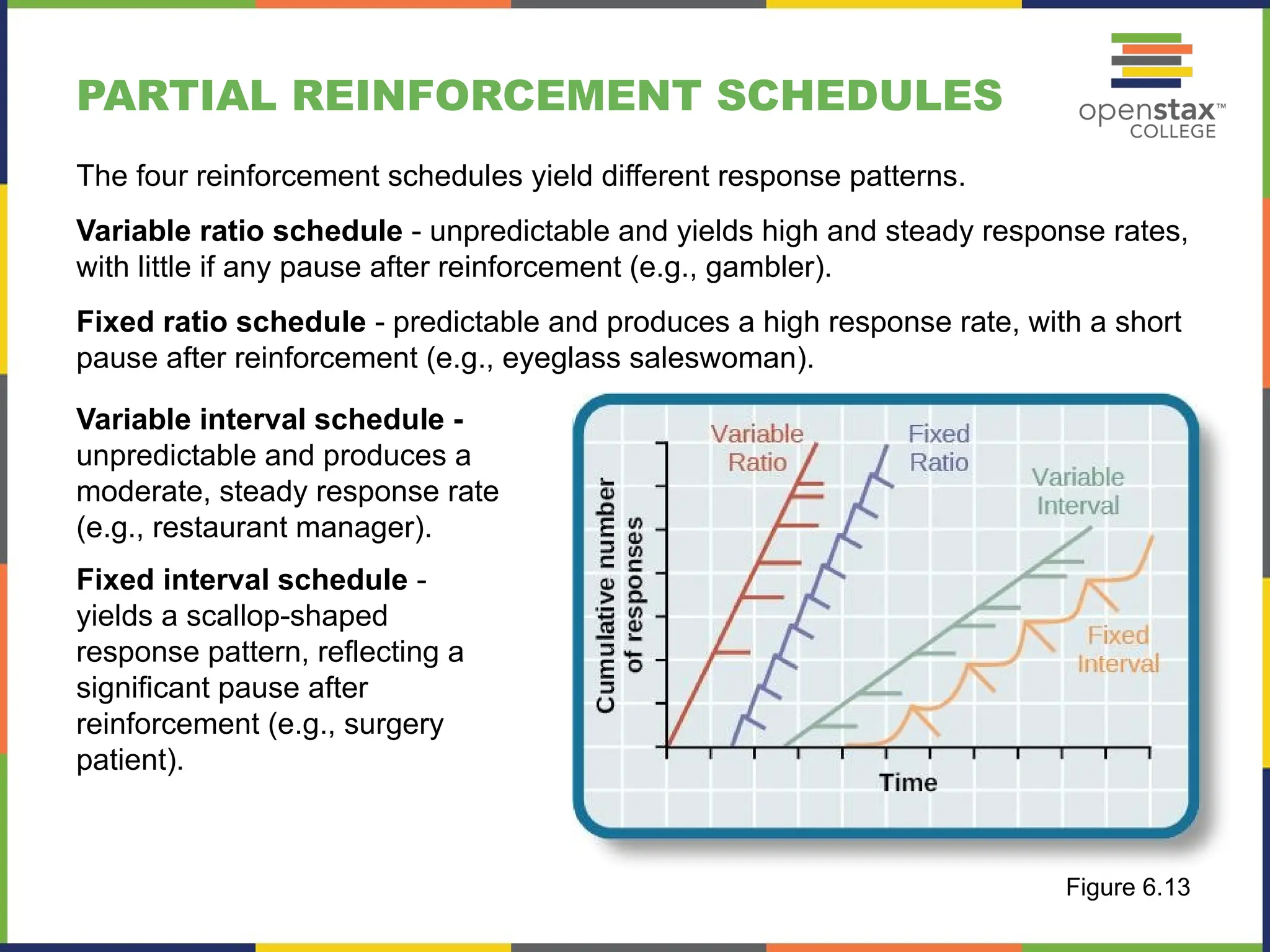
Variable interval schedule -
unpredictable and produces a
moderate, steady response rate
(e.g., restaurant manager).
Fixed interval schedule -
yields a scallop-shaped
response pattern, reflecting a
significant pause after
reinforcement (e.g., surgery
patient).
Figure 6.13
The four reinforcement schedules yield different response patterns.
Variable ratio schedule - unpredictable and yields high and steady response rates,
with little if any pause after reinforcement (e.g., gambler).
Fixed ratio schedule - predictable and produces a high response rate, with a short
pause after reinforcement (e.g., eyeglass saleswoman).
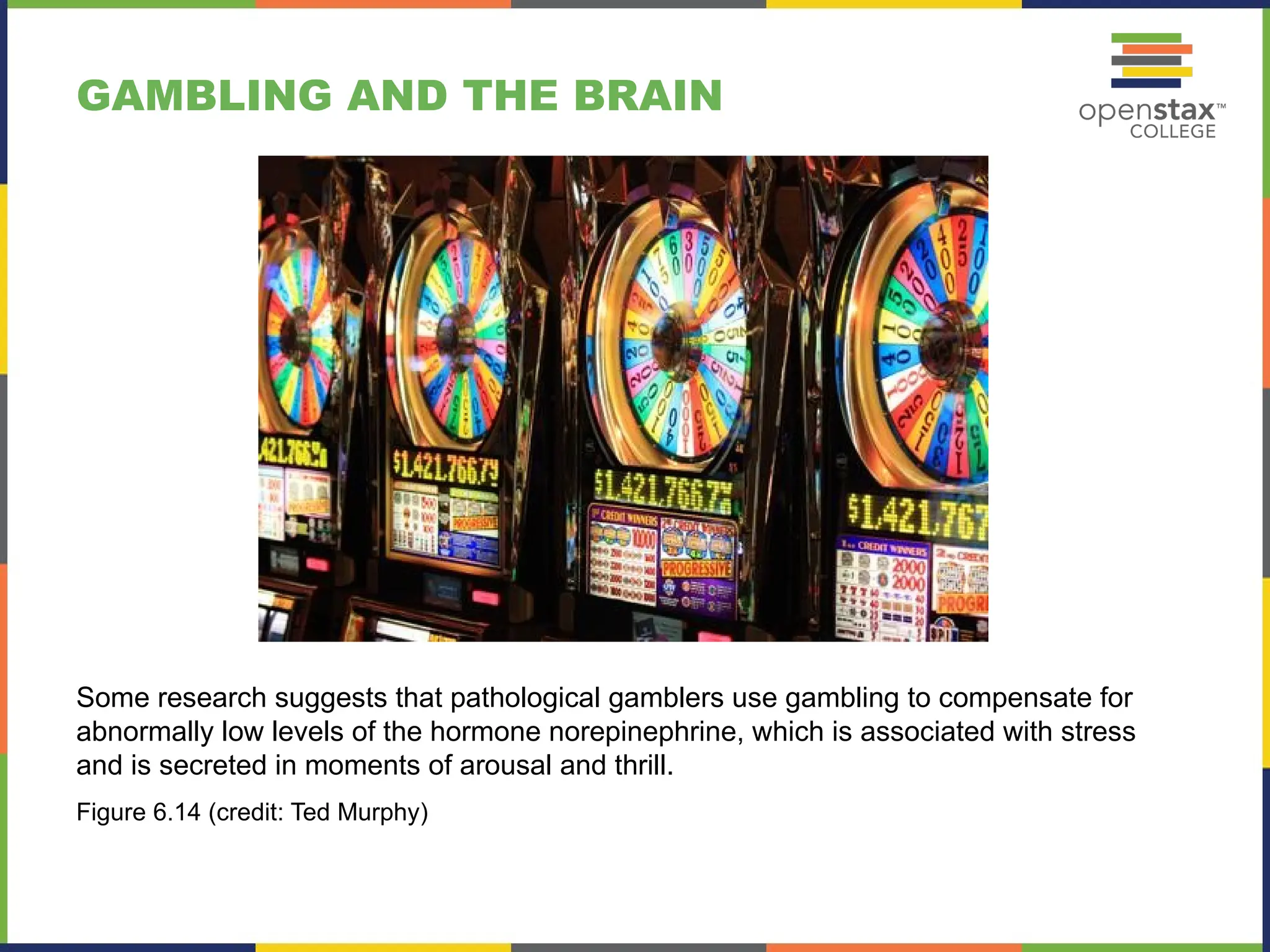
GAMBLING AND THE BRAIN
Some research suggests that pathological gamblers use gambling to compensate for
abnormally low levels of the hormone norepinephrine, which is associated with stress
and is secreted in moments of arousal and thrill.
Figure 6.14 (credit: Ted Murphy)
COGNITION & LATENT LEARNING
Research conducted by Edward C. Tolman found that learning could still occur
without reinforcement. This introduced the idea that there is a cognitive aspect to
learning.
While studying rats he found that if he put them in a maze to learn their way through
it, they would eventually form a cognitive map of it.
Cognitive map – a mental picture of the layout an environment.
After 10 sessions in the maze without food as reinforcement, food was placed at the
exit and the rats were able to very quickly exit the maze showing that they had
learned the way out. This is called latent learning.
Latent learning – learning that occurs but is not observable in behavior until there is
a reason to demonstrate it.
- Children may learn behaviors from their parents that they do not demonstrate until
they are older.
- A child may learn the route to school from watching his parent drive there but will
not demonstrate this until they can drive themselves or have to get there by bike,
walking etc.
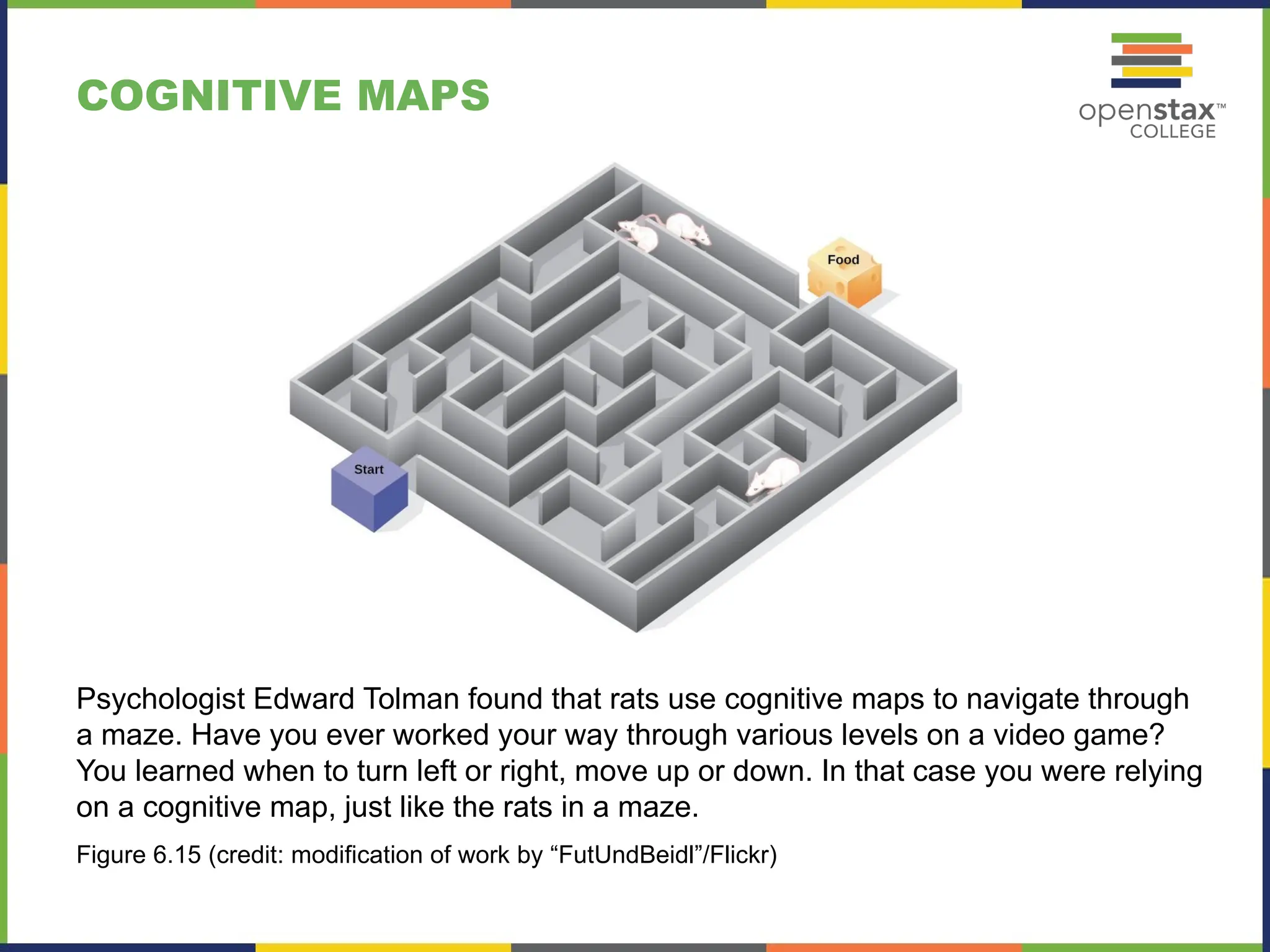
COGNITIVE MAPS
Psychologist Edward Tolman found that rats use cognitive maps to navigate through
a maze. Have you ever worked your way through various levels on a video game?
You learned when to turn left or right, move up or down. In that case you were relying
on a cognitive map, just like the rats in a maze.
Figure 6.15 (credit: modification of work by “FutUndBeidl”/Flickr)
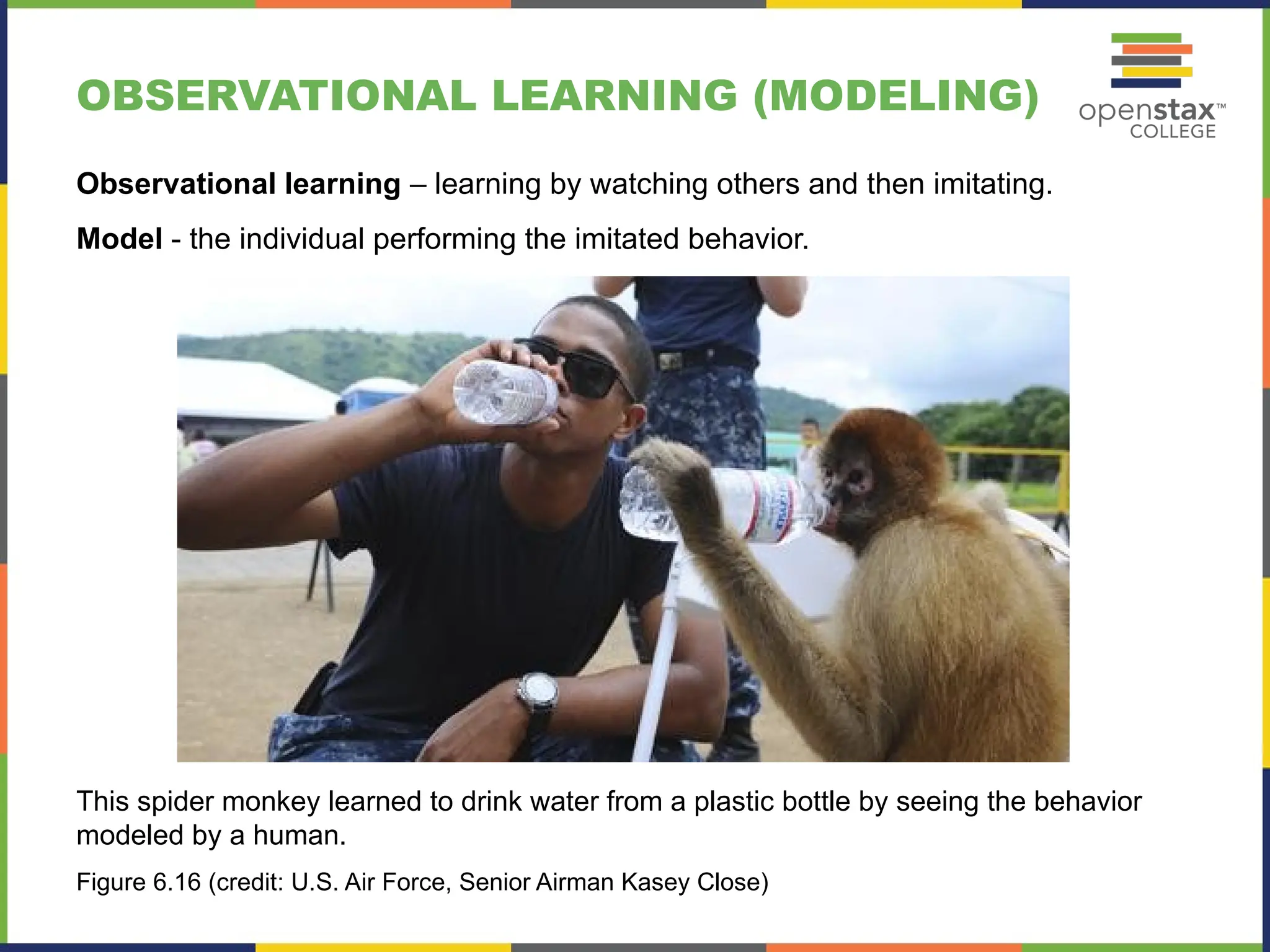
OBSERVATIONAL LEARNING (MODELING)
This spider monkey learned to drink water from a plastic bottle by seeing the behavior
modeled by a human.
Figure 6.16 (credit: U.S. Air Force, Senior Airman Kasey Close)
Observational learning – learning by watching others and then imitating.
Model - the individual performing the imitated behavior.
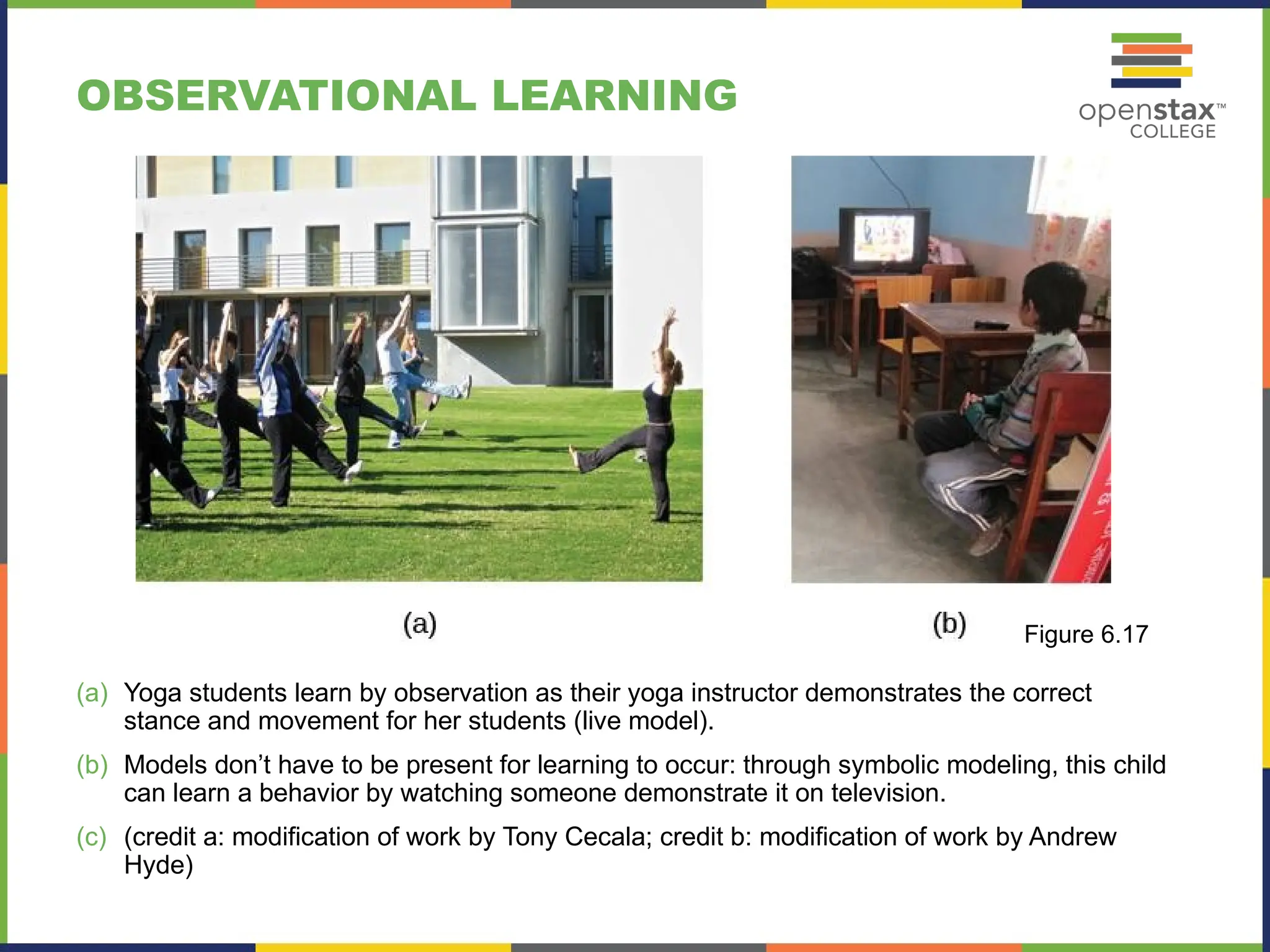
OBSERVATIONAL LEARNING
(a) Yoga students learn by observation as their yoga instructor demonstrates the correct
stance and movement for her students (live model).
(b) Models don’t have to be present for learning to occur: through symbolic modeling, this child
can learn a behavior by watching someone demonstrate it on television.
(c) (credit a: modification of work by Tony Cecala; credit b: modification of work by Andrew
Hyde)
Figure 6.17
SOCIAL LEARNING THEORY
In order to explain how learning occurred without external reinforcement, Albert
Bandura proposed social learning theory.
He believed that observational learning involved more than just imitation and that
internal mental states must be involved.
Steps in the Modeling Process
1. Attention – focus on the behavior.
2. Retention – remember what you observed.
3. Reproduction – be able to perform the behavior.
4. Motivation – must want to copy the behavior.
Motivation depends on what happened to the model.
Vicarious reinforcement – process where the observer sees the model rewarded,
making the observer more likely to imitate the model’s behavior.
Vicarious punishment – process where the observer sees the model punished,
making the observer less likely to imitate the model’s behavior.
BANDURA’S BOBO DOLL EXPERIMENT
In a famous study known as the Bobo doll experiment, Bandura studied modeling of
aggressive and violent behaviors.
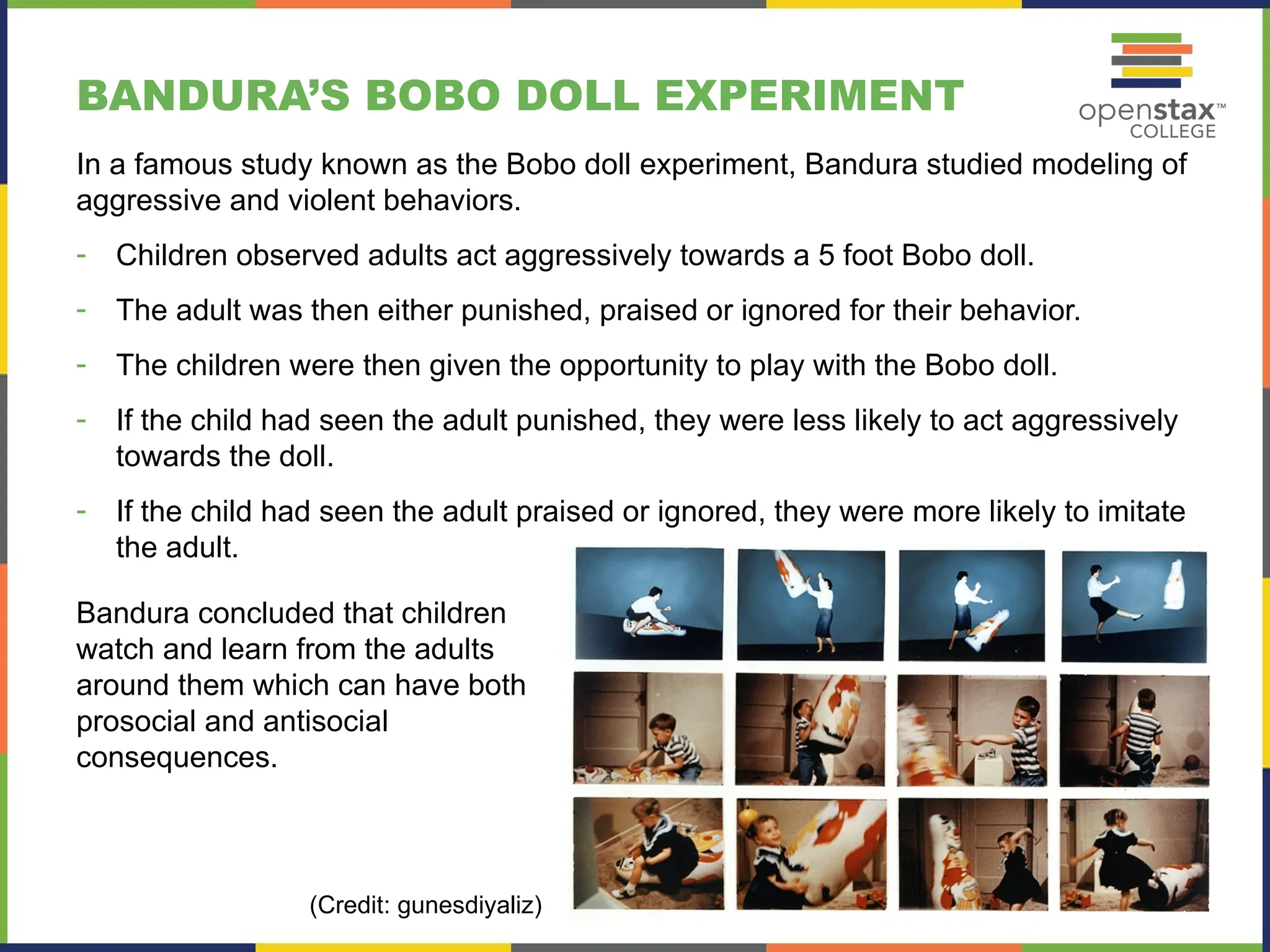
- Children observed adults act aggressively towards a 5 foot Bobo doll.
- The adult was then either punished, praised or ignored for their behavior.
- The children were then given the opportunity to play with the Bobo doll.
- If the child had seen the adult punished, they were less likely to act aggressively
towards the doll.
- If the child had seen the adult praised or ignored, they were more likely to imitate
the adult.
(Credit: gunesdiyaliz)
Bandura concluded that children
watch and learn from the adults
around them which can have both
prosocial and antisocial
consequences.
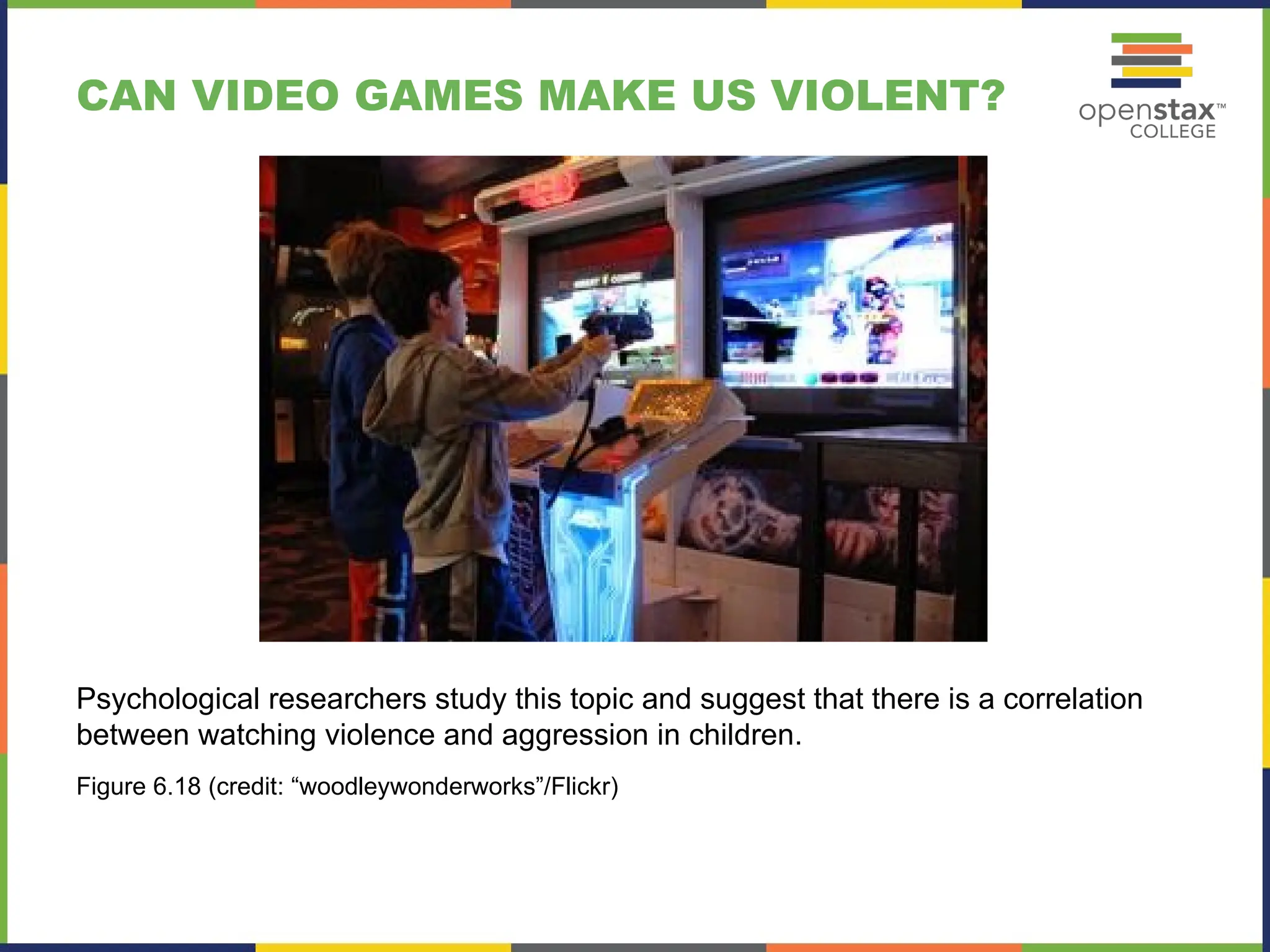
CAN VIDEO GAMES MAKE US VIOLENT?
Psychological researchers study this topic and suggest that there is a correlation
between watching violence and aggression in children.
Figure 6.18 (credit: “woodleywonderworks”/Flickr)

OpenStax_Psychology_CH06_ImageSlideshow (4).pptx

  • 1.
  • 2.
    LEARNING Figure 6.1 (credit“turtle”: modification of work by Becky Skiba, USFWS; credit “surfer”: modification of work by Mike Baird) Loggerhead sea turtle hatchlings are born knowing how to find the ocean and how to swim. Unlike the sea turtle, humans must learn how to swim (and surf). As humans, we pride ourselves on our ability to learn. What processes are at work as we come to know what we know?
  • 3.
    UNLEARNED BEHAVIORS Instincts andReflexes Instincts and reflexes are innate behaviors that organisms are born with. - Help organisms adapt to their environment. Reflexes – motor/neural reactions to a specific stimulus. - Simpler than instincts. - Involve activity of specific body parts. - Involve primitive centers of the CNS (e.g., spinal cord and medulla). - E.g. Human babies are born with a sucking reflex. Instincts – behaviors triggered by a broader range of events (e.g., aging, change of seasons). - More complex. - Involve movement of the organism as a whole (e.g., sexual activity, migration). - Involve higher brain centers.
  • 4.
    WHAT IS LEARNING? Inoperant conditioning, a response is associated with a consequence. This dog has learned that certain behaviors result in receiving a treat. Figure 6.2 (credit: Crystal Rolfe) Learning – a relatively permanent change in behavior or knowledge that results from experience. - Involves acquiring skills/knowledge through experience. - Involves conscious and unconscious processes. Associative learning – when an organism makes connections between stimuli or events that occur together in the environment. There are many approaches to learning. We will look at approaches that are part of behaviorism: 1. Classical conditioning 2. Operant conditioning 3. Observational learning Learning also helps organisms adapt to their environment but learned behaviors involve change and experience.
  • 5.
    CLASSICAL CONDITIONING Classical conditioning– process by which we learn to associate stimuli and, consequently, to anticipate events. Pavlov noticed that dogs salivated not only at the taste of food, but also at the footsteps of the lab assistants’ footsteps. He realized that organisms have 2 types of responses to its environment; unconditioned (unlearned) responses and conditioned (learned) responses. In the most famous example, dogs were conditioned to associate the sound of a bell with food. When the dogs heard the bell they anticipated food and began to salivate. So how does classical conditioning occur? Figure 6.3 Ivan Pavlov’s research on the digestive system of dogs unexpectedly led to his discovery of the learning process now known as classical conditioning.
  • 6.
    CLASSICAL CONDITIONING Before Conditioning Unconditionedstimulus (UCS) – stimulus that elicits a reflexive response (food). Unconditioned response –UCR) – a natural unlearned reaction to a stimulus (salivation in response to food). Food (UCS) → Salivation (UCR) During Conditioning Neutral stimulus (NS) – stimulus that does not naturally elicit a response (ringing a bell – does not cause salivation by itself prior to conditioning). - The NS and UCS are paired repeatedly. Bell (NS) + Food (UCS) → Salivation (UCR) After Conditioning Conditioned stimulus (CS) – stimulus that elicits a response after repeatedly being paired with an unconditioned stimulus. Conditioned response (CR) – the behavior caused by the conditioned stimulus. Bell (CS) → Salivation (CR)
  • 7.
    CLASSICAL CONDITIONING Figure 6.4 Dog salivates (UCR)in response to food (UCS). Dog does not salivate in response to the bell (NS). The bell (NS) and food (UCS) are paired. The bell (CS) causes salivation (CS).
  • 8.
    HIGHER-ORDER CONDITIONING Higher-order conditioning- an established conditioned stimulus is paired with a new neutral stimulus (the second- order stimulus), so that eventually the new stimulus also elicits the conditioned response, without the initial conditioned stimulus being presented. Example: 1. The cat is conditioned to salivate when it hears the electric can opener. 2. The squeaky cabinet door (second- order stimulus) is paired with the can opener (CS). 3. The cat salivates (CR) when it hears the squeaky cabinet door (CS) The cat learns to associate the cabinet door with the electric can opener and therefore with food. Figure 6.5
  • 9.
    GENERAL PROCESSES IN CLASSICALCONDITIONING Acquisition – The initial period of learning when an organism learns to connect a neutral stimulus and an unconditioned stimulus. - Usually this requires there to be a very short time interval between the NS and the UCS and for the pairing to repeated multiple times. - Sometimes conditioning can occur when the interval is up to several hours and the pairing occurs only once (e.g. taste aversion). Extinction – decrease in the conditioned response when the UCS is no longer presented with the CS. - If food stops being presented with the sound of the bell then eventually the dog will stop responding to the bell. Spontaneous recovery – the return of a previously extinguished conditioned response following a rest period.
  • 10.
    CURVE OF ACQUISITION,EXTINCTION & SPONTANEOUS RECOVERY The rising curve shows the conditioned response quickly getting stronger through the repeated pairing of the conditioned stimulus and the unconditioned stimulus (acquisition). Then the curve decreases, which shows how the conditioned response weakens when only the conditioned stimulus is presented (extinction). After a break or pause from conditioning, the conditioned response reappears (spontaneous recovery). Figure 6.7
  • 11.
    DISTINGUISHING BETWEEN STIMULI Organismsneed to be able to distinguish between different stimuli in order to respond appropriately. Stimulus discrimination – when an organism learns to respond differently to various stimuli that are similar. - The dog can discriminate between the specific bell sound that signals food and a similar bell sound that does not signal food. Stimulus generalization – when an organism demonstrates the conditioned response to stimuli that are similar to the conditioned stimulus. - If an individual learns to dislike a specific spider, they will usually then dislike all spiders. Classical conditioning can also lead to habituation. Habituation – learning not to respond to a stimulus that is presented repeatedly without change. - As a stimulus is repeated, we learn not to focus our attention on it.
  • 12.
    BEHAVIORISM John B. Watsonused the principles of classical conditioning in the study of human emotion. - Believed that all behavior could be studied as a stimulus-response reaction. - Believed the principles of classical conditioning could be used to condition human emotions. - Conducted a famous study with “Little Albert”. Figure 6.8
  • 13.
    LITTLE ALBERT Although initiallyconditioned to fear specific stimuli, they were all furry and therefore through stimulus generalization, Little Albert came to fear furry things, including Watson in a Santa Claus mask. There is no evidence whether Little Albert’s fear was long-lasting or not. Figure 6.9 Watson exposed Little Albert to certain stimuli and conditioned to fear them. 1. Presented with neutral stimuli (rabbit, dog, cotton wool, a white rat etc). 2. Watson then paired these with a loud sound every time Little Albert touched the stimulus that caused him to feel fear. 3. After repeated pairings, Little Albert became fearful of the stimulus alone, such as the white rabbit.
  • 14.
    OPERANT CONDITIONING Operant conditioningis a theory proposed by B.F. Skinner. In operant conditioning, organisms learn to associate a behavior and its consequences (reinforcement or punishment). - Based on the law of effect. Pleasant consequence/desired result → behavior is more likely to occur again. Unpleasant consequence/undesired result → behavior is less likely to occur again. - E.g. When we show up to work (behavior), we get paid (pleasant consequence) so we continue to show up to work. Skinner conducted experiments (mainly with rats and pigeons) to determine how learning occurs through operant conditioning. Operant Conditioning Terminology Positive – to add something. Negative– to take something away. Reinforcement – increasing a behavior. Punishment – decreasing a behavior.
  • 15.
    THE SKINNER BOX Tostudy operant conditioning, Skinner placed animals inside an operant conditioning chamber (Skinner box) containing a lever that when pressed causes food to be dispensed as a reward. a) B.F. Skinner b) A Skinner box Figure 6.10 (credit a: modification of work by “Silly rabbit”/Wikimedia Commons)
  • 16.
    REINFORCEMENT Sticker charts area form of positive reinforcement and a tool for behavior modification. Once this little girl earns a certain number of stickers for demonstrating a desired behavior, she will be rewarded with a trip to the ice cream parlor. Figure 6.11 (credit: Abigail Batchelder) Positive reinforcement – something is added to increase the likelihood of a behavior. Everyday examples: - High grades - Paychecks - Praise Negative reinforcement – something is removed to increase the likelihood of a behavior. Everyday examples: - The beeping sound that will only go away when you put your seatbelt on.
  • 17.
    PUNISHMENT Time-out is apopular form of negative punishment used by caregivers. When a child misbehaves, he or she is removed from a desirable activity in an effort to decrease the unwanted behavior. For example, (a) a child might be playing on the playground with friends and push another child; (b) the child who misbehaved would then be removed from the activity for a short period of time. Figure 6.12 (credit a: modification of work by Simone Ramella; credit b: modification of work by “JefferyTurner”/Flickr) Positive punishment – something is added to decrease the likelihood of a behavior. - Scolding a student for texting in class. Negative punishment – something is removed to decrease the likelihood of a behavior. - Taking away a favorite toy when a child misbehaves.
  • 18.
    SHAPING Shaping is atool used in operant conditioning. In shaping, instead of rewarding only the target behavior, we reward successive approximations of a target behavior. - Behaviors are broken down into many small, achievable steps. - Useful when teaching a complex chain of events. - Commonly used by animal trainers. 1. Reinforce any response that resembles the desired behavior. 2. Then reinforce the response that more closely resembles the desired behavior (no longer reinforce previously reinforced response). 3. Then begin to reinforce the response that even more closely resembles the desired behavior. 4. Continue to do this until only the desired behavior is reinforced.
  • 19.
    PRIMARY & SECONDARYREINFORCERS Rewards to reinforce behavior can come in many forms (praise, stickers, money, toys etc). Primary reinforcers - those that have innate reinforcing qualities (e.g. food, water, sleep, sex, pleasure). The value of these reinforcers does not need to be learned. Secondary reinforcers – those that have no inherent value. There value is learnt and becomes reinforcing when linked with a primary reinforcer. - Praise, a secondary reinforcer is linked with affection, a primary reinforcer. - Money is only reinforcing when it can be used to buy other things such as things that satisfy basic needs (food) or other secondary reinforcers. - Tokens are a secondary reinforcer that can be exchanged for other things. - Token economies are used in many settings to encourage correct behavior such as prisons, schools and mental institutions.
  • 20.
    REINFORCEMENT SCHEDULES The bestway to teach a behavior is with positive reinforcement. However, there are many ways that positive reinforcement can be administered. Continuous reinforcement – when an organism receives a reinforcer each time it displays a behavior. - Quickest way to teach a behavior. - E.g. a dog receives a treat every time it sits when told to. - Timing is important - the treat must be presented immediately after sitting in order for the dog to associate the target behavior with the consequence. However, if the trainer suddenly stops providing treats, the dog will stop sitting so another type of reinforcement is then used once the behavior is learnt. Partial reinforcement – the organism does not get reinforced everytime they display the desired behavior (they are reinforced intermittently). - There are several types of partial reinforcement schedules.
  • 21.
    PARTIAL REINFORCEMENT SCALES Fixedvs Variable Fixed – the number of responses between reinforcements or the amount of time between reinforcements is set and unchanging. Variable – the number of responses between reinforcements or the amount of time between reinforcements varies or changes. Interval vs Ratio Interval – the schedule is based on the time between reinforcements. Ratio – the schedule is based on the number of responses between reinforcements. • Fixed interval – reinforcement is delivered at predictable time intervals (patients take pain relief medication at set times). • Variable interval – reinforcement is delivered at unpredictable time intervals (checking facebook). • Fixed ratio – reinforcement is delivered after a predictable number of responses (facotry workers being paid for every x number of items manufactured). • Variable ratio – reinforcement is delivered after an unpredictable number of responses (gambling).
  • 22.
    PARTIAL REINFORCEMENT SCHEDULES Variableinterval schedule - unpredictable and produces a moderate, steady response rate (e.g., restaurant manager). Fixed interval schedule - yields a scallop-shaped response pattern, reflecting a significant pause after reinforcement (e.g., surgery patient). Figure 6.13 The four reinforcement schedules yield different response patterns. Variable ratio schedule - unpredictable and yields high and steady response rates, with little if any pause after reinforcement (e.g., gambler). Fixed ratio schedule - predictable and produces a high response rate, with a short pause after reinforcement (e.g., eyeglass saleswoman).
  • 23.
    GAMBLING AND THEBRAIN Some research suggests that pathological gamblers use gambling to compensate for abnormally low levels of the hormone norepinephrine, which is associated with stress and is secreted in moments of arousal and thrill. Figure 6.14 (credit: Ted Murphy)
  • 24.
    COGNITION & LATENTLEARNING Research conducted by Edward C. Tolman found that learning could still occur without reinforcement. This introduced the idea that there is a cognitive aspect to learning. While studying rats he found that if he put them in a maze to learn their way through it, they would eventually form a cognitive map of it. Cognitive map – a mental picture of the layout an environment. After 10 sessions in the maze without food as reinforcement, food was placed at the exit and the rats were able to very quickly exit the maze showing that they had learned the way out. This is called latent learning. Latent learning – learning that occurs but is not observable in behavior until there is a reason to demonstrate it. - Children may learn behaviors from their parents that they do not demonstrate until they are older. - A child may learn the route to school from watching his parent drive there but will not demonstrate this until they can drive themselves or have to get there by bike, walking etc.
  • 25.
    COGNITIVE MAPS Psychologist EdwardTolman found that rats use cognitive maps to navigate through a maze. Have you ever worked your way through various levels on a video game? You learned when to turn left or right, move up or down. In that case you were relying on a cognitive map, just like the rats in a maze. Figure 6.15 (credit: modification of work by “FutUndBeidl”/Flickr)
  • 26.
    OBSERVATIONAL LEARNING (MODELING) Thisspider monkey learned to drink water from a plastic bottle by seeing the behavior modeled by a human. Figure 6.16 (credit: U.S. Air Force, Senior Airman Kasey Close) Observational learning – learning by watching others and then imitating. Model - the individual performing the imitated behavior.
  • 27.
    OBSERVATIONAL LEARNING (a) Yogastudents learn by observation as their yoga instructor demonstrates the correct stance and movement for her students (live model). (b) Models don’t have to be present for learning to occur: through symbolic modeling, this child can learn a behavior by watching someone demonstrate it on television. (c) (credit a: modification of work by Tony Cecala; credit b: modification of work by Andrew Hyde) Figure 6.17
  • 28.
    SOCIAL LEARNING THEORY Inorder to explain how learning occurred without external reinforcement, Albert Bandura proposed social learning theory. He believed that observational learning involved more than just imitation and that internal mental states must be involved. Steps in the Modeling Process 1. Attention – focus on the behavior. 2. Retention – remember what you observed. 3. Reproduction – be able to perform the behavior. 4. Motivation – must want to copy the behavior. Motivation depends on what happened to the model. Vicarious reinforcement – process where the observer sees the model rewarded, making the observer more likely to imitate the model’s behavior. Vicarious punishment – process where the observer sees the model punished, making the observer less likely to imitate the model’s behavior.
  • 29.
    BANDURA’S BOBO DOLLEXPERIMENT In a famous study known as the Bobo doll experiment, Bandura studied modeling of aggressive and violent behaviors. - Children observed adults act aggressively towards a 5 foot Bobo doll. - The adult was then either punished, praised or ignored for their behavior. - The children were then given the opportunity to play with the Bobo doll. - If the child had seen the adult punished, they were less likely to act aggressively towards the doll. - If the child had seen the adult praised or ignored, they were more likely to imitate the adult. (Credit: gunesdiyaliz) Bandura concluded that children watch and learn from the adults around them which can have both prosocial and antisocial consequences.
  • 30.
    CAN VIDEO GAMESMAKE US VIOLENT? Psychological researchers study this topic and suggest that there is a correlation between watching violence and aggression in children. Figure 6.18 (credit: “woodleywonderworks”/Flickr)