Consumer Learning


 Consumer Behaviour
Consumer Learning

A process by which individuals acquire
the purchase and consumption
knowledge and experience that they
apply to future related behaviour.


                                    6-2
Learning Processes

 Intentional
   – learning acquired as a result of a
     careful search for information
 Incidental

  -- learning acquired by accident or
    without much effort

   Copyright © 2006 Pearson Education Canada Inc.   6-3
Importance of Learning

 Marketers             must teach consumers:
  – where to buy
  – how to use
  – how to maintain
  – how to dispose off products


  Copyright © 2006 Pearson Education Canada Inc.   6-4
Learning Theories
   Behavioural Theories:                            Cognitive Theories:
    Theories based on the                             A theory of learning
    premise that learning                             based on mental
    takes place as the result                         information
    of observable responses                           processing, often in
    to external stimuli.                              response to problem
    Also known as                                     solving.
    stimulus response
    theory.

     Copyright © 2006 Pearson Education Canada Inc.                          6-5
Elements of Learning Theories
 Motivation
 Cues
 Response
 Reinforcement


EXAMPLES

  Copyright © 2006 Pearson Education Canada Inc.   6-6
Behavioural Learning Theories
 ClassicalConditioning
 Instrumental Conditioning


  Copyright © 2006 Pearson Education Canada Inc.   6-7
Classical Conditioning

 Pairing a stimulus with another stimulus
  that elicits a known response to produce the
  same response when used alone.


   Copyright © 2006 Pearson Education Canada Inc.   6-8
Copyright © 2006 Pearson Education Canada Inc.   6-9
Copyright © 2006 Pearson Education Canada Inc.   6-10
Marketing Applications of
         Classical Conditioning
 Repetition
 – Increases the strength of association b/w CS & US
 – Can slow the process of forgetting
 – But can result in ‘advertising wearout’
 Stimulus            Generalization
  – The inability to perceive differences between slightly
    dissimilar stimuli e.g. counterfeit products, product-line
    extensions
 Stimulus            Discrimination
  – e.g. Product Differentiation
   Copyright © 2006 Pearson Education Canada Inc.          6-11
Instrumental Conditioning
 learningbased on a trial-and-error process,
  with habits forced as the result of positive
  experiences (reinforcement)


   Copyright © 2006 Pearson Education Canada Inc.   6-12
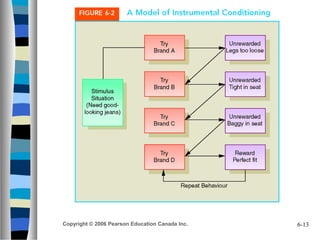
Copyright © 2006 Pearson Education Canada Inc.   6-13
Instrumental Conditioning
 Consumers   learn by means of trial and error
  process in which some purchase behaviours
  result in more favorable outcomes (rewards)
  than other purchase behaviours.
 A favorable experience is instrumental in
  teaching the individual to repeat a specific
  behaviour.

   Copyright © 2006 Pearson Education Canada Inc.   6-14
Reinforcement
                                                 Negative
   Positive
    Reinforcement:                                Reinforcement:
    Positive outcomes that                        Unpleasant or negative
    strengthen the                                outcomes that serve to
    likelihood of a specific                      encourage a specific
    response                                      behaviour
   Example: Ad showing                          Example: Ad showing
    beautiful hair as a                           wrinkled skin as
    reinforcement to buy                          reinforcement to buy
    shampoo
                                                  skin cream
     Copyright © 2006 Pearson Education Canada Inc.                    6-15
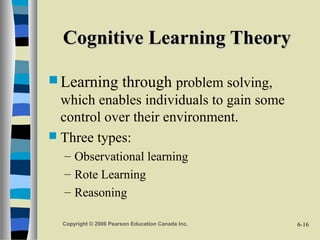
Cognitive Learning Theory

 Learning             through problem solving,
  which enables individuals to gain some
  control over their environment.
 Three types:
  – Observational learning
  – Rote Learning
  – Reasoning

  Copyright © 2006 Pearson Education Canada Inc.   6-16
Observational Learning
 individualslearn by observing the
  behaviour of others, and consequences of
  such behaviour.
 Also known as modeling or vicarious
  learning.


   Copyright © 2006 Pearson Education Canada Inc.   6-17
Rote Learning

 Learning            concepts through simple
 repetition
  – Repeated ads teach consumers about a
    product’s attributes


  Copyright © 2006 Pearson Education Canada Inc.   6-18
Reasoning

 Highest level of cognitive learning
 Involves creative thinking
 Depends on how information is
  processed and stored


  Copyright © 2006 Pearson Education Canada Inc.   6-19
Information processing and
        Involvement Theory
 Centraland Peripheral Routes to
 Persuasion
  – highly involved consumers are best reached
    through ads that focus on the specific attributes
    of the product (the central route)
  – uninvolved consumers can be attracted through
    peripheral advertising cues such as the model or
    the setting (the peripheral route).

  Copyright © 2006 Pearson Education Canada Inc.   6-20
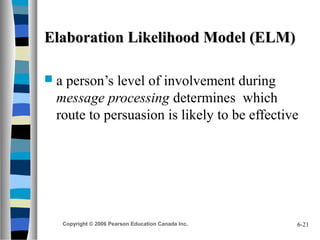
Elaboration Likelihood Model (ELM)

a person’s level of involvement during
 message processing determines which
 route to persuasion is likely to be effective


     Copyright © 2006 Pearson Education Canada Inc.   6-21
The Elaboration Likelihood Model
                                 Involvement
                                                     LOW
           HIGH

    Central                                        Peripheral
    Route                                            Route


   Message                                         Peripheral
  Arguments                                          Cues
   Influence                                       Influence
   Attitudes                                        Attitudes

  Copyright © 2006 Pearson Education Canada Inc.                6-22
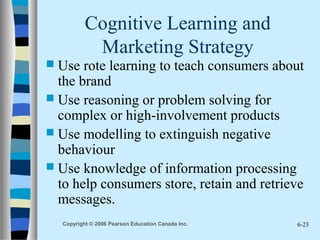
Cognitive Learning and
           Marketing Strategy
 Use  rote learning to teach consumers about
  the brand
 Use reasoning or problem solving for
  complex or high-involvement products
 Use modelling to extinguish negative
  behaviour
 Use knowledge of information processing
  to help consumers store, retain and retrieve
  messages.
  Copyright © 2006 Pearson Education Canada Inc.   6-23

Consumer learning

  • 1.
  • 2.
    Consumer Learning A processby which individuals acquire the purchase and consumption knowledge and experience that they apply to future related behaviour. 6-2
  • 3.
    Learning Processes  Intentional – learning acquired as a result of a careful search for information  Incidental -- learning acquired by accident or without much effort Copyright © 2006 Pearson Education Canada Inc. 6-3
  • 4.
    Importance of Learning Marketers must teach consumers: – where to buy – how to use – how to maintain – how to dispose off products Copyright © 2006 Pearson Education Canada Inc. 6-4
  • 5.
    Learning Theories  Behavioural Theories:  Cognitive Theories: Theories based on the A theory of learning premise that learning based on mental takes place as the result information of observable responses processing, often in to external stimuli. response to problem Also known as solving. stimulus response theory. Copyright © 2006 Pearson Education Canada Inc. 6-5
  • 6.
    Elements of LearningTheories  Motivation  Cues  Response  Reinforcement EXAMPLES Copyright © 2006 Pearson Education Canada Inc. 6-6
  • 7.
    Behavioural Learning Theories ClassicalConditioning  Instrumental Conditioning Copyright © 2006 Pearson Education Canada Inc. 6-7
  • 8.
    Classical Conditioning  Pairinga stimulus with another stimulus that elicits a known response to produce the same response when used alone. Copyright © 2006 Pearson Education Canada Inc. 6-8
  • 9.
    Copyright © 2006Pearson Education Canada Inc. 6-9
  • 10.
    Copyright © 2006Pearson Education Canada Inc. 6-10
  • 11.
    Marketing Applications of Classical Conditioning  Repetition – Increases the strength of association b/w CS & US – Can slow the process of forgetting – But can result in ‘advertising wearout’  Stimulus Generalization – The inability to perceive differences between slightly dissimilar stimuli e.g. counterfeit products, product-line extensions  Stimulus Discrimination – e.g. Product Differentiation Copyright © 2006 Pearson Education Canada Inc. 6-11
  • 12.
    Instrumental Conditioning  learningbasedon a trial-and-error process, with habits forced as the result of positive experiences (reinforcement) Copyright © 2006 Pearson Education Canada Inc. 6-12
  • 13.
    Copyright © 2006Pearson Education Canada Inc. 6-13
  • 14.
    Instrumental Conditioning  Consumers learn by means of trial and error process in which some purchase behaviours result in more favorable outcomes (rewards) than other purchase behaviours.  A favorable experience is instrumental in teaching the individual to repeat a specific behaviour. Copyright © 2006 Pearson Education Canada Inc. 6-14
  • 15.
    Reinforcement  Negative  Positive Reinforcement: Reinforcement: Positive outcomes that Unpleasant or negative strengthen the outcomes that serve to likelihood of a specific encourage a specific response behaviour  Example: Ad showing  Example: Ad showing beautiful hair as a wrinkled skin as reinforcement to buy reinforcement to buy shampoo skin cream Copyright © 2006 Pearson Education Canada Inc. 6-15
  • 16.
    Cognitive Learning Theory Learning through problem solving, which enables individuals to gain some control over their environment.  Three types: – Observational learning – Rote Learning – Reasoning Copyright © 2006 Pearson Education Canada Inc. 6-16
  • 17.
    Observational Learning  individualslearnby observing the behaviour of others, and consequences of such behaviour.  Also known as modeling or vicarious learning. Copyright © 2006 Pearson Education Canada Inc. 6-17
  • 18.
    Rote Learning  Learning concepts through simple repetition – Repeated ads teach consumers about a product’s attributes Copyright © 2006 Pearson Education Canada Inc. 6-18
  • 19.
    Reasoning  Highest levelof cognitive learning  Involves creative thinking  Depends on how information is processed and stored Copyright © 2006 Pearson Education Canada Inc. 6-19
  • 20.
    Information processing and Involvement Theory  Centraland Peripheral Routes to Persuasion – highly involved consumers are best reached through ads that focus on the specific attributes of the product (the central route) – uninvolved consumers can be attracted through peripheral advertising cues such as the model or the setting (the peripheral route). Copyright © 2006 Pearson Education Canada Inc. 6-20
  • 21.
    Elaboration Likelihood Model(ELM) a person’s level of involvement during message processing determines which route to persuasion is likely to be effective Copyright © 2006 Pearson Education Canada Inc. 6-21
  • 22.
    The Elaboration LikelihoodModel Involvement LOW HIGH Central Peripheral Route Route Message Peripheral Arguments Cues Influence Influence Attitudes Attitudes Copyright © 2006 Pearson Education Canada Inc. 6-22
  • 23.
    Cognitive Learning and Marketing Strategy  Use rote learning to teach consumers about the brand  Use reasoning or problem solving for complex or high-involvement products  Use modelling to extinguish negative behaviour  Use knowledge of information processing to help consumers store, retain and retrieve messages. Copyright © 2006 Pearson Education Canada Inc. 6-23