P A V L O V I A N CONDITIONINGBYGROUP 4:ABDUL QODIR AL-BAEKANIARIEF DUROCHMANJAJAT IMANUDIN
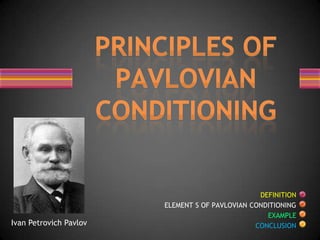
DEFINITIONELEMENT S OF PAVLOVIAN CONDITIONINGEXAMPLECONCLUSIONPRINCIPLES OF PAVLOVIAN CONDITIONINGIvan Petrovich Pavlov
DEFINITIONPavlovian conditioning is an important form of learning that involves the pairing of stimuli independent of an organism's behavior. (PAVLOV)Pav·lo·vi·an conditioning (pv-lv-n, -lô-)n.A process of behavior modification by which a subject comes to respond in a desired manner to a previously neutral stimulus that has been repeatedly presented along with an unconditioned stimulus that elicits the desired response.
Classical conditioning is a type of learning in which an animal’s natural response to one object or sensory stimulus transfers to another stimulus. © 1993-2003 Microsoft Corporation. All rights reserved.
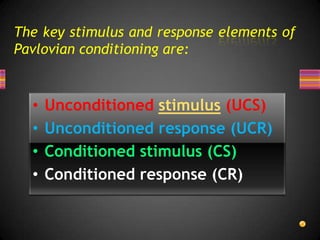
The key stimulus and response elements of Pavlovian conditioning are:Unconditioned stimulus (UCS)
Unconditioned response (UCR)
Conditioned stimulus (CS)
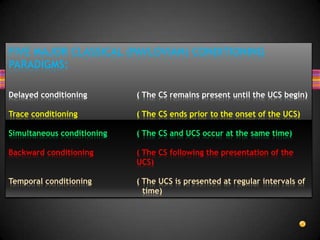
Conditioned response (CR)FIVE MAJOR CLASSICAL (PAVLOVIAN) CONDITIONING PARADIGMS:Delayed conditioning		( The CS remains present until the UCS begin)Trace conditioning		( The CS ends prior to the onset of the UCS)Simultaneous conditioning	( The CS and UCS occur at the same time)Backward conditioning		( The CS following the presentation of the 				UCS)Temporal conditioning		( The UCS is presented at regular intervals of                                                         time)
EXAMPLE
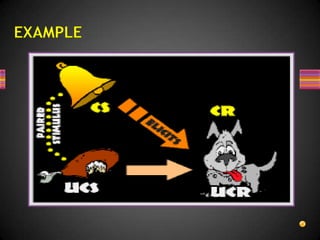
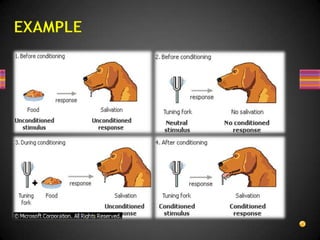
This illustration shows how a dog can learn to salivate to the sound of a tuning fork, an experiment first carried out in the early 1900s by Russian physiologist Ivan Pavlov. (see example)For conditioning to occur, the pairing of the food with the tuning fork (step 3 in the illustration) must be repeated many times, so that the dog eventually learns to associate the two items.(see example)

Principles of pavlovian conditioning

  • 1.
    P A VL O V I A N CONDITIONINGBYGROUP 4:ABDUL QODIR AL-BAEKANIARIEF DUROCHMANJAJAT IMANUDIN
  • 2.
    DEFINITIONELEMENT S OFPAVLOVIAN CONDITIONINGEXAMPLECONCLUSIONPRINCIPLES OF PAVLOVIAN CONDITIONINGIvan Petrovich Pavlov
  • 3.
    DEFINITIONPavlovian conditioning isan important form of learning that involves the pairing of stimuli independent of an organism's behavior. (PAVLOV)Pav·lo·vi·an conditioning (pv-lv-n, -lô-)n.A process of behavior modification by which a subject comes to respond in a desired manner to a previously neutral stimulus that has been repeatedly presented along with an unconditioned stimulus that elicits the desired response.
  • 4.
    Classical conditioning isa type of learning in which an animal’s natural response to one object or sensory stimulus transfers to another stimulus. © 1993-2003 Microsoft Corporation. All rights reserved.
  • 5.
    The key stimulusand response elements of Pavlovian conditioning are:Unconditioned stimulus (UCS)
  • 6.
  • 7.
  • 8.
    Conditioned response (CR)FIVEMAJOR CLASSICAL (PAVLOVIAN) CONDITIONING PARADIGMS:Delayed conditioning ( The CS remains present until the UCS begin)Trace conditioning ( The CS ends prior to the onset of the UCS)Simultaneous conditioning ( The CS and UCS occur at the same time)Backward conditioning ( The CS following the presentation of the UCS)Temporal conditioning ( The UCS is presented at regular intervals of time)
  • 9.
  • 10.
    This illustration showshow a dog can learn to salivate to the sound of a tuning fork, an experiment first carried out in the early 1900s by Russian physiologist Ivan Pavlov. (see example)For conditioning to occur, the pairing of the food with the tuning fork (step 3 in the illustration) must be repeated many times, so that the dog eventually learns to associate the two items.(see example)