Schedules of Reinforcement The Effects of Intermittently Reinforcing Behavior
Schedules of Reinforcement Behavior is not necessarily going to be reinforced every time it occurs In real life, behavior is not often reinforced each time it occurred A reinforcement schedule is a rule stating which instances of behavior, if any, will be reinforced Intermittent reinforcement refers to reinforcement that is not administered to each instance of a response
Advantages of Intermittent Reinforcement Economizing on time and reinforcers when reinforcement does not have to be administered for each instance of a behavior Building persistent behavior which is much more resistant to extinction Delays the effects of satiation since fewer reinforcements need to be delivered
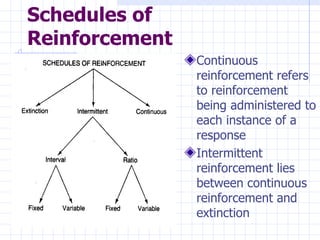
Types of Schedules Continuous reinforcement: every instance of a behavior is reinforced Ratio schedules: Reinforcement is based on the number of behaviors  required Interval schedules: Reinforcement is based on the passage of time Duration schedules: Reinforcement is based on the continued performance of a response for a period of time Fixed schedules: The requirements for reinforcement are always the same Variable schedules: The requirements for reinforcement change randomly
Schedules of Reinforcement Continuous reinforcement refers to reinforcement being administered to each instance of a response Intermittent reinforcement lies between continuous reinforcement and extinction
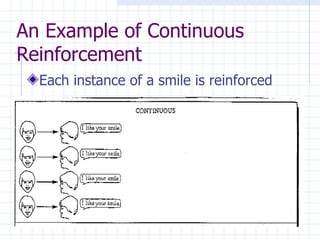
An Example of Continuous Reinforcement Each instance of a smile is reinforced
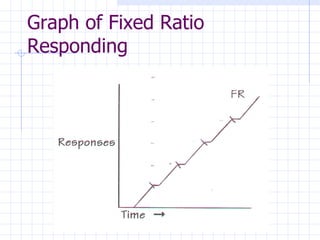
Fixed Ratio Reinforcement A fixed number of responses is required for each reinforcement These schedules are designated FR n  where  n= the number of responses required  These schedules usually produce rapid rates of responding with short post-reinforcement pauses The length of the pause is directly proportional to the number of responses required
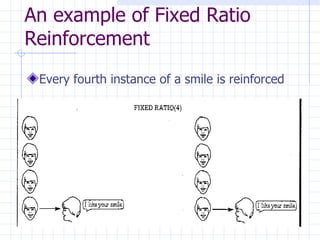
An example of Fixed Ratio Reinforcement Every fourth instance of a smile is reinforced
Graph of Fixed Ratio Responding
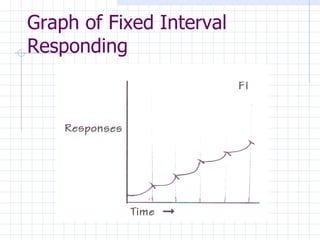
Fixed Interval Reinforcement These schedules require the passage of a specified amount of time before reinforcement will be delivered contingent on a response No response during the interval is reinforced The first response following the end of the interval is reinforced This schedule usually produces a scalloped pattern of responding in which little behavior is produced early in the interval, but as the interval nears an end, the rate of responding increases This also produces an overall low rate of responding
Graph of Fixed Interval Responding
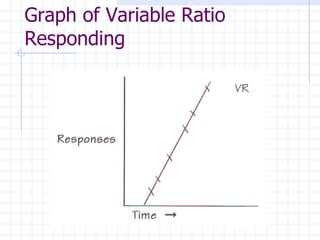
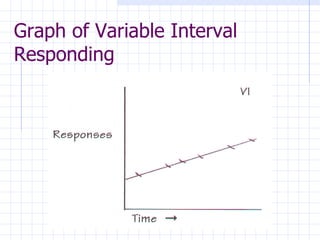
Variable Schedules of Reinforcement Variable schedules differ from fixed schedules in that the behavioral requirement for reinforcement varies randomly from one reinforcement to the next This usually produces a more consistent pattern of responding without post-reinforcement pauses Variable ratio schedules produce an overall high consistent rate of responding Variable interval schedules produce an overall low consistent rate of responding
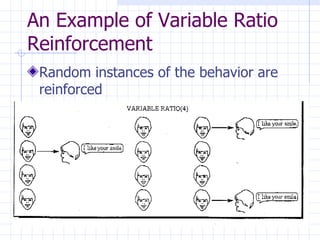
An Example of Variable Ratio Reinforcement Random instances of the behavior are reinforced
Graph of Variable Ratio Responding
Graph of Variable Interval Responding
Fixed and Variable Duration Schedules The response is required to continue for a specified or variable period of time for reinforcement to be delivered These schedules produce a continuous rate of behavior since that is the requirement for reinforcement
Extinction of Intermittently Reinforced Behavior The less often and the more inconsistently behavior is reinforced, the longer it will take to extinguish the behavior, other things being equal Behaviors that are reinforced on a “thin” schedule are more resistant to extinction than behaviors reinforced on a more dense schedule Behavior that is reinforced on a variable schedule will be more resistant to extinction than behavior reinforced on a fixed schedule
Reducing Reinforcer Density Large amounts of behavior can be obtained with very little reinforcement using intermittent schedules Initially, behavior needs dense schedules of reinforcement to establish it, preferably continuous reinforcement As the behavior is strengthened, reinforcement can be gradually reduced in frequency Start with as low a density as the behavior can tolerate and decrease the density as responding is strengthened
If it is reduced too quickly, signs of extinction may be observed Response rate may slow down Inconsistent responding may be seen May see an increase in other responses This is known as schedule strain If this happens, retreat to a denser reinforce-ment schedule  Adding a conditioned reinforcer in between reinforcements can help bridge the gap
Variations of Reinforcement Schedules I: Limited Hold This is applied when a faster rate of responding is desired with a fixed interval schedule Response rate can be slowed down if response is not made soon after the end of the interval By limiting how long the reinforcer is available following the end of the interval, responding can be speeded up If the response is not made within that period, the reinforcement is lost and another is not available until the end of the next interval
Variations of Reinforcement Schedules II: Concurrent Schedules Two or more basic schedules are operating independently at the same time for two or more different behaviors The organism has a choice of behaviors and schedules This provides a better analog for real-life situations because reinforcement is often available for more than one response class or from more than one source or both
Concurrent Schedules  (cont’d) When similar reinforcement is scheduled for each of the concurrent responses: the response receiving the higher frequency of reinforcement will increase in rate the response requiring the least effort will increase in rate the response providing the most immediate reinforcement will increase in rate
Matching Law and Maximizing The proportion of responses made to each schedule will be proportionate to the ratio of reinforcers available under each schedule Maximizing: subjects switch back and forth between alternatives to receive maximum reinforcers Concurrent ratio schedules: little switching back and forth Concurrent interval schedules: the subjects can earn close to all of the reinforcements on both schedules
Variations of Reinforcement Schedules II: Chained Schedules Two or more basic schedule requirements are in place, one schedule occurring at a time but in a specified sequence There is usually a cue that is correlated with a specific schedule and is present as long as the schedule is in effect Reinforcement for responding in the 1 st  component is the presentation of the 2 nd   Reinforcement does not occur until the final component is performed
Variations of Reinforcement Schedules III: Conjunctive Schedules The requirements for two or more schedules must be met simultaneously Task/interval interactions When the task requirements are high and the interval is short, steady work throughout the interval will be the result When task requirements are low and the interval long, many nontask behaviors will be observed

schedules of reinforcement

  • 1.
    Schedules of ReinforcementThe Effects of Intermittently Reinforcing Behavior
  • 2.
    Schedules of ReinforcementBehavior is not necessarily going to be reinforced every time it occurs In real life, behavior is not often reinforced each time it occurred A reinforcement schedule is a rule stating which instances of behavior, if any, will be reinforced Intermittent reinforcement refers to reinforcement that is not administered to each instance of a response
  • 3.
    Advantages of IntermittentReinforcement Economizing on time and reinforcers when reinforcement does not have to be administered for each instance of a behavior Building persistent behavior which is much more resistant to extinction Delays the effects of satiation since fewer reinforcements need to be delivered
  • 4.
    Types of SchedulesContinuous reinforcement: every instance of a behavior is reinforced Ratio schedules: Reinforcement is based on the number of behaviors required Interval schedules: Reinforcement is based on the passage of time Duration schedules: Reinforcement is based on the continued performance of a response for a period of time Fixed schedules: The requirements for reinforcement are always the same Variable schedules: The requirements for reinforcement change randomly
  • 5.
    Schedules of ReinforcementContinuous reinforcement refers to reinforcement being administered to each instance of a response Intermittent reinforcement lies between continuous reinforcement and extinction
  • 6.
    An Example ofContinuous Reinforcement Each instance of a smile is reinforced
  • 7.
    Fixed Ratio ReinforcementA fixed number of responses is required for each reinforcement These schedules are designated FR n where n= the number of responses required These schedules usually produce rapid rates of responding with short post-reinforcement pauses The length of the pause is directly proportional to the number of responses required
  • 8.
    An example ofFixed Ratio Reinforcement Every fourth instance of a smile is reinforced
  • 9.
    Graph of FixedRatio Responding
  • 10.
    Fixed Interval ReinforcementThese schedules require the passage of a specified amount of time before reinforcement will be delivered contingent on a response No response during the interval is reinforced The first response following the end of the interval is reinforced This schedule usually produces a scalloped pattern of responding in which little behavior is produced early in the interval, but as the interval nears an end, the rate of responding increases This also produces an overall low rate of responding
  • 11.
    Graph of FixedInterval Responding
  • 12.
    Variable Schedules ofReinforcement Variable schedules differ from fixed schedules in that the behavioral requirement for reinforcement varies randomly from one reinforcement to the next This usually produces a more consistent pattern of responding without post-reinforcement pauses Variable ratio schedules produce an overall high consistent rate of responding Variable interval schedules produce an overall low consistent rate of responding
  • 13.
    An Example ofVariable Ratio Reinforcement Random instances of the behavior are reinforced
  • 14.
    Graph of VariableRatio Responding
  • 15.
    Graph of VariableInterval Responding
  • 16.
    Fixed and VariableDuration Schedules The response is required to continue for a specified or variable period of time for reinforcement to be delivered These schedules produce a continuous rate of behavior since that is the requirement for reinforcement
  • 17.
    Extinction of IntermittentlyReinforced Behavior The less often and the more inconsistently behavior is reinforced, the longer it will take to extinguish the behavior, other things being equal Behaviors that are reinforced on a “thin” schedule are more resistant to extinction than behaviors reinforced on a more dense schedule Behavior that is reinforced on a variable schedule will be more resistant to extinction than behavior reinforced on a fixed schedule
  • 18.
    Reducing Reinforcer DensityLarge amounts of behavior can be obtained with very little reinforcement using intermittent schedules Initially, behavior needs dense schedules of reinforcement to establish it, preferably continuous reinforcement As the behavior is strengthened, reinforcement can be gradually reduced in frequency Start with as low a density as the behavior can tolerate and decrease the density as responding is strengthened
  • 19.
    If it isreduced too quickly, signs of extinction may be observed Response rate may slow down Inconsistent responding may be seen May see an increase in other responses This is known as schedule strain If this happens, retreat to a denser reinforce-ment schedule Adding a conditioned reinforcer in between reinforcements can help bridge the gap
  • 20.
    Variations of ReinforcementSchedules I: Limited Hold This is applied when a faster rate of responding is desired with a fixed interval schedule Response rate can be slowed down if response is not made soon after the end of the interval By limiting how long the reinforcer is available following the end of the interval, responding can be speeded up If the response is not made within that period, the reinforcement is lost and another is not available until the end of the next interval
  • 21.
    Variations of ReinforcementSchedules II: Concurrent Schedules Two or more basic schedules are operating independently at the same time for two or more different behaviors The organism has a choice of behaviors and schedules This provides a better analog for real-life situations because reinforcement is often available for more than one response class or from more than one source or both
  • 22.
    Concurrent Schedules (cont’d) When similar reinforcement is scheduled for each of the concurrent responses: the response receiving the higher frequency of reinforcement will increase in rate the response requiring the least effort will increase in rate the response providing the most immediate reinforcement will increase in rate
  • 23.
    Matching Law andMaximizing The proportion of responses made to each schedule will be proportionate to the ratio of reinforcers available under each schedule Maximizing: subjects switch back and forth between alternatives to receive maximum reinforcers Concurrent ratio schedules: little switching back and forth Concurrent interval schedules: the subjects can earn close to all of the reinforcements on both schedules
  • 24.
    Variations of ReinforcementSchedules II: Chained Schedules Two or more basic schedule requirements are in place, one schedule occurring at a time but in a specified sequence There is usually a cue that is correlated with a specific schedule and is present as long as the schedule is in effect Reinforcement for responding in the 1 st component is the presentation of the 2 nd Reinforcement does not occur until the final component is performed
  • 25.
    Variations of ReinforcementSchedules III: Conjunctive Schedules The requirements for two or more schedules must be met simultaneously Task/interval interactions When the task requirements are high and the interval is short, steady work throughout the interval will be the result When task requirements are low and the interval long, many nontask behaviors will be observed