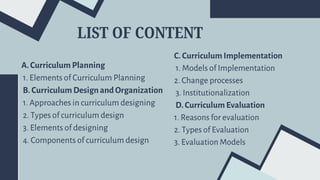
LIST OF CONTENT
A.Curriculum Planning
1. Elements of Curriculum Planning
B. Curriculum Design and Organization
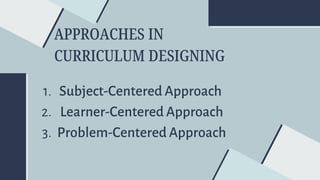
1. Approaches in curriculum designing
2. Types of curriculum design
3. Elements of designing
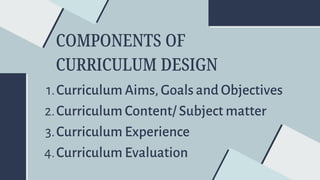
4. Components of curriculum design
C. Curriculum Implementation
1. Models of Implementation
2. Change processes
3. Institutionalization
D. Curriculum Evaluation
1. Reasons for evaluation
2. Types of Evaluation
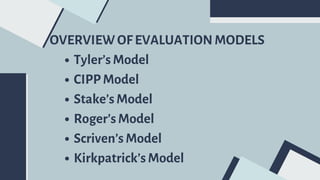
3. Evaluation Models
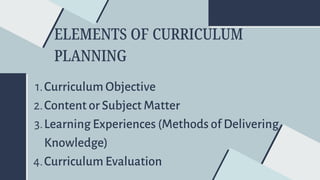
1.Curriculum Objective
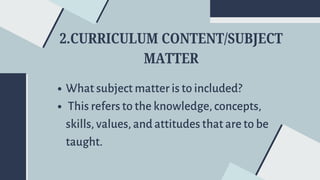
2.Content orSubject Matter
3.Learning Experiences (Methods of Delivering
Knowledge)
4.Curriculum Evaluation
ELEMENTS OF CURRICULUM
PLANNING
6.
Objectives define thegoals, vision, and mission of
the curriculum, specifying what is to be achieved.
CURRICULUM OBJECTIVE
7.
Once the goalsare established, the curriculum
planner selects the content and resources that will
be used to achieve those goals.
CONTENT OR SUBJECT MATTER
8.
Curriculum planning involvesdesigning engaging
and effective learning experiences that will help
students achieve the desired outcomes.
LEARNING EXPERIENCES (METHODS
OF DELIVERING KNOWLEDGE)
9.
Curriculum planning isnot a one-time event. It is
an ongoing process that involves implementing
the curriculum monitoring its effectiveness, and
making adjustments as needed.
CURRICULUM EVALUATION
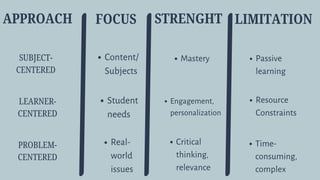
SUBJECT-CENTERED APPROACH
It isan approach in designing curriculum where
the main focus is the subject or content being
taught.
Teachthesubjectfirst—everythingelsefollow
LEARNER-CENTERD APPROACH
the mainfocus is the learner, their needs,
interests, and experiences.
students learn through activities that
match how they learn best, not just what
the subject requires.
15.
DISADVANTAGE &
LIMITATION
It oftenrelies on the teacher’s ability to
create materials appropriate to learner’s
expressed needs.
often require diverse materials, technology,
and space for collaboration.
NO SINGLE-APPROACH CURRICULUM
Throughoutthe history of the Philippine Department of Education
(DepEd), no officially implemented curriculum has used only one
approach (subject-centered, learner-centered, or problem-centered).
https://www.deped.gov.ph/wp-content/uploads/2013/07/DO_s2013_043.pdfDepEdOrderNo.43,s.2013–
ImplementingRulesandRegulationsofRA10533
The curriculum shall be flexible enough to allow contextualization
and localization without compromising the attainment of learning
standards
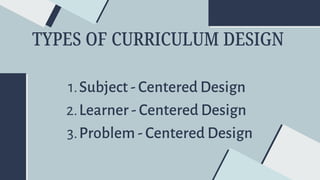
SUBJECT-CENTERED DESIGN
▪︎A modelwhere the curriculum is divided into subject
areas, and there is little flexibility for cross- curricular
activity. Subjects are siloed. (Siloed subjects - isolated learning)
23.
SUBJECT-CENTERED DESIGN
▪︎These curriculaoften encourage memorization and
repetitive practice of facts and ideas. Traditionally, students
had little choice about what they studied under these
curricula.
24.
LEARNER - CENTEREDDESIGN
▪︎The center of interest is the learner. The students are
given more importance in this type of curriculum design.
Learner centered design emphasizes individual
development and their approach to organising the
curriculum merges from the needs, interests and purposes
of students.
25.
PROBLEM - CENTEREDDESIGN
■Problem - Centered curricula focus on teaching
students how to look at a problem and come up with a
solution to the problem.
26.
PROBLEM - CENTEREDDESIGN
■School activities revolve around solutions problem
like poverty, drug problems, deterioration of values,
environmental concerns.
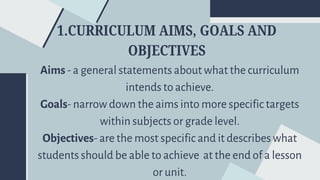
1.CURRICULUM AIMS, GOALSAND
OBJECTIVES
Aims - a general statements about what the curriculum
intends to achieve.
Goals- narrow down the aims into more specific targets
within subjects or grade level.
Objectives- are the most specific and it describes what
students should be able to achieve at the end of a lesson
or unit.
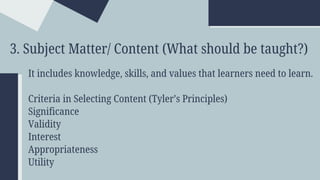
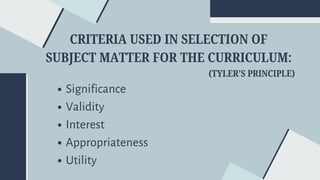
CRITERIA USED INSELECTION OF
SUBJECT MATTER FOR THE CURRICULUM:
(TYLER’S PRINCIPLE)
Significance
Validity
Interest
Appropriateness
Utility
40.
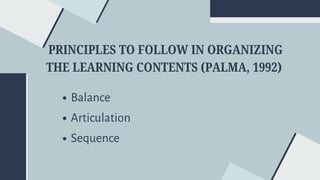
PRINCIPLES TO FOLLOWIN ORGANIZING
THE LEARNING CONTENTS (PALMA, 1992)
Balance
Articulation
Sequence
41.
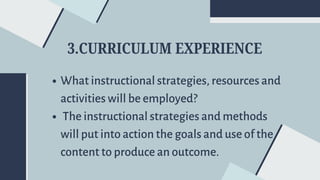
3.CURRICULUM EXPERIENCE
What instructionalstrategies, resources and
activities will be employed?
The instructional strategies and methods
will put into action the goals and use of the
content to produce an outcome.
42.
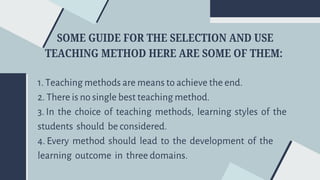
SOME GUIDE FORTHE SELECTION AND USE
TEACHING METHOD HERE ARE SOME OF THEM:
1. Teaching methods are means to achieve the end.
2. There is no single best teaching method.
3. In the choice of teaching methods, learning styles of the
students should be considered.
4. Every method should lead to the development of the
learning outcome in three domains.
43.
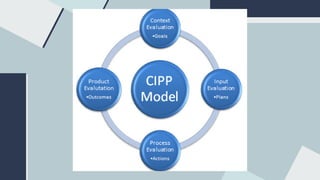
4.CURRICULUM EVALUATION
What instrumentsand methods will be used to assess
the results of the curriculum?
Curriculum evaluation refer to the formal
determination of the quality, effectiveness or value of
the program, process, and product of the curriculum.
The most widely used evaluation model is
Stufflebeam's CIPP Model.
This model restson the assumption that the success
or otherwise of curriculum implementation
primarily depends on the impact the developer can
make on the consumers, i.e., teachers, students and
the society in general.
ORC MODEL
(OVERCOMING RESISTANCE TO CHANGE)
47.
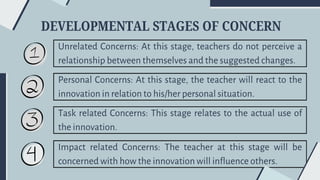
DEVELOPMENTAL STAGES OFCONCERN
Personal Concerns: At this stage, the teacher will react to the
innovation in relation to his/her personal situation.
Task related Concerns: This stage relates to the actual use of
the innovation.
Impact related Concerns: The teacher at this stage will be
concerned with how the innovation will influence others.
Unrelated Concerns: At this stage, teachers do not perceive a
relationship between themselves and the suggested changes.
48.
LOC MODEL
(LEADERSHIP-OBSTACLE COURSE)
Thismodel treats staff resistance to change as problematic and
proposes that we should collect data to determine the extent
and nature of the resistance.
We can do this by making sure that the following five conditions exist:
a. the organizational members must have a clear understanding of the proposed
innovation;
b. individuals within the organization must be given relevant skills so that they
possess the capabilities requisite for carrying out the innovation;
49.
The LOC modelconsiders educational change as a sequence of three
stages:
1. initiation;
2. attempted implementation; and
3. incorporation
c. the necessary materials and equipment for the innovation must be furnished;
d. if need be, the organizational structure must be modified so that it is compatible
with the innovation being suggested; and
e. the participants in the innovation must be motivated to spend the required time
and effort to make the innovation a success.
50.
It recognizes thatthere are innovators in research and development centers,
universities, etc. Educators in the field, however, find some of their
attempts at innovations that are inappropriate for solving the problems.
What is therefore needed is a match between the problems and
innovations-the establishment of linkages.
This model envisages two systems:
• User system (individual's problems, societal problems)
• Resource system (university, resource center)
LINKAGE MODEL
51.
It suggests thatorganizational dynamics
seem to be the chief barriers to change.
RCA MODEL
(RAND CHANGE AGENT)
As in ORC and LOC models, it puts forward the following
three stages in the change process:
1. initiation;
2. implementation; and
3. incorporation
WHAT IS CHANGEIN CURRICULUM
DEVELOPMENT?
Curriculum change means making
improvements in what we teach and how we
teach. It happens because the world is always
changing (new technology, new knowledge,
and new needs of learners).
54.
WHY DO WENEED TO CHANGE?
The world is changing
(e.g. use of computers and internet in learning).
Students are different today
Society needs new skills
Laws and Policies requires updates.
55.
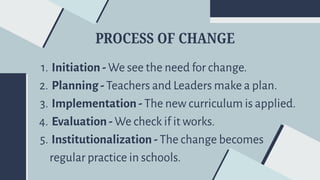
PROCESS OF CHANGE
1.Initiation - We see the need for change.
2. Planning - Teachers and Leaders make a plan.
3. Implementation - The new curriculum is applied.
4. Evaluation - We check if it works.
5. Institutionalization - The change becomes
regular practice in schools.
56.
Change must beplanned, not rushed.
Change must involve everyone (teachers,
parents, students, leaders).
Change must be flexible.
Change must be sustainable
To assess effectivenessand relevance
To guide curriculum improvement
To inform policy and instructional decisions
To ensure alignment with standards
To support accountability and transparency
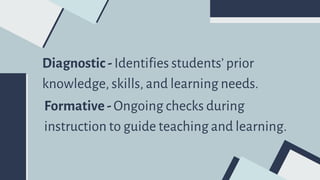
Diagnostic - Identifiesstudents’ prior
knowledge, skills, and learning needs.
Formative - Ongoing checks during
instruction to guide teaching and learning.
61.
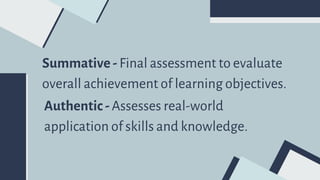
Summative - Finalassessment to evaluate
overall achievement of learning objectives.
Authentic - Assesses real-world
application of skills and knowledge.
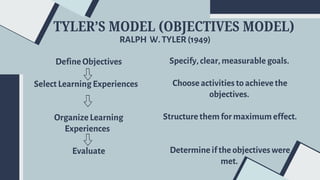
Define Objectives
Select LearningExperiences
Organize Learning
Experiences
Evaluate
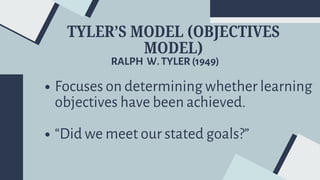
TYLER’S MODEL (OBJECTIVES MODEL)
RALPH W. TYLER (1949)
Specify, clear, measurable goals.
Choose activities to achieve the
objectives.
Structure them for maximum effect.
Determine if the objectives were
met.
66.
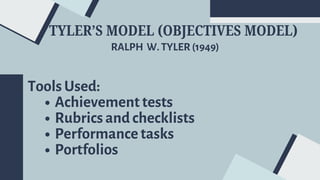
TYLER’S MODEL (OBJECTIVESMODEL)
Tools Used:
Achievement tests
Rubrics and checklists
Performance tasks
Portfolios
RALPH W. TYLER (1949)
67.
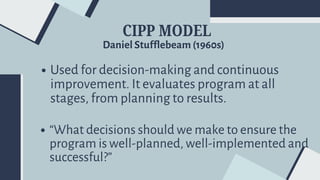
CIPP MODEL
Used fordecision-making and continuous
improvement. It evaluates program at all
stages, from planning to results.
“What decisions should we make to ensure the
program is well-planned, well-implemented and
successful?”
Daniel Stufflebeam (1960s)
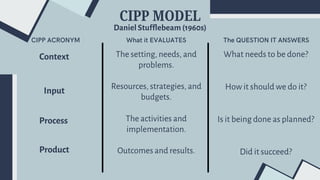
68.
The setting, needs,and
problems.
Resources, strategies, and
budgets.
The activities and
implementation.
Outcomes and results.
CIPP MODEL
Daniel Stufflebeam (1960s)
Context
Input
Process
Product
What needs to be done?
How it should we do it?
Is it being done as planned?
Did it succeed?
CIPP ACRONYM What it EVALUATES The QUESTION IT ANSWERS
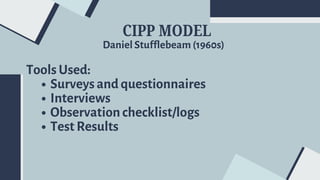
69.
CIPP MODEL
Tools Used:
Surveysand questionnaires
Interviews
Observation checklist/logs
Test Results
Daniel Stufflebeam (1960s)
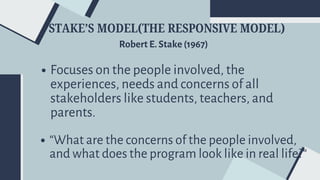
70.
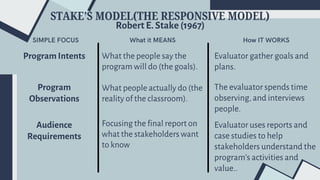
STAKE’S MODEL(THE RESPONSIVEMODEL)
Focuses on the people involved, the
experiences, needs and concerns of all
stakeholders like students, teachers, and
parents.
“What are the concerns of the people involved,
and what does the program look like in real life?“
Robert E. Stake (1967)
71.
What the peoplesay the
program will do (the goals).
What people actually do (the
reality of the classroom).
Focusing the final report on
what the stakeholders want
to know
Program Intents
Program
Observations
Audience
Requirements
Evaluator gather goals and
plans.
The evaluator spends time
observing, and interviews
people.
Evaluator uses reports and
case studies to help
stakeholders understand the
program’s activities and
value..
SIMPLE FOCUS What it MEANS How IT WORKS
STAKE’S MODEL(THE RESPONSIVE MODEL)
Robert E. Stake (1967)
72.
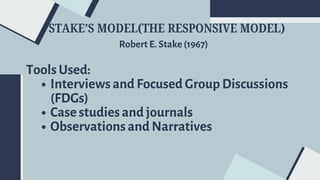
STAKE’S MODEL(THE RESPONSIVEMODEL)
Tools Used:
Interviews and Focused Group Discussions
(FDGs)
Case studies and journals
Observations and Narratives
Robert E. Stake (1967)
73.
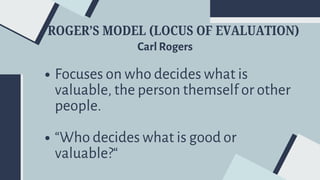
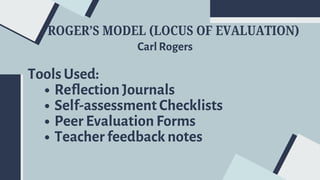
ROGER’S MODEL (LOCUSOF EVALUATION)
Focuses on who decides what is
valuable, the person themself or other
people.
“Who decides what is good or
valuable?“
Carl Rogers
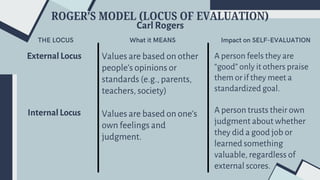
74.
Values are basedon other
people’s opinions or
standards (e.g., parents,
teachers, society)
Values are based on one’s
own feelings and
judgment.
External Locus
Internal Locus
A person feels they are
“good” only it others praise
them or if they meet a
standardized goal.
A person trusts their own
judgment about whether
they did a good job or
learned something
valuable, regardless of
external scores.
THE LOCUS What it MEANS Impact on SELF-EVALUATION
ROGER’S MODEL (LOCUS OF EVALUATION)
Carl Rogers
75.
ROGER’S MODEL (LOCUSOF EVALUATION)
Tools Used:
Reflection Journals
Self-assessment Checklists
Peer Evaluation Forms
Teacher feedback notes
Carl Rogers
76.
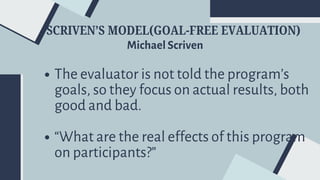
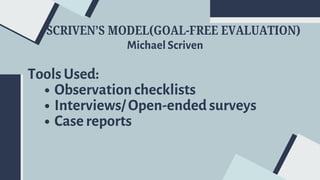
SCRIVEN’S MODEL(GOAL-FREE EVALUATION)
Theevaluator is not told the program’s
goals, so they focus on actual results, both
good and bad.
“What are the real effects of this program
on participants?”
Michael Scriven
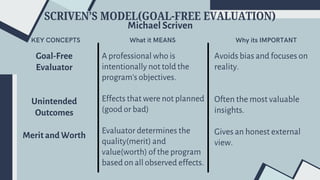
77.
A professional whois
intentionally not told the
program’s objectives.
Effects that were not planned
(good or bad)
Evaluator determines the
quality(merit) and
value(worth) of the program
based on all observed effects.
Goal-Free
Evaluator
Unintended
Outcomes
Merit and Worth
Avoids bias and focuses on
reality.
Often the most valuable
insights.
Gives an honest external
view.
KEY CONCEPTS What it MEANS Why its IMPORTANT
SCRIVEN’S MODEL(GOAL-FREE EVALUATION)
Michael Scriven
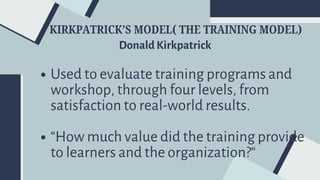
KIRKPATRICK’S MODEL( THETRAINING MODEL)
Used to evaluate training programs and
workshop, through four levels, from
satisfaction to real-world results.
“How much value did the training provide
to learners and the organization?“
Donald Kirkpatrick
80.
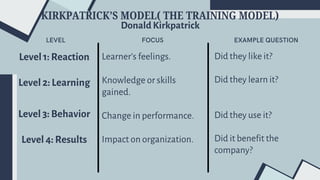
Learner’s feelings.
Knowledge orskills
gained.
Change in performance.
Impact on organization.
Level 1: Reaction
Level 2: Learning
Level 3: Behavior
Level 4: Results
Did they like it?
Did they learn it?
Did they use it?
Did it benefit the
company?
LEVEL FOCUS EXAMPLE QUESTION
KIRKPATRICK’S MODEL( THE TRAINING MODEL)
Donald Kirkpatrick
81.
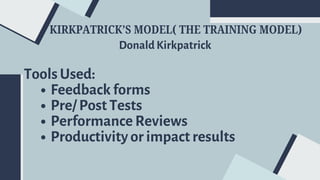
KIRKPATRICK’S MODEL( THETRAINING MODEL)
Tools Used:
Feedback forms
Pre/ Post Tests
Performance Reviews
Productivity or impact results
Donald Kirkpatrick
82.
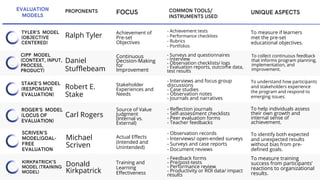
Daniel
Stufflebeam
Carl Rogers
Donald
Kirkpatrick
Michael
Scriven
Robert E.
Stake
Continuous
Decision-Making
for
Improvement
Sourceof Value
Judgment
(Internal vs.
External)
Training and
Learning
Effectiveness
Actual Effects
(Intended and
Unintended)
Stakeholder
Experiences and
Needs
- Surveys and questionnaires
- Interview
- Observation checklists/ logs
- Evaluation reports, outcome data,
test results
- Reflection journals
- Self-assessment checklists
- Peer evaluation forms
- Teacher feedbacks
- Feedback forms
- Pre/post-tests
- Performance review
- Productivity or ROI data/ impact
results
- Observation records
- Interviews/ open-ended surveys
- Surveys and case reports
- Document reviews
- Interviews and focus group
discussions
- Case studies
- Observation notes
- Journals and narratives
To collect continuous feedback
that informs program planning,
implementation, and
improvement.
To help individuals assess
their own growth and
internal sense of
achievement.
To measure training
success from participants’
reactions to organizational
results.
To identify both expected
and unexpected results
without bias from pre-
defined goals.
To understand how participants
and stakeholders experience
the program and respond to
emerging issues.
PROPONENTS FOCUS COMMON TOOLS/
INSTRUMENTS USED
UNIQUE ASPECTS
EVALUATION
MODELS
Ralph Tyler Achievement of
Pre-set
Objectives
- Achievement tests
- Performance checklists
- Rubrics
- Portfolios
To measure if learners
met the pre-set
educational objectives.
TYLER’S MODEL
(OBJECTIVE
CENTERED)
CIPP MODEL
(CONTEXT, INPUT,
PROCESS,
PRODUCT)
STAKE’S MODEL
(RESPONSIVE
EVALUATION)
ROGER’S MODEL
(LOCUS OF
EVALUATION)
SCRIVEN’S
MODEL(GOAL-
FREE
EVALUATION
KIRKPATRICK’S
MODEL (TRAINING
MODEL)
Daniel
Stufflebeam
Carl
Rogers
Donald
Kirkpatrick
Michael
Scriven
Robert E.
Stake
Continuous
Decision-
Making for
Improvement
Sourceof Value
Judgment
(Internal vs.
External)
Training and
Learning
Effectiveness
Actual Effects
(Intended and
Unintended)
Stakeholder
Experiences
and Needs
Evaluates Context,
Input, Process, and
Product stages.
Emphasizes Locus
of Evaluation —
who determines
value.
Four evaluation
levels: Reaction,
Learning, Behavior,
Results.
Goal-Free
Evaluation
(GFE).
Responsive
evaluation; adapts
to changing needs.
Used to guide
decisions rather than
just judge results.
Promotes self-
assessment and
personal growth.
Widely used in
training and
professional
development.
Focuses on merit,
worth, and impact
without bias from
stated goals.
Uses qualitative
data and multiple
perspectives.
Broader in scope;
emphasizes
improvement and
decision-making rather
than just proving success
or failure.
Not a standard program
evaluation; focuses on
personal reflection and
internal evaluation.
Structured and
hierarchical,
measuring
effectiveness step-by-
step.
Evaluates without
knowing program
goals, revealing
unexpected outcomes.
Emphasizes real
experiences and
stakeholder concerns
over pre-set goals.
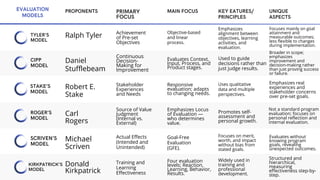
PROPONENTS PRIMARY
FOCUS
MAIN FOCUS KEY EATURES/
PRINCIPLES
UNIQUE
ASPECTS
EVALUATION
MODELS
Ralph Tyler Achievement
of Pre-set
Objectives
Objective-based
and linear
process.
Emphasizes
alignment between
objectives, learning
activities, and
evaluation.
Focuses mainly on goal
attainment and
measurable outcomes;
less flexible to changes
during implementation.
TYLER’S
MODEL
CIPP
MODEL
STAKE’S
MODEL
ROGER’S
MODEL
SCRIVEN’S
MODEL
KIRKPATRICK’S
MODEL
 Most read