Learning
Learning A relatively permanent change in behavior that results from experience Types Classical conditioning Operant conditioning Cognitive and social learning
Classical Conditioning: Examples Sound of a dentist’s drill: sweaty palms Sight of significant other: smiling Smell of a certain beverage: nausea Noise of a can opener: cat comes running How does this happen?
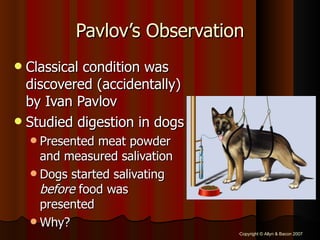
Pavlov’s Observation Classical condition was discovered (accidentally) by Ivan Pavlov Studied digestion in dogs Presented meat powder and measured salivation Dogs started salivating  before  food was presented Why?
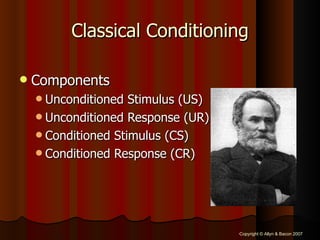
Classical Conditioning Components Unconditioned Stimulus (US) Unconditioned Response (UR) Conditioned Stimulus (CS) Conditioned Response (CR)
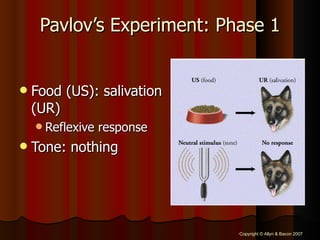
Pavlov’s Experiment: Phase 1 Food (US): salivation (UR) Reflexive response Tone: nothing
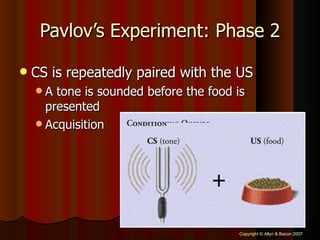
Pavlov’s Experiment: Phase 2 CS is repeatedly paired with the US A tone is sounded before the food is presented Acquisition
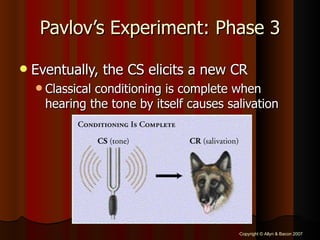
Pavlov’s Experiment: Phase 3 Eventually, the CS elicits a new CR Classical conditioning is complete when hearing the tone by itself causes salivation
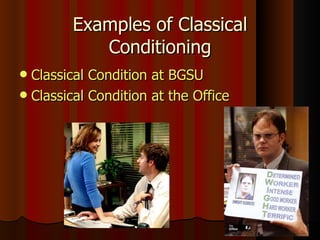
Examples of Classical Conditioning Classical Condition at BGSU Classical Condition at the Office
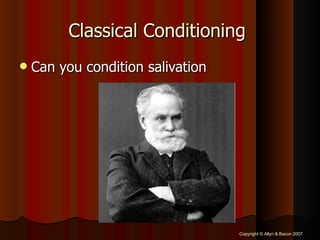
Classical Conditioning  Can you condition salivation
CS and US Presentation Different Presentation Types Delayed conditioning CS occurs before and during Trace conditioning CS ends before presentation of the US Backward conditioning US comes first followed by CS Simultaneous conditioning CS and US at the same time
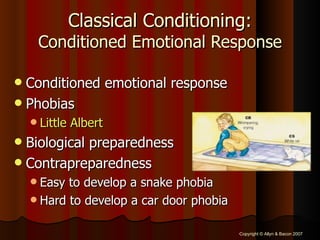
Classical Conditioning: Conditioned Emotional Response Conditioned emotional response Phobias Little Albert Biological preparedness Contrapreparedness Easy to develop a snake phobia Hard to develop a car door phobia
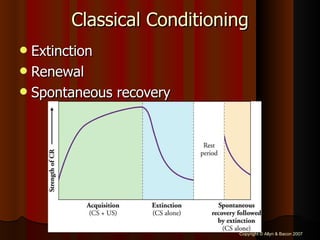
Classical Conditioning Extinction Renewal Spontaneous recovery
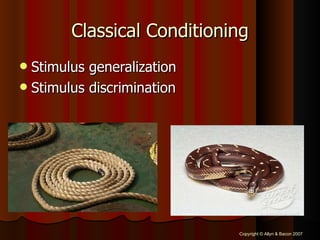
Classical Conditioning Stimulus generalization Stimulus discrimination
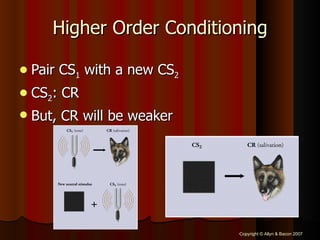
Higher Order Conditioning Pair CS 1  with a new CS 2 CS 2 : CR But, CR will be weaker
Associative Learning This involves an organism making a connection (or ‘association’) between a particular situation and a particular response.   $$$$ = Happiness $$$$ = Sex $$$$ = Love
Dissecting Classical Conditioning Learning to be afraid Information registers in the brain Amygdala reacts Hippocampus helps store associations with context Sets of neurons become linked
Classical Conditioning Applied Drug overdoses Conditioned compensatory response Smoking: environmental cues Therapy: systematic desensitization Advertising: sex appeal Anticipatory nausea Conditioning and the immune system
Types of Learning Classical conditioning Operant conditioning Cognitive and social learning
Operant Conditioning: Examples Tantrums are punished: fewer tantrums Tantrums bring attention: more tantrums Slot machine pays out: gamble more Reward dog for sitting: dog is likely to sit How does this happen?
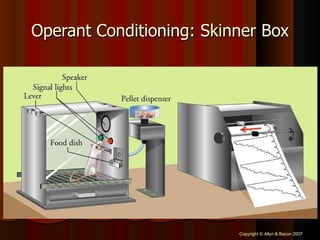
Operant Conditioning: Skinner Box
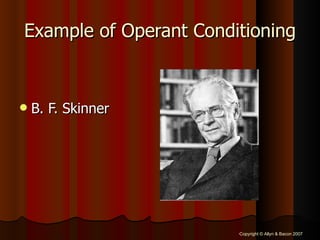
Example of Operant Conditioning B. F. Skinner
Operant Conditioning: Principles Positive Reinforcement:  Behavior is increased because it is followed by rewarding stimulus.  Give a compliment, get a kiss give; you begin to give more compliments. Negative Reinforcement : Behavior is increased because a negative stimulus is removed.  Nag your roommate to clean, stop nagging when your roommate cleans; your roommate cleans more to avoid nagging. Positive Punishment:  Behavior is decreased because it is followed by negative stimulus.  You boss yells at you for arriving late; you arrive on time next time. Negative Punishment:  Behavior is decreased because rewarding stimulus is removed.  You BF/GF won’t kiss you because you smoke; you begin to smoke less.
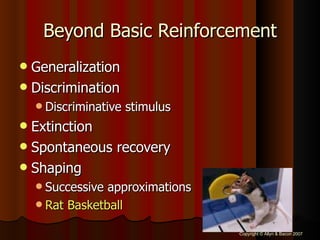
Beyond Basic Reinforcement Generalization Discrimination Discriminative stimulus Extinction Spontaneous recovery Shaping Successive approximations Rat Basketball
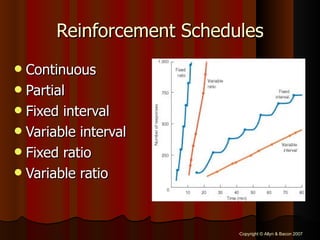
Reinforcement Schedules Continuous Partial Fixed interval Variable interval Fixed ratio Variable ratio
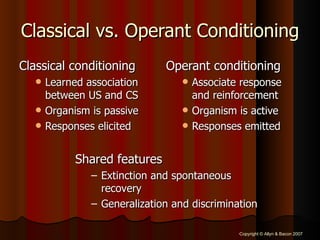
Classical vs. Operant Conditioning Classical conditioning Learned association between US and CS Organism is passive Responses elicited Operant conditioning Associate response and reinforcement Organism is active Responses emitted Shared features Extinction and spontaneous recovery Generalization and discrimination
Types of Learning Classical conditioning Operant conditioning Cognitive and social learning
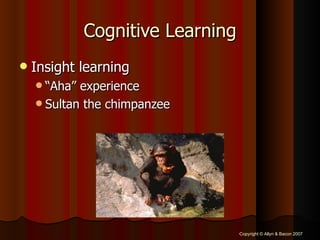
Cognitive Learning Insight learning “ Aha” experience Sultan the chimpanzee
Observational Learning Bandura’s social learning theory Bobo doll study Modeling Learning from models
Observational Learning Violence on TV 57% of programs contain violence 73% of perpetrators receive no punishment No harm to victim in almost half of the violent interactions 58% of victims show no pain 4% of violent programs show nonviolent solutions Video games

Chapter 4

  • 1.
  • 2.
    Learning A relativelypermanent change in behavior that results from experience Types Classical conditioning Operant conditioning Cognitive and social learning
  • 3.
    Classical Conditioning: ExamplesSound of a dentist’s drill: sweaty palms Sight of significant other: smiling Smell of a certain beverage: nausea Noise of a can opener: cat comes running How does this happen?
  • 4.
    Pavlov’s Observation Classicalcondition was discovered (accidentally) by Ivan Pavlov Studied digestion in dogs Presented meat powder and measured salivation Dogs started salivating before food was presented Why?
  • 5.
    Classical Conditioning ComponentsUnconditioned Stimulus (US) Unconditioned Response (UR) Conditioned Stimulus (CS) Conditioned Response (CR)
  • 6.
    Pavlov’s Experiment: Phase1 Food (US): salivation (UR) Reflexive response Tone: nothing
  • 7.
    Pavlov’s Experiment: Phase2 CS is repeatedly paired with the US A tone is sounded before the food is presented Acquisition
  • 8.
    Pavlov’s Experiment: Phase3 Eventually, the CS elicits a new CR Classical conditioning is complete when hearing the tone by itself causes salivation
  • 9.
    Examples of ClassicalConditioning Classical Condition at BGSU Classical Condition at the Office
  • 10.
    Classical Conditioning Can you condition salivation
  • 11.
    CS and USPresentation Different Presentation Types Delayed conditioning CS occurs before and during Trace conditioning CS ends before presentation of the US Backward conditioning US comes first followed by CS Simultaneous conditioning CS and US at the same time
  • 12.
    Classical Conditioning: ConditionedEmotional Response Conditioned emotional response Phobias Little Albert Biological preparedness Contrapreparedness Easy to develop a snake phobia Hard to develop a car door phobia
  • 13.
    Classical Conditioning ExtinctionRenewal Spontaneous recovery
  • 14.
    Classical Conditioning Stimulusgeneralization Stimulus discrimination
  • 15.
    Higher Order ConditioningPair CS 1 with a new CS 2 CS 2 : CR But, CR will be weaker
  • 16.
    Associative Learning Thisinvolves an organism making a connection (or ‘association’) between a particular situation and a particular response.  $$$$ = Happiness $$$$ = Sex $$$$ = Love
  • 17.
    Dissecting Classical ConditioningLearning to be afraid Information registers in the brain Amygdala reacts Hippocampus helps store associations with context Sets of neurons become linked
  • 18.
    Classical Conditioning AppliedDrug overdoses Conditioned compensatory response Smoking: environmental cues Therapy: systematic desensitization Advertising: sex appeal Anticipatory nausea Conditioning and the immune system
  • 19.
    Types of LearningClassical conditioning Operant conditioning Cognitive and social learning
  • 20.
    Operant Conditioning: ExamplesTantrums are punished: fewer tantrums Tantrums bring attention: more tantrums Slot machine pays out: gamble more Reward dog for sitting: dog is likely to sit How does this happen?
  • 21.
  • 22.
    Example of OperantConditioning B. F. Skinner
  • 23.
    Operant Conditioning: PrinciplesPositive Reinforcement: Behavior is increased because it is followed by rewarding stimulus. Give a compliment, get a kiss give; you begin to give more compliments. Negative Reinforcement : Behavior is increased because a negative stimulus is removed. Nag your roommate to clean, stop nagging when your roommate cleans; your roommate cleans more to avoid nagging. Positive Punishment: Behavior is decreased because it is followed by negative stimulus. You boss yells at you for arriving late; you arrive on time next time. Negative Punishment: Behavior is decreased because rewarding stimulus is removed. You BF/GF won’t kiss you because you smoke; you begin to smoke less.
  • 24.
    Beyond Basic ReinforcementGeneralization Discrimination Discriminative stimulus Extinction Spontaneous recovery Shaping Successive approximations Rat Basketball
  • 25.
    Reinforcement Schedules ContinuousPartial Fixed interval Variable interval Fixed ratio Variable ratio
  • 26.
    Classical vs. OperantConditioning Classical conditioning Learned association between US and CS Organism is passive Responses elicited Operant conditioning Associate response and reinforcement Organism is active Responses emitted Shared features Extinction and spontaneous recovery Generalization and discrimination
  • 27.
    Types of LearningClassical conditioning Operant conditioning Cognitive and social learning
  • 28.
    Cognitive Learning Insightlearning “ Aha” experience Sultan the chimpanzee
  • 29.
    Observational Learning Bandura’ssocial learning theory Bobo doll study Modeling Learning from models
  • 30.
    Observational Learning Violenceon TV 57% of programs contain violence 73% of perpetrators receive no punishment No harm to victim in almost half of the violent interactions 58% of victims show no pain 4% of violent programs show nonviolent solutions Video games

Editor's Notes

  • #8 Note: Figure 6.2 on page 215 in the textbook incorrectly labels the CS as “Food”