Presented by
Prince kumar kushwaha
0902EC101053
4/19/2014 1
1 What Is Artificial Intelligence
2 History
3 Scientist In Creation Of AI
4 Problems Of AI
5 The Turing’s Test, Picture Arrangement Test
6 Artificial Intelligence Vs Human Intelligence
7 Artificial Intelligence Applications
8 Future Of AI
9 Advantages And Disadvantages Of AI
10 Conclusion
4/19/2014 2
Artificial intelligence (AI) is the
intelligence exhibited by machines or
software, and the branch of computer
science that develops machines and
software with human-like
intelligence.
4/19/2014 3
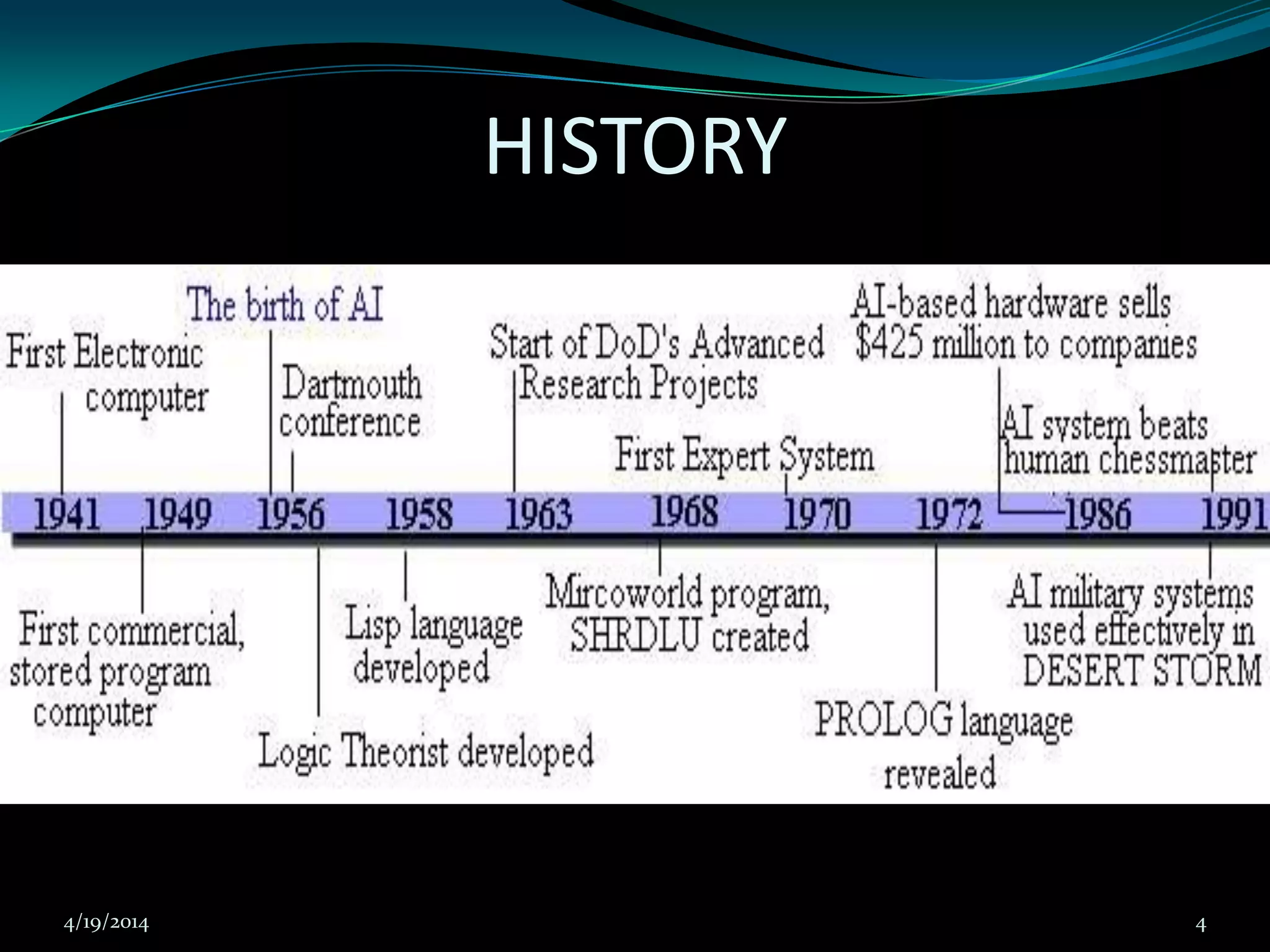
HISTORY
4/19/2014 4
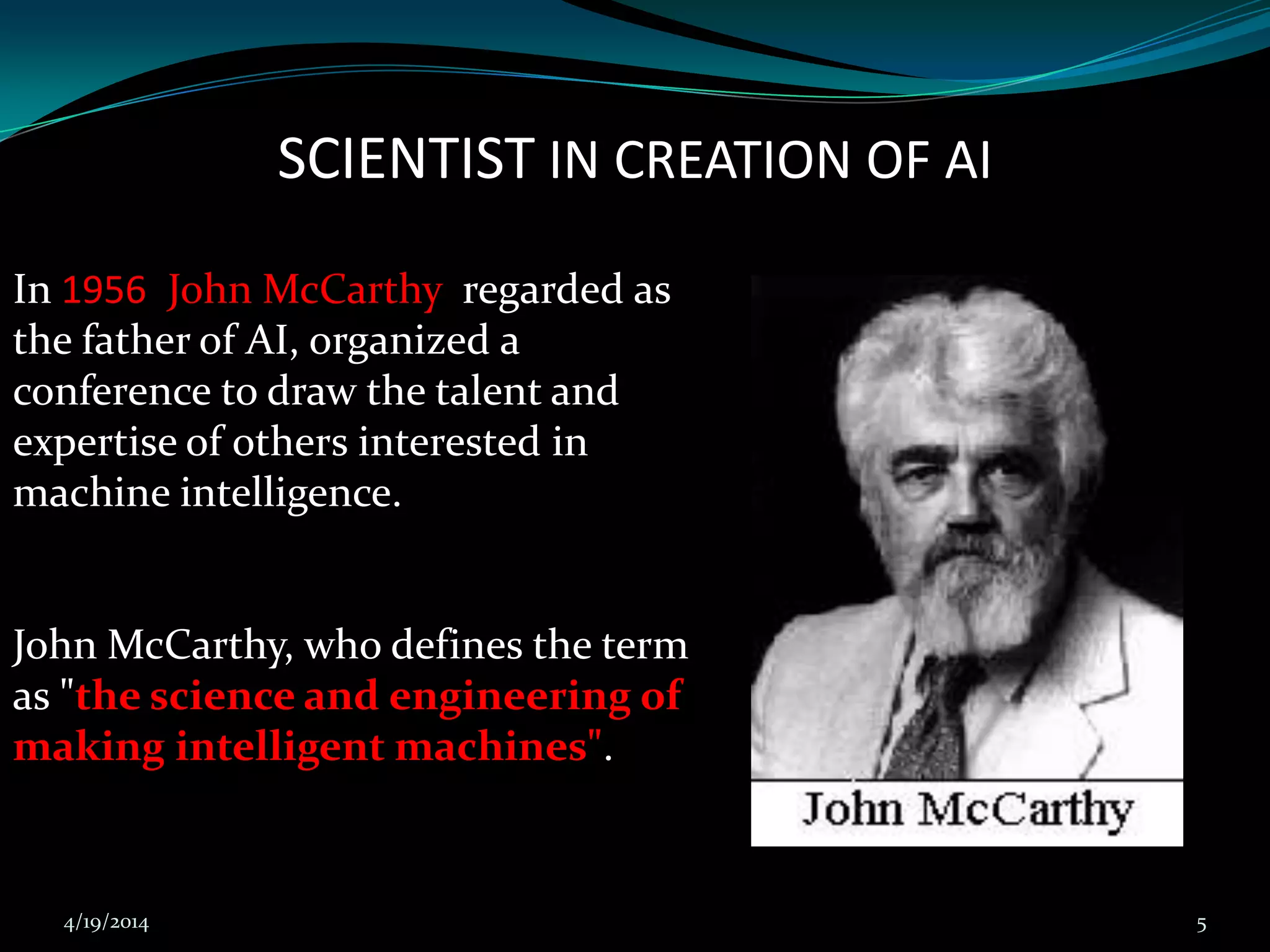
SCIENTIST IN CREATION OF AI
In 1956 John McCarthy regarded as
the father of AI, organized a
conference to draw the talent and
expertise of others interested in
machine intelligence.
John McCarthy, who defines the term
as "the science and engineering of
making intelligent machines".
4/19/2014 5
Problems of AI
The general problem of simulating intelligence has been
broken down into a number of specific sub-problems. These
consist of particular traits or capabilities that researchers
would like an intelligent system to display.
Deduction, reasoning, problem solving
Knowledge Representation
Planning
Learning
Natural language processing
Motion and manipulation4/19/2014 6
1 Deduction, reasoning, problem solving
Early AI researchers developed Algorithms
that imitated the step-by-step reasoning that
human beings use when they solve puzzles,
play board games or make logical
deductions.
2 Knowledge Representation
Many of the problems machines are
expected to solve will require4/19/2014 7
3 Planning
Intelligent agents must be able to set goals
and achieve them. They need a way to visualize
the future and be able to make choices that
maximize the utility (or "value") of the available
choices.
Types of planning
1 Classical planning 2
Multi agent planning
4 Learning
Machine learning is the study of computer
algorithms that improve automatically through
experience and has been central to AI research
since the field's inception.
Types of learning
1 Unsupervised learning4/19/2014 8
5 Natural language processing
Natural language processing gives machines
the ability to read and understand the
languages that the human beings speak.
6 Motion and manipulation
The field of robotics is closely related to AI.
Intelligence is required for robots to be able to
handle such tasks as object manipulation and
navigation, with sub-problems of localization
(knowing where you are), mapping (learning
what is around you) , motion planning (figuring
out how to get there) and path planning (going
from one point in space to another point).4/19/2014 9
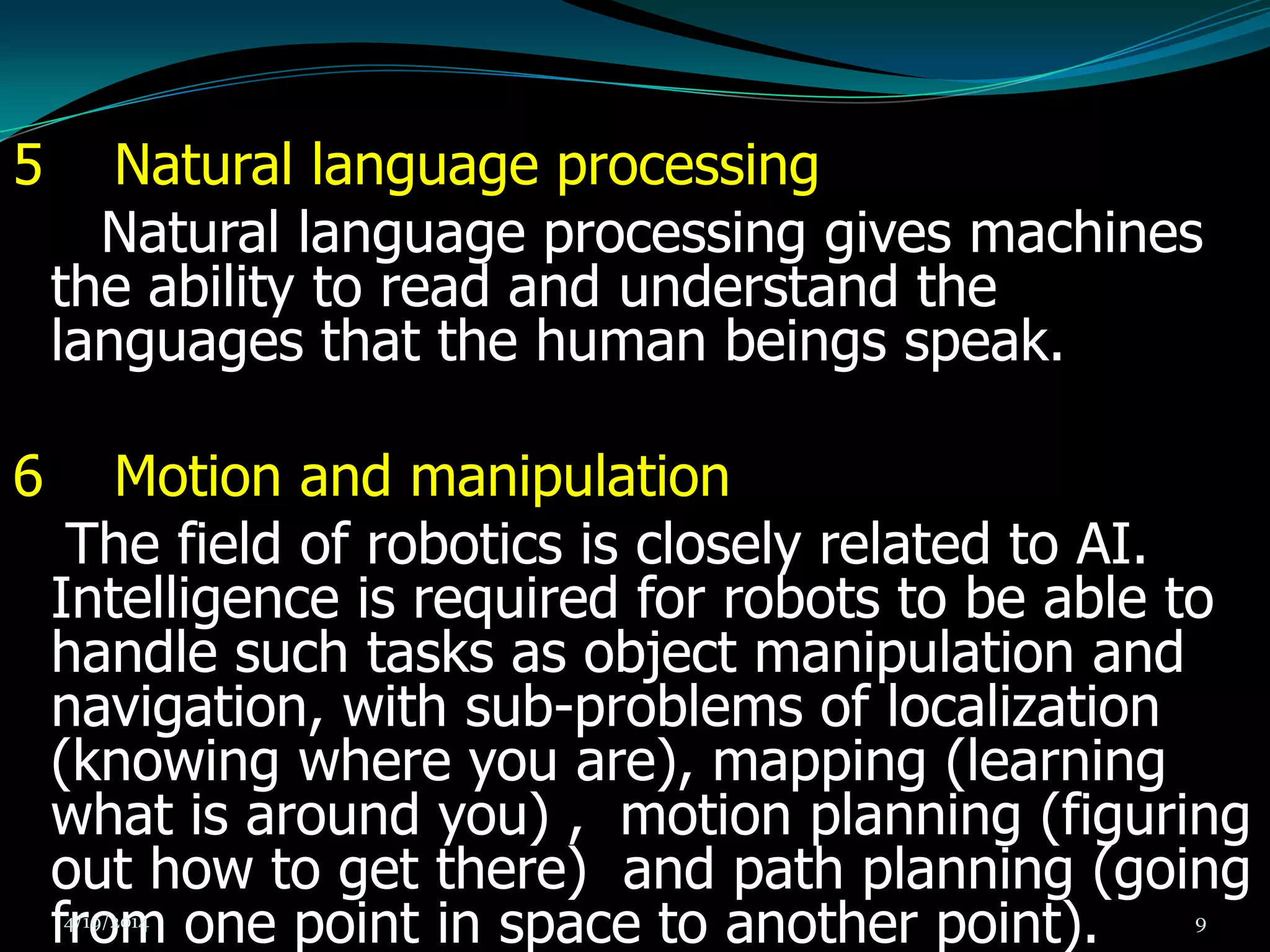
The Turing’s Test
 Alan Turing (1912 - 1954)
 Proposed a test - Turing’s
Imitation Game
 Tests the intelligence of
the computer.
 Phase 1:
 Man and woman
separated from an
interrogator.
 The interrogator types in
a question to either
party.
 By observing responses,
the interrogator’s goal
was to identify which
was the man and which
was the woman.
4/19/2014 10
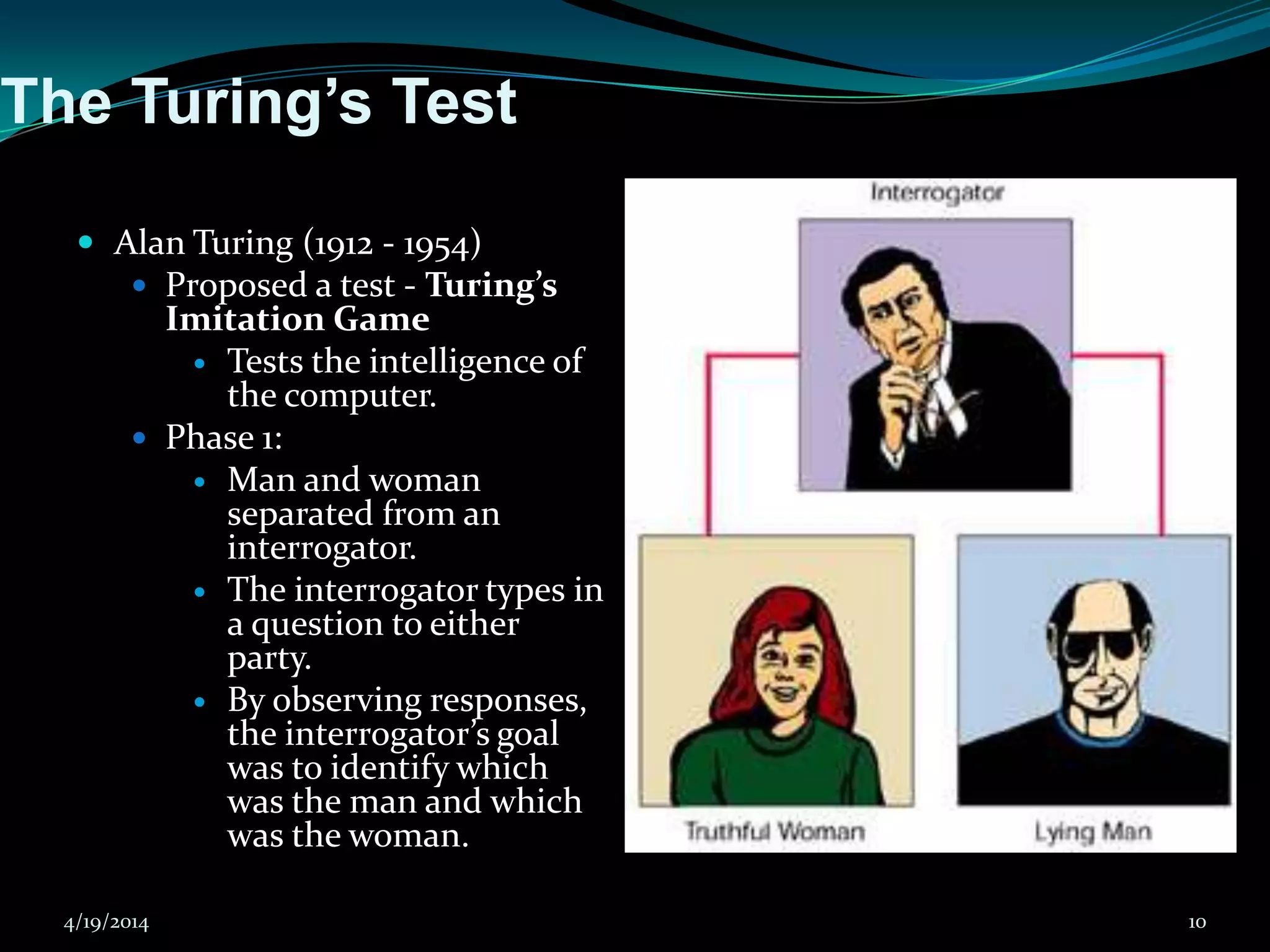
 Phase 2 of the Turing’s test:
 The man was replaced by
the computer.
 If the computer could fool the
interrogator as often as the
person did, it could be said
that the computer had
displayed intelligence.
4/19/2014 11
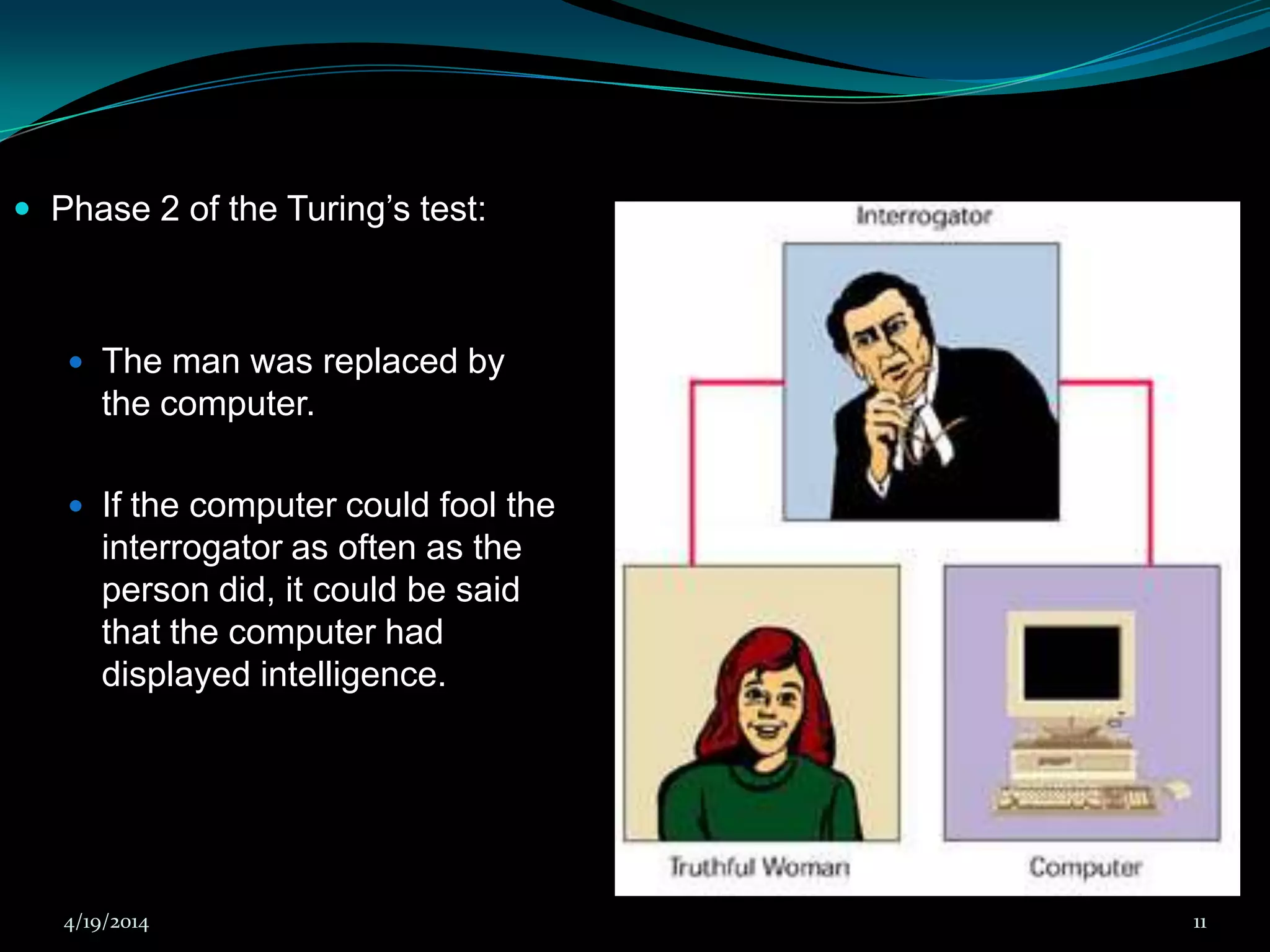
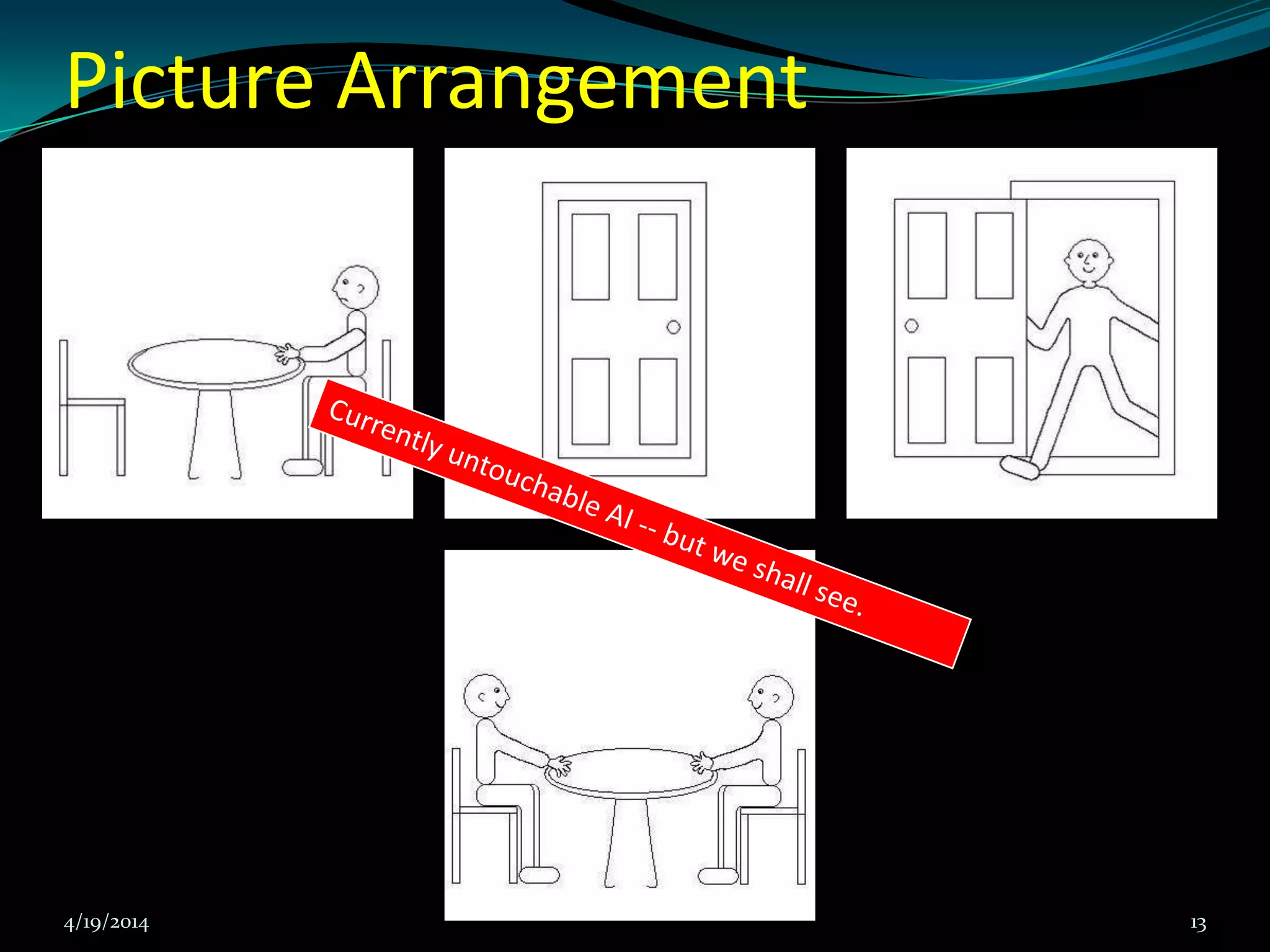
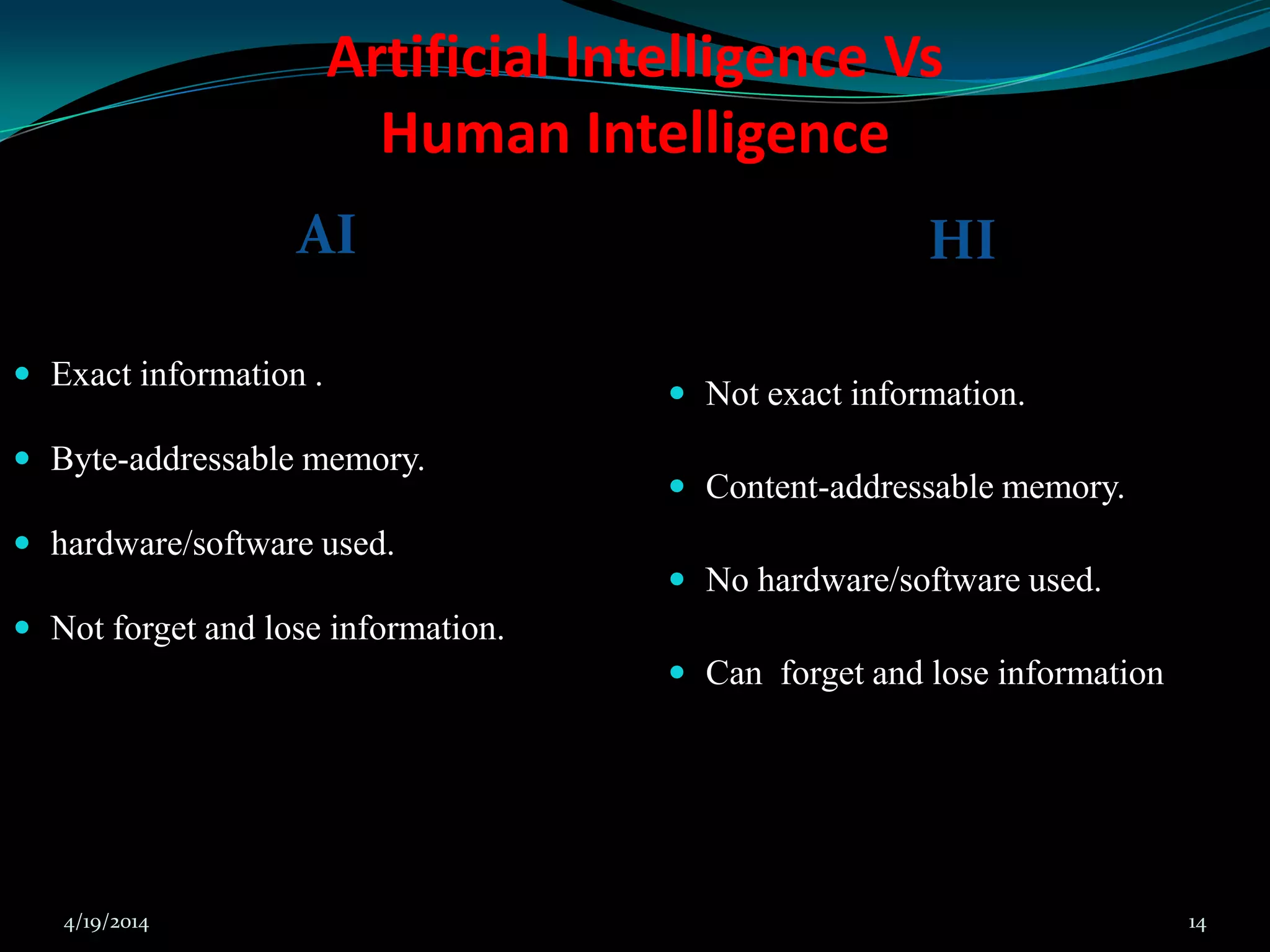
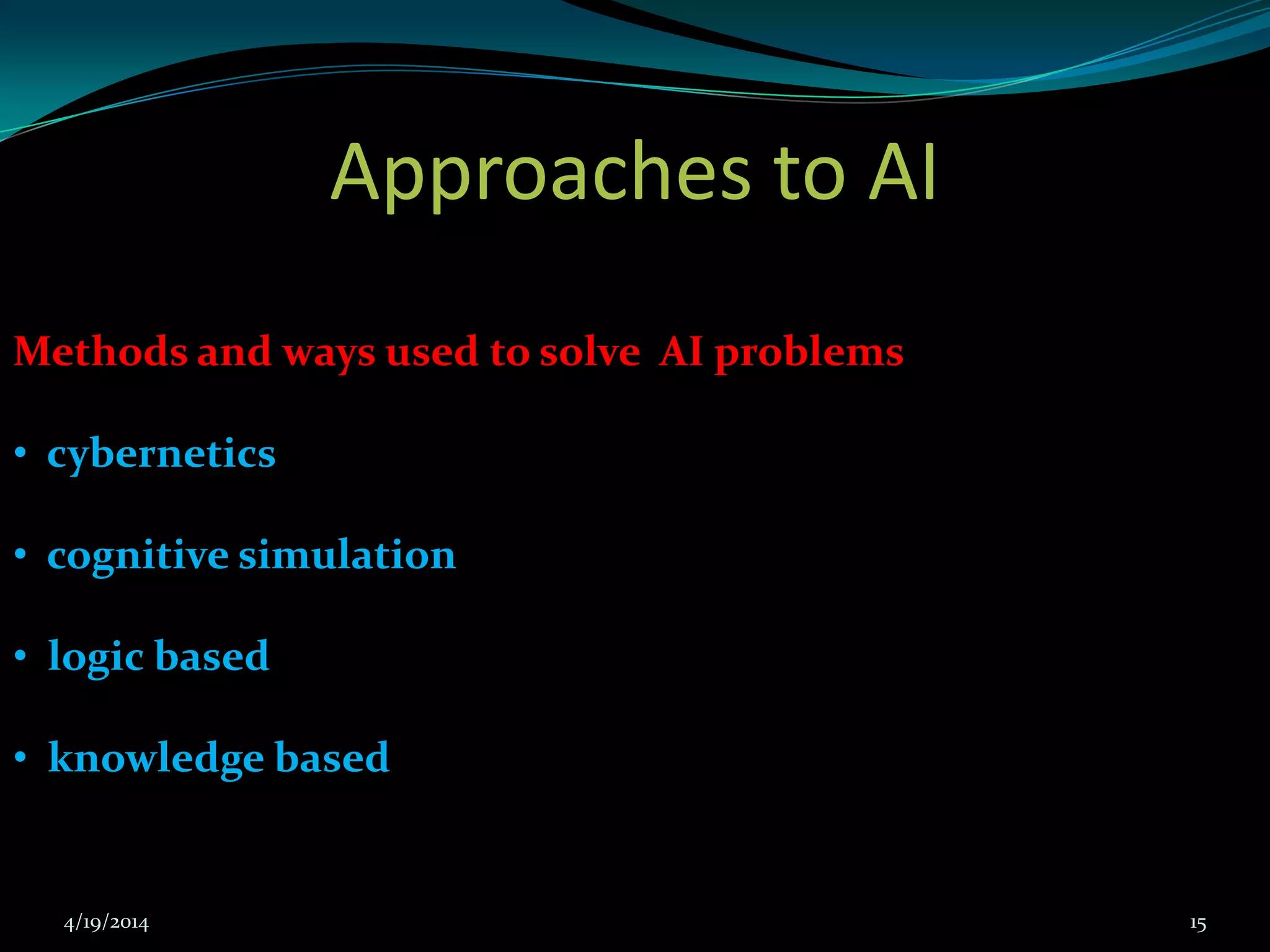
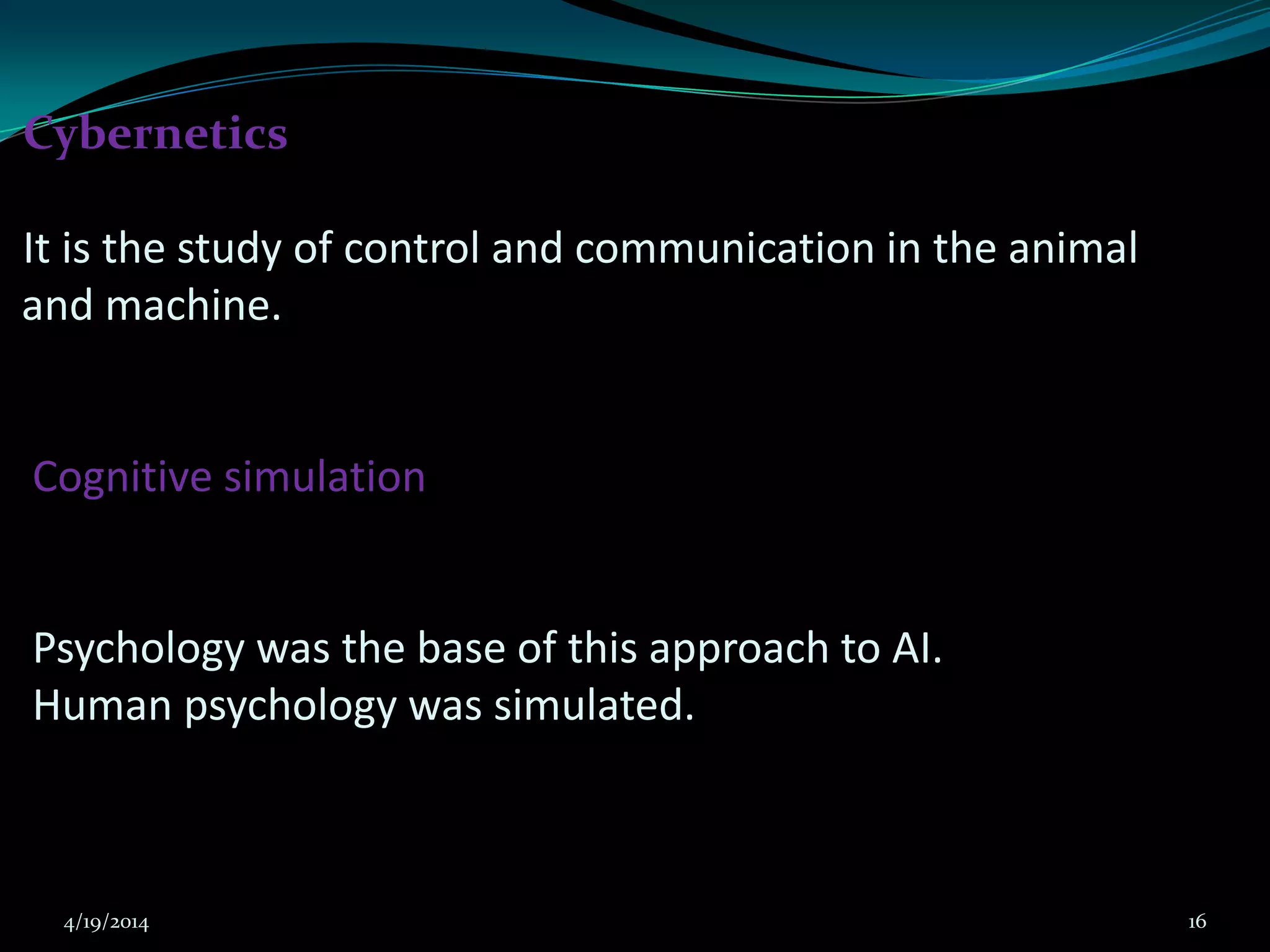
Picture Arrangement
4/19/2014 12
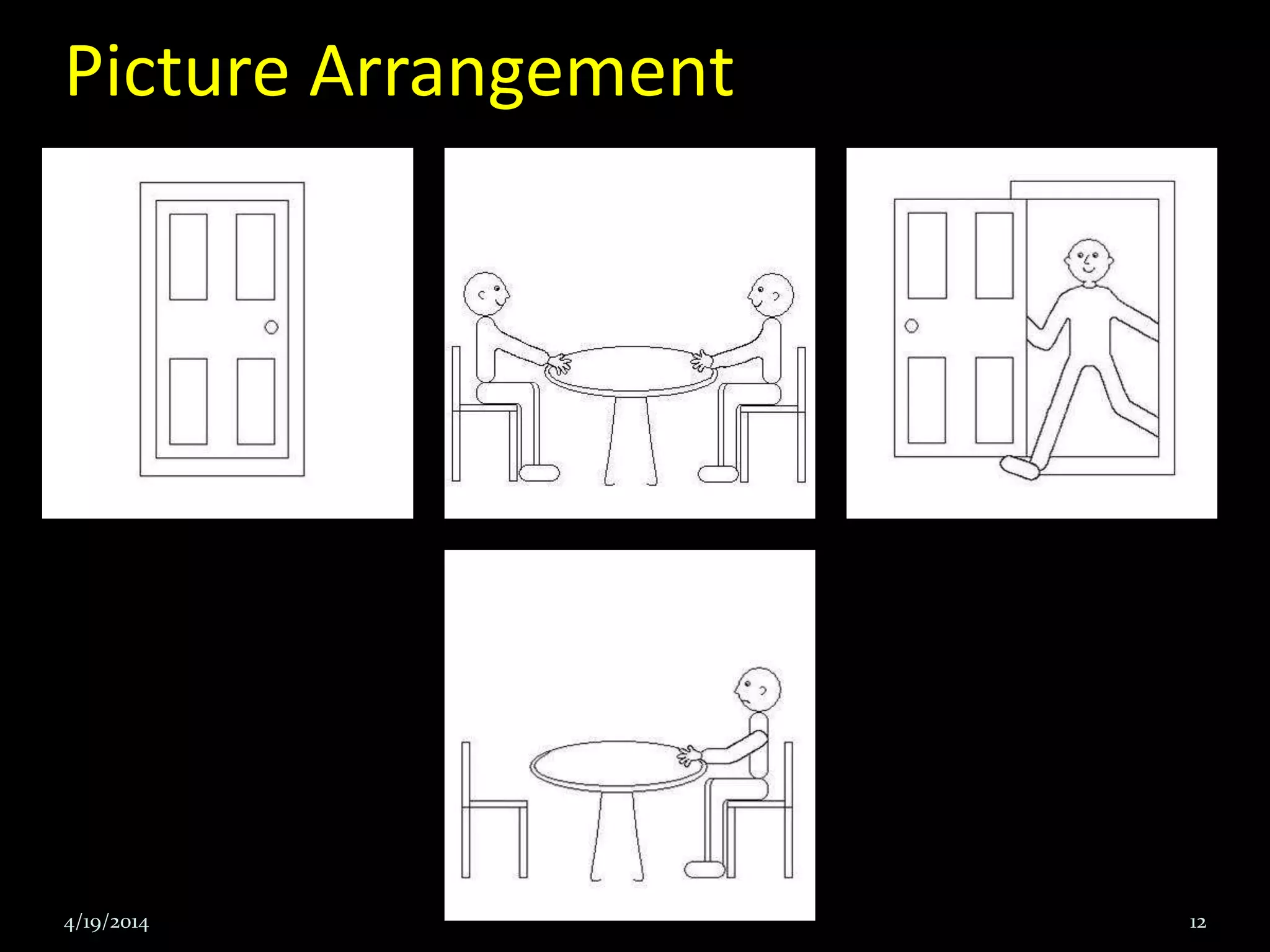
Picture Arrangement
4/19/2014 13
Artificial Intelligence Vs
Human Intelligence
AI
 Exact information .
 Byte-addressable memory.
 hardware/software used.
 Not forget and lose information.
HI
 Not exact information.
 Content-addressable memory.
 No hardware/software used.
 Can forget and lose information
4/19/2014 14
Approaches to AI
Methods and ways used to solve AI problems
• cybernetics
• cognitive simulation
• logic based
• knowledge based
4/19/2014 15
Cybernetics
It is the study of control and communication in the animal
and machine.
Cognitive simulation
Psychology was the base of this approach to AI.
Human psychology was simulated.
4/19/2014 16
Logic based
This approach uses formal logic to solve a wide variety
of problems, Including knowledge representation, planning
and learning. programming language used is PROLOG
Knowledge based
Expert systems were developed keeping knowledge as the base,
these systems could behave like an human expert and
answer or provide solutions to any questions related to that field
to which it is intended.
4/19/2014 17
1 ROBOTICS
2 MILITARY
3 MEDICINE
4 NATURAL LANGUAGE PROCESSING
5 PATTERN RECOGNITION
6 TELEPHONE TRANSLATORS
4/19/2014 18
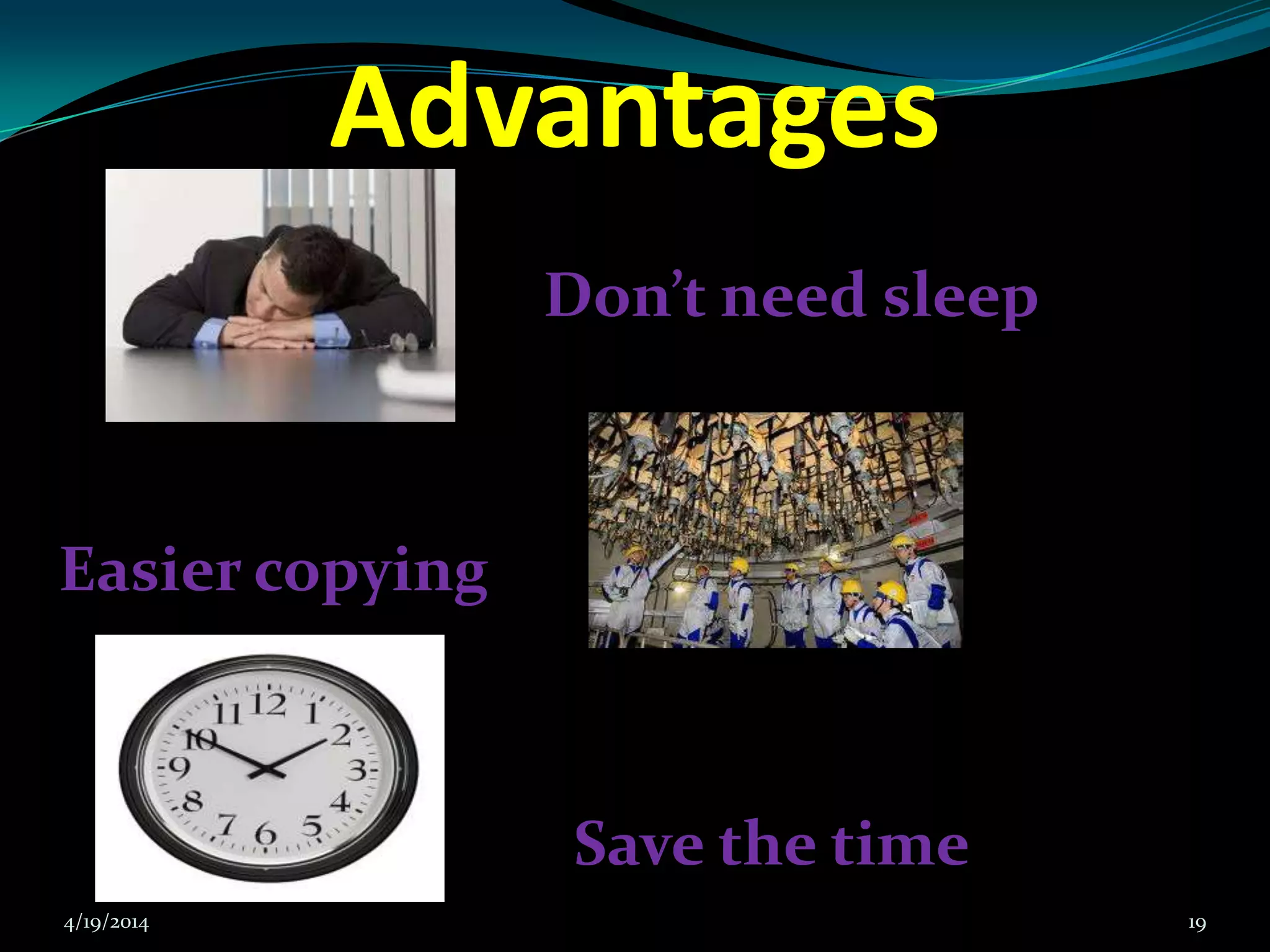
Advantages
Don’t need sleep
Easier copying
Save the time
4/19/2014 19
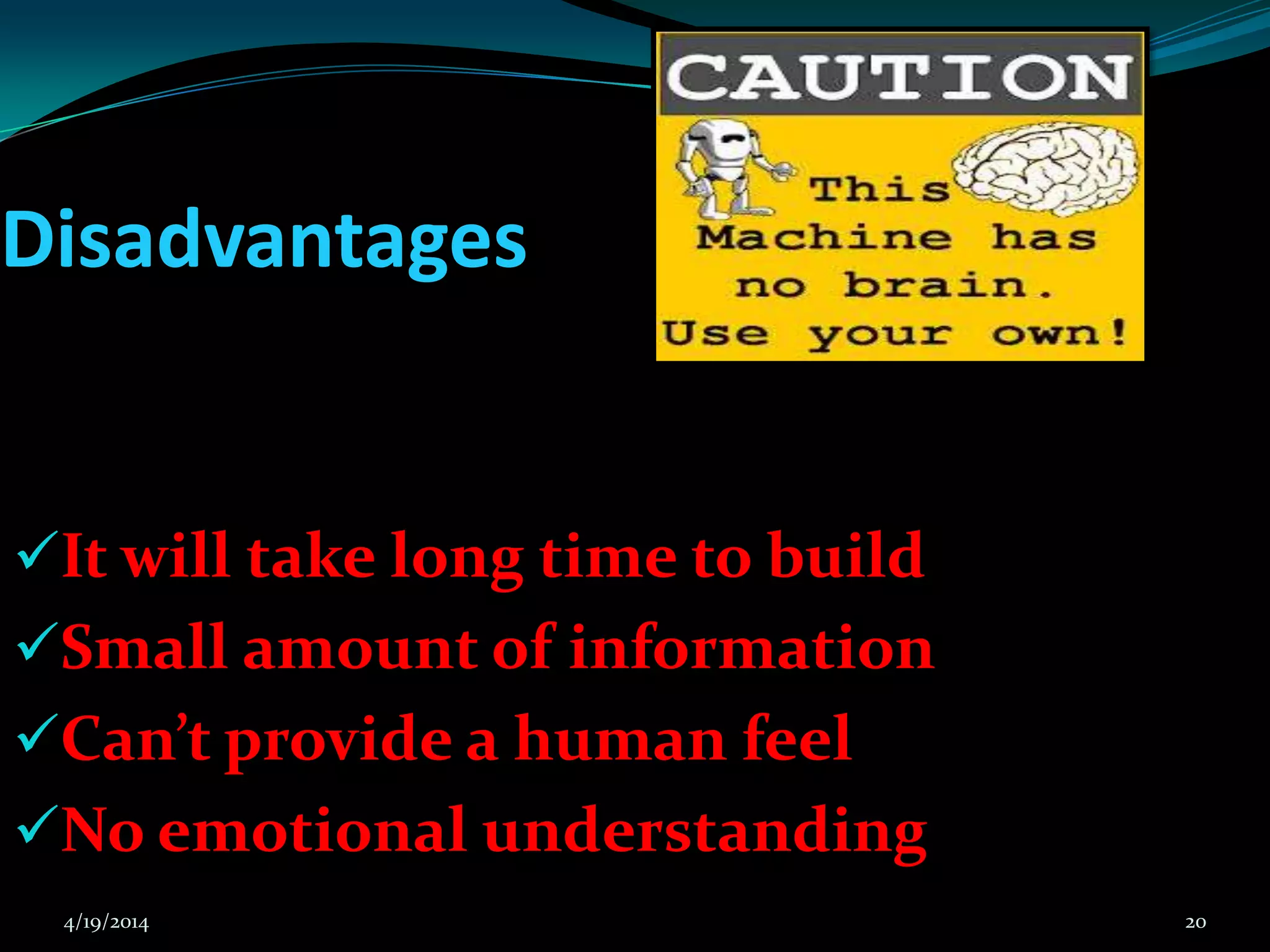
Disadvantages
It will take long time to build
Small amount of information
Can’t provide a human feel
No emotional understanding
4/19/2014 20
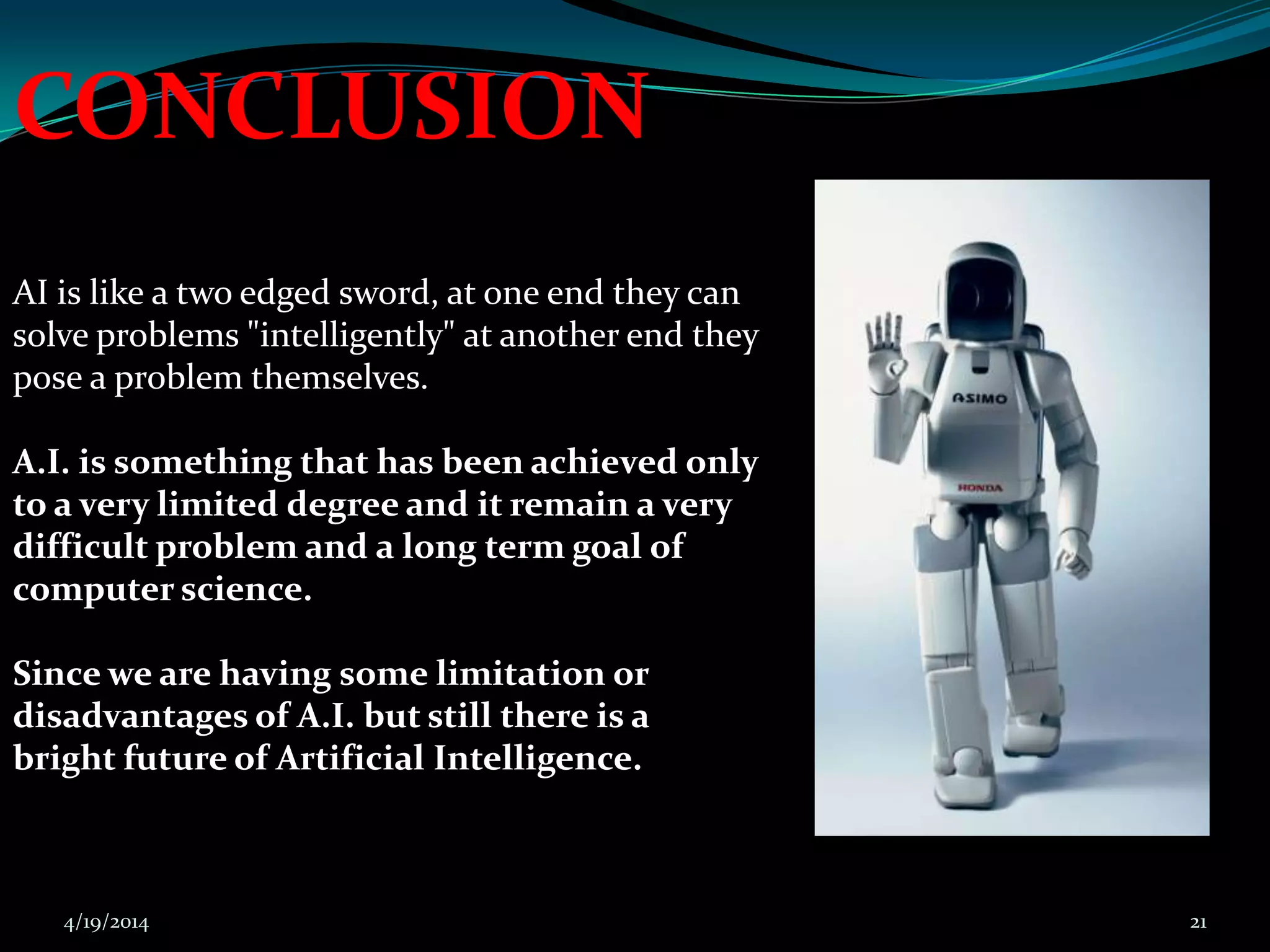
AI is like a two edged sword, at one end they can
solve problems "intelligently" at another end they
pose a problem themselves.
A.I. is something that has been achieved only
to a very limited degree and it remain a very
difficult problem and a long term goal of
computer science.
Since we are having some limitation or
disadvantages of A.I. but still there is a
bright future of Artificial Intelligence.
CONCLUSION
4/19/2014 21
Just You Wait...
or 20...
or 30...
or 50...
4/19/2014 22
4/19/2014 23
ANY QUERY …
4/19/2014 24

presentation on Artificial intelligence by prince kumar kushwaha from rustamji institute of technology

  • 1.
    Presented by Prince kumarkushwaha 0902EC101053 4/19/2014 1
  • 2.
    1 What IsArtificial Intelligence 2 History 3 Scientist In Creation Of AI 4 Problems Of AI 5 The Turing’s Test, Picture Arrangement Test 6 Artificial Intelligence Vs Human Intelligence 7 Artificial Intelligence Applications 8 Future Of AI 9 Advantages And Disadvantages Of AI 10 Conclusion 4/19/2014 2
  • 3.
    Artificial intelligence (AI)is the intelligence exhibited by machines or software, and the branch of computer science that develops machines and software with human-like intelligence. 4/19/2014 3
  • 4.
  • 5.
    SCIENTIST IN CREATIONOF AI In 1956 John McCarthy regarded as the father of AI, organized a conference to draw the talent and expertise of others interested in machine intelligence. John McCarthy, who defines the term as "the science and engineering of making intelligent machines". 4/19/2014 5
  • 6.
    Problems of AI Thegeneral problem of simulating intelligence has been broken down into a number of specific sub-problems. These consist of particular traits or capabilities that researchers would like an intelligent system to display. Deduction, reasoning, problem solving Knowledge Representation Planning Learning Natural language processing Motion and manipulation4/19/2014 6
  • 7.
    1 Deduction, reasoning,problem solving Early AI researchers developed Algorithms that imitated the step-by-step reasoning that human beings use when they solve puzzles, play board games or make logical deductions. 2 Knowledge Representation Many of the problems machines are expected to solve will require4/19/2014 7
  • 8.
    3 Planning Intelligent agentsmust be able to set goals and achieve them. They need a way to visualize the future and be able to make choices that maximize the utility (or "value") of the available choices. Types of planning 1 Classical planning 2 Multi agent planning 4 Learning Machine learning is the study of computer algorithms that improve automatically through experience and has been central to AI research since the field's inception. Types of learning 1 Unsupervised learning4/19/2014 8
  • 9.
    5 Natural languageprocessing Natural language processing gives machines the ability to read and understand the languages that the human beings speak. 6 Motion and manipulation The field of robotics is closely related to AI. Intelligence is required for robots to be able to handle such tasks as object manipulation and navigation, with sub-problems of localization (knowing where you are), mapping (learning what is around you) , motion planning (figuring out how to get there) and path planning (going from one point in space to another point).4/19/2014 9
  • 10.
    The Turing’s Test Alan Turing (1912 - 1954)  Proposed a test - Turing’s Imitation Game  Tests the intelligence of the computer.  Phase 1:  Man and woman separated from an interrogator.  The interrogator types in a question to either party.  By observing responses, the interrogator’s goal was to identify which was the man and which was the woman. 4/19/2014 10
  • 11.
     Phase 2of the Turing’s test:  The man was replaced by the computer.  If the computer could fool the interrogator as often as the person did, it could be said that the computer had displayed intelligence. 4/19/2014 11
  • 12.
  • 13.
  • 14.
    Artificial Intelligence Vs HumanIntelligence AI  Exact information .  Byte-addressable memory.  hardware/software used.  Not forget and lose information. HI  Not exact information.  Content-addressable memory.  No hardware/software used.  Can forget and lose information 4/19/2014 14
  • 15.
    Approaches to AI Methodsand ways used to solve AI problems • cybernetics • cognitive simulation • logic based • knowledge based 4/19/2014 15
  • 16.
    Cybernetics It is thestudy of control and communication in the animal and machine. Cognitive simulation Psychology was the base of this approach to AI. Human psychology was simulated. 4/19/2014 16
  • 17.
    Logic based This approachuses formal logic to solve a wide variety of problems, Including knowledge representation, planning and learning. programming language used is PROLOG Knowledge based Expert systems were developed keeping knowledge as the base, these systems could behave like an human expert and answer or provide solutions to any questions related to that field to which it is intended. 4/19/2014 17
  • 18.
    1 ROBOTICS 2 MILITARY 3MEDICINE 4 NATURAL LANGUAGE PROCESSING 5 PATTERN RECOGNITION 6 TELEPHONE TRANSLATORS 4/19/2014 18
  • 19.
    Advantages Don’t need sleep Easiercopying Save the time 4/19/2014 19
  • 20.
    Disadvantages It will takelong time to build Small amount of information Can’t provide a human feel No emotional understanding 4/19/2014 20
  • 21.
    AI is likea two edged sword, at one end they can solve problems "intelligently" at another end they pose a problem themselves. A.I. is something that has been achieved only to a very limited degree and it remain a very difficult problem and a long term goal of computer science. Since we are having some limitation or disadvantages of A.I. but still there is a bright future of Artificial Intelligence. CONCLUSION 4/19/2014 21
  • 22.
    Just You Wait... or20... or 30... or 50... 4/19/2014 22
  • 23.
  • 24.