
AP PSYCHOLOGY

Learning

1
Section 1: Classical Conditioning- Part I
Learning Goals
• Students should be able to answer the following:
1. What is classical conditioning, and how did Pavlov’s
work influence behaviorism?
2. How does a neutral stimulus become a conditioned
stimulus?

2
Pavlov’ Study
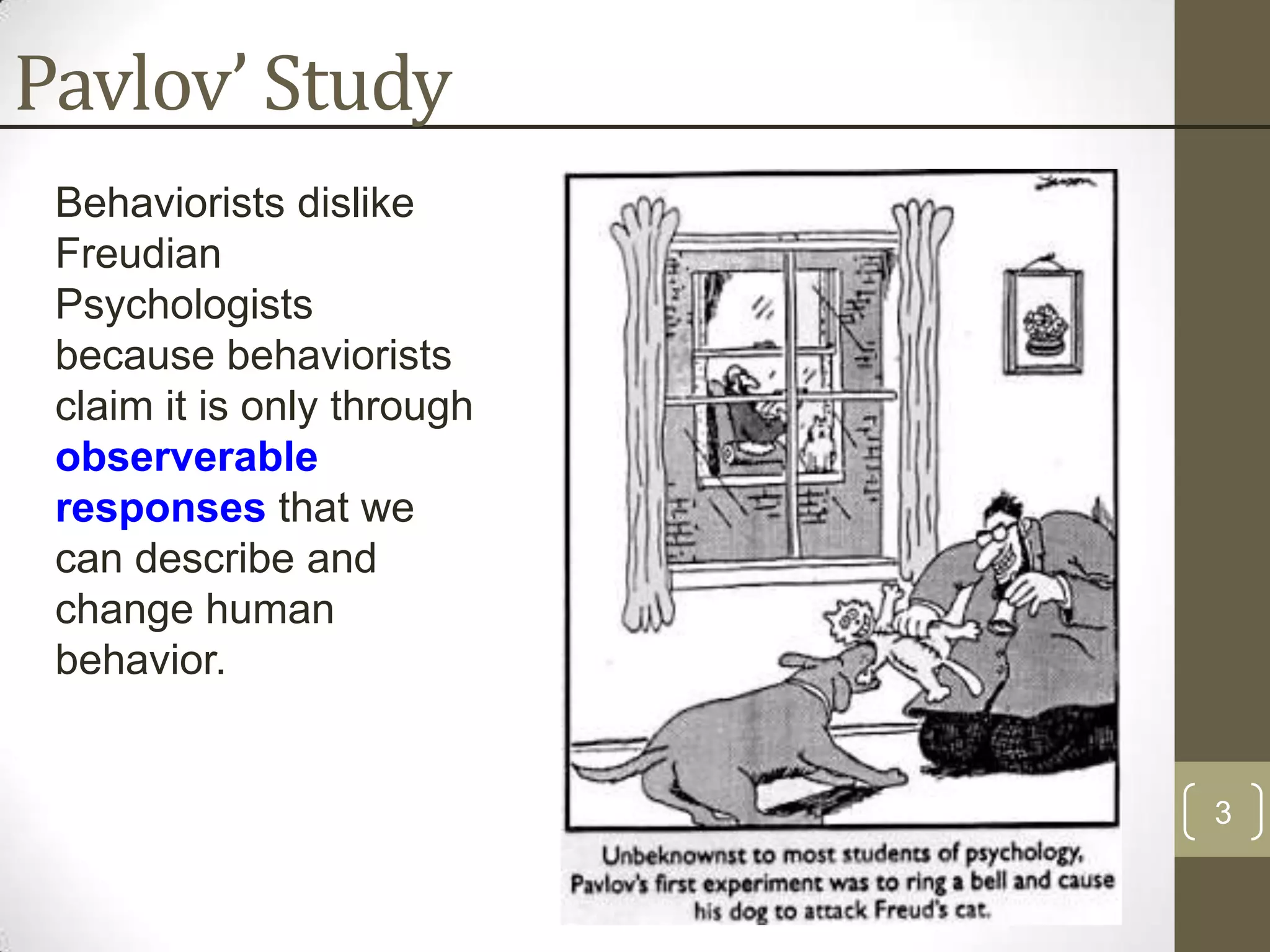
Behaviorists dislike
Freudian
Psychologists
because behaviorists
claim it is only through
observerable
responses that we
can describe and
change human
behavior.

3
PAVLOV‟S STUDY
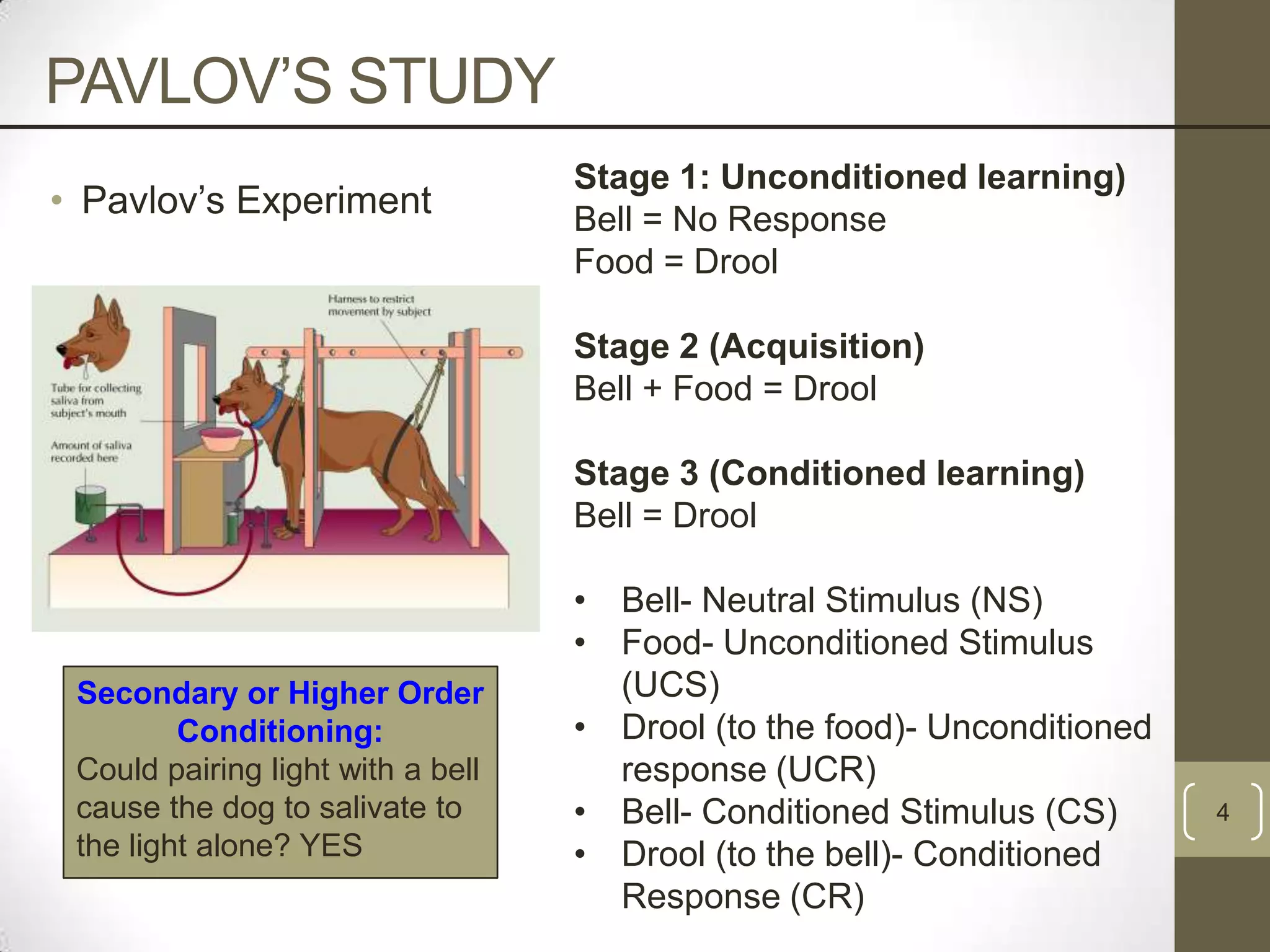
• Pavlov‟s Experiment

Stage 1: Unconditioned learning)
Bell = No Response
Food = Drool
Stage 2 (Acquisition)
Bell + Food = Drool
Stage 3 (Conditioned learning)
Bell = Drool

Secondary or Higher Order
Conditioning:
Could pairing light with a bell
cause the dog to salivate to
the light alone? YES

• Bell- Neutral Stimulus (NS)
• Food- Unconditioned Stimulus
(UCS)
• Drool (to the food)- Unconditioned
response (UCR)
• Bell- Conditioned Stimulus (CS)
• Drool (to the bell)- Conditioned
Response (CR)

4
CLASSICAL CONDITIONING BASICS
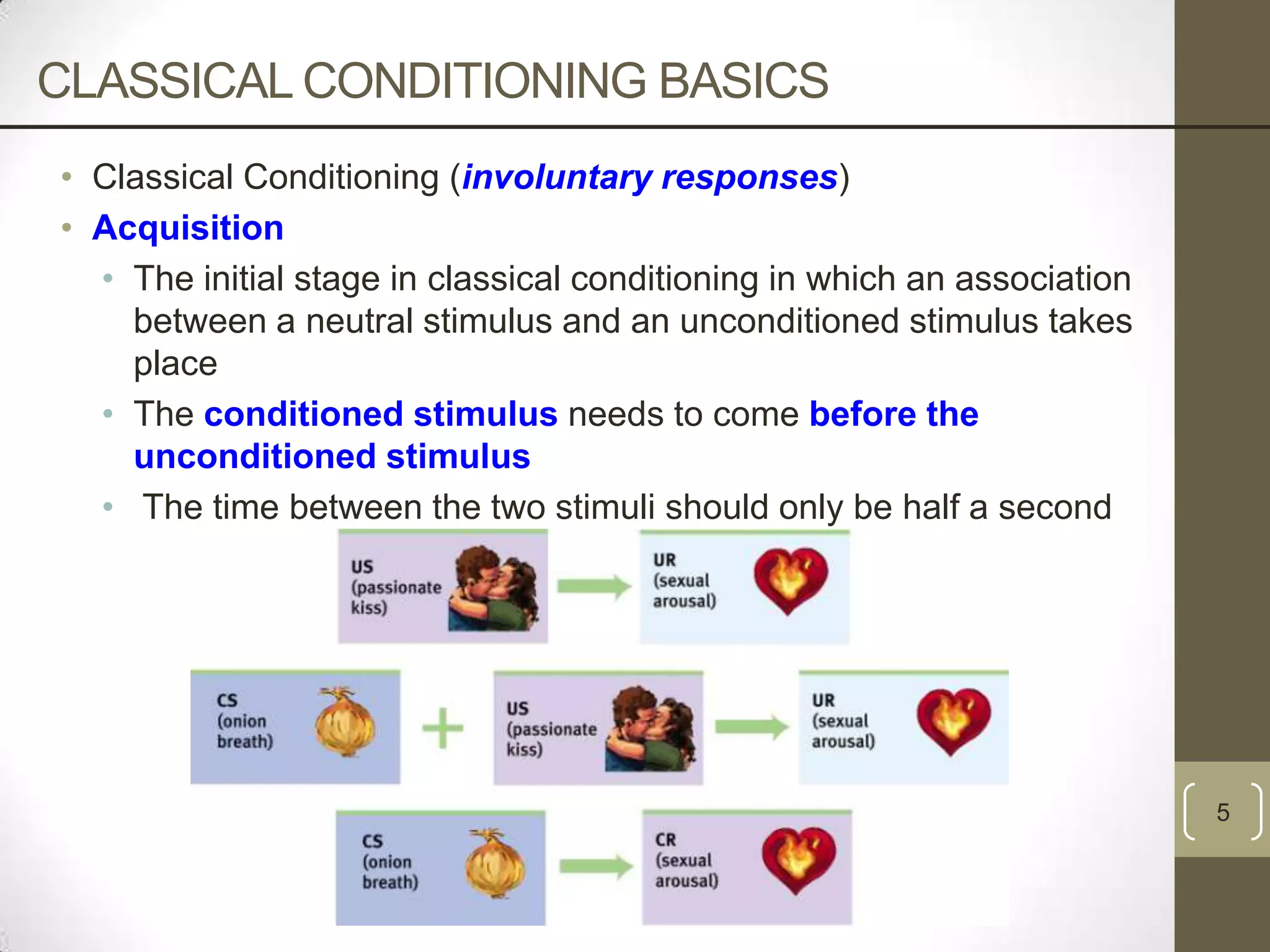
• Classical Conditioning (involuntary responses)
• Acquisition
• The initial stage in classical conditioning in which an association
between a neutral stimulus and an unconditioned stimulus takes
place
• The conditioned stimulus needs to come before the
unconditioned stimulus
• The time between the two stimuli should only be half a second

5
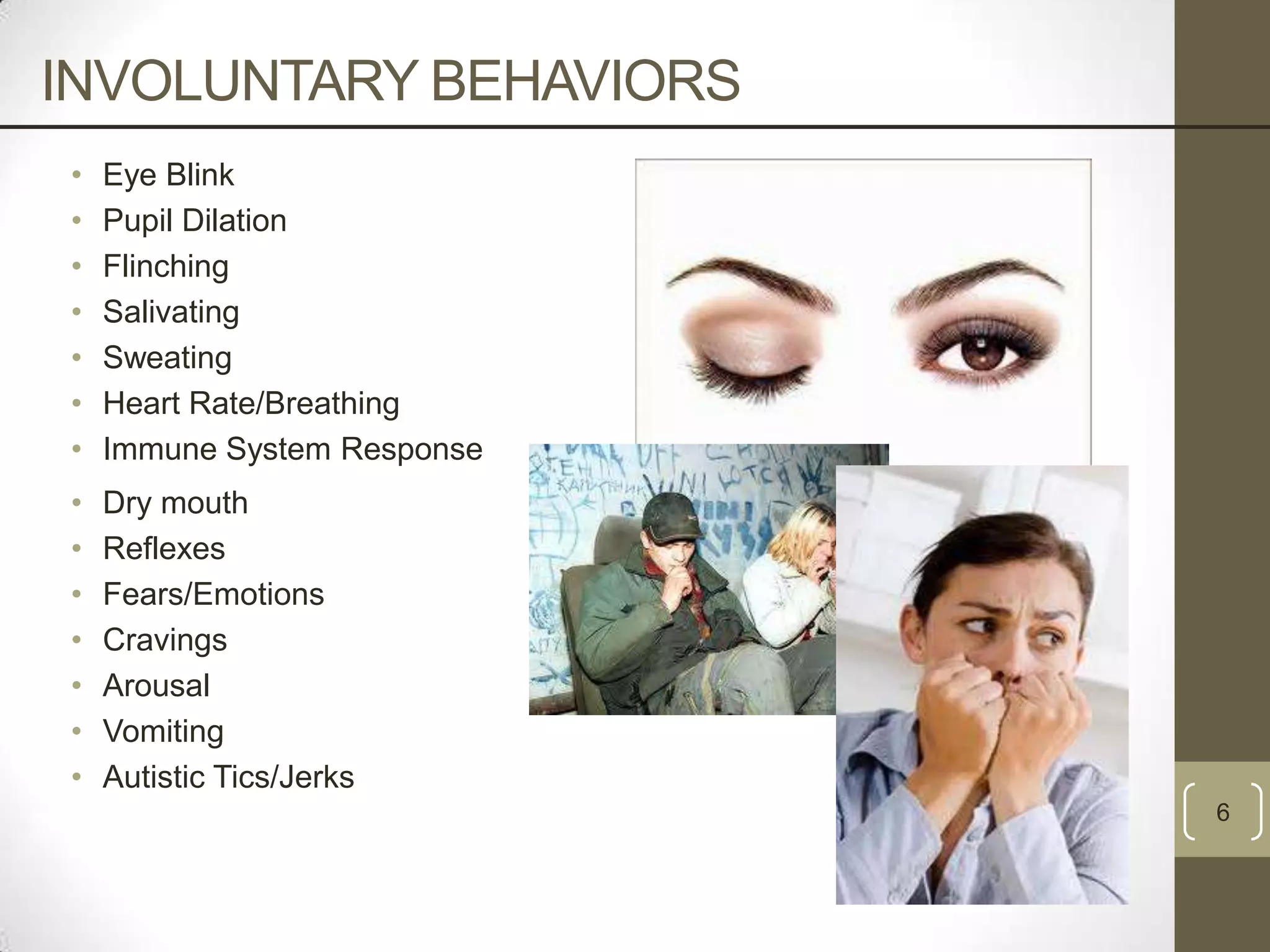
INVOLUNTARY BEHAVIORS
•
•
•
•
•
•
•

Eye Blink
Pupil Dilation
Flinching
Salivating
Sweating
Heart Rate/Breathing
Immune System Response

•
•
•
•
•
•
•

Dry mouth
Reflexes
Fears/Emotions
Cravings
Arousal
Vomiting
Autistic Tics/Jerks
6
Section 1: Classical Conditioning- Part I
Reflect on Learning Goals
• Students should be able to answer the following:
1. What is classical conditioning, and how did Pavlov’s
work influence behaviorism?
2. How does a neutral stimulus become a conditioned
stimulus?

Good
Understanding

Fair
Understanding

Little
Understanding

7
Section 1: Test Your Knowledge
A mouse will normally flinch after getting a mild shock.
During conditioning, a red light is present right before the
mild shock is given to the mouse. Soon, the mouse will
freeze/flinch when the red light is present alone.
US=
UR=
CS=
CR=
NS=
Would the following process also work to condition the mouse: The
mild shock is given to the mouse before the red light is present. Why
or Why Not?

8
Section 2: Classical Conditioning- Part II
Learning Goals
• Students should be able to answer the following:
1.

2.

In classical conditioning, what are the processes of acquisition,
extinction, spontaneous recovery, generalization and
discrimination?
Do Cognitive processes and biological constraints affect classical
conditioning?

9
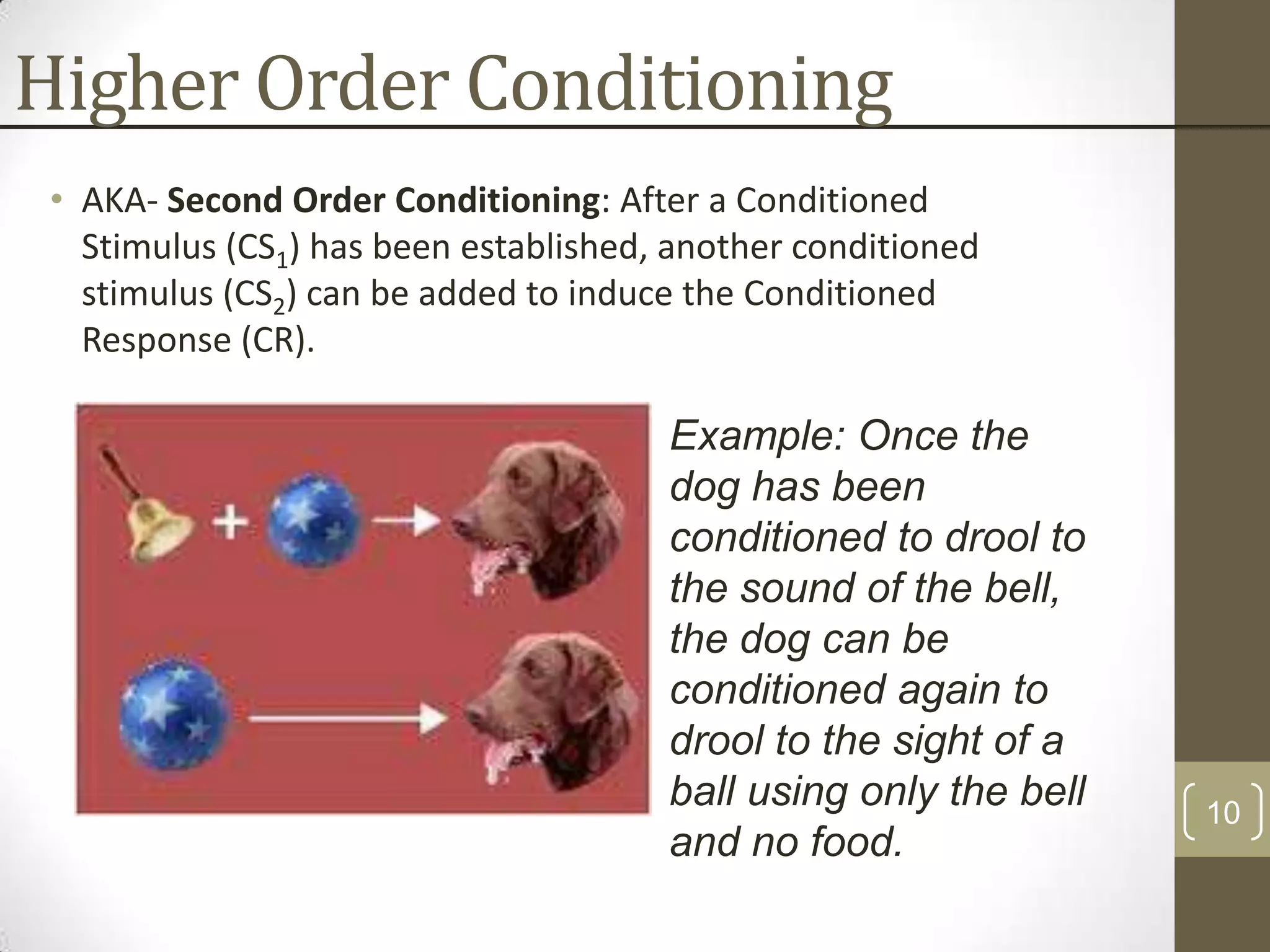
Higher Order Conditioning
• AKA- Second Order Conditioning: After a Conditioned
Stimulus (CS1) has been established, another conditioned
stimulus (CS2) can be added to induce the Conditioned
Response (CR).

Example: Once the
dog has been
conditioned to drool to
the sound of the bell,
the dog can be
conditioned again to
drool to the sight of a
ball using only the bell
and no food.

10
CLASSICAL CONDITIONING
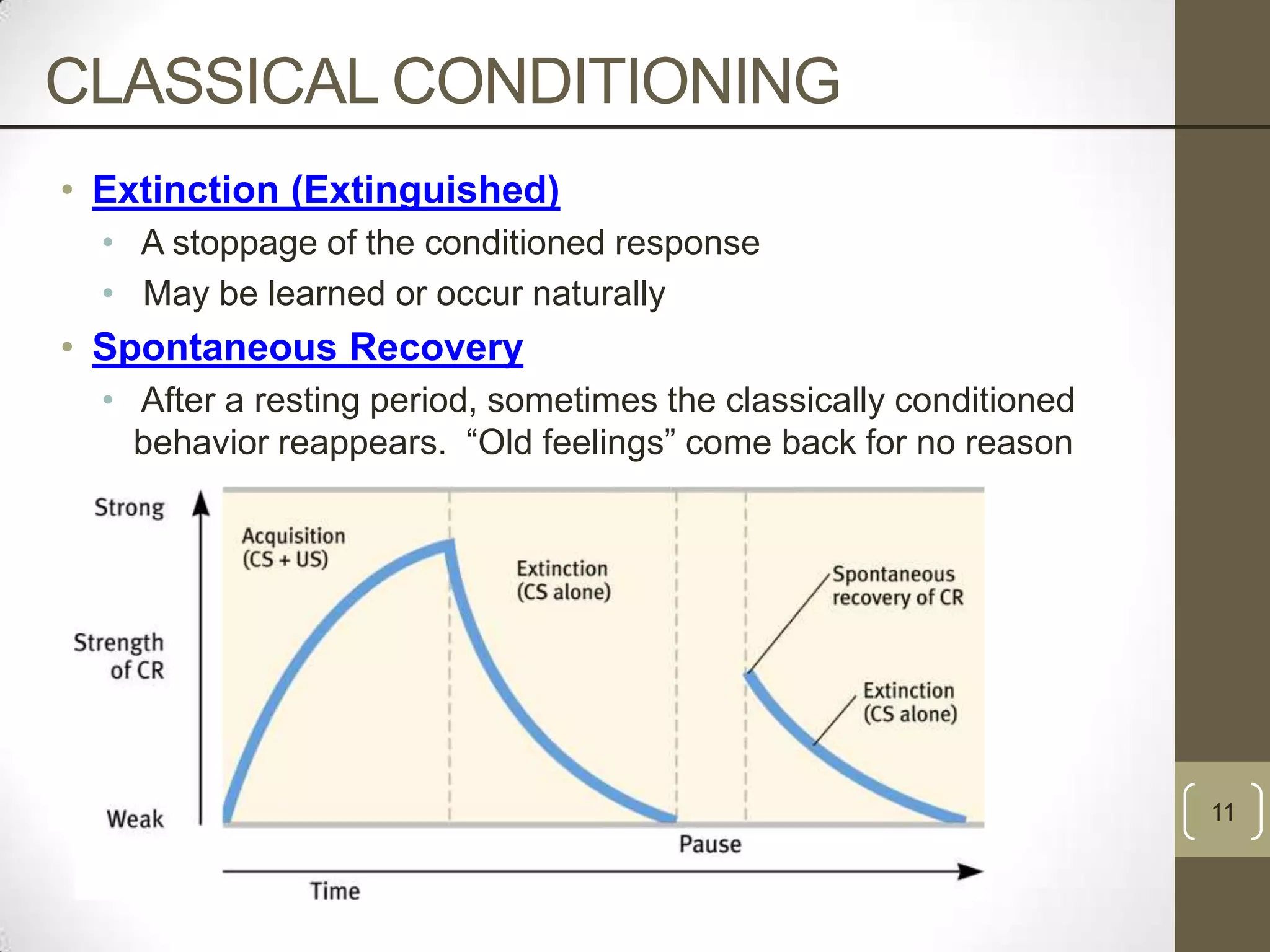
• Extinction (Extinguished)
• A stoppage of the conditioned response
• May be learned or occur naturally

• Spontaneous Recovery
• After a resting period, sometimes the classically conditioned
behavior reappears. “Old feelings” come back for no reason

11
GENERALIZATION V. DISCRIMINATION
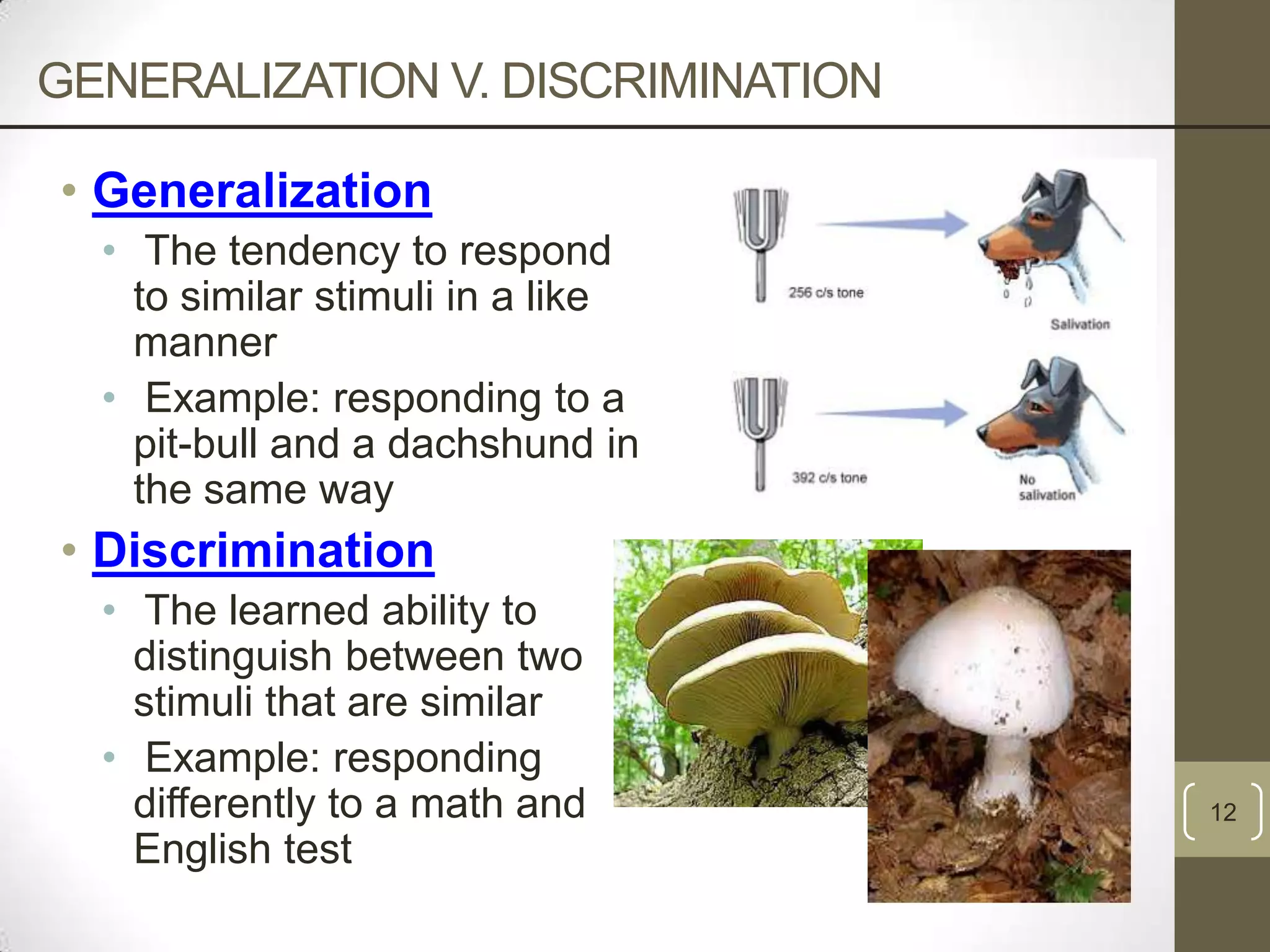
• Generalization
• The tendency to respond
to similar stimuli in a like
manner
• Example: responding to a
pit-bull and a dachshund in
the same way

• Discrimination
• The learned ability to
distinguish between two
stimuli that are similar
• Example: responding
differently to a math and
English test

12
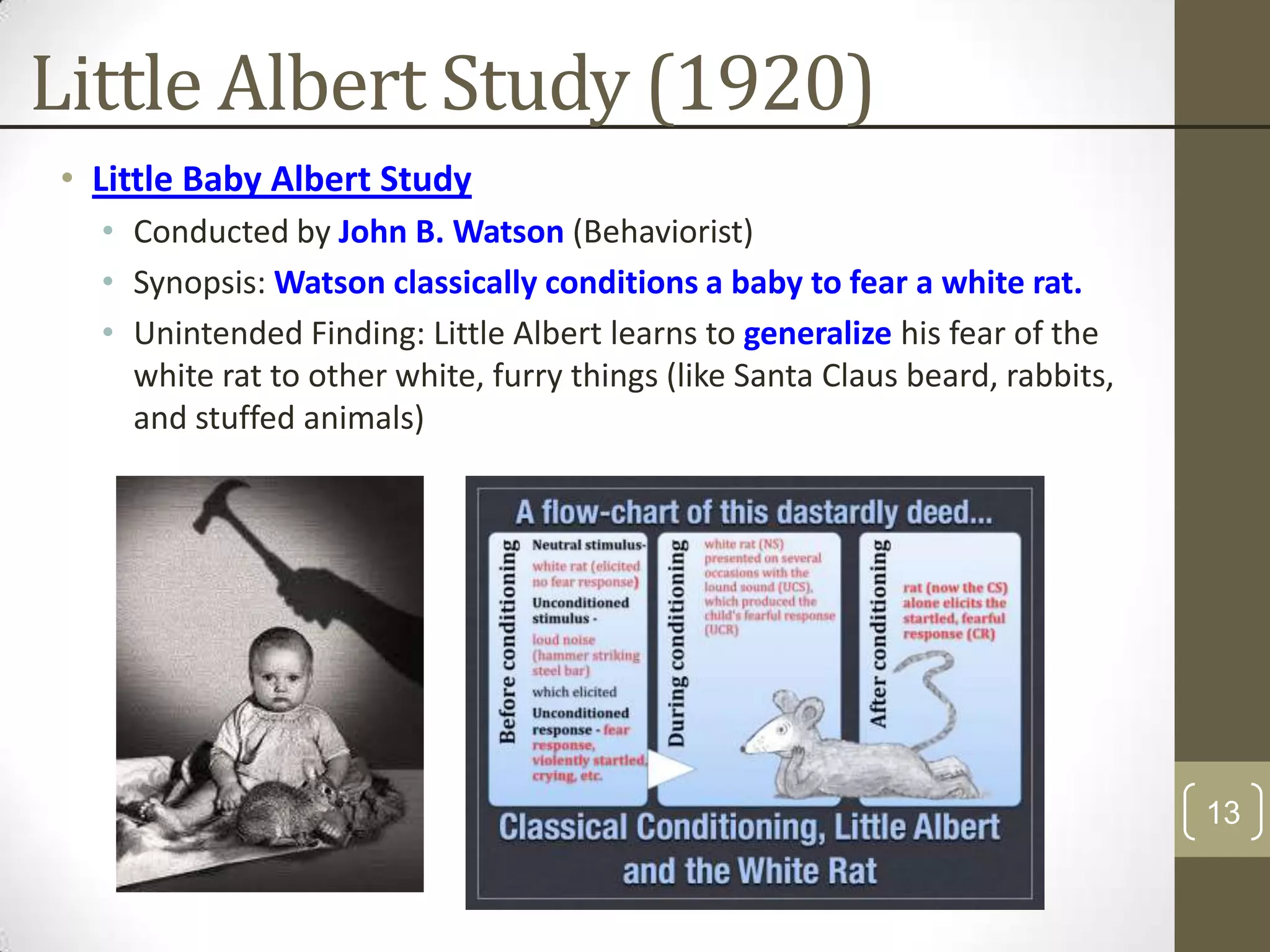
Little Albert Study (1920)
• Little Baby Albert Study
• Conducted by John B. Watson (Behaviorist)
• Synopsis: Watson classically conditions a baby to fear a white rat.
• Unintended Finding: Little Albert learns to generalize his fear of the
white rat to other white, furry things (like Santa Claus beard, rabbits,
and stuffed animals)

13
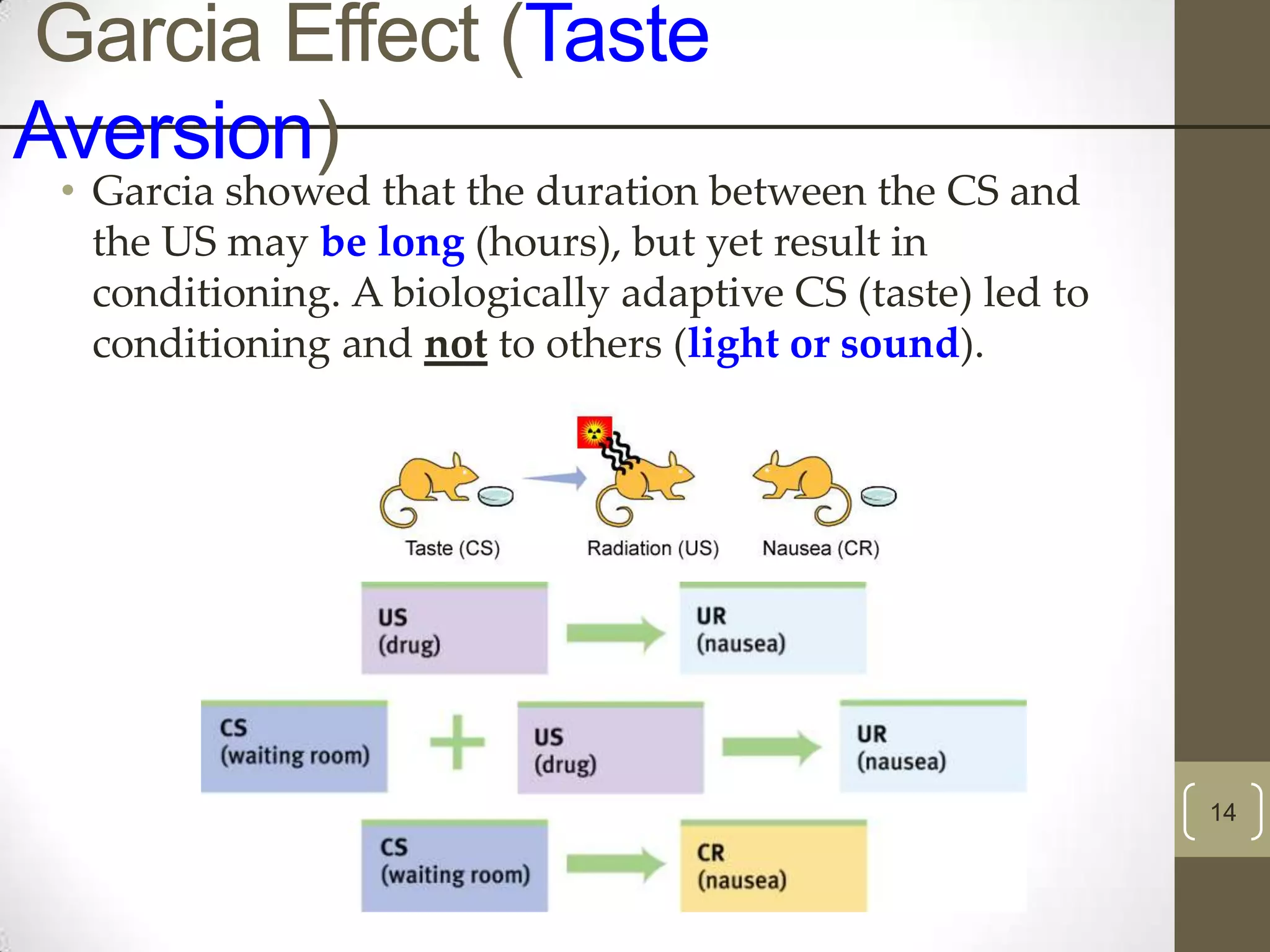
Garcia Effect (Taste
Aversion)

• Garcia showed that the duration between the CS and
the US may be long (hours), but yet result in
conditioning. A biologically adaptive CS (taste) led to
conditioning and not to others (light or sound).

14
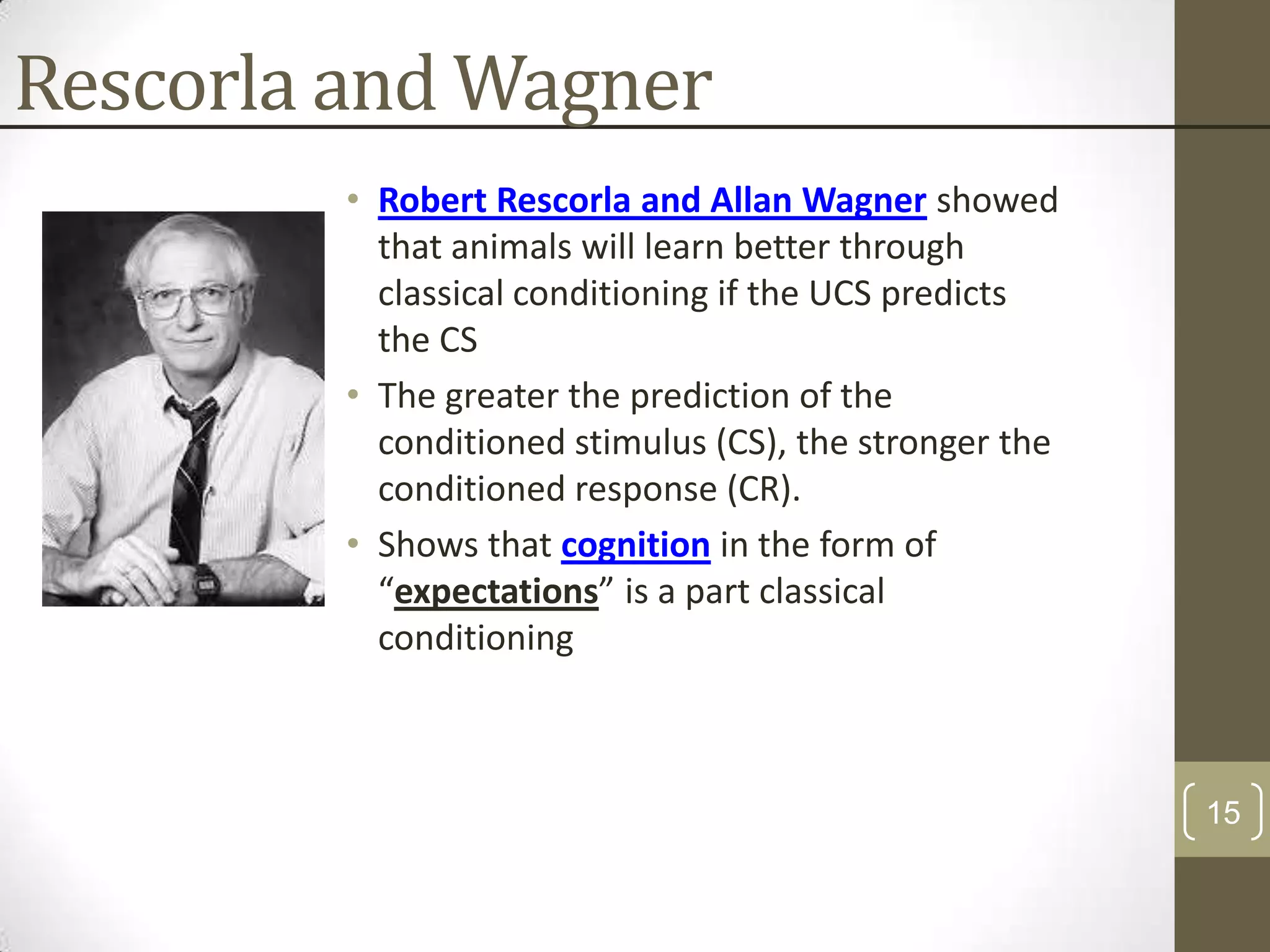
Rescorla and Wagner
• Robert Rescorla and Allan Wagner showed
that animals will learn better through
classical conditioning if the UCS predicts
the CS
• The greater the prediction of the
conditioned stimulus (CS), the stronger the
conditioned response (CR).
• Shows that cognition in the form of
“expectations” is a part classical
conditioning

15
Section 2: Classical Conditioning- Part II
Reflect on Learning Goals
• Students should be able to answer the following:
1.

2.

In classical conditioning, what are the processes of acquisition,
extinction, spontaneous recovery, generalization and
discrimination?
Do Cognitive processes and biological constraints affect classical
conditioning?

Good
Understanding

Fair
Understanding

Little
Understanding

16
Section 2: Test Your
Knowledge

1. An individual‟s fear of dogs that is lost as the individual is exposed to
dogs in a non-threatening situation is referred to by behaviorists as a fear
that has been:
A. Satiated
B. Suppressed
C. Repressed
D. Extinguished
E. Punished
2. Watson conditioned “Little Albert” to fear white rats by banging a hammer
on steel bars as the child played with the white rat. Later it was discovered
that Albert feared not only white rats, but also white stuffed animals. Albert‟s
fear can be attributed to:

A.
B.
C.
D.

The law of effect
Stimulus generalization
Stimulus discrimination
An overactive imagination

17
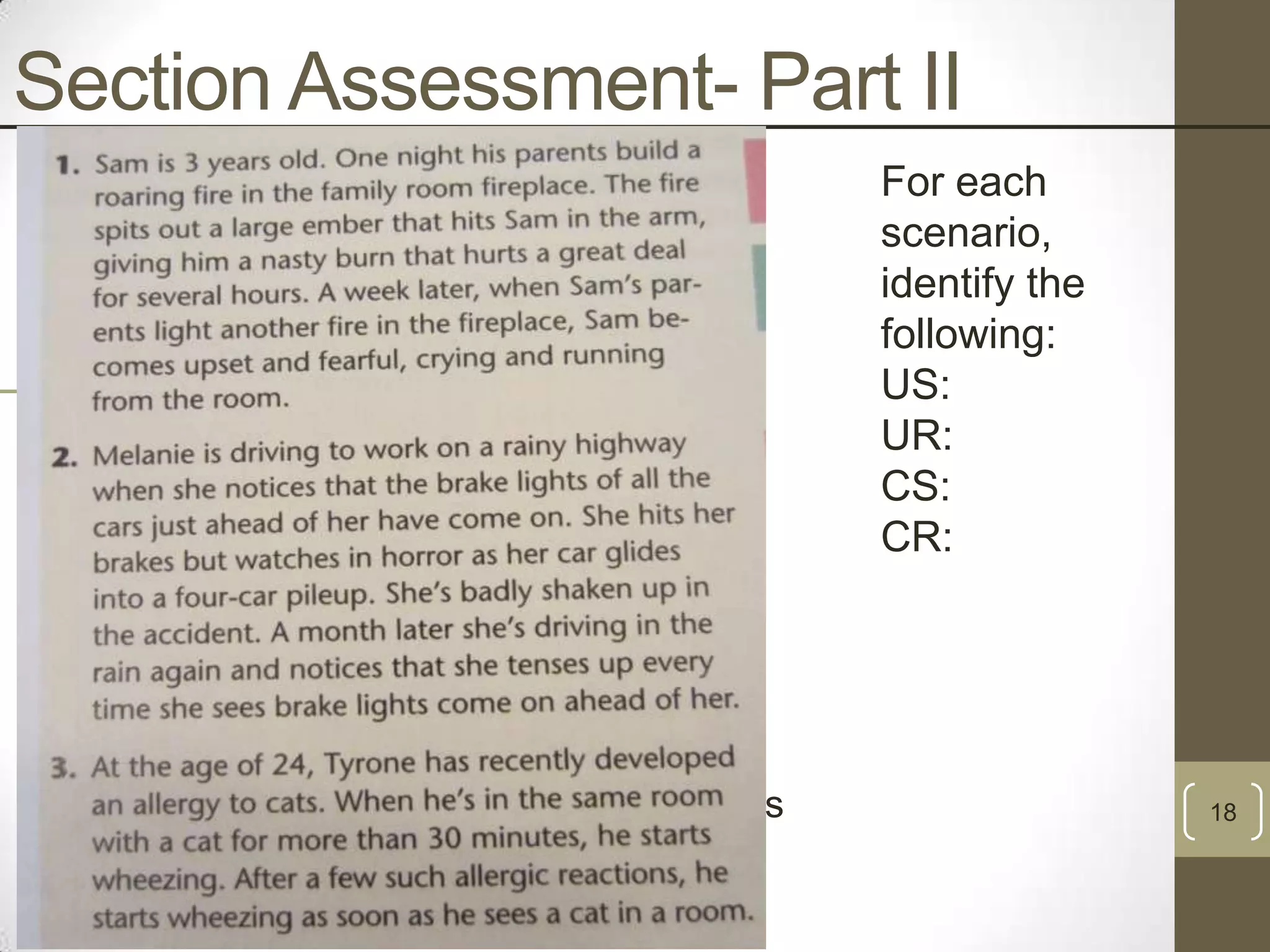
Section Assessment- Part II
#1

#2

#3

US- Burn
UR- Pain From Burn
CS- Fire in Fireplace
CR- Fear of Fire
US- Car Accident
UR- Fear, tensing after accident
CS- Brake lights in rain
CR- Tense feeling
US- Being around cats (dander)
UR- Wheezing
CS- Sight of cats
CR- Wheezing from the sight of cats

For each
scenario,
identify the
following:
US:
UR:
CS:
CR:

18
Section 3: Operant Conditioning- Part I
Learning Goals
• Students should be able to answer the following:
1. What is operant conditioning, and how does it differ
from classical conditioning?
2. How do different schedules of reinforcement affect
behavior?

19
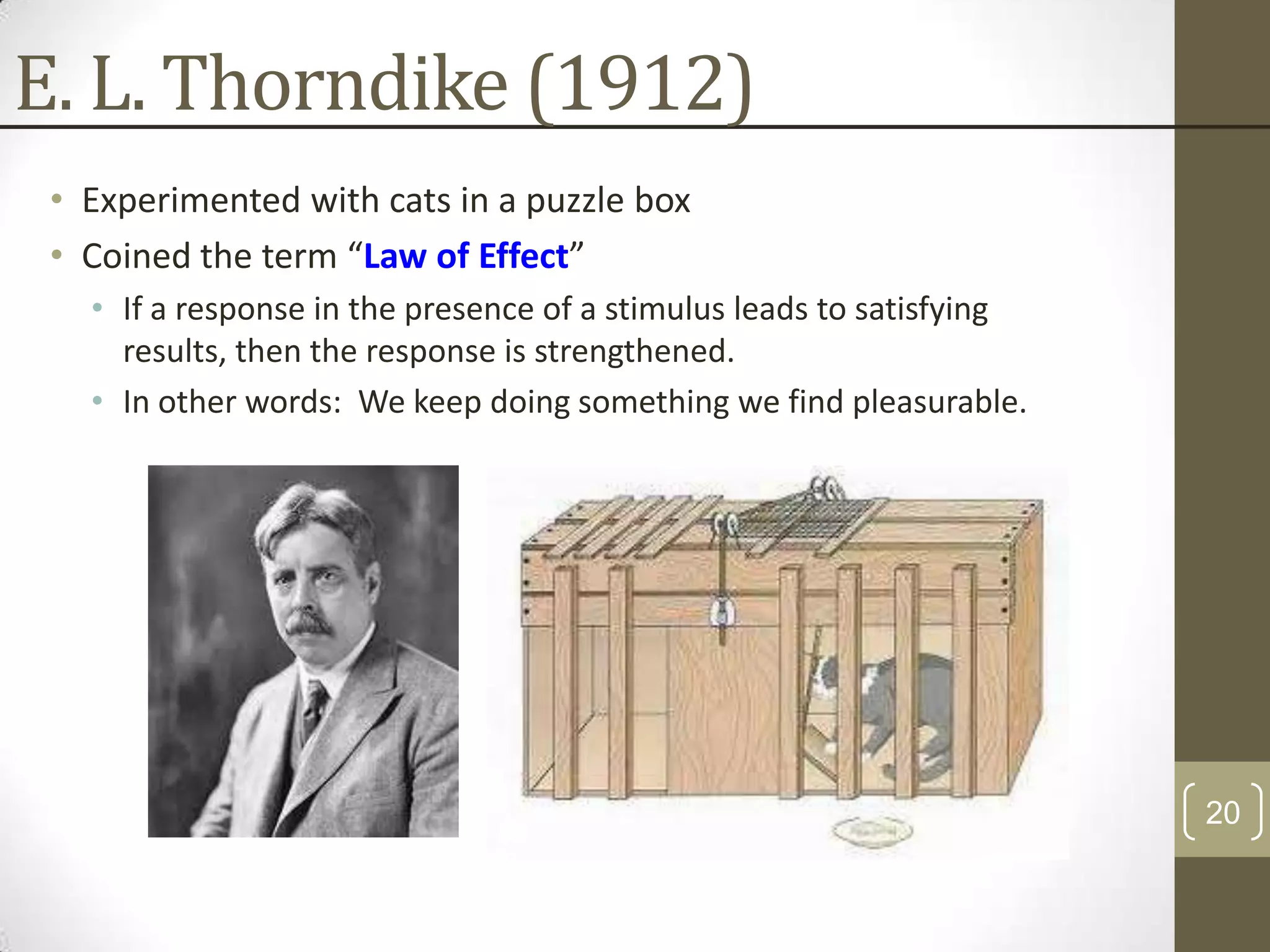
E. L. Thorndike (1912)
• Experimented with cats in a puzzle box
• Coined the term “Law of Effect”
• If a response in the presence of a stimulus leads to satisfying
results, then the response is strengthened.
• In other words: We keep doing something we find pleasurable.

20
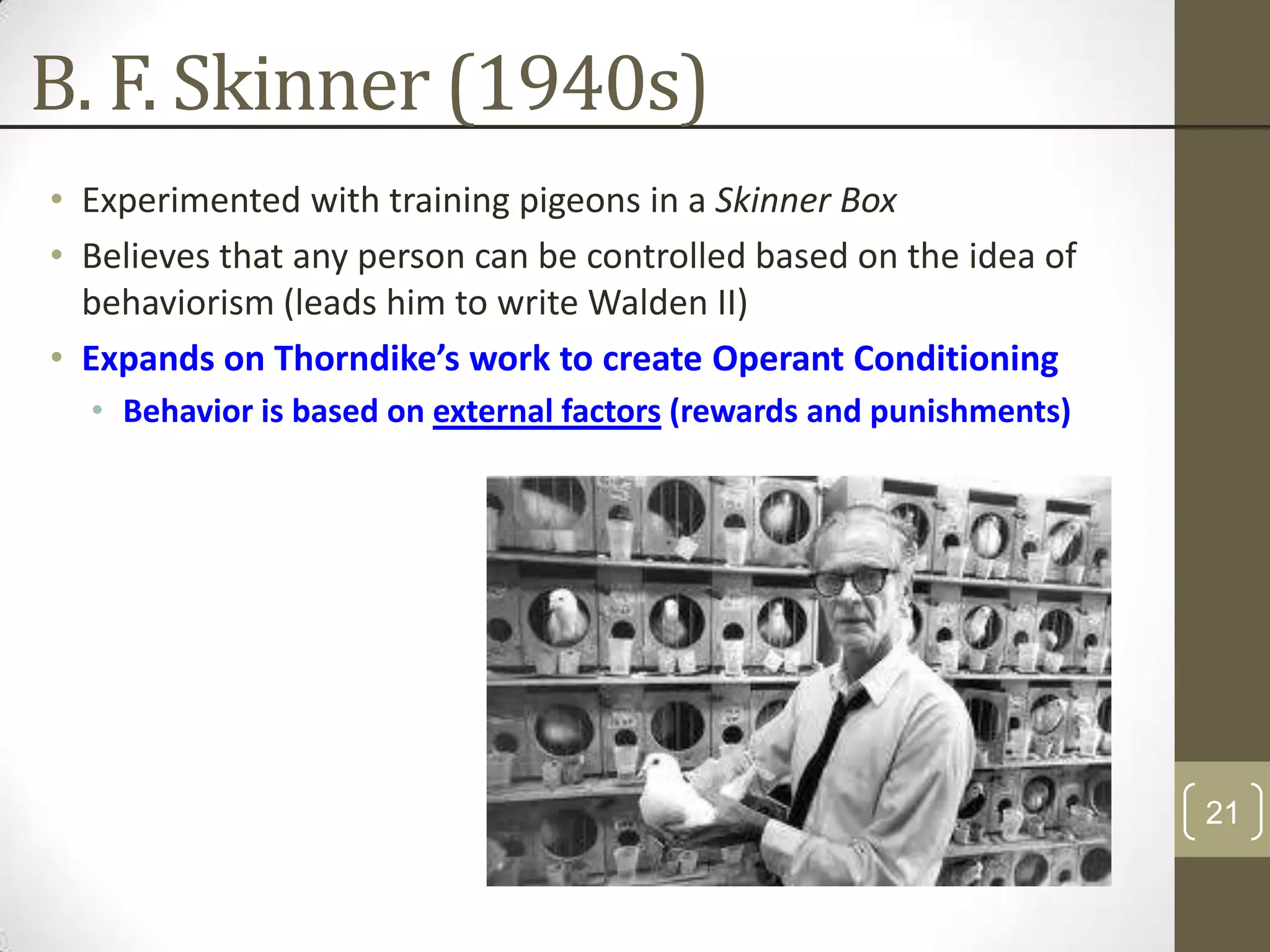
B. F. Skinner (1940s)
• Experimented with training pigeons in a Skinner Box
• Believes that any person can be controlled based on the idea of
behaviorism (leads him to write Walden II)
• Expands on Thorndike’s work to create Operant Conditioning
• Behavior is based on external factors (rewards and punishments)

21
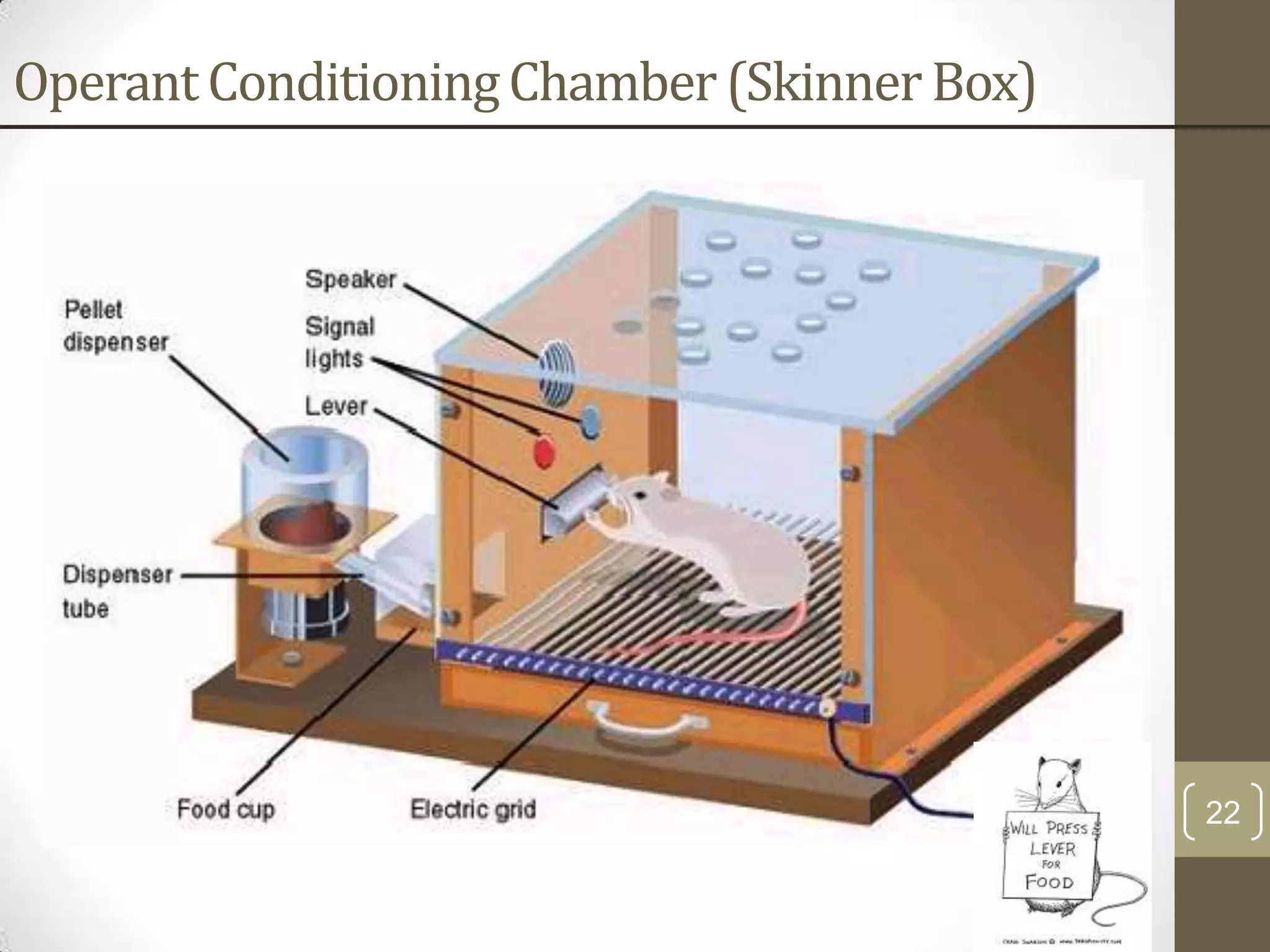
Operant Conditioning Chamber (Skinner Box)

22
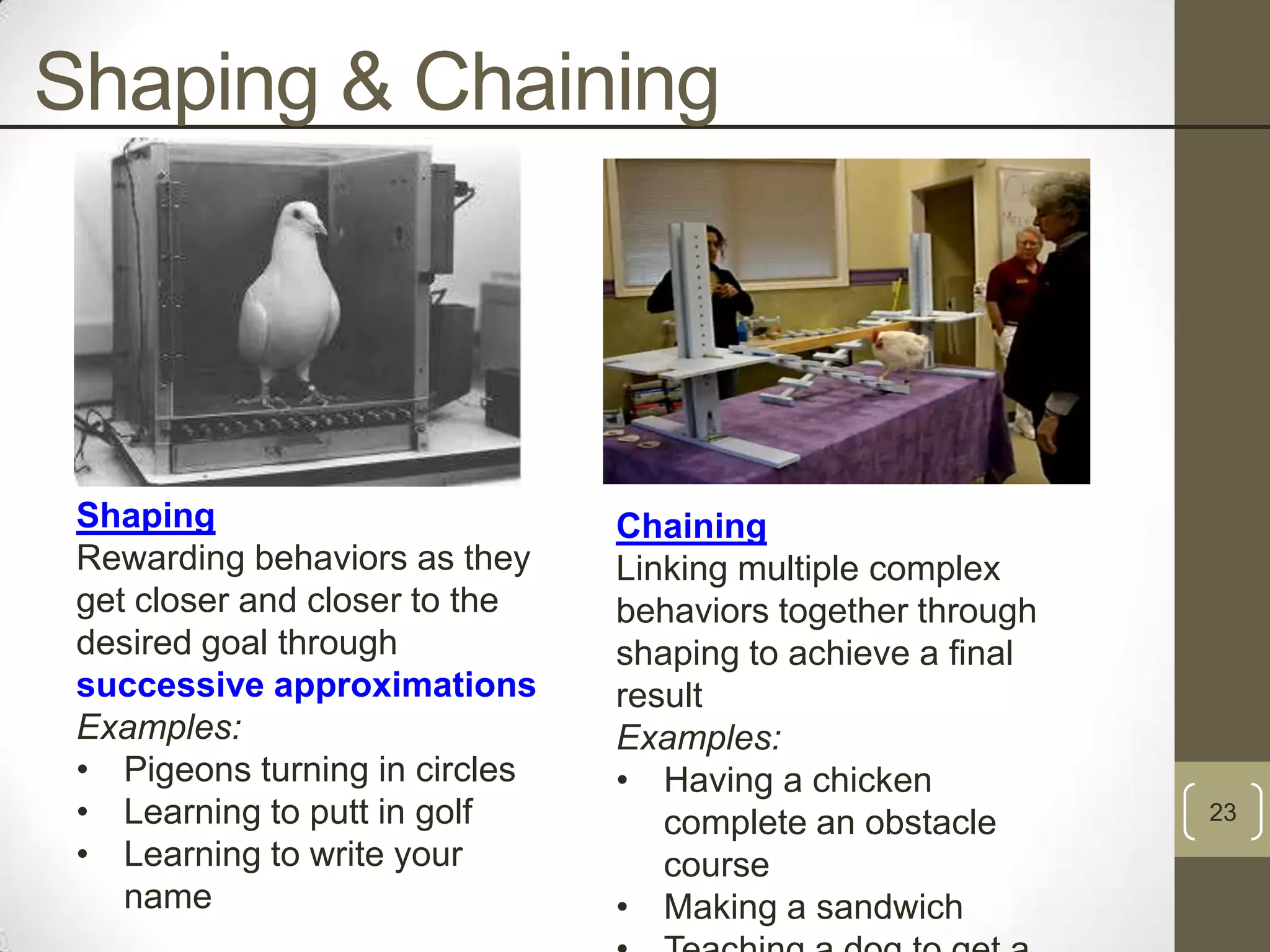
Shaping & Chaining

Shaping
Rewarding behaviors as they
get closer and closer to the
desired goal through
successive approximations
Examples:
• Pigeons turning in circles
• Learning to putt in golf
• Learning to write your
name

Chaining
Linking multiple complex
behaviors together through
shaping to achieve a final
result
Examples:
• Having a chicken
complete an obstacle
course
• Making a sandwich

23
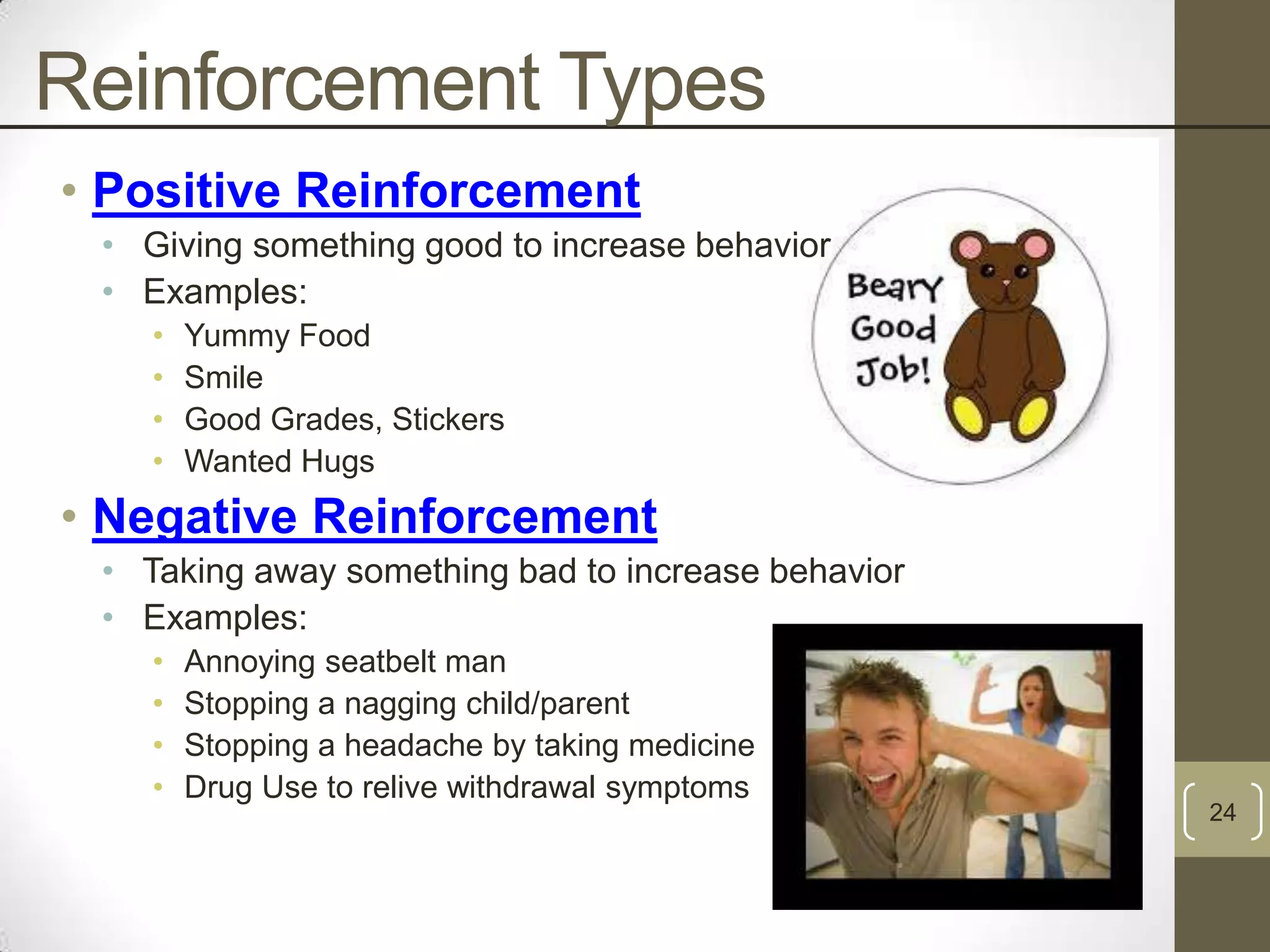
Reinforcement Types
• Positive Reinforcement
• Giving something good to increase behavior
• Examples:
•
•
•
•

Yummy Food
Smile
Good Grades, Stickers
Wanted Hugs

• Negative Reinforcement
• Taking away something bad to increase behavior
• Examples:
•
•
•
•

Annoying seatbelt man
Stopping a nagging child/parent
Stopping a headache by taking medicine
Drug Use to relive withdrawal symptoms

24
Other Types of Reinforcement
• Primary Reinforcer
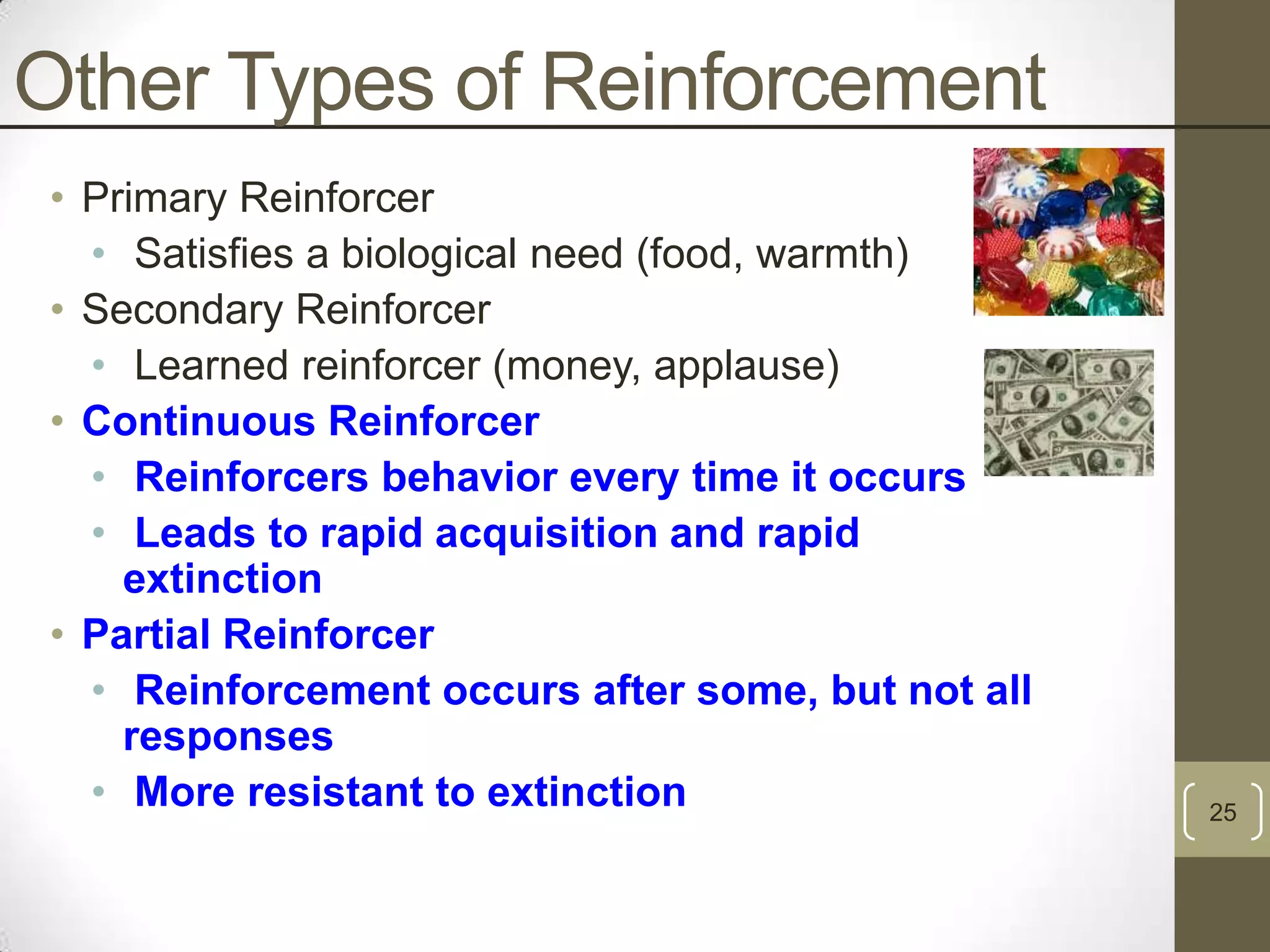
• Satisfies a biological need (food, warmth)
• Secondary Reinforcer
• Learned reinforcer (money, applause)
• Continuous Reinforcer
• Reinforcers behavior every time it occurs
• Leads to rapid acquisition and rapid
extinction
• Partial Reinforcer
• Reinforcement occurs after some, but not all
responses
• More resistant to extinction

25
Schedules of Reinforcement
• Ratio (Response)
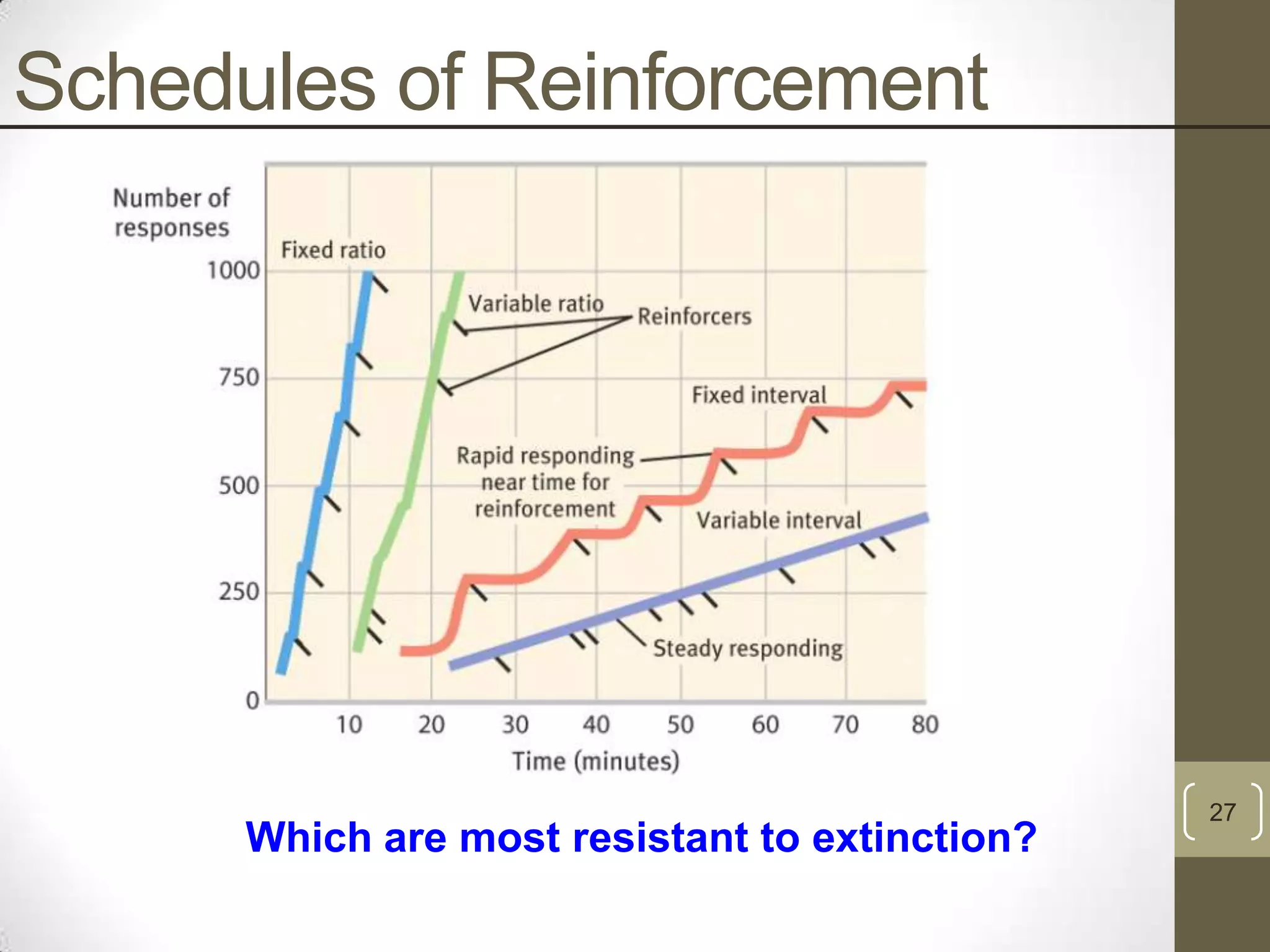
• Fixed-Ratio: Every time a response occurs
• People work harder
• Example: typist gets paid by the number of pages
typed

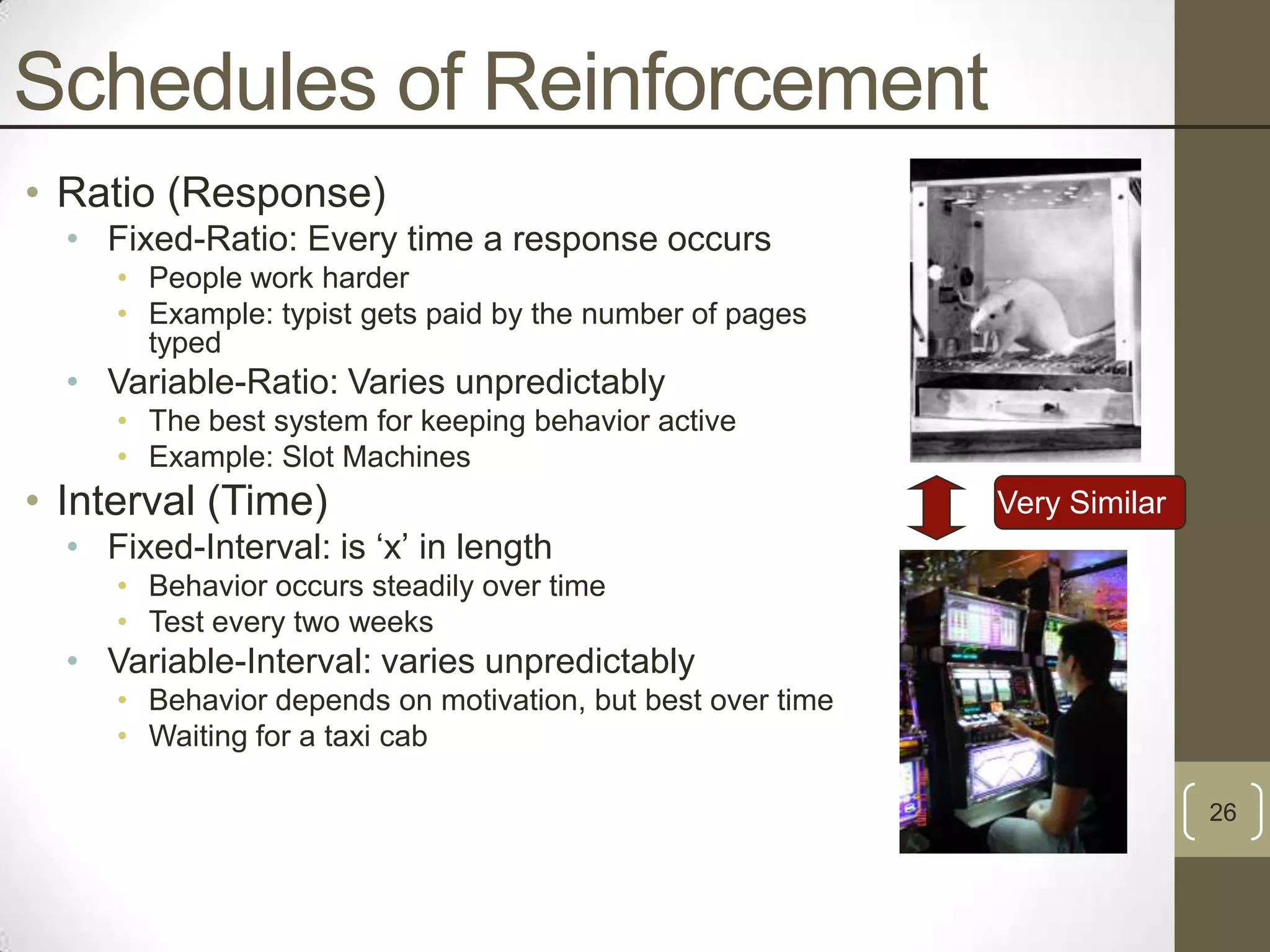
• Variable-Ratio: Varies unpredictably
• The best system for keeping behavior active
• Example: Slot Machines

• Interval (Time)

Very Similar

• Fixed-Interval: is „x‟ in length
• Behavior occurs steadily over time
• Test every two weeks

• Variable-Interval: varies unpredictably
• Behavior depends on motivation, but best over time
• Waiting for a taxi cab
26
Schedules of Reinforcement

Which are most resistant to extinction?

27
Section 3: Operant Conditioning- Part I
Reflect on Learning Goals
• Students should be able to answer the following:
1. What is operant conditioning, and how does it differ
from classical conditioning?
2. How do different schedules of reinforcement affect
behavior?

Good
Understanding

Fair
Understanding

Little
Understanding

28
Section 4: Operant Conditioning- Part II
Learning Goals
• Students should be able to answer the following:
1. How does punishment affect behavior?

29
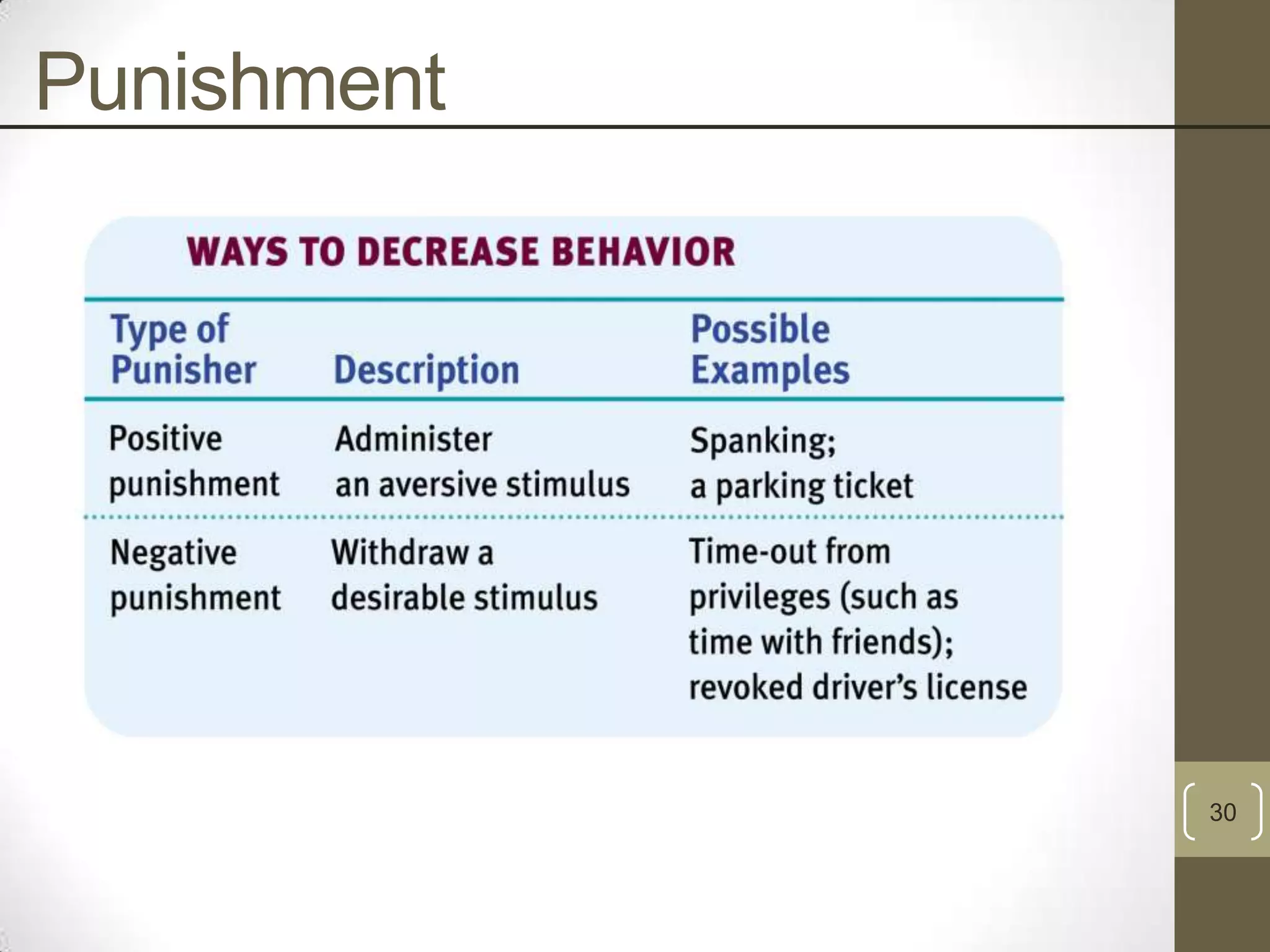
Punishment

30
Negative Reinforcement vs. Punishment
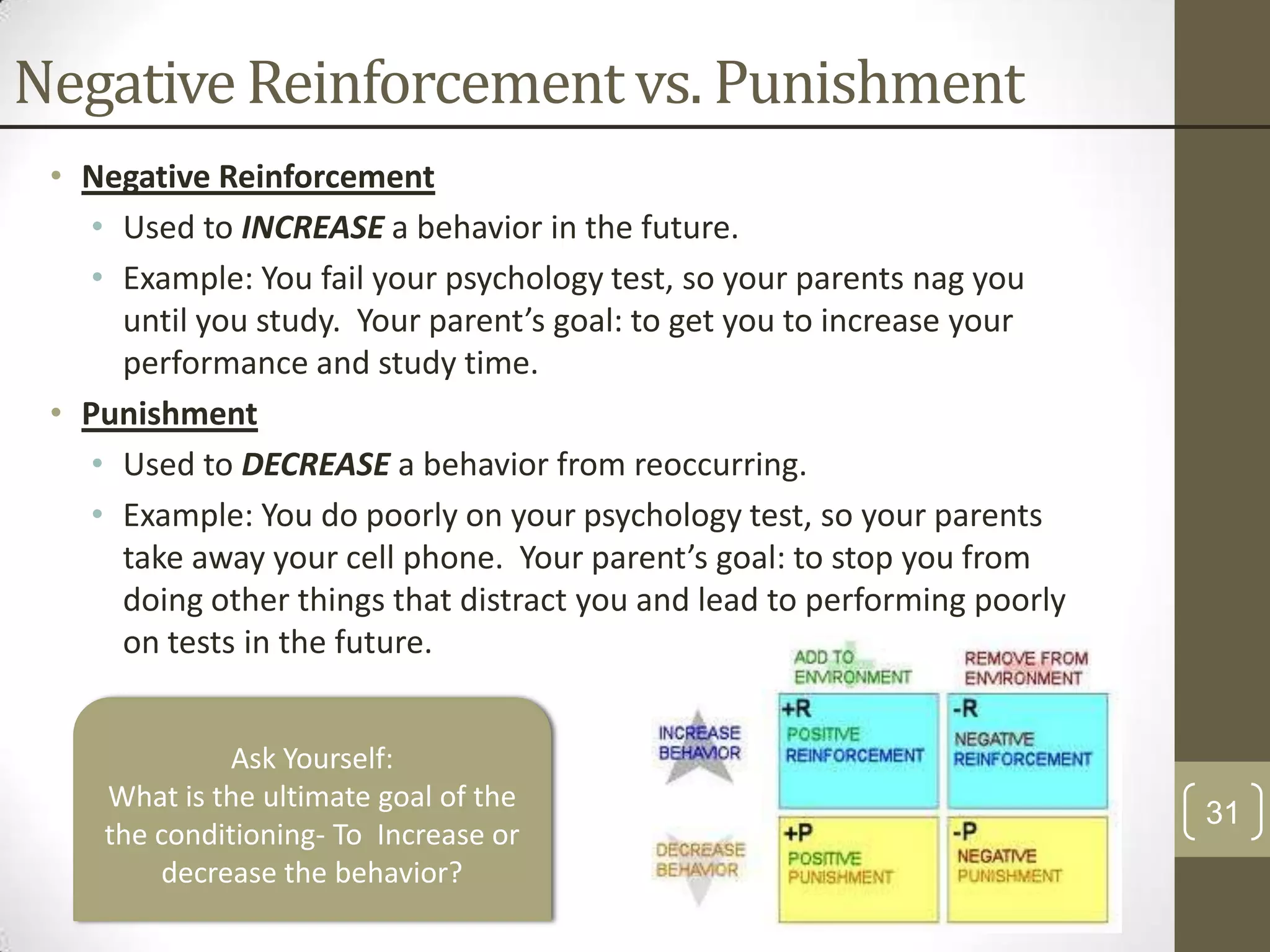
• Negative Reinforcement
• Used to INCREASE a behavior in the future.
• Example: You fail your psychology test, so your parents nag you
until you study. Your parent’s goal: to get you to increase your
performance and study time.
• Punishment
• Used to DECREASE a behavior from reoccurring.
• Example: You do poorly on your psychology test, so your parents
take away your cell phone. Your parent’s goal: to stop you from
doing other things that distract you and lead to performing poorly
on tests in the future.
Ask Yourself:
What is the ultimate goal of the
the conditioning- To Increase or
decrease the behavior?

31
Effects of Punishment
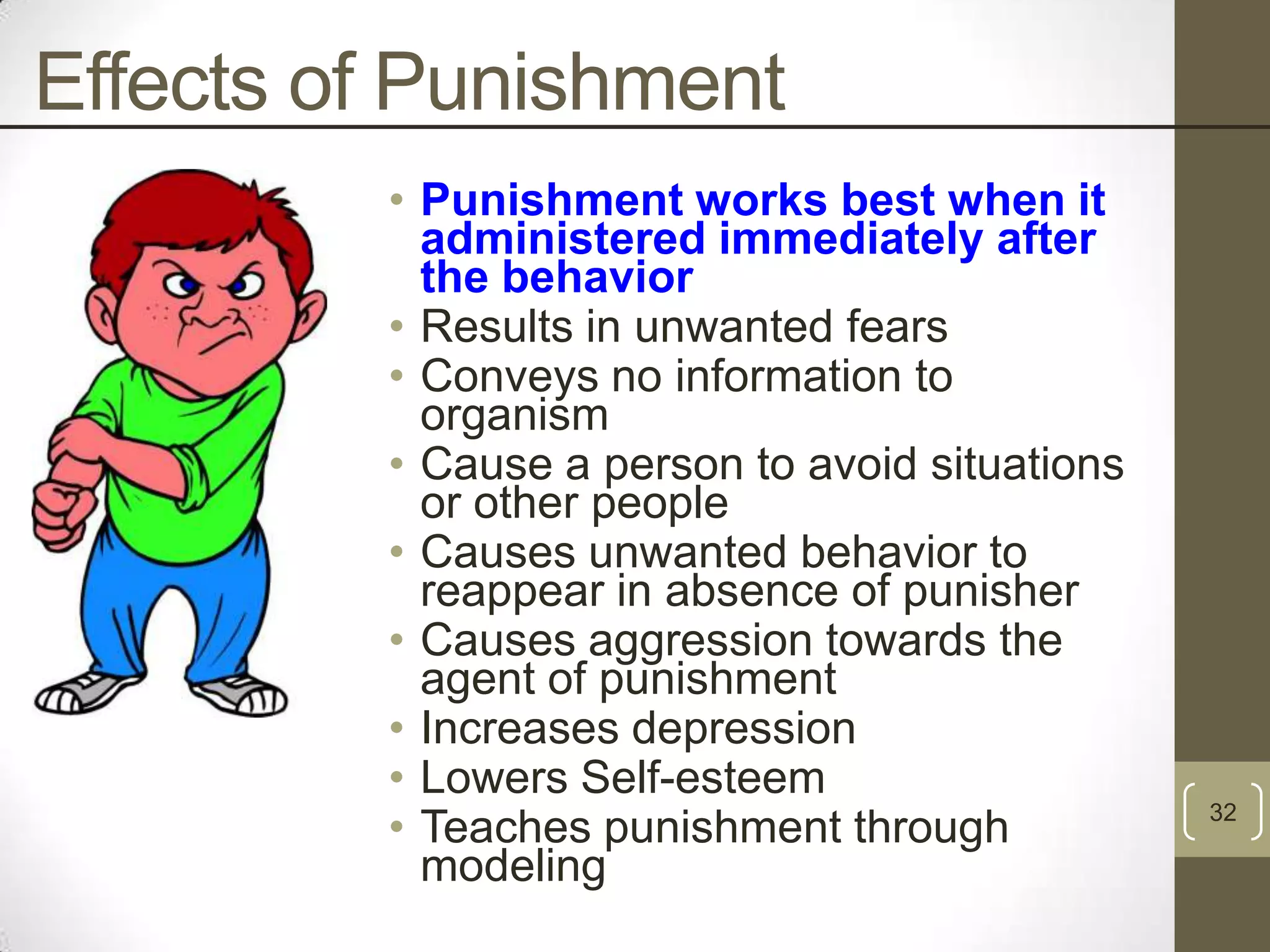
• Punishment works best when it
administered immediately after
the behavior
• Results in unwanted fears
• Conveys no information to
organism
• Cause a person to avoid situations
or other people
• Causes unwanted behavior to
reappear in absence of punisher
• Causes aggression towards the
agent of punishment
• Increases depression
• Lowers Self-esteem
• Teaches punishment through
modeling

32
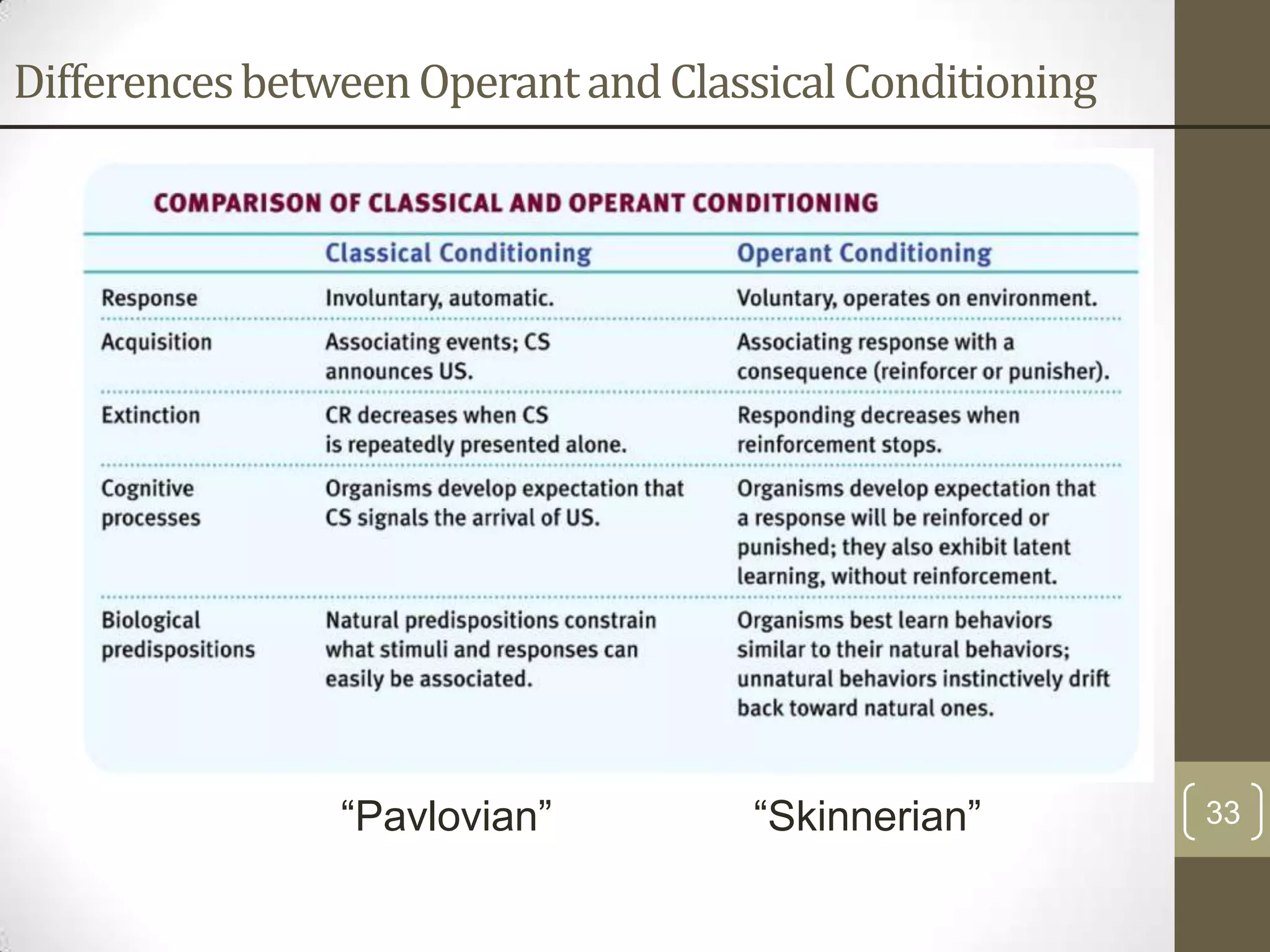
Differences between Operant and Classical Conditioning

“Pavlovian”

“Skinnerian”

33
Keys to Operant Conditioning
• Provide immediate and clear feedback
• Reinforcers and punishers should be presented as close
in time to response as possible
• Reinforcement and punishment must be consistent
• Biologically predisposed behaviors are more easily
reinforced than non-predisposed behaviors.
• Feedback must follow subject‟s behavior, not precede it!

34
‹#›
Section 4: Operant Conditioning- Part II
Reflect on Learning Goals
• Students should be able to answer the following:
1. How does punishment affect behavior?

Good
Understanding

Fair
Understanding

Little
Understanding

36
Section 4: Test Your
Knowledge
• Answer Questions on the Worksheet:
• Types of Schedule of Reinforcement
• FI, FR, VI, VR

• Punishment or Reinforcement
• PR, NR, PUN

37
Section 5: Operant Conditioning- Part III
Learning Goals
• Students should be able to answer the following:
1. Do cognitive processes and biological constraints
affect operant conditioning?

38
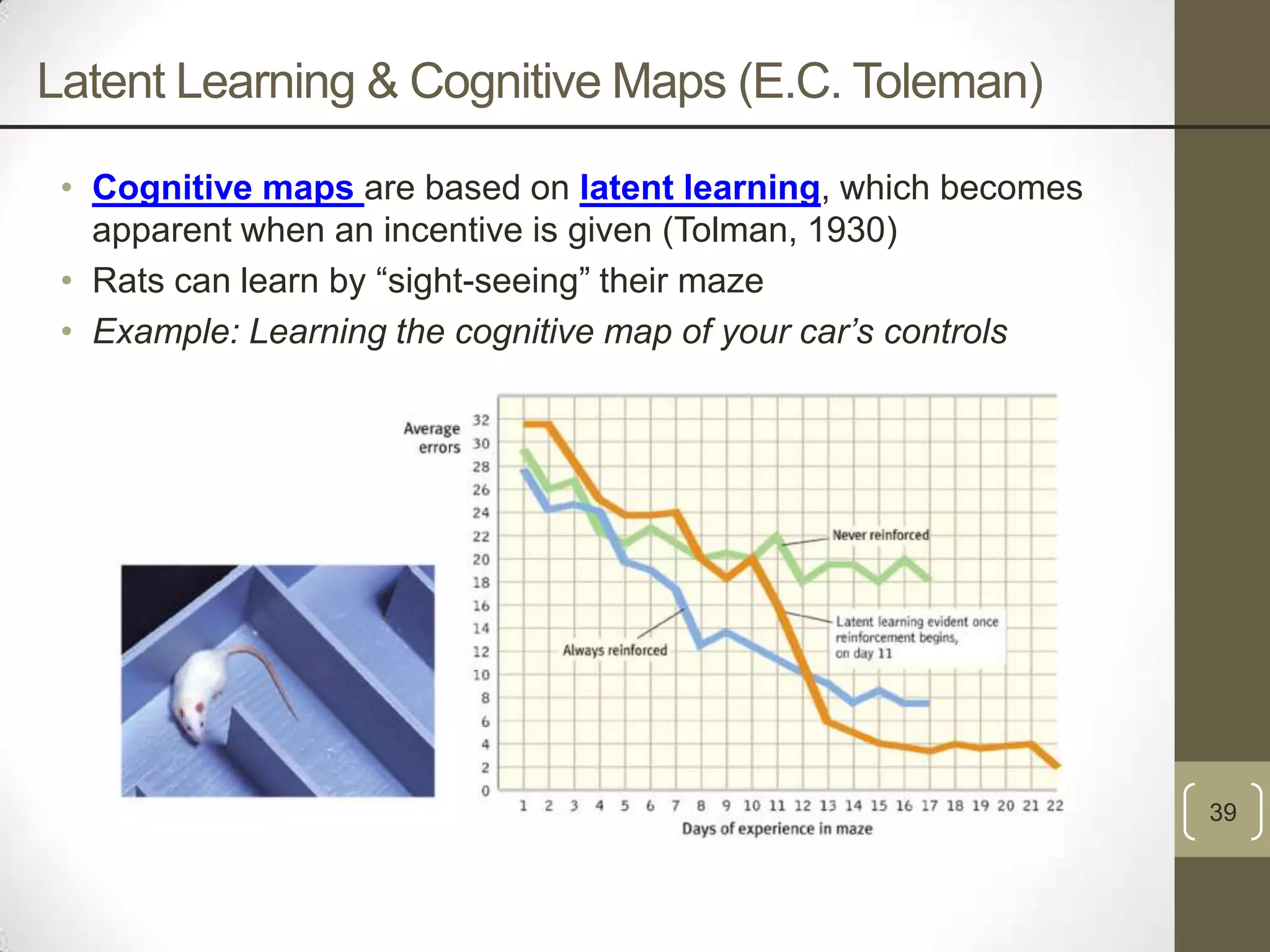
Latent Learning & Cognitive Maps (E.C. Toleman)
• Cognitive maps are based on latent learning, which becomes
apparent when an incentive is given (Tolman, 1930)
• Rats can learn by “sight-seeing” their maze
• Example: Learning the cognitive map of your car’s controls

39
Biological Predispositions
• Animals will learn behaviors they are biological predisposed
to faster than behaviors that do not come naturally.
• Example: A dog will learn to fetch slippers faster than they will
learn to climb a tree.

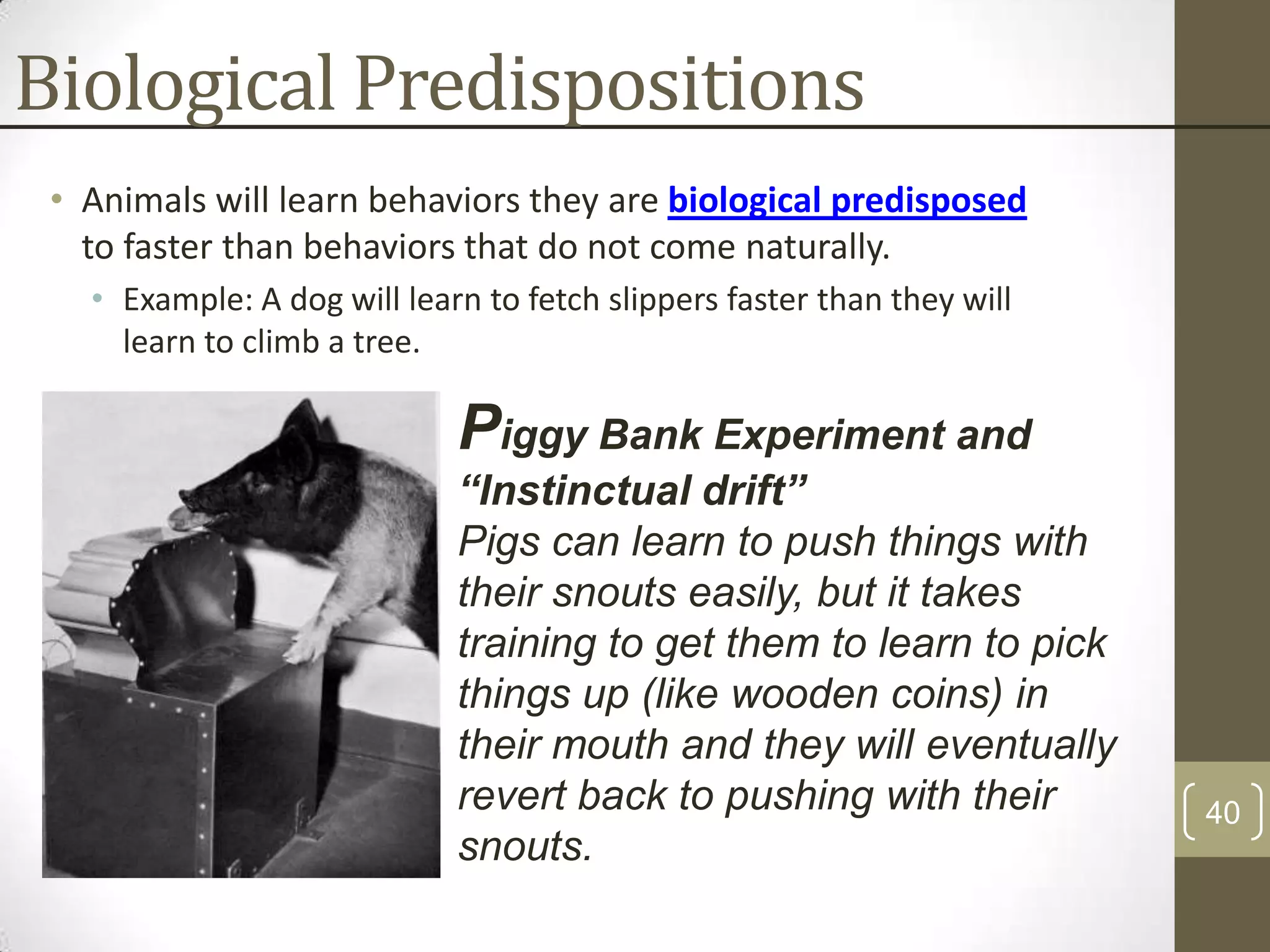
Piggy Bank Experiment and
“Instinctual drift”
Pigs can learn to push things with
their snouts easily, but it takes
training to get them to learn to pick
things up (like wooden coins) in
their mouth and they will eventually
revert back to pushing with their
snouts.

40
Overjustification Effect
• Intrinsic Motivation: Motivated by internal drive (Doing things
because they interest you)
• Extrinsic Motivation: Motivated by outside forces (Doing
things to get a reward or avoid punishment)
• Overjustification Effect: If you are rewarded for something
you already enjoy doing, and then the reward is removed, you
will lose your intrinsic motivation.

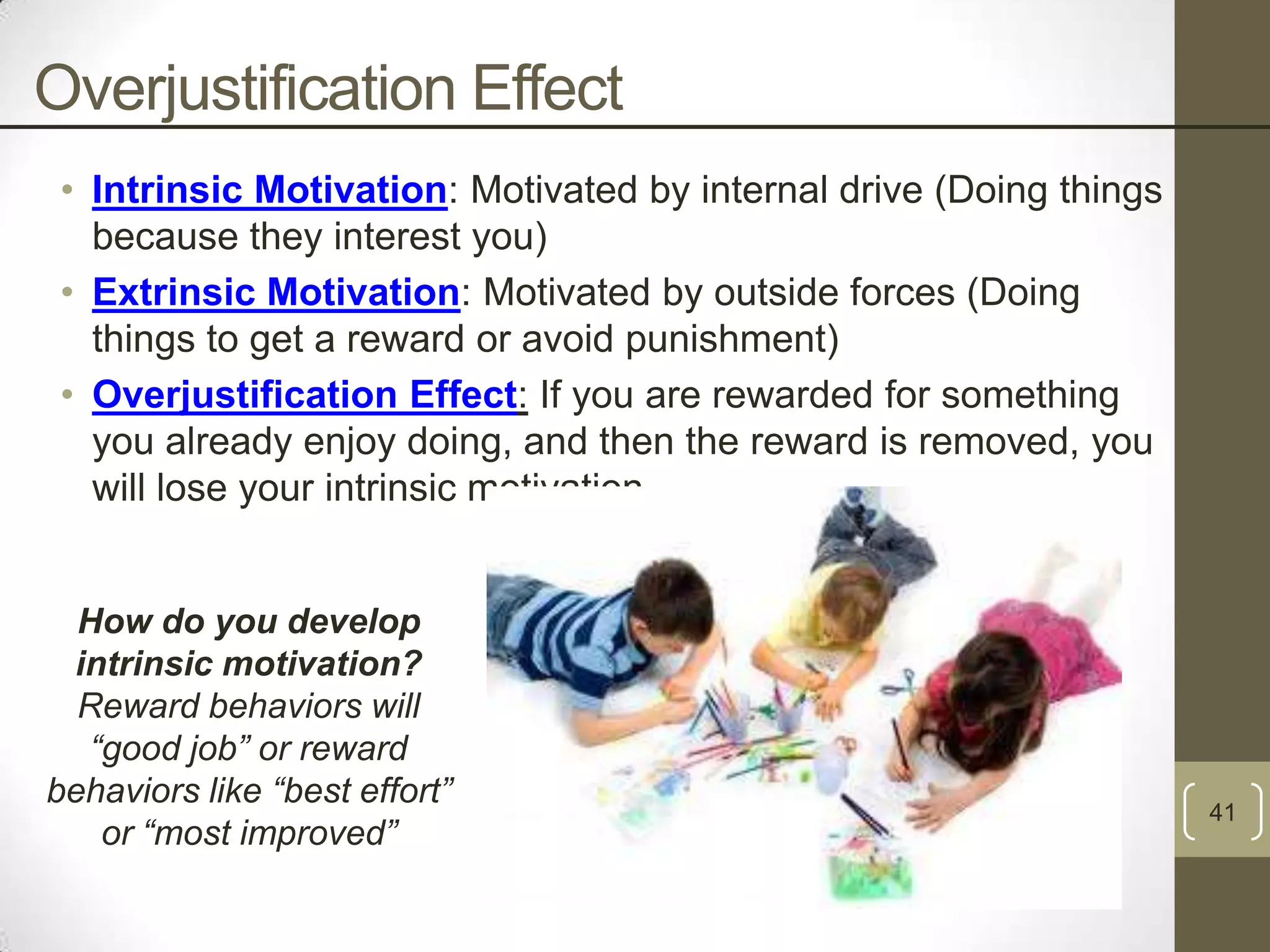
How do you develop
intrinsic motivation?
Reward behaviors will
“good job” or reward
behaviors like “best effort”
or “most improved”

41
Practical Applications for Operant Conditioning: Biofeedback

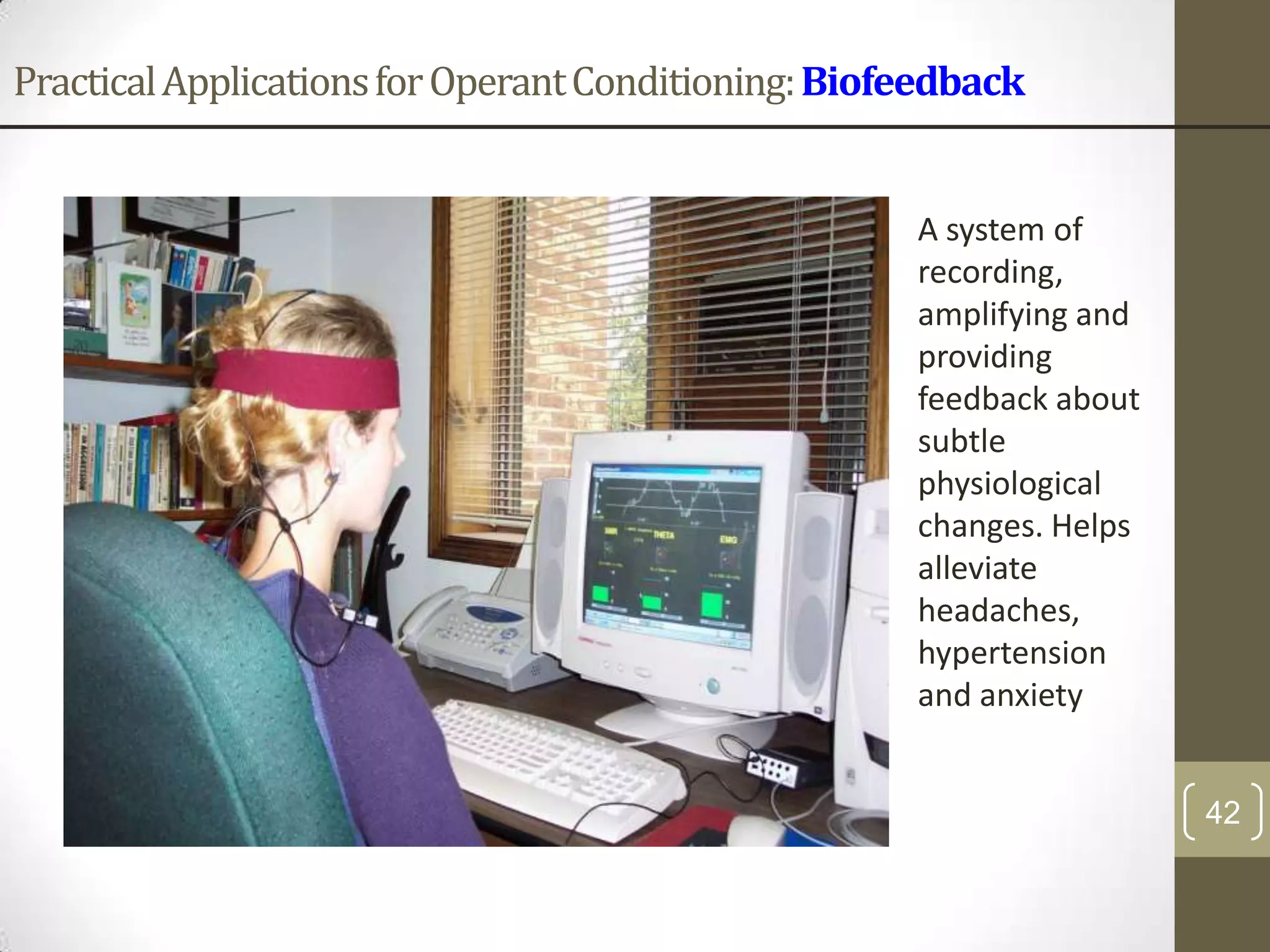
A system of
recording,
amplifying and
providing
feedback about
subtle
physiological
changes. Helps
alleviate
headaches,
hypertension
and anxiety
42
Section 5: Operant Conditioning- Part III
Reflect on Learning Goals
• Students should be able to answer the following:
1. Do cognitive processes and biological constraints
affect operant conditioning?

Good
Understanding

Fair
Understanding

Little
Understanding

43
Section 6: Learning by Observation
Learning Goals
• Students should be able to answer the following:
1. What is observational learning, and how is it enabled
by mirror neurons?
2. What is the impact of prosocial modeling and of
antisocial modeling?

44
Learning Through Observation
• Observational Learning
• Learning by watching others
• Modeling
• The process of observing and imitating a specific behavior
• Animals and humans can learn through observation
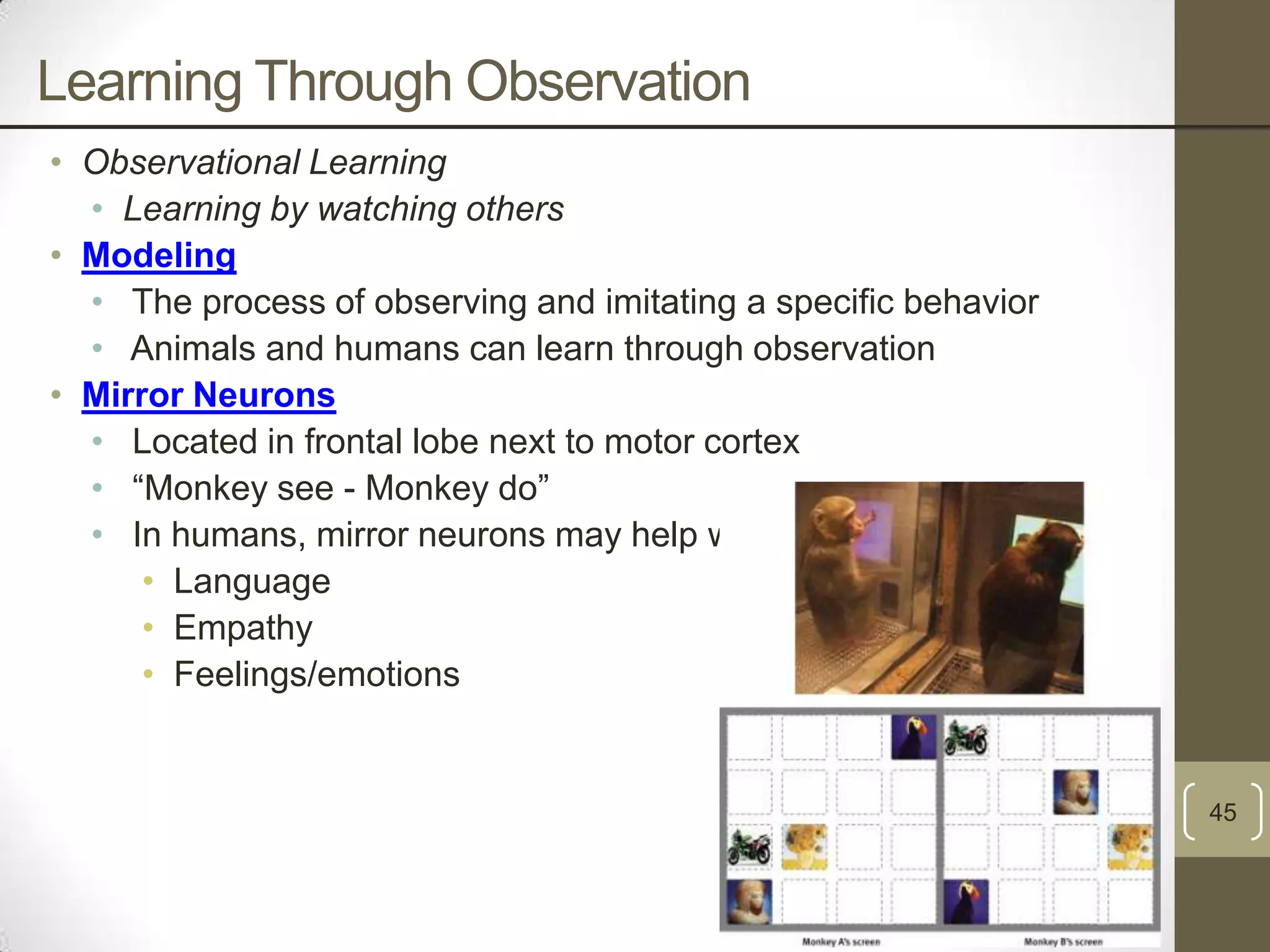
• Mirror Neurons
• Located in frontal lobe next to motor cortex
• “Monkey see - Monkey do”
• In humans, mirror neurons may help with:
• Language
• Empathy
• Feelings/emotions

45
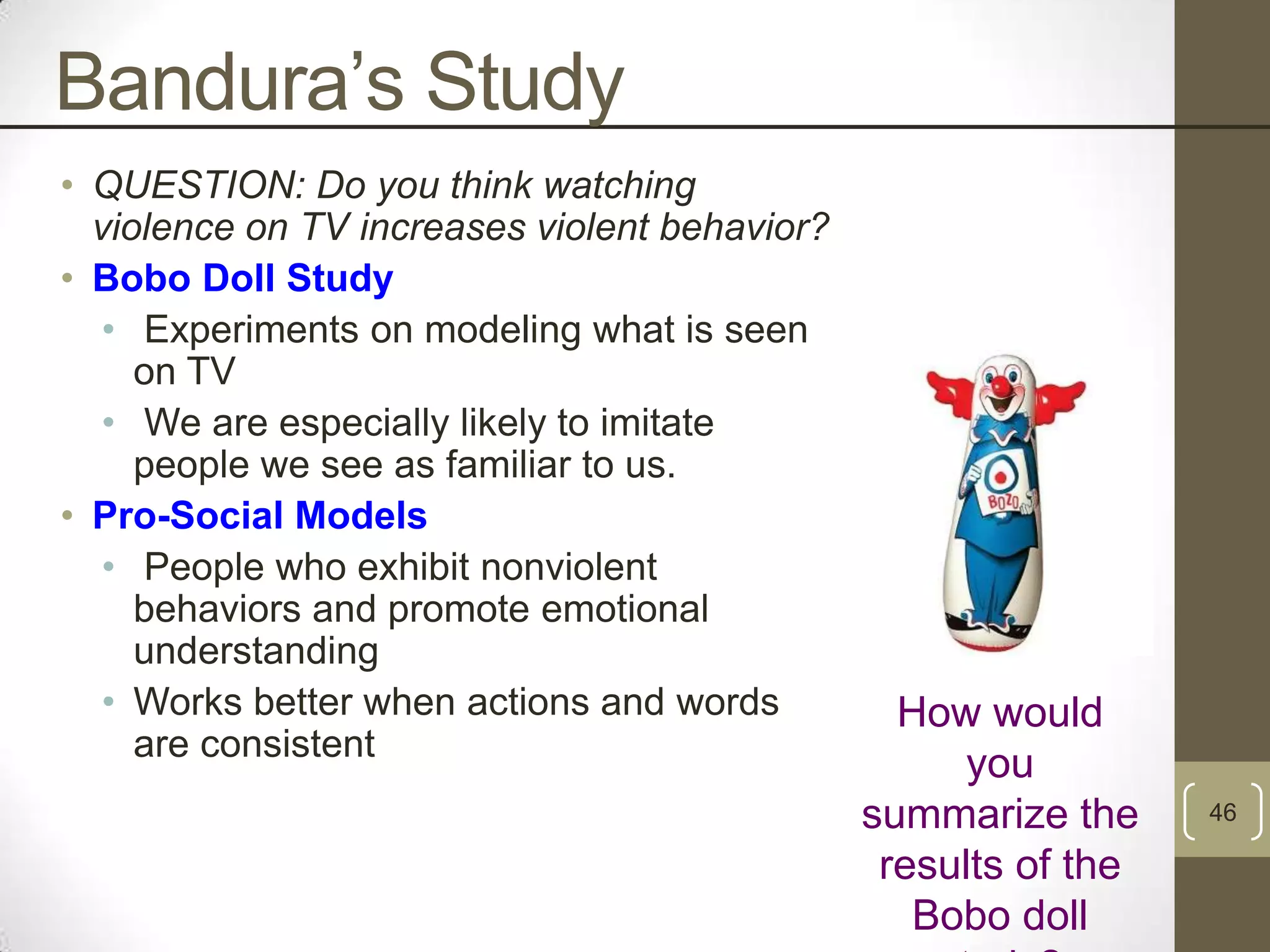
Bandura‟s Study
• QUESTION: Do you think watching
violence on TV increases violent behavior?
• Bobo Doll Study
• Experiments on modeling what is seen
on TV
• We are especially likely to imitate
people we see as familiar to us.
• Pro-Social Models
• People who exhibit nonviolent
behaviors and promote emotional
understanding
• Works better when actions and words
are consistent

How would
you
summarize the
results of the
Bobo doll

46
Reel World to Real Word Violence
• More violence on TV is correlated with more
fights in school (Gentile, 2004)
• More aggressive acts are committed by
those who watch more violent TV (Eron et
al, 1987)
• White South Africans were introduced to TV
in 1975, since then the homicide rate has
doubled (Centerwall, 1989)
• People who view violence in TV and Video
Games tend to be more aggressive and less
sympathetic.

47
Section 6: Learning by Observation
Reflect on Learning Goals
• Students should be able to answer the following:
1. What is observational learning, and how is it enabled
by mirror neurons?
2. What is the impact of prosocial modeling and of
antisocial modeling?

Good
Understanding

Fair
Understanding

Little
Understanding

48
Review: Mini FRQ
Emma, a seven-year-old, is playing softball for the
first time. She is learning how to hit the ball with the
bat. Describe how the following terms contribute to
her hitting the ball.
• Extrinsic Motivation
• Shaping
• Observational Learning
• Frontal Lobe

49
Review: Mini FRQ- Answers
• Extrinsic Motivation
• Rewards from outside source
• Pressure from parents or teammates

• Shaping
• Learning in stages
• First learns the grip, then the stance, then the position of the
bat OR first learns to hit off a tee, then a slow pitch, then a
fast pitch

• Observational Learning
• Learns by watching others bat (mimics other‟s behavior)

• Frontal Lobe
• Mirror neurons- neurons that allow her to imamate others
body position and movements
• Motor cortex will help her swing the bat by controlling body
movement.
50

Ap learning ss

  • 1.
  • 2.
    Section 1: ClassicalConditioning- Part I Learning Goals • Students should be able to answer the following: 1. What is classical conditioning, and how did Pavlov’s work influence behaviorism? 2. How does a neutral stimulus become a conditioned stimulus? 2
  • 3.
    Pavlov’ Study Behaviorists dislike Freudian Psychologists becausebehaviorists claim it is only through observerable responses that we can describe and change human behavior. 3
  • 4.
    PAVLOV‟S STUDY • Pavlov‟sExperiment Stage 1: Unconditioned learning) Bell = No Response Food = Drool Stage 2 (Acquisition) Bell + Food = Drool Stage 3 (Conditioned learning) Bell = Drool Secondary or Higher Order Conditioning: Could pairing light with a bell cause the dog to salivate to the light alone? YES • Bell- Neutral Stimulus (NS) • Food- Unconditioned Stimulus (UCS) • Drool (to the food)- Unconditioned response (UCR) • Bell- Conditioned Stimulus (CS) • Drool (to the bell)- Conditioned Response (CR) 4
  • 5.
    CLASSICAL CONDITIONING BASICS •Classical Conditioning (involuntary responses) • Acquisition • The initial stage in classical conditioning in which an association between a neutral stimulus and an unconditioned stimulus takes place • The conditioned stimulus needs to come before the unconditioned stimulus • The time between the two stimuli should only be half a second 5
  • 6.
    INVOLUNTARY BEHAVIORS • • • • • • • Eye Blink PupilDilation Flinching Salivating Sweating Heart Rate/Breathing Immune System Response • • • • • • • Dry mouth Reflexes Fears/Emotions Cravings Arousal Vomiting Autistic Tics/Jerks 6
  • 7.
    Section 1: ClassicalConditioning- Part I Reflect on Learning Goals • Students should be able to answer the following: 1. What is classical conditioning, and how did Pavlov’s work influence behaviorism? 2. How does a neutral stimulus become a conditioned stimulus? Good Understanding Fair Understanding Little Understanding 7
  • 8.
    Section 1: TestYour Knowledge A mouse will normally flinch after getting a mild shock. During conditioning, a red light is present right before the mild shock is given to the mouse. Soon, the mouse will freeze/flinch when the red light is present alone. US= UR= CS= CR= NS= Would the following process also work to condition the mouse: The mild shock is given to the mouse before the red light is present. Why or Why Not? 8
  • 9.
    Section 2: ClassicalConditioning- Part II Learning Goals • Students should be able to answer the following: 1. 2. In classical conditioning, what are the processes of acquisition, extinction, spontaneous recovery, generalization and discrimination? Do Cognitive processes and biological constraints affect classical conditioning? 9
  • 10.
    Higher Order Conditioning •AKA- Second Order Conditioning: After a Conditioned Stimulus (CS1) has been established, another conditioned stimulus (CS2) can be added to induce the Conditioned Response (CR). Example: Once the dog has been conditioned to drool to the sound of the bell, the dog can be conditioned again to drool to the sight of a ball using only the bell and no food. 10
  • 11.
    CLASSICAL CONDITIONING • Extinction(Extinguished) • A stoppage of the conditioned response • May be learned or occur naturally • Spontaneous Recovery • After a resting period, sometimes the classically conditioned behavior reappears. “Old feelings” come back for no reason 11
  • 12.
    GENERALIZATION V. DISCRIMINATION •Generalization • The tendency to respond to similar stimuli in a like manner • Example: responding to a pit-bull and a dachshund in the same way • Discrimination • The learned ability to distinguish between two stimuli that are similar • Example: responding differently to a math and English test 12
  • 13.
    Little Albert Study(1920) • Little Baby Albert Study • Conducted by John B. Watson (Behaviorist) • Synopsis: Watson classically conditions a baby to fear a white rat. • Unintended Finding: Little Albert learns to generalize his fear of the white rat to other white, furry things (like Santa Claus beard, rabbits, and stuffed animals) 13
  • 14.
    Garcia Effect (Taste Aversion) •Garcia showed that the duration between the CS and the US may be long (hours), but yet result in conditioning. A biologically adaptive CS (taste) led to conditioning and not to others (light or sound). 14
  • 15.
    Rescorla and Wagner •Robert Rescorla and Allan Wagner showed that animals will learn better through classical conditioning if the UCS predicts the CS • The greater the prediction of the conditioned stimulus (CS), the stronger the conditioned response (CR). • Shows that cognition in the form of “expectations” is a part classical conditioning 15
  • 16.
    Section 2: ClassicalConditioning- Part II Reflect on Learning Goals • Students should be able to answer the following: 1. 2. In classical conditioning, what are the processes of acquisition, extinction, spontaneous recovery, generalization and discrimination? Do Cognitive processes and biological constraints affect classical conditioning? Good Understanding Fair Understanding Little Understanding 16
  • 17.
    Section 2: TestYour Knowledge 1. An individual‟s fear of dogs that is lost as the individual is exposed to dogs in a non-threatening situation is referred to by behaviorists as a fear that has been: A. Satiated B. Suppressed C. Repressed D. Extinguished E. Punished 2. Watson conditioned “Little Albert” to fear white rats by banging a hammer on steel bars as the child played with the white rat. Later it was discovered that Albert feared not only white rats, but also white stuffed animals. Albert‟s fear can be attributed to: A. B. C. D. The law of effect Stimulus generalization Stimulus discrimination An overactive imagination 17
  • 18.
    Section Assessment- PartII #1 #2 #3 US- Burn UR- Pain From Burn CS- Fire in Fireplace CR- Fear of Fire US- Car Accident UR- Fear, tensing after accident CS- Brake lights in rain CR- Tense feeling US- Being around cats (dander) UR- Wheezing CS- Sight of cats CR- Wheezing from the sight of cats For each scenario, identify the following: US: UR: CS: CR: 18
  • 19.
    Section 3: OperantConditioning- Part I Learning Goals • Students should be able to answer the following: 1. What is operant conditioning, and how does it differ from classical conditioning? 2. How do different schedules of reinforcement affect behavior? 19
  • 20.
    E. L. Thorndike(1912) • Experimented with cats in a puzzle box • Coined the term “Law of Effect” • If a response in the presence of a stimulus leads to satisfying results, then the response is strengthened. • In other words: We keep doing something we find pleasurable. 20
  • 21.
    B. F. Skinner(1940s) • Experimented with training pigeons in a Skinner Box • Believes that any person can be controlled based on the idea of behaviorism (leads him to write Walden II) • Expands on Thorndike’s work to create Operant Conditioning • Behavior is based on external factors (rewards and punishments) 21
  • 22.
  • 23.
    Shaping & Chaining Shaping Rewardingbehaviors as they get closer and closer to the desired goal through successive approximations Examples: • Pigeons turning in circles • Learning to putt in golf • Learning to write your name Chaining Linking multiple complex behaviors together through shaping to achieve a final result Examples: • Having a chicken complete an obstacle course • Making a sandwich 23
  • 24.
    Reinforcement Types • PositiveReinforcement • Giving something good to increase behavior • Examples: • • • • Yummy Food Smile Good Grades, Stickers Wanted Hugs • Negative Reinforcement • Taking away something bad to increase behavior • Examples: • • • • Annoying seatbelt man Stopping a nagging child/parent Stopping a headache by taking medicine Drug Use to relive withdrawal symptoms 24
  • 25.
    Other Types ofReinforcement • Primary Reinforcer • Satisfies a biological need (food, warmth) • Secondary Reinforcer • Learned reinforcer (money, applause) • Continuous Reinforcer • Reinforcers behavior every time it occurs • Leads to rapid acquisition and rapid extinction • Partial Reinforcer • Reinforcement occurs after some, but not all responses • More resistant to extinction 25
  • 26.
    Schedules of Reinforcement •Ratio (Response) • Fixed-Ratio: Every time a response occurs • People work harder • Example: typist gets paid by the number of pages typed • Variable-Ratio: Varies unpredictably • The best system for keeping behavior active • Example: Slot Machines • Interval (Time) Very Similar • Fixed-Interval: is „x‟ in length • Behavior occurs steadily over time • Test every two weeks • Variable-Interval: varies unpredictably • Behavior depends on motivation, but best over time • Waiting for a taxi cab 26
  • 27.
    Schedules of Reinforcement Whichare most resistant to extinction? 27
  • 28.
    Section 3: OperantConditioning- Part I Reflect on Learning Goals • Students should be able to answer the following: 1. What is operant conditioning, and how does it differ from classical conditioning? 2. How do different schedules of reinforcement affect behavior? Good Understanding Fair Understanding Little Understanding 28
  • 29.
    Section 4: OperantConditioning- Part II Learning Goals • Students should be able to answer the following: 1. How does punishment affect behavior? 29
  • 30.
  • 31.
    Negative Reinforcement vs.Punishment • Negative Reinforcement • Used to INCREASE a behavior in the future. • Example: You fail your psychology test, so your parents nag you until you study. Your parent’s goal: to get you to increase your performance and study time. • Punishment • Used to DECREASE a behavior from reoccurring. • Example: You do poorly on your psychology test, so your parents take away your cell phone. Your parent’s goal: to stop you from doing other things that distract you and lead to performing poorly on tests in the future. Ask Yourself: What is the ultimate goal of the the conditioning- To Increase or decrease the behavior? 31
  • 32.
    Effects of Punishment •Punishment works best when it administered immediately after the behavior • Results in unwanted fears • Conveys no information to organism • Cause a person to avoid situations or other people • Causes unwanted behavior to reappear in absence of punisher • Causes aggression towards the agent of punishment • Increases depression • Lowers Self-esteem • Teaches punishment through modeling 32
  • 33.
    Differences between Operantand Classical Conditioning “Pavlovian” “Skinnerian” 33
  • 34.
    Keys to OperantConditioning • Provide immediate and clear feedback • Reinforcers and punishers should be presented as close in time to response as possible • Reinforcement and punishment must be consistent • Biologically predisposed behaviors are more easily reinforced than non-predisposed behaviors. • Feedback must follow subject‟s behavior, not precede it! 34
  • 35.
  • 36.
    Section 4: OperantConditioning- Part II Reflect on Learning Goals • Students should be able to answer the following: 1. How does punishment affect behavior? Good Understanding Fair Understanding Little Understanding 36
  • 37.
    Section 4: TestYour Knowledge • Answer Questions on the Worksheet: • Types of Schedule of Reinforcement • FI, FR, VI, VR • Punishment or Reinforcement • PR, NR, PUN 37
  • 38.
    Section 5: OperantConditioning- Part III Learning Goals • Students should be able to answer the following: 1. Do cognitive processes and biological constraints affect operant conditioning? 38
  • 39.
    Latent Learning &Cognitive Maps (E.C. Toleman) • Cognitive maps are based on latent learning, which becomes apparent when an incentive is given (Tolman, 1930) • Rats can learn by “sight-seeing” their maze • Example: Learning the cognitive map of your car’s controls 39
  • 40.
    Biological Predispositions • Animalswill learn behaviors they are biological predisposed to faster than behaviors that do not come naturally. • Example: A dog will learn to fetch slippers faster than they will learn to climb a tree. Piggy Bank Experiment and “Instinctual drift” Pigs can learn to push things with their snouts easily, but it takes training to get them to learn to pick things up (like wooden coins) in their mouth and they will eventually revert back to pushing with their snouts. 40
  • 41.
    Overjustification Effect • IntrinsicMotivation: Motivated by internal drive (Doing things because they interest you) • Extrinsic Motivation: Motivated by outside forces (Doing things to get a reward or avoid punishment) • Overjustification Effect: If you are rewarded for something you already enjoy doing, and then the reward is removed, you will lose your intrinsic motivation. How do you develop intrinsic motivation? Reward behaviors will “good job” or reward behaviors like “best effort” or “most improved” 41
  • 42.
    Practical Applications forOperant Conditioning: Biofeedback A system of recording, amplifying and providing feedback about subtle physiological changes. Helps alleviate headaches, hypertension and anxiety 42
  • 43.
    Section 5: OperantConditioning- Part III Reflect on Learning Goals • Students should be able to answer the following: 1. Do cognitive processes and biological constraints affect operant conditioning? Good Understanding Fair Understanding Little Understanding 43
  • 44.
    Section 6: Learningby Observation Learning Goals • Students should be able to answer the following: 1. What is observational learning, and how is it enabled by mirror neurons? 2. What is the impact of prosocial modeling and of antisocial modeling? 44
  • 45.
    Learning Through Observation •Observational Learning • Learning by watching others • Modeling • The process of observing and imitating a specific behavior • Animals and humans can learn through observation • Mirror Neurons • Located in frontal lobe next to motor cortex • “Monkey see - Monkey do” • In humans, mirror neurons may help with: • Language • Empathy • Feelings/emotions 45
  • 46.
    Bandura‟s Study • QUESTION:Do you think watching violence on TV increases violent behavior? • Bobo Doll Study • Experiments on modeling what is seen on TV • We are especially likely to imitate people we see as familiar to us. • Pro-Social Models • People who exhibit nonviolent behaviors and promote emotional understanding • Works better when actions and words are consistent How would you summarize the results of the Bobo doll 46
  • 47.
    Reel World toReal Word Violence • More violence on TV is correlated with more fights in school (Gentile, 2004) • More aggressive acts are committed by those who watch more violent TV (Eron et al, 1987) • White South Africans were introduced to TV in 1975, since then the homicide rate has doubled (Centerwall, 1989) • People who view violence in TV and Video Games tend to be more aggressive and less sympathetic. 47
  • 48.
    Section 6: Learningby Observation Reflect on Learning Goals • Students should be able to answer the following: 1. What is observational learning, and how is it enabled by mirror neurons? 2. What is the impact of prosocial modeling and of antisocial modeling? Good Understanding Fair Understanding Little Understanding 48
  • 49.
    Review: Mini FRQ Emma,a seven-year-old, is playing softball for the first time. She is learning how to hit the ball with the bat. Describe how the following terms contribute to her hitting the ball. • Extrinsic Motivation • Shaping • Observational Learning • Frontal Lobe 49
  • 50.
    Review: Mini FRQ-Answers • Extrinsic Motivation • Rewards from outside source • Pressure from parents or teammates • Shaping • Learning in stages • First learns the grip, then the stance, then the position of the bat OR first learns to hit off a tee, then a slow pitch, then a fast pitch • Observational Learning • Learns by watching others bat (mimics other‟s behavior) • Frontal Lobe • Mirror neurons- neurons that allow her to imamate others body position and movements • Motor cortex will help her swing the bat by controlling body movement. 50

Editor's Notes

  • #6 Ask what involuntary responses humans have
  • #14 Show homemade Watson Clip with actual footage.
  • #15 Video Clip- Inside Out Learning Machine (Garcia Effect with Lambs and Coyotes)
  • #18 D, B
  • #21 Edward Lee Thorndike
  • #22 Barrhus Francis Skinner; Show Video Clip of Skinner
  • #24 Chicken Training Clip; Ping Pong Clip
  • #26 Start With Big-Bang Clip of Operant conditioning
  • #28 Any variable
  • #36 Spot Operant Conditioning
  • #40 Video: Rat MazeDemonstration: go to commons area and have three students draw the room (proctors needed so no cheating occurs)
  • #46 Video: Chimp w/AK47, Chimp minds; Mirror Neurons
  • #47 Video: Bobo Doll Study