Classical
Conditioning and
Operant
Conditioning
Classical Conditioning
Theory
By: Ivan Pavlov
STARE!

IS YOUR MOUTH WATERING?

DO YOU KNOW THAT
WHAT YOU HAVE DONE
HAS A CONNECTION TO THE TOPIC
WE ARE GOING TO DISCUSS ?
SEATBACK AND LISTEN. 
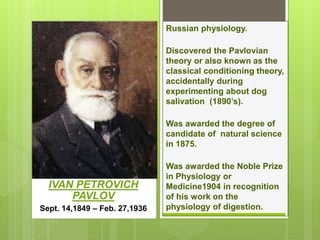
IVAN PETROVICH
PAVLOV
Sept. 14,1849 – Feb. 27,1936
Russian physiology.
Discovered the Pavlovian
theory or also known as the
classical conditioning theory,
accidentally during
experimenting about dog
salivation (1890’s).
Was awarded the degree of
candidate of natural science
in 1875.
Was awarded the Noble Prize
in Physiology or
Medicine1904 in recognition
of his work on the
physiology of digestion.
 Classical conditioning is a learning
process that occurs through associations
between an environmental stimulus and a
naturally occurring stimulus.
 It had a major influence on behaviourism
which is based on the assumption that
learning occurs through interactions with
the environment.
CLASSICAL CONDITIONING
Components of Classical
Conditioning Theory
Unconditioned Stimulus
(UCS)
 A stimulus that
naturally and
automatically
triggers a response.
 Example:
The way you
imagine while staring
at the food I am
showing to you.
Unconditioned Response
(UCR)
 The unlearned
response that occurs
naturally in response
to the unconditioned
stimulus.
 Example:
The watering of
your mouth or simply
your salivation to those
food I shown on the
previous slide.
Conditioned
Stimulus (CS)
 A previously neutral
stimulus that when
paired with an
unconditioned
stimulus triggers a
conditioned
response.
 Example:
The sound of
the clap of my hands.
Conditioned Response
(CR)
 Learned response
to the previously
neutral stimulus.
 Example:
The way you
feel hungry when you
hear the sound of the
clap.
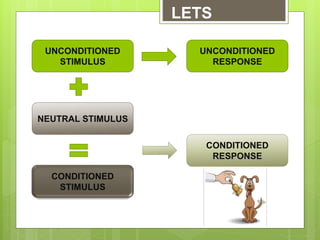
LETS
RECAP!
UNCONDITIONED
STIMULUS
UNCONDITIONED
RESPONSE
NEUTRAL STIMULUS
CONDITIONED
STIMULUS
CONDITIONED
RESPONSE
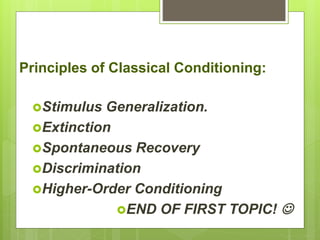
Principles of Classical Conditioning:
Stimulus Generalization.
Extinction
Spontaneous Recovery
Discrimination
Higher-Order Conditioning
END OF FIRST TOPIC! 
BRING OUT 1 PESO COIN
AND GET A PARTNER.
STONE, PAPER, SCISSOR WITH A
TWIST! 
- IS EVERYONE FAMILIAR TO THIS GAME?
- BY PLAYING STONE, PAPER, SCISSOR THE FIRST
WHO GET 1 POINT WILL EARN THE COIN OF HIS
PARTNER. THEN THE LOSER WILL BE SITTED.
- AGAIN THE WINNER WILL GET A PARTNER THIS
TIME BEST OF 2. THE WINNER WILL GET THE
COINS OF THE LOSER. AND SO ON….
- UNTIL TO THE LAST TWO WINNERS. THEY WILL
GOING TO COMPIT FOR BEST OF 3. THE WINNER
WILL GETS ALL THE COINS EARNED BY THE
opponent.
LETS PLAY!
DID YOU ENJOY? 
OUR ACTIVITY HAS A CONNECTION TO OUR NEXT
TOPIC.
Operant Conditioning
Theory
By: Burrhus F. Skinner
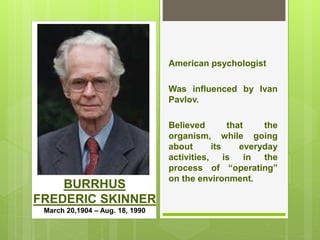
BURRHUS
FREDERIC SKINNER
March 20,1904 – Aug. 18, 1990
American psychologist
Was influenced by Ivan
Pavlov.
Believed that the
organism, while going
about its everyday
activities, is in the
process of “operating”
on the environment.
Operant Conditioning Theory
 Operant conditioning is a method of
learning that occurs through rewards and
punishments for behaviour. Through
operant conditioning, an association is
made between a behaviour and a
consequence for that behaviour.
 “Operant” refer to any “active behaviour
that operates upon the environment to
generate consequences” (1953).
Components of Operant
Conditioning
Reinforcement
 A kind of stimulus
that aims to
increase the
strength in
behaviour due to
consequence.
Punishment
 Any event that
causes a decrease
in the behaviour.
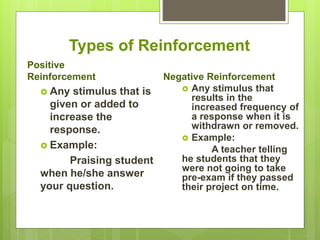
Types of Reinforcement
Positive
Reinforcement
 Any stimulus that is
given or added to
increase the
response.
 Example:
Praising student
when he/she answer
your question.
Negative Reinforcement
 Any stimulus that
results in the
increased frequency of
a response when it is
withdrawn or removed.
 Example:
A teacher telling
he students that they
were not going to take
pre-exam if they passed
their project on time.
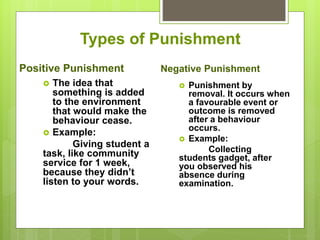
 Punishment by
removal. It occurs when
a favourable event or
outcome is removed
after a behaviour
occurs.
 Example:
Collecting
students gadget, after
you observed his
absence during
examination.
Types of Punishment
Positive Punishment
 The idea that
something is added
to the environment
that would make the
behaviour cease.
 Example:
Giving student a
task, like community
service for 1 week,
because they didn’t
listen to your words.
Negative Punishment
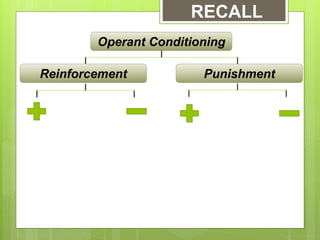
RECALL
Operant Conditioning
Reinforcement Punishment
QUIZ! 
 Identification. Wrong spelling wrong!
1. It is the idea of adding something to the environment that
would make the behaviour cease.
2. Any stimulus that results in the increased frequency of a
response when it is withdrawn or removed.
3. A kind of stimulus that aims to increase the strength in
behaviour due to consequence.
4. A method of learning that occurs through rewards and
punishments for behaviour.
5. A Russian physiology who accidentally discovered
classical conditioning.
6. Any event that causes a decrease in the behaviour.
7. A previously neutral stimulus that when paired with an
unconditioned stimulus triggers a conditioned response.
8. Give three (3) Principles of classical conditioning.
Thank You


Classical conditioning and operant conditioning

  • 1.
  • 2.
  • 3.
  • 5.
    IS YOUR MOUTHWATERING?  DO YOU KNOW THAT WHAT YOU HAVE DONE HAS A CONNECTION TO THE TOPIC WE ARE GOING TO DISCUSS ? SEATBACK AND LISTEN. 
  • 6.
    IVAN PETROVICH PAVLOV Sept. 14,1849– Feb. 27,1936 Russian physiology. Discovered the Pavlovian theory or also known as the classical conditioning theory, accidentally during experimenting about dog salivation (1890’s). Was awarded the degree of candidate of natural science in 1875. Was awarded the Noble Prize in Physiology or Medicine1904 in recognition of his work on the physiology of digestion.
  • 7.
     Classical conditioningis a learning process that occurs through associations between an environmental stimulus and a naturally occurring stimulus.  It had a major influence on behaviourism which is based on the assumption that learning occurs through interactions with the environment. CLASSICAL CONDITIONING
  • 8.
    Components of Classical ConditioningTheory Unconditioned Stimulus (UCS)  A stimulus that naturally and automatically triggers a response.  Example: The way you imagine while staring at the food I am showing to you. Unconditioned Response (UCR)  The unlearned response that occurs naturally in response to the unconditioned stimulus.  Example: The watering of your mouth or simply your salivation to those food I shown on the previous slide.
  • 9.
    Conditioned Stimulus (CS)  Apreviously neutral stimulus that when paired with an unconditioned stimulus triggers a conditioned response.  Example: The sound of the clap of my hands. Conditioned Response (CR)  Learned response to the previously neutral stimulus.  Example: The way you feel hungry when you hear the sound of the clap.
  • 10.
  • 11.
    Principles of ClassicalConditioning: Stimulus Generalization. Extinction Spontaneous Recovery Discrimination Higher-Order Conditioning END OF FIRST TOPIC! 
  • 12.
    BRING OUT 1PESO COIN AND GET A PARTNER. STONE, PAPER, SCISSOR WITH A TWIST!  - IS EVERYONE FAMILIAR TO THIS GAME? - BY PLAYING STONE, PAPER, SCISSOR THE FIRST WHO GET 1 POINT WILL EARN THE COIN OF HIS PARTNER. THEN THE LOSER WILL BE SITTED. - AGAIN THE WINNER WILL GET A PARTNER THIS TIME BEST OF 2. THE WINNER WILL GET THE COINS OF THE LOSER. AND SO ON…. - UNTIL TO THE LAST TWO WINNERS. THEY WILL GOING TO COMPIT FOR BEST OF 3. THE WINNER WILL GETS ALL THE COINS EARNED BY THE opponent. LETS PLAY!
  • 13.
    DID YOU ENJOY? OUR ACTIVITY HAS A CONNECTION TO OUR NEXT TOPIC.
  • 14.
  • 15.
    BURRHUS FREDERIC SKINNER March 20,1904– Aug. 18, 1990 American psychologist Was influenced by Ivan Pavlov. Believed that the organism, while going about its everyday activities, is in the process of “operating” on the environment.
  • 16.
    Operant Conditioning Theory Operant conditioning is a method of learning that occurs through rewards and punishments for behaviour. Through operant conditioning, an association is made between a behaviour and a consequence for that behaviour.  “Operant” refer to any “active behaviour that operates upon the environment to generate consequences” (1953).
  • 17.
    Components of Operant Conditioning Reinforcement A kind of stimulus that aims to increase the strength in behaviour due to consequence. Punishment  Any event that causes a decrease in the behaviour.
  • 18.
    Types of Reinforcement Positive Reinforcement Any stimulus that is given or added to increase the response.  Example: Praising student when he/she answer your question. Negative Reinforcement  Any stimulus that results in the increased frequency of a response when it is withdrawn or removed.  Example: A teacher telling he students that they were not going to take pre-exam if they passed their project on time.
  • 19.
     Punishment by removal.It occurs when a favourable event or outcome is removed after a behaviour occurs.  Example: Collecting students gadget, after you observed his absence during examination. Types of Punishment Positive Punishment  The idea that something is added to the environment that would make the behaviour cease.  Example: Giving student a task, like community service for 1 week, because they didn’t listen to your words. Negative Punishment
  • 20.
  • 21.
    QUIZ!   Identification.Wrong spelling wrong! 1. It is the idea of adding something to the environment that would make the behaviour cease. 2. Any stimulus that results in the increased frequency of a response when it is withdrawn or removed. 3. A kind of stimulus that aims to increase the strength in behaviour due to consequence. 4. A method of learning that occurs through rewards and punishments for behaviour. 5. A Russian physiology who accidentally discovered classical conditioning. 6. Any event that causes a decrease in the behaviour. 7. A previously neutral stimulus that when paired with an unconditioned stimulus triggers a conditioned response. 8. Give three (3) Principles of classical conditioning.
  • 22.