Lecture 4
Numerical
Analysis
Solution of
Non-Linear
Equations
Chapter 2
Introduction
Bisection Method
Regula-Falsi Method
Method of iteration
Newton - Raphson Method
Muller’s Method
Graeffe’s Root Squaring
Method
Bisection
Method
(Bolzano)
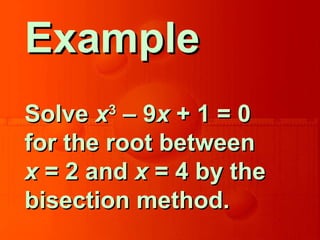
ExampleExample
SolveSolve xx33
– 9– 9xx + 1 = 0+ 1 = 0
for the root betweenfor the root between
xx = 2 and= 2 and xx = 4 by the= 4 by the
bisection method.bisection method.
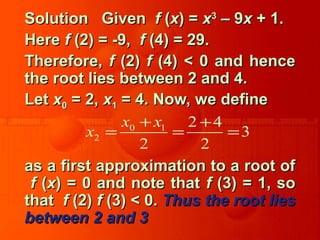
Solution GivenSolution Given ff ((xx) =) = xx33
– 9– 9xx + 1.+ 1.
HereHere ff (2) = -9,(2) = -9, ff (4) = 29.(4) = 29.
Therefore,Therefore, ff (2)(2) ff (4) < 0 and hence(4) < 0 and hence
the root lies between 2 and 4.the root lies between 2 and 4.
LetLet xx00 = 2,= 2, xx11 = 4. Now, we define= 4. Now, we define
as a first approximation to a root ofas a first approximation to a root of
ff ((xx) = 0 and note that) = 0 and note that ff (3) = 1, so(3) = 1, so
thatthat ff (2)(2) ff (3) < 0.(3) < 0. Thus the root liesThus the root lies
between 2 and 3between 2 and 3
0 1
2
2 4
3
2 2
x x
x
+ +
= = =
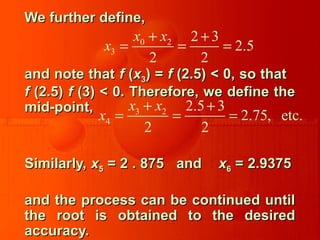
We further define,We further define,
and note thatand note that ff ((xx33) =) = ff (2.5) < 0, so that(2.5) < 0, so that
ff (2.5)(2.5) ff (3) < 0. Therefore, we define the(3) < 0. Therefore, we define the
mid-point,mid-point,
Similarly,Similarly, xx55 = 2 . 875 and= 2 . 875 and xx66 = 2.9375= 2.9375
and the process can be continued untiland the process can be continued until
the root is obtained to the desiredthe root is obtained to the desired
accuracy.accuracy.
0 2
3
2 3
2.5
2 2
x x
x
+ +
= = =
3 2
4
2.5 3
2.75, etc.
2 2
x x
x
+ +
= = =
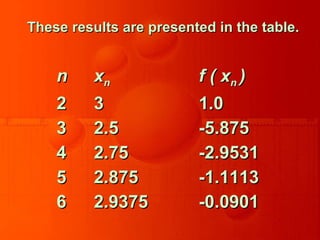
These results are presented in the table.These results are presented in the table.
nn xxnn f ( xf ( xnn ))
22 33 1.01.0
33 2.52.5 -5.875-5.875
44 2.752.75 -2.9531-2.9531
55 2.8752.875 -1.1113-1.1113
66 2.93752.9375 -0.0901-0.0901
Regula-Falsi
Method
Method of falseMethod of false
positionposition
Method of falseMethod of false
positionposition
Here, we choose two points xn
and xn -1 such that f (xn) and f
(xn-1) are of opposite signs.
Intermediate value property
suggests that the graph of
y = f (x) crosses the x-axis
between these two points and
therefore, a root say lies
between these two points.
Thus, to find a real root of
f (x) = 0 using Regula-Falsi
method, we replace the part of
the curve between the points
A[xn, f(xn)] and B[xn-1, f (xn-1)] by
a chord in that interval and we
take the point of intersection of
this chord with the x-axis as a
first approximation to the root.
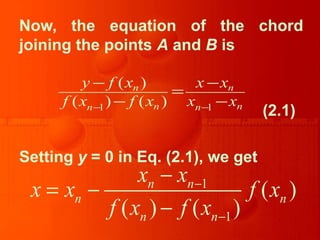
Now, the equation of the chord
joining the points A and B is
(2.1)
Setting y = 0 in Eq. (2.1), we get
1 1
( )
( ) ( )
n n
n nn n
y f x x x
f x f x x x− −
− −
=
− −
1
1
( )
( ) ( )
n n
n n
n n
x x
x x f x
f x f x
−
−
−
= −
−
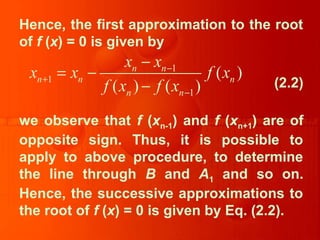
Hence, the first approximation to the root
of f (x) = 0 is given by
(2.2)
we observe that f (xn-1) and f (xn+1) are of
opposite sign. Thus, it is possible to
apply to above procedure, to determine
the line through B and A1 and so on.
Hence, the successive approximations to
the root of f (x) = 0 is given by Eq. (2.2).
1
1
1
( )
( ) ( )
n n
n n n
n n
x x
x x f x
f x f x
−
+
−
−
= −
−
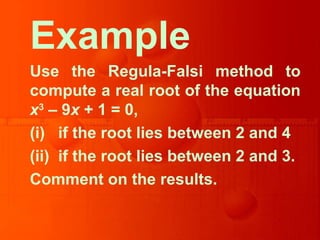
Example
Use the Regula-Falsi method to
compute a real root of the equation
x3
– 9x + 1 = 0,
(i) if the root lies between 2 and 4
(ii) if the root lies between 2 and 3.
Comment on the results.
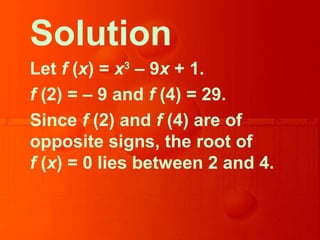
Solution
Let f (x) = x3
– 9x + 1.
f (2) = – 9 and f (4) = 29.
Since f (2) and f (4) are of
opposite signs, the root of
f (x) = 0 lies between 2 and 4.
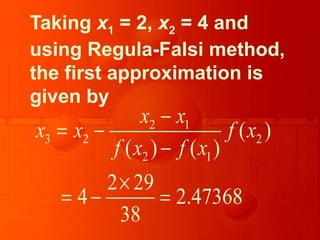
Taking x1 = 2, x2 = 4 and
using Regula-Falsi method,
the first approximation is
given by
2 1
3 2 2
2 1
( )
( ) ( )
2 29
4 2.47368
38
x x
x x f x
f x f x
−
= −
−
×
= − =
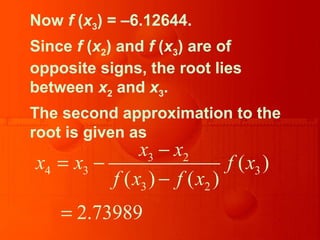
Now f (x3) = –6.12644.
Since f (x2) and f (x3) are of
opposite signs, the root lies
between x2 and x3.
The second approximation to the
root is given as
3 2
4 3 3
3 2
( )
( ) ( )
2.73989
x x
x x f x
f x f x
−
= −
−
=
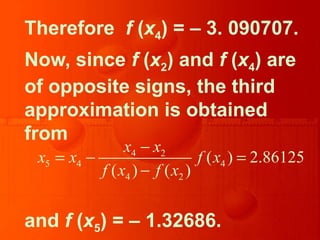
Therefore f (x4) = – 3. 090707.
Now, since f (x2) and f (x4) are
of opposite signs, the third
approximation is obtained
from
and f (x5) = – 1.32686.
4 2
5 4 4
4 2
( ) 2.86125
( ) ( )
x x
x x f x
f x f x
−
= − =
−
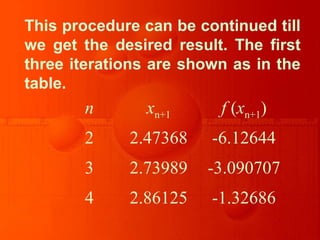
This procedure can be continued till
we get the desired result. The first
three iterations are shown as in the
table.
n xn+1 f (xn+1)
2 2.47368 -6.12644
3 2.73989 -3.090707
4 2.86125 -1.32686
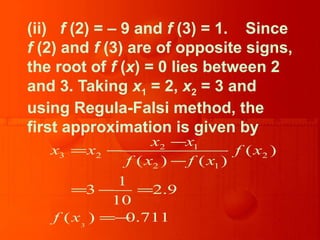
(ii) f (2) = – 9 and f (3) = 1. Since
f (2) and f (3) are of opposite signs,
the root of f (x) = 0 lies between 2
and 3. Taking x1 = 2, x2 = 3 and
using Regula-Falsi method, the
first approximation is given by
3
2 1
3 2 2
2 1
( )
( ) ( )
1
3 2.9
10
( ) 0.711
x x
x x f x
f x f x
f x
−
= −
−
= − =
=−
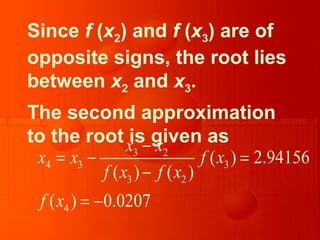
Since f (x2) and f (x3) are of
opposite signs, the root lies
between x2 and x3.
The second approximation
to the root is given as
3 2
4 3 3
3 2
4
( ) 2.94156
( ) ( )
( ) 0.0207
x x
x x f x
f x f x
f x
−
= − =
−
= −
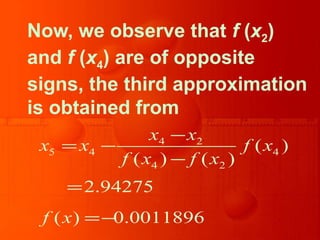
Now, we observe that f (x2)
and f (x4) are of opposite
signs, the third approximation
is obtained from
4 2
5 4 4
4 2
( )
( ) ( )
2.94275
( ) 0.0011896
x x
x x f x
f x f x
f x
−
= −
−
=
=−
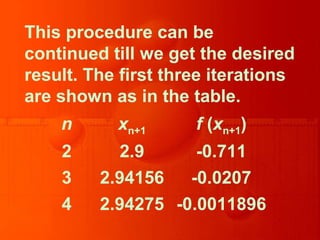
This procedure can be
continued till we get the desired
result. The first three iterations
are shown as in the table.
n xn+1 f (xn+1)
2 2.9 -0.711
3 2.94156 -0.0207
4 2.94275 -0.0011896
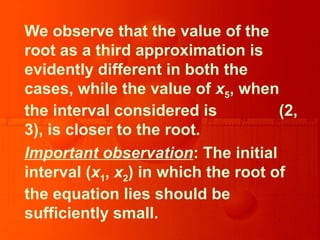
We observe that the value of the
root as a third approximation is
evidently different in both the
cases, while the value of x5, when
the interval considered is (2,
3), is closer to the root.
Important observation: The initial
interval (x1, x2) in which the root of
the equation lies should be
sufficiently small.
Example
Use Regula-Falsi method to
find a real root of the equation
log x – cos x = 0
accurate to four decimal places
after three successive
approximations.
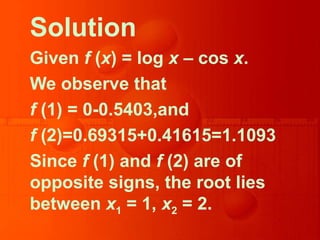
Solution
Given f (x) = log x – cos x.
We observe that
f (1) = 0-0.5403,and
f (2)=0.69315+0.41615=1.1093
Since f (1) and f (2) are of
opposite signs, the root lies
between x1 = 1, x2 = 2.
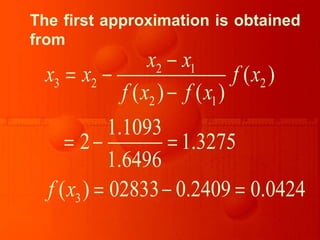
The first approximation is obtained
from
2 1
3 2 2
2 1
3
( )
( ) ( )
1.1093
2 1.3275
1.6496
( ) 02833 0.2409 0.0424
x x
x x f x
f x f x
f x
−
= −
−
= − =
= − =
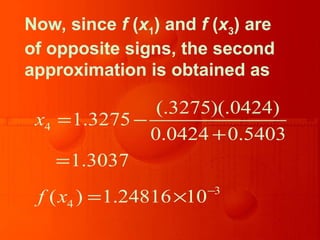
Now, since f (x1) and f (x3) are
of opposite signs, the second
approximation is obtained as
4
3
4
(.3275)(.0424)
1.3275
0.0424 0.5403
1.3037
( ) 1.24816 10
x
f x −
= −
+
=
= ×
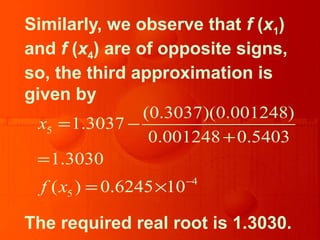
Similarly, we observe that f (x1)
and f (x4) are of opposite signs,
so, the third approximation is
given by
The required real root is 1.3030.
5
4
5
(0.3037)(0.001248)
1.3037
0.001248 0.5403
1.3030
( ) 0.6245 10
x
f x −
= −
+
=
= ×
Lecture 4
Numerical
Analysis

Numerical Analysis (Solution of Non-Linear Equations)

  • 1.
  • 2.
  • 3.
    Introduction Bisection Method Regula-Falsi Method Methodof iteration Newton - Raphson Method Muller’s Method Graeffe’s Root Squaring Method
  • 4.
  • 5.
    ExampleExample SolveSolve xx33 – 9–9xx + 1 = 0+ 1 = 0 for the root betweenfor the root between xx = 2 and= 2 and xx = 4 by the= 4 by the bisection method.bisection method.
  • 6.
    Solution GivenSolution Givenff ((xx) =) = xx33 – 9– 9xx + 1.+ 1. HereHere ff (2) = -9,(2) = -9, ff (4) = 29.(4) = 29. Therefore,Therefore, ff (2)(2) ff (4) < 0 and hence(4) < 0 and hence the root lies between 2 and 4.the root lies between 2 and 4. LetLet xx00 = 2,= 2, xx11 = 4. Now, we define= 4. Now, we define as a first approximation to a root ofas a first approximation to a root of ff ((xx) = 0 and note that) = 0 and note that ff (3) = 1, so(3) = 1, so thatthat ff (2)(2) ff (3) < 0.(3) < 0. Thus the root liesThus the root lies between 2 and 3between 2 and 3 0 1 2 2 4 3 2 2 x x x + + = = =
  • 7.
    We further define,Wefurther define, and note thatand note that ff ((xx33) =) = ff (2.5) < 0, so that(2.5) < 0, so that ff (2.5)(2.5) ff (3) < 0. Therefore, we define the(3) < 0. Therefore, we define the mid-point,mid-point, Similarly,Similarly, xx55 = 2 . 875 and= 2 . 875 and xx66 = 2.9375= 2.9375 and the process can be continued untiland the process can be continued until the root is obtained to the desiredthe root is obtained to the desired accuracy.accuracy. 0 2 3 2 3 2.5 2 2 x x x + + = = = 3 2 4 2.5 3 2.75, etc. 2 2 x x x + + = = =
  • 8.
    These results arepresented in the table.These results are presented in the table. nn xxnn f ( xf ( xnn )) 22 33 1.01.0 33 2.52.5 -5.875-5.875 44 2.752.75 -2.9531-2.9531 55 2.8752.875 -1.1113-1.1113 66 2.93752.9375 -0.0901-0.0901
  • 9.
    Regula-Falsi Method Method of falseMethodof false positionposition Method of falseMethod of false positionposition
  • 10.
    Here, we choosetwo points xn and xn -1 such that f (xn) and f (xn-1) are of opposite signs. Intermediate value property suggests that the graph of y = f (x) crosses the x-axis between these two points and therefore, a root say lies between these two points.
  • 11.
    Thus, to finda real root of f (x) = 0 using Regula-Falsi method, we replace the part of the curve between the points A[xn, f(xn)] and B[xn-1, f (xn-1)] by a chord in that interval and we take the point of intersection of this chord with the x-axis as a first approximation to the root.
  • 12.
    Now, the equationof the chord joining the points A and B is (2.1) Setting y = 0 in Eq. (2.1), we get 1 1 ( ) ( ) ( ) n n n nn n y f x x x f x f x x x− − − − = − − 1 1 ( ) ( ) ( ) n n n n n n x x x x f x f x f x − − − = − −
  • 13.
    Hence, the firstapproximation to the root of f (x) = 0 is given by (2.2) we observe that f (xn-1) and f (xn+1) are of opposite sign. Thus, it is possible to apply to above procedure, to determine the line through B and A1 and so on. Hence, the successive approximations to the root of f (x) = 0 is given by Eq. (2.2). 1 1 1 ( ) ( ) ( ) n n n n n n n x x x x f x f x f x − + − − = − −
  • 14.
    Example Use the Regula-Falsimethod to compute a real root of the equation x3 – 9x + 1 = 0, (i) if the root lies between 2 and 4 (ii) if the root lies between 2 and 3. Comment on the results.
  • 15.
    Solution Let f (x)= x3 – 9x + 1. f (2) = – 9 and f (4) = 29. Since f (2) and f (4) are of opposite signs, the root of f (x) = 0 lies between 2 and 4.
  • 16.
    Taking x1 =2, x2 = 4 and using Regula-Falsi method, the first approximation is given by 2 1 3 2 2 2 1 ( ) ( ) ( ) 2 29 4 2.47368 38 x x x x f x f x f x − = − − × = − =
  • 17.
    Now f (x3)= –6.12644. Since f (x2) and f (x3) are of opposite signs, the root lies between x2 and x3. The second approximation to the root is given as 3 2 4 3 3 3 2 ( ) ( ) ( ) 2.73989 x x x x f x f x f x − = − − =
  • 18.
    Therefore f (x4)= – 3. 090707. Now, since f (x2) and f (x4) are of opposite signs, the third approximation is obtained from and f (x5) = – 1.32686. 4 2 5 4 4 4 2 ( ) 2.86125 ( ) ( ) x x x x f x f x f x − = − = −
  • 19.
    This procedure canbe continued till we get the desired result. The first three iterations are shown as in the table. n xn+1 f (xn+1) 2 2.47368 -6.12644 3 2.73989 -3.090707 4 2.86125 -1.32686
  • 20.
    (ii) f (2)= – 9 and f (3) = 1. Since f (2) and f (3) are of opposite signs, the root of f (x) = 0 lies between 2 and 3. Taking x1 = 2, x2 = 3 and using Regula-Falsi method, the first approximation is given by 3 2 1 3 2 2 2 1 ( ) ( ) ( ) 1 3 2.9 10 ( ) 0.711 x x x x f x f x f x f x − = − − = − = =−
  • 21.
    Since f (x2)and f (x3) are of opposite signs, the root lies between x2 and x3. The second approximation to the root is given as 3 2 4 3 3 3 2 4 ( ) 2.94156 ( ) ( ) ( ) 0.0207 x x x x f x f x f x f x − = − = − = −
  • 22.
    Now, we observethat f (x2) and f (x4) are of opposite signs, the third approximation is obtained from 4 2 5 4 4 4 2 ( ) ( ) ( ) 2.94275 ( ) 0.0011896 x x x x f x f x f x f x − = − − = =−
  • 23.
    This procedure canbe continued till we get the desired result. The first three iterations are shown as in the table. n xn+1 f (xn+1) 2 2.9 -0.711 3 2.94156 -0.0207 4 2.94275 -0.0011896
  • 24.
    We observe thatthe value of the root as a third approximation is evidently different in both the cases, while the value of x5, when the interval considered is (2, 3), is closer to the root. Important observation: The initial interval (x1, x2) in which the root of the equation lies should be sufficiently small.
  • 25.
    Example Use Regula-Falsi methodto find a real root of the equation log x – cos x = 0 accurate to four decimal places after three successive approximations.
  • 26.
    Solution Given f (x)= log x – cos x. We observe that f (1) = 0-0.5403,and f (2)=0.69315+0.41615=1.1093 Since f (1) and f (2) are of opposite signs, the root lies between x1 = 1, x2 = 2.
  • 27.
    The first approximationis obtained from 2 1 3 2 2 2 1 3 ( ) ( ) ( ) 1.1093 2 1.3275 1.6496 ( ) 02833 0.2409 0.0424 x x x x f x f x f x f x − = − − = − = = − =
  • 28.
    Now, since f(x1) and f (x3) are of opposite signs, the second approximation is obtained as 4 3 4 (.3275)(.0424) 1.3275 0.0424 0.5403 1.3037 ( ) 1.24816 10 x f x − = − + = = ×
  • 29.
    Similarly, we observethat f (x1) and f (x4) are of opposite signs, so, the third approximation is given by The required real root is 1.3030. 5 4 5 (0.3037)(0.001248) 1.3037 0.001248 0.5403 1.3030 ( ) 0.6245 10 x f x − = − + = = ×
  • 30.