G.H.Patel College of 
Engineering And Technology 
Chain Rule And Euler’s Theoram 
Created By 
Enrolment number 
130110120022 To 
130110120028 
Tanuj Parikh 
Akash Pansuriya
The Chain Rule 
In this section, we will learn 
about: 
The Chain Rule
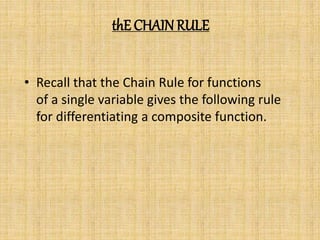
thE CHAIN RULE 
• Recall that the Chain Rule for functions 
of a single variable gives the following rule 
for differentiating a composite function.
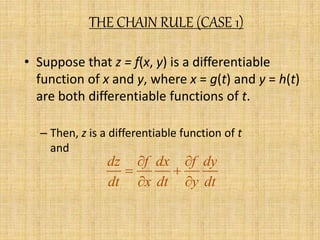
THE CHAIN RULE (CASE 1) 
• Suppose that z = f(x, y) is a differentiable 
function of x and y, where x = g(t) and y = h(t) 
are both differentiable functions of t. 
– Then, z is a differentiable function of t 
and 
dz f dx f dy 
dt x dt y dt 
  
  
 
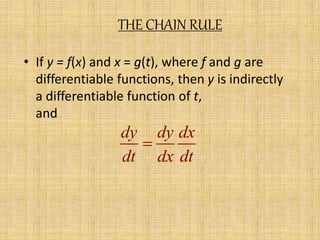
THE CHAIN RULE 
• If y = f(x) and x = g(t), where f and g are 
differentiable functions, then y is indirectly 
a differentiable function of t, 
and 
dy dy dx 
 
dt dx dt
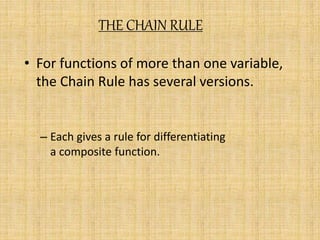
THE CHAIN RULE 
• For functions of more than one variable, 
the Chain Rule has several versions. 
– Each gives a rule for differentiating 
a composite function.
-Example(1) 
THE CHAIN RULE (CASE 1) 
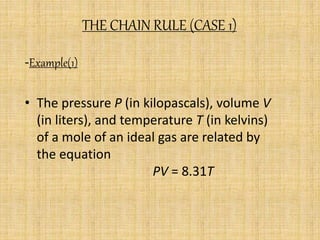
• The pressure P (in kilopascals), volume V 
(in liters), and temperature T (in kelvins) 
of a mole of an ideal gas are related by 
the equation 
PV = 8.31T
THE CHAIN RULE (CASE 1) 
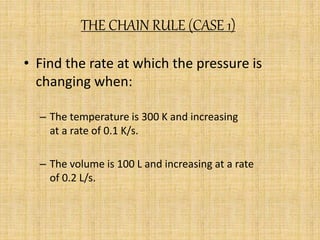
• Find the rate at which the pressure is 
changing when: 
– The temperature is 300 K and increasing 
at a rate of 0.1 K/s. 
– The volume is 100 L and increasing at a rate 
of 0.2 L/s.
THE CHAIN RULE (CASE 1) 
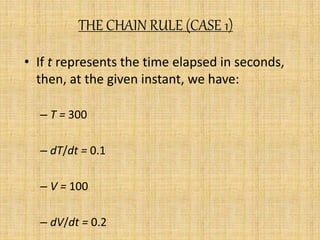
• If t represents the time elapsed in seconds, 
then, at the given instant, we have: 
– T = 300 
– dT/dt = 0.1 
– V = 100 
– dV/dt = 0.2
THE CHAIN RULE (CASE 1) 
8.31 
T 
P 
 
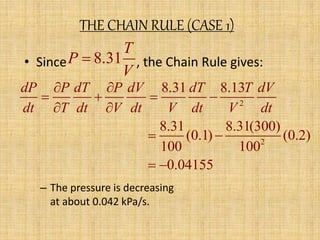
• Since , the Chain Rule gives: 
V 
dP  P dT  
P dV dT T dV 
    
dt  T dt  
V dt V dt V dt 
  
– The pressure is decreasing 
at about 0.042 kPa/s. 
2 
2 
8.31 8.13 
8.31 8.31(300) 
(0.1) (0.2) 
100 100 
0.04155 
 
THE CHAIN RULE (CASE 1) 
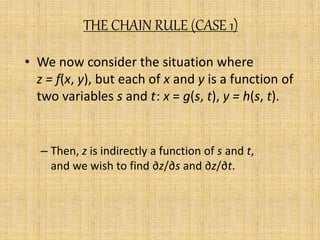
• We now consider the situation where 
z = f(x, y), but each of x and y is a function of 
two variables s and t: x = g(s, t), y = h(s, t). 
– Then, z is indirectly a function of s and t, 
and we wish to find ∂z/∂s and ∂z/∂t.
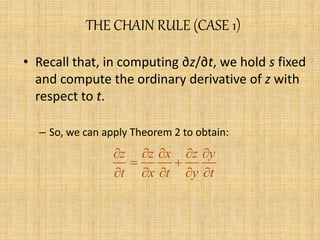
THE CHAIN RULE (CASE 1) 
• Recall that, in computing ∂z/∂t, we hold s fixed 
and compute the ordinary derivative of z with 
respect to t. 
– So, we can apply Theorem 2 to obtain: 
z z x z y 
t x t y t 
     
  
    
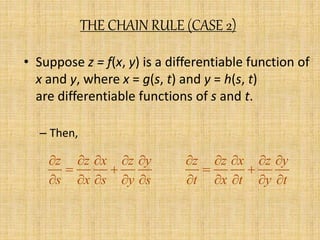
• Suppose z = f(x, y) is a differentiable function of 
x and y, where x = g(s, t) and y = h(s, t) 
are differentiable functions of s and t. 
– Then, 
THE CHAIN RULE (CASE 2) 
z z x z y z z x z y 
s x s y s t x t y t 
          
    
         
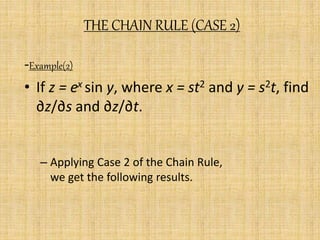
THE CHAIN RULE (CASE 2) 
-Example(2) 
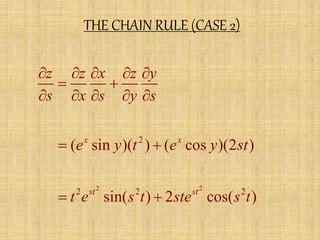
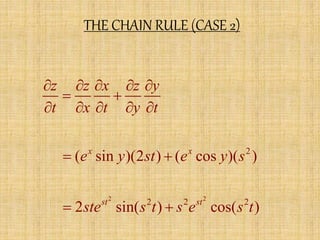
• If z = ex sin y, where x = st2 and y = s2t, find 
∂z/∂s and ∂z/∂t. 
– Applying Case 2 of the Chain Rule, 
we get the following results.
THE CHAIN RULE (CASE 2) 
z z x z y 
s x s y s 
     
  
     
x 2 
x 
e y t e y st 
  
( sin )( ) ( cos )(2 ) 
2 2 
st st 
2 2 2 
t e s t ste s t 
  
sin( ) 2 cos( )
THE CHAIN RULE (CASE 2) 
z z x z y 
t x t y t 
x x 
2 
     
  
     
e y st e y s 
 ( sin )(2 )  
( cos )( ) 
2 2 
st st 
2 2 2 
ste s t s e s t 
 2 sin( )  
cos( )
THE CHAIN RULE 
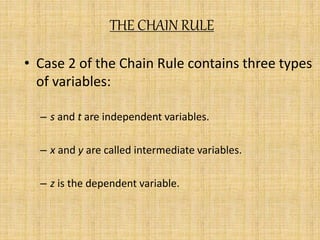
• Case 2 of the Chain Rule contains three types 
of variables: 
– s and t are independent variables. 
– x and y are called intermediate variables. 
– z is the dependent variable.
THE CHAIN RULE 
• To remember the Chain Rule, 
it’s helpful to draw a tree diagram, 
as follows.
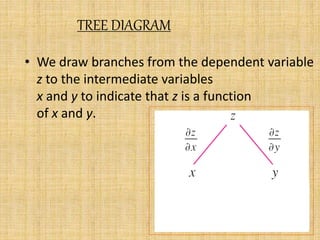
TREE DIAGRAM 
• We draw branches from the dependent variable 
z to the intermediate variables 
x and y to indicate that z is a function 
of x and y.
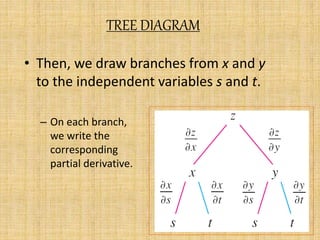
TREE DIAGRAM 
• Then, we draw branches from x and y 
to the independent variables s and t. 
– On each branch, 
we write the 
corresponding 
partial derivative.
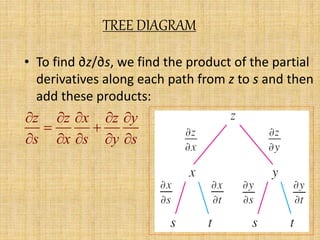
TREE DIAGRAM 
• To find ∂z/∂s, we find the product of the partial 
derivatives along each path from z to s and then 
add these products: 
z z x z y 
s x s y s 
     
  
    
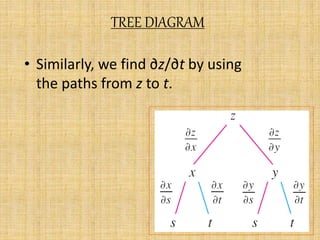
TREE DIAGRAM 
• Similarly, we find ∂z/∂t by using 
the paths from z to t.
THE CHAIN RULE (GEN. VERSION) 
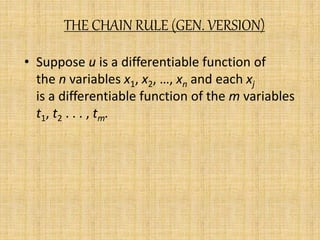
• Suppose u is a differentiable function of 
the n variables x1, x2, …, xn and each xj 
is a differentiable function of the m variables 
t1, t2 . . . , tm.
THE CHAIN RULE (GEN. VERSION) 
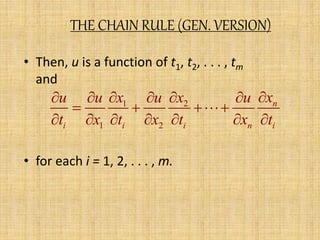
• Then, u is a function of t1, t2, . . . , tm 
and 
u u x u x u x 
t x t x t x t 
       
1 2 
       
       
1 2 
• for each i = 1, 2, . . . , m. 
n 
i i i n i
THE CHAIN RULE (GEN. VERSION) 
-Example(3) 
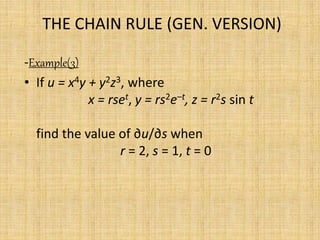
• If u = x4y + y2z3, where 
x = rset, y = rs2e–t, z = r2s sin t 
find the value of ∂u/∂s when 
r = 2, s = 1, t = 0
THE CHAIN RULE (GEN. VERSION) 
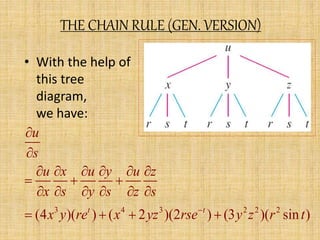
• With the help of 
this tree 
diagram, 
we have: 
u 
s 
u x u y u z 
x s y s z s 
 
 
      
   
      
    
(4 x 3 y )( re t ) ( x 4 2 yz 3 )(2 rse  
t 
) (3 y 2 z 2 )( r 2 sin t )
THE CHAIN RULE (GEN. VERSION) 
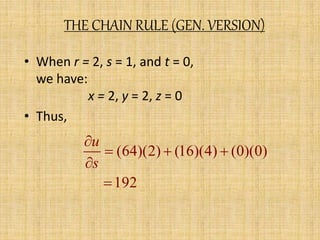
• When r = 2, s = 1, and t = 0, 
we have: 
x = 2, y = 2, z = 0 
• Thus, 
(64)(2) (16)(4) (0)(0) 
192 
u 
s 
 
   
 

29 
Homogeneous Functions 
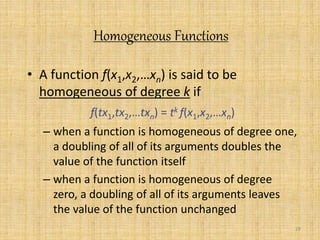
• A function f(x1,x2,…xn) is said to be 
homogeneous of degree k if 
f(tx1,tx2,…txn) = tk f(x1,x2,…xn) 
– when a function is homogeneous of degree one, 
a doubling of all of its arguments doubles the 
value of the function itself 
– when a function is homogeneous of degree 
zero, a doubling of all of its arguments leaves 
the value of the function unchanged
30 
Homogeneous Functions 
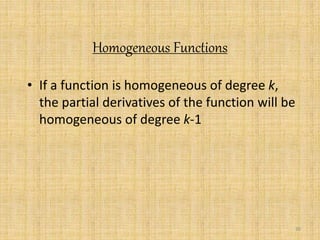
• If a function is homogeneous of degree k, 
the partial derivatives of the function will be 
homogeneous of degree k-1
31 
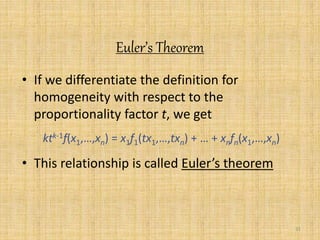
Euler’s Theorem 
• If we differentiate the definition for 
homogeneity with respect to the 
proportionality factor t, we get 
ktk-1f(x1,…,xn) = x1f1(tx1,…,txn) + … + xnfn(x1,…,xn) 
• This relationship is called Euler’s theorem
32 
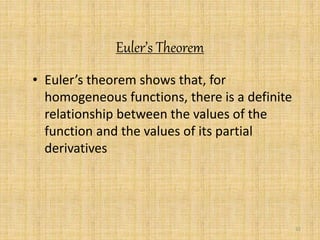
Euler’s Theorem 
• Euler’s theorem shows that, for 
homogeneous functions, there is a definite 
relationship between the values of the 
function and the values of its partial 
derivatives
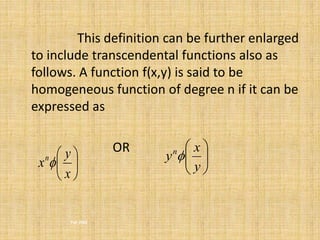
This definition can be further enlarged 
to include transcendental functions also as 
follows. A function f(x,y) is said to be 
homogeneous function of degree n if it can be 
expressed as 
 
Fall 2002 
OR 
 
 
 
x 
 
 
y 
 
 
y 
xn   
 
  
 
x 
yn
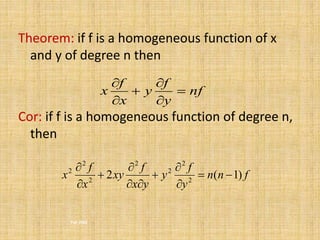
Theorem: if f is a homogeneous function of x 
and y of degree n then 
f 
f 
 
 
x  
Cor: if f is a homogeneous function of degree n, 
then 
 
Fall 2002 
nf 
y 
y 
x 
 
 
 
n n f 
2 
y 
f 
y 
f 
2 
 
x y 
xy 
x 
f 
2 
 
x 2 ( 1) 2 
2 
2 
2   
 
 
  
 

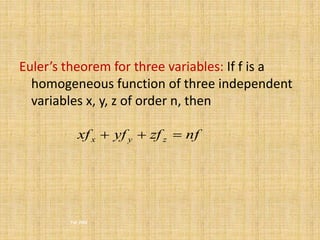
Euler’s theorem for three variables: If f is a 
homogeneous function of three independent 
variables x, y, z of order n, then 
xf yf zf nf x y z    
Fall 2002
Modified EULER’s theorem 
If Z is a Homogeneous function of degree n in 
the variables x and y and z=f(u) 
f u 
( ) 
f u 
' ( ) 
n 
u 
 
 
x  
y 
y 
u 
x 
 
 
 
If z is a homogeneous function of degree n in 
the variables x and y and z=f(u) 
2 
 
u 
2 ( )[ ' ( ) 1], 
u 
2 
2 
2 
u 
2 
2 
 
 
2   
  
 
 
 
 
g u g u 
x y 
xy 
y 
y 
x 
x 
f u 
( ) 
' ( ) 
( ) 
f u 
g u  n 
where
Partial differentiation

Partial differentiation

  • 1.
    G.H.Patel College of Engineering And Technology Chain Rule And Euler’s Theoram Created By Enrolment number 130110120022 To 130110120028 Tanuj Parikh Akash Pansuriya
  • 2.
    The Chain Rule In this section, we will learn about: The Chain Rule
  • 3.
    thE CHAIN RULE • Recall that the Chain Rule for functions of a single variable gives the following rule for differentiating a composite function.
  • 4.
    THE CHAIN RULE(CASE 1) • Suppose that z = f(x, y) is a differentiable function of x and y, where x = g(t) and y = h(t) are both differentiable functions of t. – Then, z is a differentiable function of t and dz f dx f dy dt x dt y dt      
  • 5.
    THE CHAIN RULE • If y = f(x) and x = g(t), where f and g are differentiable functions, then y is indirectly a differentiable function of t, and dy dy dx  dt dx dt
  • 6.
    THE CHAIN RULE • For functions of more than one variable, the Chain Rule has several versions. – Each gives a rule for differentiating a composite function.
  • 7.
    -Example(1) THE CHAINRULE (CASE 1) • The pressure P (in kilopascals), volume V (in liters), and temperature T (in kelvins) of a mole of an ideal gas are related by the equation PV = 8.31T
  • 8.
    THE CHAIN RULE(CASE 1) • Find the rate at which the pressure is changing when: – The temperature is 300 K and increasing at a rate of 0.1 K/s. – The volume is 100 L and increasing at a rate of 0.2 L/s.
  • 9.
    THE CHAIN RULE(CASE 1) • If t represents the time elapsed in seconds, then, at the given instant, we have: – T = 300 – dT/dt = 0.1 – V = 100 – dV/dt = 0.2
  • 10.
    THE CHAIN RULE(CASE 1) 8.31 T P  • Since , the Chain Rule gives: V dP  P dT  P dV dT T dV     dt  T dt  V dt V dt V dt   – The pressure is decreasing at about 0.042 kPa/s. 2 2 8.31 8.13 8.31 8.31(300) (0.1) (0.2) 100 100 0.04155  
  • 11.
    THE CHAIN RULE(CASE 1) • We now consider the situation where z = f(x, y), but each of x and y is a function of two variables s and t: x = g(s, t), y = h(s, t). – Then, z is indirectly a function of s and t, and we wish to find ∂z/∂s and ∂z/∂t.
  • 12.
    THE CHAIN RULE(CASE 1) • Recall that, in computing ∂z/∂t, we hold s fixed and compute the ordinary derivative of z with respect to t. – So, we can apply Theorem 2 to obtain: z z x z y t x t y t            
  • 13.
    • Suppose z= f(x, y) is a differentiable function of x and y, where x = g(s, t) and y = h(s, t) are differentiable functions of s and t. – Then, THE CHAIN RULE (CASE 2) z z x z y z z x z y s x s y s t x t y t                        
  • 14.
    THE CHAIN RULE(CASE 2) -Example(2) • If z = ex sin y, where x = st2 and y = s2t, find ∂z/∂s and ∂z/∂t. – Applying Case 2 of the Chain Rule, we get the following results.
  • 15.
    THE CHAIN RULE(CASE 2) z z x z y s x s y s             x 2 x e y t e y st   ( sin )( ) ( cos )(2 ) 2 2 st st 2 2 2 t e s t ste s t   sin( ) 2 cos( )
  • 16.
    THE CHAIN RULE(CASE 2) z z x z y t x t y t x x 2             e y st e y s  ( sin )(2 )  ( cos )( ) 2 2 st st 2 2 2 ste s t s e s t  2 sin( )  cos( )
  • 17.
    THE CHAIN RULE • Case 2 of the Chain Rule contains three types of variables: – s and t are independent variables. – x and y are called intermediate variables. – z is the dependent variable.
  • 18.
    THE CHAIN RULE • To remember the Chain Rule, it’s helpful to draw a tree diagram, as follows.
  • 19.
    TREE DIAGRAM •We draw branches from the dependent variable z to the intermediate variables x and y to indicate that z is a function of x and y.
  • 20.
    TREE DIAGRAM •Then, we draw branches from x and y to the independent variables s and t. – On each branch, we write the corresponding partial derivative.
  • 21.
    TREE DIAGRAM •To find ∂z/∂s, we find the product of the partial derivatives along each path from z to s and then add these products: z z x z y s x s y s            
  • 22.
    TREE DIAGRAM •Similarly, we find ∂z/∂t by using the paths from z to t.
  • 23.
    THE CHAIN RULE(GEN. VERSION) • Suppose u is a differentiable function of the n variables x1, x2, …, xn and each xj is a differentiable function of the m variables t1, t2 . . . , tm.
  • 24.
    THE CHAIN RULE(GEN. VERSION) • Then, u is a function of t1, t2, . . . , tm and u u x u x u x t x t x t x t        1 2               1 2 • for each i = 1, 2, . . . , m. n i i i n i
  • 25.
    THE CHAIN RULE(GEN. VERSION) -Example(3) • If u = x4y + y2z3, where x = rset, y = rs2e–t, z = r2s sin t find the value of ∂u/∂s when r = 2, s = 1, t = 0
  • 26.
    THE CHAIN RULE(GEN. VERSION) • With the help of this tree diagram, we have: u s u x u y u z x s y s z s                      (4 x 3 y )( re t ) ( x 4 2 yz 3 )(2 rse  t ) (3 y 2 z 2 )( r 2 sin t )
  • 27.
    THE CHAIN RULE(GEN. VERSION) • When r = 2, s = 1, and t = 0, we have: x = 2, y = 2, z = 0 • Thus, (64)(2) (16)(4) (0)(0) 192 u s      
  • 29.
    29 Homogeneous Functions • A function f(x1,x2,…xn) is said to be homogeneous of degree k if f(tx1,tx2,…txn) = tk f(x1,x2,…xn) – when a function is homogeneous of degree one, a doubling of all of its arguments doubles the value of the function itself – when a function is homogeneous of degree zero, a doubling of all of its arguments leaves the value of the function unchanged
  • 30.
    30 Homogeneous Functions • If a function is homogeneous of degree k, the partial derivatives of the function will be homogeneous of degree k-1
  • 31.
    31 Euler’s Theorem • If we differentiate the definition for homogeneity with respect to the proportionality factor t, we get ktk-1f(x1,…,xn) = x1f1(tx1,…,txn) + … + xnfn(x1,…,xn) • This relationship is called Euler’s theorem
  • 32.
    32 Euler’s Theorem • Euler’s theorem shows that, for homogeneous functions, there is a definite relationship between the values of the function and the values of its partial derivatives
  • 33.
    This definition canbe further enlarged to include transcendental functions also as follows. A function f(x,y) is said to be homogeneous function of degree n if it can be expressed as  Fall 2002 OR    x   y   y xn       x yn
  • 34.
    Theorem: if fis a homogeneous function of x and y of degree n then f f   x  Cor: if f is a homogeneous function of degree n, then  Fall 2002 nf y y x    n n f 2 y f y f 2  x y xy x f 2  x 2 ( 1) 2 2 2 2        
  • 35.
    Euler’s theorem forthree variables: If f is a homogeneous function of three independent variables x, y, z of order n, then xf yf zf nf x y z    Fall 2002
  • 36.
    Modified EULER’s theorem If Z is a Homogeneous function of degree n in the variables x and y and z=f(u) f u ( ) f u ' ( ) n u   x  y y u x    If z is a homogeneous function of degree n in the variables x and y and z=f(u) 2  u 2 ( )[ ' ( ) 1], u 2 2 2 u 2 2   2         g u g u x y xy y y x x f u ( ) ' ( ) ( ) f u g u  n where